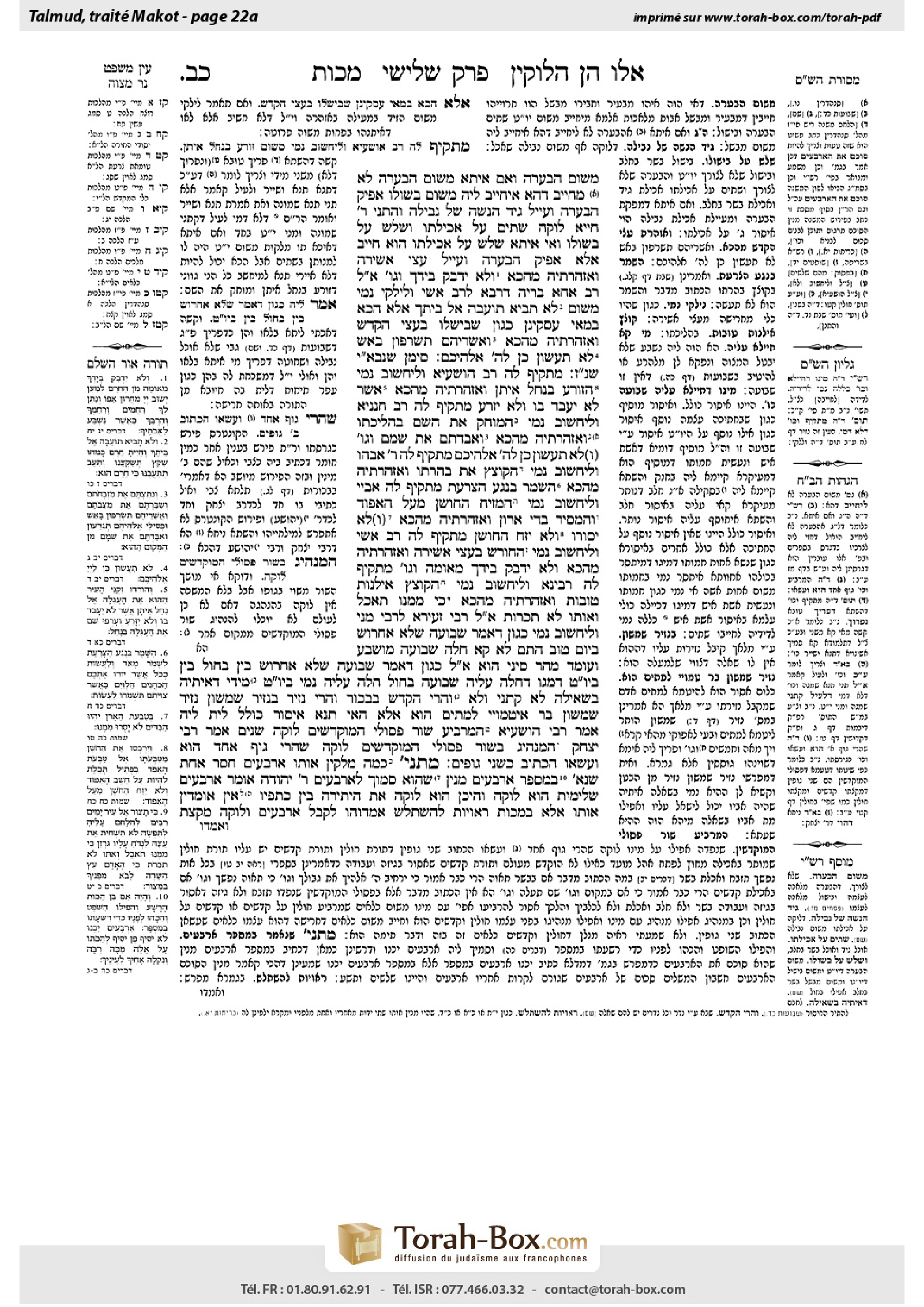
Makkot 22a: Talmud study for Daf Yomi
Daf Yomi is the daily study of one Talmud folio. Explore 37 tractates with scans, Hebrew text, Sefaria English and AI-generated French translations where annotated.
Passage selection and English or AI-generated French translation are available where the scan has annotations. Daf Study is independent of Torah-Box and Sefaria.
Browse Makkot · מכות · All tractatesMakkot 22a text and translations
This page of Makkot includes the Aramaic text, an English translation and an AI-generated French translation, alongside the scan above.
מכות כ״ב א · Aramaic and Hebrew text
מִשּׁוּם הַבְעָרָה. וְאִם אִיתָא, מִשּׁוּם הַבְעָרָה לָא מִחַיַּיב, דְּהָא אִיחַיַּיב לֵיהּ מִשּׁוּם בִּשּׁוּלוֹ! אַפֵּיק הַבְעָרָה וְעַיֵּיל גִּיד הַנָּשֶׁה שֶׁל נְבֵילָה.
וְהָתָנֵי רַבִּי חִיָּיא: לוֹקֶה שְׁתַּיִם עַל אֲכִילָתוֹ וְשָׁלֹשׁ עַל בִּשּׁוּלוֹ. וְאִי אִיתָא, שָׁלֹשׁ עַל אֲכִילָתוֹ הוּא חַיָּיב! אֶלָּא: אַפֵּיק הַבְעָרָה וְעַיֵּיל עֲצֵי אֲשֵׁירָה, וְאַזְהָרְתֵּיהּ מֵהָכָא: ״וְלֹא יִדְבַּק בְּיָדְךָ וְגוֹ׳״.
אֲמַר לֵיהּ רַב אַחָא בְּרֵיהּ דְּרָבָא לְרַב אָשֵׁי: וְלִילְקֵי נָמֵי מִשּׁוּם ״לֹא תָבִיא תוֹעֵבָה אֶל בֵּיתֶךָ״! אֶלָּא: הָכָא בְּמַאי עָסְקִינַן – כְּגוֹן שֶׁבִּישְּׁלוֹ בַּעֲצֵי הֶקְדֵּשׁ, וְאַזְהַרְתֵּיהּ מֵהָכָא: ״וַאֲשֵׁרֵיהֶם תִּשְׂרְפוּן בָּאֵשׁ... לֹא תַעֲשׂוּן כֵּן לַה׳ אֱלֹהֵיכֶם״.
סִימָן. שנבא״י שנ״ז
מַתְקֵיף לַהּ רַב הוֹשַׁעְיָא: וְלִיחְשׁוֹב נָמֵי הַזּוֹרֵעַ בְּנַחַל אֵיתָן, וְאַזְהָרְתֵּיהּ מֵהָכָא: ״אֲשֶׁר לֹא יֵעָבֵד בּוֹ וְלֹא יִזָּרֵעַ״!
מַתְקֵיף לַהּ רַב חֲנַנְיָא: וְלִיחְשׁוֹב נָמֵי הַמּוֹחֵק אֶת הַשֵּׁם בַּהֲלִיכָתוֹ, וְאַזְהָרְתֵּיהּ מֵהָכָא: ״וְאִבַּדְתֶּם אֶת שְׁמָם וְגוֹ׳ (וְ)לֹא תַעֲשׂוּן כֵּן לַה׳ אֱלֹהֵיכֶם״!
מַתְקֵיף לַהּ רַבִּי אֲבָהוּ: וְלִיחְשׁוֹב נָמֵי הַקּוֹצֵץ אֶת בַּהַרְתּוֹ, וְאַזְהָרְתֵּיהּ מֵהָכָא: ״הִשָּׁמֶר בְּנֶגַע הַצָּרַעַת״!
מַתְקֵיף לַהּ אַבָּיֵי: וְלִיחְשׁוֹב נָמֵי הַמֵּזִיחַ הַחוֹשֶׁן מֵעַל הָאֵפוֹד, וְהַמֵּסִיר בַּדֵּי אָרוֹן, וְאַזְהָרְתֵּיהּ מֵהָכָא: ״(וְ)לֹא יָסֻרוּ״, ״וְלֹא יִזַּח הַחֹשֶׁן״!
מַתְקֵיף לַהּ רַב אָשֵׁי: וְלִיחְשׁוֹב נָמֵי הַחוֹרֵשׁ בַּעֲצֵי אֲשֵׁירָה, וְאַזְהָרְתֵּיהּ מֵהָכָא: ״וְלֹא יִדְבַּק בְּיָדְךָ מְאוּמָה וְגוֹ״!
מַתְקֵיף לַהּ רָבִינָא: וְלִיחְשׁוֹב נָמֵי הַקּוֹצֵץ אִילָנוֹת טוֹבוֹת, וְאַזְהָרְתֵּיהּ מֵהָכָא: ״כִּי מִמֶּנּוּ תֹאכֵל וְאֹתוֹ לֹא תִכְרֹת״!
אֲמַר לֵיהּ רַבִּי זְעֵירָא לְרַבִּי מָנִי: וְלִיחְשׁוֹב נָמֵי כְּגוֹן דְּאָמַר ״שְׁבוּעָה שֶׁלֹּא אֶחְרוֹשׁ בְּיוֹם טוֹב״! הָתָם לָא קָא חָלָה שְׁבוּעָה, מוּשְׁבָּע וְעוֹמֵד מֵהַר סִינַי הוּא. אֲמַר לֵיהּ: כְּגוֹן דְּאָמַר ״שְׁבוּעָה שֶׁלֹּא אֶחְרוֹשׁ בֵּין בַּחוֹל בֵּין בְּיוֹם טוֹב״, דְּמִגּוֹ דְּחָלָה עֲלֵיהּ שְׁבוּעָה בְּחוֹל – חָלָה עֲלֵיהּ נָמֵי בְּיוֹם טוֹב! מִידֵּי דְּאִיתֵיהּ בִּשְׁאֵילָה לָא קָתָנֵי.
וְלָא? וַהֲרֵי הֶקְדֵּשׁ! בִּבְכוֹר. וַהֲרֵי נָזִיר! בִּנְזִיר שִׁמְשׁוֹן.
נְזִיר שִׁמְשׁוֹן בַּר אִיטַּמּוֹיֵי לְמֵתִים הוּא? אֶלָּא, הַאי תַּנָּא אִיסּוּר כּוֹלֵל לֵית לֵיהּ.
אָמַר רַבִּי הוֹשַׁעְיָא: הַמַּרְבִּיעַ שׁוֹר פְּסוּלֵי הַמּוּקְדָּשִׁים – לוֹקֶה שְׁנַיִם. אָמַר רַבִּי יִצְחָק: הַמַּנְהִיג בְּשׁוֹר פְּסוּלֵי הַמּוּקְדָּשִׁים – לוֹקֶה, שֶׁהֲרֵי גּוּף אֶחָד הוּא, וַעֲשָׂאוֹ הַכָּתוּב כִּשְׁנֵי גּוּפִים.
מַתְנִי׳ כַּמָּה מַלְקִין אוֹתוֹ – אַרְבָּעִים חָסֵר אַחַת, שֶׁנֶּאֱמַר ״בְּמִסְפַּר אַרְבָּעִים״ – מִנְיָן שֶׁהוּא סָמוּךְ לְאַרְבָּעִים. רַבִּי יְהוּדָה אוֹמֵר: אַרְבָּעִים שְׁלֵימוֹת הוּא לוֹקֶה, וְהֵיכָן הוּא לוֹקֶה אֶת הַיְּתֵירָה – בֵּין כְּתֵפָיו.
אֵין אוֹמְדִין אוֹתוֹ, אֶלָּא בְּמַכּוֹת רְאוּיוֹת לְהִשְׁתַּלֵּשׁ. אֲמָדוּהוּ לְקַבֵּל אַרְבָּעִים, וְלוֹקֶה מִקְצָת,
Makkot 22a · English translation
for violating the prohibition of kindling a fire on a Festival. And if it is so, that there is no division of labors on a Festival, he is not liable for violating the prohibition of kindling a fire, as he is already liable for violating the prohibition of cooking the sciatic nerve on a Festival. Rava said: Remove kindling from the list of five prohibitions for which he is flogged, as he is not liable for violating that prohibition, and insert the prohibition of eating the sciatic nerve of an unslaughtered animal carcass.
The Gemara asks: But didn’t Rabbi Ḥiyya teach a baraita that summarizes the prohibitions listed in this mishna: One is flogged with two sets of lashes for his eating and three sets of lashes for his cooking? And if it is so, that the prohibition of kindling a fire is replaced with the prohibition of eating the sciatic nerve of an unslaughtered animal carcass, he is liable to receive three sets of lashes for his eating; for eating a sciatic nerve, for eating meat cooked in milk, and for eating an unslaughtered animal carcass. Rather, say: Remove kindling from the list of prohibitions, and insert the prohibition of using wood of a tree worshipped as part of idolatrous rites [ashera], whose prohibition is derived from here: “And nothing of the dedicated item shall cleave to your hand” (Deuteronomy 13:18), indicating that it is forbidden to derive benefit from accoutrements of idol worship.
Rav Aḥa, son of Rava, said to Rav Ashi: If the reference is to the wood of an ashera, let him also be flogged for violating the prohibition: “You shall not bring an abomination into your house” (Deuteronomy 7:26), in addition to the other prohibitions enumerated. Rather, say: What are we dealing with here? We are dealing with a case where one cooked the sciatic nerve with wood consecrated for use in the Temple, whose warning, the source of its prohibition, is from here: “And their asherim you shall burn in fire…you shall not do so to the Lord your God” (Deuteronomy 12:3–4), indicating that one who destroys a consecrated item violates a prohibition.
§ The Gemara provides a mnemonic: Shin, nun, beit, alef, yod; shin, nun, zayin; representing the amora’im who suggest additions to the eight prohibitions violated by the person in the mishna who plows the field with diverse kinds: Hoshaya; Ḥananya; Abbahu; Abaye; Ashi; Ravina; Zeira.
Rav Hoshaya objects to this: And let the tanna also enumerate in his list the prohibition of sowing in a forceful stream, the land where a heifer’s neck is broken by the Elders of the city closest to the corpse of a murder victim whose murderer is unknown, and its prohibition is from here: “And the Elders of that city shall bring the heifer down to a forceful stream, which will be neither plowed nor sown” (Deuteronomy 21:4). The verse is written in the future tense as a prohibition for the future: It is prohibited to work the land there after the heifer’s neck is broken.
Rav Ḥananya objects to this: And let the tanna also enumerate one who erases the name of God in the course of his walking and plowing, and its prohibition is from here: “And you shall destroy their names…you shall not do so to the Lord your God” (Deuteronomy 12:3–4).
Rabbi Abbahu objects to this: And let the tanna also enumerate one who severs his snow-white leprous mark in the course of his plowing, and its prohibition is from here: “Take heed of the plague of leprosy” (Deuteronomy 24:8), indicating the prohibition against severing the mark.
Abaye objects to this: And let the tanna also enumerate one who loosens the breastplate from upon the ephod in the course of plowing, or one who removes the staves of the Ark of the Covenant. And its prohibition is from here: “The staves shall be in the rings of the Ark; they shall not be removed from it” (Exodus 25:15), while the relevant verse with regard to the breastplate is: “And the breastplate shall not be loosened from the ephod” (Exodus 28:28).
Rav Ashi objects to this: And let the tanna also enumerate one who plows with a plow crafted from the wood of an ashera, and its prohibition is from here: “And there shall cleave nothing of the dedicated item to your hand” (Deuteronomy 13:18).
Ravina objects to this: And let the tanna also enumerate one who chops down beautiful fruit trees in the course of plowing, and its prohibition is from here: “For you may eat of it, and you shall not chop it down” (Deuteronomy 20:19).
Rabbi Zeira said to Rabbi Mani: And let the tanna also enumerate a case where one says: On my oath I will not plow on the Festival, and then proceeds to violate his oath. Rabbi Mani said: There, the oath does not take effect, as he is already under oath from Mount Sinai not to plow on a Festival, and an oath does not take effect when another oath is already in effect. Rabbi Zeira said to him: The oath can take effect in a case where one says: On my oath I will not plow whether during the week or on a Festival, as in that case, since the oath takes effect in his regard during the week, it takes effect in his regard on a Festival as well. Rabbi Mani replied: The mishna did not include that prohibition because the tanna is not teaching a matter that is in the category of those matters subject to dissolution by means of posing a request to a Torah scholar. As oaths fall into that category, this case is not enumerated in the mishna.
Rabbi Zeira asked: And did the tanna not teach matters subject to dissolution by means of a Torah scholar? But isn’t there the matter of consecrated animals, whose sanctity can be repealed by means of dissolution of the vow by a Torah scholar, which was included in the mishna? Rabbi Mani answered: The tanna is referring to a firstborn animal, which is consecrated from the womb. Since it was not consecrated by means of a vow, the sanctity cannot be dissolved by a Torah scholar. Rabbi Zeira asked: But isn’t there the matter of the impurity of a nazirite, whose vow of naziriteship can be dissolved by a Torah scholar, which was included in the mishna? Rabbi Mani answered: The reference in the mishna is to one who is a nazirite like Samson, for whom there is no dissolution.
Rabbi Zeira asked: Is a nazirite like Samson subject to the prohibition of contracting impurity imparted by corpses? He is not. As the tanna enumerated the prohibition of a nazirite becoming impure with impurity imparted by a corpse, clearly he is not a nazirite like Samson. Rather, the tanna does not enumerate the case of one who violated an oath not to plow both during the week and on a Festival, because this tanna is not of the opinion that a more inclusive prohibition takes effect when the standard prohibition does not take effect. Just as with regard to one who takes an oath not to perform labor on a Festival, the oath does not take effect, so too, even if he adds to it an oath not to plow during the week, it does not take effect, because he is already under oath from Sinai not to plow on a Festival.
Rabbi Hoshaya says: One who breeds a disqualified consecrated ox with a female even of the same species is flogged with two sets of lashes, one for labor with a disqualified consecrated animal, and one for breeding two animals of diverse kinds. Even after the animal is desacralized through redemption, it remains prohibited to perform labor with it. It is considered diverse kinds because the Torah accorded disqualified consecrated animals the status of two animals, one consecrated and one non-sacred. If one breeds such an animal with an ox, it is as though he bred it with an animal of a different species, thereby violating the prohibition. Likewise, Rabbi Yitzḥak says: One who drives a disqualified consecrated ox to plow the field is flogged, as it is one body, and the verse accorded it the status of two bodies. One who plows with two different species of animals together is liable to receive lashes.
MISHNA: With how many lashes does one flog a person sentenced to receive lashes? One flogs him with forty lashes less one, as it is stated: “And he shall strike him before him, in accordance with his wickedness, by number. Forty he shall strike him, he shall not add” (Deuteronomy 25:2–3). The mishna joins the end of the first verse and the beginning of the second, forming the phrase: “By number, forty,” which is interpreted as: A sum adjacent to forty. Rabbi Yehuda says: He is flogged with a full forty lashes. And where is he flogged the extra lash? As the mishna proceeds to explain, the thirty-nine lashes are divided into three and administered in three places on the body of the person being flogged; according to Rabbi Yehuda there is one lash that remains. That lash is administered between his shoulders.
One assesses the number of lashes that the one being punished is capable of withstanding only with a number of lashes fit to be divided into three equal groups. If the assessment was that he can survive twenty lashes, he is flogged with eighteen. Likewise, if doctors assessed concerning him that he is able to receive forty lashes and survive, and he is then flogged some of those forty lashes,
Makkot 22a · Traduction française (IA)
pour avoir enfreint l’interdiction d’allumer un feu un jour de fête. Et s’il en est ainsi, s’il n’y a pas de distinction entre les travaux un jour de fête, il n’est pas passible de flagellation pour avoir enfreint l’interdiction d’allumer un feu, puisqu’il est déjà passible de flagellation pour avoir enfreint l’interdiction de cuire le nerf sciatique un jour de fête. Rava dit : Retirez l’allumage du feu de la liste des cinq interdictions pour lesquelles il est flagellé, car il n’est pas passible de flagellation pour cette interdiction, et ajoutez l’interdiction de manger le nerf sciatique d’une carcasse d’animal non abattu rituellement.
La Guemara demande : Mais Rabbi Ḥiyya n’a-t-il pas enseigné une baraïta qui récapitule les interdictions énumérées dans cette Michna : On le flagelle deux fois pour ce qu’il a mangé et trois fois pour ce qu’il a cuit ? Or, s’il en est ainsi, si l’interdiction d’allumer un feu est remplacée par celle de manger le nerf sciatique d’une carcasse d’animal non abattu rituellement, il est passible de trois séries de coups pour avoir mangé : pour avoir mangé un nerf sciatique, de la viande cuite dans du lait et une carcasse d’animal non abattu rituellement. Il faut plutôt dire : Retirez l’allumage du feu de la liste des interdictions et ajoutez l’interdiction d’utiliser le bois d’un arbre consacré au culte idolâtre [ashera], interdiction qui se déduit d’ici : « Et rien de ce qui est voué à la destruction ne s’attachera à ta main » (Deutéronome 13:18), ce qui indique qu’il est interdit de tirer profit des objets servant au culte idolâtre.
Rav Aḥa, fils de Rava, dit à Rav Ashi : S’il s’agit du bois d’une ashera, qu’il soit également flagellé pour avoir enfreint l’interdiction : « Tu n’introduiras pas une abomination dans ta maison » (Deutéronome 7:26), en plus des autres interdictions énumérées. Il faut plutôt dire : De quoi parlons-nous ici ? Du cas où il a cuit le nerf sciatique avec du bois consacré à l’usage du Temple, dont l’avertissement, c’est-à-dire la source de l’interdiction, se trouve ici : « Vous brûlerez leurs asherim par le feu… vous n’agirez pas ainsi envers le Seigneur votre Dieu » (Deutéronome 12:3–4), ce qui indique que celui qui détruit un objet consacré enfreint une interdiction.
§ La Guemara fournit un moyen mnémotechnique : shin, noun, beit, alef, yod ; shin, noun, zayin ; représentant les amoraïm qui proposent d’ajouter des interdictions aux huit interdictions enfreintes par celui qui, dans la Michna, laboure un champ avec des espèces différentes : Hoshaya ; Ḥananya ; Abbahu ; Abaye ; Ashi ; Ravina ; Zeira.
Rav Hoshaya objecte : Que le tanna énumère aussi dans sa liste l’interdiction de semer dans le torrent impétueux, c’est-à-dire sur le terrain où les anciens de la ville la plus proche du cadavre d’une victime d’homicide dont le meurtrier est inconnu brisent la nuque d’une génisse ; cette interdiction se déduit d’ici : « Les anciens de cette ville feront descendre la génisse vers un torrent impétueux, qui ne sera ni labouré ni ensemencé » (Deutéronome 21:4). Le verset est formulé au futur comme une interdiction pour l’avenir : il est interdit de travailler cette terre après que la nuque de la génisse a été brisée.
Rav Ḥananya objecte : Que le tanna énumère aussi celui qui efface le nom de Dieu en marchant et en labourant ; l’interdiction se déduit d’ici : « Vous détruirez leurs noms… vous n’agirez pas ainsi envers le Seigneur votre Dieu » (Deutéronome 12:3–4).
Rabbi Abbahu objecte : Que le tanna énumère aussi celui qui coupe sa tache lépreuse d’un blanc éclatant en labourant ; l’interdiction se déduit d’ici : « Prends garde à la plaie de la lèpre » (Deutéronome 24:8), ce qui indique qu’il est interdit de couper la tache.
Abaye objecte : Que le tanna énumère aussi celui qui détache le pectoral de l’éphod en labourant, ou celui qui retire les barres de l’Arche de l’Alliance. L’interdiction se déduit d’ici : « Les barres resteront dans les anneaux de l’Arche ; elles n’en seront pas retirées » (Exode 25:15), tandis que le verset pertinent concernant le pectoral est : « Le pectoral ne sera pas détaché de l’éphod » (Exode 28:28).
Rav Ashi objecte : Que le tanna énumère aussi celui qui laboure avec une charrue fabriquée dans le bois d’une ashera ; l’interdiction se déduit d’ici : « Rien de ce qui est voué à la destruction ne s’attachera à ta main » (Deutéronome 13:18).
Ravina objecte : Que le tanna énumère aussi celui qui abat de beaux arbres fruitiers en labourant ; l’interdiction se déduit d’ici : « Tu pourras en manger, mais tu ne l’abattras pas » (Deutéronome 20:19).
Rabbi Zeira dit à Rabbi Mani : Que le tanna énumère aussi le cas de celui qui dit : « Par serment, je ne labourerai pas un jour de fête », puis enfreint son serment. Rabbi Mani dit : Dans ce cas, le serment ne prend pas effet, car il est déjà lié par le serment prononcé au mont Sinaï de ne pas labourer un jour de fête, et un serment ne prend pas effet lorsqu’un autre serment est déjà en vigueur. Rabbi Zeira lui dit : Le serment peut prendre effet dans le cas où quelqu’un dit : « Par serment, je ne labourerai ni en semaine ni un jour de fête », car, dans ce cas, puisque le serment prend effet à son égard en semaine, il prend également effet à son égard un jour de fête. Rabbi Mani répondit : La Michna n’a pas inclus cette interdiction parce que le tanna n’enseigne pas un cas relevant de ceux auxquels on peut mettre fin en s’adressant à un sage de la Torah. Puisque les serments relèvent de cette catégorie, ce cas n’est pas énuméré dans la Michna.
Rabbi Zeira demanda : Le tanna n’a-t-il donc pas enseigné des cas auxquels on peut mettre fin en s’adressant à un sage de la Torah ? Mais il y a le cas des animaux consacrés, dont la sainteté peut être annulée par la dissolution du vœu par un sage de la Torah, et qui a été inclus dans la Michna. Rabbi Mani répondit : Le tanna parle d’un animal premier-né, consacré dès le ventre de sa mère. Puisqu’il n’a pas été consacré par un vœu, un sage de la Torah ne peut pas annuler sa sainteté. Rabbi Zeira demanda : Mais il y a aussi le cas de l’impureté du nazir, dont le vœu de naziréat peut être annulé par un sage de la Torah, et qui a été inclus dans la Michna. Rabbi Mani répondit : La Michna fait référence à celui qui est nazir comme Samson, pour qui il n’y a pas de dissolution.
Rabbi Zeira demanda : Un nazir comme Samson est-il soumis à l’interdiction de contracter l’impureté transmise par les cadavres ? Il ne l’est pas. Puisque le tanna a énuméré l’interdiction pour un nazir de devenir impur par l’impureté transmise par un cadavre, il est clair qu’il ne s’agit pas d’un nazir comme Samson. Il faut plutôt dire que le tanna n’énumère pas le cas de celui qui a enfreint un serment de ne pas labourer, ni en semaine ni un jour de fête, parce que ce tanna ne considère pas qu’une interdiction plus générale entre en vigueur lorsque l’interdiction ordinaire n’entre pas en vigueur. De même que, pour celui qui jure de ne pas effectuer de travail un jour de fête, le serment ne prend pas effet, ainsi, même s’il y ajoute un serment de ne pas labourer en semaine, celui-ci ne prend pas effet, car il est déjà lié par le serment du Sinaï de ne pas labourer un jour de fête.
Rabbi Hoshaya dit : Celui qui fait s’accoupler un bœuf consacré disqualifié avec une femelle, même de la même espèce, est passible de deux séries de coups : l’une pour avoir fait travailler un animal consacré disqualifié, et l’autre pour avoir fait s’accoupler deux animaux d’espèces différentes. Même après que l’animal a été désacralisé par le rachat, il reste interdit de le faire travailler. Il est considéré comme appartenant à une espèce différente parce que la Torah a conféré aux animaux consacrés disqualifiés le statut de deux animaux, l’un consacré et l’autre non consacré. Si quelqu’un fait s’accoupler un tel animal avec un bœuf, c’est comme s’il l’avait fait s’accoupler avec un animal d’une autre espèce, enfreignant ainsi l’interdiction. De même, Rabbi Yitzḥak dit : Celui qui fait labourer le champ par un bœuf consacré disqualifié est passible de flagellation : il s’agit d’un seul corps, mais le verset lui a conféré le statut de deux corps. Celui qui laboure avec deux animaux d’espèces différentes attelés ensemble est passible de flagellation.
MICHNA : De combien de coups flagelle-t-on une personne condamnée à la flagellation ? On la flagelle de trente-neuf coups, car il est dit : « Il le fera frapper devant lui, selon sa faute, en nombre. Il le frappera de quarante coups, il n’en ajoutera pas » (Deutéronome 25:2–3). La Michna associe la fin du premier verset au début du second, formant l’expression « en nombre, quarante », qui est interprétée ainsi : un nombre proche de quarante. Rabbi Yehuda dit : Il est flagellé de quarante coups complets. Et où reçoit-il le coup supplémentaire ? Comme la Michna va l’expliquer, les trente-neuf coups sont divisés en trois groupes et administrés en trois endroits du corps de la personne flagellée ; selon Rabbi Yehuda, il reste un coup. Celui-ci est administré entre ses épaules.
On évalue le nombre de coups que la personne punie est capable de supporter en ne retenant qu’un nombre pouvant être divisé en trois groupes égaux. Si l’évaluation conclut qu’elle peut survivre à vingt coups, elle est flagellée de dix-huit coups. De même, si des médecins ont évalué qu’elle peut recevoir quarante coups et y survivre, et qu’on lui administre ensuite une partie de ces quarante coups,
Traduction française générée par IA à partir de l’édition anglaise de Sefaria. Vérifie toujours un passage avec le texte source.
Text from Sefaria: William Davidson Edition - Vocalized Aramaic (CC BY NC); William Davidson Edition - English (CC BY NC).