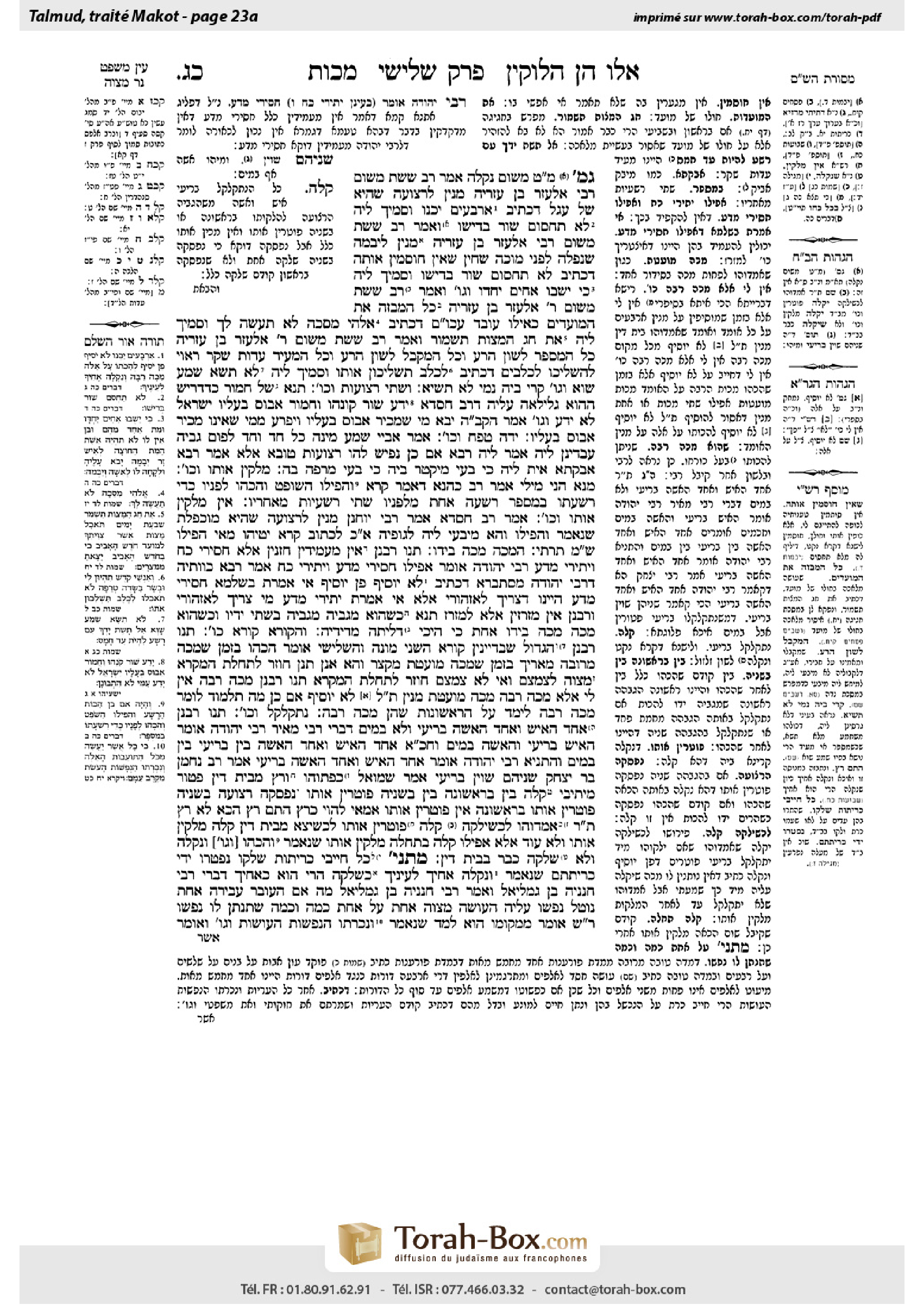
Makkot 23a: Talmud study for Daf Yomi
Daf Yomi is the daily study of one Talmud folio. Explore 37 tractates with scans, Hebrew text, Sefaria English and AI-generated French translations where annotated.
Passage selection and English or AI-generated French translation are available where the scan has annotations. Daf Study is independent of Torah-Box and Sefaria.
Browse Makkot · מכות · All tractatesMakkot 23a text and translations
This page of Makkot includes the Aramaic text, an English translation and an AI-generated French translation, alongside the scan above.
מכות כ״ג א · Aramaic and Hebrew text
גְּמָ׳ מַאי טַעְמָא – מִשּׁוּם ״נִקְלָה״.
אָמַר רַב שֵׁשֶׁת מִשּׁוּם רַבִּי אֶלְעָזָר בֶּן עֲזַרְיָה: מִנַּיִן לִרְצוּעָה שֶׁהִיא שֶׁל עֵגֶל – דִּכְתִיב ״אַרְבָּעִים יַכֶּנּוּ״, וּסְמִיךְ לֵיהּ ״לֹא תַחְסֹם שׁוֹר בְּדִישׁוֹ״.
וְאָמַר רַב שֵׁשֶׁת מִשּׁוּם רַבִּי אֶלְעָזָר בֶּן עֲזַרְיָה: מִנַּיִן לִיבָמָה שֶׁנָּפְלָה לִפְנֵי מוּכֵּה שְׁחִין, שֶׁאֵין חוֹסְמִין אוֹתָהּ – דִּכְתִיב ״לֹא תַחְסֹם שׁוֹר בְּדִישׁוֹ״, וּסְמִיךְ לֵיהּ ״כִּי יֵשְׁבוּ אַחִים יַחְדָּו וְגוֹ׳״.
וְאָמַר רַב שֵׁשֶׁת מִשּׁוּם רַבִּי אֶלְעָזָר בֶּן עֲזַרְיָה: כׇּל הַמְבַזֶּה אֶת הַמּוֹעֲדִים כְּאִילּוּ עוֹבֵד עֲבוֹדָה זָרָה, דִּכְתִיב ״אֱלֹהֵי מַסֵּכָה לֹא תַעֲשֶׂה לָּךְ״, וּסְמִיךְ לֵיהּ ״אֶת חַג הַמַּצּוֹת תִּשְׁמֹר״.
וְאָמַר רַב שֵׁשֶׁת מִשּׁוּם רַבִּי אֶלְעָזָר בֶּן עֲזַרְיָה: כׇּל הַמְסַפֵּר לָשׁוֹן הָרָע, וְכֵן הַמְקַבֵּל לָשׁוֹן הָרָע, וְכׇל הַמֵּעִיד עֵדוּת שֶׁקֶר – רָאוּי לְהַשְׁלִיכוֹ לִכְלָבִים, דִּכְתִיב ״לַכֶּלֶב תַּשְׁלִכוּן אֹתוֹ״, וּסְמִיךְ לֵיהּ ״לֹא תִשָּׂא שֵׁמַע שָׁוְא וְגוֹ׳״, קְרִי בֵּיהּ נָמֵי ״לֹא תַשִּׂיא״.
וּשְׁתֵּי רְצוּעוֹת וְכוּ׳. תָּנָא: שֶׁל חֲמוֹר. כִּדְדָרֵישׁ הָהוּא גָּלִילָאָה עֲלֵיהּ דְּרַב חִסְדָּא: ״יָדַע שׁוֹר קֹנֵהוּ וַחֲמוֹר אֵבוּס בְּעָלָיו יִשְׂרָאֵל לֹא יָדַע וְגוֹ׳״, אָמַר הַקָּדוֹשׁ בָּרוּךְ הוּא: יָבֹא מִי שֶׁמַּכִּיר אֵבוּס בְּעָלָיו, וְיִפָּרַע מִמִּי שֶׁאֵינוֹ מַכִּיר אֵבוּס בְּעָלָיו.
יָדָהּ טֶפַח וְכוּ׳. אָמַר אַבָּיֵי: שְׁמַע מִינַּהּ כֹּל חַד וְחַד לְפוּם גַּבֵּיהּ עָבְדִינַן לֵיהּ. אֲמַר לֵיהּ רָבָא: אִם כֵּן נַפֵּישׁ לְהוּ רְצוּעוֹת טוּבָא! אֶלָּא אָמַר רָבָא: אַבְקָתָא אִית לַיהּ, כִּי בָּעֵי מְיקַטַּר בַּיהּ, כִּי בָּעֵי מְרַפֵּה בַּהּ.
מַלְקִין אוֹתוֹ וְכוּ׳. מְנָא הָנֵי מִילֵּי? אָמַר רַב כָּהֲנָא: דְּאָמַר קְרָא ״וְהִפִּילוֹ הַשֹּׁפֵט וְהִכָּהוּ לְפָנָיו כְּדֵי רִשְׁעָתוֹ בְּמִסְפָּר״ – רִשְׁעָה אַחַת מִלְּפָנָיו, שְׁתֵּי רִשְׁעָיוֹת מֵאַחֲרָיו.
אֵין מַלְקִין אוֹתוֹ וְכוּ׳. אָמַר רַב חִסְדָּא אָמַר רַבִּי יוֹחָנָן: מִנַּיִן לִרְצוּעָה שֶׁהִיא מוּכְפֶּלֶת – שֶׁנֶּאֱמַר ״וְהִפִּילוֹ״. וְהָא מִיבְּעֵי לֵיהּ לְגוּפֵיהּ! אִם כֵּן לִכְתּוֹב קְרָא ״יַטֵּיהוּ״, מַאי ״הִפִּילוֹ״? שְׁמַע מִינַּהּ תַּרְתֵּי.
הַמַּכֶּה מַכֶּה בְּיָדוֹ. תָּנוּ רַבָּנַן: אֵין מַעֲמִידִין חַזָּנִין אֶלָּא חֲסֵירֵי כֹחַ וִיתֵירֵי מַדָּע. רַבִּי יְהוּדָה אוֹמֵר: אֲפִילּוּ חֲסֵירֵי מַדָּע וִיתֵירֵי כֹּחַ.
אָמַר רָבָא: כְּווֹתֵיהּ דְּרַבִּי יְהוּדָה מִסְתַּבְּרָא, דִּכְתִיב ״לֹא יוֹסִיף... פֶּן יוֹסִיף״, אִי אָמְרַתְּ בִּשְׁלָמָא חֲסֵירֵי מַדָּע – הַיְינוּ דִּצְרִיךְ לְאַזְהוֹרֵי. אֶלָּא אִי אָמְרַתְּ יְתֵירֵי מַדָּע – מִי צְרִיךְ לְאַזְהוֹרֵי? וְרַבָּנַן: אֵין מְזָרְזִין אֶלָּא לַמְזוֹרָז.
תָּנָא: כְּשֶׁהוּא מַגְבִּיהַּ – מַגְבִּיהַּ בִּשְׁתֵּי יָדָיו, וּכְשֶׁהוּא מַכֶּה – מַכֶּה בְּיָדוֹ אַחַת, כִּי הֵיכִי (דְּלֵיתֵא) [דְּתֵיתֵי] מִדִּידֵיהּ.
וְהַקּוֹרֵא קוֹרֵא וְכוּ׳. תָּנוּ רַבָּנַן: הַגָּדוֹל שֶׁבַּדַּיָּינִין קוֹרֵא, הַשֵּׁנִי מוֹנֶה, וְהַשְּׁלִישִׁי אוֹמֵר: ״הַכֵּהוּ״! בִּזְמַן שֶׁמַּכָּה מְרוּבָּה – מַאֲרִיךְ, בִּזְמַן שֶׁמַּכָּה מוּעֶטֶת – מְקַצֵּר. וְהָא אֲנַן תְּנַן: חוֹזֵר לִתְחִלַּת הַמִּקְרָא! מִצְוָה לְצַמְצֵם, וְאִי[ם] לֹא צִמְצֵם – חוֹזֵר לִתְחִלַּת הַמִּקְרָא.
תָּנוּ רַבָּנַן: ״מַכָּה רַבָּה״, אֵין לִי אֶלָּא מַכָּה רַבָּה, מַכָּה מוּעֶטֶת מִנַּיִן? תַּלְמוּד לוֹמַר: ״לֹא יוֹסִיף״. אִם כֵּן, מָה תַּלְמוּד לוֹמַר ״מַכָּה רַבָּה״? לִימֵּד עַל הָרִאשׁוֹנוֹת שֶׁהֵן מַכָּה רַבָּה.
נִתְקַלְקֵל וְכוּ׳. תָּנוּ רַבָּנַן: אֶחָד הָאִישׁ וְאֶחָד הָאִשָּׁה בְּרֵיעִי וְלֹא בְּמַיִם, דִּבְרֵי רַבִּי מֵאִיר. רַבִּי יְהוּדָה אוֹמֵר: הָאִישׁ בְּרֵיעִי, וְהָאִשָּׁה בְּמַיִם. וַחֲכָמִים אוֹמְרִים: אֶחָד הָאִישׁ וְאֶחָד הָאִשָּׁה – בֵּין בְּרֵיעִי בֵּין בְּמַיִם.
וְהָתַנְיָא, רַבִּי יְהוּדָה אוֹמֵר: אֶחָד הָאִישׁ וְאֶחָד הָאִשָּׁה – בְּרֵיעִי! אָמַר רַב נַחְמָן בַּר יִצְחָק: שְׁנֵיהֶם שָׁוִין בְּרֵיעִי.
אָמַר שְׁמוּאֵל: כְּפָתוּהוּ, וְרָץ מִבֵּית דִּין – פָּטוּר. מֵיתִיבִי: קָלָה, בֵּין בָּרִאשׁוֹנָה בֵּין בַּשְּׁנִיָּה – פּוֹטְרִין אוֹתוֹ. נִפְסְקָה רְצוּעָה בַּשְּׁנִיָּה – פּוֹטְרִין אוֹתוֹ, בָּרִאשׁוֹנָה – אֵין פּוֹטְרִין אוֹתוֹ. אַמַּאי? לֶהֱוֵי כְּרָץ! הָתָם רָץ, הָכָא לָא רָץ.
תָּנוּ רַבָּנַן: אֲמָדוּהוּ לִכְשֶׁיִּלְקֶה קָלֶה – פּוֹטְרִין אוֹתוֹ. לִכְשֶׁיֵּצֵא מִבֵּית דִּין קָלֶה – מַלְקִין אוֹתוֹ. וְלֹא עוֹד אֶלָּא, אֲפִילּוּ קָלָה בַּתְּחִלָּה – מַלְקִין אוֹתוֹ שֶׁנֶּאֱמַר: ״וְהִכָּהוּ וְגוֹ׳ וְנִקְלָה״ וְלֹא שֶׁלָּקָה כְּבָר בְּבֵית דִּין.
מַתְנִי׳ כׇּל חַיָּיבֵי כָרֵיתוֹת שֶׁלָּקוּ – נִפְטְרוּ יְדֵי כְּרִיתָתָם, שֶׁנֶּאֱמַר: ״וְנִקְלָה אָחִיךָ לְעֵינֶיךָ״ – כְּשֶׁלָּקָה הֲרֵי הוּא כְּאָחִיךָ, דִּבְרֵי רַבִּי חֲנַנְיָה בֶּן גַּמְלִיאֵל.
וְאָמַר רַבִּי חֲנַנְיָה בֶּן גַּמְלִיאֵל: מָה אִם הָעוֹבֵר עֲבֵירָה אַחַת נוֹטֵל נַפְשׁוֹ עָלֶיהָ, הָעוֹשֶׂה מִצְוָה אַחַת עַל אַחַת כַּמָּה וְכַמָּה שֶׁתִּנָּתֵן לוֹ נַפְשׁוֹ. רַבִּי שִׁמְעוֹן אוֹמֵר: מִמְּקוֹמוֹ הוּא לָמֵד, שֶׁנֶּאֱמַר: ״וְנִכְרְתוּ הַנְּפָשׁוֹת הָעֹשֹׂת וְגוֹ׳״
Makkot 23a · English translation
GEMARA: The mishna teaches that the attendant rips the garments of the person about to be flogged. The Gemara explains: What is the reason for this? It is due to the verse: “Forty he shall flog him…and your brother shall be debased before you” (Deuteronomy 25:3), as tearing his garments debases him.
Rav Sheshet says in the name of Rabbi Elazar ben Azarya: From where is it derived with regard to the strap used for flogging that it is a strap from the hide of a calf? It is as it is written: “Forty he shall flog him,” and juxtaposed to it is written: “You shall not muzzle an ox in its threshing” (Deuteronomy 25:4), indicating that the strap is from the hide of an ox.
And Rav Sheshet says in the name of Rabbi Elazar ben Azarya: From where is it derived with regard to a yevama who happened before a yavam afflicted with boils, that one does not compel her to enter into that levirate marriage? It is derived from a verse, as it is written: “You shall not muzzle an ox in its threshing,” and juxtaposed to it is written: “When brothers dwell together” (Deuteronomy 25:5), which is the passage dealing with levirate marriage. The yevama is not muzzled, as it were, when she states that she does not want to enter into levirate marriage with him.
And Rav Sheshet says in the name of Rabbi Elazar ben Azarya: Concerning anyone who treats the Festivals with contempt, it is as though he is worshipping idols, as it is written: “Molten gods you shall not make for yourself” (Exodus 34:17), and juxtaposed to it is written: “The festival of Passover you shall observe” (Exodus 34:18).
And Rav Sheshet says in the name of Rabbi Elazar ben Azarya: Concerning anyone who speaks malicious speech, and anyone who accepts malicious speech as the truth, and anyone who testifies a false testimony, it is fit to throw him to the dogs, as it is written: “To the dog you shall cast it” (Exodus 22:30), and juxtaposed to it is written: “You shall not accept [lo tissa] a false report; do not join with the wicked to be a false witness” (Exodus 23:1). In addition to prohibitions against false testimony and against accepting malicious speech, Rav Sheshet also reads into the verse the meaning: You shall not relate [lo tassi] a false report.
§ The mishna teaches: And two straps go up and down the doubled strap of calf hide. The Sage taught: And they are straps of donkey hide. As a certain Galilean interpreted before Rav Ḥisda: It is written: “The ox knows its owner, and the donkey its master’s trough; but Israel does not know, My people does not consider” (Isaiah 1:3). The Holy One, Blessed be He, says: Let the one who recognizes its master’s trough, an ox and donkey, come and exact retribution, through lashes with a strap of ox and donkey hide, from one who does not recognize his Master’s trough and performs transgressions.
The mishna teaches: The length of its handle is one handbreadth, and the width of the straps is one handbreadth, and the strap must be long enough so that its end reaches the top of his abdomen. Abaye said: Conclude from it that for each and every one, we craft the strap according to the size of their back. Rava said to him: If so, there will be numerous straps in court for them. Rather, Rava said: It has loops; when the attendant wants, he ties the loops to shorten the strap, and when the attendant wants, he loosens the loops to lengthen the strap. The length of the strap can be adjusted to correspond to the height of the person being flogged.
§ The mishna teaches: One flogs him with one-third of the lashes from the front of him and two one-third portions from behind him. The Gemara asks: From where are these matters derived? Rav Kahana said: It is derived from a verse, as the verse states: “And the judge shall cause him to lie down, and strike him before him in accordance with his wickedness, by number” (Deuteronomy 25:2), indicating that the attendant strikes him in accordance with one portion of wickedness from the front of him, and two portions of wickedness from behind him.
The mishna teaches: And he does not flog him when the one receiving lashes is standing, nor when he is sitting; rather, he flogs him when he is hunched, as it is stated: “And the judge shall cause him to lie down.” Rav Ḥisda says that Rabbi Yoḥanan says: From where is it derived with regard to the strap that it is doubled? It is derived from a verse, as it is stated: And he shall cause him to lie down [vehippilo], which is interpreted based on the similar Aramaic root ayin, peh, peh, meaning double. The Gemara asks: But doesn’t he require that verse for the fundamental halakha itself, as the mishna teaches: He flogs him when he is hunched. The Gemara answers: If so, let the verse write: Shall bend him. What is the meaning of: “Shall cause him to lie down”? Conclude two conclusions from it: The halakha that the person being flogged must be hunched, and the allusion to the doubling of the strap.
§ The mishna teaches: And the attendant flogging the one receiving lashes flogs him with one hand with all his strength. The Sages taught: For the administration of lashes, the court appoints only attendants who are lacking in strength and are exceedingly knowledgeable in Torah. Rabbi Yehuda says: The court may appoint even those who are lacking in knowledge and are exceedingly strong.
Rava said: It is reasonable to rule in accordance with the opinion of Rabbi Yehuda, as it is written: “Forty he shall flog him; he shall not exceed, lest he continue to beat him” (Deuteronomy 25:3). He explains: Granted, if you say that even people lacking in halakhic knowledge are appointed, that is why it is necessary to warn him not to add lashes. But if you say only people who are exceedingly knowledgeable are appointed, does the Torah need to warn the attendant? Apparently, even a person lacking in knowledge can be appointed as an attendant. And according to the Rabbis, that is no proof, as there is an expression that one implores only one who is already implored. In other words, only one who is already cognizant of a halakha can be effectively warned to observe it.
It is taught: When the attendant raises the strap to administer the lashes, he raises it with both hands, and when he flogs the one receiving lashes, he flogs with one hand, so that the lashes will come from him in a deliberate manner.
§ The mishna teaches: And the court crier recites the verse beginning: “If you do not observe to perform,” as well as other verses. The Sages taught: The most prominent of the judges recites the verses, the second most prominent judge counts the lashes, and the third most prominent says to the attendant: Strike him. When the lashes are numerous, the one reciting the verses extends his recitation; when the lashes are few, he curtails his recitation by reciting it faster. In both cases, he does so to coordinate the recitation with the duration of the lashes. The Gemara asks: But didn’t we learn in the mishna: And then he returns to the beginning of the first verse, indicating that one could read the passage several times? The Gemara answers: The mitzva is to precisely coordinate recitation of the verses with the flogging, and if he did not precisely coordinate between them, and he completed the recitation of the verses before completing the lashes, he returns to the beginning of the first verse.
The Gemara cites another baraita with regard to the number of lashes. The Sages taught: From the verse: “He shall not exceed, lest he continue to beat him beyond these, a great flogging” (Deuteronomy 25:3), I have derived only a prohibition with regard to a great flogging; from where do I derive that even a minimal excessive flogging is prohibited? I derive it from the verse that states: “He shall not exceed,” at all. The Gemara asks: If so, why must the verse state: “A great flogging”? This teaches that the initial lashes must be administered as a great flogging, with all of the attendant’s strength.
§ The mishna teaches: If the one being flogged sullies himself, with excrement or urine, he is exempt from further lashes. Rabbi Yehuda says: The man is exempted with excrement, and the woman is exempted even with urine. The Sages taught in a baraita: For both a man and a woman, they are exempted if they sully themselves with excrement, but not if they do so with urine; this is the statement of Rabbi Meir. Rabbi Yehuda says: The man with excrement, and the woman even with urine. And the Rabbis say: Both a man and a woman are exempt from further lashes whether they sullied themselves with excrement or with urine.
The Gemara asks with regard to the opinion attributed to Rabbi Yehuda: But isn’t it taught in a baraita that Rabbi Yehuda says: Both a man and a woman are exempted with excrement, indicating that Rabbi Yehuda holds that a woman is not exempted with urine. Rav Naḥman bar Yitzḥak said: There is no contradiction; that baraita is merely stating that according to Rabbi Yehuda both are equal with regard to excrement. That does not mean that Rabbi Yehuda holds that a woman is not exempted with urine.
Shmuel says: If they bound him to be flogged and he fled from the court, he is exempt. The Gemara raises an objection from a baraita: If he was debased with excrement, whether during the first lash or during the second lash, the court exempts him. But in a case where the strap was severed during the course of the flogging, if this occurred during the second lash they exempt him, but if it happened during the first lash, they do not exempt him. Why is he not exempted during the first lash? Let his status be like one who fled from the court before the flogging began, in which case he is exempt. The Gemara answers: There, in that case, he fled from the court and he is not compelled to return; here, he did not flee, and therefore he is not exempted without being flogged.
The Sages taught: If they assessed concerning him that when he is flogged he will be debased with excrement, they exempt him, as the court does not administer a punishment that will lead to debasing the one being flogged beyond the shame generated by the lashes themselves. But if they assessed concerning him that it is only when he will leave the court that he will be debased with excrement, they flog him. Moreover, even if he was debased initially, before any lashes were administered, they nevertheless flog him, as it is stated: “And strike him…and your brother shall be debased” (Deuteronomy 25:2–3), indicating that the reference is to one debased as a result of the lashes, and not to one who was already debased in court prior to being flogged.
MISHNA: All those liable to receive karet who were flogged are exempted from their punishment of karet, as it is stated: “And your brother shall be debased before your eyes” (Deuteronomy 25:3), indicating: Once he is flogged he is as your brother, as his sin has been atoned and he is no longer excised from the Jewish people; this is the statement of Rabbi Ḥananya ben Gamliel.
And Rabbi Ḥananya ben Gamliel says: And if for one who performs one transgression his soul is taken for it, as one’s soul can be uprooted from the world for one transgression, for one who performs a single mitzva, it is all the more so the case that his soul will be given to him, as the reward for performing mitzvot is greater than the punishment for performing transgressions. Rabbi Shimon says: It is derived from its own place in the Torah, as it is stated at the conclusion of the passage discussing intercourse with forbidden relatives, which is punishable with karet: “And the souls that perform them shall be excised” (Leviticus 18:29), and it states toward the beginning of that chapter:
Makkot 23a · Traduction française (IA)
GUEMARA : La Michna enseigne que l’assistant déchire les vêtements de celui qui va recevoir les coups. La Guemara explique : pourquoi ? En raison du verset : « Il le frappera de quarante coups… et ton frère sera avili sous tes yeux » (Deutéronome 25,3), car déchirer ses vêtements l’avilit.
Rav Sheshet dit au nom de Rabbi Elazar ben Azarya : d’où sait-on que la lanière utilisée pour administrer les coups est faite de peau de veau ? Du verset : « Il le frappera de quarante coups », auquel est juxtaposé le verset : « Tu ne muselleras pas un bœuf pendant qu’il foule le grain » (Deutéronome 25,4), ce qui indique que la lanière est faite de peau de bœuf.
Et Rav Sheshet dit au nom de Rabbi Elazar ben Azarya : d’où sait-on que, lorsqu’une yevama est soumise au lévirat avec un yavam atteint de furoncles, on ne la contraint pas à contracter ce mariage léviratique ? On l’apprend d’un verset : « Tu ne muselleras pas un bœuf pendant qu’il foule le grain », auquel est juxtaposé : « Lorsque des frères demeureront ensemble » (Deutéronome 25,5), passage qui traite du mariage léviratique. Pour ainsi dire, on ne muselle pas la yevama lorsqu’elle déclare qu’elle ne veut pas contracter de mariage léviratique avec lui.
Et Rav Sheshet dit au nom de Rabbi Elazar ben Azarya : quiconque traite les fêtes avec mépris, c’est comme s’il pratiquait l’idolâtrie, comme il est écrit : « Tu ne te feras pas de dieux en métal fondu » (Exode 34,17), auquel est juxtaposé : « Tu observeras la fête de Pessa’h » (Exode 34,18).
Et Rav Sheshet dit au nom de Rabbi Elazar ben Azarya : celui qui tient des propos malveillants, celui qui les accepte comme véridiques et celui qui porte un faux témoignage, il convient de les jeter aux chiens, comme il est écrit : « Tu le jetteras au chien » (Exode 22,30), auquel est juxtaposé : « Tu n’accepteras pas [lo tissa] un faux rapport ; ne te joins pas au méchant pour être un faux témoin » (Exode 23,1). Outre les interdictions de porter un faux témoignage et d’accepter des propos malveillants, Rav Sheshet lit également dans le verset le sens suivant : tu ne rapporteras pas [lo tassi] de faux rapport.
§ La Michna enseigne : deux lanières montent et descendent le long de la lanière doublée en peau de veau. Le Sage a enseigné : ce sont des lanières en peau d’âne. En effet, un certain Galiléen interpréta ainsi devant Rav Ḥisda : il est écrit : « Le bœuf connaît son propriétaire, et l’âne la mangeoire de son maître ; mais Israël ne connaît pas, mon peuple ne comprend pas » (Isaïe 1,3). Le Saint, béni soit-Il, dit : que celui qui reconnaît la mangeoire de son maître — le bœuf et l’âne — vienne exercer sa vengeance, au moyen de coups administrés avec une lanière en peau de bœuf et d’âne, contre celui qui ne reconnaît pas la mangeoire de son Maître et commet des transgressions.
La Michna enseigne : le manche mesure un téfaḥ de long, les lanières un téfaḥ de large, et la lanière doit être assez longue pour que son extrémité atteigne le haut de l’abdomen de celui qui reçoit les coups. Abaye dit : déduis-en que nous fabriquons pour chacun une lanière adaptée à la taille de son dos. Rava lui dit : dans ce cas, il y aura de nombreuses lanières au tribunal. Rava dit plutôt : la lanière comporte des boucles ; lorsque l’assistant le souhaite, il noue les boucles pour la raccourcir, et lorsqu’il le souhaite, il les desserre pour l’allonger. On peut ainsi ajuster sa longueur à la taille de celui qui reçoit les coups.
§ La Michna enseigne : il lui administre un tiers des coups par-devant et deux tiers par-derrière. La Guemara demande : d’où tire-t-on ces règles ? Rav Kahana dit : on les déduit d’un verset, qui dit : « Le juge le fera coucher et le fera frapper devant lui, selon sa culpabilité, en nombre » (Deutéronome 25,2), ce qui indique que l’assistant le frappe en lui infligeant un tiers des coups par-devant et deux tiers par-derrière.
La Michna enseigne : il ne le frappe ni lorsqu’il est debout ni lorsqu’il est assis ; il le frappe plutôt lorsqu’il est courbé, comme il est dit : « Le juge le fera coucher. » Rav Ḥisda dit au nom de Rabbi Yoḥanan : d’où sait-on que la lanière est doublée ? On le déduit d’un verset, comme il est dit : « Il le fera coucher » [vehippilo], expression interprétée à partir de la racine araméenne apparentée ayin, peh, peh, qui signifie « doubler ». La Guemara demande : mais n’a-t-on pas besoin de ce verset pour la règle fondamentale elle-même, comme l’enseigne la Michna : il le frappe lorsqu’il est courbé ? La Guemara répond : si tel était le cas, que le verset dise : « Il le courbera ». Que signifie alors « Il le fera coucher » ? Déduis-en deux choses : la règle selon laquelle celui qui reçoit les coups doit être courbé et l’allusion au doublement de la lanière.
§ La Michna enseigne : l’assistant qui frappe celui qui reçoit les coups le frappe d’une seule main, de toutes ses forces. Les Sages ont enseigné : pour administrer les coups, le tribunal ne nomme que des assistants qui manquent de force et sont extrêmement versés dans la Torah. Rabbi Yehuda dit : le tribunal peut même nommer des assistants qui manquent de connaissance et sont extrêmement forts.
Rava dit : il est raisonnable de statuer conformément à l’avis de Rabbi Yehuda, car il est écrit : « Il le frappera de quarante coups ; il ne dépassera pas ce nombre, de peur qu’il ne continue à le frapper » (Deutéronome 25,3). Il explique : certes, si tu dis que même des personnes qui manquent de connaissance en halakha sont nommées, il est nécessaire de les mettre en garde afin qu’elles n’ajoutent pas de coups. Mais si tu dis que seules des personnes extrêmement versées dans la Torah sont nommées, la Torah a-t-elle besoin de mettre l’assistant en garde ? Il ressort donc que même une personne qui manque de connaissance peut être nommée assistant. Et selon les Rabbins, cela ne prouve rien, car on n’avertit efficacement que celui qui est déjà averti. Autrement dit, seul celui qui connaît déjà une halakha peut être efficacement averti de la respecter.
Il est enseigné : lorsque l’assistant lève la lanière pour administrer les coups, il la lève à deux mains ; lorsqu’il frappe celui qui les reçoit, il le frappe d’une seule main, afin de porter les coups de manière mesurée.
§ La Michna enseigne : le crieur du tribunal récite le verset qui commence par : « Si tu ne veilles pas à accomplir », ainsi que d’autres versets. Les Sages ont enseigné : le plus éminent des juges récite les versets, le deuxième juge par ordre d’importance compte les coups, et le troisième dit à l’assistant : « Frappe-le. » Lorsque les coups sont nombreux, celui qui récite les versets prolonge sa récitation ; lorsqu’ils sont peu nombreux, il la raccourcit en récitant plus vite. Dans les deux cas, il agit ainsi pour faire coïncider la récitation avec la durée des coups. La Guemara demande : mais n’avons-nous pas appris dans la Michna : « Et alors il revient au début du premier verset », ce qui indique qu’on peut réciter le passage plusieurs fois ? La Guemara répond : la mitsva consiste à faire coïncider exactement la récitation des versets avec la flagellation ; s’il n’y parvient pas et achève la récitation avant la fin des coups, il revient au début du premier verset.
La Guemara cite une autre baraïta au sujet du nombre de coups. Les Sages ont enseigné : du verset « Il ne dépassera pas ce nombre, de peur qu’il ne continue à le frapper au-delà de ceux-ci, d’une grande flagellation » (Deutéronome 25,3), je n’ai déduit que l’interdiction d’administrer une flagellation excessive ; d’où déduis-je que même un excès minime de coups est interdit ? Je le déduis du verset qui dit : « Il ne dépassera pas », en aucun cas. La Guemara demande : si tel est le cas, pourquoi le verset précise-t-il : « Une grande flagellation » ? Cela enseigne que les premiers coups doivent être administrés avec une grande force, de toutes les forces de l’assistant.
§ La Michna enseigne : si celui qui reçoit les coups se souille avec ses excréments ou son urine, il est dispensé des coups restants. Rabbi Yehuda dit : l’homme en est dispensé s’il se souille avec ses excréments, et la femme en est dispensée même si elle se souille avec son urine. Les Sages ont enseigné dans une baraïta : un homme comme une femme en sont dispensés s’ils se souillent avec leurs excréments, mais pas s’ils le font avec leur urine ; telle est la déclaration de Rabbi Meir. Rabbi Yehuda dit : l’homme en est dispensé s’il se souille avec ses excréments, et la femme même si elle se souille avec son urine. Et les Rabbins disent : un homme comme une femme sont dispensés des coups restants, qu’ils se soient souillés avec leurs excréments ou avec leur urine.
La Guemara pose une question au sujet de l’opinion attribuée à Rabbi Yehuda : mais n’est-il pas enseigné dans une baraïta que Rabbi Yehuda dit : un homme comme une femme en sont dispensés s’ils se souillent avec leurs excréments, ce qui indique que, selon lui, une femme n’en est pas dispensée si elle se souille avec son urine ? Rav Naḥman bar Yitzḥak dit : il n’y a pas de contradiction ; cette baraïta indique seulement que, selon Rabbi Yehuda, les deux sont égaux en ce qui concerne les excréments. Cela ne signifie pas que, selon lui, une femme n’est pas dispensée si elle se souille avec son urine.
Shmuel dit : si on l’a ligoté pour le frapper et qu’il s’est enfui du tribunal, il est dispensé. La Guemara soulève une objection à partir d’une baraïta : s’il s’est souillé avec ses excréments, que ce soit pendant le premier coup ou pendant le deuxième, le tribunal le dispense. Mais si la lanière s’est rompue pendant la flagellation, le tribunal le dispense si cela s’est produit pendant le deuxième coup, mais pas si cela s’est produit pendant le premier. Pourquoi ne le dispense-t-on pas après le premier coup ? Que son statut soit le même que celui de quelqu’un qui s’est enfui du tribunal avant le début de la flagellation, auquel cas il est dispensé. La Guemara répond : dans ce cas-là, il s’est enfui du tribunal et on ne le contraint pas à revenir ; ici, il ne s’est pas enfui et il n’est donc pas dispensé avant d’avoir reçu les coups.
Les Sages ont enseigné : si l’on a estimé qu’il se souillerait avec ses excréments lorsqu’il serait frappé, on le dispense, car le tribunal n’inflige pas une peine qui l’avilirait au-delà de la honte provoquée par les coups eux-mêmes. Mais si l’on a estimé qu’il ne se souillerait avec ses excréments qu’en quittant le tribunal, on le frappe. De plus, même s’il s’est souillé au préalable, avant qu’on lui administre le moindre coup, on le frappe néanmoins, comme il est dit : « Et il le frappera… et ton frère sera avili » (Deutéronome 25,2–3), ce qui indique qu’il s’agit de quelqu’un qui a été avili à la suite des coups, et non de quelqu’un qui était déjà avili au tribunal avant d’être frappé.
MICHNA : tous ceux qui encourent le retranchement et qui ont reçu les coups sont dispensés de la peine de retranchement, comme il est dit : « Et ton frère sera avili sous tes yeux » (Deutéronome 25,3), ce qui indique qu’une fois qu’il a reçu les coups, il est comme ton frère, car son péché a été expié et il n’est plus retranché du peuple juif. Telle est la déclaration de Rabbi Ḥananya ben Gamliel.
Et Rabbi Ḥananya ben Gamliel dit : si l’âme de celui qui commet une transgression lui est retirée pour celle-ci, puisqu’une seule transgression peut entraîner l’arrachement de l’âme au monde, à plus forte raison l’âme de celui qui accomplit une seule mitsva lui sera-t-elle donnée, car la récompense de l’accomplissement des mitsvot est supérieure à la punition des transgressions. Rabbi Shimon dit : on le déduit de l’endroit même où cela figure dans la Torah, comme il est dit à la fin du passage qui traite des relations sexuelles interdites, passibles de retranchement : « Les âmes qui les commettent seront retranchées » (Lévitique 18,29), et il est dit au début de ce chapitre :
Traduction française générée par IA à partir de l’édition anglaise de Sefaria. Vérifie toujours un passage avec le texte source.
Text from Sefaria: William Davidson Edition - Vocalized Aramaic (CC BY NC); William Davidson Edition - English (CC BY NC).