Makkot 23b: Talmud study for Daf Yomi
Daf Yomi is the daily study of one Talmud folio. Explore 37 tractates with scans, Hebrew text, Sefaria English and AI-generated French translations where annotated.
Passage selection and English or AI-generated French translation are available where the scan has annotations. Daf Study is independent of Torah-Box and Sefaria.
Browse Makkot · מכות · All tractatesMakkot 23b text and translations
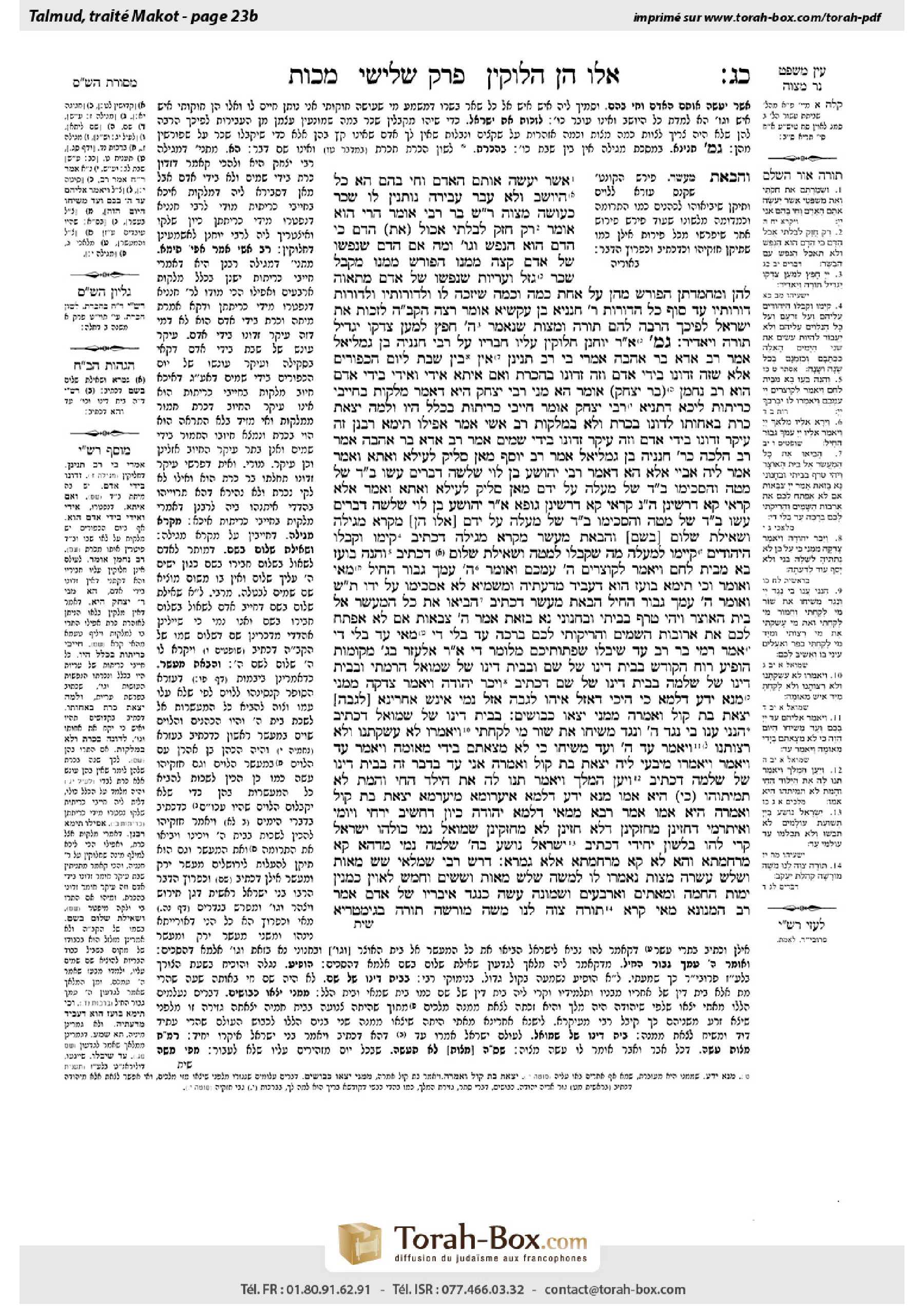
This page of Makkot includes the Aramaic text, an English translation and an AI-generated French translation, alongside the scan above.
מכות כ״ג ב · Aramaic and Hebrew text
״אֲשֶׁר יַעֲשֶׂה אֹתָם הָאָדָם וָחַי בָּהֶם״. הָא הַיּוֹשֵׁב וְלָא עָבַר עֲבֵירָה נוֹתְנִין לוֹ שָׂכָר כָּעוֹשֶׂה מִצְוָה.
רַבִּי שִׁמְעוֹן בַּר רַבִּי אוֹמֵר: הֲרֵי הוּא אוֹמֵר ״רַק חֲזַק לְבִלְתִּי אֲכֹל (אֶת) הַדָּם כִּי הַדָּם הוּא הַנָּפֶשׁ וְגוֹ׳״ וּמָה אִם הַדָּם, שֶׁנַּפְשׁוֹ שֶׁל הָאָדָם קָצָה מִמֶּנּוּ – הַפּוֹרֵשׁ מִמֶּנּוּ מְקַבֵּל שָׂכָר, גָּזֵל וַעֲרָיוֹת, שֶׁנַּפְשׁוֹ שֶׁל אָדָם מִתְאַוָּה לָהֶן וּמְחַמַּדְתָּן – הַפּוֹרֵשׁ מֵהֶן עַל אַחַת כַּמָּה וְכַמָּה שֶׁיִּזְכֶּה לוֹ וּלְדוֹרוֹתָיו וּלְדוֹרוֹת דּוֹרוֹתָיו עַד סוֹף כׇּל הַדּוֹרוֹת.
רַבִּי חֲנַנְיָא בֶּן עֲקַשְׁיָא אוֹמֵר: רָצָה הַקָּדוֹשׁ בָּרוּךְ הוּא לְזַכּוֹת אֶת יִשְׂרָאֵל, לְפִיכָךְ הִרְבָּה לָהֶם תּוֹרָה וּמִצְוֹת, שֶׁנֶּאֱמַר ״ה׳ חָפֵץ לְמַעַן צִדְקוֹ יַגְדִּיל תּוֹרָה וְיַאְדִּיר״.
גְּמָ׳ אָמַר רַבִּי יוֹחָנָן: חֲלוּקִין עָלָיו חֲבֵרָיו עַל רַבִּי חֲנַנְיָה בֶּן גַּמְלִיאֵל. אָמַר רַב אַדָּא בַּר אַהֲבָה: אָמְרִי בֵּי רַב, תְּנֵינַן: אֵין בֵּין שַׁבָּת לְיוֹם הַכִּפּוּרִים אֶלָּא שֶׁזֶּה זְדוֹנוֹ בִּידֵי אָדָם וְזֶה זְדוֹנוֹ בְּהִכָּרֵת. וְאִם אִיתָא, אִידֵּי וְאִידֵּי בִּידֵי אָדָם הוּא.
רַב נַחְמָן בַּר יִצְחָק אוֹמֵר: הָא מַנִּי – רַבִּי יִצְחָק הִיא, דְּאָמַר: מַלְקוֹת בְּחַיָּיבֵי כָרֵיתוֹת לֵיכָּא. דְּתַנְיָא, רַבִּי יִצְחָק אוֹמֵר: חַיָּיבֵי כָרֵיתוֹת בַּכְּלָל הָיוּ, וְלָמָּה יָצָאת כָּרֵת בַּאֲחוֹתוֹ – לְדוּנוֹ בְּכָרֵת וְלֹא בְּמַלְקוֹת.
רַב אָשֵׁי אָמַר: אֲפִילּוּ תֵּימָא רַבָּנַן, זֶה – עִיקַּר זְדוֹנוֹ בִּידֵי אָדָם, וְזֶה – עִיקַּר זְדוֹנוֹ בִּידֵי שָׁמַיִם.
אָמַר רַב אַדָּא בַּר אַהֲבָה אָמַר רַב: הֲלָכָה כְּרַבִּי חֲנַנְיָא בֶּן גַּמְלִיאֵל. אָמַר רַב יוֹסֵף: מַאן סְלֵיק לְעֵילָּא וַאֲתָא וַאֲמַר?! אֲמַר לֵיהּ אַבָּיֵי: אֶלָּא הָא דְּאָמַר רַבִּי יְהוֹשֻׁעַ בֶּן לֵוִי: שְׁלֹשָׁה דְּבָרִים עָשׂוּ בֵּית דִּין שֶׁל מַטָּה וְהִסְכִּימוּ בֵּית דִּין שֶׁל מַעְלָה עַל יָדָם – מַאן סְלֵיק לְעֵילָּא וַאֲתָא וַאֲמַר? אֶלָּא: קְרָאֵי קָא דָרְשִׁינַן, הָכָא נָמֵי, קְרָאֵי קָא דָרְשִׁינַן.
גּוּפָא, אָמַר רַבִּי יְהוֹשֻׁעַ בֶּן לֵוִי: שְׁלֹשָׁה דְּבָרִים עָשׂוּ בֵּית דִּין שֶׁל מַטָּה וְהִסְכִּימוּ בֵּית דִּין שֶׁל מַעְלָה עַל יָדָם, [אֵלּוּ הֵן]: מִקְרָא מְגִילָּה, וּשְׁאֵילַת שָׁלוֹם [בַּשֵּׁם], וַהֲבָאַת מַעֲשֵׂר.
מִקְרָא מְגִילָּה – דִּכְתִיב ״קִיְּמוּ וְקִבְּלוּ הַיְּהוּדִים״ – קִיְּימוּ לְמַעְלָה מַה שֶּׁקִּבְּלוּ לְמַטָּה.
וּשְׁאֵילַת שָׁלוֹם – דִּכְתִיב ״וְהִנֵּה בֹעַז בָּא מִבֵּית לֶחֶם וַיֹּאמֶר לַקּוֹצְרִים ה׳ עִמָּכֶם״, וְאוֹמֵר ״ה׳ עִמְּךָ גִּבּוֹר הֶחָיִל״. מַאי ״וְאוֹמֵר״? וְכִי תֵּימָא בּוֹעַז הוּא דַּעֲבַד מִדַּעְתֵּיהּ, וּמִשְּׁמַיָּא לָא אַסְכִּימוּ עַל יְדֵיהּ – תָּא שְׁמַע: וְאוֹמֵר ״ה׳ עִמְּךָ גִּבּוֹר הֶחָיִל״.
הֲבָאַת מַעֲשֵׂר – דִּכְתִיב ״הָבִיאוּ אֶת כׇּל הַמַּעֲשֵׂר אֶל בֵּית הָאוֹצָר וִיהִי טֶרֶף בְּבֵיתִי וּבְחָנוּנִי נָא בָּזֹאת אָמַר ה׳ צְבָאוֹת אִם לֹא אֶפְתַּח לָכֶם אֵת אֲרֻבּוֹת הַשָּׁמַיִם וַהֲרִיקֹתִי לָכֶם בְּרָכָה עַד בְּלִי דָי״. מַאי ״עַד בְּלִי דָּי״? אָמַר רָמֵי בַּר רַב: עַד שֶׁיִּבְלוּ שִׂפְתוֹתֵיכֶם מִלּוֹמַר ״דָּי״.
אָמַר רַבִּי אֶלְעָזָר: בִּשְׁלֹשָׁה מְקוֹמוֹת הוֹפִיעַ רוּחַ הַקּוֹדֶשׁ: בְּבֵית דִּינוֹ שֶׁל שֵׁם, וּבְבֵית דִּינוֹ שֶׁל שְׁמוּאֵל הָרָמָתִי, וּבְבֵית דִּינוֹ שֶׁל שְׁלֹמֹה. בְּבֵית דִּינוֹ שֶׁל שֵׁם – דִּכְתִיב ״וַיַּכֵּר יְהוּדָה וַיֹּאמֶר צָדְקָה מִמֶּנִּי״. מְנָא יָדַע? דִּלְמָא כִּי הֵיכִי דַּאֲזַל אִיהוּ לְגַבַּהּ אֲזַל נָמֵי אִינָשׁ אַחֲרִינָא [לְגַבַּהּ]! יָצָאת בַּת קוֹל וְאָמְרָה: מִמֶּנִּי יָצְאוּ כְּבוּשִׁים.
בְּבֵית דִּינוֹ שֶׁל שְׁמוּאֵל – דִּכְתִיב ״הִנְנִי עֲנוּ בִי נֶגֶד ה׳ וְנֶגֶד מְשִׁיחוֹ אֶת שׁוֹר מִי לָקַחְתִּי... וַיֹּאמְרוּ לֹא עֲשַׁקְתָּנוּ וְלֹא רַצּוֹתָנוּ... וַיֹּאמֶר עֵד ה׳ וְעֵד מְשִׁיחוֹ... כִּי לֹא מְצָאתֶם בְּיָדִי מְאוּמָה וַיֹּאמֶר עֵד״, ״וַיֹּאמֶר״? ״וַיֹּאמְרוּ״ מִיבְּעֵי לֵיהּ! יָצָאת בַּת קוֹל וְאָמְרָה: אֲנִי עֵד בְּדָבָר זֶה.
בְּבֵית דִּינוֹ שֶׁל שְׁלֹמֹה – דִּכְתִיב ״וַיַּעַן הַמֶּלֶךְ וַיֹּאמֶר תְּנוּ לָהּ אֶת הַיֶּלֶד הַחַי וְהָמֵת לֹא תְמִיתֻהוּ (כִּי) הִיא אִמּוֹ״. מְנָא יָדַע? דִּלְמָא אִיעָרוּמֵא מְיעָרְמָא! יָצָאת בַּת קוֹל וְאָמְרָה: ״הִיא אִמּוֹ״.
אָמַר רָבָא: מִמַּאי? דִּלְמָא יְהוּדָה, כֵּיוָן דְּחַשֵּׁיב יַרְחֵי וְיוֹמֵי וְאִיתְרְמִי – דְּחָזֵינַן מַחְזְקִינַן, דְּלָא חָזֵינַן לָא מַחְזְקִינַן.
שְׁמוּאֵל נָמֵי, כּוּלְּהוּ יִשְׂרָאֵל קָרֵי לְהוּ בִּלְשׁוֹן יְחִידִי, דִּכְתִיב ״יִשְׂרָאֵל נוֹשַׁע בַּה׳״.
שְׁלֹמֹה נָמֵי – מִדְּהָא קָא (מְרַחַמְתָּא) [מְרַחֲמָא] וְהָא לָא קָא (מְרַחַמְתָּא) [מְרַחֲמָא]! אֶלָּא גְּמָרָא.
דָּרַשׁ רַבִּי שִׂמְלַאי: שֵׁשׁ מֵאוֹת וּשְׁלֹשׁ עֶשְׂרֵה מִצְוֹת נֶאֶמְרוּ לוֹ לְמֹשֶׁה, שְׁלֹשׁ מֵאוֹת וְשִׁשִּׁים וְחָמֵשׁ לָאוִין כְּמִנְיַן יְמוֹת הַחַמָּה, וּמָאתַיִם וְאַרְבָּעִים וּשְׁמוֹנָה עֲשֵׂה כְּנֶגֶד אֵיבָרָיו שֶׁל אָדָם. אָמַר רַב הַמְנוּנָא: מַאי קְרָא – ״תּוֹרָה צִוָּה לָנוּ מֹשֶׁה מוֹרָשָׁה״, ״תּוֹרָה״ בְּגִימַטְרִיָּא
Makkot 23b · English translation
“That a person shall perform and live by them” (Leviticus 18:5). It is inferred that with regard to one who sits and did not perform a transgression, God gives him a reward like that received by one who performs a mitzva.
Rabbi Shimon bar Rabbi Yehuda HaNasi says that as the verse states: “Only be steadfast to not eat the blood, as the blood is the soul” (Deuteronomy 12:23), it can be derived a fortiori: And if with regard to the blood, which a person’s soul loathes, one who abstains from its consumption receives a reward for that action, as it is written in a subsequent verse: “You shall not eat it, so that it shall be good for you and for your children after you” (Deuteronomy 12:25); then concerning robbery and intercourse with forbidden relatives, which a person’s soul desires and covets, one who abstains from their performance and overcomes his inclination, all the more so that he and his descendants and the descendants of his descendants until the end of all generations will merit a reward.
Rabbi Ḥananya ben Akashya says: The Holy One, Blessed be He, sought to confer merit upon the Jewish people; therefore, He increased for them Torah and mitzvot, as each mitzva increases merit, as it is stated: “It pleased the Lord for the sake of His righteousness to make the Torah great and glorious” (Isaiah 42:21). God sought to make the Torah great and glorious by means of the proliferation of mitzvot.
GEMARA: Rabbi Yoḥanan says: Rabbi Ḥananya ben Gamliel’s colleagues are in disagreement with him and hold that lashes do not exempt the sinner from karet. Rav Adda bar Ahava said that this is so, as they say in the school of Rav that we learned in a mishna (Megilla 7b): The difference between Shabbat and Yom Kippur with regard to the labor prohibited on those days is only that in this case, Shabbat, its intentional desecration is punishable by human hands, as he is stoned by a court based on the testimony of witnesses who forewarned the transgressor, and in that case, Yom Kippur, its intentional desecration is punishable at the hand of God, with karet. And if the statement of Rabbi Ḥananya ben Gamliel is so, in both this case, Shabbat, and that case, Yom Kippur, the punishment would be by human hands. Apparently, the tanna of the mishna, the Rabbis, disagrees with Rabbi Ḥananya ben Gamliel.
Rav Naḥman bar Yitzḥak says: There is no proof from here that Rabbi Ḥananya ben Gamliel’s colleagues disagree with him, as in accordance with whose opinion is this mishna taught? It is in accordance with the opinion of Rabbi Yitzḥak, who says: There are no lashes in cases of those liable to receive karet. As it is taught in a baraita that Rabbi Yitzḥak says: All those liable to receive karet in cases of forbidden relations were included in the principle: “For whoever shall commit any of these abominations, even the people who commit them shall be cut off from among their people” (Leviticus 18:29). And why was karet in the case of relations with one’s sister excluded from this verse and mentioned independently (Leviticus 20:17)? It is to sentence one who transgresses a prohibition punishable with karet to be punished with karet alone, and not with lashes. Other Sages disagree with Rabbi Yitzḥak (see 13b).
Rav Ashi said: Even if you say that the mishna is in accordance with the opinion of the Rabbis, who disagree with Rabbi Yitzḥak and hold that there are lashes even in cases where there is liability for karet, there is no proof that Rabbi Ḥananya ben Gamliel’s colleagues disagree with him. The mishna can be understood as follows: In this case, Shabbat, the primary punishment for its intentional desecration is by human hands, and in that case, Yom Kippur, the primary punishment for its intentional desecration is karet, which is a punishment at the hand of Heaven. If he was flogged, he is exempt from karet.
Rav Adda bar Ahava says that Rav says: The halakha is in accordance with the opinion of Rabbi Ḥananya ben Gamliel, who ruled that lashes exempt the sinner from karet. Rav Yosef said: Who ascended on high and came and said to you that one who is flogged is exempted from karet? That is not dependent upon the decision of an earthly court. Abaye said to Rav Yosef: But according to your reasoning, then with regard to that which Rabbi Yehoshua ben Levi says: There are three matters that the earthly court implemented and the heavenly court agreed with them, the same question applies: Who ascended on high and came and said to him that this is so? Rather, in arriving at Rabbi Yehoshua ben Levi’s conclusion we homiletically interpret verses. Here too, with regard to lashes and karet, we homiletically interpret verses.
§ With regard to the matter itself, Rabbi Yehoshua ben Levi says: There are three matters that the earthly court implemented and the heavenly court agreed with them, and these are they: Reading the Scroll of Esther on Purim, and greeting another with the name of God, and bringing the first tithe to the Temple treasury in Jerusalem. From where is it derived that the heavenly court agreed with them?
Reading the Scroll of Esther is derived from a verse, as it is written: “The Jews confirmed, and they took upon themselves” (Esther 9:27). The verse could have simply said: They took upon themselves. From the formulation of the verse it is interpreted: They confirmed above in Heaven that which they took upon themselves below on earth.
And greeting another with the name of God is derived from a verse, as it is written: “And presently Boaz came from Bethlehem and said to the harvesters: The Lord is with you, and they said to him: May the Lord bless you” (Ruth 2:4). And it states: “And the angel of the Lord appeared to him and said to him: The Lord is with you, mighty man of valor” (Judges 6:12). The Gemara asks: What is the reason that the Gemara cites the additional source about Gideon, introduced with the phrase: And it states? Why was the proof from Boaz’s statement to the harvesters insufficient? The Gemara explains: And if you would say: It is Boaz who did so on his own, and from Heaven they did not agree with him; come and hear proof, and it says: “The Lord is with you, mighty man of valor.” The angel greeted Gideon with the name of God, indicating that there is agreement in Heaven that this is an acceptable form of greeting.
From where is it derived that the heavenly court agreed to the bringing of the first tithe to the Temple treasury in Jerusalem? It is derived from a verse, as it is written: “Bring you the whole tithe into the storehouse, that there may be food in My house, and try Me now with this, says the Lord of hosts, if I will not open for you the windows of heaven and pour you out a blessing, that there shall be more than sufficiency [ad beli dai]” (Malachi 3:10). This indicates that the heavenly court agreed that the first tithe should be brought to the Temple treasury. The Gemara asks: What is the meaning of “ad beli dai”? Rami bar Rav says: It means that the abundance will be so great that your lips will be worn out [yivlu], from saying enough [dai].
The Gemara cites a somewhat similar statement. Rabbi Elazar says: In three places the Divine Spirit appeared before all to affirm that the action taken was appropriate: In the court of Shem, in the court of Samuel the Ramathite, and in the court of Solomon. The Gemara elaborates: This occurred in the court of Shem, as it is written in the context of the episode of Judah and Tamar: “And Judah acknowledged them and said: She is more righteous than I [mimmenni]” (Genesis 38:26). How did Judah know that Tamar’s assertion that she was bearing his child was correct? Perhaps, just as he went to her and hired her as a prostitute, another person went to her and hired her as well, and he is not the father. Rather, a Divine Voice emerged and said: It is from Me [mimmenni] that these secrets emerged. God affirmed that her assertion was correct and that it was His divine plan that Judah would father a child from Tamar.
Likewise, this occurred in the court of Samuel, as it is written: “Here I am; testify against me before the Lord and before His anointed: Whose ox have I taken…And they said: You have neither defrauded us nor oppressed us…And he said to them: The Lord is witness against you, and His anointed is witness this day, that you have not found anything in my hand. And he said: He is witness” (I Samuel 12:3–5). Based on the context, instead of the singular: “And he said,” the plural: And they said, should have been written, as the verse appears to be the reply of the Jewish people to Samuel’s challenge, attesting to the truth of his statement. Rather, a Divine Voice emerged and said: I, God, am witness to this matter.
This occurred in the court of Solomon, when the Divine Spirit appeared in the dispute between two prostitutes over who was the mother of the surviving child, as it is written: “And the king answered and said: Give her the living child, and do not slay him; she is his mother” (I Kings 3:27). How did Solomon know that she was the mother? Perhaps she was devious and was not the mother of the surviving child at all. Rather, a Divine Voice emerged and said: She is his mother.
Rava said: From where do you draw these conclusions? None of these proofs is absolute. Perhaps in the case of Judah, once he calculated the passage of the months and the days from when he engaged in intercourse with Tamar and it happened to correspond with the duration of her pregnancy, he realized that her assertion is correct. There is no room to suspect that another man was the father, as the principle is: Based on that which we see, we establish presumptive status; based on that which we do not see, we do not establish presumptive status.
With regard to Samuel too, no proof may be cited from the use of the singular, as on occasion the entire Jewish people is referred to in the singular, as it is written, e.g.: “The Jewish people is saved by the Lord” (Isaiah 45:17).
With regard to Solomon too, perhaps he reasoned that due to the fact that this woman is merciful and seeks to spare the baby and this woman is not merciful, it is evident that the former is its mother. Rather, Rava concludes: There is no proof from the verses that a Divine Spirit appeared in those circumstances; rather, there is a tradition that this is the case.
§ Rabbi Simlai taught: There were 613 mitzvot stated to Moses in the Torah, consisting of 365 prohibitions corresponding to the number of days in the solar year, and 248 positive mitzvot corresponding to the number of a person’s limbs. Rav Hamnuna said: What is the verse that alludes to this? It is written: “Moses commanded to us the Torah, an inheritance of the congregation of Jacob” (Deuteronomy 33:4). The word Torah, in terms of its numerical value [gimatriyya],
Makkot 23b · Traduction française (IA)
« L’homme qui les met en pratique vivra par elles » (Lévitique 18:5). On en déduit que celui qui s’abstient de commettre une transgression reçoit de Dieu une récompense semblable à celle qui revient à celui qui accomplit une mitsva.
Rabbi Shimon bar Rabbi Yehuda HaNasi dit : Comme le verset déclare : « Seulement, sois ferme à ne pas manger le sang, car le sang, c’est l’âme » (Deutéronome 12:23), on peut en tirer une conclusion a fortiori : si, pour le sang, que l’âme de l’homme répugne à consommer, celui qui s’abstient d’en manger reçoit une récompense pour cette conduite, comme le dit le verset suivant : « Tu ne le mangeras pas, afin que tu sois heureux, toi et tes enfants après toi » (Deutéronome 12:25), alors, en ce qui concerne le vol et les relations avec des parentes interdites, que l’âme de l’homme désire et convoite, celui qui s’abstient de les commettre et maîtrise son penchant, à plus forte raison lui-même, ses descendants et les descendants de ses descendants, jusqu’à la fin de toutes les générations, mériteront une récompense.
Rabbi Ḥananya ben Akashya dit : Le Saint, béni soit-Il, a voulu accorder des mérites au peuple juif ; c’est pourquoi Il a multiplié pour lui la Torah et les mitsvot, car chaque mitsva accroît le mérite, ainsi qu’il est dit : « Le Seigneur a voulu, à cause de Sa justice, rendre la Torah grande et glorieuse » (Isaïe 42:21). Dieu a voulu rendre la Torah grande et glorieuse en multipliant les mitsvot.
GUEMARA : Rabbi Yoḥanan dit : Les collègues de Rabbi Ḥananya ben Gamliel sont en désaccord avec lui et considèrent que la flagellation ne dispense pas le pécheur du karet. Rav Adda bar Ahava dit qu’il en est bien ainsi, car on enseigne à l’école de Rav ce que nous avons appris dans une Michna (Meguila 7b) : La seule différence entre Chabbat et Yom Kippour concernant les travaux interdits ces jours-là est la suivante : dans le premier cas, Chabbat, sa profanation intentionnelle est punissable par les hommes, car le tribunal le lapide sur la foi du témoignage de témoins qui ont averti le transgresseur ; dans le second cas, Yom Kippour, sa profanation intentionnelle est punissable par la main de Dieu, par le karet. Or, si l’opinion de Rabbi Ḥananya ben Gamliel était correcte, dans les deux cas, Chabbat comme Yom Kippour, la peine serait infligée par les hommes. Apparemment, le tanna de la Michna, les Sages, est en désaccord avec Rabbi Ḥananya ben Gamliel.
Rav Naḥman bar Yitzḥak dit : Il n’y a pas lieu d’en conclure que les collègues de Rabbi Ḥananya ben Gamliel sont en désaccord avec lui, car selon l’opinion de qui cette Michna a-t-elle été enseignée ? Selon celle de Rabbi Yitzḥak, qui dit que la flagellation ne s’applique pas aux cas passibles de karet. En effet, il est enseigné dans une baraïta que Rabbi Yitzḥak dit : Tous ceux qui sont passibles de karet pour des relations interdites étaient inclus dans le principe : « Quiconque commet l’une de ces abominations, les personnes qui les commettent seront retranchées de leur peuple » (Lévitique 18:29). Pourquoi le karet dans le cas de relations avec sa sœur a-t-il été écarté de ce verset et mentionné séparément (Lévitique 20:17) ? C’est afin de statuer que celui qui transgresse un interdit passible de karet est puni uniquement du karet, et non de la flagellation. D’autres Sages sont en désaccord avec Rabbi Yitzḥak (voir 13b).
Rav Ashi dit : Même si l’on affirme que la Michna suit l’opinion des Sages, qui sont en désaccord avec Rabbi Yitzḥak et considèrent que la flagellation s’applique également aux cas passibles de karet, rien ne prouve que les collègues de Rabbi Ḥananya ben Gamliel soient en désaccord avec lui. On peut comprendre la Michna ainsi : dans le premier cas, Chabbat, la peine principale pour sa profanation intentionnelle est infligée par les hommes ; dans le second cas, Yom Kippour, la peine principale pour sa profanation intentionnelle est le karet, une peine infligée par la main du Ciel. S’il a été fouetté, il est dispensé du karet.
Rav Adda bar Ahava dit au nom de Rav : La halakha est conforme à l’opinion de Rabbi Ḥananya ben Gamliel, qui a statué que la flagellation dispense le pécheur du karet. Rav Yosef dit : Qui est monté là-haut et est venu te dire que celui qui est fouetté est dispensé du karet ? Cela ne dépend pas de la décision d’un tribunal terrestre. Abaye dit à Rav Yosef : Mais, selon ton raisonnement, à propos de ce que dit Rabbi Yehoshua ben Levi — le tribunal terrestre a appliqué trois décisions et le tribunal céleste les a approuvées —, la même question se pose : qui est monté là-haut et est venu lui dire qu’il en est ainsi ? Au contraire, pour parvenir à la conclusion de Rabbi Yehoshua ben Levi, nous interprétons les versets selon la méthode homilétique. Ici aussi, au sujet de la flagellation et du karet, nous interprétons les versets selon la méthode homilétique.
§ À propos de cette question elle-même, Rabbi Yehoshua ben Levi dit : Le tribunal terrestre a appliqué trois décisions que le tribunal céleste a approuvées, les voici : la lecture du Rouleau d’Esther à Pourim, le fait de saluer autrui en invoquant le nom de Dieu, et l’apport de la première dîme au trésor du Temple à Jérusalem. D’où déduit-on que le tribunal céleste les a approuvées ?
La lecture du Rouleau d’Esther est déduite d’un verset, comme il est écrit : « Les Juifs confirmèrent et prirent sur eux-mêmes » (Esther 9:27). Le verset aurait pu simplement dire : « Ils prirent sur eux-mêmes ». La formulation du verset est donc interprétée ainsi : ils confirmèrent au Ciel ce qu’ils avaient pris sur eux-mêmes ici-bas.
Le fait de saluer autrui en invoquant le nom de Dieu est déduit d’un verset, comme il est écrit : « À ce moment, Boaz arriva de Bethléem et dit aux moissonneurs : “Que le Seigneur soit avec vous !” Ils lui répondirent : “Que le Seigneur vous bénisse !” » (Ruth 2:4). Et il est dit : « L’ange du Seigneur lui apparut et lui dit : “Le Seigneur est avec toi, vaillant guerrier” » (Juges 6:12). La Guemara demande : Pourquoi la Guemara cite-t-elle cette source supplémentaire au sujet de Gédéon, introduite par les mots : « Et il est dit » ? Pourquoi la preuve tirée des paroles de Boaz aux moissonneurs ne suffisait-elle pas ? La Guemara explique : Et si tu dis : c’est Boaz qui a agi de sa propre initiative, sans que le Ciel l’approuve, viens entendre cette preuve : « Le Seigneur est avec toi, vaillant guerrier. » L’ange salua Gédéon en invoquant le nom de Dieu, ce qui indique que le Ciel approuve cette façon de saluer.
D’où déduit-on que le tribunal céleste a approuvé que la première dîme soit apportée au trésor du Temple à Jérusalem ? On le déduit d’un verset, comme il est écrit : « Apportez toute la dîme au grenier, afin qu’il y ait de la nourriture dans Ma maison ; mettez-Moi à l’épreuve en cela, dit le Seigneur des armées : vous verrez si Je n’ouvre pas pour vous les écluses du ciel et ne répands pas sur vous une bénédiction en abondance, au-delà de toute mesure [ad beli dai] » (Malachie 3:10). Cela indique que le tribunal céleste a approuvé que la première dîme soit apportée au trésor du Temple. La Guemara demande : Que signifie « ad beli dai » ? Rami bar Rav dit : Cela signifie que l’abondance sera telle que vos lèvres seront usées [yivlu] à force de dire : « assez » [dai].
La Guemara cite une déclaration quelque peu similaire. Rabbi Elazar dit : En trois lieux, l’Esprit divin s’est manifesté devant tous pour confirmer que l’action entreprise était appropriée : au tribunal de Shem, au tribunal de Samuel le Ramathite et au tribunal de Salomon. La Guemara détaille : cela s’est produit au tribunal de Shem, comme il est écrit dans le contexte de l’épisode de Juda et Tamar : « Juda les reconnut et dit : “Elle est plus juste que moi [mimmenni]” » (Genèse 38:26). Comment Juda savait-il que l’affirmation de Tamar, selon laquelle elle attendait un enfant de lui, était exacte ? Peut-être qu’après être allé vers elle et l’avoir payée pour se prostituer, un autre homme était lui aussi allé vers elle et l’avait payée, et qu’il n’était pas le père. Au contraire, une Voix divine se fit entendre et dit : « C’est de Moi [mimmenni] que ces secrets sont issus. » Dieu confirma que son affirmation était exacte et qu’il relevait de Son dessein divin que Juda engendre un enfant de Tamar.
De même, cela s’est produit au tribunal de Samuel, comme il est écrit : « Me voici ; témoignez contre moi devant le Seigneur et devant Son oint : De qui ai-je pris le bœuf… Ils dirent : Tu ne nous as ni fraudés ni opprimés… Il leur dit : Le Seigneur est témoin contre vous, et Son oint est témoin aujourd’hui que vous n’avez rien trouvé dans ma main. Et il dit : Il est témoin » (I Samuel 12:3–5). D’après le contexte, au lieu du singulier « Et il dit », le pluriel « Et ils dirent » aurait dû être écrit, puisque le verset semble rapporter la réponse du peuple juif au défi de Samuel, attestant la véracité de ses paroles. Au contraire, une Voix divine se fit entendre et dit : « Moi, Dieu, je suis témoin de cette affaire. »
Cela s’est produit au tribunal de Salomon, lorsque l’Esprit divin se manifesta dans le différend entre deux prostituées au sujet de l’identité de la mère de l’enfant qui avait survécu, comme il est écrit : « Le roi répondit et dit : “Donnez-lui l’enfant vivant et ne le faites pas mourir ; c’est elle sa mère” » (I Rois 3:27). Comment Salomon savait-il qu’elle était la mère ? Peut-être était-elle rusée et n’était-elle pas du tout la mère de l’enfant qui avait survécu. Au contraire, une Voix divine se fit entendre et dit : « C’est elle sa mère. »
Rava dit : D’où tirez-vous ces conclusions ? Aucune de ces preuves n’est absolue. Peut-être, dans le cas de Juda, après avoir calculé le nombre de mois et de jours écoulés depuis ses relations avec Tamar et constaté que cela correspondait à la durée de sa grossesse, a-t-il compris que son affirmation était exacte. Il n’y a pas lieu de soupçonner qu’un autre homme était le père, car le principe est le suivant : sur la base de ce que nous voyons, nous établissons un statut présumé ; sur la base de ce que nous ne voyons pas, nous n’établissons pas de statut présumé.
En ce qui concerne Samuel également, on ne peut tirer aucune preuve de l’emploi du singulier, car il arrive que tout le peuple juif soit désigné au singulier, comme il est écrit, par exemple : « Le peuple juif est sauvé par le Seigneur » (Isaïe 45:17).
En ce qui concerne Salomon également, peut-être a-t-il raisonné ainsi : du fait que cette femme est compatissante et cherche à épargner le bébé, tandis que cette femme ne l’est pas, il est évident que la première en est la mère. Au contraire, Rava conclut : les versets ne prouvent pas que l’Esprit divin se soit manifesté dans ces circonstances ; il existe plutôt une tradition selon laquelle c’est bien le cas.
§ Rabbi Simlai enseigna : Six cent treize mitsvot furent énoncées à Moïse dans la Torah : 365 interdictions, correspondant au nombre de jours de l’année solaire, et 248 mitsvot positives, correspondant au nombre de membres du corps humain. Rav Hamnuna dit : Quel verset y fait allusion ? Il est écrit : « Moïse nous a ordonné la Torah, héritage de l’assemblée de Jacob » (Deutéronome 33:4). Le mot Torah, selon sa valeur numérique [gimatriyya],
Traduction française générée par IA à partir de l’édition anglaise de Sefaria. Vérifie toujours un passage avec le texte source.
Text from Sefaria: William Davidson Edition - Vocalized Aramaic (CC BY NC); William Davidson Edition - English (CC BY NC).