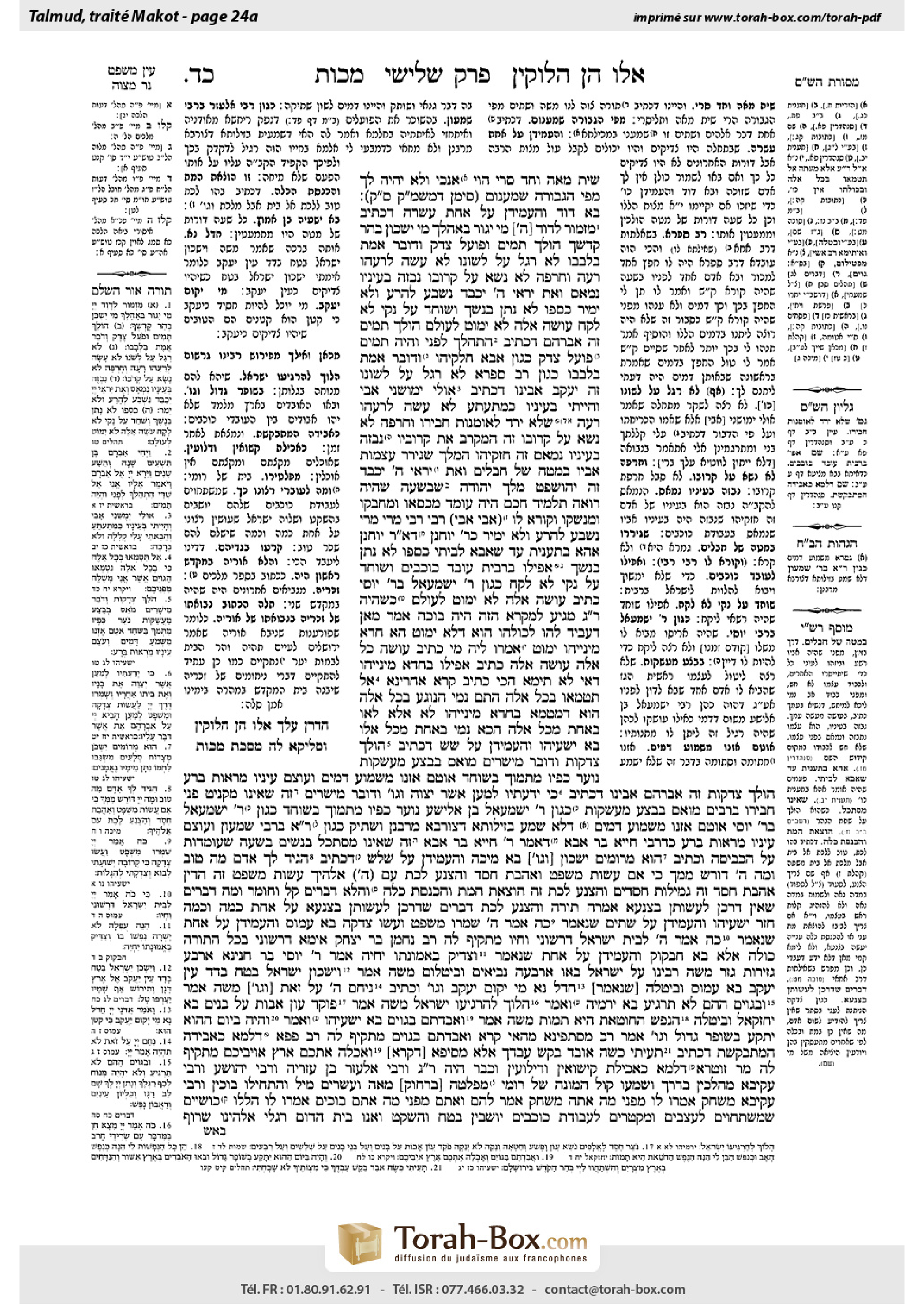
Makkot 24a: Talmud study for Daf Yomi
Daf Yomi is the daily study of one Talmud folio. Explore 37 tractates with scans, Hebrew text, Sefaria English and AI-generated French translations where annotated.
Passage selection and English or AI-generated French translation are available where the scan has annotations. Daf Study is independent of Torah-Box and Sefaria.
Browse Makkot · מכות · All tractatesMakkot 24a text and translations
This page of Makkot includes the Aramaic text, an English translation and an AI-generated French translation, alongside the scan above.
מכות כ״ד א · Aramaic and Hebrew text
שֵׁית מְאָה וְחַד סְרֵי הָוֵי, ״אָנֹכִי״ וְ״לֹא יִהְיֶה לְךָ״ – מִפִּי הַגְּבוּרָה שְׁמַעְנוּם.
(סימן דמשמק סק).
בָּא דָּוִד וְהֶעֱמִידָן עַל אַחַת עֶשְׂרֵה, דִּכְתִיב ״מִזְמוֹר לְדָוִד [ה׳] מִי יָגוּר בְּאׇהֳלֶךָ מִי יִשְׁכֹּן בְּהַר קׇדְשֶׁךָ. הוֹלֵךְ תָּמִים וּפוֹעֵל צֶדֶק וְדֹבֵר אֱמֶת בִּלְבָבוֹ, לֹא רָגַל עַל לְשֹׁנוֹ לֹא עָשָׂה לְרֵעֵהוּ רָעָה וְחֶרְפָּה לֹא נָשָׂא עַל קְרֹבוֹ. נִבְזֶה בְּעֵינָיו נִמְאָס וְאֶת יִרְאֵי ה׳ יְכַבֵּד נִשְׁבַּע לְהָרַע וְלֹא יָמִר. כַּסְפּוֹ לֹא נָתַן בְּנֶשֶׁךְ וְשֹׁחַד עַל נָקִי לֹא לָקָח עֹשֵׂה אֵלֶּה לֹא יִמּוֹט לְעוֹלָם״.
״הוֹלֵךְ תָּמִים״ – זֶה אַבְרָהָם, דִּכְתִיב ״הִתְהַלֵּךְ לְפָנַי וֶהְיֵה תָמִים״.
״פּוֹעֵל צֶדֶק״ – כְּגוֹן אַבָּא חִלְקִיָּהוּ.
״וְדוֹבֵר אֱמֶת בִּלְבָבוֹ״ – כְּגוֹן רַב סָפְרָא.
״לֹא רָגַל עַל לְשֹׁנוֹ״ – זֶה יַעֲקֹב אָבִינוּ, דִּכְתִיב ״אוּלַי יְמֻשֵּׁנִי אָבִי וְהָיִיתִי בְעֵינָיו כִּמְתַעְתֵּעַ״.
״לֹא עָשָׂה לְרֵעֵהוּ רָעָה״ – שֶׁלֹּא יָרַד לְאוּמָּנוּת חֲבֵירוֹ.
״וְחֶרְפָּה לֹא נָשָׂא עַל קְרֹבוֹ״ – זֶה הַמְקָרֵב אֶת קְרוֹבָיו.
״נִבְזֶה בְּעֵינָיו נִמְאָס״ – זֶה חִזְקִיָּהוּ הַמֶּלֶךְ, שֶׁגֵּירַר עַצְמוֹת אָבִיו בְּמִטָּה שֶׁל חֲבָלִים.
״וְאֶת יִרְאֵי ה׳ יְכַבֵּד״ – זֶה יְהוֹשָׁפָט מֶלֶךְ יְהוּדָה, שֶׁבְּשָׁעָה שֶׁהָיָה רוֹאֶה תַּלְמִיד חָכָם הָיָה עוֹמֵד מִכִּסְּאוֹ וּמְחַבְּקוֹ וּמְנַשְּׁקוֹ וְקוֹרֵא לוֹ ״אָבִי אָבִי, רַבִּי רַבִּי, מָרִי מָרִי״.
״נִשְׁבַּע לְהָרַע וְלֹא יָמִר״ – כְּרַבִּי יוֹחָנָן, דְּאָמַר רַבִּי יוֹחָנָן: אֱהֵא בְּתַעֲנִית עַד שֶׁאָבֹא לְבֵיתִי.
״כַּסְפּוֹ לֹא נָתַן בְּנֶשֶׁךְ״ – אֲפִילּוּ (בְּ)רִבִּית גּוֹי.
״וְשֹׁחַד עַל נָקִי לֹא לָקָח״ – כְּגוֹן רַבִּי יִשְׁמָעֵאל בְּרַבִּי יוֹסֵי.
כְּתִיב ״עֹשֵׂה אֵלֶּה לֹא יִמּוֹט לְעוֹלָם״ – כְּשֶׁהָיָה רַבָּן גַּמְלִיאֵל מַגִּיעַ לְמִקְרָא הַזֶּה הָיָה בּוֹכֶה, אֲמַר: מַאן דְּעָבֵיד לְהוּ לְכוּלְּהוּ – הוּא דְּלָא יִמּוֹט, הָא חֲדָא מִינַּיְיהוּ – יִמּוֹט.
אֲמַרוּ לֵיהּ: מִי כְּתִיב ״עֹשֵׂה כׇּל אֵלֶּה״? ״עֹשֵׂה אֵלֶּה״ כְּתִיב, אֲפִילּוּ בַּחֲדָא מִינַּיְיהוּ. דְּאִי לָא תֵּימָא הָכִי, כְּתִיב קְרָא אַחֲרִינָא ״אַל תִּטַּמְּאוּ בְּכׇל אֵלֶּה״, הָתָם נָמֵי, הַנּוֹגֵעַ בְּכׇל אֵלֶּה – הוּא דְּמִטַּמֵּא, בַּחֲדָא מִינַּיְיהוּ – לָא? אֶלָּא לָאו בְּאַחַת מִכׇּל אֵלֶּה, הָכָא נָמֵי בְּאַחַת מִכׇּל אֵלּוּ.
בָּא יְשַׁעְיָהוּ וְהֶעֱמִידָן עַל שֵׁשׁ, דִּכְתִיב ״הֹלֵךְ צְדָקוֹת וְדֹבֵר מֵישָׁרִים מֹאֵס בְּבֶצַע מַעֲשַׁקּוֹת נֹעֵר כַּפָּיו מִתְּמֹךְ בַּשֹּׁחַד אֹטֵם אׇזְנוֹ מִשְּׁמֹעַ דָּמִים וְעֹצֵם עֵינָיו מֵרְאוֹת בְּרָע״.
״הֹלֵךְ צְדָקוֹת״ – זֶה אַבְרָהָם אָבִינוּ, דִּכְתִיב ״כִּי יְדַעְתִּיו לְמַעַן אֲשֶׁר יְצַוֶּה וְגוֹ׳״.
״וְדֹבֵר מֵישָׁרִים״ – זֶה שֶׁאֵינוֹ מַקְנִיט פְּנֵי חֲבֵירוֹ בָּרַבִּים.
״מֹאֵס בְּבֶצַע מַעֲשַׁקּוֹת״ – כְּגוֹן רַבִּי יִשְׁמָעֵאל בֶּן אֱלִישָׁע.
״נֹעֵר כַּפָּיו מִתְּמֹךְ בַּשֹּׁחַד״ – כְּגוֹן רַבִּי יִשְׁמָעֵאל בְּרַבִּי יוֹסֵי.
״אֹטֵם אׇזְנוֹ מִשְּׁמֹעַ דָּמִים״ – דְּלָא שָׁמַע בְּזִילוּתָא דְּצוּרְבָּא מֵרַבָּנַן וְשָׁתֵיק, כְּגוֹן רַבִּי אֶלְעָזָר בְּרַבִּי שִׁמְעוֹן.
״וְעֹצֵם עֵינָיו מֵרְאוֹת בְּרָע״ – כְּרַבִּי חִיָּיא בַּר אַבָּא, דְּאָמַר רַבִּי חִיָּיא בַּר אַבָּא: זֶה שֶׁאֵינוֹ מִסְתַּכֵּל בְּנָשִׁים בְּשָׁעָה שֶׁעוֹמְדוֹת עַל הַכְּבִיסָה.
וּכְתִיב: ״הוּא מְרוֹמִים יִשְׁכּוֹן״.
בָּא מִיכָה וְהֶעֱמִידָן עַל שָׁלֹשׁ, דִּכְתִיב ״הִגִּיד לְךָ אָדָם מַה טּוֹב וּמָה ה׳ דּוֹרֵשׁ מִמְּךָ כִּי אִם עֲשׂוֹת מִשְׁפָּט וְאַהֲבַת חֶסֶד וְהַצְנֵעַ לֶכֶת עִם (ה׳) אֱלֹהֶיךָ״.
״עֲשׂוֹת מִשְׁפָּט״ – זֶה הַדִּין. ״אַהֲבַת חֶסֶד״ – זֶה גְּמִילוּת חֲסָדִים. ״וְהַצְנֵעַ לֶכֶת״ – זֶה הוֹצָאַת הַמֵּת וְהַכְנָסַת כַּלָּה. וַהֲלֹא דְּבָרִים קַל וָחוֹמֶר: וּמָה דְּבָרִים שֶׁאֵין דַּרְכָּן לַעֲשׂוֹתָן בְּצִנְעָא, אָמְרָה תּוֹרָה ״וְהַצְנֵעַ לֶכֶת״, דְּבָרִים שֶׁדַּרְכָּם לַעֲשׂוֹתָם בְּצִנְעָא – עַל אַחַת כַּמָּה וְכַמָּה!
חָזַר יְשַׁעְיָהוּ וְהֶעֱמִידָן עַל שְׁתַּיִם, שֶׁנֶּאֱמַר ״כֹּה אָמַר ה׳ שִׁמְרוּ מִשְׁפָּט וַעֲשׂוּ צְדָקָה״. בָּא עָמוֹס וְהֶעֱמִידָן עַל אַחַת, שֶׁנֶּאֱמַר ״כֹּה אָמַר ה׳ לְבֵית יִשְׂרָאֵל דִּרְשׁוּנִי וִחְיוּ״. מַתְקֵיף לַהּ רַב נַחְמָן בַּר יִצְחָק: אֵימָא דִּרְשׁוּנִי בְּכׇל הַתּוֹרָה! אֶלָּא: בָּא חֲבַקּוּק וְהֶעֱמִידָן עַל אַחַת, שֶׁנֶּאֱמַר ״וְצַדִּיק בֶּאֱמוּנָתוֹ יִחְיֶה״.
אָמַר רַבִּי יוֹסֵי בַּר חֲנִינָא: אַרְבַּע גְּזֵירוֹת גָּזַר מֹשֶׁה רַבֵּינוּ עַל יִשְׂרָאֵל, בָּאוּ אַרְבָּעָה נְבִיאִים וּבִיטְּלוּם. מֹשֶׁה אָמַר: ״וַיִּשְׁכֹּן יִשְׂרָאֵל בֶּטַח בָּדָד עֵין יַעֲקֹב״, בָּא עָמוֹס וּבִיטְּלָהּ, [שֶׁנֶּאֱמַר]: ״חֲדַל נָא מִי יָקוּם יַעֲקֹב וְגוֹ׳״ וּכְתִיב ״נִחַם ה׳ עַל זֹאת״.
מֹשֶׁה אָמַר: ״וּבַגּוֹיִם הָהֵם לֹא תַרְגִּיעַ״, בָּא יִרְמְיָה וְאָמַר: ״הָלוֹךְ לְהַרְגִּיעוֹ יִשְׂרָאֵל״.
מֹשֶׁה אָמַר: ״פֹּקֵד עֲוֹן אָבוֹת עַל בָּנִים״, בָּא יְחֶזְקֵאל וּבִיטְּלָהּ: ״הַנֶּפֶשׁ הַחֹטֵאת הִיא תָמוּת״.
מֹשֶׁה אָמַר ״וַאֲבַדְתֶּם בַּגּוֹיִם״, בָּא יְשַׁעְיָהוּ וְאָמַר: ״וְהָיָה בַּיּוֹם הַהוּא יִתָּקַע בְּשׁוֹפָר גָּדוֹל״.
אָמַר רַב: מִסְתְּפֵינָא מֵהַאי קְרָא ״וַאֲבַדְתֶּם בַּגּוֹיִם״. מַתְקֵיף לַהּ רַב פָּפָּא: דִּלְמָא כַּאֲבֵידָה הַמִּתְבַּקֶּשֶׁת, דִּכְתִיב ״תָּעִיתִי כְּשֶׂה אֹבֵד בַּקֵּשׁ עַבְדֶּךָ״! אֶלָּא מִסֵּיפָא [דִּקְרָא], ״וְאָכְלָה אֶתְכֶם אֶרֶץ אֹיְבֵיכֶם״. מַתְקֵיף לַהּ מָר זוּטְרָא: דִּלְמָא כַּאֲכִילַת קִישּׁוּאִין וְדִילּוּעִין.
וּכְבָר הָיָה רַבָּן גַּמְלִיאֵל וְרַבִּי אֶלְעָזָר בֶּן עֲזַרְיָה וְרַבִּי יְהוֹשֻׁעַ וְרַבִּי עֲקִיבָא מְהַלְּכִין בַּדֶּרֶךְ, וְשָׁמְעוּ קוֹל הֲמוֹנָהּ שֶׁל רוֹמִי מִפְּלָטָהּ [בְּרָחוֹק] מֵאָה וְעֶשְׂרִים מִיל, וְהִתְחִילוּ בּוֹכִין, וְרַבִּי עֲקִיבָא מְשַׂחֵק. אָמְרוּ לוֹ: מִפְּנֵי מָה אַתָּה מְשַׂחֵק? אָמַר לָהֶם: וְאַתֶּם מִפְּנֵי מָה אַתֶּם בּוֹכִים? אָמְרוּ לוֹ: הַלָּלוּ גּוֹיִם שֶׁמִּשְׁתַּחֲוִים לַעֲצַבִּים וּמְקַטְּרִים לַעֲבוֹדָה זָרָה יוֹשְׁבִין בֶּטַח וְהַשְׁקֵט, וְאָנוּ, בֵּית הֲדוֹם רַגְלֵי אֱלֹהֵינוּ שָׂרוּף
Makkot 24a · English translation
is 611, the number of mitzvot that were received and taught by Moses our teacher. In addition, there are two mitzvot: “I am the Lord your God” and: “You shall have no other gods” (Exodus 20:2, 3), the first two of the Ten Commandments, that we heard from the mouth of the Almighty, for a total of 613.
The Gemara provides a mnemonic for the biblical figures cited in the course of the discussion that follows: Dalet, mem, shin, mem, kuf; samekh, kuf; representing David, Micah, Isaiah, Amos, Habakkuk, Amos, and Ezekiel.
Rabbi Simlai continued: King David came and established the 613 mitzvot upon eleven mitzvot, as it is written: “A Psalm of David. Lord, who shall sojourn in Your Tabernacle? Who shall dwell upon Your sacred mountain? He who walks wholeheartedly, and works righteousness, and speaks truth in his heart. Who has no slander upon his tongue, nor does evil to his neighbor, nor takes up reproach against his relative. In whose eyes a vile person is despised, and he honors those who fear the Lord; he takes an oath to his own detriment, and changes not. He neither gives his money with interest, nor takes a bribe against the innocent. He who performs these shall never be moved” (Psalms, chapter 15). Eleven attributes that facilitate one’s entry into the World-to-Come appear on this list.
The Gemara analyzes these verses: “He who walks wholeheartedly”; this is referring to one who conducts himself like our forefather Abraham, as it is written concerning him: “Walk before Me and be wholehearted” (Genesis 17:1).
“Works righteousness”; this is referring to one such as Abba Ḥilkiyyahu, a laborer who would not pause from his labor even to greet people; he righteously continued working.
“And speaks truth in his heart”; this is referring to one such as Rav Safra, who was reciting Shema when a person approached him to purchase an item. He intended to accept the man’s offer, but he was unable to respond because it is prohibited to interrupt the recitation of Shema. The buyer misinterpreted Rav Safra’s silence and concluded that Rav Safra demanded a higher price, so he raised his offer. Rav Safra insisted on selling him the item for the sum that he was offered initially.
“Who has no slander upon his tongue”; this is referring to one who conducts himself like our forefather Jacob, who did not want to mislead his father in order to receive his blessings, as it is written: “Perhaps my father will feel me, and I will be in his eyes like a fraud” (Genesis 27:12).
“Nor does evil to his neighbor”; this is referring to one who did not infringe upon another’s trade, constituting illegal competition.
“Nor takes up reproach against his relative”; this is referring to one who draws his relatives near, and does not distance them when they embarrass him.
“In whose eyes a vile person is despised”; this is referring to one who conducts himself like King Hezekiah, who dragged the bones of his evil father, King Ahaz, in a bed of ropes, because he despised those considered vile by God.
“And he honors those who fear the Lord”; this is referring to one who conducts himself like Jehoshaphat, king of Judea, who when he would see a Torah scholar would arise from his throne and hug him and kiss him, and call him: My father, my father, my teacher, my teacher, my master, my master.
“He takes an oath to his own detriment, and changes not”; this is in accordance with the conduct of Rabbi Yoḥanan, as Rabbi Yoḥanan would say in the form of a vow when seeking to refrain from eating in another’s home: I shall fast until I will come to my house. He would fulfill that vow and refrain from eating, even though he took the vow only to avoid eating in that place.
“He neither gives his money with interest”; meaning he does not lend money with interest even to a gentile, which is permitted by Torah law.
“Nor takes a bribe against the innocent”; this is referring to one such as Rabbi Yishmael, son of Rabbi Yosei, who refused to sit in judgment in a case involving his sharecropper. Since the latter would bring him a basket of fruit, he was concerned that he might unconsciously favor him.
At the conclusion of the verses, it is written: “He who performs these shall never be moved.” The Gemara relates: When Rabban Gamliel would reach this verse he would cry, and he said: It is one who performed all these actions who shall never be moved; but if he performed only one of them, he shall be moved.
The Sages said to him: Is it written: He who performs all these? Rather, the phrase “he who performs these” is written, indicating that one is blessed even in a case where he performed one of them. As if you do not say so, compare that to a different verse that is written with regard to severe transgressions punishable by karet: “Do not impurify yourselves with all these” (Leviticus 18:24). Would you say that there too it means that it is one who comes into contact with all these who becomes impure, but one who comes into contact with one of these, no, he does not become impure? Rather, is it not that the phrase “with all these” means: With one of all these? Here too it means that one who performs one of all these has a place in the World-to-Come.
Rabbi Simlai’s exposition continues: Isaiah came and established the 613 mitzvot upon six, as it is written: “He who walks righteously, and speaks uprightly; he who despises the gain of oppressions, who shakes his hands from holding of bribes, who stops his ears from hearing blood, and shuts his eyes from looking upon evil” (Isaiah 33:15).
The Gemara elaborates: “He who walks righteously”; this is referring to one who conducts himself like our forefather Abraham, as it is written concerning him: “For I have known him, that he will command his children…to perform righteousness and justice” (Genesis 18:19).
“And speaks uprightly”; this is referring to one who does not shame another in public.
“He who despises the gain of oppressions”; this is referring to one such as Rabbi Yishmael ben Elisha, who refused to sit in judgment in a case involving one who gave him priestly gifts, to avoid the appearance of impropriety.
“Who shakes his hands from holding of bribes”; this is referring to one such as Rabbi Yishmael, son of Rabbi Yosei, who, as explained above, refused to sit in judgment in a case involving his sharecropper.
“Who stops his ears from hearing blood”; this is referring to one who would not hear derision of a Torah scholar and remain silent, such as Rabbi Elazar, son of Rabbi Shimon, who was well known for this.
“And shuts his eyes from looking upon evil” is to be understood in accordance with the statement of Rabbi Ḥiyya bar Abba, as Rabbi Ḥiyya bar Abba says: This is referring to one who does not look at women when they stand over the laundry at the river. The women would lift the garments they were wearing to keep them out of the water, and thereby expose part of their bodies.
And it is written with regard to one who performs these matters: “He shall dwell on high; his fortress shall be the munitions of rocks; his bread shall be given, his waters shall be sure” (Isaiah 33:16).
Micah came and established the 613 mitzvot upon three, as it is written: “It has been told to you, O man, what is good, and what the Lord does require of you; only to do justly, and to love mercy, and to walk humbly with your God” (Micah 6:8).
The Gemara elaborates: “To do justly,” this is justice; “to love mercy,” this is an allusion to acts of loving-kindness; “and to walk humbly with your God,” this is an allusion to taking the indigent dead out for burial and accompanying a poor bride to her wedding canopy, both of which are to be performed without fanfare glorifying the doer. The Gemara notes: And are these matters not inferred a fortiori? If, with regard to matters that tend to be conducted in public, e.g., funerals and weddings, the Torah states “walk humbly” when doing them, then in matters that tend to be conducted in private, e.g., charity and Torah study, all the more so should they be conducted in private.
Isaiah then established the 613 mitzvot upon two, as it is stated: “So says the Lord: Observe justice and perform righteousness” (Isaiah 56:1). Amos came and established the 613 mitzvot upon one, as it is stated: “So says the Lord to the house of Israel: Seek Me and live” (Amos 5:4). Rav Naḥman bar Yitzḥak objects to this: There is no proof that the verse in Amos is establishing all the mitzvot upon one; say that Amos is saying: Seek Me throughout the entire Torah, as the verse does not specify the manner in which one should seek the Lord. Rather, say: Habakkuk came and established the 613 mitzvot upon one, as it is stated: “But the righteous person shall live by his faith” (Habakkuk 2:4).
§ Rabbi Yosei bar Ḥanina says: Moses our teacher issued four decrees upon the Jewish people, and four prophets came and revoked them. Moses said: “And Israel dwells in safety, the fountain [ein] of Jacob alone” (Deuteronomy 33:28), indicating that the Jewish people will dwell in safety only when they reach a lofty spiritual level similar to [me’ein] that of Jacob our forefather. Amos came and revoked it, as it is stated: “Lord God, cease, I beseech You; how shall Jacob stand, as he is small” (Amos 7:5), and immediately afterward it states: “The Lord regretted this; it too shall not be, says the Lord God” (Amos 7:6).
Moses said: “And among these nations you shall have no repose” (Deuteronomy 28:65). Jeremiah came and revoked it, and said: “Even Israel, when I go to cause him to rest” (Jeremiah 31:1), indicating that the Jewish people will find rest even in exile.
Moses said: “He visits the transgression of the fathers upon the sons” (Exodus 34:7). Ezekiel came and revoked it: “The soul that sins, it shall die” (Ezekiel 18:4), and not the children of that soul.
Moses said: “And you shall be lost among the nations” (Leviticus 26:38). Isaiah came and revoked it, and said: “And it shall be on that day the great shofar shall be sounded, and those lost in the land of Assyria shall come” (Isaiah 27:13).
Rav says: I am afraid of that verse: “And you shall be lost among the nations.” Rav Pappa objects to this: Perhaps it means that the Jewish people will be like a lost item that is sought by its owner, and God will restore those lost in exile, as it is written: “I have gone astray like a lost lamb; seek Your servant” (Psalms 119:176). Rather, Rav was afraid from that which is written in the latter portion of that verse, where it is written: “And the land of your enemies shall consume you.” Mar Zutra objects to this: Perhaps it means like the consumption of cucumbers and gourds, which are not consumed in their entirety. Some is left over, from which additional plants can grow.
§ Apropos tribulations of exile and hope for redemption, the Gemara relates: And it once was that Rabban Gamliel, Rabbi Elazar ben Azarya, Rabbi Yehoshua, and Rabbi Akiva were walking along the road in the Roman Empire, and they heard the sound of the multitudes of Rome from Puteoli at a distance of one hundred and twenty mil. The city was so large that they were able to hear its tumult from a great distance. And the other Sages began weeping and Rabbi Akiva was laughing. They said to him: For what reason are you laughing? Rabbi Akiva said to them: And you, for what reason are you weeping? They said to him: These gentiles, who bow to false gods and burn incense to idols, dwell securely and tranquilly in this colossal city, and for us, the House of the footstool of our God, the Temple, is burnt
Makkot 24a · Traduction française (IA)
est 611, le nombre de mitsvot que Moïse notre maître a reçues et enseignées. À celles-ci s’ajoutent deux mitsvot, « Je suis le Seigneur ton Dieu » et « Tu n’auras pas d’autres dieux » (Exode 20, 2-3), les deux premiers commandements des Dix Commandements, que nous avons entendus de la bouche du Tout-Puissant, soit un total de 613.
La Guemara donne un moyen mnémotechnique pour retenir les personnages bibliques cités dans la discussion qui suit : dalet, mem, shin, mem, qof ; samekh, qof, qui renvoient à David, Michée, Isaïe, Amos, Habacuc, Amos et Ézéchiel.
Rabbi Simlaï poursuivit : Le roi David ramena les 613 mitsvot à onze, ainsi qu’il est écrit : « Psaume de David. Seigneur, qui séjournera dans Ta tente ? Qui demeurera sur Ta montagne sainte ? Celui qui marche avec intégrité, pratique la justice et dit la vérité dans son cœur. Celui qui n’a pas de calomnie sur la langue, ne fait pas de mal à son prochain et ne jette pas l’opprobre sur son proche. Celui qui méprise l’homme vil à ses yeux et honore ceux qui craignent le Seigneur ; il prête serment à son propre détriment et ne revient pas sur sa parole. Il ne prête pas son argent à intérêt et n’accepte pas de pot-de-vin contre l’innocent. Celui qui agit ainsi ne vacillera jamais » (Psaumes, chapitre 15). Cette liste énumère onze qualités qui facilitent l’accès au monde à venir.
La Guemara analyse ces versets : « Celui qui marche avec intégrité » désigne celui qui se conduit comme notre ancêtre Abraham, à propos duquel il est écrit : « Marche devant Moi et sois intègre » (Genèse 17, 1).
« Pratique la justice » désigne quelqu’un comme Abba Ḥilkiyyahu, un ouvrier qui n’interrompait pas son travail, même pour saluer les gens ; il continuait à travailler avec droiture.
« Et dit la vérité dans son cœur » désigne quelqu’un comme Rav Safra, qui récitait le Chéma lorsqu’un homme s’approcha pour lui acheter un objet. Il avait l’intention d’accepter l’offre de l’homme, mais ne pouvait pas répondre, car il est interdit d’interrompre la récitation du Chéma. L’acheteur interpréta mal le silence de Rav Safra et conclut que celui-ci demandait un prix plus élevé ; il augmenta donc son offre. Rav Safra insista pour lui vendre l’objet au prix qui lui avait été proposé initialement.
« Celui qui n’a pas de calomnie sur la langue » désigne celui qui se conduit comme notre ancêtre Jacob, qui ne voulait pas tromper son père afin de recevoir sa bénédiction, ainsi qu’il est écrit : « Peut-être mon père me touchera-t-il, et je serai à ses yeux comme un imposteur » (Genèse 27, 12).
« Ne fait pas de mal à son prochain » désigne celui qui ne porte pas atteinte au commerce d’autrui, ce qui constituerait une concurrence déloyale.
« Et ne jette pas l’opprobre sur son proche » désigne celui qui rapproche ses proches et ne les repousse pas lorsqu’ils l’humilient.
« Celui qui méprise l’homme vil à ses yeux » désigne celui qui se conduit comme le roi Ézéchias, qui fit traîner les os de son mauvais père, le roi Achaz, sur un lit de cordes, car il méprisait ceux que Dieu considère comme vils.
« Et honore ceux qui craignent le Seigneur » désigne celui qui se conduit comme Josaphat, roi de Judée. Lorsqu’il voyait un érudit en Torah, il se levait de son trône, l’embrassait et l’enlaçait, et l’appelait : « Mon père, mon père ; mon maître, mon maître ; mon maître, mon maître. »
« Il prête serment à son propre détriment et ne revient pas sur sa parole » correspond à la conduite de Rabbi Yoḥanan. Lorsqu’il voulait s’abstenir de manger chez quelqu’un, Rabbi Yoḥanan formulait sa résolution sous la forme d’un vœu : « Je jeûnerai jusqu’à ce que je rentre chez moi. » Il respectait ce vœu et s’abstenait de manger, bien qu’il l’ait prononcé uniquement pour éviter de manger à cet endroit.
« Il ne prête pas son argent à intérêt » signifie qu’il ne prête pas d’argent à intérêt, même à un non-Juif, bien que la Torah l’autorise.
« Et n’accepte pas de pot-de-vin contre l’innocent » désigne quelqu’un comme Rabbi Yishmaël, fils de Rabbi Yosei, qui refusa de siéger comme juge dans une affaire concernant son métayer. Comme celui-ci lui apportait un panier de fruits, Rabbi Yishmaël craignait que cela ne le conduise, sans qu’il en ait conscience, à le favoriser.
À la fin des versets, il est écrit : « Celui qui agit ainsi ne vacillera jamais. » La Guemara rapporte que, lorsque Rabban Gamliel arrivait à ce verset, il pleurait et disait : « Seul celui qui accomplit toutes ces actions ne vacillera jamais ; mais s’il n’en accomplit qu’une seule, il vacillera. »
Les Sages lui dirent : « Est-il écrit : “Celui qui accomplit toutes ces actions” ? » Il est écrit plutôt : « Celui qui accomplit ces actions », ce qui indique que l’on est béni même si l’on n’en accomplit qu’une seule. Car, si tu ne l’admets pas, compare avec un autre verset qui concerne de graves transgressions passibles de retranchement : « Ne vous rendez pas impurs par toutes ces choses » (Lévitique 18, 24). Dirais-tu là aussi que seuls ceux qui entrent en contact avec toutes ces choses deviennent impurs, mais que celui qui entre en contact avec l’une d’elles ne devient pas impur ? N’est-ce pas plutôt que l’expression « par toutes ces choses » signifie : par l’une quelconque d’entre elles ? Ici aussi, cela signifie que celui qui accomplit l’une de ces actions a sa place dans le monde à venir.
L’interprétation de Rabbi Simlaï se poursuit : Isaïe ramena les 613 mitsvot à six, ainsi qu’il est écrit : « Celui qui marche dans la justice et parle avec droiture ; celui qui méprise le gain de l’oppression, qui secoue ses mains pour ne pas accepter de pot-de-vin, qui bouche ses oreilles pour ne pas entendre parler de sang et ferme ses yeux pour ne pas regarder le mal » (Isaïe 33, 15).
La Guemara développe : « Celui qui marche dans la justice » désigne celui qui se conduit comme notre ancêtre Abraham, à propos duquel il est écrit : « Car Je l’ai connu, afin qu’il ordonne à ses enfants […] de pratiquer la justice et le droit » (Genèse 18, 19).
« Et parle avec droiture » désigne celui qui n’humilie pas autrui en public.
« Celui qui méprise le gain de l’oppression » désigne quelqu’un comme Rabbi Yishmaël ben Elisha, qui refusa de siéger comme juge dans une affaire concernant une personne qui lui avait donné des dons sacerdotaux, afin d’éviter toute apparence de comportement inconvenant.
« Qui secoue ses mains pour ne pas accepter de pot-de-vin » désigne quelqu’un comme Rabbi Yishmaël, fils de Rabbi Yosei, qui, comme il a été expliqué plus haut, refusa de siéger comme juge dans une affaire concernant son métayer.
« Qui bouche ses oreilles pour ne pas entendre parler de sang » désigne celui qui ne tolère pas d’entendre dénigrer un érudit en Torah sans réagir, comme Rabbi Elazar, fils de Rabbi Shimon, qui était connu pour cela.
« Et ferme ses yeux pour ne pas regarder le mal » s’interprète selon la déclaration de Rabbi Ḥiyya bar Abba, car Rabbi Ḥiyya bar Abba dit : « Cela désigne celui qui ne regarde pas les femmes lorsqu’elles se tiennent au bord de la rivière pour laver le linge. » Les femmes relevaient les vêtements qu’elles portaient pour les empêcher de tremper dans l’eau, exposant ainsi une partie de leur corps.
Et il est écrit au sujet de celui qui accomplit ces choses : « Il demeurera sur les hauteurs ; sa forteresse sera faite de rochers ; son pain lui sera donné, ses eaux lui seront assurées » (Isaïe 33, 16).
Michée ramena les 613 mitsvot à trois, ainsi qu’il est écrit : « On t’a dit, ô homme, ce qui est bon et ce que le Seigneur exige de toi : rien d’autre que de pratiquer la justice, d’aimer la bonté et de marcher humblement avec ton Dieu » (Michée 6, 8).
La Guemara développe : « Pratiquer la justice » désigne la justice ; « aimer la bonté » fait allusion aux actes de bienveillance ; « et marcher humblement avec ton Dieu » fait allusion au fait de conduire les morts indigents à leur sépulture et d’accompagner une mariée pauvre jusqu’au dais nuptial, deux actes qui doivent être accomplis sans faste ni mise en valeur de celui qui les accomplit. La Guemara fait remarquer : ces principes ne se déduisent-ils pas a fortiori ? Si, pour des actes qui ont tendance à se dérouler en public, comme les funérailles et les mariages, la Torah dit de « marcher humblement » lorsqu’on les accomplit, alors, à plus forte raison, les actes qui ont tendance à se dérouler en privé, comme la charité et l’étude de la Torah, doivent-ils être accomplis en privé.
Isaïe ramena ensuite les 613 mitsvot à deux, ainsi qu’il est dit : « Ainsi parle le Seigneur : observez le droit et pratiquez la justice » (Isaïe 56, 1). Amos ramena les 613 mitsvot à une seule, ainsi qu’il est dit : « Ainsi parle le Seigneur à la maison d’Israël : cherchez-Moi et vous vivrez » (Amos 5, 4). Rav Naḥman bar Yitzḥak objecte : « Rien ne prouve que le verset d’Amos ramène toutes les mitsvot à une seule ; dis plutôt qu’Amos dit : “Cherchez-Moi dans toute la Torah”, puisque le verset ne précise pas de quelle manière il faut chercher le Seigneur. » Il faut plutôt dire : Habacuc vint et ramena les 613 mitsvot à une seule, ainsi qu’il est dit : « Le juste vivra par sa foi » (Habacuc 2, 4).
§ Rabbi Yosei bar Ḥanina dit : « Moïse notre maître prononça quatre décrets contre le peuple juif, et quatre prophètes vinrent les annuler. » Moïse dit : « Et Israël demeure en sécurité, la source [ein] de Jacob à part » (Deutéronome 33, 28), indiquant que le peuple juif ne demeurera en sécurité que lorsqu’il atteindra un niveau spirituel élevé semblable [me’ein] à celui de Jacob notre ancêtre. Amos vint et annula ce décret, ainsi qu’il est dit : « Seigneur Dieu, je T’en prie, cesse ; comment Jacob pourra-t-il tenir ? Il est si petit ! » (Amos 7, 5). Et immédiatement après, il est écrit : « Le Seigneur se repentit de cela ; cela aussi n’aura pas lieu, dit le Seigneur Dieu » (Amos 7, 6).
Moïse dit : « Parmi ces nations, tu ne trouveras aucun repos » (Deutéronome 28, 65). Jérémie vint et annula ce décret, disant : « Israël aussi, lorsque Je le ferai reposer » (Jérémie 31, 1), ce qui indique que le peuple juif trouvera le repos même en exil.
Moïse dit : « Il fait retomber la faute des pères sur les fils » (Exode 34, 7). Ézéchiel vint et annula ce décret : « L’âme qui pèche, c’est elle qui mourra » (Ézéchiel 18, 4), et non les enfants de cette âme.
Moïse dit : « Vous disparaîtrez parmi les nations » (Lévitique 26, 38). Isaïe vint et annula ce décret, disant : « Et en ce jour-là, on sonnera du grand chofar, et ceux qui étaient perdus au pays d’Assyrie viendront » (Isaïe 27, 13).
Rav dit : « Ce verset me fait peur : “Vous disparaîtrez parmi les nations.” » Rav Pappa objecte : « Peut-être cela signifie-t-il que le peuple juif sera comme un objet perdu que son propriétaire recherche et que Dieu ramènera ceux qui sont perdus en exil, ainsi qu’il est écrit : “Je me suis égaré comme un agneau perdu ; cherche Ton serviteur” » (Psaumes 119, 176). Rav craignait plutôt ce qui est écrit dans la suite de ce verset : « Et le pays de vos ennemis vous dévorera. » Mar Zutra objecte : « Peut-être cela signifie-t-il qu’ils seront dévorés comme des concombres et des courges, qui ne sont pas consommés entièrement. Il en reste une partie, d’où peuvent pousser de nouvelles plantes. »
§ À propos des épreuves de l’exil et de l’espoir de la rédemption, la Guemara rapporte : Un jour, Rabban Gamliel, Rabbi Elazar ben Azarya, Rabbi Yehoshua et Rabbi Akiva marchaient sur une route de l’Empire romain lorsqu’ils entendirent au loin le tumulte des foules de Rome, depuis Pouzzoles, à une distance de cent vingt mil. La ville était si grande que l’on pouvait entendre son agitation de très loin. Les autres Sages se mirent à pleurer, tandis que Rabbi Akiva riait. Ils lui dirent : « Pourquoi ris-tu ? » Rabbi Akiva leur dit : « Et vous, pourquoi pleurez-vous ? » Ils lui répondirent : « Ces non-Juifs, qui se prosternent devant de faux dieux et brûlent de l’encens devant des idoles, vivent en sécurité et en toute tranquillité dans cette ville immense, tandis que pour nous, la Maison de l’escabeau de notre Dieu, le Temple, est brûlée
Traduction française générée par IA à partir de l’édition anglaise de Sefaria. Vérifie toujours un passage avec le texte source.
Text from Sefaria: William Davidson Edition - Vocalized Aramaic (CC BY NC); William Davidson Edition - English (CC BY NC).