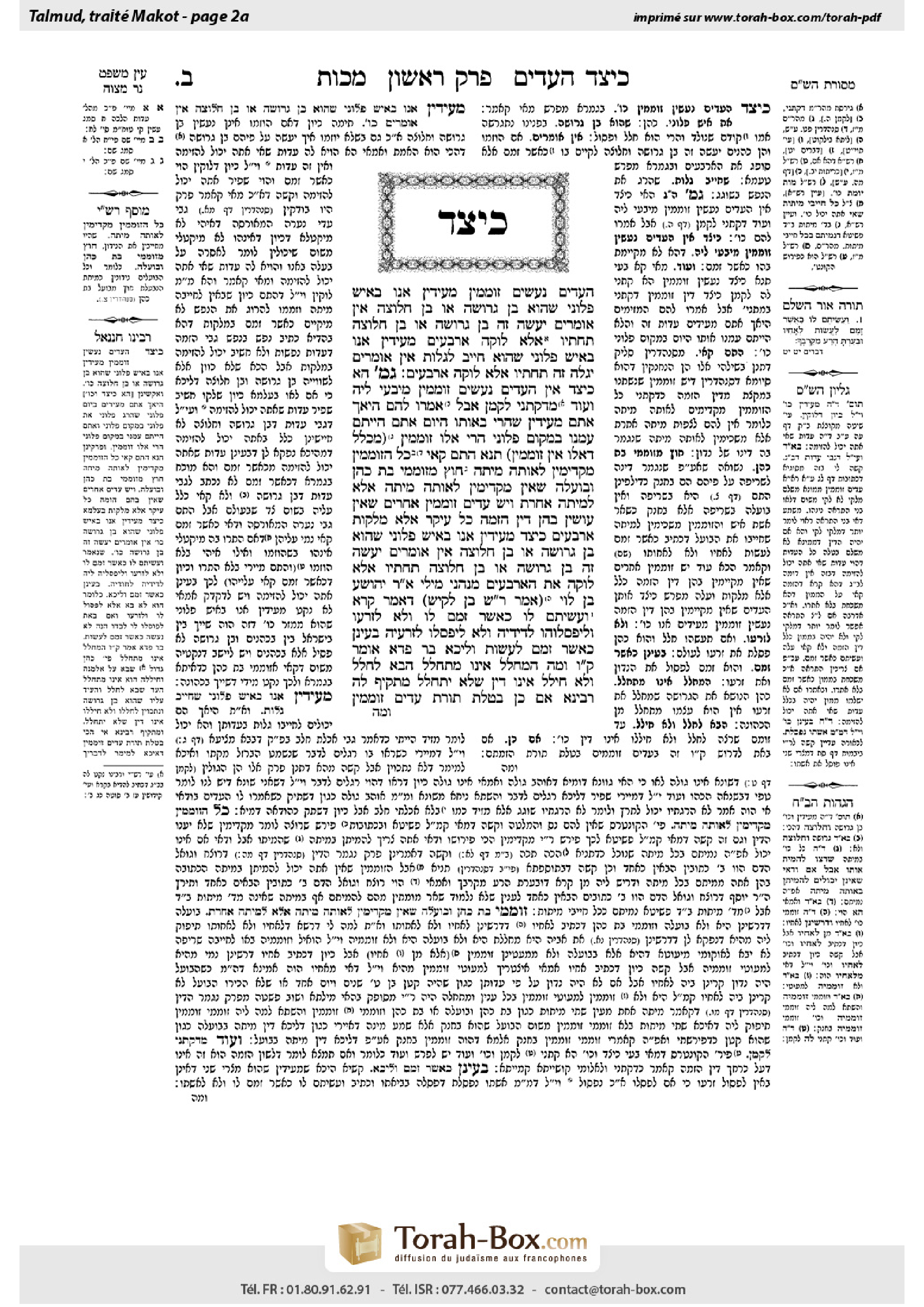
Makkot 2a: Talmud study for Daf Yomi
Daf Yomi is the daily study of one Talmud folio. Explore 37 tractates with scans, Hebrew text, Sefaria English and AI-generated French translations where annotated.
Passage selection and English or AI-generated French translation are available where the scan has annotations. Daf Study is independent of Torah-Box and Sefaria.
Browse Makkot · מכות · All tractatesMakkot 2a text and translations
This page of Makkot includes the Aramaic text, an English translation and an AI-generated French translation, alongside the scan above.
מכות ב׳ א · Aramaic and Hebrew text
מַתְנִי׳ כֵּיצַד הָעֵדִים נַעֲשִׂים זוֹמְמִין? ״מְעִידִין אָנוּ בְּאִישׁ פְּלוֹנִי שֶׁהוּא בֶּן גְּרוּשָׁה אוֹ בֶּן חֲלוּצָה״, אֵין אוֹמְרִים: יֵעָשֶׂה זֶה בֶּן גְּרוּשָׁה אוֹ בֶּן חֲלוּצָה תַּחְתָּיו, אֶלָּא לוֹקֶה אַרְבָּעִים.
״מְעִידִין אָנוּ בְּאִישׁ פְּלוֹנִי שֶׁהוּא חַיָּיב לִגְלוֹת״, אֵין אוֹמְרִים: יִגְלֶה זֶה תַּחְתָּיו, אֶלָּא לוֹקֶה אַרְבָּעִים.
גְּמָ׳ הָא ״כֵּיצַד אֵין הָעֵדִים נַעֲשִׂים זוֹמְמִין״ מִיבְּעֵי לֵיהּ! וְעוֹד, מִדְּקָתָנֵי לְקַמַּן: אֲבָל אָמְרוּ לָהֶם: ״הֵיאַךְ אַתֶּם מְעִידִין, הֲרֵי בְּאוֹתוֹ הַיּוֹם אַתֶּם הֱיִיתֶם עִמָּנוּ בְּמָקוֹם פְּלוֹנִי״ – הֲרֵי אֵלּוּ זוֹמְמִין, מִכְּלָל דְּאֵלּוּ אֵין זוֹמְמִין!
תַּנָּא הָתָם קָאֵי: כׇּל הַזּוֹמְמִין מַקְדִּימִין לְאוֹתָהּ מִיתָה, חוּץ מִזּוֹמְמֵי בַּת כֹּהֵן וּבוֹעֲלָהּ, שֶׁאֵין מַקְדִּימִין לְאוֹתָהּ מִיתָה אֶלָּא לְמִיתָה אַחֶרֶת.
וְיֵשׁ עֵדִים זוֹמְמִין אֲחֵרִים, שֶׁאֵין עוֹשִׂין בָּהֶן דִּין הֲזָמָה כׇּל עִיקָּר, אֶלָּא מַלְקוֹת אַרְבָּעִים, כֵּיצַד? ״מְעִידִין אָנוּ בְּאִישׁ פְּלוֹנִי שֶׁהוּא בֶּן גְּרוּשָׁה אוֹ בֶּן חֲלוּצָה״, אֵין אוֹמְרִים: יֵעָשֶׂה זֶה בֶּן גְּרוּשָׁה אוֹ בֶּן חֲלוּצָה תַּחְתָּיו, אֶלָּא לוֹקֶה אֶת הָאַרְבָּעִים.
מְנָהָנֵי מִילֵּי? אָמַר רַבִּי יְהוֹשֻׁעַ בֶּן לֵוִי אָמַר רַבִּי שִׁמְעוֹן בֶּן לָקִישׁ: דְּאָמַר קְרָא: ״וַעֲשִׂיתֶם לוֹ כַּאֲשֶׁר זָמַם״, ״לוֹ״ – וְלֹא לְזַרְעוֹ. וְלִיפְסְלוּהוּ לְדִידֵיהּ וְלָא לִיפְסְלוּ לְזַרְעֵיהּ! בָּעִינַן ״כַּאֲשֶׁר זָמַם לַעֲשׂוֹת״, וְלֵיכָּא.
בַּר פְּדָא אוֹמֵר: קַל וָחוֹמֶר, וּמָה הַמְחַלֵּל אֵינוֹ מִתְחַלֵּל, הַבָּא לְחַלֵּל וְלֹא חִילֵּל – אֵינוֹ דִּין שֶׁלֹּא יִתְחַלֵּל? מַתְקֵיף לַהּ רָבִינָא: אִם כֵּן בִּטַּלְתָּ תּוֹרַת עֵדִים זוֹמְמִין!
Makkot 2a · English translation
MISHNA: How are witnesses rendered conspiring witnesses? This applies in a case where two witnesses came before the court and said: We testify with regard to so-and-so, who is a priest, that he is the son of a divorced woman or the son of a ḥalutza, a yevama who performed the rite of ḥalitza to free herself from the levirate bond. Those testimonies render him a ḥalal (see Leviticus 21:6–7), one disqualified from the priesthood due to flawed lineage. If a second set of witnesses testifies in court and renders the first set conspiring witnesses, one does not say with regard to each of the conspiring witnesses: This witness shall be rendered the son of a divorced woman or the son of a ḥalutza in his stead. Rather, he receives forty lashes as punishment for his false testimony.
Likewise, in a case where two witnesses came before the court and said: We testify with regard to so-and-so that he is liable to be exiled to a city of refuge for unwittingly killing another (see Numbers 35:11), and a second set of witnesses testifies in court and renders the first set conspiring witnesses, one does not say with regard to each of the conspiring witnesses: This witness shall be exiled in his stead. Rather, he receives forty lashes.
GEMARA: The Gemara analyzes the opening question of the mishna: But based on the cases discussed in the mishna, the tanna should have asked: How are witnesses not rendered conspiring witnesses? The standard punishment for conspiring witnesses is the punishment that they conspired to have inflicted upon the subject of their testimony. The mishna cites anomalous cases where their punishment does not correspond to the punishment they sought to have inflicted. The Gemara asks: And furthermore, from the fact that the tanna teaches in a mishna cited later (5a): But if the second set of witnesses attempting to render the first set conspiring witnesses said to them: How can you testify to that incident when on that day you were with us in such and such place, these first witnesses are conspiring witnesses. One learns by inference from the final phrase in the cited passage: These are conspiring witnesses, that those enumerated in the mishna here are not conspiring witnesses.
The Gemara answers both questions: The tanna is standing there in his studies, at the end of tractate Sanhedrin, which immediately precedes Makkot, and Makkot is often appended to the end of Sanhedrin. The mishna there teaches (89a): All those who are rendered conspiring witnesses are led to be executed with the same mode of execution with which they conspired to have their victim executed, except for conspiring witnesses who testified that the daughter of a priest and her paramour committed adultery, where the daughter of the priest would be executed by burning (see Leviticus 21:9) and her paramour would be executed by strangulation. In that case, they are not taken directly to be executed with the same mode of execution that they sought to have inflicted on the woman; rather, they are executed with a different mode of execution, the one they sought to have inflicted on the paramour.
Therefore, the tanna continues in this first mishna in Makkot: And there are other conspiring witnesses with regard to whom the court does not apply the halakhot governing the punishment in standard cases of conspiring testimony at all, and they do not receive the punishment they sought to have inflicted. Rather, they receive forty lashes. How, and in what cases, is this applied? This is applied in a case where two witnesses came before the court and said: We testify with regard to so-and-so that he is the son of a divorced woman or the son of a ḥalutza, one does not say with regard to each of the conspiring witnesses: This witness shall be rendered the son of a divorced woman or the son of a ḥalutza in his stead. Rather, he receives forty lashes.
The Gemara asks: From where is this matter derived that the court does not punish the witnesses with the punishment they sought to have inflicted and disqualify them from the priesthood? Rabbi Yehoshua ben Levi says that Rabbi Shimon ben Lakish says: It is derived from a verse, as the verse states: “And you shall do to him as he conspired” (Deuteronomy 19:19), from which the Gemara infers: It is done “to him,” but not to his offspring. Rendering the witness a ḥalal would disqualify his offspring as well. The Gemara challenges: Let the court invalidate the witness and not invalidate his offspring. The Gemara explains: That too would not accord with the directive in the verse, as based on the verse we require that the punishment be “as he conspired to do” (Deuteronomy 19:19), and that is not the case here, as the witness conspired to disqualify the subject of his testimony and his offspring.
Bar Padda says that this alternative form of punishment is derived through an a fortiori inference: If one who actually disqualifies another from the priesthood, i.e., a priest who fathers a son with a divorcée disqualifies their son from the priesthood, is not himself disqualified from the priesthood, so too with regard to this witness who came to disqualify another from the priesthood but was unsuccessful and did not disqualify him because he was rendered a conspiring witness, isn’t it logical that he should not be disqualified? Ravina objects to this reasoning: If so, that the failure of the conspiring witnesses to achieve their objective is the consideration at the basis of the a fortiori inference, you have thereby rendered the halakha of conspiring witnesses obsolete, as one could claim:
Makkot 2a · Traduction française (IA)
MICHNA : Dans quel cas des témoins sont-ils déclarés témoins comploteurs ? C’est lorsqu’ils sont deux à se présenter devant le tribunal et à dire : « Nous témoignons au sujet d’Untel, qui est prêtre, qu’il est le fils d’une divorcée ou le fils d’une ḥaloutsa, une yevama qui a accompli le rite de ḥalitsa afin de se libérer du lien léviratique. » Ces témoignages le rendent ḥalal (voir Lévitique 21, 6–7), c’est-à-dire inapte à la prêtrise en raison de sa filiation. Si une seconde paire de témoins témoigne devant le tribunal et déclare la première paire témoin comploteur, on ne dit pas de chacun des témoins comploteurs : « Que ce témoin soit déclaré fils d’une divorcée ou fils d’une ḥaloutsa à sa place. » Il reçoit plutôt quarante coups de fouet pour son faux témoignage.
De même, deux témoins se présentent devant le tribunal et disent : « Nous témoignons au sujet d’Untel qu’il est passible d’exil dans une ville de refuge pour avoir tué quelqu’un par inadvertance » (voir Nombres 35, 11). Si une seconde paire de témoins témoigne devant le tribunal et déclare la première paire témoin comploteur, on ne dit pas de chacun des témoins comploteurs : « Que ce témoin soit exilé à sa place. » Il reçoit plutôt quarante coups de fouet.
GUEMARA : La Guemara analyse la question initiale de la Michna : au vu des cas examinés dans la Michna, le tanna aurait dû demander : « Dans quels cas les témoins ne sont-ils pas déclarés témoins comploteurs ? » La peine ordinaire des témoins comploteurs est celle qu’ils avaient comploté de faire infliger à la personne visée par leur témoignage. La Michna cite des cas atypiques où leur peine ne correspond pas à celle qu’ils avaient cherché à faire infliger. La Guemara demande en outre : le tanna enseigne dans une Michna citée plus loin (5a) : « Mais si la seconde paire de témoins, qui tente de déclarer la première paire témoin comploteur, lui dit : “Comment pouvez-vous témoigner au sujet de cet incident alors que ce jour-là vous étiez avec nous en tel endroit ?”, les premiers témoins sont des témoins comploteurs. » On déduit de la formule finale du passage cité — « Ce sont des témoins comploteurs » — que ceux qui sont énumérés ici dans la Michna ne sont pas des témoins comploteurs.
La Guemara répond aux deux questions : le tanna en est à son étude à la fin du traité Sanhédrin, qui précède immédiatement Makkot, et Makkot est souvent annexé à la fin de Sanhédrin. La Michna y enseigne (89a) : « Tous ceux qui sont déclarés témoins comploteurs sont conduits à l’exécution selon le même mode que celui qu’ils avaient comploté de faire subir à leur victime, à l’exception des témoins comploteurs qui ont témoigné que la fille d’un prêtre et son amant avaient commis un adultère. La fille du prêtre devait être exécutée par le feu (voir Lévitique 21, 9), tandis que son amant devait être exécuté par strangulation. Dans ce cas, les témoins ne sont pas conduits à l’exécution selon le mode qu’ils avaient cherché à faire infliger à la femme ; ils sont plutôt exécutés selon un autre mode, celui qu’ils avaient cherché à faire infliger à l’amant. »
C’est pourquoi le tanna poursuit, dans cette première Michna de Makkot : « Il existe aussi d’autres témoins comploteurs auxquels le tribunal n’applique pas du tout les règles régissant la peine dans les cas ordinaires de faux témoignage concerté ; ils ne reçoivent pas non plus la peine qu’ils avaient cherché à faire infliger. Ils reçoivent plutôt quarante coups de fouet. Dans quel cas cela s’applique-t-il ? Lorsque deux témoins se présentent devant le tribunal et disent : “Nous témoignons au sujet d’Untel qu’il est le fils d’une divorcée ou le fils d’une ḥaloutsa.” On ne dit pas de chacun des témoins comploteurs : “Que ce témoin soit déclaré fils d’une divorcée ou fils d’une ḥaloutsa à sa place.” Il reçoit plutôt quarante coups de fouet. »
La Guemara demande : d’où apprend-on que le tribunal ne punit pas les témoins de la peine qu’ils avaient cherché à faire infliger et ne les rend pas inaptes à la prêtrise ? Rabbi Yehoshua ben Levi dit au nom de Rabbi Shimon ben Lakish : cela se déduit d’un verset, car il est dit : « Vous lui ferez ce qu’il avait comploté » (Deutéronome 19, 19). La Guemara en déduit que cela lui est fait « à lui », mais pas à sa descendance. Déclarer le témoin ḥalal rendrait également sa descendance inapte à la prêtrise. La Guemara objecte : que le tribunal invalide le témoin sans invalider sa descendance. La Guemara explique : cela non plus ne serait pas conforme à l’injonction du verset, car celui-ci exige que la peine soit « ce qu’il avait comploté de faire » (Deutéronome 19, 19), ce qui n’est pas le cas ici : le témoin avait comploté de rendre inaptes la personne visée par son témoignage et sa descendance.
Bar Padda dit que cette autre forme de peine se déduit par un raisonnement a fortiori : si celui qui rend effectivement un autre inapte à la prêtrise — c’est-à-dire un prêtre qui engendre un fils avec une divorcée et rend ainsi leur fils inapte à la prêtrise — n’est pas lui-même rendu inapte à la prêtrise, à plus forte raison ce témoin, qui a tenté de rendre un autre inapte à la prêtrise, mais a échoué et ne l’a pas rendu inapte puisqu’il a été déclaré témoin comploteur, ne devrait-il pas être rendu inapte ? Ravina objecte à ce raisonnement : si tel est le cas, si le fait que les témoins comploteurs n’aient pas atteint leur objectif est le fondement du raisonnement a fortiori, on rend alors caduque la halakha relative aux témoins comploteurs, puisqu’on pourrait soutenir :
Traduction française générée par IA à partir de l’édition anglaise de Sefaria. Vérifie toujours un passage avec le texte source.
Text from Sefaria: William Davidson Edition - Vocalized Aramaic (CC BY NC); William Davidson Edition - English (CC BY NC).