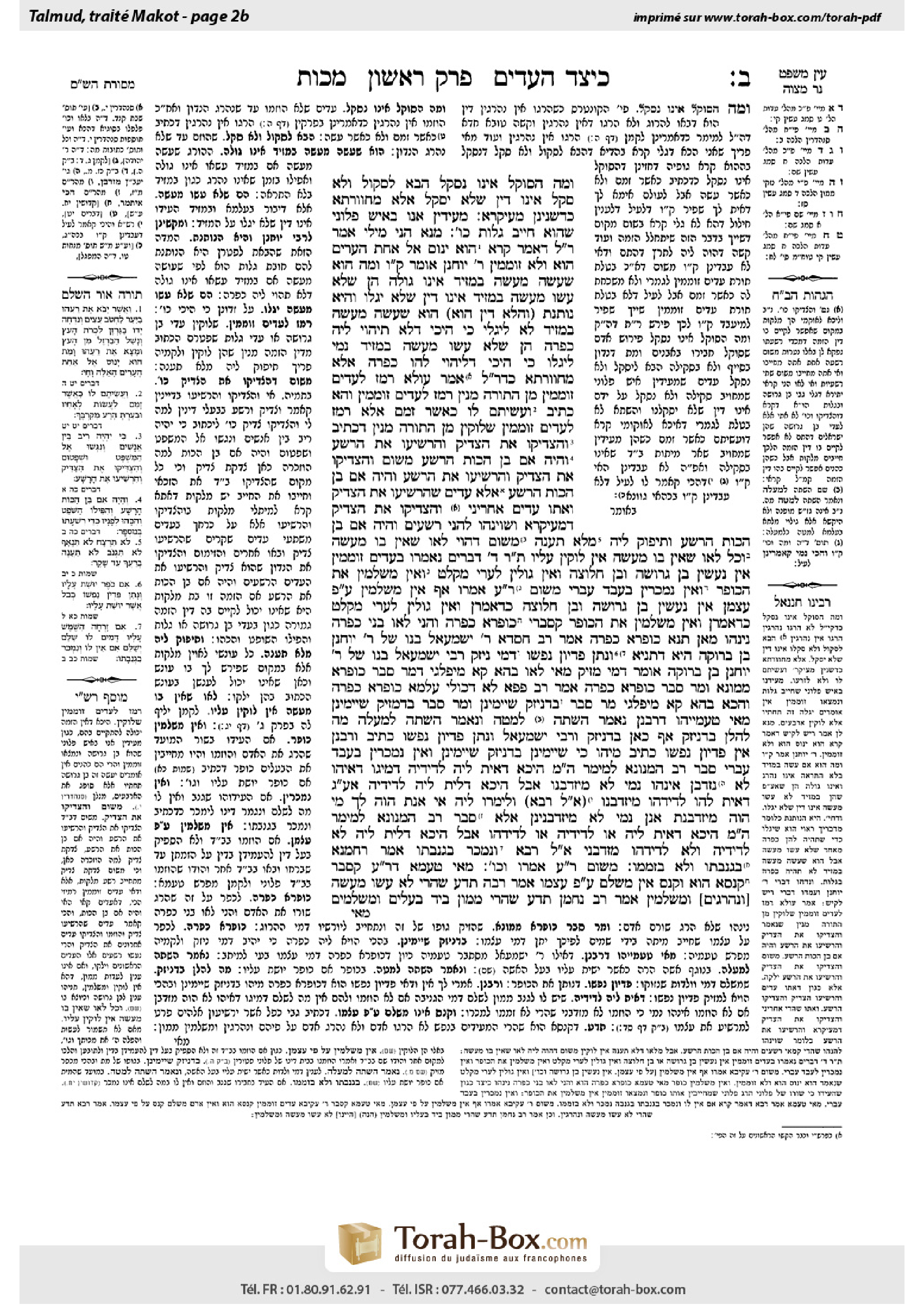
Makkot 2b: Talmud study for Daf Yomi
Daf Yomi is the daily study of one Talmud folio. Explore 37 tractates with scans, Hebrew text, Sefaria English and AI-generated French translations where annotated.
Passage selection and English or AI-generated French translation are available where the scan has annotations. Daf Study is independent of Torah-Box and Sefaria.
Browse Makkot · מכות · All tractatesMakkot 2b text and translations
This page of Makkot includes the Aramaic text, an English translation and an AI-generated French translation, alongside the scan above.
מכות ב׳ ב · Aramaic and Hebrew text
וּמָה הַסּוֹקֵל אֵינוֹ נִסְקָל, הַבָּא לִסְקוֹל וְלֹא סָקַל – אֵינוֹ דִּין שֶׁלֹּא יִסָּקֵל? אֶלָּא מְחַוַּורְתָּא כִּדְשַׁנִּינַן מֵעִיקָּרָא.
מְעִידִין אָנוּ בְּאִישׁ פְּלוֹנִי שֶׁהוּא חַיָּיב גָּלוּת כּוּ׳. מְנָא הָנֵי מִילֵּי? אָמַר רֵישׁ לָקִישׁ: דְּאָמַר קְרָא: ״הוּא יָנוּס אֶל אַחַת הֶעָרִים״ – הוּא, וְלָא זוֹמְמִין.
רַבִּי יוֹחָנָן אוֹמֵר: קַל וָחוֹמֶר: וּמָה הוּא, שֶׁעָשָׂה מַעֲשֶׂה – בְּמֵזִיד אֵינוֹ גּוֹלֶה, הֵן, שֶׁלֹּא עָשׂוּ מַעֲשֶׂה – בְּמֵזִיד אֵינוֹ דִּין שֶׁלֹּא יִגְלוּ?
וְהִיא נוֹתֶנֶת, (וַהֲלֹא דִין הוּא): הוּא, שֶׁעָשָׂה מַעֲשֶׂה – בְּמֵזִיד לָא לִיגְלֵי, כִּי הֵיכִי דְּלָא תֶּיהְוֵי לֵיהּ כַּפָּרָה. הֵן, שֶׁלֹּא עָשׂוּ מַעֲשֶׂה – בְּמֵזִיד נָמֵי לִיגְלוֹ, כִּי הֵיכִי דְּלֶיהְוֵי לְהוּ כַּפָּרָה! אֶלָּא מְחַוַּורְתָּא כִּדְרֵישׁ לָקִישׁ.
אָמַר עוּלָּא: רֶמֶז לְעֵדִים זוֹמְמִין מִן הַתּוֹרָה מִנַּיִן? רֶמֶז לְעֵדִים זוֹמְמִין?! וְהָא כְּתִיב: ״וַעֲשִׂיתֶם לוֹ כַּאֲשֶׁר זָמַם״! אֶלָּא: רֶמֶז לְעֵדִים זוֹמְמִין שֶׁלּוֹקִין מִן הַתּוֹרָה, מִנַּיִן? דִּכְתִיב: ״וְהִצְדִּיקוּ אֶת הַצַּדִּיק וְהִרְשִׁיעוּ אֶת הָרָשָׁע. וְהָיָה אִם בִּן הַכּוֹת הָרָשָׁע״. מִשּׁוּם וְהִצְדִּיקוּ אֶת הַצַּדִּיק – וְהִרְשִׁיעוּ אֶת הָרָשָׁע, וְהָיָה אִם בִּן הַכּוֹת הָרָשָׁע?
אֶלָּא: עֵדִים שֶׁהִרְשִׁיעוּ אֶת הַצַּדִּיק, וַאֲתוֹ עֵדִים אַחֲרִינֵי וְהִצְדִּיקוּ אֶת הַצַּדִּיק דְּמֵעִיקָּרָא, וְשַׁוִּינְהוּ לְהָנֵי רְשָׁעִים, ״וְהָיָה אִם בִּן הַכּוֹת הָרָשָׁע״.
וְתִיפּוֹק לֵיהּ מִ״לֹּא תַעֲנֶה״! מִשּׁוּם דְּהָוֵי לָאו שֶׁאֵין בּוֹ מַעֲשֶׂה, וְכׇל לָאו שֶׁאֵין בּוֹ מַעֲשֶׂה אֵין לוֹקִין עָלָיו.
תָּנוּ רַבָּנַן: אַרְבָּעָה דְּבָרִים נֶאֶמְרוּ בְּעֵדִים זוֹמְמִין: אֵין נַעֲשִׂין בֶּן גְּרוּשָׁה וּבֶן חֲלוּצָה, וְאֵין גּוֹלִין לְעָרֵי מִקְלָט, וְאֵין מְשַׁלְּמִין אֶת הַכּוֹפֶר, וְאֵין נִמְכָּרִין בְּעֶבֶד עִבְרִי. מִשּׁוּם רַבִּי עֲקִיבָא אָמְרוּ: אַף אֵין מְשַׁלְּמִין עַל פִּי עַצְמָן.
אֵין נַעֲשִׂין בֶּן גְּרוּשָׁה וּבֶן חֲלוּצָה – כְּדַאֲמַרַן. וְאֵין גּוֹלִין לְעָרֵי מִקְלָט – כְּדַאֲמַרַן. וְאֵין מְשַׁלְּמִין אֶת הַכּוֹפֶר – קָסָבְרִי: כּוּפְרָא – כַּפָּרָה, וְהָנֵי לָאו בְּנֵי כַּפָּרָה נִינְהוּ.
מַאן תָּנָא כּוּפְרָא כַּפָּרָה? אָמַר רַב חִסְדָּא: רַבִּי יִשְׁמָעֵאל בְּנוֹ שֶׁל רַבִּי יוֹחָנָן בֶּן בְּרוֹקָה הִיא, דְּתַנְיָא: ״וְנָתַן פִּדְיֹן נַפְשׁוֹ״ – דְּמֵי נִיזָּק. רַבִּי יִשְׁמָעֵאל בְּנוֹ שֶׁל רַבִּי יוֹחָנָן בֶּן בְּרוֹקָה אוֹמֵר: דְּמֵי מַזִּיק. מַאי לָאו בְּהָא קָא מִיפַּלְגִי? דְּמָר סָבַר: כּוּפְרָא מָמוֹנָא, וּמָר סָבַר: כּוּפְרָא כַּפָּרָה?
אָמַר רַב פָּפָּא: לָא, דְּכוּלֵּי עָלְמָא כּוּפְרָא כַּפָּרָה, וְהָכָא בְּהָא קָא מִיפַּלְגִי, מָר סָבַר: בִּדְנִיזָּק שָׁיְימִינַן, וּמָר סָבַר: בִּדְמַזִּיק שָׁיְימִינַן.
מַאי טַעְמַיְיהוּ דְּרַבָּנַן? נֶאֱמַר הֲשָׁתָה לְמַטָּה, וְנֶאֱמַר הֲשָׁתָה לְמַעְלָה. מָה לְהַלָּן – בִּדְנִיזָּק, אַף כָּאן – בִּדְנִיזָּק.
וְרַבִּי יִשְׁמָעֵאל: ״וְנָתַן פִּדְיֹן נַפְשׁוֹ״ כְּתִיב. וְרַבָּנַן? אֵין, ״פִּדְיוֹן נַפְשׁוֹ״ כְּתִיב, מִיהוּ כִּי שָׁיְימִינַן, בִּדְנִיזָּק שָׁיְימִינַן.
וְאֵין נִמְכָּרִין בְּעֶבֶד עִבְרִי. סָבַר רַב הַמְנוּנָא לְמֵימַר: הָנֵי מִילֵּי הֵיכָא דְּאִית לֵיהּ לְדִידֵיהּ, דְּמִיגּוֹ דְּאִיהוּ לָא נִזְדַּבַּן – אִינְהוּ נָמֵי לָא מִיזְדַּבְּנוּ. אֲבָל הֵיכָא דְּלֵית לֵיהּ לְדִידֵיהּ, אַף עַל גַּב דְּאִית לְהוּ לְדִידְהוּ – מִיזְדַּבְּנוּ.
אֲמַר לֵיהּ רָבָא: וְלֵימְרוּ לֵיהּ: אִי אַנְתְּ הֲוָה לָךְ מִי הֲוָה מִיזְדַּבְּנַתְּ? אֲנַן נָמֵי לָא מִיזְדַּבְּנִינַן. אֶלָּא סָבַר רַב הַמְנוּנָא לְמֵימַר: הָנֵי מִילֵּי הֵיכָא דְּאִית לֵיהּ אוֹ לְדִידֵיהּ אוֹ לְדִידְהוּ, אֲבָל הֵיכָא דְּלֵית לֵיהּ לָא לְדִידֵיהּ וְלָא לְדִידְהוּ – מִזְדַּבְּנִי. אֲמַר לֵיהּ רָבָא: ״וְנִמְכַּר בִּגְנֵבָתוֹ״, אָמַר רַחֲמָנָא – בִּגְנֵבָתוֹ, וְלֹא בִּזְמָמוֹ.
מִשּׁוּם רַבִּי עֲקִיבָא אָמְרוּ וְכוּ׳. מַאי טַעְמָא דְּרַבִּי עֲקִיבָא? קָסָבַר קְנָסָא הוּא, וּקְנָס אֵין מְשַׁלֵּם עַל פִּי עַצְמוֹ. אָמַר רַבָּה: תֵּדַע, שֶׁהֲרֵי לֹא עָשׂוּ מַעֲשֶׂה, [וְנֶהֱרָגִים] וּמְשַׁלְּמִין. אָמַר רַב נַחְמָן: תֵּדַע, שֶׁהֲרֵי מָמוֹן בְּיַד בְּעָלִים, וּמְשַׁלְּמִים.
Makkot 2b · English translation
If one who stones another, i.e., who testified that another is liable to be executed via the death penalty of stoning and was rendered a conspiring witness after that person was executed, is not stoned, as the halakha is that conspiring witnesses receive the punishment that they conspired to have inflicted and not the punishment that they actually had inflicted, then with regard to a conspiring witness who came to stone another and was unsuccessful and did not stone him, as he was rendered a conspiring witness before that person was executed, isn’t it logical that he should not be stoned? The Gemara concludes: Rather, it is clear as we answered initially: “And you shall do to him as he conspired”; this should be done to him, but not to his offspring.
§ The mishna teaches that in a case where two witnesses came before the court and said: We testify with regard to so-and-so that he is liable to be punished with exile, one does not say that these witnesses shall be exiled in his stead; rather, they receive forty lashes. The Gemara asks: From where is this matter derived? Reish Lakish says: It is derived from a verse, as the verse states with regard to an unwitting killer: “And he shall flee to one of the cities” (Deuteronomy 19:5), and the Gemara infers: He shall flee, but conspiring witnesses shall not.
Rabbi Yoḥanan says: It is derived through an a fortiori inference: If the killer, who performed an action that, had he done so intentionally, he would not be exiled for it even if he were not sentenced to death, e.g., because there was no forewarning, then in the case of the conspiring witnesses, who did not perform an action, as their conspiracy was exposed and their testimony rejected, even if they testified intentionally, isn’t it logical that they should not be exiled?
The Gemara challenges: But that distinction provides support to the contrary. Could this not be derived through logical inference? With regard to one who performed an action, i.e., killed a person, if he did so intentionally, let him not be exiled so that he will not have atonement for his action, and he will instead receive harsh punishment at the hand of Heaven. With regard to the conspiring witnesses, who did not perform an action, even if they testified intentionally, let them also be exiled so that they will have atonement for their misdeed. The Gemara concludes: Rather, it is clear in accordance with the explanation of Reish Lakish: “And he shall flee to one of the cities”; he, but not conspiring witnesses.
§ Ulla says: From where is an allusion in the Torah to conspiring witnesses derived? The Gemara asks: Is an allusion to conspiring witnesses required? But isn’t it written explicitly: “And you shall do to him as he conspired” (Deuteronomy 19:19)? Rather, Ulla’s question is: From where is an allusion in the Torah to the halakha that conspiring witnesses are flogged in certain cases derived? It is derived from that which is written: “If there is a quarrel between people and they come to judgment, and the judges judge them, and they vindicated the righteous and condemned the wicked, and it shall be if the wicked is deserving of lashes” (Deuteronomy 25:1–2). Ostensibly, this verse is difficult: Is it due to the fact that “they vindicated the righteous” that they “condemned the wicked, and it shall be if the wicked is deserving of lashes”? In most disputes, the fact that one party is vindicated does not necessarily lead to lashes for the other party.
Rather, the verse is addressing the case of witnesses who, through their testimony, condemned the righteous, and other witnesses came and vindicated the original righteous person and rendered these first set of witnesses wicked conspiring witnesses. In that case, the verse states: “And it shall be if the wicked is deserving of lashes,” indicating that lashes are an appropriate punishment for conspiring witnesses.
The Gemara asks: And why not derive the halakha that conspiring witnesses are liable to receive lashes from the prohibition: “You shall not bear false witness against your neighbor” (Exodus 20:13)? The Gemara answers: One is not flogged for violating that prohibition, due to the fact that it is a prohibition that does not involve an action, as one violates it through speech, not action, and the principle is: For every prohibition that does not involve an action, one is not flogged for its violation. Therefore, it was necessary to derive the halakha from the verse: “And they vindicated the righteous.”
§ The Sages taught in a baraita: Four matters were stated with regard to conspiring witnesses, i.e., there are four cases in which their punishment deviates from the norm. They are not rendered the son of a divorced woman or the son of a ḥalutza; they are not exiled to a city of refuge; they do not pay the ransom if they testified that the forewarned ox of someone killed another; and they are not sold as a Hebrew slave in a case where they testified that one stole property and he would be sold into slavery if he lacked the means to repay the owner. The Sages said in the name of Rabbi Akiva: They also do not pay based on their own admission. If they were rendered conspiring witnesses in one court, and before that court managed to collect the payment that they owed, they appeared in a different court and admitted that they had been rendered conspiring witnesses, they are exempt from payment.
The Gemara elaborates: They are not rendered the son of a divorced woman or the son of a ḥalutza, as we stated and explained earlier. And they are not exiled to a city of refuge, as we stated and explained earlier. And they do not pay the ransom, as these Sages hold that the ransom paid by one whose ox killed another is atonement for him, as he is liable for the actions of his animal, and it is not payment of damages. And these conspiring witnesses are not subject to a need for atonement, as their ox did not kill anyone.
The Gemara asks: Who is the tanna who taught that the ransom is atonement? Rav Ḥisda says: It is Rabbi Yishmael, son of Rabbi Yoḥanan ben Beroka, as it is taught in a baraita with regard to the verse concerning a case where the ox of one person gored another: “If ransom is imposed upon him, and he shall give the redemption of his soul” (Exodus 21:30); the term “his soul” means the value of the victim, i.e., the owner of the ox must pay the heirs of the deceased his value as it would be assessed were he sold as a slave in the market. Rabbi Yishmael, son of Rabbi Yoḥanan ben Beroka, says: The term “his soul” means the value of the one liable for the damage. What, is it not that they disagree with regard to this principle: That one Sage, the Rabbis, holds that the ransom is monetary restitution for the damage that his ox caused the victim; and one Sage, Rabbi Yishmael, holds that the ransom is atonement, as he thereby redeems his own soul from death at the hand of Heaven?
Rav Pappa says: No, perhaps everyone agrees that the ransom is atonement, and here, it is with regard to this matter that they disagree: One Sage, the Rabbis, holds that we assess the payment in terms of the value of the victim; and one Sage, Rabbi Yishmael, holds that we assess the payment in terms of the value of the one liable for the damage.
The Gemara asks: What is the reason for the opinion of the Rabbis, who abandon the straightforward meaning of the verse? The Rabbis derive it in the following manner: Imposition is stated below with regard to one whose ox killed another: “If ransom is imposed upon him” (Exodus 21:30), and imposition is stated above, in the case of one who struck a pregnant woman, causing her to miscarry: “He shall be punished, as the husband of the woman imposes upon him” (Exodus 21:22). Just as there, with regard to the miscarriage, it is in terms of the value of the victim, the fetus, that we assess the payment, here too, in the case of the ransom, it is in terms of the value of the victim that we assess the payment.
And Rabbi Yishmael, son of Rabbi Yoḥanan ben Beroka, says: “And he shall give the redemption of his soul” is written, indicating that the sum is based on the value of the one seeking atonement. And the Rabbis explain: Yes, the phrase “redemption of his soul” is written, and the payment functions to redeem his soul. Nevertheless, when we assess the sum of the redemption payment, it is in terms of the value of the victim that we assess the payment.
§ The baraita teaches: Conspiring witnesses are not sold as a Hebrew slave in a case where they testified that one stole property. Rav Hamnuna thought to say: This statement applies only in a case where the falsely accused has means of his own to repay the sum of the alleged theft, as since, had the testimony been true, he would not have been sold for his transgression, the witnesses too are not sold when they are rendered conspiring witnesses. But in a case where the falsely accused does not have means of his own, and would have been sold into slavery had their testimony been accepted, even if the witnesses have means of their own, they are sold, as they sought to have slavery inflicted upon him.
Rava said to him: And let the witnesses say to the person against whom they testified: If you had money, would you have been sold? We too will not be sold. Since they have the means, they can pay the sum that they owe and not be sold as slaves. Rather, the Gemara proposes an alternative formulation of the statement of Rav Hamnuna. Rav Hamnuna thought to say: This statement applies only in a case where either he, the falsely accused, or they, the witnesses, have the means to pay the sum; but in a case where neither he nor they have the means, the witnesses are sold. In that case, had their testimony stood, the alleged thief would have been sold into slavery, and they too lack the means to pay the sum that they are liable to pay as conspiring witnesses. Therefore, they are sold. Rava said to him: That is not so, as the Merciful One states: “And he shall be sold for his theft” (Exodus 21:30), from which it is inferred: For his theft, but not for his conspiring testimony.
§ It is taught in the baraita: The Sages said in the name of Rabbi Akiva: They also do not pay based on their own admission. The Gemara explains: What is the reason for the opinion of Rabbi Akiva? He holds that money paid by a convicted conspiring witnesses is a fine [kenasa], and the principle is: One does not pay a fine based on his own admission; one pays a fine only on the basis of testimony. Rabba says: Know that it is a fine, as these witnesses did not perform an action and caused no actual damage, and yet they are executed or pay depending on the nature of their testimony, indicating that it is a fine rather than a monetary restitution. Rav Naḥman says: Know that it is a fine rather than a monetary restitution for damages, as the money they sought to compel him to pay ultimately remains in the possession of the owner against whom they testified, and yet they pay him.
Makkot 2b · Traduction française (IA)
Si celui qui lapide autrui — c’est-à-dire celui qui a témoigné qu’un autre est passible de la peine de lapidation et qui a été reconnu comme témoin comploteur après l’exécution de cette personne — n’est pas lapidé, puisque la halakha veut que les témoins comploteurs reçoivent la peine qu’ils avaient comploté de faire infliger, et non celle qui a effectivement été infligée, alors, s’agissant d’un témoin comploteur venu faire lapider autrui, mais qui a échoué et ne l’a pas fait, puisqu’il a été reconnu comme témoin comploteur avant l’exécution de cette personne, n’est-il pas logique qu’il ne soit pas lapidé ? La Guemara conclut : Il faut plutôt retenir la réponse donnée initialement : « Vous lui ferez comme il avait comploté » ; cela doit lui être fait, mais pas à ses descendants.
§ La Michna enseigne que, lorsque deux témoins comparaissent devant le tribunal et disent : « Nous témoignons qu’untel est passible d’exil », on ne dit pas que ces témoins seront exilés à sa place ; ils reçoivent plutôt quarante coups. La Guemara demande : D’où tire-t-on cette règle ? Reish Lakish dit : On la déduit d’un verset, car il est écrit au sujet d’un meurtrier involontaire : « Il s’enfuira dans l’une des villes » (Deutéronome 19, 5). La Guemara en déduit : Lui s’enfuira, mais pas les témoins comploteurs.
Rabbi Yoḥanan dit : On le déduit par un raisonnement a fortiori. Si le meurtrier, qui a accompli un acte pour lequel il n’aurait pas été exilé s’il l’avait commis intentionnellement, même s’il n’avait pas été condamné à mort — par exemple, parce qu’il n’avait pas été averti au préalable —, alors, dans le cas des témoins comploteurs, qui n’ont accompli aucun acte puisque leur complot a été dévoilé et leur témoignage rejeté, même s’ils ont témoigné intentionnellement, n’est-il pas logique qu’ils ne soient pas exilés ?
La Guemara objecte : Mais cette distinction plaide en faveur de la conclusion contraire. Ne pourrait-on pas le déduire par un raisonnement logique ? Pour celui qui a accompli un acte, c’est-à-dire qui a tué une personne : s’il l’a fait intentionnellement, qu’il ne soit pas exilé, afin qu’il n’obtienne pas l’expiation de son acte et qu’il reçoive plutôt une sévère punition du Ciel. Quant aux témoins comploteurs, qui n’ont accompli aucun acte, même s’ils ont témoigné intentionnellement, qu’ils soient eux aussi exilés afin d’obtenir l’expiation de leur faute. La Guemara conclut : Il faut plutôt retenir l’explication de Reish Lakish : « Il s’enfuira dans l’une des villes » ; lui, mais pas les témoins comploteurs.
§ Oulla dit : Où trouve-t-on dans la Torah une allusion aux témoins comploteurs ? La Guemara demande : Faut-il une allusion aux témoins comploteurs ? N’est-il pas écrit explicitement : « Vous lui ferez comme il avait comploté » (Deutéronome 19, 19) ? Oulla demande plutôt : Où trouve-t-on dans la Torah une allusion à la halakha selon laquelle, dans certains cas, les témoins comploteurs reçoivent des coups ? On la déduit de ce qui est écrit : « S’il y a un différend entre des hommes et qu’ils comparaissent en justice, que les juges les jugent, qu’ils déclarent le juste innocent et le coupable coupable, et s’il arrive que le coupable mérite des coups » (Deutéronome 25, 1-2). À première vue, ce verset pose problème : Est-ce parce qu’« ils déclarent le juste innocent » qu’ils « déclarent le coupable coupable, et s’il arrive que le coupable mérite des coups » ? Dans la plupart des litiges, le fait qu’une partie soit déclarée innocente n’entraîne pas nécessairement que l’autre reçoive des coups.
Il s’agit plutôt du cas de témoins qui, par leur témoignage, ont condamné un innocent, puis d’autres témoins sont venus, ont innocenté la première personne et ont établi que les témoins du premier groupe étaient coupables, c’est-à-dire des témoins comploteurs. Dans ce cas, le verset dit : « Et s’il arrive que le coupable mérite des coups », ce qui indique que les coups sont une peine appropriée pour les témoins comploteurs.
La Guemara demande : Pourquoi ne pas déduire que les témoins comploteurs sont passibles de coups de l’interdiction : « Tu ne porteras pas de faux témoignage contre ton prochain » (Exode 20, 13) ? La Guemara répond : On ne reçoit pas de coups pour avoir transgressé cette interdiction, car elle n’implique pas d’acte : on la transgresse par la parole, et non par un acte. Or, le principe est qu’on ne reçoit pas de coups pour la transgression d’une interdiction qui n’implique pas d’acte. Il était donc nécessaire de déduire cette halakha du verset : « Ils déclarent le juste innocent ».
§ Les Sages ont enseigné dans une baraïta : Quatre règles ont été énoncées au sujet des témoins comploteurs, c’est-à-dire qu’il existe quatre cas où leur peine déroge à la règle habituelle. Ils ne sont pas déclarés fils d’une femme divorcée ou fils d’une ḥaloutsa ; ils ne sont pas exilés dans une ville de refuge ; ils ne paient pas la rançon s’ils ont témoigné que le bœuf dangereux de quelqu’un avait tué une autre personne ; et ils ne sont pas vendus comme esclaves hébreux lorsqu’ils ont témoigné qu’une personne avait volé un bien et qu’elle aurait été vendue comme esclave si elle n’avait pas eu de quoi rembourser le propriétaire. Les Sages ont dit au nom de Rabbi Akiva : Ils ne paient pas non plus sur la base de leur propre aveu. S’ils ont été reconnus comme témoins comploteurs par un tribunal et que, avant que ce tribunal ait pu percevoir le paiement qu’ils devaient, ils comparaissent devant un autre tribunal et reconnaissent avoir été reconnus comme témoins comploteurs, ils sont exempts de paiement.
La Guemara précise : Ils ne sont pas déclarés fils d’une femme divorcée ou fils d’une ḥaloutsa, comme nous l’avons dit et expliqué précédemment. Ils ne sont pas non plus exilés dans une ville de refuge, comme nous l’avons dit et expliqué précédemment. Ils ne paient pas la rançon, car ces Sages considèrent que la rançon payée par celui dont le bœuf a tué une personne constitue une expiation pour lui, puisqu’il est responsable des actes de son animal, et non des dommages-intérêts. Or, ces témoins comploteurs n’ont pas à obtenir d’expiation, puisque leur bœuf n’a tué personne.
La Guemara demande : Quel est le tanna qui enseigne que la rançon constitue une expiation ? Rav Ḥisda dit : C’est Rabbi Yishmael, fils de Rabbi Yoḥanan ben Beroka, comme il est enseigné dans une baraïta au sujet du verset concernant le cas où le bœuf d’un homme encorne une autre personne : « Si une rançon lui est imposée, il donnera le prix de rachat de sa personne » (Exode 21, 30). L’expression « sa personne » désigne la valeur de la victime, c’est-à-dire que le propriétaire du bœuf doit verser aux héritiers du défunt la somme correspondant à sa valeur, évaluée comme s’il avait été vendu comme esclave sur le marché. Rabbi Yishmael, fils de Rabbi Yoḥanan ben Beroka, dit : L’expression « sa personne » désigne la valeur de la personne responsable du dommage. N’est-ce pas qu’ils sont en désaccord sur le principe suivant : selon un Sage, les Rabbins, la rançon constitue une compensation pécuniaire pour le dommage que son bœuf a causé à la victime ; selon l’autre Sage, Rabbi Yishmael, la rançon constitue une expiation, car par ce paiement il rachète sa propre personne et la préserve ainsi de la mort aux mains du Ciel ?
Rav Pappa dit : Non, peut-être tous sont-ils d’accord pour dire que la rançon constitue une expiation ; ici, leur désaccord porte sur le point suivant : selon un Sage, les Rabbins, on évalue le paiement d’après la valeur de la victime ; selon l’autre Sage, Rabbi Yishmael, on l’évalue d’après la valeur de la personne responsable du dommage.
La Guemara demande : Pourquoi les Rabbins s’écartent-ils du sens littéral du verset ? Les Rabbins le déduisent ainsi : le terme « imposer » apparaît plus bas, au sujet de celui dont le bœuf a tué une autre personne : « Si une rançon lui est imposée » (Exode 21, 30), et le même terme apparaît plus haut, dans le cas de celui qui a frappé une femme enceinte et provoqué une fausse couche : « Il sera puni selon ce que le mari de la femme lui imposera » (Exode 21, 22). De même que là, dans le cas de la fausse couche, le paiement est évalué d’après la valeur de la victime, le fœtus, ici aussi, dans le cas de la rançon, il est évalué d’après la valeur de la victime.
Et Rabbi Yishmael, fils de Rabbi Yoḥanan ben Beroka, dit : Il est écrit : « Il donnera le prix de rachat de sa personne », ce qui indique que la somme est fondée sur la valeur de la personne qui cherche à obtenir l’expiation. Les Rabbins expliquent : Certes, l’expression « prix de rachat de sa personne » est écrite, et le paiement sert à racheter sa personne. Néanmoins, lorsqu’on évalue le montant de la rançon, on le fait d’après la valeur de la victime.
§ La baraïta enseigne : Les témoins comploteurs ne sont pas vendus comme esclaves hébreux lorsqu’ils ont témoigné qu’une personne avait volé un bien. Rav Hamnouna pensait que cette règle s’appliquait uniquement dans le cas où l’accusé à tort avait de quoi rembourser la somme du vol allégué, car, si le témoignage avait été véridique, il n’aurait pas été vendu pour sa faute ; de même, les témoins ne sont pas vendus lorsqu’ils sont reconnus comme témoins comploteurs. Mais, si l’accusé à tort n’avait pas de quoi rembourser et aurait été vendu comme esclave si leur témoignage avait été accepté, les témoins sont vendus, même s’ils ont eux-mêmes de quoi payer, car ils ont cherché à faire infliger l’esclavage à cet homme.
Rava lui dit : Que les témoins disent à la personne contre laquelle ils ont témoigné : « Si tu avais eu de l’argent, aurais-tu été vendu ? Nous non plus, nous ne serons pas vendus. » Puisqu’ils ont les moyens, ils peuvent payer la somme qu’ils doivent et ne pas être vendus comme esclaves. La Guemara propose plutôt une autre formulation de l’enseignement de Rav Hamnouna. Rav Hamnouna pensait que cette règle s’appliquait uniquement lorsque lui, l’accusé à tort, ou eux, les témoins, avaient de quoi payer la somme ; mais si ni lui ni eux n’avaient de quoi payer, les témoins étaient vendus. Dans ce cas, si leur témoignage avait été retenu, le voleur présumé aurait été vendu comme esclave, et eux aussi n’auraient pas eu de quoi payer la somme dont ils étaient redevables en tant que témoins comploteurs. Ils étaient donc vendus. Rava lui dit : Il n’en est pas ainsi, car le Miséricordieux déclare : « Il sera vendu pour son vol » (Exode 21, 30), ce dont on déduit : pour son vol, mais pas pour son témoignage comploteur.
§ Il est enseigné dans la baraïta : Les Sages ont dit au nom de Rabbi Akiva qu’ils ne paient pas non plus sur la base de leur propre aveu. La Guemara explique : Quelle est la raison de l’opinion de Rabbi Akiva ? Il considère que l’argent versé par des témoins comploteurs condamnés constitue une amende [kenasa], et le principe est qu’on ne paie pas une amende sur la base de son propre aveu ; une amende n’est due que sur la base d’un témoignage. Rabba dit : Sachez qu’il s’agit d’une amende, car ces témoins n’ont accompli aucun acte et n’ont causé aucun dommage réel, et pourtant ils sont exécutés ou paient, selon la nature de leur témoignage ; cela indique qu’il s’agit d’une amende plutôt que d’une compensation pécuniaire. Rav Naḥman dit : Sachez qu’il s’agit d’une amende, et non d’une compensation pour des dommages, car l’argent qu’ils ont cherché à le contraindre à payer reste finalement entre les mains du propriétaire contre lequel ils ont témoigné, et pourtant ils le lui paient.
Traduction française générée par IA à partir de l’édition anglaise de Sefaria. Vérifie toujours un passage avec le texte source.
Text from Sefaria: William Davidson Edition - Vocalized Aramaic (CC BY NC); William Davidson Edition - English (CC BY NC).