Makkot 3a: Talmud study for Daf Yomi
Daf Yomi is the daily study of one Talmud folio. Explore 37 tractates with scans, Hebrew text, Sefaria English and AI-generated French translations where annotated.
Passage selection and English or AI-generated French translation are available where the scan has annotations. Daf Study is independent of Torah-Box and Sefaria.
Browse Makkot · מכות · All tractatesMakkot 3a text and translations
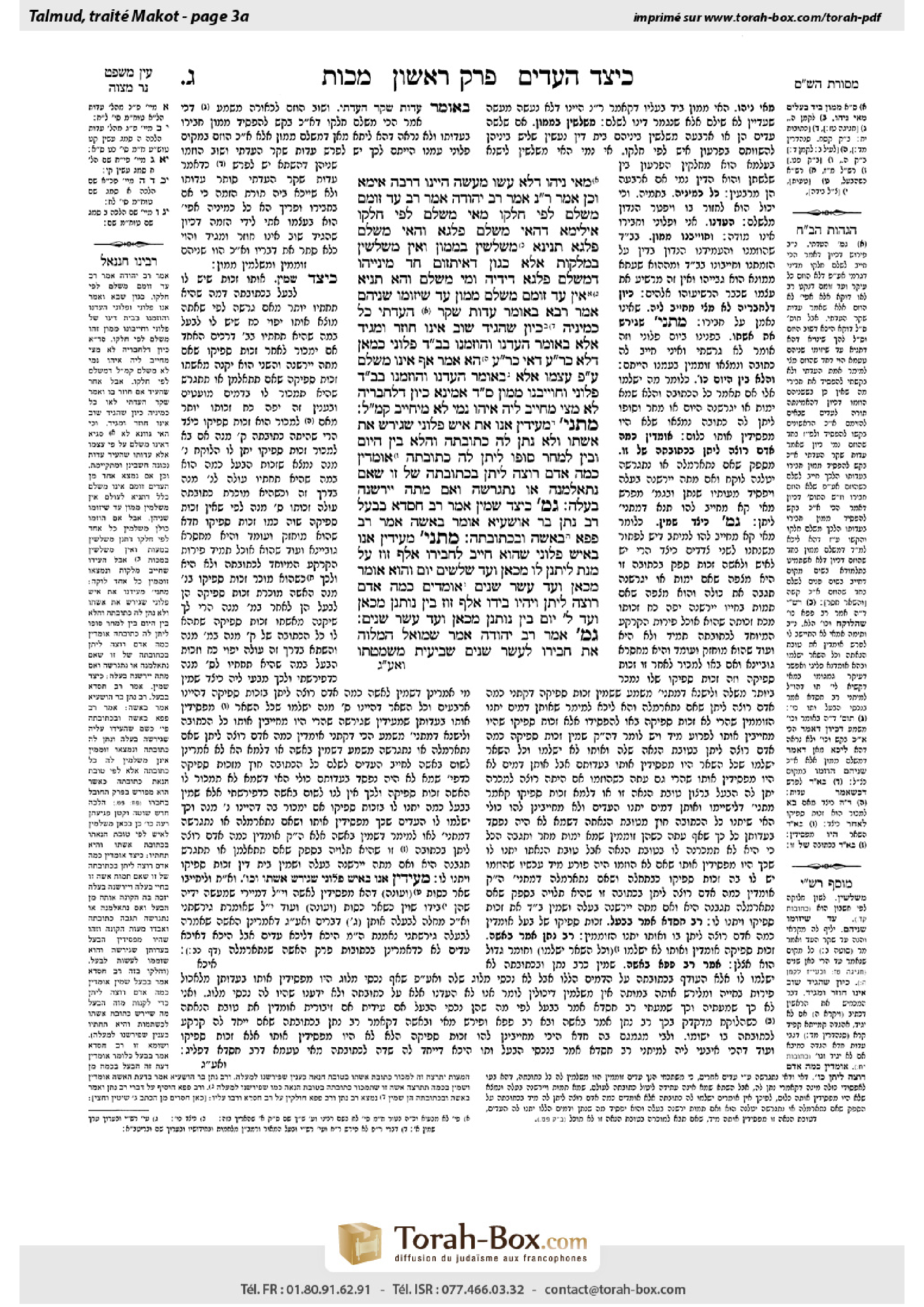
This page of Makkot includes the Aramaic text, an English translation and an AI-generated French translation, alongside the scan above.
מכות ג׳ א · Aramaic and Hebrew text
מַאי נִיהוּ, דְּלֹא עָשׂוּ מַעֲשֶׂה? הַיְינוּ דְּרַבָּה! אֵימָא: ״וְכֵן אָמַר רַב נַחְמָן״.
אָמַר רַב יְהוּדָה אָמַר רַב: עֵד זוֹמֵם מְשַׁלֵּם לְפִי חֶלְקוֹ. מַאי ״מְשַׁלֵּם לְפִי חֶלְקוֹ״? אִילֵּימָא דְּהַאי מְשַׁלֵּם פַּלְגָא וְהַאי מְשַׁלֵּם פַּלְגָא, תְּנֵינָא: מְשַׁלְּשִׁין בְּמָמוֹן, וְאֵין מְשַׁלְּשִׁין בְּמַלְקוֹת!
אֶלָּא: כְּגוֹן דְּאִיתַּזּוּם חַד מִינַּיְיהוּ, דִּמְשַׁלֵּם פַּלְגָא דִידֵיהּ, וּמִי מְשַׁלֵּם? וְהָא תַּנְיָא: אֵין עֵד זוֹמֵם מְשַׁלֵּם מָמוֹן עַד שֶׁיִּזּוֹמּוּ שְׁנֵיהֶם!
אָמַר רָבָא: בְּאוֹמֵר ״עֵדוּת שֶׁקֶר הֵעַדְתִּי״. כֹּל כְּמִינֵּיהּ? כֵּיוָן שֶׁהִגִּיד שׁוּב אֵינוֹ חוֹזֵר וּמַגִּיד!
אֶלָּא בְּאוֹמֵר: ״הֵעַדְנוּ וְהוּזַמְנוּ בְּבֵית דִּין פְּלוֹנִי״. כְּמַאן – דְּלָא כְּרַבִּי עֲקִיבָא, דְּאִי כְּרַבִּי עֲקִיבָא, הָא אָמַר: אַף אֵינוֹ מְשַׁלֵּם עַל פִּי עַצְמוֹ!
אֶלָּא בְּאוֹמֵר ״הֵעַדְנוּ וְהוּזַמְנוּ בְּבֵית דִּין פְּלוֹנִי וְחוּיַּיבְנוּ מָמוֹן״.
סָלְקָא דַּעְתָּךְ אָמֵינָא: כֵּיוָן דִּלְחַבְרֵיהּ לָא מָצֵי מְחַיֵּיב לֵיהּ, אִיהוּ נָמֵי לָא מִיחַיַּיב, קָא מַשְׁמַע לַן.
מַתְנִי׳ ״מְעִידִין אָנוּ אֶת אִישׁ פְּלוֹנִי שֶׁגֵּירַשׁ אֶת אִשְׁתּוֹ וְלֹא נָתַן לָהּ כְּתוּבָתָהּ״, וַהֲלֹא בֵּין הַיּוֹם וּבֵין לְמָחָר, סוֹפוֹ לִיתֵּן לָהּ כְּתוּבָתָהּ.
אוֹמְדִין כַּמָּה אָדָם רוֹצֶה לִיתֵּן בִּכְתוּבָּתָהּ שֶׁל זוֹ, שֶׁאִם נִתְאַלְמְנָה אוֹ נִתְגָּרְשָׁה, וְאִם מֵתָה, יִירָשֶׁנָּה בַּעֲלָהּ.
גְּמָ׳ כֵּיצַד שָׁמִין? אָמַר רַב חִסְדָּא: בַּבַּעַל.
רַב נָתָן בַּר אוֹשַׁעְיָא אוֹמֵר: בָּאִשָּׁה.
אָמַר רַב פָּפָּא: בָּאִשָּׁה וּבִכְתוּבָּתָהּ.
מַתְנִי׳ ״מְעִידִין אָנוּ בְּאִישׁ פְּלוֹנִי שֶׁהוּא חַיָּיב לַחֲבֵירוֹ אֶלֶף זוּז, עַל מְנָת לִיתְּנָן לוֹ מִכָּאן וְעַד שְׁלֹשִׁים יוֹם״, וְהוּא אוֹמֵר, ״מִכָּאן וְעַד עֶשֶׂר שָׁנִים״.
אוֹמְדִים כַּמָּה אָדָם רוֹצֶה לִיתֵּן וְיִהְיוּ בְּיָדוֹ אֶלֶף זוּז, בֵּין נוֹתְנָן מִכָּאן וְעַד שְׁלֹשִׁים יוֹם, בֵּין נוֹתְנָן מִכָּאן וְעַד עֶשֶׂר שָׁנִים.
גְּמָ׳ אָמַר רַב יְהוּדָה אָמַר שְׁמוּאֵל: הַמַּלְוֶה אֶת חֲבֵירוֹ לְעֶשֶׂר שָׁנִים – שְׁבִיעִית מְשַׁמַּטְתּוֹ.
Makkot 3a · English translation
The Gemara is puzzled by this: What is the meaning of the statement: The money remains in the possession of the owner? It means that they did not perform an action. That is identical to the reasoning of Rabba, and it is not an additional explanation. The Gemara emends the formulation of the presentation of the statement. Say: And likewise Rav Naḥman says: Know that it is so, as the money remains in the possession of the owner. Rav Naḥman is not disagreeing with Rabba; he merely formulates the statement differently.
§ Apropos the statement of Rabbi Akiva in the baraita, Rav Yehuda says that Rav says: A conspiring witness pays according to his share. The Gemara asks: What is the meaning of: Pays according to his share? If we say that it means that this witness pays half of the sum that the set conspired to render another liable to pay with their testimony, and that witness pays the other half, we already learned this in a mishna (5a): When punishing conspiring witnesses, one divides the punishment of money among them, but one does not divide the punishment of lashes among them; each receives the full thirty-nine lashes.
Rather, the Gemara explains that the expression: Pays according to his share, means that in a case where only one of the set was rendered a conspiring witness, the halakha is that he pays his half of the sum. The Gemara asks: And does he pay at all in that case? But isn’t it taught in a baraita: A conspiring witness pays money only when both were rendered conspiring witnesses? If only one was rendered a conspiring witness, he does not pay.
Rava says: The statement is not referring to a case of conspiring witnesses; rather, Rav’s statement applies to the case of one who says: It was false testimony that I testified. The Gemara asks: Is it in his power to have this statement accepted by the court? That runs counter to the principle: Once a witness stated his testimony he may not then state a revision of that testimony.
The Gemara answers: Rather, Rav’s statement applies to the case of one who says: We testified and were rendered conspiring witnesses in such and such a court. Since he was already convicted as a conspiring witness, it is as though he is admitting an obligation to give monetary restitution, and he is therefore liable to pay his share. The Gemara asks: In accordance with whose opinion is this halakha? It is not in accordance with the opinion of Rabbi Akiva, since if it were in accordance with the opinion of Rabbi Akiva, doesn’t he say: A conspiring witness also does not pay based on his own admission?
The Gemara answers: Rather, Rav’s statement applies to the case of one who says: We testified and were rendered conspiring witnesses in such and such a court and we were rendered liable to pay a specific sum of money. In that scenario, Rabbi Akiva would concede that one pays on the basis of his own admission. Once the court rendered him liable to pay a specific sum, his admission is not that he is liable to pay a fine, in which case he would be exempt. Once the court actually instructed them to pay, the debt has the status of any other monetary restitution, and one does pay monetary restitution based on his own admission.
The Gemara explains the novel element in Rav’s statement: It might enter your mind to say that since he is unable to render his fellow witness liable to pay based on his admission, as only the testimony of two witnesses is capable of doing so, he too is not liable to pay based on that admission. To counter this, Rav teaches us that his admission that he owes money renders him liable to pay.
MISHNA: In the case of witnesses who said: We testify with regard to a man called so-and-so that he divorced his wife and did not give her payment of her marriage contract, and they were then rendered conspiring witnesses, the question arises with regard to the manner in which the sum of their payment is calculated. It is not possible to render the witnesses liable to pay the entire sum of the marriage contract, as they can claim: But isn’t it so that either today or tomorrow, i.e., at some point in the future, he may divorce his wife or die and ultimately he will be liable to give her payment of her marriage contract? That being the case, the witnesses did not conspire to render him liable to pay a sum that he would otherwise not be liable to pay.
The sum of their payment is calculated as follows: The court assesses how much money another person would be willing to give in order to purchase the rights to this woman’s marriage contract, cognizant of the uncertainty that if she was widowed or divorced the purchaser will receive payment of the marriage contract but if she dies, her husband will inherit from her, and the one who purchased her marriage contract will receive nothing.
GEMARA: The mishna establishes that the payment of the conspiring witnesses is calculated based on the sum that one would be willing to pay for rights to payment of the marriage contract, taking into consideration the uncertainty whether he will ultimately receive that payment. The Gemara asks: How does the court assess that sum? Rav Ḥisda says: One calculates the sum in terms of the husband: How much would one be willing to pay for the husband’s rights to the marriage contract based on the likelihood that his wife will die first and he will inherit from her?
Rav Natan bar Oshaya says: One calculates the sum in terms of the wife: How much would one be willing to pay for the wife’s rights to the marriage contract based on the likelihood that the husband will die first or divorce her?
Rav Pappa says: One calculates the sum in terms of the wife, as Rav Natan bar Oshaya said, and the assessment is done in terms of the sum of her marriage contract. One does not include in the calculation any usufruct property that the wife brought with her into the marriage, the profits of which belong to the husband, despite the fact that as a result of the testimony of the conspiring witnesses the husband would lose his rights to those profits. One calculates the sum only in terms of her marriage contract.
MISHNA: In the case of witnesses who said: We testify with regard to a man called so-and-so that he owes another person one thousand dinars that he borrowed on the condition that he is to give the money back to him from now until thirty days have passed, and the borrower says that he borrowed that sum but it was on the condition that he is to give the money back to him from now until ten years have passed, and they were rendered conspiring witnesses, here too, it is not possible to render the witnesses liable to pay the entire sum.
Rather, the court estimates how much money a person would be willing to give so that he would keep a loan of one thousand dinars in his possession, and one calculates the difference between that sum in a situation where he would be required to give the money back from now until thirty days have passed, and that same sum in a situation where he would be required to give the money back from now until ten years have passed. That difference is the sum that the testimony of the conspiring witnesses sought to have the borrower lose; therefore, it is the sum that they must pay.
GEMARA: Rav Yehuda says that Shmuel says: In the case of one who lends money to another for a period of ten years, the Sabbatical Year abrogates the debt (see Deuteronomy 15:1–11) and absolves the borrower of the obligation to repay it.
Makkot 3a · Traduction française (IA)
La Guemara s’interroge : Que signifie l’énoncé « L’argent reste en possession de son propriétaire » ? Cela signifie qu’ils n’ont accompli aucun acte. C’est exactement le raisonnement de Rabba, et non une explication supplémentaire. La Guemara rectifie la formulation de la présentation de cet énoncé. Il faut dire : « Et de même, Rav Naḥman dit : Sache que c’est ainsi, car l’argent reste en possession de son propriétaire. » Rav Naḥman ne contredit pas Rabba ; il formule simplement l’énoncé différemment.
§ À propos de l’énoncé de Rabbi Akiva dans la baraïta, Rav Yehouda dit au nom de Rav : Un témoin comploteur paie selon sa part. La Guemara demande : Que signifie « paie selon sa part » ? Si l’on entend par là que ce témoin paie la moitié de la somme que les témoins avaient, par leur témoignage, cherché à faire payer à autrui, et que l’autre témoin paie l’autre moitié, nous l’avons déjà appris dans une Michna (5a) : Lorsqu’on punit des témoins comploteurs, on répartit entre eux la peine pécuniaire, mais on ne répartit pas entre eux la peine de flagellation ; chacun reçoit les trente-neuf coups en entier.
La Guemara explique plutôt que l’expression « paie selon sa part » signifie que, dans le cas où un seul témoin du groupe a été reconnu comme témoin comploteur, la halakha est qu’il paie sa moitié de la somme. La Guemara demande : Paie-t-il vraiment dans ce cas ? N’est-il pas enseigné dans une baraïta : Un témoin comploteur ne paie une somme d’argent que si les deux témoins ont été reconnus comme témoins comploteurs ? Si un seul a été reconnu comme témoin comploteur, il ne paie pas.
Rava dit : Cet énoncé ne concerne pas le cas de témoins comploteurs ; l’énoncé de Rav s’applique plutôt au cas de celui qui dit : « J’ai fait un faux témoignage. » La Guemara demande : Peut-il faire accepter cette déclaration par le tribunal ? Cela va à l’encontre du principe selon lequel, une fois qu’un témoin a déposé son témoignage, il ne peut ensuite le réviser.
La Guemara répond : L’énoncé de Rav s’applique plutôt au cas de celui qui dit : « Nous avons témoigné et avons été reconnus comme témoins comploteurs par tel tribunal. » Puisqu’il a déjà été condamné comme témoin comploteur, c’est comme s’il reconnaissait être tenu à une restitution pécuniaire ; il est donc redevable de sa part. La Guemara demande : Selon l’opinion de qui cette halakha est-elle formulée ? Elle ne correspond pas à l’opinion de Rabbi Akiva, car, si c’était le cas, ne dit-il pas qu’un témoin comploteur ne paie pas non plus sur la base de son propre aveu ?
La Guemara répond : L’énoncé de Rav s’applique plutôt au cas de celui qui dit : « Nous avons témoigné et avons été reconnus comme témoins comploteurs par tel tribunal, et nous avons été condamnés à payer une somme précise. » Dans ce cas, Rabbi Akiva admettrait que l’on paie sur la base de son propre aveu. Dès lors que le tribunal l’a condamné à payer une somme précise, son aveu ne porte pas sur une obligation de payer une amende, auquel cas il serait exempté. Une fois que le tribunal leur a effectivement ordonné de payer, la dette a le statut de toute autre restitution pécuniaire, et l’on paie une restitution pécuniaire sur la base de son propre aveu.
La Guemara explique l’élément novateur de l’énoncé de Rav : On pourrait penser que, puisqu’il ne peut pas rendre son co-témoin redevable d’un paiement sur la base de son aveu — car seul le témoignage de deux témoins peut le faire —, lui non plus n’est pas redevable d’un paiement sur la base de cet aveu. Pour écarter cette idée, Rav nous enseigne que son aveu reconnaissant qu’il doit de l’argent le rend redevable du paiement.
MICHNA : Dans le cas de témoins qui ont dit : « Nous témoignons au sujet d’un homme appelé Untel qu’il a divorcé de sa femme sans lui verser le montant de sa ketouba », puis ont été reconnus comme témoins comploteurs, la question se pose de savoir comment calculer la somme qu’ils doivent payer. Il n’est pas possible de rendre les témoins redevables de la totalité du montant de la ketouba, car ils peuvent prétendre : « Mais tôt ou tard, c’est-à-dire à un moment donné dans l’avenir, il peut divorcer de sa femme ou mourir, et il sera finalement tenu de lui verser le montant de sa ketouba. » Dans ces conditions, les témoins n’ont pas cherché à le rendre redevable d’une somme qu’il n’aurait pas eu à payer autrement.
La somme qu’ils doivent payer est calculée de la manière suivante : le tribunal évalue combien une autre personne serait prête à donner pour acquérir les droits sur la ketouba de cette femme, en tenant compte de l’incertitude suivante : si elle devient veuve ou est divorcée, l’acheteur recevra le montant de la ketouba, mais si elle meurt, son mari héritera d’elle et celui qui a acheté les droits sur sa ketouba ne recevra rien.
GUEMARA : La Michna établit que le paiement dû par les témoins comploteurs est calculé à partir de la somme que quelqu’un serait prêt à payer pour acquérir les droits au montant de la ketouba, en tenant compte de l’incertitude quant au fait qu’il recevra ou non ce paiement. La Guemara demande : Comment le tribunal évalue-t-il cette somme ? Rav Ḥisda dit : On calcule cette somme du point de vue du mari : combien quelqu’un serait-il prêt à payer pour acquérir les droits du mari sur la ketouba, compte tenu de la probabilité que sa femme meure avant lui et qu’il hérite d’elle ?
Rav Natan bar Oshaya dit : On calcule cette somme du point de vue de la femme : combien quelqu’un serait-il prêt à payer pour acquérir les droits de la femme sur la ketouba, compte tenu de la probabilité que son mari meure avant elle ou qu’il divorce d’elle ?
Rav Pappa dit : On calcule cette somme du point de vue de la femme, comme l’a dit Rav Natan bar Oshaya, et l’évaluation se fait d’après le montant de sa ketouba. On n’inclut pas dans le calcul les biens usufructuaires que la femme a apportés au mariage, dont les revenus reviennent au mari, bien qu’à la suite du témoignage des témoins comploteurs, le mari perde ses droits sur ces revenus. On calcule la somme uniquement d’après le montant de sa ketouba.
MICHNA : Dans le cas de témoins qui ont dit : « Nous témoignons au sujet d’un homme appelé Untel qu’il doit à une autre personne mille dinars, empruntés à la condition qu’il les lui rende dans les trente jours à compter de maintenant », tandis que l’emprunteur affirme avoir emprunté cette somme à la condition de la lui rendre dans les dix ans à compter de maintenant, et que les témoins ont été reconnus comme témoins comploteurs, ici encore, il n’est pas possible de rendre les témoins redevables de la totalité de la somme.
Le tribunal estime plutôt combien une personne serait prête à payer pour conserver en sa possession un prêt de mille dinars, puis calcule la différence entre cette somme dans le cas où elle devrait rendre l’argent dans les trente jours à compter de maintenant et cette même somme dans le cas où elle devrait le rendre dans les dix ans à compter de maintenant. Cette différence est la somme que le témoignage des témoins comploteurs cherchait à faire perdre à l’emprunteur ; c’est donc la somme qu’ils doivent payer.
GUEMARA : Rav Yehouda dit au nom de Shmuel : Dans le cas de celui qui prête de l’argent à autrui pour une durée de dix ans, l’année sabbatique annule la dette (voir Deutéronome 15, 1-11) et libère l’emprunteur de l’obligation de la rembourser.
Traduction française générée par IA à partir de l’édition anglaise de Sefaria. Vérifie toujours un passage avec le texte source.
Text from Sefaria: William Davidson Edition - Vocalized Aramaic (CC BY NC); William Davidson Edition - English (CC BY NC).