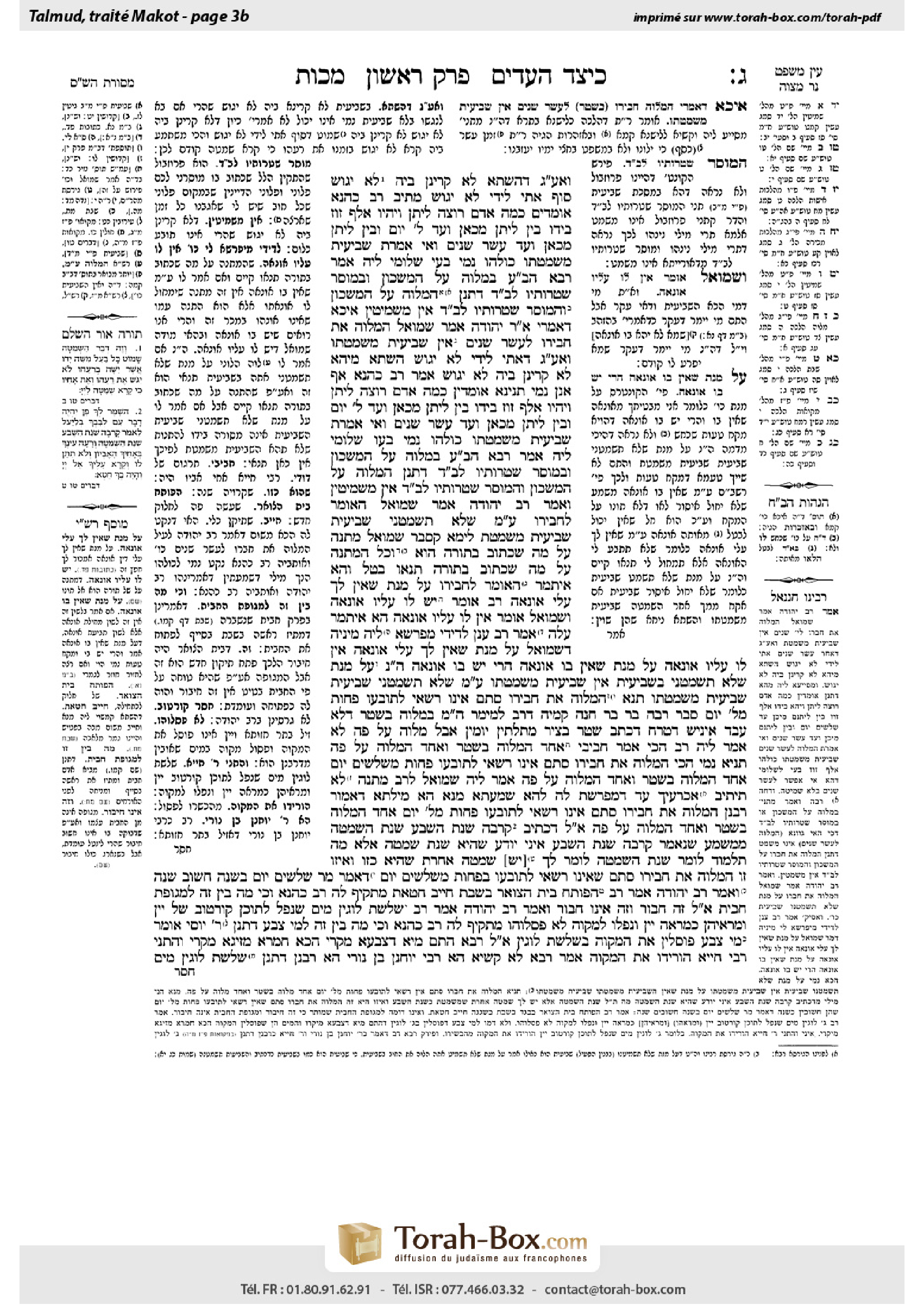
Makkot 3b: Talmud study for Daf Yomi
Daf Yomi is the daily study of one Talmud folio. Explore 37 tractates with scans, Hebrew text, Sefaria English and AI-generated French translations where annotated.
Passage selection and English or AI-generated French translation are available where the scan has annotations. Daf Study is independent of Torah-Box and Sefaria.
Browse Makkot · מכות · All tractatesMakkot 3b text and translations
This page of Makkot includes the Aramaic text, an English translation and an AI-generated French translation, alongside the scan above.
מכות ג׳ ב · Aramaic and Hebrew text
וְאַף עַל גַּב דְּהַשְׁתָּא לָא קָרֵינַן בֵּיהּ ״לֹא יִגֹּשׂ״, סוֹף אָתֵי לִידֵי ״לֹא יִגֹּשׂ״.
מֵתִיב רַב כָּהֲנָא: אוֹמְדִים כַּמָּה אָדָם רוֹצֶה לִיתֵּן וְיִהְיוּ אֶלֶף זוּז בְּיָדוֹ בֵּין לִיתֵּן מִכָּאן וְעַד שְׁלֹשִׁים יוֹם, וּבֵין לִיתֵּן מִכָּאן וְעַד עֶשֶׂר שָׁנִים. וְאִי אָמְרַתְּ שְׁבִיעִית מְשַׁמַּטְתּוֹ – כּוּלְּהוּ נָמֵי בָּעֵי שַׁלּוֹמֵי לֵיהּ!
אָמַר רָבָא: הָכָא בְּמַאי עָסְקִינַן – בְּמַלְוֶה עַל הַמַּשְׁכּוֹן, וּבְמוֹסֵר שְׁטָרוֹתָיו לְבֵית דִּין. דִּתְנַן: הַמַּלְוֶה עַל הַמַּשְׁכּוֹן, וְהַמּוֹסֵר שְׁטָרוֹתָיו לְבֵית דִין – אֵין מַשְׁמִיטִין.
אִיכָּא דְּאָמְרִי, אָמַר רַב יְהוּדָה אָמַר שְׁמוּאֵל: הַמַּלְוֶה אֶת חֲבֵירוֹ לְעֶשֶׂר שָׁנִים – אֵין שְׁבִיעִית מְשַׁמַּטְתּוֹ. וְאַף עַל גַּב דְּאָתֵי לִידֵי ״לֹא יִגֹּשׂ״, הַשְׁתָּא מִיהָא לָא קָרֵינַן בֵּיהּ ״לֹא יִגֹּשׂ״.
אָמַר רַב כָּהֲנָא: אַף אֲנַן נָמֵי תְּנֵינָא: אוֹמְדִין כַּמָּה אָדָם רוֹצֶה לִיתֵּן וְיִהְיוּ אֶלֶף זוּז בְּיָדוֹ, בֵּין לִיתֵּן מִכָּאן וְעַד שְׁלֹשִׁים יוֹם, וּבֵין לִיתֵּן מִכָּאן וְעַד עֶשֶׂר שָׁנִים. וְאִי אָמְרַתְּ שְׁבִיעִית מְשַׁמַּטְתּוֹ – כּוּלְּהוּ נָמֵי בָּעוּ שַׁלּוֹמֵי לֵיהּ.
אָמַר רָבָא: הָכָא בְּמַאי עָסְקִינַן – בְּמַלְוֶה עַל הַמַּשְׁכּוֹן, וּבְמוֹסֵר שְׁטָרוֹתָיו לְבֵית דִּין, דִּתְנַן: הַמַּלְוֶה עַל הַמַּשְׁכּוֹן, וְהַמּוֹסֵר שְׁטָרוֹתָיו לְבֵית דִין – אֵין מַשְׁמִיטִין.
וְאָמַר רַב יְהוּדָה אָמַר שְׁמוּאֵל: הָאוֹמֵר לַחֲבֵירוֹ ״עַל מְנָת שֶׁלֹּא תְּשַׁמְּטֵנִי שְׁבִיעִית״ – שְׁבִיעִית מְשַׁמֶּטֶת. לֵימָא קָסָבַר שְׁמוּאֵל: מַתְנֶה עַל מָה שֶׁכָּתוּב בַּתּוֹרָה הוּא, וְכׇל הַמַּתְנֶה עַל מָה שֶׁכָּתוּב בַּתּוֹרָה – תְּנָאוֹ בָּטֵל?
וְהָא אִיתְּמַר, הָאוֹמֵר לַחֲבֵירוֹ: ״עַל מְנָת שֶׁאֵין לְךָ עָלַי אוֹנָאָה״, רַב אוֹמֵר: יֵשׁ לוֹ עָלָיו אוֹנָאָה, וּשְׁמוּאֵל אוֹמֵר: אֵין לוֹ עָלָיו אוֹנָאָה.
הָא אִיתְּמַר עֲלַהּ, אָמַר רַב עָנָן: לְדִידִי מִפָּרְשָׁא לֵיהּ מִינֵּיהּ דִּשְׁמוּאֵל, ״עַל מְנָת שֶׁאֵין לְךָ עָלַי אוֹנָאָה״ – אֵין לוֹ עָלָיו אוֹנָאָה. ״עַל מְנָת שֶׁאֵין בּוֹ אוֹנָאָה״ – הֲרֵי יֵשׁ בּוֹ אוֹנָאָה.
הָכָא נָמֵי, ״עַל מְנָת שֶׁלֹּא תְּשַׁמְּטֵנִי בַּשְּׁבִיעִית״ – אֵין שְׁבִיעִית מְשַׁמַּטְתּוֹ. ״עַל מְנָת שֶׁלֹּא תְּשַׁמְּטֵנִי שְׁבִיעִית״ – שְׁבִיעִית מְשַׁמַּטְתּוֹ.
תָּנָא: הַמַּלְוֶה אֶת חֲבֵירוֹ סְתָם – אֵינוֹ רַשַּׁאי לְתוֹבְעוֹ פָּחוֹת מִשְּׁלֹשִׁים יוֹם. סְבַר רַבָּה בַּר בַּר חַנָּה קַמֵּיהּ דְּרַב לְמֵימַר: הָנֵי מִילֵּי בְּמִלְוֶה בִּשְׁטָר, דְּלָא עֲבִד אִינִישׁ דְּטָרַח דְּכָתֵב שְׁטָר בְּצִיר מִתְּלָתִין יוֹמִין, אֲבָל מִלְוֶה עַל פֶּה – לָא. אֲמַר לֵיהּ רַב: הָכִי אָמַר חֲבִיבִי: אֶחָד הַמַּלְוֶה בִּשְׁטָר וְאֶחָד הַמַּלְוֶה עַל פֶּה.
תַּנְיָא נָמֵי הָכִי: הַמַּלְוֶה אֶת חֲבֵירוֹ סְתָם – אֵינוֹ רַשַּׁאי לְתוֹבְעוֹ פָּחוֹת מִשְּׁלֹשִׁים יוֹם, אֶחָד הַמַּלְוֶה בִּשְׁטָר וְאֶחָד הַמַּלְוֶה עַל פֶּה.
אֲמַר לֵיהּ שְׁמוּאֵל לְרַב מַתְנָה: לָא תִּיתֵּיב אַכַּרְעָיךָ עַד דִּמְפָרְשַׁתְּ לָהּ לְהָא שְׁמַעְתָּא: מְנַָא הָא מִילְּתָא דַאֲמוּר רַבָּנַן: הַמַּלְוֶה אֶת חֲבֵירוֹ סְתָם אֵינוֹ רַשַּׁאי לְתוֹבְעוֹ פָּחוֹת מִשְּׁלֹשִׁים יוֹם, אֶחָד הַמַּלְוֶה בִּשְׁטָר וְאֶחָד הַמַּלְוֶה עַל פֶּה?
אֲמַר לֵיהּ: דִּכְתִיב ״קָרְבָה שְׁנַת הַשֶּׁבַע שְׁנַת הַשְּׁמִטָּה״, מִמַּשְׁמַע שֶׁנֶּאֱמַר ״קָרְבָה שְׁנַת הַשֶּׁבַע״, אֵינִי יוֹדֵעַ שֶׁהִיא שְׁנַת שְׁמִטָּה? אֶלָּא מָה תַּלְמוּד לוֹמַר ״שְׁנַת הַשְּׁמִטָּה״? לוֹמַר לָךְ: [יֵשׁ] שְׁמִטָּה אַחֶרֶת שֶׁהִיא כָּזוֹ, וְאֵיזוֹ – זוֹ הַמַּלְוֶה אֶת חֲבֵירוֹ סְתָם, שֶׁאֵינוֹ רַשַּׁאי לְתוֹבְעוֹ בְּפָחוֹת מִשְּׁלֹשִׁים יוֹם. דְּאָמַר מָר: שְׁלֹשִׁים יוֹם בַּשָּׁנָה חָשׁוּב שָׁנָה.
וְאָמַר רַב יְהוּדָה אָמַר רַב: הַפּוֹתֵחַ בֵּית הַצַּוָּאר בְּשַׁבָּת – חַיָּיב חַטָּאת. מַתְקֵיף לָהּ רַב כָּהֲנָא: וְכִי מָה בֵּין זֶה לִמְגוּפַת חָבִית? אֲמַר לֵיהּ: זֶה חִבּוּר, וְזֶה אֵינוֹ חִבּוּר.
וְאָמַר רַב יְהוּדָה אָמַר רַב: שְׁלֹשֶׁת לוּגִּין מַיִם שֶׁנָּפַל לְתוֹכָן קוּרְטוֹב שֶׁל יַיִן, וּמַרְאֵיהֶן כְּמַרְאֵה יַיִן, וְנָפְלוּ לְמִקְוֶה – לֹא פְּסָלוּהוּ. מַתְקֵיף לָהּ רַב כָּהֲנָא: וְכִי מָה בֵּין זֶה לְמֵי צֶבַע? דִּתְנַן: רַבִּי יוֹסֵי אוֹמֵר: מֵי צֶבַע פּוֹסְלִין אֶת הַמִּקְוֶה בִּשְׁלֹשֶׁת לוּגִּין. אֲמַר לֵיהּ רָבָא: הָתָם ״מַיָּא דְצִבְעָא״ מִקְּרֵי, הָכָא ״חַמְרָא מְזִיגָא״ מִקְּרֵי.
וְהָתָנֵי רַבִּי חִיָּיא: הוֹרִידוּ אֶת הַמִּקְוֶה! אָמַר רָבָא: לָא קַשְׁיָא, הָא רַבִּי יוֹחָנָן בֶּן נוּרִי, הָא רַבָּנַן, דִּתְנַן: שְׁלֹשֶׁת לוּגִּין מַיִם
Makkot 3b · English translation
And even though now, during the Sabbatical Year, we do not yet read concerning his loan the prohibition: “He shall not exact it of his neighbor and his brother, because the Lord’s release has been proclaimed” (Deuteronomy 15:2), as the time for repayment has not yet arrived, ultimately, when the time for repayment arrives, he will come to a situation where the prohibition “He shall not exact it” applies. Therefore, like all other debts it is abrogated by the Sabbatical Year.
Rav Kahana raises an objection from the mishna: Rather, the court estimates how much money a person would be willing to give so that he would keep a loan of one thousand dinars in his possession, and one calculates the difference between that sum in a situation where he would be required to give the money back from now until thirty days have passed, and that same sum in a situation where he would be required to give the money back from now until ten years have passed. And if you say that the Sabbatical Year abrogates a ten-year loan, the conspiring witnesses need to pay the borrower the entire sum of the loan as well, as their testimony sought to render the borrower liable to pay a debt that by right should be entirely forgiven.
Rava said: What are we dealing with here in our mishna? We are dealing with debts that are not abrogated with the passing of the Sabbatical Year, e.g., in the case of one who lends money on the basis of collateral, or in the case of one who transfers his promissory notes to the court for collection. As we learned in a mishna (Shevi’it 10:2): In the cases of one who lends money on the basis of collateral and one who transfers his promissory notes to the court for collection, the Sabbatical Year does not abrogate those loans. In those cases, the debt would not have been forgiven during the Sabbatical Year. Therefore, the conspiring witnesses are not liable to pay the entire sum.
There are those who state another version of this discussion: Rav Yehuda says that Shmuel says: In the case of one who lends money to another for a period of ten years, the Sabbatical Year does not abrogate the debt. And even though when the time for repayment arrives he will come to a situation where the prohibition “He shall not exact it” applies, now, in any event, during the Sabbatical Year we do not yet read the prohibition of “He shall not exact it” concerning his loan.
Rav Kahana says: We learn this ruling in the mishna as well: The court estimates how much money a person would be willing to give so that a loan of one thousand dinars will be in his possession, and one calculates the difference between that sum in a situation where he would be required to give the money back from now until thirty days have passed, and that sum in a situation where he would be required to give the money back from now until ten years have passed. And if you say that the Sabbatical Year abrogates a ten-year loan, then the conspiring witnesses should pay the borrower the entire sum of the loan as well, as their testimony sought to render the borrower liable to pay a debt that by right should be entirely forgiven. The fact that they are not required to pay the entire sum proves that a ten-year loan is not abrogated by the Sabbatical Year.
Rava said: No proof may be cited from there, as what are we dealing with here in our mishna? We are dealing with debts that are not abrogated with the passing of the Sabbatical Year, e.g., in the case of one who lends money on the basis of collateral, or in the case of one who transfers his promissory notes to the court for collection. As we learned in a mishna (Shevi’it 10:2): In the cases of one who lends money on the basis of collateral and one who transfers his promissory notes to the court for collection, the Sabbatical Year does not abrogate those loans. In those cases, the debt would not have been forgiven during the Sabbatical Year. Therefore, the conspiring witnesses are not liable to pay the entire sum.
§ And Rav Yehuda says that Shmuel says with regard to abrogation of debts: In the case of one who says to another the stipulation: I am lending you money on the condition that the Sabbatical Year will not abrogate my debt, even if the borrower agrees to that stipulation, the Sabbatical Year abrogates the debt. The Gemara suggests: Let us say that Shmuel holds that the lender who proposed that stipulation is one who stipulates counter to that which is written in the Torah, and in the case of anyone who stipulates counter to that which is written in the Torah, his stipulation is voided.
The Gemara asks: But wasn’t it stated that there is a dispute between Rav and Shmuel concerning this matter? In the case of one who says to another the stipulation: I am selling you this item on the condition that you have no claim of exploitation against me if I charge you more than the item is worth, Rav says: The buyer has a claim of exploitation against him, as one cannot stipulate to waive the halakha of exploitation. And Shmuel says: He has no claim of exploitation against him. Apparently, according to Shmuel, one may stipulate to waive a Torah law in monetary matters, as it is tantamount to waiving his rights to money due him and it is not in effect counter to that which is written in the Torah.
The Gemara answers: Wasn’t it stated with regard to that halakha that Rav Anan said: It was explained to me personally by Shmuel himself that the matter depends on the formulation of the stipulation. If the seller stipulates: On the condition that you have no claim of exploitation against me, then the buyer has no claim of exploitation against him, as it is as though he is waiving his right to money due him. But if the seller stipulates: On the condition that there is no prohibition of exploitation in this transaction, there is a prohibition of exploitation in that transaction.
Here too, if the lender stipulated to the borrower: I am lending you money on the condition that you will not abrogate the debt during the Sabbatical Year, the Sabbatical Year does not abrogate his debt, as the borrower is merely waiving money due him. But if he stipulated: On the condition that the Sabbatical Year will not abrogate my debt, the Sabbatical Year abrogates the debt, as that is a stipulation to nullify the halakha of the Sabbatical Year concerning that loan, and one may not stipulate counter to that which is written in the Torah.
§ Apropos the loan discussed in the mishna, the Gemara cites a Sage who taught: One who lends money to another for an unspecified period is not permitted to demand repayment from him less than thirty days after the loan took place. The Gemara comments: Rabba bar bar Ḥana, who was seated before Rav, thought to say: This statement applies only with regard to a loan with a promissory note, as a person does not typically exert himself to write a promissory note for a loan whose duration is less than thirty days. But with regard to a loan by oral agreement, no, it may be for less than thirty days. Rav said to him: This is what my uncle, Rabbi Ḥiyya, said: This halakha applies to both one who lends with a promissory note and one who lends by oral agreement. If one fails to establish a time for repayment of the loan, he may not demand repayment until thirty days have passed since the loan was given.
The Gemara notes: That is also taught in a baraita: One who lends money to another for an unspecified period is not permitted to demand repayment from him less than thirty days after the loan took place, and that is the case with regard to both one who lends with a promissory note and one who lends by oral agreement.
The Gemara relates: Shmuel said to Rav Mattana: You shall not sit on your feet until you have explained this halakha; explain it immediately. From where is this matter that the Sages stated derived: One who lends money to another for an unspecified period is not permitted to demand repayment from him less than thirty days after the loan took place, and that is the case with regard to both one who lends with a promissory note and one who lends by oral agreement?
Rav Mattana said to him that it is derived from a verse, as it is written: “The seventh year, the Sabbatical Year, approaches” (Deuteronomy 15:9). The question arises: From the fact that it is stated: “The seventh year…approaches,” don’t I know that it is the Sabbatical Year? Rather, why must the verse state: “The Sabbatical Year”? It is to tell you that there is another period that is like the Sabbatical Year; and which period is it? It is the period in the case of one who lends money to another for an unspecified period, who is not permitted to demand repayment from him less than thirty days after the loan took place. During that period, as during the Sabbatical Year, one may not exact payment for his loan. In what sense can that period be characterized as a year? It is as the Master said: Thirty days in a year are considered a year.
§ And Rav Yehuda says that Rav says: One who unwittingly opens a new neck opening in a shirt on Shabbat by cutting through the fabric and threads that kept it closed is liable to bring a sin-offering. By creating the opening he renders the shirt fit to wear, thereby fashioning a utensil on Shabbat. Rav Kahana objects to this: And what is the difference between this and the stopper of a wine barrel, which the Sages permitted piercing on Shabbat in order to serve wine to guests? There too, by piercing the stopper he fashions a utensil. Rava said to him: The cases are not comparable: In this case, that of the neck opening of a shirt, the material closing the neck hole is considered a connecting element, i.e., it is an organic part of the weave of the fabric; and in that case, that of the stopper of the barrel, the stopper is not considered a connecting element, as its purpose is to be removed from the barrel.
§ And Rav Yehuda says that Rav says: In the case of three log of drawn water into which one sixty-fourth of a log [kortov] of wine fell, and the color of the water is like the color of wine, and that liquid fell into a ritual bath containing less than forty se’a, although the Sages ruled that three log of drawn water invalidate a ritual bath, in this case the liquid does not invalidate it, because the halakhic status of the liquid that fell into the ritual bath is that of wine, and wine does not invalidate a ritual bath. Rav Kahana objects to this: And what is the difference between this case of water into which wine fell and the case of dye water, as we learned in a mishna (Mikvaot 7:3): Rabbi Yosei says: Dye water in the amount of three log invalidates a ritual bath? The wine, like the dye, colors the water. Rava said to him: The difference is that there the mixture is called dye water, where the water maintains the status of water; here it is called diluted wine.
The Gemara asks with regard to Rav’s statement: But didn’t Rabbi Ḥiyya teach that three log of water into which a kortov of wine fell reduce the ritual bath into a state where it is no longer valid? Rava said that this baraita is not difficult, as this statement of Rav is in accordance with the opinion of Rabbi Yoḥanan ben Nuri, and that baraita taught by Rabbi Ḥiyya is in accordance with the opinion of the Rabbis, who disagree with Rabbi Yoḥanan ben Nuri. As we learned in a mishna (Mikvaot 7:5): In a case where there are three log of drawn water
Makkot 3b · Traduction française (IA)
Et bien qu’à présent, pendant l’année de la Chemita, nous ne puissions pas encore appliquer à son prêt l’interdiction : « Il ne l’exigera pas de son prochain ni de son frère, car on a proclamé la remise du Seigneur » (Deutéronome 15,2), puisque l’échéance du remboursement n’est pas encore arrivée, lorsque celle-ci arrivera, il se trouvera finalement dans une situation où l’interdiction « Il ne l’exigera pas » s’appliquera. Par conséquent, comme toutes les autres dettes, celle-ci est annulée par l’année de la Chemita.
Rav Kahana soulève une objection à partir de la Michna : Le tribunal évalue la somme qu’une personne serait prête à donner pour conserver en sa possession un prêt de mille dinars, puis calcule la différence entre cette somme si elle devait rendre l’argent dans les trente jours à compter de maintenant et cette même somme si elle devait le rendre dans dix ans à compter de maintenant. Et si tu dis que l’année de la Chemita annule un prêt de dix ans, les témoins comploteurs devraient également payer à l’emprunteur le montant total du prêt, puisque leur témoignage visait à rendre l’emprunteur redevable d’une dette qui, à juste titre, aurait dû être entièrement remise.
Rava dit : De quoi traite notre Michna ? De dettes qui ne sont pas annulées à l’issue de l’année de la Chemita, par exemple lorsqu’une personne prête de l’argent contre un gage, ou lorsqu’elle remet ses actes de créance au tribunal pour recouvrement. En effet, nous avons appris dans une Michna (Cheviit 10,2) : Dans le cas de celui qui prête de l’argent contre un gage et dans celui de celui qui remet ses actes de créance au tribunal pour recouvrement, l’année de la Chemita n’annule pas ces prêts. Dans ces cas, la dette n’aurait pas été remise pendant l’année de la Chemita. Les témoins comploteurs ne sont donc pas tenus de payer le montant total.
Certains rapportent une autre version de cette discussion : Rav Yehouda dit au nom de Chmouel : Dans le cas de celui qui prête de l’argent à un autre pour une durée de dix ans, l’année de la Chemita n’annule pas la dette. Et bien qu’à l’échéance du remboursement il se trouve dans une situation où l’interdiction « Il ne l’exigera pas » s’appliquera, pour l’instant, pendant l’année de la Chemita, nous ne pouvons pas encore appliquer à son prêt l’interdiction « Il ne l’exigera pas ».
Rav Kahana dit : Nous apprenons également cette règle de la Michna : Le tribunal évalue la somme qu’une personne serait prête à donner pour conserver en sa possession un prêt de mille dinars, puis calcule la différence entre cette somme si elle devait rendre l’argent dans les trente jours à compter de maintenant et cette même somme si elle devait le rendre dans dix ans à compter de maintenant. Et si tu dis que l’année de la Chemita annule un prêt de dix ans, les témoins comploteurs devraient également payer à l’emprunteur le montant total du prêt, puisque leur témoignage visait à rendre l’emprunteur redevable d’une dette qui, à juste titre, aurait dû être entièrement remise. Le fait qu’ils ne soient pas tenus de payer le montant total prouve qu’un prêt de dix ans n’est pas annulé par l’année de la Chemita.
Rava dit : On ne peut pas en tirer de preuve, car de quoi traite notre Michna ? De dettes qui ne sont pas annulées à l’issue de l’année de la Chemita, par exemple lorsqu’une personne prête de l’argent contre un gage, ou lorsqu’elle remet ses actes de créance au tribunal pour recouvrement. En effet, nous avons appris dans une Michna (Cheviit 10,2) : Dans le cas de celui qui prête de l’argent contre un gage et dans celui de celui qui remet ses actes de créance au tribunal pour recouvrement, l’année de la Chemita n’annule pas ces prêts. Dans ces cas, la dette n’aurait pas été remise pendant l’année de la Chemita. Les témoins comploteurs ne sont donc pas tenus de payer le montant total.
§ À propos de l’annulation des dettes, Rav Yehouda dit au nom de Chmouel : Dans le cas de celui qui dit à un autre, comme condition : « Je te prête de l’argent à condition que l’année de la Chemita n’annule pas ma dette », même si l’emprunteur accepte cette condition, l’année de la Chemita annule la dette. La Guemara suggère : Disons que, selon Chmouel, le prêteur qui a proposé cette condition stipule à l’encontre de ce qui est écrit dans la Torah, et que toute personne qui stipule à l’encontre de ce qui est écrit dans la Torah voit sa condition annulée.
La Guemara demande : Mais n’a-t-on pas enseigné qu’il existe une controverse entre Rav et Chmouel à ce sujet ? Dans le cas de celui qui dit à un autre, comme condition : « Je te vends cet objet à condition que tu ne puisses pas réclamer de compensation pour tromperie si je te le fais payer plus cher que sa valeur », Rav dit que l’acheteur peut réclamer une compensation pour tromperie, car on ne peut pas stipuler que l’on renonce à la halakha relative à la tromperie. Chmouel dit, quant à lui, qu’il ne peut pas réclamer de compensation pour tromperie. Il apparaît donc que, selon Chmouel, on peut stipuler de renoncer à une loi de la Torah dans les affaires d’argent, car cela équivaut à renoncer à l’argent qui lui est dû et ne revient pas à stipuler à l’encontre de ce qui est écrit dans la Torah.
La Guemara répond : N’a-t-on pas enseigné, au sujet de cette halakha, que Rav Anan a dit : « Chmouel lui-même m’a expliqué que cela dépend de la formulation de la condition. Si le vendeur stipule : “À condition que tu ne puisses pas réclamer de compensation pour tromperie”, l’acheteur ne peut pas en réclamer contre lui, car c’est comme s’il renonçait à l’argent qui lui est dû. Mais si le vendeur stipule : “À condition que l’interdiction de tromperie ne s’applique pas à cette transaction”, alors cette interdiction s’applique à la transaction. »
De même ici, si le prêteur stipule à l’emprunteur : « Je te prête de l’argent à condition que tu ne fasses pas annuler la dette pendant l’année de la Chemita », l’année de la Chemita n’annule pas sa dette, car l’emprunteur renonce simplement à l’argent qui lui est dû. Mais s’il stipule : « À condition que l’année de la Chemita n’annule pas ma dette », l’année de la Chemita annule la dette, car cette condition vise à écarter, pour ce prêt, la halakha de l’année de la Chemita ; or, on ne peut pas stipuler à l’encontre de ce qui est écrit dans la Torah.
§ À propos du prêt dont traite la Michna, la Guemara cite un Sage qui enseignait : Celui qui prête de l’argent à un autre sans fixer de durée ne peut pas en exiger le remboursement moins de trente jours après le prêt. La Guemara commente : Rabba bar bar Ḥana, qui était assis devant Rav, s’apprêtait à dire : Cette règle ne s’applique qu’à un prêt assorti d’un acte de créance, car on ne se donne généralement pas la peine de rédiger un acte de créance pour un prêt d’une durée inférieure à trente jours. Mais, dans le cas d’un prêt conclu oralement, non : sa durée peut être inférieure à trente jours. Rav lui dit : « Voici ce qu’a dit mon oncle, Rabbi Ḥiyya : Cette halakha s’applique aussi bien à celui qui prête avec un acte de créance qu’à celui qui prête oralement. Si l’on ne fixe pas de date de remboursement du prêt, on ne peut pas en exiger le remboursement avant que trente jours se soient écoulés depuis qu’il a été accordé. »
La Guemara relève : Cela est également enseigné dans une baraïta : Celui qui prête de l’argent à un autre sans fixer de durée ne peut pas en exiger le remboursement moins de trente jours après le prêt, et cela s’applique aussi bien à celui qui prête avec un acte de créance qu’à celui qui prête oralement.
La Guemara raconte : Chmouel dit à Rav Mattana : « Ne te lève pas avant d’avoir expliqué cette halakha ; explique-la immédiatement. » D’où les Sages ont-ils tiré cette règle : celui qui prête de l’argent à un autre sans fixer de durée ne peut pas en exiger le remboursement moins de trente jours après le prêt, et cela s’applique aussi bien à celui qui prête avec un acte de créance qu’à celui qui prête oralement ?
Rav Mattana lui répondit que cette règle est déduite d’un verset, comme il est écrit : « La septième année, l’année de la Chemita, approche » (Deutéronome 15,9). La question se pose : Puisqu’il est dit « La septième année approche », ne sais-je pas déjà qu’il s’agit de l’année de la Chemita ? Pourquoi le verset doit-il alors préciser « l’année de la Chemita » ? C’est pour t’enseigner qu’il existe une autre période semblable à l’année de la Chemita. Quelle est cette période ? C’est celle du prêt accordé sans durée fixée : le prêteur ne peut pas en exiger le remboursement moins de trente jours après l’avoir accordé. Pendant cette période, comme pendant l’année de la Chemita, on ne peut pas exiger le remboursement du prêt. En quel sens cette période peut-elle être qualifiée d’année ? Comme l’a dit le Maître : trente jours d’une année sont considérés comme une année.
§ Rav Yehouda dit au nom de Rav : Celui qui, par inadvertance, ouvre une nouvelle encolure à une chemise pendant Chabbat, en coupant le tissu et les fils qui la maintenaient fermée, doit apporter un sacrifice expiatoire. En créant l’ouverture, il rend la chemise propre à être portée et façonne ainsi un ustensile pendant Chabbat. Rav Kahana objecte : En quoi cela diffère-t-il du bouchon d’un tonneau de vin, que les Sages ont permis de percer pendant Chabbat afin de servir du vin aux invités ? Là aussi, en perçant le bouchon, on façonne un ustensile. Rava lui dit : Ces cas ne sont pas comparables. Dans le cas de l’ouverture au col de la chemise, la matière qui ferme l’encolure est considérée comme faisant corps avec le tissu, c’est-à-dire qu’elle fait partie intégrante de son tissage. En revanche, dans le cas du bouchon du tonneau, celui-ci n’est pas considéré comme faisant corps avec le tonneau, puisqu’il est destiné à en être retiré.
§ Rav Yehouda dit au nom de Rav : Dans le cas de trois log d’eau puisée auxquels s’est mêlé un soixante-quatrième de log [kortov] de vin, si l’eau a pris la couleur du vin et que ce liquide est tombé dans un mikvé contenant moins de quarante séa, il ne l’invalide pas, bien que les Sages aient statué que trois log d’eau puisée invalident un mikvé. En effet, le liquide tombé dans le mikvé a le statut halakhique du vin, lequel n’invalide pas un mikvé. Rav Kahana objecte : En quoi ce cas de l’eau mêlée à du vin diffère-t-il de celui de l’eau colorée, comme nous l’avons appris dans une Michna (Mikvaot 7,3) : Rabbi Yossei dit que trois log d’eau colorée invalident un mikvé ? Le vin, tout comme la teinture, colore l’eau. Rava lui dit : La différence est que, dans ce cas-là, le mélange est appelé « eau colorée », l’eau conservant son statut d’eau ; ici, on l’appelle « vin dilué ».
La Guemara demande au sujet de l’affirmation de Rav : Mais Rabbi Ḥiyya n’a-t-il pas enseigné que trois log d’eau auxquels s’est mêlé un kortov de vin rendent le mikvé invalide ? Rava dit que cette baraïta ne pose pas de difficulté, car l’affirmation de Rav est conforme à l’opinion de Rabbi Yoḥanan ben Nouri, tandis que la baraïta enseignée par Rabbi Ḥiyya est conforme à l’opinion des Sages, qui sont en désaccord avec Rabbi Yoḥanan ben Nouri. En effet, nous avons appris dans une Michna (Mikvaot 7,5) : Dans le cas où il y a trois log d’eau puisée
Traduction française générée par IA à partir de l’édition anglaise de Sefaria. Vérifie toujours un passage avec le texte source.
Text from Sefaria: William Davidson Edition - Vocalized Aramaic (CC BY NC); William Davidson Edition - English (CC BY NC).