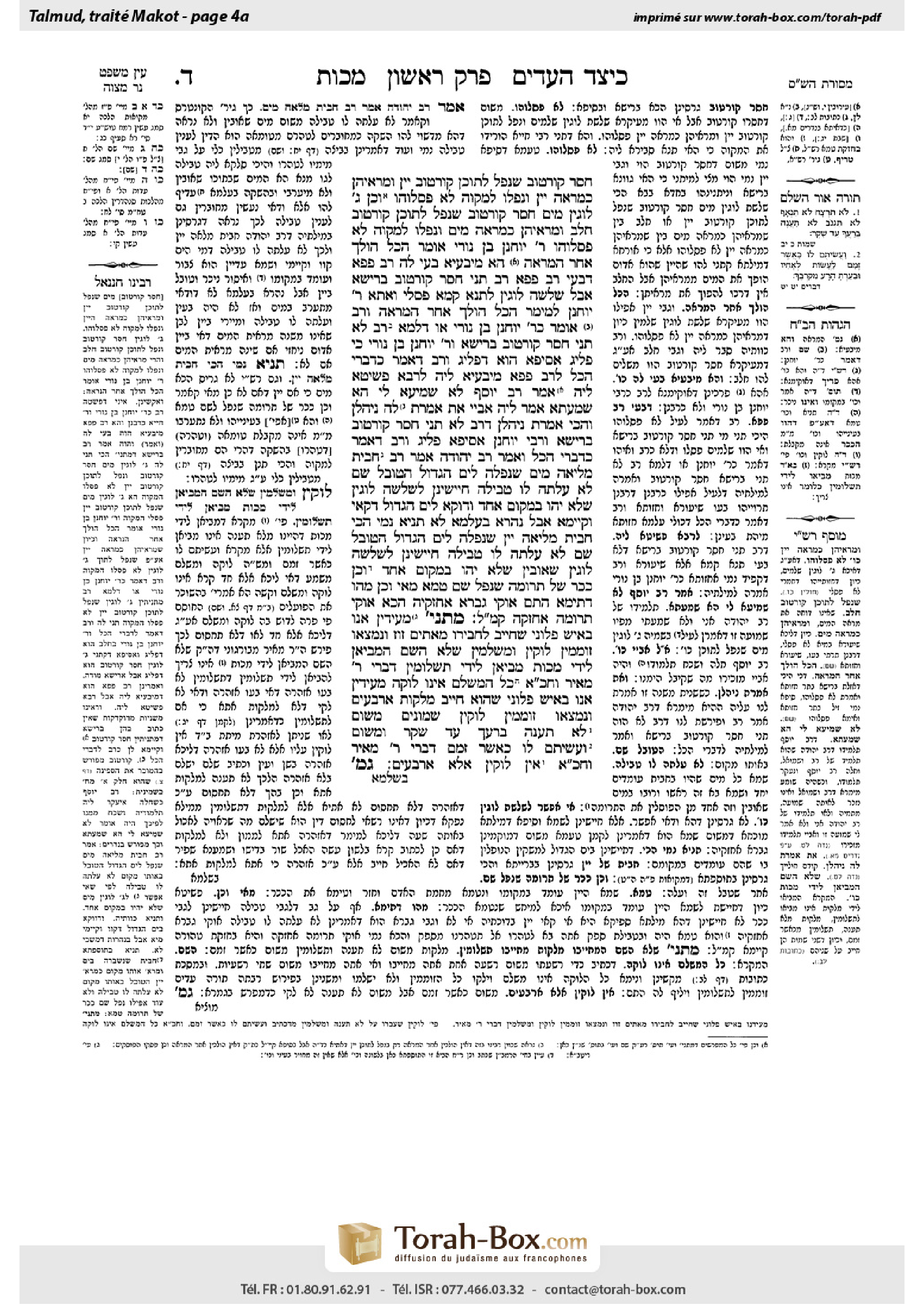
Makkot 4a: Talmud study for Daf Yomi
Daf Yomi is the daily study of one Talmud folio. Explore 37 tractates with scans, Hebrew text, Sefaria English and AI-generated French translations where annotated.
Passage selection and English or AI-generated French translation are available where the scan has annotations. Daf Study is independent of Torah-Box and Sefaria.
Browse Makkot · מכות · All tractatesMakkot 4a text and translations
This page of Makkot includes the Aramaic text, an English translation and an AI-generated French translation, alongside the scan above.
מכות ד׳ א · Aramaic and Hebrew text
חָסֵר קוּרְטוֹב, שֶׁנָּפַל לְתוֹכָן קוּרְטוֹב יַיִן, וּמַרְאֵיהֶן כְּמַרְאֵה יַיִן, וְנָפְלוּ לַמִּקְוֶה – לֹא פְּסָלוּהוּ. וְכֵן שְׁלֹשָׁה לוּגִּין מַיִם חָסֵר קוּרְטוֹב, שֶׁנָּפַל לְתוֹכָן קוּרְטוֹב חָלָב, וּמַרְאֵיהֶן כְּמַרְאֵה מַיִם, וְנָפְלוּ לַמִּקְוֶה – לֹא פְּסָלוּהוּ.
רַבִּי יוֹחָנָן בֶּן נוּרִי אוֹמֵר: הַכֹּל הוֹלֵךְ אַחַר הַמַּרְאֶה.
הָא מִיבַּעְיָא בָּעֵי לַהּ רַב פָּפָּא. דְּבָעֵי רַב פָּפָּא: רַב תָּנֵי: ״חָסֵר קוּרְטוֹב״ בְּרֵישָׁא, אֲבָל שְׁלֹשָׁה לוּגִּין, לְתַנָּא קַמָּא פָּסְלִי, וַאֲתָא רַבִּי יוֹחָנָן לְמֵימַר: הַכֹּל הוֹלֵךְ אַחַר הַמַּרְאֶה, וְרַב אוֹמֵר כְּרַבִּי יוֹחָנָן בֶּן נוּרִי.
אוֹ דִּלְמָא רַב לָא תָּנֵי: ״חָסֵר קוּרְטוֹב״ בְּרֵישָׁא, וְרַבִּי יוֹחָנָן בֶּן נוּרִי – כִּי פְּלִיג, אַסֵּיפָא הוּא דִּפְלִיג,
וְרַב דְּאָמַר – כְּדִבְרֵי הַכֹּל?
לְרַב פָּפָּא מִיבַּעְיָא לֵיהּ, לְרָבָא פְּשִׁיטָא לֵיהּ.
אָמַר רַב יוֹסֵף: לָא שְׁמִיעָא לִי הָא שְׁמַעְתָּא. אֲמַר לֵיהּ אַבָּיֵי: אַתְּ אֲמַרְתְּ לַהּ נִיהֲלַן, וְהָכִי אֲמַרְתְּ נִיהֲלַן, דְּרַב לָא תָּנֵי ״חָסֵר קוּרְטוֹב״ בְּרֵישָׁא, וְרַבִּי יוֹחָנָן אַסֵּיפָא פְּלִיג, וְרַב דְּאָמַר כְּדִבְרֵי הַכֹּל.
וְאָמַר רַב יְהוּדָה אָמַר רַב: חָבִית מְלֵיאָה מַיִם שֶׁנָּפְלָה לַיָּם הַגָּדוֹל, הַטּוֹבֵל שָׁם – לֹא עָלְתָה לוֹ טְבִילָה. חָיְישִׁינַן לִשְׁלֹשָׁה לוּגִּין שֶׁלֹּא יְהוּ בְּמָקוֹם אֶחָד. וְדַוְקָא לַיָּם הַגָּדוֹל, דְּקָאֵי וְקָיְימָא, אֲבָל נַהֲרָא בְּעָלְמָא – לָא.
תַּנְיָא נָמֵי הָכִי: חָבִית מְלֵיאָה יַיִן שֶׁנָּפְלָה לַיָּם הַגָּדוֹל, הַטּוֹבֵל שָׁם – לֹא עָלְתָה לוֹ טְבִילָה. חָיְישִׁינַן לִשְׁלֹשָׁה לוּגִּין שְׁאוּבִין שֶׁלֹּא יְהוּ בְּמָקוֹם אֶחָד. וְכֵן כִּכָּר שֶׁל תְּרוּמָה שֶׁנָּפַל שָׁם – טָמֵא.
מַאי ״וְכֵן״? מַהוּ דְּתֵימָא, הָתָם אוֹקֵי גַּבְרָא אַחֶזְקֵיהּ, הָכָא אוֹקֵי תְּרוּמָה אַחֶזְקַהּ, קָא מַשְׁמַע לַן.
מַתְנִי׳ ״מְעִידִין אָנוּ בְּאִישׁ פְּלוֹנִי שֶׁחַיָּיב לַחֲבֵירוֹ מָאתַיִם זוּז״, וְנִמְצְאוּ זוֹמְמִין – לוֹקִין וּמְשַׁלְּמִין, שֶׁלֹּא הַשֵּׁם הַמְּבִיאָן לִידֵי מַכּוֹת מְבִיאָן לִידֵי תַּשְׁלוּמִין, דִּבְרֵי רַבִּי מֵאִיר. וַחֲכָמִים אוֹמְרִים: כׇּל הַמְשַׁלֵּם – אֵינוֹ לוֹקָה.
״מְעִידִין אָנוּ בְּאִישׁ פְּלוֹנִי שֶׁהוּא חַיָּיב מַלְקוֹת אַרְבָּעִים״, וְנִמְצְאוּ זוֹמְמִין – לוֹקִין שְׁמוֹנִים, מִשּׁוּם: ״לֹא תַעֲנֶה בְרֵעֲךָ עֵד שָׁקֶר״, וּמִשּׁוּם: ״וַעֲשִׂיתֶם לוֹ כַּאֲשֶׁר זָמַם״, דִּבְרֵי רַבִּי מֵאִיר. וַחֲכָמִים אוֹמְרִים: אֵין לוֹקִין אֶלָּא אַרְבָּעִים.
Makkot 4a · English translation
less one kortov or any small measure of water, into which a kortov of wine fell, increasing the measure of liquid to a total of three log, and the appearance of those three log is like the appearance of wine; and then those three log fell into a ritual bath, completing its requisite forty se’a, it did not invalidate the ritual bath, because three log of drawn water invalidate the ritual bath, and less than that measure of water fell into the ritual bath. And likewise, in a case where there are three log of drawn water less one kortov into which a kortov of milk fell and the appearance of those three log is like the appearance of water, and those three log fell into a ritual bath, completing its requisite forty se’a, it did not invalidate the ritual bath, because in this case too, less than three log of drawn water fell into the ritual bath.
Rabbi Yoḥanan ben Nuri says: Everything follows the appearance of those three log. Therefore, if it has the appearance of wine it does not invalidate the ritual bath; if it has the appearance of water it invalidates the ritual bath. Perhaps Rav Yehuda says that Rav says that the mixture of water and wine does not invalidate the ritual bath because he holds in accordance with the opinion of Rabbi Yoḥanan ben Nuri that everything follows the appearance. Rabbi Ḥiyya holds in accordance with the opinion of the first tanna that the amount of drawn water is the decisive factor, and therefore, regardless of its appearance, three log of water invalidates a ritual bath.
The Gemara asks: Wasn’t this matter already raised as a dilemma by Rav Pappa? As Rav Pappa raised a dilemma: There are two ways to explain the mishna. One is that Rav teaches: In a case where there are three log of drawn water less one kortov, in the first clause. But in a case where there are three complete log of water, according to the first tanna, it invalidates the ritual bath even if its appearance is that of wine. And Rabbi Yoḥanan ben Nuri comes to say: Everything follows the appearance, meaning that even in that case, if its appearance is that of wine it does not invalidate the ritual bath. And if that is the dispute, Rav states his opinion in accordance with the opinion of Rabbi Yoḥanan ben Nuri.
Or perhaps Rav did not teach: In a case where there are three log of drawn water less one kortov, in the first clause of the mishna; rather, he taught: In a case where there are three complete log of water into which a kortov of wine fell. According to this version of the mishna, even the first tanna agrees that if its appearance is that of wine it does not invalidate the ritual bath. And when Rabbi Yoḥanan ben Nuri disagrees, it is only with regard to the latter clause that he disagrees, in the case of three log of drawn water less one kortov into which a kortov of milk fell and the appearance of those three log is like the appearance of water. The first tanna holds that in order to invalidate a ritual bath two criteria must be fulfilled: There must be three log of water and its appearance must be that of water. In this case there is less than three log of water. Rabbi Yoḥanan ben Nuri holds that there is only one criterion, appearance. Therefore, in the case of milk, the ritual bath is invalidated.
And according to this latter rendering of the dispute, Rav states his opinion in accordance with the opinion of everyone. Why then does Rava state: This statement of Rav is in accordance with the opinion of Rabbi Yoḥanan ben Nuri?
The Gemara answers: This is not difficult, as although for Rav Pappa there is a dilemma how to interpret the mishna, for Rava it is obvious.
Apropos this discussion, the Gemara relates that Rav Yosef said: I did not hear this halakha with regard to the dilemma whether the first clause of the mishna includes the phrase: Less one kortov. Abaye said to him: You said it to us, but you forgot due to your illness. And this is what you said to us: Rav did not teach: Less one kortov, in the first clause of the mishna, and Rabbi Yoḥanan ben Nuri disagrees only with regard to the latter clause, and it is Rav who states his opinion in accordance with the opinion of everyone.
§ And Rav Yehuda says that Rav says: In the case of a barrel full of drawn water that fell into the Mediterranean Sea, concerning one who immerses there in the spot where the water fell, the immersion did not effect his purification, because we are concerned that three log of drawn water should not be collected in one place, in the place where he immerses. The Gemara qualifies this halakha: And this applies specifically to the Mediterranean Sea, whose waters are largely stagnant. But in the case of a standard river, whose waters flow, no, this halakha does not apply, as the water from the barrel will immediately intermingle with the river water.
The Gemara notes: This is also taught in a baraita: In the case of a barrel full of wine that fell into the Mediterranean Sea, concerning one who immerses there, the immersion did not effect his purification, because we are concerned that three log of drawn wine that is unfit for immersion should not be collected in one place. And likewise, a loaf of teruma that fell there, where the wine fell, is impure through contact with the wine.
The Gemara asks: What is added by the clause introduced with the term: And likewise? If the concern is that the wine remained in one place and did not intermingle with the seawater, ostensibly that concern applies to halakhot of ritual impurity. The Gemara answers: Lest you say that there, with regard to immersion, the reason he is impure is that since there is uncertainty whether his immersion effected his purification, the principle is: Establish the person on his presumptive status of impurity. But here, in the case of a loaf of teruma, since there is uncertainty whether it was rendered impure, the principle is: Establish the teruma on its presumptive status of purity. Therefore, the tanna of the baraita teaches us that the concern that the loaf touched the wine is substantial to the extent that it prevails even over the loaf’s presumptive status of purity.
MISHNA: If witnesses said: We testify with regard to a man called so-and-so that he is liable to pay another person two hundred dinars, and they were found to be conspiring witnesses, they are flogged, and they pay the money they sought to render him liable to pay. Why do they receive two punishments? It is due to the fact that the source that brings them to liability to receive lashes is not the source that brings them to liability for payment; this is the statement of Rabbi Meir. And the Rabbis say: Anyone who pays as punishment for a transgression is not flogged for that same transgression.
Likewise, if witnesses said: We testify with regard to a man called so-and-so that he is liable to receive forty lashes, and they were discovered to be conspiring witnesses, they are flogged with eighty lashes; one set of lashes due to violation of the prohibition: “You shall not bear false witness against your neighbor” (Exodus 20:13), and one set of lashes due to the verse: “And you shall do to him as he conspired” (Deuteronomy 19:19), which is the punishment for conspiring witnesses; this is the statement of Rabbi Meir. And the Rabbis say: They are flogged with only forty lashes, due to the verse “And you shall do to him as he conspired.”
Makkot 4a · Traduction française (IA)
moins un kortov, ou toute petite mesure d’eau dans laquelle est tombé un kortov de vin, portant la quantité totale de liquide à trois log, et dont l’aspect est celui du vin ; puis ces trois log sont tombés dans un mikvé, complétant les quarante séa requis : ils n’ont pas invalidé le mikvé, car ce sont trois log d’eau puisée qui invalident un mikvé, et une quantité d’eau inférieure à cette mesure est tombée dans le mikvé. De même, dans le cas où il y a trois log d’eau puisée moins un kortov, dans lesquels est tombé un kortov de lait, et dont l’aspect est celui de l’eau, ces trois log sont tombés dans un mikvé, complétant les quarante séa requis : ils n’ont pas invalidé le mikvé, car, dans ce cas aussi, moins de trois log d’eau puisée sont tombés dans le mikvé.
Rabbi Yoḥanan ben Nuri dit : Tout dépend de l’aspect de ces trois log. Par conséquent, si leur aspect est celui du vin, ils n’invalident pas le mikvé ; si leur aspect est celui de l’eau, ils l’invalident. Peut-être Rav Yehuda dit-il au nom de Rav que le mélange d’eau et de vin n’invalide pas le mikvé parce qu’il suit l’opinion de Rabbi Yoḥanan ben Nuri, selon laquelle tout dépend de l’aspect. Rabbi Ḥiyya suit l’opinion du premier tanna, selon laquelle la quantité d’eau puisée est le facteur déterminant ; par conséquent, quel que soit son aspect, trois log d’eau invalident un mikvé.
La Guemara demande : Cette question n’avait-elle pas déjà été soulevée par Rav Pappa ? Rav Pappa avait en effet soulevé la question suivante : Il y a deux façons d’expliquer la Michna. Selon l’une, Rav enseigne, dans le premier cas, qu’il s’agit de trois log d’eau puisée moins un kortov. Mais, s’il s’agit de trois log complets d’eau, selon le premier tanna, le mélange invalide le mikvé même si son aspect est celui du vin. Rabbi Yoḥanan ben Nuri vient alors dire que tout dépend de l’aspect, c’est-à-dire que même dans ce cas, si son aspect est celui du vin, le mélange n’invalide pas le mikvé. Si tel est le désaccord, Rav énonce son opinion conformément à celle de Rabbi Yoḥanan ben Nuri.
Ou peut-être Rav n’a-t-il pas enseigné, dans le premier cas de la Michna, qu’il s’agit de trois log d’eau puisée moins un kortov ; il a plutôt enseigné qu’il s’agit de trois log complets d’eau dans lesquels est tombé un kortov de vin. Selon cette version de la Michna, même le premier tanna convient que si l’aspect est celui du vin, le mélange n’invalide pas le mikvé. Rabbi Yoḥanan ben Nuri n’est en désaccord que sur le dernier cas : celui de trois log d’eau puisée moins un kortov, dans lesquels est tombé un kortov de lait, et dont l’aspect est celui de l’eau. Le premier tanna considère que deux critères doivent être réunis pour invalider un mikvé : il faut qu’il y ait trois log d’eau et que leur aspect soit celui de l’eau. Dans ce cas, il y a moins de trois log d’eau. Rabbi Yoḥanan ben Nuri considère qu’un seul critère est nécessaire : l’aspect. Par conséquent, dans le cas du lait, le mikvé est invalidé.
Selon cette dernière interprétation du désaccord, Rav énonce son opinion conformément à celle de tous. Pourquoi Rava dit-il alors : « Cette déclaration de Rav est conforme à l’opinion de Rabbi Yoḥanan ben Nuri » ?
La Guemara répond : Il n’y a pas de difficulté, car si Rav Pappa hésite sur la manière d’interpréter la Michna, pour Rava, cela est évident.
À propos de cette discussion, la Guemara rapporte que Rav Yosef a dit : « Je n’ai pas entendu cette halakha concernant la question de savoir si le premier cas de la Michna comporte la formule “moins un kortov”. » Abaye lui dit : « Tu nous l’as dit, mais tu l’as oublié à cause de ta maladie. » Voici ce que tu nous avais dit : Rav n’a pas enseigné « moins un kortov » dans le premier cas de la Michna ; Rabbi Yoḥanan ben Nuri n’est en désaccord que sur le dernier cas, et Rav énonce son opinion conformément à celle de tous.
§ Rav Yehuda dit au nom de Rav : Dans le cas d’un tonneau rempli d’eau puisée qui est tombé dans la mer Méditerranée, celui qui s’y immerge à l’endroit où l’eau est tombée n’est pas purifié par son immersion, car nous craignons que trois log d’eau puisée ne se rassemblent en un seul endroit, là où il s’immerge. La Guemara précise cette halakha : cela s’applique uniquement à la mer Méditerranée, dont les eaux sont en grande partie stagnantes. Mais dans le cas d’une rivière ordinaire, dont les eaux s’écoulent, cette halakha ne s’applique pas, car l’eau du tonneau se mêle immédiatement à celle de la rivière.
La Guemara note : Cela est également enseigné dans une baraïta : Dans le cas d’un tonneau rempli de vin qui est tombé dans la mer Méditerranée, celui qui s’y immerge n’est pas purifié par son immersion, car nous craignons que trois log de vin, impropres à l’immersion, ne se rassemblent en un seul endroit. De même, un pain de terouma tombé là, à l’endroit où le vin est tombé, devient impur au contact du vin.
La Guemara demande : Qu’ajoute la clause introduite par les mots « et de même » ? Si l’on craint que le vin soit resté au même endroit sans se mêler à l’eau de mer, cette crainte s’applique, semble-t-il, aux halakhot de l’impureté rituelle. La Guemara répond : De peur que tu ne dises qu’en ce qui concerne l’immersion, la raison pour laquelle il demeure impur est que, puisqu’il existe un doute quant à savoir si son immersion l’a purifié, le principe est : on maintient la personne dans son statut présumé d’impureté. Mais ici, dans le cas d’un pain de terouma, puisqu’il existe un doute quant à savoir s’il a été rendu impur, le principe est : on maintient la terouma dans son statut présumé de pureté. Le tanna de la baraïta nous enseigne donc que la crainte que le pain ait touché le vin est suffisamment fondée pour prévaloir même sur le statut présumé de pureté du pain.
MICHNA : Si des témoins ont dit : « Nous témoignons au sujet d’un homme appelé Untel qu’il est redevable à une autre personne de deux cents dinars », et qu’il a été établi qu’ils étaient des témoins comploteurs, ils sont fouettés et paient la somme qu’ils cherchaient à faire condamner cet homme à verser. Pourquoi reçoivent-ils deux châtiments ? Parce que la source qui les rend passibles de la flagellation n’est pas celle qui les rend passibles d’un paiement. Telle est la déclaration de Rabbi Meïr. Et les Sages disent : Quiconque paie une peine pour une transgression ne reçoit pas la flagellation pour cette même transgression.
De même, si des témoins ont dit : « Nous témoignons au sujet d’un homme appelé Untel qu’il est passible de recevoir quarante coups », et qu’il a été établi qu’ils étaient des témoins comploteurs, ils reçoivent quatre-vingts coups : une série de coups pour avoir transgressé l’interdiction « Tu ne porteras pas de faux témoignage contre ton prochain » (Exode 20, 13), et une autre série en vertu du verset « Vous lui ferez ce qu’il avait projeté de faire » (Deutéronome 19, 19), qui prescrit la peine des témoins comploteurs. Telle est la déclaration de Rabbi Meïr. Et les Sages disent : Ils ne reçoivent que quarante coups, en vertu du verset « Vous lui ferez ce qu’il avait projeté de faire ».
Traduction française générée par IA à partir de l’édition anglaise de Sefaria. Vérifie toujours un passage avec le texte source.
Text from Sefaria: William Davidson Edition - Vocalized Aramaic (CC BY NC); William Davidson Edition - English (CC BY NC).