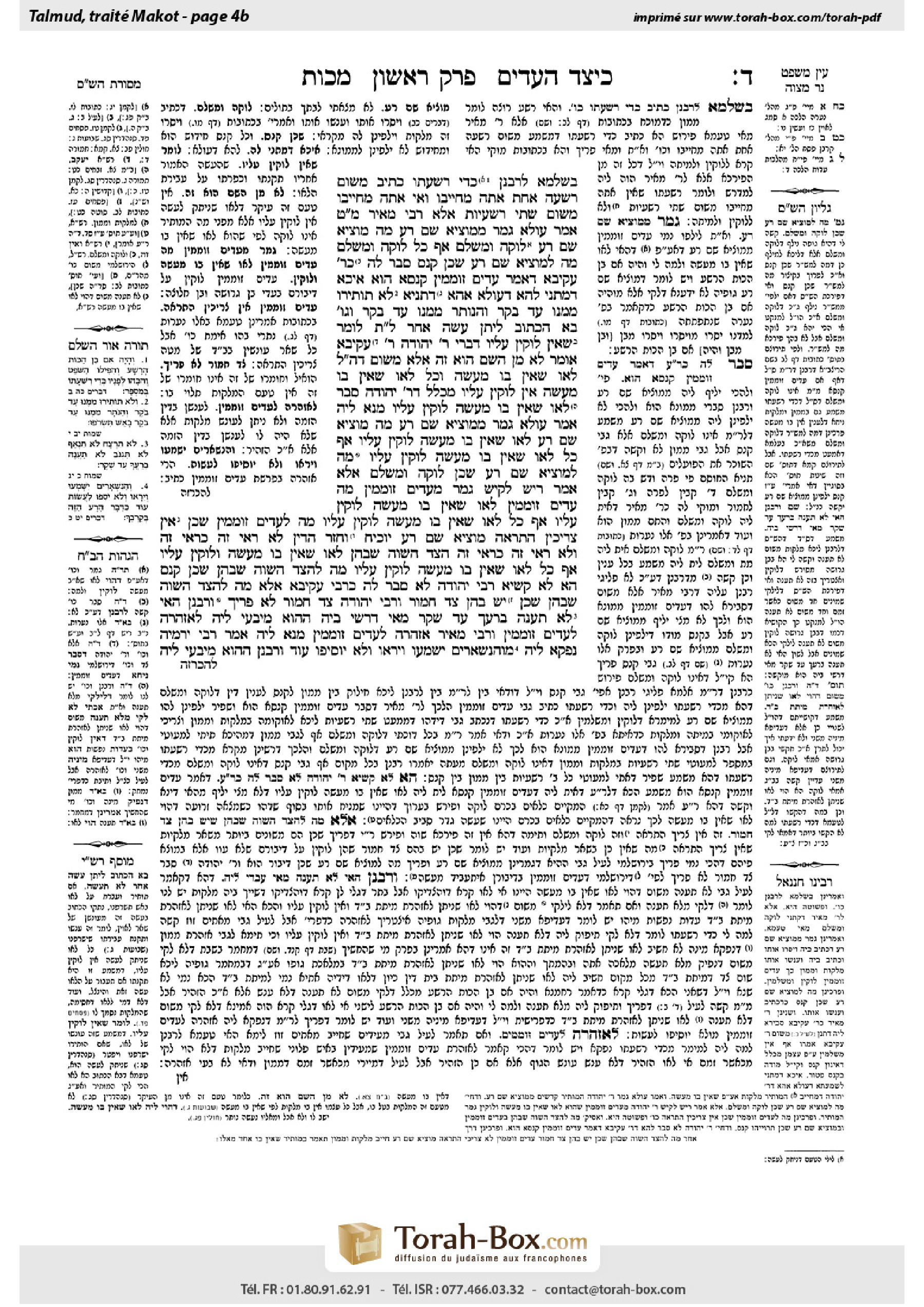
Makkot 4b: Talmud study for Daf Yomi
Daf Yomi is the daily study of one Talmud folio. Explore 37 tractates with scans, Hebrew text, Sefaria English and AI-generated French translations where annotated.
Passage selection and English or AI-generated French translation are available where the scan has annotations. Daf Study is independent of Torah-Box and Sefaria.
Browse Makkot · מכות · All tractatesMakkot 4b text and translations
This page of Makkot includes the Aramaic text, an English translation and an AI-generated French translation, alongside the scan above.
מכות ד׳ ב · Aramaic and Hebrew text
גְּמָ׳ בִּשְׁלָמָא לְרַבָּנַן. ״כְּדֵי רִשְׁעָתוֹ״ כְּתִיב, מִשּׁוּם רִשְׁעָה אַחַת אַתָּה מְחַיְּיבוֹ וְאִי אַתָּה מְחַיְּיבוֹ מִשּׁוּם שְׁתֵּי רִשְׁעָיוֹת. אֶלָּא רַבִּי מֵאִיר מַאי טַעְמָא?
אָמַר עוּלָּא: גָּמַר מִמּוֹצִיא שֵׁם רַע. מָה מוֹצִיא שֵׁם רַע – לוֹקֶה וּמְשַׁלֵּם, אַף כֹּל – לוֹקֶה וּמְשַׁלֵּם. מָה לְמוֹצִיא שֵׁם רַע, שֶׁכֵּן קְנָס! סָבַר לַהּ כְּרַבִּי עֲקִיבָא, דְּאָמַר: עֵדִים זוֹמְמִין – קְנָסָא הוּא.
אִיכָּא דְּמַתְנֵי לְהָא דְּעוּלָּא אַהָא דְּתַנְיָא: ״לֹא תוֹתִירוּ מִמֶּנּוּ עַד בֹּקֶר וְהַנֹּתָר מִמֶּנּוּ עַד בֹּקֶר, וְגוֹ׳״ – בָּא הַכָּתוּב לִיתֵּן עֲשֵׂה אַחַר לֹא תַעֲשֶׂה, לוֹמַר שֶׁאֵין לוֹקִין עָלָיו, דִּבְרֵי רַבִּי יְהוּדָה.
רַבִּי עֲקִיבָא אוֹמֵר: לֹא מִן הַשֵּׁם הוּא זֶה, אֶלָּא מִשּׁוּם דְּהָוֵה לֵיהּ לָאו שֶׁאֵין בּוֹ מַעֲשֶׂה, וְכׇל לָאו שֶׁאֵין בּוֹ מַעֲשֶׂה אֵין לוֹקִין עָלָיו. מִכְּלָל דְּרַבִּי יְהוּדָה סָבַר לָאו שֶׁאֵין בּוֹ מַעֲשֶׂה לוֹקִין עָלָיו, מְנָא לֵיהּ?
אָמַר עוּלָּא: גָּמַר מִמּוֹצִיא שֵׁם רַע. מָה מוֹצִיא שֵׁם רַע לָאו שֶׁאֵין בּוֹ מַעֲשֶׂה – לוֹקִין עָלָיו, אַף כׇּל לָאו שֶׁאֵין בּוֹ מַעֲשֶׂה – לוֹקִין עָלָיו. מָה לְמוֹצִיא שֵׁם רַע, שֶׁכֵּן לוֹקֶה וּמְשַׁלֵּם!
אֶלָּא אָמַר רֵישׁ לָקִישׁ: גָּמַר מֵעֵדִים זוֹמְמִין. מָה עֵדִים זוֹמְמִין לָאו שֶׁאֵין בּוֹ מַעֲשֶׂה – לוֹקִין עָלָיו, אַף כׇּל לָאו שֶׁאֵין בּוֹ מַעֲשֶׂה – לוֹקִין עָלָיו. מָה לְעֵדִים זוֹמְמִין, שֶׁכֵּן אֵין צְרִיכִין הַתְרָאָה!
מוֹצִיא שֵׁם רַע יוֹכִיחַ. וְחָזַר הַדִּין: לֹא רְאִי זֶה כִּרְאִי זֶה, וְלֹא רְאִי זֶה כִּרְאִי זֶה. הַצַּד הַשָּׁוֶה שֶׁבָּהֶן – לָאו שֶׁאֵין בּוֹ מַעֲשֶׂה וְלוֹקִין עָלָיו, אַף כׇּל לָאו שֶׁאֵין בּוֹ מַעֲשֶׂה לוֹקִין עָלָיו.
מָה לְהַצַּד הַשָּׁוֶה שֶׁבָּהֶן, שֶׁכֵּן קְנָס! הָא לָא קַשְׁיָא: רַבִּי יְהוּדָה לָא סָבַר לַהּ כְּרַבִּי עֲקִיבָא.
אֶלָּא: מָה לְהַצַּד הַשָּׁוֶה שֶׁבָּהֶן, שֶׁכֵּן יֵשׁ בָּהֶן צַד חָמוּר! וְרַבִּי יְהוּדָה? צַד חָמוּר לָא פָּרֵיךְ.
וְרַבָּנַן, הַאי ״לֹא תַעֲנֶה בְרֵעֲךָ עֵד שָׁקֶר״ מַאי דָּרְשִׁי בֵּיהּ?
הַהוּא מִיבְּעֵי לֵיהּ לְאַזְהָרָה לְעֵדִים זוֹמְמִין. וְרַבִּי מֵאִיר, אַזְהָרָה לְעֵדִים זוֹמְמִין מְנָא לֵיהּ? אָמַר רַבִּי יִרְמְיָה: נָפְקָא לֵיהּ מִ״וְּהַנִּשְׁאָרִים יִשְׁמְעוּ וְיִרָאוּ וְלֹא יֹסִיפוּ עוֹד״.
וְרַבָּנַן? הַהוּא מִיבְּעֵי לֵיהּ
Makkot 4b · English translation
GEMARA: With regard to the initial dispute between Rabbi Meir and the Rabbis in the mishna whether conspiring witnesses pay and are flogged, the Gemara asks: Granted, according to the Rabbis, the verse that states: “The judge shall cause him to lie down, and to be beaten before him, according to the measure of his wickedness” (Deuteronomy 25:2), is written concerning one who was liable to receive lashes. From “according to the measure of his wickedness” it is inferred with regard to an individual who commits one transgression: For one evildoing you can render him liable, but you cannot render him liable for two evildoings, i.e., one cannot receive two punishments for the same act. But according to Rabbi Meir, what is the reason that he is punished twice for committing a single transgression?
Ulla said: Rabbi Meir derived this halakha from the halakha concerning one who defames his wife, claiming that when he consummated the marriage he discovered that she was not a virgin: Just as the defamer is flogged and pays, as it is written: “And they shall chastise him and fine him one hundred silver coins” (Deuteronomy 22:18–19), so too, anyone who commits a transgression punishable with lashes and a monetary payment is flogged and pays. The Gemara questions this derivation: What is notable about the case of a defamer? It is notable in that the payment of the defamer is a fine, which is a fixed sum that the Torah deems him liable to pay. How can the halakha of conspiring witnesses, whose payment is monetary restitution, be derived from there? The Gemara answers: Rabbi Meir holds in accordance with the opinion of Rabbi Akiva, who says: The payment that conspiring witnesses are liable to pay is a fine.
The Gemara comments: There are those who teach this statement of Ulla with regard to that which is taught in a baraita: It is stated with regard to the Paschal offering: “And you shall let nothing of it remain until morning, but that which remains of it until morning you shall burn with fire” (Exodus 12:10). The verse comes to provide a positive mitzva to burn the remains after it has taught a prohibition, which states: “You shall let nothing of it remain,” to say that one is not flogged for its violation; this is the statement of Rabbi Yehuda. This is a prohibition whose transgression entails the fulfillment of a positive mitzva, in which the mitzva serves to rectify the violation of the prohibition, and no lashes are administered.
Rabbi Akiva says: The fact that one is not flogged is not for that reason; rather, it is due to the fact that this prohibition: “And you shall let nothing of it remain,” is a prohibition that does not involve an action, as one violates the prohibition through failure to take action, and concerning any prohibition that does not involve an action, one is not flogged for its violation. The Gemara learns by inference that Rabbi Yehuda holds in principle with regard to a prohibition that does not involve an action, that one is flogged for its violation. From where does Rabbi Yehuda derive that one is flogged in that case?
Ulla said: Rabbi Yehuda derived this halakha from the defamer; just as the defamer violates a prohibition that does not involve an action, as it involves only speech, and one is flogged for its violation, so too, with regard to any prohibition that does not involve an action, one is flogged for its violation. The Gemara questions this derivation: What is notable about the case of the defamer? It is notable in that he is flogged and pays for violation of a single prohibition. Due to that stringency, other less stringent prohibitions cannot be derived from the case of the defamer.
Rather, Reish Lakish says: Rabbi Yehuda derives this principle from the case of conspiring witnesses. Just as the conspiring witnesses violate a prohibition that does not involve an action and an individual is flogged for its violation, so too, with regard to any prohibition that does not involve an action, one is flogged for its violation. The Gemara questions this derivation: What is notable about the case of conspiring witnesses? It is notable in that the witnesses do not require forewarning in order to administer their punishment, which is an exception to the principle that corporal punishment may be administered only after forewarning. Due to that stringency, other less stringent prohibitions cannot be derived from the case of conspiring witnesses.
The Gemara answers: The case of the defamer will prove that the absence of forewarning is not a significant factor, as the defamer requires forewarning and nevertheless is flogged for a prohibition that does not involve an action. And the inference has reverted to its starting point. The defining characteristic of this case is not like the defining characteristic of that case, and the defining characteristic of that case is not like the defining characteristic of this case. Their common denominator is that in both cases there is a prohibition that does not involve an action and one is flogged for its violation. So too, with regard to any prohibition that does not involve an action, one is flogged for its violation.
The Gemara questions this derivation: What is notable about their common denominator? They are notable in that payment in both cases is a fine, and therefore other, less stringent prohibitions cannot be derived from them. The Gemara answers: This is not difficult; Rabbi Yehuda does not hold in accordance with the opinion of Rabbi Akiva that the payment of conspiring witnesses is a fine. In his opinion, therefore, that is not a common denominator.
Rather, the Gemara proposes an alternative refutation: What is notable about their common denominator? They are notable in that the cases of the defamer and of conspiring witnesses both contain a stringent aspect; therefore, other, less stringent prohibitions cannot be derived from them. The stringency in the case of the defamer is that he both is flogged and pays, and the stringency in the case of conspiring witnesses is that they do not require forewarning. The Gemara answers: And Rabbi Yehuda does not refute a derivation from a common denominator based on the fact that both cases contain a different stringent aspect. He holds that the mere fact that there is a stringency in each does not serve as a common denominator.
§ The Gemara resumes its analysis of the dispute between Rabbi Meir and the Rabbis in the case of conspiring witnesses who testify that another is liable to receive lashes. Rabbi Meir holds that they are flogged with eighty lashes, one set of lashes due to violation of the prohibition: “You shall not bear false witness against your neighbor” (Exodus 20:13), and one set of lashes due to the verse: “And you shall do to him as he conspired” (Deuteronomy 19:19). The Rabbis say: They are flogged with only forty lashes, due to the verse “And you shall do to him as he conspired.” The Gemara asks: And with regard to the Rabbis, concerning this verse: “You shall not bear false witness against your neighbor,” what do they derive from it, if one is not flogged for its violation?
The Gemara answers: They require that verse as a prohibition against conspiring witnesses. Every punishment enumerated in the Torah, including that of conspiring witnesses, is accompanied by an explicit verse prohibiting the action that results in the punishment. The Gemara asks: And with regard to Rabbi Meir, who holds that conspiring witnesses are flogged for violating this prohibition, from where does he derive a prohibition for conspiring witnesses? Rabbi Yirmeya said: He derives it from the verse written in the context of conspiring witnesses: “And those who remain shall hear and fear, and shall not continue to perform any more evil of this kind in your midst” (Deuteronomy 19:20). The verse warns that conspiring witnesses should not continue with their sinful conduct.
The Gemara asks: And concerning the Rabbis, what do they derive from that verse? The Gemara answers: That verse is necessary according to the Rabbis
Makkot 4b · Traduction française (IA)
GUEMARA : À propos de la controverse initiale entre Rabbi Meïr et les Sages dans la Michna, concernant la question de savoir si les témoins conspirateurs paient et reçoivent des coups, la Guemara demande : Certes, selon les Sages, le verset qui dit : « Le juge le fera coucher et le fera battre devant lui, selon la mesure de sa méchanceté » (Deutéronome 25, 2) concerne celui qui est passible de coups. De l’expression « selon la mesure de sa méchanceté », on déduit, à propos d’un individu qui commet une seule transgression : pour une faute, on peut le rendre passible d’une peine, mais on ne peut pas le rendre passible de deux peines ; autrement dit, on ne peut pas lui infliger deux châtiments pour un même acte. Mais selon Rabbi Meïr, pour quelle raison est-il puni deux fois pour avoir commis une seule transgression ?
Oula dit : Rabbi Meïr déduit cette halakha de celle qui concerne l’homme qui diffame sa femme en prétendant qu’après avoir consommé le mariage, il a découvert qu’elle n’était pas vierge. De même que le diffamateur reçoit des coups et paie, comme il est écrit : « Ils le châtieront et lui imposeront une amende de cent pièces d’argent » (Deutéronome 22, 18-19), de même, quiconque commet une transgression passible de coups et d’une peine pécuniaire reçoit des coups et paie. La Guemara conteste cette déduction : Qu’a de particulier le cas du diffamateur ? Le paiement qu’il doit verser est une amende, somme fixe que la Torah le rend passible de payer. Comment peut-on en déduire la halakha des témoins conspirateurs, dont le paiement consiste en une réparation pécuniaire ? La Guemara répond : Rabbi Meïr suit l’opinion de Rabbi Akiva, selon laquelle le paiement auquel les témoins conspirateurs sont passibles est une amende.
La Guemara commente : Certains enseignent cette déclaration d’Oula à propos de ce qui est enseigné dans une baraïta : Au sujet de l’offrande pascale, il est dit : « Vous n’en laisserez rien jusqu’au matin ; ce qui en restera jusqu’au matin, vous le brûlerez au feu » (Exode 12, 10). Après avoir énoncé l’interdiction « Vous n’en laisserez rien », le verset vient prescrire, au titre d’une mitsva positive, de brûler les restes, afin d’enseigner qu’on ne reçoit pas de coups pour avoir transgressé cette interdiction ; telle est la déclaration de Rabbi Yehouda. Il s’agit d’une interdiction dont la transgression entraîne l’accomplissement d’une mitsva positive qui vient réparer cette transgression ; aucune peine de coups n’est donc administrée.
Rabbi Akiva dit : Si l’on ne reçoit pas de coups, ce n’est pas pour cette raison ; c’est plutôt parce que l’interdiction « Vous n’en laisserez rien » n’implique pas d’action, car on la transgresse en s’abstenant d’agir. Or, on ne reçoit pas de coups pour avoir transgressé une interdiction qui n’implique pas d’action. La Guemara déduit que, selon Rabbi Yehouda, en principe, on reçoit des coups pour avoir transgressé une interdiction qui n’implique pas d’action. De quoi Rabbi Yehouda déduit-il qu’on reçoit des coups dans ce cas ?
Oula dit : Rabbi Yehouda déduit cette halakha du cas du diffamateur. De même que le diffamateur transgresse une interdiction qui n’implique pas d’action, puisqu’elle consiste uniquement en paroles, et qu’il reçoit des coups pour cette transgression, de même, on reçoit des coups pour avoir transgressé toute interdiction qui n’implique pas d’action. La Guemara conteste cette déduction : Qu’a de particulier le cas du diffamateur ? Il a ceci de particulier qu’il reçoit des coups et paie pour avoir transgressé une seule interdiction. En raison de cette rigueur, on ne peut pas déduire de son cas ce qui s’applique à des interdictions moins rigoureuses.
Au contraire, Reish Lakish dit : Rabbi Yehouda déduit ce principe du cas des témoins conspirateurs. De même que les témoins conspirateurs transgressent une interdiction qui n’implique pas d’action et qu’un individu reçoit des coups pour cette transgression, de même, on reçoit des coups pour avoir transgressé toute interdiction qui n’implique pas d’action. La Guemara conteste cette déduction : Qu’a de particulier le cas des témoins conspirateurs ? Ils ont ceci de particulier qu’aucun avertissement préalable n’est nécessaire pour leur infliger leur peine, ce qui fait exception au principe selon lequel une peine corporelle ne peut être infligée qu’après un avertissement préalable. En raison de cette rigueur, on ne peut pas déduire de leur cas ce qui s’applique à des interdictions moins rigoureuses.
La Guemara répond : Le cas du diffamateur prouvera que l’absence d’avertissement préalable n’est pas un facteur déterminant, car le diffamateur doit recevoir un avertissement préalable et reçoit néanmoins des coups pour avoir transgressé une interdiction qui n’implique pas d’action. L’inférence revient donc à son point de départ. La caractéristique déterminante de ce cas n’est pas celle de l’autre cas, et celle de l’autre cas n’est pas celle de ce cas. Leur dénominateur commun est que, dans les deux cas, il s’agit d’une interdiction qui n’implique pas d’action et que l’on reçoit des coups pour l’avoir transgressée. De même, on reçoit des coups pour avoir transgressé toute interdiction qui n’implique pas d’action.
La Guemara conteste cette déduction : Qu’a de particulier leur dénominateur commun ? Dans les deux cas, le paiement est une amende ; on ne peut donc pas en déduire ce qui s’applique à des interdictions moins rigoureuses. La Guemara répond : Cela ne pose pas de difficulté : Rabbi Yehouda ne suit pas l’opinion de Rabbi Akiva, selon laquelle le paiement des témoins conspirateurs est une amende. À son avis, ce n’est donc pas un dénominateur commun.
Au contraire, la Guemara propose une autre réfutation : Qu’a de particulier leur dénominateur commun ? Les cas du diffamateur et des témoins conspirateurs comportent tous deux un aspect rigoureux ; on ne peut donc pas en déduire ce qui s’applique à des interdictions moins rigoureuses. Dans le cas du diffamateur, la rigueur tient au fait qu’il reçoit à la fois des coups et doit payer ; dans le cas des témoins conspirateurs, elle tient au fait qu’ils n’ont pas besoin d’un avertissement préalable. La Guemara répond : Rabbi Yehouda ne réfute pas une déduction fondée sur un dénominateur commun au motif que les deux cas comportent chacun un aspect rigoureux différent. Selon lui, le simple fait qu’il y ait une rigueur dans chacun des cas ne constitue pas un dénominateur commun.
§ La Guemara reprend son analyse de la controverse entre Rabbi Meïr et les Sages au sujet des témoins conspirateurs qui témoignent qu’un autre est passible de coups. Rabbi Meïr estime qu’ils reçoivent quatre-vingts coups : une série pour avoir transgressé l’interdiction « Tu ne porteras pas de faux témoignage contre ton prochain » (Exode 20, 13), et une série en vertu du verset « Vous lui ferez comme il avait conspiré » (Deutéronome 19, 19). Les Sages disent qu’ils ne reçoivent que quarante coups, en vertu du verset « Vous lui ferez comme il avait conspiré ». La Guemara demande : Et les Sages, que déduisent-ils du verset « Tu ne porteras pas de faux témoignage contre ton prochain », s’ils n’infligent pas de coups pour sa transgression ?
La Guemara répond : Ils ont besoin de ce verset pour établir l’interdiction visant les témoins conspirateurs. Chaque peine énoncée dans la Torah, y compris celle des témoins conspirateurs, est accompagnée d’un verset explicite interdisant l’acte qui entraîne cette peine. La Guemara demande : Et Rabbi Meïr, qui estime que les témoins conspirateurs reçoivent des coups pour avoir transgressé cette interdiction, de quoi déduit-il l’interdiction visant les témoins conspirateurs ? Rabbi Yirmeya dit : Il la déduit du verset écrit dans le contexte des témoins conspirateurs : « Ceux qui resteront l’apprendront et craindront, et ne recommenceront plus à commettre une telle mauvaise action au milieu de toi » (Deutéronome 19, 20). Le verset avertit les témoins conspirateurs de ne pas poursuivre leur conduite fautive.
La Guemara demande : Et les Sages, que déduisent-ils de ce verset ? La Guemara répond : Ce verset est nécessaire aux Sages.
Traduction française générée par IA à partir de l’édition anglaise de Sefaria. Vérifie toujours un passage avec le texte source.
Text from Sefaria: William Davidson Edition - Vocalized Aramaic (CC BY NC); William Davidson Edition - English (CC BY NC).