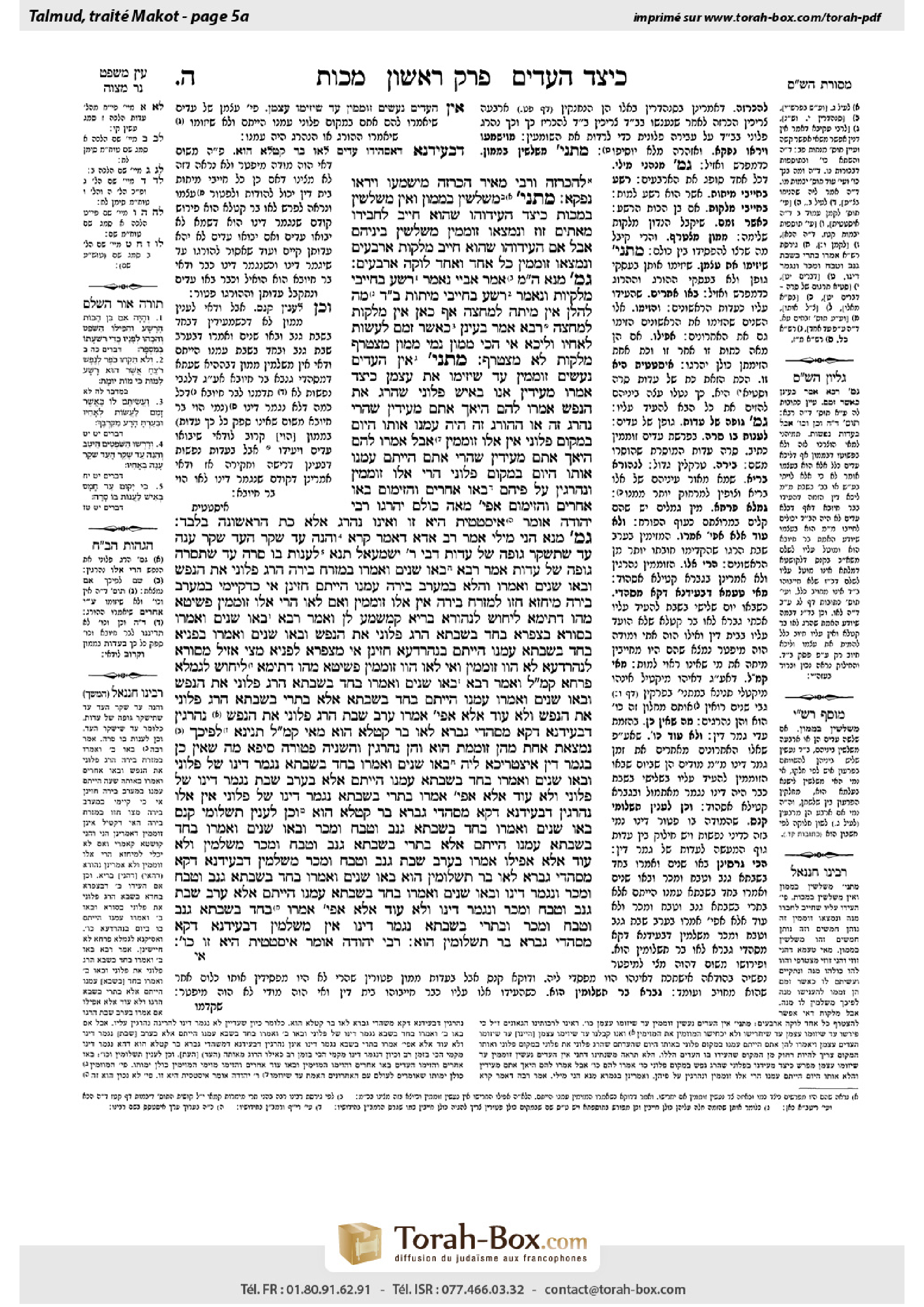
Makkot 5a: Talmud study for Daf Yomi
Daf Yomi is the daily study of one Talmud folio. Explore 37 tractates with scans, Hebrew text, Sefaria English and AI-generated French translations where annotated.
Passage selection and English or AI-generated French translation are available where the scan has annotations. Daf Study is independent of Torah-Box and Sefaria.
Browse Makkot · מכות · All tractatesMakkot 5a text and translations
This page of Makkot includes the Aramaic text, an English translation and an AI-generated French translation, alongside the scan above.
מכות ה׳ א · Aramaic and Hebrew text
לְהַכְרָזָה. וְרַבִּי מֵאִיר? הַכְרָזָה מִ״יִּשְׁמְעוּ וְיִרָאוּ״ נָפְקָא.
מַתְנִי׳ מְשַׁלְּשִׁין בַּמָּמוֹן וְאֵין מְשַׁלְּשִׁין בַּמַּכּוֹת. כֵּיצַד? הֶעִידוּהוּ שֶׁהוּא חַיָּיב לַחֲבֵירוֹ מָאתַיִם זוּז וְנִמְצְאוּ זוֹמְמִין – מְשַׁלְּשִׁין בֵּינֵיהֶם. אֲבָל אִם הֶעִידוּהוּ שֶׁהוּא חַיָּיב מַלְקוֹת אַרְבָּעִים וְנִמְצְאוּ זוֹמְמִין – כׇּל אֶחָד וְאֶחָד לוֹקֶה אַרְבָּעִים.
גְּמָ׳ מְנָא הָנֵי מִילֵּי? אָמַר אַבָּיֵי: נֶאֱמַר ״רָשָׁע״ בְּחַיָּיבֵי מַלְקִיּוֹת, וְנֶאֱמַר ״רָשָׁע״ בְּחַיָּיבֵי מִיתוֹת בֵּית דִּין. מָה לְהַלָּן – אֵין מִיתָה לְמֶחֱצָה, אַף כָּאן – אֵין מַלְקוֹת לְמֶחֱצָה.
רָבָא אָמַר: בָּעִינַן ״כַּאֲשֶׁר זָמַם לַעֲשׂוֹת לְאָחִיו״, וְלֵיכָּא. אִי הָכִי, מָמוֹן נָמֵי! מָמוֹן מִצְטָרֵף, מַלְקוֹת לָא מִצְטָרֵף.
מַתְנִי׳ אֵין הָעֵדִים נַעֲשִׂים זוֹמְמִין עַד שֶׁיָּזֵימּוּ אֶת עַצְמָן.
כֵּיצַד? אָמְרוּ ״מְעִידִין אָנוּ בְּאִישׁ פְּלוֹנִי שֶׁהָרַג אֶת הַנֶּפֶשׁ״. אָמְרוּ לָהֶם: ״הֵיאַךְ אַתֶּם מְעִידִין? שֶׁהֲרֵי נֶהֱרָג זֶה אוֹ הַהוֹרֵג זֶה הָיָה עִמָּנוּ אוֹתוֹ הַיּוֹם בְּמָקוֹם פְּלוֹנִי!״ – אֵין אֵלּוּ זוֹמְמִין. אֲבָל אָמְרוּ לָהֶם: ״הֵיאַךְ אַתֶּם מְעִידִין? שֶׁהֲרֵי אַתֶּם הֱיִיתֶם עִמָּנוּ אוֹתוֹ הַיּוֹם בְּמָקוֹם פְּלוֹנִי!״ – הֲרֵי אֵלּוּ זוֹמְמִין, וְנֶהֱרָגִין עַל פִּיהֶם.
בָּאוּ אֲחֵרִים וֶהֱזִימּוּם, בָּאוּ אֲחֵרִים וֶהֱזִימּוּם, אֲפִילּוּ מֵאָה – כּוּלָּם יֵהָרְגוּ. רַבִּי יְהוּדָה אוֹמֵר: אִיסְטָטִית הִיא זוֹ, וְאֵינוֹ נֶהֱרָג אֶלָּא כַּת הָרִאשׁוֹנָה בִּלְבַד.
גְּמָ׳ מְנָא הָנֵי מִילֵּי? אָמַר רַב אַדָּא: דְּאָמַר קְרָא: ״וְהִנֵּה עֵד שֶׁקֶר הָעֵד שֶׁקֶר עָנָה״ – עַד שֶׁתִּשָּׁקֵר גּוּפָהּ שֶׁל עֵדוּת.
דְּבֵי רַבִּי יִשְׁמָעֵאל תָּנָא: ״לַעֲנוֹת בּוֹ סָרָה״ – עַד שֶׁתִּסְרֶה גּוּפָהּ שֶׁל עֵדוּת.
אָמַר רָבָא: בָּאוּ שְׁנַיִם וְאָמְרוּ: ״בְּמִזְרַח בִּירָה הָרַג פְּלוֹנִי אֶת הַנֶּפֶשׁ״, וּבָאוּ שְׁנַיִם וְאָמְרוּ: ״וַהֲלֹא בְּמַעֲרַב בִּירָה עִמָּנוּ הֱיִיתֶם!״, חָזֵינַן, אִי כִּדְקָיְימִי בְּמַעֲרַב בִּירָה מִיחְזֵא חָזוּ לְמִזְרַח בִּירָה – אֵין אֵלּוּ זוֹמְמִין, וְאִם לָאו – הֲרֵי אֵלּוּ זוֹמְמִין.
פְּשִׁיטָא! מַהוּ דְּתֵימָא: לֵיחוּשׁ לִנְהוֹרָא בָּרְיָא, קָמַשְׁמַע לַן.
וְאָמַר רָבָא: בָּאוּ שְׁנַיִם וְאָמְרוּ ״בְּסוּרָא בְּצַפְרָא בְּחַד בְּשַׁבְּתָא הָרַג פְּלוֹנִי אֶת הַנֶּפֶשׁ״, וּבָאוּ שְׁנַיִם וְאָמְרוּ: ״בְּפַנְיָא בְּחַד בְּשַׁבְּתָא עִמָּנוּ הֱיִיתֶם בִּנְהַרְדְּעָא!״, חָזֵינַן, אִי מִצַּפְרָא לְפַנְיָא מָצֵי אָזֵיל מִסּוּרָא לִנְהַרְדְּעָא – לָא הָווּ זוֹמְמִין, וְאִי לָאו – הָווּ זוֹמְמִין.
פְּשִׁיטָא! מַהוּ דְּתֵימָא לֵיחוּשׁ לְגַמְלָא פָּרָחָא, קָא מַשְׁמַע לַן.
וְאָמַר רָבָא: בָּאוּ שְׁנַיִם וְאָמְרוּ ״בְּחַד בְּשַׁבְּתָא הָרַג פְּלוֹנִי אֶת הַנֶּפֶשׁ״, וּבָאוּ שְׁנַיִם וְאָמְרוּ ״עִמָּנוּ הֱיִיתֶם בְּחַד בְּשַׁבְּתָא, אֶלָּא בִּתְרֵי בְּשַׁבְּתָא הָרַג פְּלוֹנִי אֶת הַנֶּפֶשׁ״. וְלֹא עוֹד, אֶלָּא אֲפִילּוּ אָמְרוּ ״עֶרֶב שַׁבָּת הָרַג פְּלוֹנִי אֶת הַנֶּפֶשׁ״ – נֶהֱרָגִין, דִּבְעִידָּנָא דְּקָא מַסְהֲדִי, גַּבְרָא לָאו בַּר קְטָלָא הוּא.
מַאי קָא מַשְׁמַע לַן? תְּנֵינָא: לְפִיכָךְ, נִמְצֵאת אַחַת מֵהֶן זוֹמֶמֶת – הוּא וָהֵן נֶהֱרָגִין, וְהַשְּׁנִיָּה פְּטוּרָה.
סֵיפָא, ״מַה שֶּׁאֵין כֵּן בִּגְמַר דִּין״, אִיצְטְרִיכָא לֵיהּ: בָּאוּ שְׁנַיִם וְאָמְרוּ ״בְּחַד בְּשַׁבְּתָא נִגְמַר דִּינוֹ שֶׁל פְּלוֹנִי״, וּבָאוּ שְׁנַיִם וְאָמְרוּ ״בְּחַד בְּשַׁבְּתָא עִמָּנוּ הֱיִיתֶם, אֶלָּא בְּעֶרֶב שַׁבָּת נִגְמַר דִּינוֹ שֶׁל פְּלוֹנִי״. וְלֹא עוֹד, אֶלָּא אֲפִילּוּ אָמְרוּ ״בִּתְרֵי בְּשַׁבְּתָא נִגְמַר דִּינוֹ שֶׁל פְּלוֹנִי״ – אֵין אֵלּוּ נֶהֱרָגִין. דִּבְעִידָּנָא דְּקָא מַסְהֲדִי, גַּבְרָא בַּר קְטָלָא הוּא.
וְכֵן לְעִנְיַן תַּשְׁלוּמֵי קְנָס:
בָּאוּ שְׁנַיִם וְאָמְרוּ ״בְּחַד בְּשַׁבְּתָא גָּנַב וְטָבַח וּמָכַר״, וּבָאוּ שְׁנַיִם וְאָמְרוּ ״בְּחַד בְּשַׁבְּתָא עִמָּנוּ הֱיִיתֶם, אֶלָּא בִּתְרֵי בְּשַׁבְּתָא גָּנַב וְטָבַח וּמָכַר״ – מְשַׁלְּמִין. וְלֹא עוֹד, אֶלָּא אֲפִילּוּ אָמְרוּ ״בְּעֶרֶב שַׁבָּת גָּנַב וְטָבַח וּמָכַר״ – מְשַׁלְּמִין, דִּבְעִידָּנָא דְּקָא מַסְהֲדִי גַּבְרָא לָאו בַּר תַּשְׁלוּמִין הוּא.
בָּאוּ שְׁנַיִם וְאָמְרוּ ״בְּחַד בְּשַׁבְּתָא גָּנַב וְטָבַח וּמָכַר וְנִגְמַר דִּינוֹ״, וּבָאוּ שְׁנַיִם וְאָמְרוּ ״בְּחַד בְּשַׁבְּתָא עִמָּנוּ הֱיִיתֶם, אֶלָּא עֶרֶב שַׁבָּת גָּנַב וְטָבַח וּמָכַר וְנִגְמַר דִּינוֹ״, וְלֹא עוֹד, אֶלָּא אֲפִילּוּ אָמְרוּ ״בְּחַד בְּשַׁבְּתָא גָּנַב וְטָבַח וּמָכַר, וּבִתְרֵי בְּשַׁבְּתָא נִגְמַר דִּינוֹ״ – אֵין מְשַׁלְּמִין, דִּבְעִידָּנָא דְּקָא מַסְהֲדִי גַּבְרָא בַּר תַּשְׁלוּמִין הוּא.
רַבִּי יְהוּדָה אוֹמֵר: אִיסְטָטִית הִיא זוֹ כּוּ׳.
Makkot 5a · English translation
for the requirement of proclamation. When the witnesses are taken to their execution, there is a mitzva for the court to publicly proclaim the transgression for which they are being punished, in order to deter others from committing the same transgression. And Rabbi Meir derives the requirement of proclamation from the phrase in that verse: “Shall hear and fear.” The prohibition is derived from the phrase “and shall not continue to perform any more evil.”
MISHNA: When punishing conspiring witnesses based on the verse: “As he conspired to do to his brother” (Deuteronomy 19:19), one divides the punishment of money among them, but one does not divide the punishment of lashes among them; each receives thirty-nine lashes. The mishna elaborates: How so? If the witnesses testified about someone that he owes another person two hundred dinars and they were then found to be conspiring witnesses, the witnesses divide the sum among themselves and pay a total of two hundred dinars. But if they testified about someone that he was liable to receive forty lashes and they were then found to be conspiring witnesses, each and every one of the witnesses receives forty lashes.
GEMARA: The Gemara asks: From where are these matters, that the witnesses do not divide the punishment of lashes among themselves, derived? Abaye said: “Wicked” (Deuteronomy 25:2), is stated with regard to those liable to receive lashes, and: “Wicked” (Numbers 35:31), is stated with regard to those liable to receive a court-imposed death penalty. Just as there, with regard to those sentenced to be executed, there is no partial death penalty, so too here, with regard to those liable to receive lashes, there is no partial administering of lashes.
Rava said: The reason the punishment of lashes is not divided is that we require fulfillment of the verse: “As he conspired to do to his brother” (Deuteronomy 19:19), and were the conspiring witness to receive fewer than thirty-nine lashes, the verse would not be fulfilled. The Gemara asks: If so, in the case of money too, one should not divide the sum between them, as each sought to cause the defendant loss of the entire sum. The Gemara answers: Sums of money paid by the witnesses can combine, as the person against whom they testified receives the entire sum that they sought to cause him to lose, but lashes administered to the witnesses cannot combine.
MISHNA: Witnesses are not rendered conspiring witnesses until the witnesses who come to render them conspiring impeach the witnesses themselves and not merely their testimony.
How so? A set of witnesses said: We testify with regard to a man called so-and-so that he killed a person, and they attested to the precise time and place that the murder took place. Then, a second set of witnesses came to court and said to them: How can you testify about this event? This person who was killed, or this person who killed, was with us, i.e., with the second set of witnesses, on that day in such and such place, which is not the location identified by the first set of witnesses. In that case, although the second set of witnesses contradicted the testimony of the first set, these first witnesses are not rendered conspiring witnesses. But if the second set of witnesses came to court and said to them: How can you testify about that event? You were with us on that day in such and such place. In this case, these first witnesses are rendered conspiring witnesses, and are executed on the basis of their, i.e., the second set’s, testimony.
If other witnesses, i.e., a third set, came and corroborated the testimony of the first set of witnesses, and the second set of witnesses testified that this third set of witnesses were also with them elsewhere that day and rendered them conspiring witnesses, and similarly, if yet other witnesses, i.e., a fourth set, came and corroborated the testimony of the first set of witnesses and the second set rendered them conspiring witnesses, even if one hundred sets of witnesses were all rendered conspiring witnesses by the same second set of witnesses, all of them are executed on the basis of their testimony, as the authority of two witnesses is equivalent to the authority of numerous witnesses. Rabbi Yehuda says: This situation where a set of witnesses renders all the others conspiring witnesses is a conspiracy [istatit], as there is room for suspicion that they simply decided to impeach all witnesses who offer that testimony, and it is only the first set alone that is executed.
GEMARA: With regard to the halakha that witnesses are rendered conspiring witnesses only if the second set testifies that the first set was with them elsewhere at that time, and not if they directly contradict the testimony of the first set, the Gemara asks: From where are these matters derived? Rav Adda said: It is derived from a verse, as the verse states with regard to conspiring witnesses: “And the witness is a false witness; he testified falsely against his brother” (Deuteronomy 19:18), indicating that they are not rendered conspiring witnesses until the body of the testimony is rendered false, i.e., the testimony with regard to the actual witnesses was proven wrong, as they were not there at the time of the event in question.
The school of Rabbi Yishmael taught a different source for this halakha. It is stated in that passage: “If an unrighteous witness rise up against any man to bear perverted witness against him” (Deuteronomy 19:16), indicating that the witnesses are not rendered conspiring witnesses until the body of the testimony is rendered perverted, but not through contradiction of any aspect of the testimony.
§ Rava says: Two witnesses came and said: So-and-so killed a person to the east of a building [bira], and two other witnesses came to court and said to the first set: But were you not with us to the west of the building at that time? How can you testify to an incident that transpired on the other side of the building? We see: If, when people are standing to the west of the building they see to the east of the building, these witnesses are not conspiring witnesses. But if it is not possible to see from one side of the building to the other, these witnesses are conspiring witnesses.
The Gemara asks: Isn’t that obvious? The Gemara answers: Lest you say: Let us be concerned about the possibility that these witnesses have particularly good eyesight and were able to see that far despite a typical person being unable to see that far. Therefore, Rava teaches us that one does not take that possibility into account.
And Rava says: If two witnesses came and said: So-and-so killed a person in Sura in the morning on Sunday, and two other witnesses came to court and said to the first set: In the evening on Sunday you were with us in Neharde’a, we see: If one is able to travel from Sura to Neharde’a from morning until evening they are not conspiring witnesses, as conceivably they could have witnessed the murder in Sura and traveled to Neharde’a by evening. And if it is not possible to travel that distance in that period of time, they are conspiring witnesses.
The Gemara asks: Isn’t that obvious? The Gemara answers: Lest you say: Let us be concerned about the possibility that these witnesses traveled on a flying camel, i.e., one that runs so quickly that it enabled them to traverse the distance faster than the typical person. Therefore, Rava teaches us that one need not take that possibility into account.
And Rava says: If two witnesses came and said: On Sunday so-and-so killed a person, and two other witnesses came and said: You were with us on Sunday, but on Monday that same so-and-so killed that same person. Moreover, even if the second set of witnesses said: On Shabbat eve so-and-so killed that same person, the first set of witnesses is executed, despite the fact that the person against whom they testified was liable to be executed without their testimony. The reason they are liable is that at the time that they testified, conspiring to have him executed by the court, the man was not yet liable for execution by the court.
The Gemara asks: What is Rava teaching us? We learn in a mishna (6b) with regard to two sets of witnesses who testified that one person killed another: Therefore, if one of the sets of witnesses was found to be a set of conspiring witnesses, he, the accused, and they, the conspiring witnesses, are executed by the court, and the second set of witnesses is exempt. The accused is executed because the testimony of the witnesses who were not rendered conspiring witnesses remains unchallenged. The first set of witnesses is executed because they were rendered conspiring witnesses. Clearly, conspiring witnesses may be executed even though they testified against a guilty person who was sentenced to death, provided that their testimony was delivered before he was sentenced.
The Gemara answers: It was the latter clause of this halakha, teaching that it is not so with regard to the verdict, that contains a novel element, and therefore it was necessary for Rava to teach it, and in the context of teaching the latter halakha he taught the first case as well. The latter clause is: If two witnesses came on Tuesday and said: On Sunday so-and-so was sentenced to death in a certain court, and two other witnesses came and said: On Sunday you were with us elsewhere and you could not have witnessed the verdict in that court, but on Shabbat eve the same so-and-so was sentenced to death, the first set of witnesses are not executed. Moreover, even if the second set of witnesses said: On Monday the same so-and-so was sentenced to death, the first set of witnesses are not executed, as at the time that they testified against him, on Tuesday, the man was already liable to be executed, and it is as though they conspired to kill a dead man.
The Gemara adds: And likewise, the same halakha that applies with regard to witnesses who testify about one who is sentenced to death applies to the matter of payments of a fine.
The Gemara explains: If two witnesses came and said: On Sunday this person stole and then slaughtered or sold an ox or a lamb, thereby rendering him liable to pay a fine of four or five times the value of the stolen animal (see Exodus 21:37), and then two other witnesses came and said to the first set of witnesses: On Sunday you were with us elsewhere, but on Monday this same person stole and then slaughtered or sold an ox or a lamb, the first set of witnesses pay the accused four or five times the value of the stolen animal. This is because at the time that according to their testimony he stole the animals, he had not yet stolen. Moreover, even if the second set of witnesses said: It was earlier, on Shabbat eve, that he stole and then slaughtered or sold the animals, the first set of witnesses pay the accused the amount of the fine he would have had to pay, as at the time that they testified the accused man had not yet been found liable for payment by the court, and he could have admitted his guilt and exempted himself from paying the fine. They conspired to render him liable.
But if two witnesses came on Tuesday and said: On Sunday this person stole and then slaughtered or sold an ox or a lamb and was sentenced to pay a fine of four or five times the value of the stolen animal, and two other witnesses came and said: On Sunday you were with us, but that person stole and then slaughtered or sold an ox or a lamb, and was sentenced on Shabbat eve, the first set of witnesses are exempt from payment. Moreover, even if the second set of witnesses said: On Sunday he stole and then slaughtered or sold an ox or a lamb, corroborating the testimony of the first set, and on Monday he was sentenced to pay the fine, the first set of witnesses do not pay the accused. This is because at the time that they testified against him, on Tuesday, the man had already been found liable for payment by the court, and therefore they are not conspiring witnesses.
§ The mishna teaches that Rabbi Yehuda says that if a single set of witnesses rendered numerous sets of witnesses, all of whom testified that one person killed another, conspiring witnesses, this situation is a conspiracy, and only the first set of conspiring witnesses is executed.
Makkot 5a · Traduction française (IA)
pour l’obligation de proclamation. Lorsque les témoins sont conduits à leur exécution, le tribunal a la mitsva de proclamer publiquement la transgression pour laquelle ils sont punis, afin de dissuader les autres de commettre la même transgression. Rabbi Meïr déduit également l’obligation de proclamation de l’expression du verset : « Ils entendront et craindront. » L’interdiction est déduite de l’expression : « et ne continueront plus à commettre aucun méfait. »
MICHNA : Lorsqu’on punit des témoins comploteurs conformément au verset : « Comme il avait comploté de faire à son frère » (Deutéronome 19,19), on partage entre eux la peine pécuniaire, mais on ne partage pas entre eux la peine de flagellation : chacun reçoit trente-neuf coups. Comment cela ? Si les témoins ont déclaré au sujet d’un homme qu’il devait deux cents dinars à une autre personne, puis qu’ils ont été reconnus comme témoins comploteurs, ils se partagent la somme et paient au total deux cents dinars. Mais s’ils ont déclaré au sujet d’un homme qu’il était passible de quarante coups, puis qu’ils ont été reconnus comme témoins comploteurs, chacun des témoins reçoit quarante coups.
GUEMARA : La Guemara demande : De quelle source déduit-on que les témoins ne partagent pas entre eux la peine de flagellation ? Abayé dit : Le terme « coupable » (Deutéronome 25,2) est employé à propos de ceux qui sont passibles de flagellation, et le terme « coupable » (Nombres 35,31) à propos de ceux qui sont passibles de la peine de mort prononcée par un tribunal. De même que, dans le cas de ceux qui sont condamnés à être exécutés, la peine de mort ne peut être partielle, de même, dans le cas de ceux qui sont passibles de flagellation, les coups ne peuvent être administrés partiellement.
Rava dit : La peine de flagellation n’est pas partagée parce qu’il faut que le verset s’accomplisse : « Comme il avait comploté de faire à son frère » (Deutéronome 19,19). Si le témoin comploteur recevait moins de trente-neuf coups, le verset ne s’accomplirait pas. La Guemara demande : Dans ce cas, pour l’argent aussi, il ne faudrait pas partager la somme entre eux, puisque chacun a cherché à faire perdre à l’accusé la totalité de cette somme. La Guemara répond : Les sommes d’argent payées par les témoins peuvent s’additionner, car la personne contre laquelle ils ont témoigné reçoit la totalité de la somme qu’ils ont cherché à lui faire perdre ; en revanche, les coups administrés aux témoins ne peuvent pas s’additionner.
MICHNA : Des témoins ne sont reconnus comme témoins comploteurs que si les témoins venus les déclarer tels les incriminent personnellement, et non pas seulement leur témoignage.
Comment cela ? Un groupe de témoins déclare : « Nous témoignons au sujet d’un homme appelé Untel qu’il a tué une personne », et précise l’heure et le lieu exacts du meurtre. Puis un deuxième groupe de témoins comparaît devant le tribunal et leur dit : « Comment pouvez-vous témoigner au sujet de cet événement ? La personne qui a été tuée, ou celle qui l’a tuée, était avec nous, c’est-à-dire avec le deuxième groupe de témoins, ce jour-là, à tel endroit », qui n’est pas le lieu indiqué par le premier groupe. Dans ce cas, même si le deuxième groupe contredit le témoignage du premier, les premiers témoins ne sont pas reconnus comme témoins comploteurs. Mais si le deuxième groupe comparaît devant le tribunal et leur dit : « Comment pouvez-vous témoigner au sujet de cet événement ? Vous étiez avec nous ce jour-là, à tel endroit », les premiers témoins sont alors reconnus comme témoins comploteurs et exécutés sur la base de leur témoignage, c’est-à-dire celui du deuxième groupe.
Si d’autres témoins, c’est-à-dire un troisième groupe, viennent corroborer le témoignage du premier groupe, et que le deuxième groupe déclare que ces troisièmes témoins étaient eux aussi avec lui ailleurs ce jour-là, les faisant ainsi reconnaître comme témoins comploteurs, et de même, si d’autres témoins encore, c’est-à-dire un quatrième groupe, viennent corroborer le témoignage du premier groupe et que le deuxième groupe les fait reconnaître comme témoins comploteurs, alors, même si cent groupes de témoins sont tous reconnus comme témoins comploteurs par ce même deuxième groupe, ils sont tous exécutés sur la base de son témoignage, car l’autorité de deux témoins équivaut à celle d’un grand nombre de témoins. Rabbi Yehouda dit : Cette situation, où un groupe de témoins fait reconnaître tous les autres comme témoins comploteurs, constitue une conspiration [istatit], car on peut soupçonner qu’ils ont simplement décidé d’incriminer tous les témoins qui présentent ce témoignage ; seuls les premiers témoins sont alors exécutés.
GUEMARA : À propos de la halakha selon laquelle des témoins ne sont reconnus comme témoins comploteurs que si le deuxième groupe déclare que le premier se trouvait ailleurs à ce moment-là, et non s’il contredit directement son témoignage, la Guemara demande : De quelle source déduit-on cette règle ? Rav Adda dit : Elle est déduite d’un verset, car le verset dit au sujet des témoins comploteurs : « Le témoin est un faux témoin ; il a témoigné faussement contre son frère » (Deutéronome 19,18). Cela indique qu’ils ne sont reconnus comme témoins comploteurs que lorsque le corps même du témoignage est établi comme faux, c’est-à-dire lorsque le témoignage concernant les témoins eux-mêmes est réfuté, puisqu’il est prouvé qu’ils n’étaient pas présents au moment de l’événement en question.
L’école de Rabbi Yishmaël enseigne une autre source pour cette halakha. Le passage dit : « Si un témoin injuste se lève contre un homme pour porter contre lui un témoignage perverti » (Deutéronome 19,16). Cela indique que les témoins ne sont reconnus comme témoins comploteurs que lorsque le corps même du témoignage est perverti, et non par la contradiction d’un quelconque élément du témoignage.
§ Rava dit : Deux témoins viennent et déclarent : « Untel a tué une personne à l’est d’un bâtiment [bira] », puis deux autres témoins comparaissent devant le tribunal et disent aux premiers : « Mais n’étiez-vous pas avec nous à l’ouest du bâtiment à ce moment-là ? Comment pouvez-vous témoigner d’un événement qui s’est produit de l’autre côté du bâtiment ? » On examine alors la situation : si, lorsqu’on se tient à l’ouest du bâtiment, on peut voir ce qui se passe à l’est, ces témoins ne sont pas des témoins comploteurs. Mais s’il est impossible de voir d’un côté à l’autre du bâtiment, ces témoins sont des témoins comploteurs.
La Guemara demande : Cela n’est-il pas évident ? La Guemara répond : De peur que tu dises : « Tenons compte de la possibilité que ces témoins aient une vue particulièrement perçante et aient pu voir aussi loin, même si une personne ordinaire n’aurait pas pu le faire. » Rava nous enseigne donc qu’on ne tient pas compte de cette possibilité.
Et Rava dit : Si deux témoins viennent et déclarent : « Untel a tué une personne à Soura, dimanche matin », puis que deux autres témoins comparaissent devant le tribunal et disent aux premiers : « Dimanche soir, vous étiez avec nous à Nehardea », on examine la situation : s’il est possible de voyager de Soura à Nehardea entre le matin et le soir, ils ne sont pas des témoins comploteurs, car il est concevable qu’ils aient assisté au meurtre à Soura et se soient rendus à Nehardea avant le soir. Mais s’il est impossible de parcourir cette distance dans ce laps de temps, ils sont des témoins comploteurs.
La Guemara demande : Cela n’est-il pas évident ? La Guemara répond : De peur que tu dises : « Tenons compte de la possibilité que ces témoins aient voyagé sur un chameau volant, c’est-à-dire un chameau courant si vite qu’il leur aurait permis de parcourir cette distance plus rapidement qu’une personne ordinaire. » Rava nous enseigne donc qu’il n’est pas nécessaire de tenir compte de cette possibilité.
Et Rava dit : Si deux témoins viennent et déclarent : « Dimanche, Untel a tué une personne », puis que deux autres témoins viennent et disent : « Dimanche, vous étiez avec nous, mais c’est lundi que ce même Untel a tué cette même personne », le premier groupe de témoins est exécuté. Et même si le deuxième groupe de témoins dit : « C’est la veille de Chabbat qu’Untel a tué cette même personne », le premier groupe est exécuté, bien que la personne contre laquelle il a témoigné ait été passible d’exécution sans son témoignage. La raison en est qu’au moment où les premiers témoins ont témoigné, complotant pour qu’il soit exécuté par le tribunal, cet homme n’était pas encore passible d’exécution par le tribunal.
La Guemara demande : Qu’est-ce que Rava nous enseigne ? Nous apprenons dans une Michna (6b), au sujet de deux groupes de témoins qui ont déclaré qu’une personne en avait tué une autre : si l’un des groupes est reconnu comme groupe de témoins comploteurs, lui, l’accusé, et eux, les témoins comploteurs, sont exécutés par le tribunal, tandis que le deuxième groupe de témoins est exempté. L’accusé est exécuté parce que le témoignage des témoins qui n’ont pas été reconnus comme témoins comploteurs demeure incontesté. Le premier groupe de témoins est exécuté parce qu’il a été reconnu comme groupe de témoins comploteurs. Il est donc clair que des témoins comploteurs peuvent être exécutés même s’ils ont témoigné contre une personne coupable et condamnée à mort, à condition que leur témoignage ait été présenté avant qu’elle ne soit condamnée.
La Guemara répond : C’est la clause finale de cette halakha, qui enseigne qu’il en va autrement dans le cas d’un verdict, qui comporte un élément nouveau ; Rava devait donc l’enseigner et, en exposant cette dernière halakha, il a également enseigné le premier cas. La clause finale est la suivante : Si deux témoins comparaissent mardi et déclarent : « Dimanche, Untel a été condamné à mort par un certain tribunal », puis que deux autres témoins viennent et disent : « Dimanche, vous étiez ailleurs avec nous et vous n’avez pas pu assister au verdict de ce tribunal ; mais c’est la veille de Chabbat que ce même Untel a été condamné à mort », le premier groupe de témoins n’est pas exécuté. Et même si le deuxième groupe de témoins dit : « C’est lundi que ce même Untel a été condamné à mort », le premier groupe n’est pas exécuté, car au moment où il a témoigné contre lui, mardi, cet homme était déjà passible d’exécution ; c’est comme si les témoins avaient comploté pour tuer un homme déjà mort.
La Guemara ajoute : De même, la halakha qui s’applique aux témoins qui déposent au sujet d’une personne condamnée à mort s’applique également en matière de paiement d’une amende.
La Guemara explique : Si deux témoins viennent et déclarent : « Dimanche, cette personne a volé un bœuf ou un agneau, puis l’a abattu ou vendu », la rendant ainsi passible d’une amende équivalant à quatre ou cinq fois la valeur de l’animal volé (voir Exode 21,37), puis que deux autres témoins disent au premier groupe : « Dimanche, vous étiez ailleurs avec nous, mais c’est lundi que cette même personne a volé un bœuf ou un agneau, puis l’a abattu ou vendu », les premiers témoins paient à l’accusé quatre ou cinq fois la valeur de l’animal volé. En effet, au moment où, selon leur témoignage, il a volé les animaux, il ne les avait pas encore volés. Et même si le deuxième groupe de témoins dit : « C’est plus tôt, la veille de Chabbat, qu’il a volé les animaux, puis les a abattus ou vendus », les premiers témoins paient à l’accusé le montant de l’amende qu’il aurait dû payer, car, au moment où ils ont témoigné, l’accusé n’avait pas encore été reconnu par le tribunal comme passible de paiement et aurait pu avouer sa culpabilité et être ainsi exempté du paiement de l’amende. Ils ont comploté pour le rendre passible de cette amende.
Mais si deux témoins comparaissent mardi et déclarent : « Dimanche, cette personne a volé un bœuf ou un agneau, puis l’a abattu ou vendu, et a été condamnée à payer une amende équivalant à quatre ou cinq fois la valeur de l’animal volé », puis que deux autres témoins disent : « Dimanche, vous étiez avec nous, mais cette personne a volé un bœuf ou un agneau, puis l’a abattu ou vendu et a été condamnée la veille de Chabbat », les premiers témoins sont exemptés de paiement. Et même si le deuxième groupe de témoins dit : « Dimanche, il a volé un bœuf ou un agneau, puis l’a abattu ou vendu », corroborant ainsi le témoignage du premier groupe, « et il a été condamné lundi à payer l’amende », les premiers témoins ne paient rien à l’accusé. En effet, au moment où ils ont témoigné contre lui, mardi, l’homme avait déjà été reconnu par le tribunal comme passible de paiement ; ils ne sont donc pas des témoins comploteurs.
§ La Michna enseigne que, selon Rabbi Yehouda, si un seul groupe de témoins fait reconnaître comme témoins comploteurs de nombreux groupes de témoins, qui ont tous déclaré qu’une personne en avait tué une autre, il s’agit d’une conspiration et seuls les premiers témoins comploteurs sont exécutés.
Traduction française générée par IA à partir de l’édition anglaise de Sefaria. Vérifie toujours un passage avec le texte source.
Text from Sefaria: William Davidson Edition - Vocalized Aramaic (CC BY NC); William Davidson Edition - English (CC BY NC).