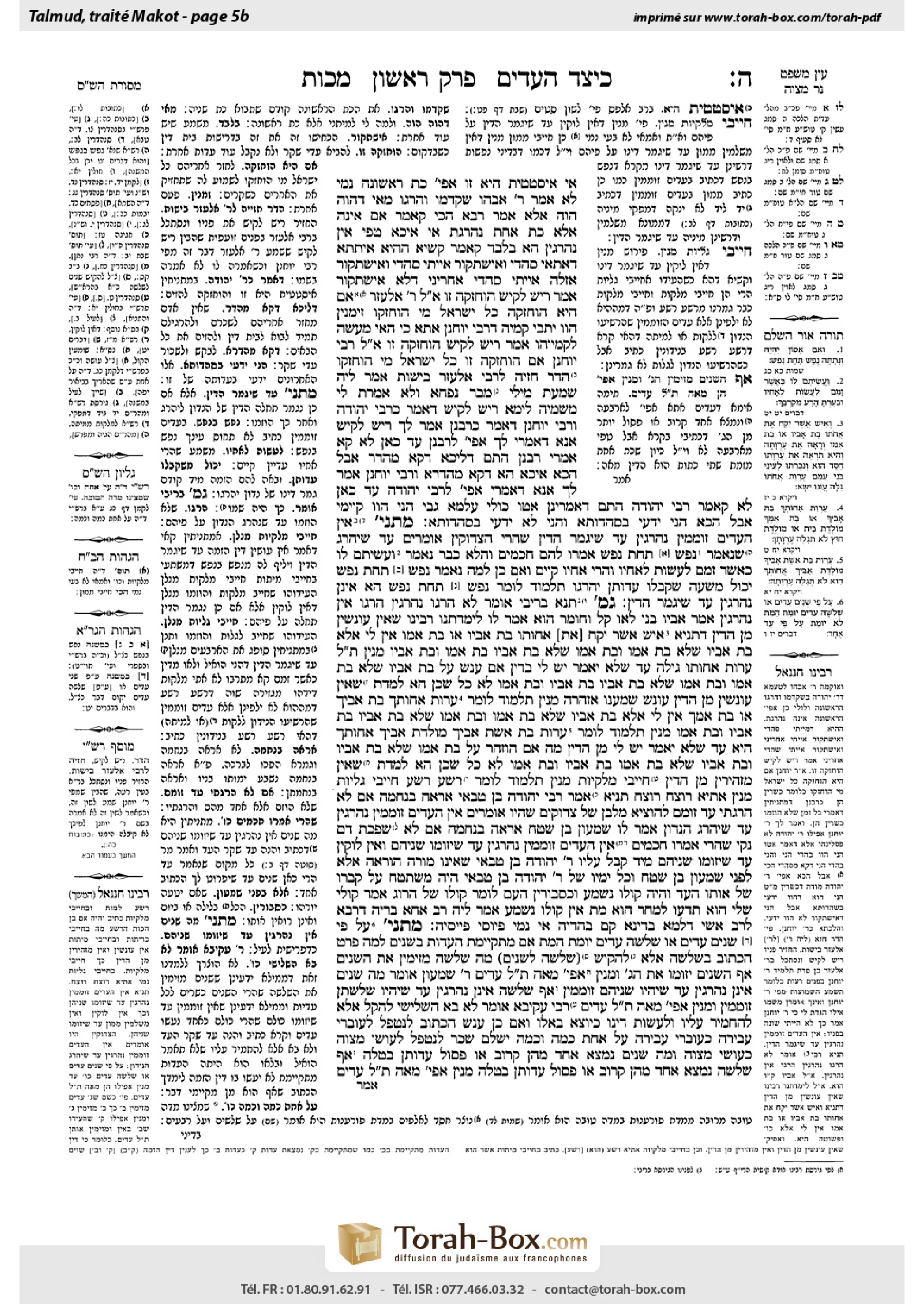
Makkot 5b: Talmud study for Daf Yomi
Daf Yomi is the daily study of one Talmud folio. Explore 37 tractates with scans, Hebrew text, Sefaria English and AI-generated French translations where annotated.
Passage selection and English or AI-generated French translation are available where the scan has annotations. Daf Study is independent of Torah-Box and Sefaria.
Browse Makkot · מכות · All tractatesMakkot 5b text and translations
This page of Makkot includes the Aramaic text, an English translation and an AI-generated French translation, alongside the scan above.
מכות ה׳ ב · Aramaic and Hebrew text
אִי אִיסְטָטִית הִיא זוֹ, אֲפִילּוּ כַּת רִאשׁוֹנָה נָמֵי לָא! אָמַר רַבִּי אֲבָהוּ: שֶׁקָדְמוּ וְהָרְגוּ.
מַאי דַהֲוָה הֲוָה! אֶלָּא אָמַר רָבָא, הָכִי קָאָמַר: אִם אֵינָהּ אֶלָּא כַּת אַחַת – נֶהֱרֶגֶת, אִי אִיכָּא טְפֵי – אֵין נֶהֱרָגִין. הָא ״בִּלְבַד״ קָאָמַר! קַשְׁיָא.
הָהִיא אִיתְּתָא דַּאֲתַאי סָהֲדִי וְאִישְׁתַּקּוּר, אַיְיתִי סָהֲדִי וְאִישְׁתַּקּוּר. אֲזַלָה אַיְיתִי סָהֲדִי אַחֲרִינֵי דְּלָא אִישְׁתַּקּוּר. אָמַר רֵישׁ לָקִישׁ: הוּחְזְקָה זוֹ. אֲמַר לֵיהּ רַבִּי אֶלְעָזָר: אִם הִיא הוּחְזְקָה, כׇּל יִשְׂרָאֵל מִי הוּחְזְקוּ?
זִימְנִין הָווּ יָתְבִי קַמֵּיהּ דְּרַבִּי יוֹחָנָן, אֲתָא כִּי הַאי מַעֲשֶׂה לְקַמַּיְיהוּ. אָמַר רֵישׁ לָקִישׁ: הוּחְזְקָה זוֹ. אֲמַר לֵיהּ רַבִּי יוֹחָנָן: אִם הוּחְזְקָה זוֹ – כׇּל יִשְׂרָאֵל מִי הוּחְזְקוּ? הֲדַר חַזְיֵהּ לְרַבִּי אֶלְעָזָר בִּישׁוּת, אֲמַר לֵיהּ: שָׁמְעַתְּ מִילֵּי מִבַּר נַפָּחָא וְלָא אֲמַרְתְּ לִי מִשְּׁמֵיהּ?
לֵימָא רֵישׁ לָקִישׁ דְּאָמַר כְּרַבִּי יְהוּדָה, וְרַבִּי יוֹחָנָן דְּאָמַר כְּרַבָּנַן?
אָמַר לָךְ רֵישׁ לָקִישׁ: אֲנָא דַּאֲמַרִי לָךְ אֲפִילּוּ לְרַבָּנַן – עַד כָּאן לָא קָא אָמְרִי רַבָּנַן הָתָם, דְּלֵיכָּא דְּקָא מְהַדַּר. אֲבָל הָכָא, אִיכָּא הָא דְּקָא מְהַדְּרָא.
וְרַבִּי יוֹחָנָן אָמַר לָךְ: אֲנָא דַּאֲמַרִי אֲפִילּוּ לְרַבִּי יְהוּדָה – עַד כָּאן לָא קָאָמַר רַבִּי יְהוּדָה הָתָם, דְּאָמְרִינַן: ״אַטּוּ כּוּלֵּי עָלְמָא גַּבֵּי הָנֵי הָווּ קָיְימִי?״, אֲבָל הָכָא, הָנֵי יָדְעִי בְּסָהֲדוּתָא, וְהָנֵי לָא יָדְעִי בְּסָהֲדוּתָא.
מַתְנִי׳ אֵין הָעֵדִים זוֹמְמִין נֶהֱרָגִין עַד שֶׁיִּגָּמֵר הַדִּין. שֶׁהֲרֵי הַצַּדּוּקִין אוֹמְרִים: עַד שֶׁיֵּהָרֵג, שֶׁנֶּאֱמַר ״נֶפֶשׁ תַּחַת נָפֶשׁ״.
אָמְרוּ לָהֶם חֲכָמִים: וַהֲלֹא כְּבָר נֶאֱמַר ״וַעֲשִׂיתֶם לוֹ כַּאֲשֶׁר זָמַם לַעֲשׂוֹת לְאָחִיו״, וַהֲרֵי אָחִיו קַיָּים! וְאִם כֵּן לָמָּה נֶאֱמַר ״נֶפֶשׁ תַּחַת נָפֶשׁ״? יָכוֹל מִשָּׁעָה שֶׁקִּבְּלוּ עֵדוּתָן יֵהָרְגוּ? תַּלְמוּד לוֹמַר: ״נֶפֶשׁ תַּחַת נָפֶשׁ״, הָא אֵינָם נֶהֱרָגִין עַד שֶׁיִּגָּמֵר הַדִּין.
גְּמָ׳ תָּנָא, בְּרִיבִּי אוֹמֵר: לֹא הָרְגוּ – נֶהֱרָגִין, הָרְגוּ – אֵין נֶהֱרָגִין. אָמַר אָבִיו: בְּנִי, לָאו קַל וָחוֹמֶר הוּא?
אָמַר לוֹ: לִימַּדְתָּנוּ רַבֵּינוּ שֶׁאֵין עוֹנְשִׁין מִן הַדִּין. דְּתַנְיָא: ״אִישׁ אֲשֶׁר יִקַּח [אֶת] אֲחֹתוֹ בַּת אָבִיו אוֹ בַת אִמּוֹ״, אֵין לִי אֶלָּא בַּת אָבִיו שֶׁלֹּא בַּת אִמּוֹ וּבַת אִמּוֹ שֶׁלֹּא בַּת אָבִיו. בַּת אִמּוֹ וּבַת אָבִיו מִנַּיִן? תַּלְמוּד לוֹמַר: ״עֶרְוַת אֲחֹתוֹ גִּלָּה״.
עַד שֶׁלֹּא יֵאָמֵר יֵשׁ לִי בַּדִּין: אִם עָנַשׁ עַל בַּת אָבִיו שֶׁלֹּא בַּת אִמּוֹ, וּבַת אִמּוֹ שֶׁלֹּא בַּת אָבִיו – בַּת אָבִיו וּבַת אִמּוֹ לֹא כׇּל שֶׁכֵּן? הָא לָמַדְתָּ שֶׁאֵין עוֹנְשִׁין מִן הַדִּין.
עוֹנֶשׁ שָׁמַעְנוּ, אַזְהָרָה מִנַּיִן? תַּלְמוּד לוֹמַר ״עֶרְוַת אֲחוֹתְךָ בַת אָבִיךָ אוֹ בַת אִמֶּךָ״. אֵין לִי אֶלָּא בַּת אָבִיו שֶׁלֹּא בַּת אִמּוֹ, וּבַת אִמּוֹ שֶׁלֹּא בַּת אָבִיו. בַּת אָבִיו וּבַת אִמּוֹ מִנַּיִן? תַּלְמוּד לוֹמַר: ״עֶרְוַת בַּת אֵשֶׁת אָבִיךָ מוֹלֶדֶת אָבִיךָ אֲחוֹתְךָ הִוא״.
עַד שֶׁלֹּא יֵאָמֵר יֵשׁ לִי מִן הַדִּין: מָה אִם הוּזְהַר עַל בַּת אִמּוֹ שֶׁלֹּא בַּת אָבִיו, וּבַת אָבִיו שֶׁלֹּא בַּת אִמּוֹ, בַּת אָבִיו וּבַת אִמּוֹ לֹא כׇּל שֶׁכֵּן? הָא לָמַדְתָּ שֶׁאֵין מַזְהִירִין מִן הַדִּין.
חַיָּיבֵי מַלְקִיּוֹת מִנַּיִן – תַּלְמוּד לוֹמַר ״רָשָׁע״ ״רָשָׁע״.
חַיָּיבֵי גָּלִיּוֹת מִנַּיִן – אָתְיָא ״רֹצֵחַ״ ״רֹצֵחַ״.
תַּנְיָא, אָמַר רַבִּי יְהוּדָה בֶּן טָבַאי: אֶרְאֶה בְּנֶחָמָה אִם לֹא הָרַגְתִּי עֵד זוֹמֵם. לְהוֹצִיא מִלִּבָּן שֶׁל צַדּוּקִים, שֶׁהָיוּ אוֹמְרִים: אֵין הָעֵדִים זוֹמְמִין נֶהֱרָגִין עַד שֶׁיֵּהָרֵג הַנִּדּוֹן.
אָמַר לוֹ שִׁמְעוֹן בֶּן שָׁטַח: אֶרְאֶה בְּנֶחָמָה אִם לֹא שָׁפַכְתָּ דָּם נָקִי, שֶׁהֲרֵי אָמְרוּ חֲכָמִים: אֵין הָעֵדִים זוֹמְמִין נֶהֱרָגִין עַד שֶׁיִּזּוֹמּוּ שְׁנֵיהֶם, וְאֵין לוֹקִין עַד שֶׁיִּזּוֹמּוּ שְׁנֵיהֶם.
מִיָּד קִבֵּל עָלָיו רַבִּי יְהוּדָה בֶּן טָבַאי שֶׁאֵינוֹ מוֹרֶה הוֹרָאָה אֶלָּא לִפְנֵי שִׁמְעוֹן בֶּן שָׁטַח. וְכׇל יָמָיו שֶׁל רַבִּי יְהוּדָה בֶּן טָבַאי הָיָה מִשְׁתַּטֵּחַ עַל קִבְרוֹ שֶׁל אוֹתוֹ הָעֵד, וְהָיָה קוֹלוֹ נִשְׁמָע, וְכִסְבוּרִין הָעָם לוֹמַר: קוֹלוֹ שֶׁל הָרוּג. אָמַר: קוֹלִי שֶׁלִּי הוּא, תֵּדְעוּ – לְמָחָר הוּא מֵת, אֵין קוֹלוֹ נִשְׁמָע.
אֲמַר לֵיהּ רַב אַחָא בְּרֵיהּ דְּרָבָא לְרַב אָשֵׁי: דִּלְמָא בְּדִינָא קָם בַּהֲדֵיהּ, אִי נָמֵי פַּיּוֹסֵי פַּיְּיסֵיהּ.
מַתְנִי׳ ״עַל פִּי שְׁנַיִם עֵדִים אוֹ שְׁלֹשָׁה עֵדִים יוּמַת הַמֵּת״ – אִם מִתְקַיֶּימֶת הָעֵדוּת בִּשְׁנַיִם לָמָּה פָּרַט הַכָּתוּב בִּשְׁלֹשָׁה? אֶלָּא לְהַקִּישׁ שְׁלֹשָׁה לִשְׁנַיִם: מָה שְׁלֹשָׁה מְזִימִּין אֶת הַשְּׁנַיִם, אַף הַשְּׁנַיִם יָזוֹמּוּ אֶת הַשְּׁלֹשָׁה. וּמִנַּיִן אֲפִילּוּ מֵאָה? תַּלְמוּד לוֹמַר ״עֵדִים״.
רַבִּי שִׁמְעוֹן אוֹמֵר: מָה שְׁנַיִם אֵינָן נֶהֱרָגִין עַד שֶׁיִּהְיוּ שְׁנֵיהֶם זוֹמְמִין – אַף שְׁלֹשָׁה אֵינָן נֶהֱרָגִין עַד שֶׁיִּהְיוּ שְׁלׇשְׁתָּם זוֹמְמִין. וּמִנַּיִן אֲפִילּוּ מֵאָה – תַּלְמוּד לוֹמַר ״עֵדִים״.
רַבִּי עֲקִיבָא אוֹמֵר: לֹא בָּא הַשְּׁלִישִׁי לְהָקֵל, אֶלָּא לְהַחֲמִיר עָלָיו וְלַעֲשׂוֹת דִּינוֹ כַּיּוֹצֵא בָּאֵלּוּ.
וְאִם כֵּן עָנַשׁ הַכָּתוּב לַנִּטְפָּל לְעוֹבְרֵי עֲבֵירָה כְּעוֹבְרֵי עֲבֵירָה – עַל אַחַת כַּמָּה וְכַמָּה יְשַׁלֵּם שָׂכָר לַנִּטְפָּל לְעוֹשֵׂי מִצְוָה כְּעוֹשֵׂי מִצְוָה.
וּמָה שְׁנַיִם נִמְצָא אֶחָד מֵהֶן קָרוֹב אוֹ פָּסוּל – עֵדוּתָן בְּטֵלָה, אַף שְׁלֹשָׁה נִמְצָא אֶחָד מֵהֶן קָרוֹב אוֹ פָּסוּל – עֵדוּתָן בְּטֵלָה. מִנַּיִן אֲפִילּוּ מֵאָה? תַּלְמוּד לוֹמַר ״עֵדִים״.
Makkot 5b · English translation
The Gemara asks: If Rabbi Yehuda states that this situation is a conspiracy, and there is suspicion that the second set is not truthful, let even the first set of witnesses who were rendered conspiring witnesses based on their testimony also not be executed. Rabbi Abbahu said: The mishna is referring to a case where the judges already executed the first set of witnesses. Rabbi Yehuda is saying that no witnesses are executed other than the first set of witnesses, who were already executed.
The Gemara challenges: If so, what was, already was; there is no point in stating it as a halakha. Rather, Rava said this is what Rabbi Yehuda is saying: If it is only one set of witnesses that is rendered conspiring witnesses by the second set, the witnesses are executed; if there is more than one set they are not executed at all. The Gemara asks: But doesn’t Rabbi Yehuda say: It is only the first set alone that is executed? This indicates that contrary to Rava’s explanation, it is a case involving more than one set of witnesses. The Gemara notes: Indeed, this matter is difficult.
Apropos the dispute in the mishna, the Gemara relates: There was a certain woman who brought witnesses to testify on her behalf, and they were proven to be liars. She brought other witnesses, and they too were proven to be liars. She went and brought yet other witnesses, who were not proven to be liars. There is an amoraic dispute whether the testimony of the third set of witnesses is accepted. Reish Lakish said: This woman has assumed the presumptive status of dishonesty because of her repeated reliance on false witnesses; therefore, the testimony of the third set is rejected. Rabbi Elazar said to him: If she has assumed the presumptive status of dishonesty, has the entire Jewish people assumed that presumptive status? Why assume that these witnesses are dishonest?
The Gemara relates: On another occasion, Reish Lakish and Rabbi Elazar were sitting before Rabbi Yoḥanan and an incident similar to this one came before them for judgment. Reish Lakish said: This woman has assumed the presumptive status of dishonesty. Rabbi Yoḥanan said to him: If she has assumed the presumptive status of dishonesty, has the entire Jewish people assumed that presumptive status? When Reish Lakish heard Rabbi Yoḥanan respond in a manner identical to the earlier response of Rabbi Elazar, he turned his head and glared angrily at Rabbi Elazar, and he said to him: You heard this matter from bar Nappaḥa, i.e., Rabbi Yoḥanan, and you did not say it to me in his name? Had I known that you were stating Rabbi Yoḥanan’s opinion I would have accepted it.
The Gemara suggests: Let us say that Reish Lakish stated his opinion that this woman has assumed the presumptive status of dishonesty in accordance with the opinion of Rabbi Yehuda, who invalidates the testimony of witnesses based on suspicion that arises due to the circumstances even though there is no proof that they lied. And Rabbi Yoḥanan stated his opinion in accordance with the opinion of the Rabbis, who do not invalidate testimony based on unsubstantiated suspicion.
The Gemara rejects this suggestion: Reish Lakish could say to you: I state my opinion even in accordance with the opinion of the Rabbis, as the Rabbis say that one relies on witnesses who render multiple sets of witnesses conspiring witnesses only there, in the mishna, in a case where there is no one who is seeking to hire witnesses to testify on his behalf, and one could assert that their testimony is true. But here, there is this woman who is seeking to hire witnesses to testify on her behalf, which arouses suspicion that she hired them to lie on her behalf.
And Rabbi Yoḥanan could say to you: I state my opinion even in accordance with the opinion of Rabbi Yehuda, as Rabbi Yehuda says that the testimony of the second set is invalid based on unsubstantiated suspicion only there, in the mishna, where circumstances exacerbate the suspicion that they are lying, as we say: Is that to say that everyone, the numerous sets of witnesses, was standing near these witnesses who testify in order to render them conspiring witnesses? But here, perhaps these witnesses who came last and were not proven to be liars know the content of the testimony, and these witnesses who were proven to be liars do not know the content of the testimony. The fact that the testimony of the first sets of witnesses was rendered void has no bearing on the status of other witnesses.
MISHNA: The conspiring witnesses are executed only if they are rendered conspiring witnesses after the verdict of the accused is concluded. This is in contrast to the opinion of the Sadducees, as the Sadducees say: Conspiring witnesses are executed only if they are rendered conspiring witnesses after the accused is killed on the basis of their testimony, as it is stated: “A life for a life” (Exodus 21:23; see Deuteronomy 19:21).
The Rabbis said to the Sadducees: But wasn’t it already stated: “And you shall do to him as he conspired to do to his brother” (Deuteronomy 19:19), and this latter verse indicates that his accused brother is alive? And if so, why is it stated: “A life for a life”? One might have thought that if they are rendered conspiring witnesses from the moment the judges accepted their testimony in court, they will be executed, even though no verdict was concluded. Therefore, the verse states: “A life for a life,” teaching that they are executed only if they are rendered conspiring witnesses after the verdict of the accused will be concluded, from the moment that the court is on the verge of taking his life.
GEMARA: It is taught with regard to the halakha in the mishna that a Sage referred to as the Distinguished [Beribbi] says: If the conspiring witnesses have not yet killed the accused with their testimony they are executed, but if they killed the accused with their testimony they are not executed. The father of that Sage, who was also a prominent Sage, said to him: My son, is this matter not derived through an a fortiori inference? If, when they were unsuccessful in their attempt to kill the accused they are executed, all the more so if they were successful in killing him should they be executed.
He said to his father: You have taught us, our teacher, that one does not administer punishment based on an a fortiori inference. The punishment must be stated in the Torah. As it is taught in a baraita that among the relatives with whom engaging in intercourse is forbidden it states: “A man who takes his sister, the daughter of his father or the daughter of his mother” (Leviticus 20:17): I have derived only the daughter of his father who is not the daughter of his mother, or the daughter of his mother who is not the daughter of his father. From where is it derived that one is liable for engaging in intercourse with his sister who is both the daughter of his mother and the daughter of his father? It is derived from a verse, as the verse states: “He has uncovered the nakedness of his sister” (Leviticus 20:17), indicating that one is liable for engaging in intercourse with any sister.
The baraita continues: Even if the verse had not stated that one is liable for engaging in intercourse with his sister, i.e., one’s sister with whom he has both parents in common, I have proof from an a fortiori inference: If the Torah punished an individual for engaging in intercourse with the daughter of his father who is not the daughter of his mother, or for engaging in intercourse with the daughter of his mother who is not the daughter of his father, is it not all the more so clear that he should be punished for engaging in intercourse with his sister who is both the daughter of his father and the daughter of his mother? From the fact that the Torah explicitly prohibited intercourse in that case and did not rely on the inference, you learn that one does not administer punishment based on an a fortiori inference.
The baraita continues: We heard from that verse (Leviticus 20:17) the punishment for engaging in intercourse with one’s sister with whom he has both parents in common. From where is the prohibition against engaging in those acts of intercourse derived? It is derived from a verse, as the verse states: “The nakedness of your sister, the daughter of your father or the daughter of your mother…you shall not uncover” (Leviticus 18:9). I have derived the prohibition against engaging in intercourse only with the daughter of his father who is not the daughter of his mother, or with the daughter of his mother who is not the daughter of his father. From where do I derive a prohibition against engaging in intercourse with his sister who is both the daughter of his father and the daughter of his mother? It is derived from a verse, as the verse states: “The nakedness of the daughter of your father’s wife, born of your father; she is your sister” (Leviticus 18:11), indicating that engaging in intercourse with any sister is prohibited.
The baraita continues: Even if the verse had not stated that engaging in intercourse with one’s sister with whom he has both parents in common is forbidden, I have proof for this from an a fortiori inference: If one was prohibited from engaging in intercourse with the daughter of his mother who is not the daughter of his father, and with the daughter of his father who is not the daughter of his mother, is it not all the more so clear that he is prohibited from engaging in intercourse with his sister who is both the daughter of his father and the daughter of his mother? You learn from this that one does not derive a prohibition based on an a fortiori inference.
The baraita continues: From where is it derived that one does not administer punishment to those liable to receive lashes based on an a fortiori inference, and that the principle is not limited to capital punishment? The verse states a verbal analogy between the term “wicked” written with regard to those liable to be executed and the term “wicked” written with regard to those liable to receive lashes. With regard to those liable to be executed, it is written: “Who is wicked and deserves to die” (Numbers 35:31). With regard to those liable to receive lashes, it is written: “And it shall be if the wicked is deserving of lashes” (Deuteronomy 25:2).
From where is it derived that one does not administer punishment to those liable to be exiled based on an a fortiori inference? It is derived by means of a verbal analogy between the term “murderer” written with regard to those who kill intentionally (see Numbers 35:21) and the term “murderer” written with regard to those who kill unwittingly (see Numbers 35:11). The conclusion is that one does not administer any punishment based on an a fortiori inference.
§ Apropos the dispute between the Sadducees and the Sages, it is taught in a baraita: Rabbi Yehuda ben Tabbai says in the form of an oath: I will not see the future consolation of the Jewish people if I did not as a member of the court kill a single conspiring witness, in order to eradicate this reasoning from the hearts of the Sadducees, who would say: The conspiring witnesses are executed only if they are rendered conspiring witnesses after the accused will be killed. Rabbi Yehuda ben Tabbai killed the conspiring witness while the accused remained alive.
Shimon ben Shataḥ said to him: I will not see the consolation of the Jewish people if you did not shed thereby innocent blood, as the Sages said: Conspiring witnesses are not executed unless both of them are rendered conspiring witnesses, and they are not flogged unless both of them are rendered conspiring witnesses. In this case, only one was rendered a conspiring witness.
Rabbi Yehuda ben Tabbai immediately accepted a commitment upon himself that he would issue a halakhic ruling only when he was before Shimon ben Shataḥ, to avoid mistakes in the future. And throughout all of Rabbi Yehuda ben Tabbai’s days he would tearfully prostrate himself on the grave of that witness whom he executed, to request forgiveness for having done so, and his voice was heard from a distance. And the people thought to say that it was the voice of the executed witness that was heard. Rabbi Yehuda ben Tabbai said to them: It is my voice. Know that this is so, as tomorrow, i.e., sometime in the future, he, referring to himself, will die, and his voice will no longer be heard.
Rav Aḥa, son of Rava, said to Rav Ashi: The fact that the voice will cease after Rabbi Yehuda ben Tabbai’s death is inconclusive as proof that the voice is not that of the executed witness. Perhaps the reason that the voice of the executed person will no longer be heard is that he confronted Rabbi Yehuda ben Tabbai in trial before the heavenly court, obviating the need for crying from his grave. Alternatively, perhaps Rabbi Yehuda ben Tabbai appeased the executed witness in the World-to-Come, and there is silence because no grievances remained.
MISHNA: It is written: “At the mouth of two witnesses or three witnesses shall he who is to die be executed” (Deuteronomy 17:6). The question is: If the testimony is valid with two witnesses, why did the verse specify that it is valid with three? Rather, it is to juxtapose and liken three to two: Just as three witnesses can render the two witnesses conspiring witnesses, so too, the two witnesses can render the three witnesses conspiring witnesses. And from where is it derived that two witnesses can render even one hundred witnesses conspiring witnesses? It is derived from a verse, as the verse states: “Three witnesses.” Since the verse is obviously discussing witnesses, the term witnesses is superfluous, as it could have stated: Two or three. The term “witnesses” teaches that two witnesses can render a set of witnesses conspiring witnesses irrespective of their number.
Rabbi Shimon says that three witnesses are mentioned in the verse in order to teach: Just as two witnesses who testified that a person is liable to be executed are not killed for this testimony unless both of them are found to be conspiring witnesses, so too, three witnesses who testified together are not killed unless all three of them are found to be conspiring witnesses. And from where is it derived that the same halakha applies even to one hundred witnesses? It is derived from a verse, as the verse states: “Three witnesses.” The superfluous term “witnesses” teaches that the status of all witnesses who come to court as a single set of witnesses is that of one testimony with regard to this halakha.
Rabbi Akiva says: The third witness mentioned in this verse does not come for the judges to be lenient concerning him; rather, its mention comes for the judges to be stringent concerning him and to render his halakhic status like that of these two witnesses who testified with him. One could claim that since the testimony of the third witness is superfluous, as the testimony of the other two witnesses sufficed, the third witness and any other witnesses beyond the first two should be exempt. Therefore, the verse teaches that since he testified with them and was rendered a conspiring witness with them, he too is executed.
One can learn a moral from this halakha: And if the verse punished one who associates with transgressors with a punishment like the one received by the transgressors, even though his role in the transgression is ancillary, all the more so will God pay a reward to one who associates with those who perform a mitzva like the reward of those who perform the mitzva themselves, even though his role in performing the mitzva is ancillary.
The mishna cites another derivation based on the juxtaposition of two to three: And just as with regard to two witnesses, if one of them is found to be a relative or is otherwise disqualified, their entire testimony is voided, as it is no longer the testimony of two witnesses, so too, with regard to three witnesses who came to testify as one set, if one of them is found to be a relative or is otherwise disqualified, their entire testimony is voided, even though two valid witnesses remain. From where is it derived that the same halakha applies even in the case of one hundred witnesses? It is derived from a verse, as the verse states: “Witnesses.”
Makkot 5b · Traduction française (IA)
La Guemara demande : Si Rabbi Yehuda affirme que cette situation constitue une conspiration, et qu'il existe un soupçon que le second groupe de témoins ne soit pas véridique, que même le premier groupe de témoins, qui a été déclaré témoins conspirateurs sur la base de leur témoignage, ne soit pas exécuté. Rabbi Abbahu a dit : La Michna fait référence à un cas où les juges ont déjà exécuté le premier groupe de témoins. Rabbi Yehuda dit que aucun témoin n'est exécuté, à l'exception du premier groupe de témoins, qui a déjà été exécuté.
La Guemara objecte : Si c'est le cas, cela était déjà acquis ; il n'y a aucun point à l'énoncer comme une halakha. Plutôt, Rava a dit que c'est ce que Rabbi Yehuda signifie : Si c'est seulement un groupe de témoins qui est déclaré témoins conspirateurs par le second groupe, les témoins sont exécutés ; s'il y a plus d'un groupe, ils ne sont pas exécutés du tout. La Guemara demande : Mais n'est-ce pas Rabbi Yehuda qui dit : C'est seulement le premier groupe seul qui est exécuté ? Cela indique que, contrairement à l'explication de Rava, il s'agit d'un cas impliquant plus d'un groupe de témoins. La Guemara note : En effet, cette question est difficile.
À propos de la controverse dans la Michna, la Guemara rapporte : Il y avait une certaine femme qui a présenté des témoins pour témoigner en sa faveur, et ils ont été prouvés menteurs. Elle a présenté d'autres témoins, et eux aussi ont été prouvés menteurs. Elle est allée en présenter d'autres encore, qui n'ont pas été prouvés menteurs. Il y a une controverse amoraïque quant à savoir si le témoignage du troisième groupe de témoins est accepté. Reish Lakish a dit : Cette femme a acquis le statut présumé de malhonnêteté en raison de sa dépendance répétée à des témoins faux ; par conséquent, le témoignage du troisième groupe est rejeté. Rabbi Elazar lui a dit : Si elle a acquis le statut présumé de malhonnêteté, est-ce que tout le peuple juif a acquis ce statut présumé ? Pourquoi supposer que ces témoins sont malhonnêtes ?
La Guemara rapporte : À une autre occasion, Reish Lakish et Rabbi Elazar étaient assis devant Rabbi Yoḥanan lorsqu'un incident similaire à celui-ci leur fut soumis pour jugement. Reish Lakish déclara : Cette femme a acquis le statut présumé de malhonnêteté. Rabbi Yoḥanan lui dit : Si elle a acquis le statut présumé de malhonnêteté, est-ce que tout le peuple juif a acquis ce statut présumé ? Lorsque Reish Lakish entendit Rabbi Yoḥanan répondre d'une manière identique à la réponse antérieure de Rabbi Elazar, il tourna la tête et jeta un regard furieux à Rabbi Elazar, et lui dit : Tu as entendu cette affaire de bar Nappaḥa, c'est-à-dire Rabbi Yoḥanan, et tu ne me l'as pas rapportée en son nom ? Si j'avais su que tu énonçais l'opinion de Rabbi Yoḥanan, je l'aurais acceptée.
La Guemara suggère : Disons que Reish Lakish a énoncé son opinion selon laquelle cette femme a acquis le statut présumé de malhonnêteté conformément à l'opinion de Rabbi Yehuda, qui invalide le témoignage des témoins sur la base d'un soupçon qui naît des circonstances, même s'il n'y a pas de preuve qu'ils aient menti. Et Rabbi Yoḥanan a énoncé son opinion conformément à l'opinion des Sages, qui n'invalident pas le témoignage sur la base d'un soupçon non étayé.
La Guemara rejette cette suggestion : Reish Lakish pourrait te dire : J'énonce mon opinion même conformément à l'opinion des Sages, car les Sages disent qu'on se fie aux témoins qui déclarent plusieurs groupes de témoins conspirateurs seulement là, dans la Michna, dans un cas où personne ne cherche à engager des témoins pour témoigner en sa faveur, et on pourrait affirmer que leur témoignage est vrai. Mais ici, il y a cette femme qui cherche à engager des témoins pour témoigner en sa faveur, ce qui suscite le soupçon qu'elle les a engagés pour mentir en sa faveur.
Et Rabbi Yoḥanan pourrait te dire : J'énonce mon opinion même conformément à l'opinion de Rabbi Yehuda, car Rabbi Yehuda dit que le témoignage du second groupe est invalide sur la base d'un soupçon non étayé seulement là, dans la Michna, où les circonstances aggravent le soupçon qu'ils mentent, car nous disons : Est-ce à dire que tout le monde, les nombreux groupes de témoins, se tenait près de ces témoins qui témoignent afin de les déclarer conspirateurs ? Mais ici, peut-être que ces témoins qui sont arrivés en dernier et n'ont pas été prouvés menteurs connaissent le contenu du témoignage, et ces témoins qui ont été prouvés menteurs ne connaissent pas le contenu du témoignage. Le fait que le témoignage des premiers groupes de témoins ait été annulé n'a aucune incidence sur le statut d'autres témoins.
MICHNA : Les témoins conspirateurs sont exécutés seulement s'ils sont déclarés témoins conspirateurs après que le verdict de l'accusé a été rendu. Cela contraste avec l'opinion des Sadducéens, car les Sadducéens disent : Les témoins conspirateurs sont exécutés seulement s'ils sont déclarés témoins conspirateurs après que l'accusé a été tué sur la base de leur témoignage, car il est écrit : « Une vie pour une vie » (Exode 21:23 ; voir Deutéronome 19:21).
Les Sages ont dit aux Sadducéens : Mais n'est-il pas déjà écrit : « Et vous ferez à lui comme il a comploté de faire à son frère » (Deutéronome 19:19), et ce dernier verset indique que son frère accusé est vivant ? Et si c'est le cas, pourquoi est-il écrit : « Une vie pour une vie » ? On aurait pu penser que s'ils sont déclarés témoins conspirateurs à partir du moment où les juges ont accepté leur témoignage en cour, ils seront exécutés, même si aucun verdict n'a été rendu. Par conséquent, le verset dit : « Une vie pour une vie », enseignant qu'ils sont exécutés seulement s'ils sont déclarés témoins conspirateurs après que le verdict de l'accusé aura été rendu, à partir du moment où la cour est sur le point de lui ôter la vie.
Guemara : Il est enseigné à propos de la halakha de la Michna, selon laquelle un Sage appelé le Distingué [Beribbi] dit : Si les témoins conspirateurs n'ont pas encore fait exécuter l'accusé par leur témoignage, ils sont exécutés ; mais s'ils ont fait exécuter l'accusé par leur témoignage, ils ne sont pas exécutés. Le père de ce Sage, qui était également un Sage éminent, lui dit : Mon fils, cette règle ne se déduit-elle pas par une inférence a fortiori ? Si, lorsqu'ils ont échoué dans leur tentative de faire exécuter l'accusé, ils sont exécutés, d'autant plus s'ils ont réussi à le faire exécuter, ne devraient-ils pas l'être ?
Il répondit à son père : Vous nous avez enseigné, notre maître, qu'on n'applique pas une peine sur la base d'une inférence a fortiori. La peine doit être explicitement mentionnée dans la Torah. Comme l'enseigne une baraïta : parmi les proches avec qui les relations sexuelles sont interdites, il est écrit : « Un homme qui prend sa sœur, fille de son père ou fille de sa mère » (Lévitique 20:17) : j'en ai déduit uniquement la fille de son père qui n'est pas la fille de sa mère, ou la fille de sa mère qui n'est pas la fille de son père. D'où déduit-on qu'on est passible de châtiment pour des relations sexuelles avec sa sœur qui est à la fois la fille de sa mère et la fille de son père ? Cela se déduit d'un verset, car le verset dit : « Il a découvert la nudité de sa sœur » (Lévitique 20:17), indiquant qu'on est passible de châtiment pour des relations sexuelles avec n'importe quelle sœur.
La baraïta continue : Même si le verset n'avait pas indiqué qu'on est passible de châtiment pour avoir des relations sexuelles avec sa sœur, c'est-à-dire sa sœur avec qui il a les deux parents en commun, j'ai une preuve par une déduction a fortiori : Si la Torah a puni un individu pour avoir des relations sexuelles avec la fille de son père qui n'est pas la fille de sa mère, ou pour avoir des relations sexuelles avec la fille de sa mère qui n'est pas la fille de son père, n'est-il pas d'autant plus clair qu'il doit être puni pour avoir des relations sexuelles avec sa sœur qui est à la fois la fille de son père et la fille de sa mère ? Du fait que la Torah a explicitement interdit ces relations dans ce cas et n'a pas fait appel à la déduction, vous apprenez qu'on n'administre pas de châtiment sur la base d'une déduction a fortiori.
La baraïta continue : Nous avons entendu de ce verset (Lévitique 20:17) le châtiment pour avoir des relations sexuelles avec sa sœur avec qui il a les deux parents en commun. D'où déduit-on l'interdiction d'engager ces actes de relations sexuelles ? Cela se déduit d'un verset, car le verset dit : « La nudité de ta sœur, fille de ton père ou fille de ta mère… tu ne la découvriras pas » (Lévitique 18:9). J'ai déduit l'interdiction d'avoir des relations sexuelles uniquement avec la fille de son père qui n'est pas la fille de sa mère, ou avec la fille de sa mère qui n'est pas la fille de son père. D'où déduis-je une interdiction d'avoir des relations sexuelles avec sa sœur qui est à la fois la fille de son père et la fille de sa mère ? Cela se déduit d'un verset, car le verset dit : « La nudité de la fille de la femme de ton père, née de ton père ; elle est ta sœur » (Lévitique 18:11), indiquant que les relations sexuelles avec n'importe quelle sœur sont interdites.
La baraïta continue : Même si le verset n'avait pas indiqué que les relations sexuelles avec sa sœur germaine sont interdites, j'ai une preuve pour cela par une déduction a fortiori : Si l'on est interdit d'avoir des relations sexuelles avec la fille de sa mère qui n'est pas la fille de son père, et avec la fille de son père qui n'est pas la fille de sa mère, n'est-il pas d'autant plus clair qu'il est interdit d'avoir des relations sexuelles avec sa sœur qui est à la fois la fille de son père et la fille de sa mère ? Vous apprenez de cela qu'on ne déduit pas une interdiction sur la base d'une déduction a fortiori.
La baraïta continue : D'où déduit-on qu'on n'administre pas de châtiment à ceux qui sont passibles de coups de fouet sur la base d'une déduction a fortiori, et que ce principe n'est pas limité à la peine capitale ? Le verset établit une analogie verbale entre le terme « méchant » écrit à propos de ceux qui sont passibles d'exécution et le terme « méchant » écrit à propos de ceux qui sont passibles de coups de fouet. À propos de ceux qui sont passibles d'exécution, il est écrit : « Qui est méchant et mérite la mort » (Nombres 35:31). À propos de ceux qui sont passibles de coups de fouet, il est écrit : « Et il arrivera que si le méchant mérite des coups de fouet » (Deutéronome 25:2).
D'où déduit-on qu'on n'administre pas de châtiment à ceux qui sont passibles d'exil sur la base d'une déduction a fortiori ? Cela se déduit par le moyen d'une analogie verbale entre le terme « meurtrier » écrit à propos de ceux qui tuent intentionnellement (voir Nombres 35:21) et le terme « meurtrier » écrit à propos de ceux qui tuent involontairement (voir Nombres 35:11). La conclusion est qu'on n'administre aucun châtiment sur la base d'une déduction a fortiori.
§ À propos du différend entre les Sadducéens et les Sages, il est enseigné dans une baraïta : Rabbi Yehouda ben Tabbaï dit sous forme de serment : Je ne verrai pas la consolation future du peuple juif si je n'ai pas, en tant que membre du tribunal, exécuté un seul témoin conspirateur, afin d'éradiquer ce raisonnement des cœurs des Sadducéens, qui disent : Les témoins conspirateurs ne sont exécutés que s'ils sont déclarés conspirateurs après que l'accusé a été tué. Rabbi Yehouda ben Tabbaï a exécuté le témoin conspirateur alors que l'accusé était encore en vie.
Shimon ben Chatah lui dit : Je ne verrai pas la consolation du peuple juif si tu n'as pas ainsi répandu du sang innocent, car les Sages ont dit : Les témoins conspirateurs ne sont exécutés que si tous les deux sont déclarés conspirateurs, et ils ne sont pas fouettés que si tous les deux sont déclarés conspirateurs. Dans ce cas, seul l'un d'eux a été déclaré conspirateur.
Rabbi Yehouda ben Tabbaï s'imposa immédiatement l'engagement de ne rendre une décision halakhique qu'en présence de Shimon ben Chatah, afin d'éviter les erreurs à l'avenir. Et durant toute sa vie, Rabbi Yehouda ben Tabbaï se prosternait en pleurant sur la tombe de ce témoin qu'il avait exécuté, pour demander pardon de l'avoir fait, et sa voix était entendue de loin. Et les gens pensaient que c'était la voix du témoin exécuté qui était entendue. Rabbi Yehouda ben Tabbaï leur dit : C'est ma voix. Sachez que c'est ainsi, car demain, c'est-à-dire à un moment dans le futur, lui, se référant à lui-même, mourra, et sa voix ne sera plus entendue.
Rav Aḥa, fils de Rava, dit à Rav Ashi : Le fait que la voix cesse après la mort de Rabbi Yehuda ben Tabbai ne constitue pas une preuve concluante que cette voix n'est pas celle du témoin exécuté. Peut-être la raison pour laquelle la voix de la personne exécutée n'est plus entendue est-elle qu'il a confronté Rabbi Yehuda ben Tabbai lors d'un procès devant la cour céleste, rendant inutile de crier depuis sa tombe. Ou bien, peut-être Rabbi Yehuda ben Tabbai a-t-il apaisé le témoin exécuté dans le Monde à venir, et y a-t-il silence parce qu'aucun grief ne subsistait.
Michna : Il est écrit : « À la bouche de deux témoins ou de trois témoins sera exécuté celui qui doit mourir » (Deutéronome 17:6). La question est : Si le témoignage est valide avec deux témoins, pourquoi le verset a-t-il précisé qu'il est valide avec trois ? Plutôt, il s'agit de juxtaposer et d'assimiler trois à deux : De même que trois témoins peuvent rendre les deux témoins des témoins conspirateurs, de même, les deux témoins peuvent rendre les trois témoins des témoins conspirateurs. Et d'où est-il dérivé que deux témoins peuvent rendre même cent témoins des témoins conspirateurs ? Il est dérivé d'un verset, car le verset énonce : « Trois témoins ». Puisque le verset discute manifestement de témoins, le terme « témoins » est superflu, car il aurait pu dire : Deux ou trois. Le terme « témoins » enseigne que deux témoins peuvent rendre un ensemble de témoins des témoins conspirateurs, indépendamment de leur nombre.
Rabbi Shimon enseigne que les trois témoins mentionnés dans le verset servent à établir le principe suivant : de même que deux témoins qui ont attesté qu'une personne est passible de la peine de mort ne sont eux-mêmes mis à mort pour ce témoignage que si tous deux sont reconnus comme témoins conspirateurs, de même, trois témoins qui ont témoigné ensemble ne sont mis à mort que si les trois sont reconnus comme témoins conspirateurs. Et d'où déduit-on que la même halakha s'applique même à cent témoins ? On le déduit du verset, car il est écrit : « Trois témoins ». Le terme superflu « témoins » enseigne que le statut de tous les témoins qui se présentent devant le tribunal en tant que groupe unique est celui d'un seul témoignage au regard de cette halakha.
Rabbi Akiva enseigne : Le troisième témoin mentionné dans ce verset n'intervient pas pour que les juges soient indulgents à son égard ; plutôt, sa mention vise à ce que les juges soient rigoureux à son égard et à ce que son statut halakhique soit assimilé à celui de ces deux témoins qui ont témoigné avec lui. On pourrait prétendre que, puisque le témoignage du troisième témoin est superflu, car le témoignage des deux autres suffisait, le troisième témoin et tout autre témoin au-delà des deux premiers devraient être exemptés. Par conséquent, le verset enseigne que, puisqu'il a témoigné avec eux et a été déclaré témoin conspirateur avec eux, lui aussi est exécuté.
On peut tirer une leçon morale de cette halakha : Et si le verset a puni celui qui s'associe à des transgresseurs d'une punition semblable à celle reçue par les transgresseurs, bien que son rôle dans la transgression soit accessoire, d'autant plus Dieu récompensera-t-il celui qui s'associe à ceux qui accomplissent une mitsva de la même récompense que celle des accomplisseurs de la mitsva eux-mêmes, bien que son rôle dans l'accomplissement de la mitsva soit accessoire.
La Michna cite une autre déduction fondée sur la juxtaposition de « deux » à « trois » : De même qu’en ce qui concerne deux témoins, si l’un d’eux s’avère être un parent ou est autrement inapte, leur témoignage dans son ensemble est annulé, car ce n’est plus le témoignage de deux témoins, de même, en ce qui concerne trois témoins qui sont venus témoigner en tant que groupe unique, si l’un d’eux s’avère être un parent ou est autrement inapte, leur témoignage dans son ensemble est annulé, même si deux témoins valides subsistent. D’où est-il déduit que la même halakha s’applique même dans le cas de cent témoins ? Cela est déduit d’un verset, car le verset énonce : « Témoins ».
Traduction française générée par IA à partir de l’édition anglaise de Sefaria. Vérifie toujours un passage avec le texte source.
Text from Sefaria: William Davidson Edition - Vocalized Aramaic (CC BY NC); William Davidson Edition - English (CC BY NC).