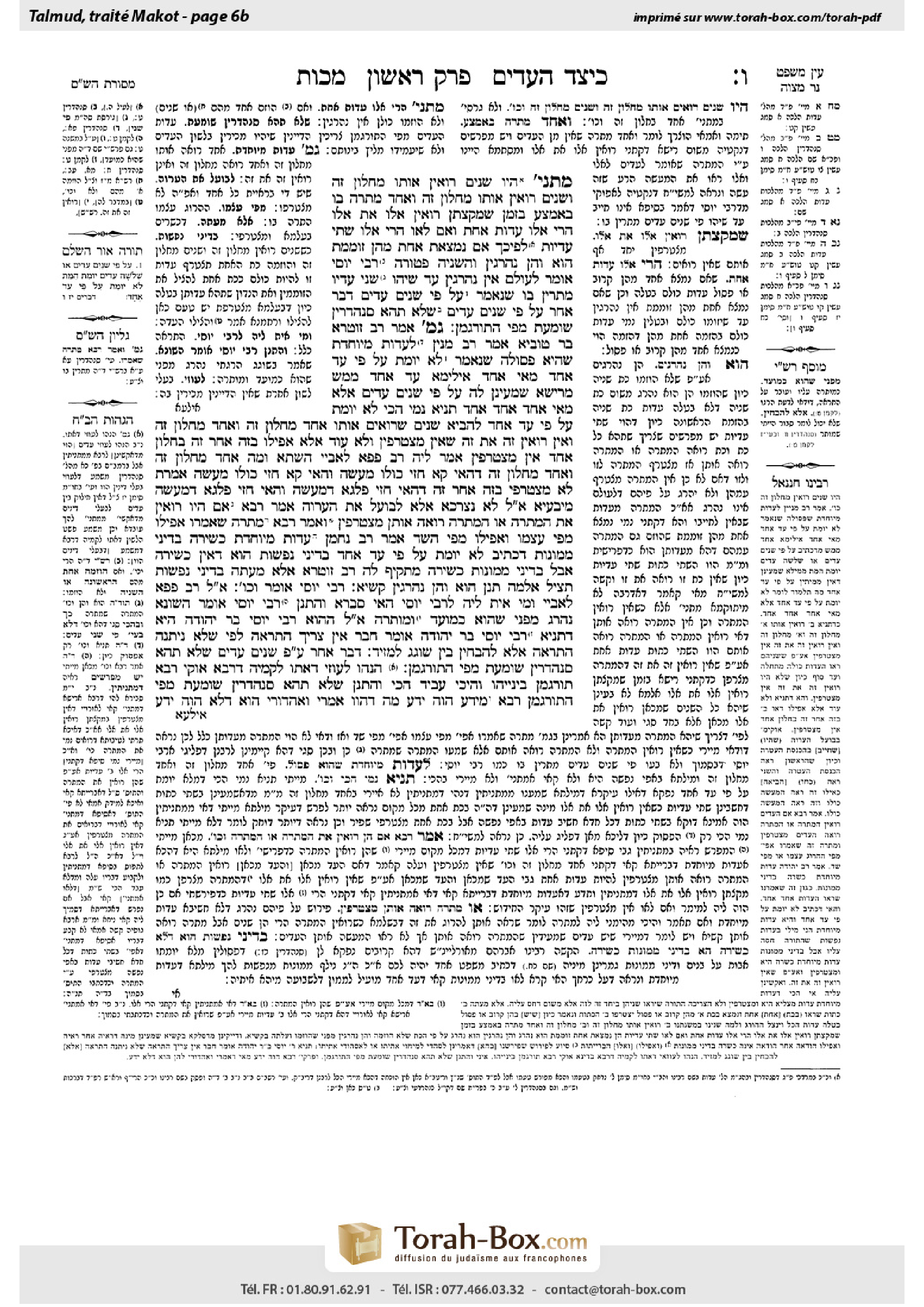
Makkot 6b: Talmud study for Daf Yomi
Daf Yomi is the daily study of one Talmud folio. Explore 37 tractates with scans, Hebrew text, Sefaria English and AI-generated French translations where annotated.
Passage selection and English or AI-generated French translation are available where the scan has annotations. Daf Study is independent of Torah-Box and Sefaria.
Browse Makkot · מכות · All tractatesMakkot 6b text and translations
This page of Makkot includes the Aramaic text, an English translation and an AI-generated French translation, alongside the scan above.
מכות ו׳ ב · Aramaic and Hebrew text
מַתְנִי׳ הָיוּ שְׁנַיִם רוֹאִין אוֹתוֹ, מֵחַלּוֹן זֶה, וּשְׁנַיִם רוֹאִין אוֹתוֹ מֵחַלּוֹן זֶה, וְאֶחָד מַתְרֶה בּוֹ בָּאֶמְצַע, בִּזְמַן שֶׁמִּקְצָתָן רוֹאִין אֵלּוּ אֶת אֵלּוּ – הֲרֵי אֵלּוּ עֵדוּת אַחַת, וְאִם לָאו – הֲרֵי אֵלּוּ שְׁתֵּי עֵדֻיוֹת. לְפִיכָךְ, אִם נִמְצֵאת אַחַת מֵהֶן זוֹמֶמֶת – הוּא וָהֵן נֶהֱרָגִין, וְהַשְּׁנִיָּה פְּטוּרָה.
רַבִּי יוֹסֵי אוֹמֵר: לְעוֹלָם אֵין נֶהֱרָגִין עַד שֶׁיְּהוּ שְׁנֵי עֵדָיו מַתְרִין בּוֹ, שֶׁנֶּאֱמַר ״עַל פִּי שְׁנַיִם עֵדִים״. דָּבָר אַחֵר: ״עַל פִּי שְׁנַיִם עֵדִים״ – שֶׁלֹּא תְּהֵא סַנְהֶדְרִין שׁוֹמַעַת מִפִּי הַתּוּרְגְּמָן.
גְּמָ׳ אָמַר רַב זוּטְרָא בַּר טוֹבִיָּא אָמַר רַב: מִנַּיִן לְעֵדוּת מְיוּחֶדֶת שֶׁהִיא פְּסוּלָה? שֶׁנֶּאֱמַר: ״לֹא יוּמַת עַל פִּי עֵד אֶחָד״. מַאי אֶחָד? אִילֵּימָא עֵד אֶחָד מַמָּשׁ – מֵרֵישָׁא שָׁמְעִינַן לָהּ, ״עַל פִּי שְׁנַיִם עֵדִים״! אֶלָּא מַאי ״אֶחָד״? אֶחָד אֶחָד.
תַּנְיָא נָמֵי הָכִי: ״לֹא יוּמַת עַל פִּי עֵד אֶחָד״, לְהָבִיא שְׁנַיִם שֶׁרוֹאִים אוֹתוֹ אֶחָד מֵחַלּוֹן זֶה וְאֶחָד מֵחַלּוֹן זֶה, וְאֵין רוֹאִין זֶה אֶת זֶה, שֶׁאֵין מִצְטָרְפִין. וְלֹא עוֹד אֶלָּא אֲפִילּוּ בְּזֶה אַחַר זֶה בְּחַלּוֹן אֶחָד – אֵין מִצְטָרְפִין.
אֲמַר לֵיהּ רַב פָּפָּא לְאַבָּיֵי: הַשְׁתָּא, וּמָה אֶחָד מֵחַלּוֹן זֶה וְאֶחָד מֵחַלּוֹן זֶה, דְּהַאי קָא חָזֵי כּוּלּוֹ מַעֲשֶׂה, וְהַאי קָא חָזֵי כּוּלּוֹ מַעֲשֶׂה – אָמְרַתְּ לָא מִצְטָרְפִי, בְּזֶה אַחַר זֶה, דְּהַאי חָזֵי פַּלְגָא דְמַעֲשֶׂה וְהַאי חָזֵי פַּלְגָא דְמַעֲשֶׂה, מִיבַּעְיָא? אֲמַר לֵיהּ: לֹא נִצְרְכָא אֶלָּא לְבוֹעֵל אֶת הָעֶרְוָה.
אָמַר רָבָא: אִם הָיוּ רוֹאִין אֶת הַמַּתְרֶה, אוֹ הַמַּתְרֶה רוֹאֶה אוֹתָן – מִצְטָרְפִין. אָמַר רָבָא: מַתְרֶה שֶׁאָמְרוּ, אֲפִילּוּ מִפִּי עַצְמוֹ, וַאֲפִילּוּ מִפִּי הַשֵּׁד.
אָמַר רַב נַחְמָן: עֵדוּת מְיוּחֶדֶת כְּשֵׁירָה בְּדִינֵי מָמוֹנוֹת, דִּכְתִיב: ״לֹא יוּמַת עַל פִּי עֵד אֶחָד״ – בְּדִינֵי נְפָשׁוֹת הוּא דְּאֵין כְּשֵׁירָה, אֲבָל בְּדִינֵי מָמוֹנוֹת – כְּשֵׁירָה.
מַתְקֵיף לַהּ רַב זוּטְרָא: אֶלָּא מֵעַתָּה בְּדִינֵי נְפָשׁוֹת תַּצִּיל! אַלְּמָה תְּנַן ״הוּא וָהֵן נֶהֱרָגִין״? קַשְׁיָא.
רַבִּי יוֹסֵי אוֹמֵר וְכוּ׳. אֲמַר לֵיהּ רַב פָּפָּא לְאַבָּיֵי: וּמִי אִית לֵיהּ לְרַבִּי יוֹסֵי הַאי סְבָרָא? וְהָתְנַן רַבִּי יוֹסֵי אוֹמֵר: הַשּׂוֹנֵא – נֶהֱרָג, מִפְּנֵי שֶׁהוּא כְּמוּעָד וּמוּתְרֶה.
אֲמַר לֵיהּ: הָהוּא – רַבִּי יוֹסֵי בַּר יְהוּדָה הִיא. דְּתַנְיָא: רַבִּי יוֹסֵי בַּר יְהוּדָה אוֹמֵר: חָבֵר אֵין צָרִיךְ הַתְרָאָה, לְפִי שֶׁלֹּא נִיתְּנָה הַתְרָאָה אֶלָּא לְהַבְחִין בֵּין שׁוֹגֵג לְמֵזִיד.
דָּבָר אַחֵר: ״עַל פִּי שְׁנַיִם עֵדִים״ – שֶׁלֹּא תְּהֵא סַנְהֶדְרִין שׁוֹמַעַת מִפִּי הַתּוּרְגְּמָן. הָנְהוּ לָעוֹזֵי דַּאֲתוֹ לְקַמֵּיהּ דְּרָבָא, אוֹקִי רָבָא תּוּרְגְּמָן בֵּינַיְיהוּ. וְהֵיכִי עֲבִיד הָכִי? וְהָתְנַן: שֶׁלֹּא תְּהֵא סַנְהֶדְרִין שׁוֹמַעַת מִפִּי הַתּוּרְגְּמָן! רָבָא מִידָּע הֲוָה יָדַע מָה דַּהֲווֹ אָמְרִי, וְאַהְדּוֹרֵי הוּא דְּלָא הֲוָה יָדַע.
Makkot 6b · English translation
MISHNA: In a case where there were two witnesses observing an individual violating a capital transgression from this window in a house, and two observing him from that window in a house, and one person was forewarning the transgressor in the middle between the two sets of witnesses, the halakha depends on the circumstances. In a situation where some of the witnesses observing from the two windows see each other, the testimony of all these witnesses constitutes one testimony, but if they do not see each other, the testimony of these witnesses constitutes two independent testimonies. Therefore, as two independent sets of witnesses, if one of the sets was found to be a set of conspiring witnesses, while the testimony of the other set remained valid, both he, the one accused of violating the capital transgression, and they, the conspiring witnesses, are executed, and the second set, whose testimony remained valid, is exempt.
Rabbi Yosei says: Transgressors are never executed unless his two witnesses are the ones forewarning him, as it is stated: “At the mouth of two witnesses…he who is to be put to death shall die” (Deuteronomy 17:6), from which it is derived that it is from the mouths of the two witnesses that the accused must be forewarned, and forewarning issued by someone else is insufficient. Alternatively, from the phrase “at the mouth of two witnesses” one derives that the judges must hear the testimony directly from the witnesses, and the Sanhedrin will not hear testimony from the mouth of an interpreter.
GEMARA: Rav Zutra bar Tuvya says that Rav says: From where is it derived with regard to disjointed testimony, in which each of the witnesses saw the incident independent of the other, that it is not valid? It is derived from a verse, as it is stated: “He shall not die at the mouth of one witness” (Deuteronomy 17:6). The exposition is as follows: What is the meaning of “one witness”? If we say that it means one witness literally, we learn it from the first portion of the verse: “At the mouth of two witnesses,” indicating that the testimony of fewer than two witnesses is not valid. Rather, what is the meaning of “one witness”? It means that the accused is not executed based on the testimony of people who witnessed an incident with one witness here and one witness elsewhere.
The Gemara notes: This is also taught in a baraita: It is written: “He shall not die at the mouth of one witness,” from which it is derived to include the halakha that in the case of two witnesses who observe an individual violating a capital transgression, one from this window and one from that window, and they do not see each other, that they do not join to constitute a set of witnesses. Moreover, even if they witnessed the same transgression from the same perspective, watching the incident not at the same time but one after the other in one window, they do not join to constitute a set of witnesses.
Rav Pappa said to Abaye: Why is it necessary to mention both cases? Now if in the case where one witness views the incident from this window and one witness views the incident from that window, where this witness sees the entire incident and that witness sees the entire incident, you say that they do not join to testify together as two witnesses, if they see the incident one after the other, where this witness sees half the incident and that witness sees half the incident, is it necessary to say that the witnesses do not join together? Abaye said to him: It is necessary to state this halakha only with regard to a case where they witnessed one who engages in intercourse with a forbidden relative, which is a continuing act, and each of the witnesses saw sufficient behavior to render the transgressor liable. The tanna of the baraita teaches that even in that case, they do not join to constitute a set of witnesses.
Apropos witnesses joining to constitute a set of witnesses, Rava says: Even if the witness in either window is unable to see the witness in the other window, if the witness in each window sees the one who is forewarning the accused, or if the one who is forewarning the accused could see the two disjointed witnesses, they join to constitute a set of witnesses. Rava says: The one forewarning the accused of whom the Sages spoke need not be a third witness, but even if the victim forewarns the murderer from his own mouth, and even if the forewarning emerged from the mouth of a demon, meaning the source of the forewarning is unknown, the forewarning is legitimate.
Rav Naḥman says: Disjointed testimony of two witnesses, each of whom observed an incident independent of the other, is valid in cases of monetary law, as it is written: “He shall not die at the mouth of one witness” (Deuteronomy 17:6). This indicates that it is only with regard to cases of capital law that disjointed testimony is not valid, but with regard to cases of monetary law that testimony is valid.
Rav Zutra objects to this: But if that is so, and disjointed testimony is effective in certain cases, in cases of capital law disjointed testimony should spare the accused from execution. Since one must exploit every avenue possible to prevent executions, in a case where some of the disjointed witnesses were rendered conspiring witnesses, the entire testimony should be voided on their account. Why, then, did we learn in the mishna that if one set witnessed the capital transgression from one window and one set from the other window, and one set was found to be a set of conspiring witnesses, he, the accused, and they, the conspiring witnesses, are executed? The Gemara comments: Indeed, that is difficult according to Rav Naḥman.
§ The mishna teaches that Rabbi Yosei says: Perpetrators are never executed unless his two witnesses are the ones forewarning him. Rav Pappa said to Abaye: And is Rabbi Yosei of the opinion that this line of reasoning is correct, and forewarning by the witnesses is indispensable? But didn’t we learn in a mishna (9b): Rabbi Yosei says: An enemy who commits murder cannot claim that he killed the victim unwittingly. Rather, he is executed even if there was no forewarning, due to the fact that his halakhic status is like that of one who is cautioned and forewarned. Apparently, Rabbi Yosei does not always require that there be forewarning.
Abaye said to him: That statement in the mishna you cited that is attributed to Rabbi Yosei is actually the opinion of Rabbi Yosei bar Yehuda, as it is taught in a baraita: Rabbi Yosei bar Yehuda says: A ḥaver does not require forewarning, as forewarning was instituted only to distinguish between one who commits a transgression unwittingly and one who does so intentionally. A ḥaver, who is a Torah scholar, does not require forewarning to distinguish between them. Rabbi Yosei ben Ḥalafta, whose opinion is cited in the mishna here, is of the opinion that forewarning is a necessary prerequisite to executing someone who is judged liable, and that forewarning must be issued by the witnesses.
§ The mishna teaches: Alternatively, from the phrase in the verse “at the mouth of two witnesses” one derives that the Sanhedrin will not hear testimony from the mouth of an interpreter. The Gemara relates: There were certain people who spoke a foreign language who came before Rava for judgment. Rava installed an interpreter between them and heard the testimony through the interpreter. The Gemara asks: And how did he do so? But didn’t we learn in the mishna that the Sanhedrin will not hear testimony from the mouth of an interpreter? The Gemara answers: Rava knew what they were saying, as he understood their language, but he did not know how to respond to them in their language. He posed questions through the interpreter but understood the answers on his own, as required by the mishna.
Makkot 6b · Traduction française (IA)
MICHNA : Si deux témoins observent, depuis cette fenêtre d’une maison, un homme commettre une transgression passible de la peine capitale, tandis que deux autres l’observent depuis cette fenêtre d’une autre maison, et qu’une personne avertit le transgresseur au milieu, entre les deux groupes de témoins, la halakha dépend des circonstances. Si certains des témoins qui observent depuis les deux fenêtres se voient les uns les autres, le témoignage de tous ces témoins constitue un seul témoignage ; mais s’ils ne se voient pas, leurs témoignages constituent deux témoignages indépendants. Par conséquent, dans le cas de deux groupes indépendants de témoins, si l’un des groupes est reconnu comme un groupe de témoins comploteurs, tandis que le témoignage de l’autre groupe demeure valable, lui, l’homme accusé d’avoir commis la transgression passible de la peine capitale, ainsi que les témoins comploteurs, sont exécutés, tandis que le second groupe, dont le témoignage est demeuré valable, est exempté.
Rabbi Yossei dit : Les transgresseurs ne sont jamais exécutés à moins que leurs deux témoins ne soient ceux qui les avertissent, comme il est dit : « Sur la déposition de deux témoins […] celui qui doit mourir sera mis à mort » (Deutéronome 17,6). On en déduit que l’accusé doit être averti par la bouche des deux témoins ; un avertissement donné par quelqu’un d’autre ne suffit pas. Autre interprétation : de l’expression « sur la déposition de deux témoins », on déduit que les juges doivent entendre le témoignage directement des témoins et que le Sanhédrin ne doit pas entendre un témoignage transmis par la bouche d’un interprète.
GUEMARA : Rav Zoutra bar Touvya dit au nom de Rav : D’où déduit-on que des témoignages disjoints, où chacun des témoins a vu l’incident indépendamment de l’autre, ne sont pas valables ? On le déduit d’un verset, comme il est dit : « Il ne sera pas mis à mort sur la déposition d’un seul témoin » (Deutéronome 17,6). Voici l’interprétation : que signifie « un seul témoin » ? Si l’on dit que cela signifie littéralement un seul témoin, nous l’apprenons de la première partie du verset : « Sur la déposition de deux témoins », ce qui indique que le témoignage de moins de deux témoins n’est pas valable. Que signifie donc « un seul témoin » ? Cela signifie que l’accusé n’est pas exécuté sur la foi de personnes qui ont vu l’incident, l’une avec un témoin ici, l’autre avec un témoin ailleurs.
La Guemara relève que cela est également enseigné dans une baraïta : il est écrit : « Il ne sera pas mis à mort sur la déposition d’un seul témoin ». On en déduit notamment que, dans le cas de deux témoins qui observent un homme commettre une transgression passible de la peine capitale, l’un depuis cette fenêtre et l’autre depuis cette autre fenêtre, et qui ne se voient pas, ils ne peuvent pas s’associer pour constituer un groupe de témoins. De plus, même s’ils ont vu la même transgression sous le même angle, mais pas au même moment — l’un après l’autre, depuis une seule fenêtre —, ils ne peuvent pas s’associer pour constituer un groupe de témoins.
Rav Pappa dit à Abayé : Pourquoi faut-il mentionner les deux cas ? Si, dans le cas où un témoin observe l’incident depuis cette fenêtre et un autre depuis cette autre fenêtre, où chacun voit l’incident dans son intégralité, tu dis qu’ils ne peuvent pas s’associer pour témoigner ensemble en tant que deux témoins, est-il nécessaire de dire qu’ils ne peuvent pas s’associer lorsqu’ils voient l’incident l’un après l’autre, chacun n’en voyant que la moitié ? Abayé lui dit : Il est nécessaire d’énoncer cette halakha uniquement à propos d’un cas où ils ont vu quelqu’un avoir des relations avec une proche parente interdite, acte qui se poursuit dans le temps, et où chacun des témoins a vu suffisamment pour rendre le transgresseur passible de la peine. Le tanna de la baraïta enseigne que même dans ce cas, ils ne peuvent pas s’associer pour constituer un groupe de témoins.
À propos des témoins qui s’associent pour constituer un groupe de témoins, Rava dit : même si le témoin qui se trouve à l’une des fenêtres ne peut pas voir celui qui se trouve à l’autre fenêtre, les témoins peuvent s’associer si chacun voit la personne qui avertit l’accusé, ou si cette personne peut voir les deux témoins dont les témoignages sont disjoints. Rava dit : la personne qui avertit l’accusé, dont les Sages ont parlé, n’a pas besoin d’être un troisième témoin. Même si la victime avertit le meurtrier de sa propre bouche, ou même si l’avertissement sort de la bouche d’un démon — c’est-à-dire que la source de l’avertissement est inconnue —, l’avertissement est valable.
Rav Naḥman dit : Le témoignage disjoint de deux témoins, dont chacun a observé un incident indépendamment de l’autre, est valable dans les affaires pécuniaires, comme il est écrit : « Il ne sera pas mis à mort sur la déposition d’un seul témoin » (Deutéronome 17,6). Cela indique que le témoignage disjoint n’est pas valable dans les affaires passibles de la peine capitale ; en revanche, il est valable dans les affaires pécuniaires.
Rav Zoutra objecte : Mais si c’est ainsi, et que le témoignage disjoint est recevable dans certains cas, alors, dans les affaires passibles de la peine capitale, un témoignage disjoint devrait épargner l’accusé de l’exécution. Puisqu’il faut exploiter toutes les possibilités pour empêcher les exécutions, si certains des témoins dont les témoignages sont disjoints sont reconnus comme des témoins comploteurs, l’ensemble du témoignage devrait être annulé à cause d’eux. Pourquoi avons-nous donc appris dans la Michna que, si un groupe a observé la transgression passible de la peine capitale depuis une fenêtre et un autre groupe depuis l’autre fenêtre, et que l’un des groupes est reconnu comme un groupe de témoins comploteurs, l’accusé et les témoins comploteurs sont exécutés ? La Guemara fait remarquer : en effet, cela constitue une difficulté selon Rav Naḥman.
§ La Michna enseigne que Rabbi Yossei dit : Les auteurs d’une transgression ne sont jamais exécutés à moins que leurs deux témoins ne soient ceux qui les avertissent. Rav Pappa dit à Abayé : Rabbi Yossei pense-t-il vraiment que cet argument est correct et que l’avertissement par les témoins est indispensable ? Mais n’avons-nous pas appris dans une Michna (9b) que Rabbi Yossei dit qu’un ennemi qui commet un meurtre ne peut pas prétendre avoir tué la victime involontairement ? Au contraire, il est exécuté même en l’absence d’avertissement, car son statut halakhique est celui d’un homme qui a été averti. Il apparaît donc que Rabbi Yossei n’exige pas toujours qu’un avertissement ait été donné.
Abayé lui dit : La déclaration de la Michna que tu as citée, attribuée à Rabbi Yossei, exprime en réalité l’opinion de Rabbi Yossei bar Yehouda, comme cela est enseigné dans une baraïta : Rabbi Yossei bar Yehouda dit qu’un ḥaver n’a pas besoin d’être averti, car l’avertissement n’a été institué que pour distinguer celui qui commet une transgression involontairement de celui qui la commet intentionnellement. Un ḥaver, qui est un érudit de la Torah, n’a pas besoin d’avertissement pour établir cette distinction. Rabbi Yossei ben Ḥalafta, dont l’opinion est citée ici dans la Michna, pense que l’avertissement est une condition préalable indispensable à l’exécution d’une personne reconnue coupable et qu’il doit être donné par les témoins.
§ La Michna enseigne que l’on déduit aussi de l’expression « sur la déposition de deux témoins », dans le verset, que le Sanhédrin ne doit pas entendre un témoignage transmis par la bouche d’un interprète. La Guemara rapporte que des personnes parlant une langue étrangère se présentèrent devant Rava pour être jugées. Rava plaça un interprète entre elles et entendit leur témoignage par son intermédiaire. La Guemara demande : Comment a-t-il pu faire cela ? N’avons-nous pas appris dans la Michna que le Sanhédrin ne doit pas entendre un témoignage transmis par la bouche d’un interprète ? La Guemara répond : Rava comprenait ce qu’elles disaient, car il connaissait leur langue, mais ne savait pas leur répondre dans cette langue. Il leur posait des questions par l’intermédiaire de l’interprète, mais comprenait lui-même leurs réponses, conformément à la Michna.
Traduction française générée par IA à partir de l’édition anglaise de Sefaria. Vérifie toujours un passage avec le texte source.
Text from Sefaria: William Davidson Edition - Vocalized Aramaic (CC BY NC); William Davidson Edition - English (CC BY NC).