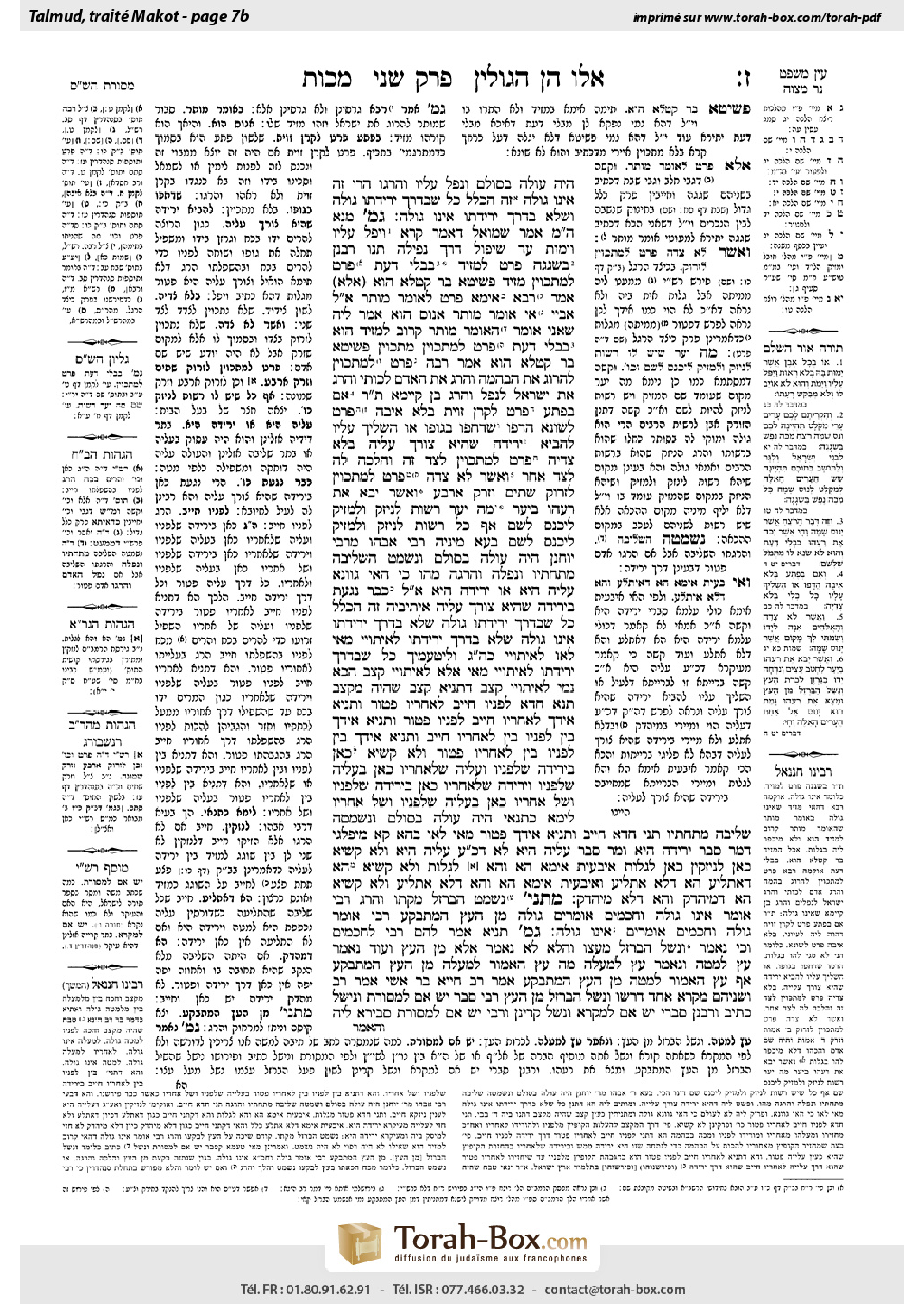
Makkot 7b: Talmud study for Daf Yomi
Daf Yomi is the daily study of one Talmud folio. Explore 37 tractates with scans, Hebrew text, Sefaria English and AI-generated French translations where annotated.
Passage selection and English or AI-generated French translation are available where the scan has annotations. Daf Study is independent of Torah-Box and Sefaria.
Browse Makkot · מכות · All tractatesMakkot 7b text and translations
This page of Makkot includes the Aramaic text, an English translation and an AI-generated French translation, alongside the scan above.
מכות ז׳ ב · Aramaic and Hebrew text
הָיָה עוֹלֶה בַּסּוּלָּם וְנָפַל עָלָיו וַהֲרָגוֹ – הֲרֵי זֶה אֵינוֹ גּוֹלֶה. זֶה הַכְּלָל: כׇּל שֶׁבְּדֶרֶךְ יְרִידָתוֹ – גּוֹלֶה, וְשֶׁלֹּא בְּדֶרֶךְ יְרִידָתוֹ – אֵינוֹ גּוֹלֶה.
גְּמָ׳ מְנָא הָנֵי מִילֵּי? דְּאָמַר שְׁמוּאֵל דְּאָמַר קְרָא: ״וַיַּפֵּל עָלָיו וַיָּמֹת״ – עַד שֶׁיִּפּוֹל דֶּרֶךְ נְפִילָה.
תָּנוּ רַבָּנַן: ״בִּשְׁגָגָה״ – פְּרָט לְמֵזִיד. ״בִּבְלִי דַּעַת״ – פְּרָט לְמִתְכַּוֵּין.
מֵזִיד? פְּשִׁיטָא, בַּר קְטָלָא הוּא! אֶלָּא אָמַר רָבָא: אֵימָא פְּרָט לְאוֹמֵר מוּתָּר. אֲמַר לֵיהּ אַבָּיֵי: אִי אוֹמֵר מוּתָּר, אָנוּס הוּא? אֲמַר לֵיהּ: שֶׁאֲנִי אוֹמֵר, הָאוֹמֵר מוּתָּר – קָרוֹב לְמֵזִיד הוּא.
״בִּבְלִי דַעַת״ – פְּרָט לְמִתְכַּוֵּין. מִתְכַּוֵּין? פְּשִׁיטָא, בַּר קְטָלָא הוּא! אָמַר רַבָּה: פְּרָט לְמִתְכַּוֵּין לַהֲרוֹג אֶת הַבְּהֵמָה וְהָרַג אֶת הָאָדָם, לַגּוֹי וְהָרַג אֶת יִשְׂרָאֵל, לַנֵּפֶל וְהָרַג בֶּן קַיָּימָא.
תָּנוּ רַבָּנַן: ״אִם בְּפֶתַע״ – פְּרָט לְקֶרֶן זָוִית. ״בְּלֹא אֵיבָה״ – פְּרָט לְשׂוֹנֵא. ״הֲדָפוֹ״ – שֶׁדְּחָפוֹ בְּגוּפוֹ. ״אוֹ הִשְׁלִיךְ עָלָיו״ – לְהָבִיא יְרִידָה שֶׁהִיא צוֹרֶךְ עֲלִיָּה. ״בְּלֹא צְדִיָּה״ – פְּרָט לְמִתְכַּוֵּין לְצַד זֶה וְהָלְכָה לָהּ לְצַד אַחֵר.
״וַאֲשֶׁר לֹא צָדָה״ – פְּרָט לְמִתְכַּוֵּין לִזְרוֹק שְׁתַּיִם, וְזָרַק אַרְבַּע. ״וַאֲשֶׁר יָבֹא אֶת רֵעֵהוּ בַיַּעַר״ – מָה יַעַר רְשׁוּת לַנִּיזָּק וְלַמַּזִּיק לִיכָּנֵס לְשָׁם, אַף כֹּל רְשׁוּת לַנִּיזָּק וְלַמַּזִּיק לִיכָּנֵס לְשָׁם.
בְּעָא מִינֵּיהּ רַבִּי אֲבָהוּ מֵרַבִּי יוֹחָנָן: הָיָה עוֹלֶה בַּסּוּלָּם וְנִשְׁמְטָה שְׁלִיבָה מִתַּחְתָּיו, וְנָפְלָה וְהָרְגָה, מַהוּ? כִּי הַאי גַוְונָא עֲלִיָּה הִיא, אוֹ יְרִידָה הִיא? אֲמַר לֵיהּ: כְּבָר נָגַעְתָּ בִּירִידָה שֶׁהִיא צוֹרֶךְ עֲלִיָּה.
אֵיתִיבֵיהּ, זֶה הַכְּלָל: כׇּל שֶׁבְּדֶרֶךְ יְרִידָתוֹ – גּוֹלֶה, שֶׁלֹּא בְּדֶרֶךְ יְרִידָתוֹ – אֵינוֹ גּוֹלֶה. שֶׁלֹּא בְּדֶרֶךְ יְרִידָתוֹ לְאֵיתוֹיֵי מַאי? לָאו לְאֵיתוֹיֵי כְּהַאי גַוְונָא? וְלִיטַעְמָיךְ, כָּל שֶׁבְּדֶרֶךְ יְרִידָתוֹ, לְאֵיתוֹיֵי מַאי?
אֶלָּא לְאֵיתוֹיֵי קַצָּב, הָכָא נָמֵי לְאֵיתוֹיֵי קַצָּב. דְּתַנְיָא: קַצָּב שֶׁהָיָה מְקַצֵּב, תָּנָא חֲדָא: לְפָנָיו – חַיָּיב, לְאַחֲרָיו – פָּטוּר. וְתַנְיָא אִידַּךְ: לְאַחֲרָיו – חַיָּיב, לְפָנָיו – פָּטוּר. וְתַנְיָא אִידַּךְ: בֵּין לְפָנָיו בֵּין לְאַחֲרָיו – חַיָּיב, וְתַנְיָא אִידַּךְ: בֵּין לְפָנָיו בֵּין לְאַחֲרָיו – פָּטוּר. וְלָא קַשְׁיָא.
כָּאן – בִּירִידָה שֶׁלְּפָנָיו, וַעֲלִיָּה שֶׁלְּאַחֲרָיו. כָּאן – בַּעֲלִיָּה שֶׁלְּפָנָיו, וִירִידָה שֶׁלְּאַחֲרָיו.
כָּאן – בִּירִידָה שֶׁלְּפָנָיו וְשֶׁל אַחֲרָיו, כָּאן – בַּעֲלִיָּה שֶׁלְּפָנָיו וְשֶׁל אַחֲרָיו.
לֵימָא כְּתַנָּאֵי: הָיָה עוֹלֶה בַּסּוּלָּם וְנִשְׁמְטָה שְׁלִיבָה מִתַּחְתָּיו, תָּנֵי חֲדָא חַיָּיב, וְתַנְיָא אִידַּךְ פָּטוּר. מַאי לָאו בְּהָא קָא מִיפַּלְגִי, דְּמָר סָבַר יְרִידָה הִיא, וּמָר סָבַר עֲלִיָּה הִיא?
לָא, דְּכוּלֵּי עָלְמָא עֲלִיָּה הִיא. וְלָא קַשְׁיָא: כָּאן לִנְיזָקִין, כָּאן לְגָלוּת.
אִיבָּעֵית אֵימָא הָא וְהָא לְגָלוּת, וְלָא קַשְׁיָא, הָא דְּאַתְלַיע, הָא דְּלָא אַתְלַע.
וְאִיבָּעֵית אֵימָא: הָא וְהָא דְּלָא אַתְלַע, וְלָא קַשְׁיָא, הָא דְּמִיהַדַּק, וְהָא דְּלָא מִיהַדַּק.
מַתְנִי׳ נִשְׁמַט הַבַּרְזֶל מִקַּתּוֹ וְהָרַג, רַבִּי אוֹמֵר: אֵינוֹ גּוֹלֶה, וַחֲכָמִים אוֹמְרִים: גּוֹלֶה. מִן הָעֵץ הַמִּתְבַּקֵּעַ, רַבִּי אוֹמֵר: גּוֹלֶה, וַחֲכָמִים אוֹמְרִים: אֵינוֹ גּוֹלֶה.
גְּמָ׳ תַּנְיָא, אָמַר לָהֶם רַבִּי לַחֲכָמִים: וְכִי נֶאֱמַר ״וְנָשַׁל הַבַּרְזֶל מֵעֵצוֹ״? וַהֲלֹא לֹא נֶאֱמַר אֶלָּא ״מִן הָעֵץ״! וְעוֹד, נֶאֱמַר ״עֵץ״ לְמַטָּה וְנֶאֱמַר ״עֵץ״ לְמַעְלָה, מָה ״עֵץ״ הָאָמוּר לְמַעְלָה מִן הָעֵץ הַמִּתְבַּקֵּעַ, אַף ״עֵץ״ הָאָמוּר לְמַטָּה מִן הָעֵץ הַמִּתְבַּקֵּעַ.
אָמַר רַב חִיָּיא בַּר אָשֵׁי אָמַר רַב: וּשְׁנֵיהֶם מִקְרָא אֶחָד דָּרְשׁוּ: ״וְנָשַׁל הַבַּרְזֶל מִן הָעֵץ״, רַבִּי סָבַר: יֵשׁ אֵם לַמָּסוֹרֶת, ״וְנִישֵּׁל״ כְּתִיב, וְרַבָּנַן סָבְרִי: יֵשׁ אֵם לַמִּקְרָא, ״וְנָשַׁל״ קָרֵינַן.
וְרַבִּי, יֵשׁ אֵם לַמָּסוֹרֶת סְבִירָא לֵיהּ?
Makkot 7b · English translation
or if one was climbing a ladder and he fell upon a person and killed him, that unintentional murderer is not exiled. This is the principle: Any murderer who kills unintentionally through his downward motion is exiled, and one who kills not through his downward motion is not exiled.
GEMARA: The Gemara asks with regard to the principle that one is exiled only if he killed unintentionally through a downward motion: From where are these matters derived? It is derived from a verse, as Shmuel says that the verse states with regard to those exiled to a city of refuge: “And he cast it down upon him and dies” (Numbers 35:23), indicating that one is not liable to be exiled unless the item falls in a downward motion.
The Sages taught in a baraita derivations from verses written with regard to the unintentional murderer: “Unintentionally” (Numbers 35:11); to exclude from exile the one who kills intentionally. “Unawares” (Deuteronomy 19:4); to exclude from exile the one who kills with intent.
The Gemara asks: Why is a derivation necessary to exclude one who kills intentionally? It is obvious that he is not exiled; he is subject to the death penalty. Rather, Rava said: Say that the type of intentional killer referred to is meant to exclude the one who says that it is permitted to kill the victim. The verse teaches that this person is neither executed nor is he exiled. Abaye said to Rava: If the reference is to one who says that it is permitted, he is a victim of circumstances beyond his control, as he did not know any better. How could that be characterized as intentional? Rava said to him: That is not a problem, as I say that with regard to one who says that it is permitted, his action borders on the intentional.
The baraita states: “Unawares”; to exclude from exile the one who kills with intent. The Gemara asks: With intent? It is obvious that he is not exiled; he is subject to the death penalty. Rabba said: The reference is to exclude the one who acted with the intent to kill an animal and he killed a person inadvertently, or one who acted with the intent to kill a gentile and he killed a Jew, or one who acted with the intent to kill a non-viable newborn and he killed a viable newborn.
The Sages taught in a baraita based on the verse written with regard to an unintentional murderer: “And if suddenly, without enmity, he thrust him or cast upon him any vessel without lying in wait” (Numbers 35:22). “If suddenly”; this serves to exclude one who unintentionally kills another that he encounters at a corner. “Without enmity”; this serves to exclude one who unintentionally kills his enemy, as even if the act appears unintentional, the presumption is that it was not. “He thrust him”; this indicates that even if he unintentionally shoved him with his body and killed him, he is liable to be exiled. “Or cast upon him”; this serves to include the case of a downward motion that is for the purpose of an upward motion, e.g., if one bent down in order to lift an item from the ground, and in the process of bending down he killed another unintentionally, he is exiled. “Without lying in wait”; this serves to exclude one who had the intent to throw a stone to this side and it went to a different side and killed a person.
And it is written with regard to an unintentional murderer: “And who did not lie in wait” (Exodus 21:13); this serves to exclude one who had intent to throw a stone two cubits and he inadvertently threw it four cubits and killed a person. And it is written concerning an unintentional murderer: “And as one who goes with his neighbor into the forest” (Deuteronomy 19:5), from which it is derived: Just as a forest is ownerless property, and there is permission for the victim and for the assailant to enter there, so too, unintentional murder that occurs in any place where there is permission for the victim and for the assailant to enter there, is punishable with exile. The unintentional murder of one who entered the assailant’s property without his permission is not cause for the murderer to be exiled.
§ The Gemara cites a related discussion. Rabbi Abbahu raised a dilemma before Rabbi Yoḥanan: If one was ascending a ladder and the rung was displaced from beneath him, and the rung fell and killed another, what is the halakha with regard to his being exiled? In a case like this, is it considered killing in an upward motion, as he was climbing the ladder, and therefore he is exempt, or is it considered killing in a downward motion, as when he stepped on the rung he pushed it down, and therefore he is liable? Rabbi Yoḥanan said to him: In the scenario you described, you already touched upon the case in the baraita cited above, the case of unintentional murder that is performed with a downward motion that is for the purpose of an upward motion. The ruling in the baraita is that one is liable to be exiled in that case.
Rabbi Abbahu raised an objection to the explanation of Rabbi Yoḥanan from the mishna, which states: This is the principle: Any murderer who kills unintentionally through his downward motion is exiled, and one who kills not through his downward motion is not exiled. Rabbi Abbahu clarifies: With regard to the phrase in the mishna: One who kills not through his downward motion, what case that was not already specified does this serve to add? Is it not to add a case like this, and to teach that even though the death was caused by the falling rung, since the assailant was ascending the ladder at the time, he is not exiled? Rabbi Yoḥanan replied: And according to your reasoning that this apparently extraneous phrase serves to include a case that is not addressed explicitly, with regard to the previous phrase in the mishna: Any murderer who kills unintentionally through his downward motion, what case that was not already specified does this serve to add?
Rather, one may say that it serves to add the case of a butcher. Here too, in the latter clause, the phrase: One who kills not through his downward motion, serves to add the case of a butcher, as it is taught in a baraita: With regard to a butcher who was chopping animal limbs with a cleaver, one Sage taught that if he killed a person in front of him, he is liable to be exiled; if he killed a person behind him, he is exempt. And it is taught in another baraita: If he killed a person behind him, he is liable; if he killed a person in front of him, he is exempt. And it is taught in another baraita: Both if he killed a person in front of him and if he killed a person behind him, he is liable. And it is taught in another baraita: Both if he killed a person in front of him and if he killed a person behind him, he is exempt. And although these baraitot appear contradictory, the apparent contradiction is not difficult.
When a butcher is about to cut the meat of an animal, he raises the cleaver and lowers it behind him in order to create momentum that will generate power. Then he raises the cleaver from behind him and brings it down forcefully onto the meat. In that process, the butcher lowers the cleaver in front of him and behind him and raises the cleaver both in front of him and behind him. Each of the four baraitot addresses a different stage of the process. Here, the baraita that says he is liable if he unintentionally murders a person in front of him and exempt if he unintentionally murders a person behind him, is referring to a case where the butcher swings the cleaver with a downward motion in front of him and an upward motion behind him. There, the baraita that says he is exempt if he unintentionally murders a person in front of him and liable if he unintentionally murders a person behind him, is referring to a case where the butcher swings the cleaver with an upward motion in front of him and a downward motion behind him.
In addition, here, the baraita where he is liable in both instances, is referring to a case where the butcher swings the cleaver with a downward motion both in front of him and behind him. There, the baraita where he is exempt in both instances, is referring to a case where the butcher swings the cleaver with an upward motion both in front of him and behind him. The two phrases that constitute the principle in the mishna teach that the determining factor is whether the motion is upward or downward, not whether it is in front of him or behind him. This is Rabbi Yoḥanan’s reply to the objection of Rabbi Abbahu.
The Gemara suggests: Let us say that Rabbi Abbahu’s dilemma with regard to unintentional murder committed by one climbing a ladder is the subject of a dispute between tanna’im: If one was ascending a ladder and its rung was displaced from beneath him, it is taught in one baraita that he is liable, and it is taught in another baraita that he is exempt. What, is it not that the tanna’im disagree with regard to this, as one Sage holds: It is unintentional murder in a downward motion, and therefore he is liable, and one Sage holds: It is unintentional murder in an upward motion, and therefore he is exempt?
The Gemara rejects that parallel: No, that is not the point of contention, as everyone agrees that it is an upward motion, and there is no dispute between the Sages in the baraitot. Nevertheless, the apparent contradiction between them is not difficult, as here, in the baraita that rules him liable, the reference is to payment of damages, as with regard to one’s liability to pay damages, there is no difference between upward and downward motions, or between intentional and unwitting damage; and there, in the baraita that rules him exempt, the reference is to exile, from which one who murders unintentionally in an upward motion is exempt by Torah edict.
If you wish, say instead that in both this baraita and that baraita the reference is to exile, and it is not difficult, as this baraita, where the ruling is that he is liable, is referring to a case where the rung of the ladder was worm infested and he should have been cautious before stepping on it, and that baraita, where the ruling is that he is exempt, is referring to a case where the rung was not worm infested, as in that case it is murder due to circumstances beyond his control, as he could not have anticipated that the rung would be displaced.
And if you wish, say that in both this baraita and that baraita the reference is to a rung that was not worm infested, and it is not difficult, as this baraita, where the ruling is that he is exempt, is referring to a case where the rung was tightly inserted into the ladder, and therefore he could not have foreseen that it would be displaced, and that baraita, where the ruling is that he is liable, is referring to a case where the rung was not tightly inserted and he should have anticipated its displacement.
MISHNA: If the blade of an ax or hatchet was displaced from its handle, and it flew through the air and killed a person, Rabbi Yehuda HaNasi says: He is not exiled, and the Rabbis say: He is exiled. If part of a tree that is being split flew through the air and killed a person, Rabbi Yehuda HaNasi says: The murderer is exiled, and the Rabbis say: He is not exiled.
GEMARA: It is taught in a baraita that Rabbi Yehuda HaNasi said to the Rabbis: Is it stated in the verse: And the blade displaces from its wood handle? But isn’t it stated: “And the blade displaces from the wood” (Deuteronomy 19:5), indicating that it is a wood chip from the tree that causes the death of the person? And furthermore: Etz is stated below: “And the blade displaces from the etz,” and etz is stated above, earlier in the same verse: “And his hand wields the ax to cut down the etz.” Just as the term etz stated above is referring to wood from the tree that is being split, so too, the term etz stated below is referring to wood from the tree that is being split, not to the wood of the ax handle.
Rav Ḥiyya bar Ashi says that Rav says: And both of them, Rabbi Yehuda HaNasi and the Rabbis, interpreted one verse to arrive at their rulings. The verse states: “And the blade displaces [venashal] from the wood.” Rabbi Yehuda HaNasi holds: The tradition of the manner in which the verses in the Torah are written is authoritative, and one derives halakhot based on the manner in which the words are written, not on the manner in which they are vocalized. And it is written venishel, a transitive verb, indicating that the blade displaced wood chips from the tree. And the Rabbis maintain: The vocalization of the Torah is authoritative, and we read the term as venashal, an intransitive verb indicating that the blade is displaced from its wooden handle and kills a person.
The Gemara asks: And does Rabbi Yehuda HaNasi hold that the tradition of the manner in which the verses in the Torah are written is authoritative?
Makkot 7b · Traduction française (IA)
ou si quelqu’un montait à une échelle, tombait sur une personne et la tuait, cet homicide involontaire ne serait pas exilé. Tel est le principe : tout meurtrier qui tue involontairement dans un mouvement descendant est exilé, tandis que celui qui ne tue pas dans un mouvement descendant ne l’est pas.
GUEMARA : À propos du principe selon lequel on n’est exilé que si l’on a tué involontairement dans un mouvement descendant, la Guemara demande : De quoi déduit-on cela ? On le déduit d’un verset, comme le dit Chmouel : le verset dit au sujet de ceux qui sont exilés dans une ville de refuge : « Il l’a projeté sur lui et il est mort » (Nombres 35,23), ce qui indique qu’on n’est passible d’exil que si l’objet tombe dans un mouvement descendant.
Les Sages enseignent dans une baraïta des déductions tirées des versets concernant l’homicide involontaire : « Involontairement » (Nombres 35,11), pour exclure de l’exil celui qui tue intentionnellement ; « sans le savoir » (Deutéronome 19,4), pour exclure de l’exil celui qui tue avec une intention criminelle.
La Guemara demande : Pourquoi faut-il une déduction pour exclure celui qui tue intentionnellement ? Il est évident qu’il n’est pas exilé : il est passible de la peine de mort. Rava dit plutôt : il s’agit d’exclure le type de meurtrier intentionnel qui prétend qu’il est permis de tuer la victime. Le verset enseigne que cette personne n’est ni exécutée ni exilée. Abayé lui dit : Si l’on parle de quelqu’un qui prétend que cela est permis, il est victime de circonstances indépendantes de sa volonté, puisqu’il ne savait pas mieux. Comment son acte pourrait-il être qualifié d’intentionnel ? Rava lui répond : Cela ne pose pas de problème, car, selon moi, l’acte de celui qui prétend qu’il est permis de tuer est à la limite de l’acte intentionnel.
La baraïta enseigne : « Sans le savoir », pour exclure de l’exil celui qui tue avec une intention criminelle. La Guemara demande : Avec une intention criminelle ? Il est évident qu’il n’est pas exilé : il est passible de la peine de mort. Rabba dit : Il s’agit d’exclure celui qui avait l’intention de tuer un animal, mais a tué involontairement une personne ; ou celui qui avait l’intention de tuer un non-Juif, mais a tué un Juif ; ou celui qui avait l’intention de tuer un nouveau-né non viable, mais a tué un nouveau-né viable.
Les Sages enseignent dans une baraïta, à partir du verset concernant l’homicide involontaire : « Et si soudainement, sans hostilité, il le pousse ou jette sur lui un objet quelconque, sans l’avoir guetté » (Nombres 35,22). « Soudainement » sert à exclure celui qui tue involontairement une personne qu’il rencontre au détour d’un angle. « Sans hostilité » sert à exclure celui qui tue involontairement son ennemi, car, même si l’acte paraît involontaire, on présume qu’il ne l’était pas. « Il le pousse » indique que même s’il l’a involontairement poussé avec son corps et l’a tué, il est passible d’exil. « Ou jette sur lui » sert à inclure le cas d’un mouvement descendant destiné à permettre un mouvement ascendant : par exemple, si quelqu’un se penche pour ramasser un objet au sol et tue involontairement une autre personne en se baissant, il est exilé. « Sans l’avoir guetté » sert à exclure celui qui avait l’intention de lancer une pierre de ce côté, mais qui l’a lancée de l’autre côté et a tué une personne.
Et il est écrit au sujet de l’homicide involontaire : « Lui qui ne l’avait pas guetté » (Exode 21,13) ; cela sert à exclure celui qui avait l’intention de lancer une pierre à deux coudées, mais l’a involontairement lancée à quatre coudées et a tué une personne. Il est également écrit au sujet de l’homicide involontaire : « Comme celui qui va avec son prochain dans la forêt » (Deutéronome 19,5), d’où l’on déduit que, de même que la forêt est un bien sans propriétaire, dans lequel la victime comme l’agresseur ont le droit d’entrer, de même, un homicide involontaire commis en tout lieu où la victime et l’agresseur ont le droit d’entrer est passible d’exil. L’homicide involontaire d’une personne entrée sans permission dans la propriété de l’agresseur n’entraîne pas l’exil du meurtrier.
§ La Guemara rapporte une discussion connexe. Rabbi Abahou soumet une question à Rabbi Yoḥanan : si quelqu’un montait à une échelle et qu’un échelon se délogeait sous son pied, puis tombait et tuait une autre personne, quelle est la halakha quant à son exil ? Dans un tel cas, considère-t-on qu’il a tué dans un mouvement ascendant, puisqu’il montait à l’échelle, et est-il donc exempt, ou considère-t-on qu’il a tué dans un mouvement descendant, puisqu’en posant le pied sur l’échelon il l’a poussé vers le bas, et est-il donc passible d’exil ? Rabbi Yoḥanan lui dit : Le scénario que tu décris correspond au cas déjà abordé dans la baraïta citée plus haut, celui d’un homicide involontaire commis dans un mouvement descendant destiné à permettre un mouvement ascendant. Selon la baraïta, dans ce cas, on est passible d’exil.
Rabbi Abahou objecte à l’explication de Rabbi Yoḥanan en citant la Michna, qui énonce : « Tel est le principe : tout meurtrier qui tue involontairement dans un mouvement descendant est exilé, tandis que celui qui ne tue pas dans un mouvement descendant ne l’est pas. » Rabbi Abahou précise : Que vient ajouter l’expression de la Michna « celui qui ne tue pas dans un mouvement descendant », à propos d’un cas qui n’a pas déjà été précisé ? N’est-ce pas pour inclure un cas comme celui-ci et enseigner que, même si la mort a été causée par la chute de l’échelon, l’agresseur n’est pas exilé puisqu’il montait à l’échelle à ce moment-là ? Rabbi Yoḥanan répond : Selon ton raisonnement, cette expression apparemment superflue sert à inclure un cas qui n’est pas explicitement traité ; alors, concernant l’expression précédente de la Michna, « tout meurtrier qui tue involontairement dans un mouvement descendant », quel cas non encore précisé vient-elle ajouter ?
On peut plutôt dire qu’elle vient ajouter le cas d’un boucher. De même, dans la dernière partie, l’expression « celui qui ne tue pas dans un mouvement descendant » vient ajouter le cas d’un boucher, comme l’enseigne une baraïta : au sujet d’un boucher qui hachait des morceaux d’animal avec un couperet, un Sage enseigne que s’il a tué une personne devant lui, il est passible d’exil, et que s’il a tué une personne derrière lui, il est exempt. Une autre baraïta enseigne que s’il a tué une personne derrière lui, il est passible d’exil, et que s’il a tué une personne devant lui, il est exempt. Une autre baraïta enseigne que, qu’il ait tué une personne devant lui ou derrière lui, il est passible d’exil. Une autre baraïta enseigne que, qu’il ait tué une personne devant lui ou derrière lui, il est exempt. Bien que ces baraïtot semblent contradictoires, cette contradiction apparente ne pose pas de difficulté.
Lorsqu’un boucher s’apprête à couper la viande d’un animal, il lève le couperet, puis l’abaisse derrière lui afin de lui donner de l’élan et de la force. Ensuite, il ramène le couperet depuis l’arrière et l’abat avec force sur la viande. Au cours de cette opération, le boucher abaisse le couperet devant lui et derrière lui, et le lève aussi bien devant lui que derrière lui. Chacune des quatre baraïtot traite d’une étape différente de l’opération. Ici, la baraïta qui dit qu’il est passible d’exil s’il tue involontairement une personne devant lui et exempt s’il en tue une derrière lui parle du cas où le boucher manie le couperet dans un mouvement descendant devant lui et dans un mouvement ascendant derrière lui. Là, la baraïta qui dit qu’il est exempt s’il tue involontairement une personne devant lui et passible d’exil s’il en tue une derrière lui parle du cas où le boucher manie le couperet dans un mouvement ascendant devant lui et dans un mouvement descendant derrière lui.
De plus, ici, la baraïta qui le rend passible d’exil dans les deux cas parle d’une situation où le boucher manie le couperet dans un mouvement descendant aussi bien devant lui que derrière lui. Là, la baraïta qui le déclare exempt dans les deux cas parle d’une situation où le boucher manie le couperet dans un mouvement ascendant aussi bien devant lui que derrière lui. Les deux expressions qui constituent le principe de la Michna enseignent que le facteur déterminant est le caractère ascendant ou descendant du mouvement, et non le fait qu’il ait lieu devant ou derrière lui. Telle est la réponse de Rabbi Yoḥanan à l’objection de Rabbi Abahou.
La Guemara suggère : Peut-on dire que la question de Rabbi Abahou au sujet d’un homicide involontaire commis par quelqu’un qui montait à une échelle fait l’objet d’un désaccord entre des tannaïm ? Si quelqu’un montait à une échelle et qu’un échelon se délogeait sous son pied, une baraïta enseigne qu’il est passible d’exil, tandis qu’une autre enseigne qu’il est exempt. N’est-ce pas là le désaccord entre les tannaïm : un Sage considère qu’il s’agit d’un homicide involontaire commis dans un mouvement descendant, et qu’il est donc passible d’exil, tandis qu’un autre considère qu’il s’agit d’un homicide involontaire commis dans un mouvement ascendant, et qu’il est donc exempt ?
La Guemara rejette ce parallèle : Non, ce n’est pas là que réside le désaccord, car tous reconnaissent qu’il s’agit d’un mouvement ascendant et qu’il n’y a pas de désaccord entre les Sages des baraïtot. La contradiction apparente entre elles ne pose toutefois pas de difficulté : ici, dans la baraïta qui statue qu’il est passible, il s’agit du paiement de dommages, car, en matière d’indemnisation, il n’y a aucune différence entre un mouvement ascendant et un mouvement descendant, ni entre un dommage intentionnel et un dommage involontaire ; là, dans la baraïta qui statue qu’il est exempt, il s’agit de l’exil, auquel échappe, selon le décret de la Torah, celui qui commet un homicide involontaire dans un mouvement ascendant.
Si tu le souhaites, dis plutôt que les deux baraïtot, celle-ci comme celle-là, traitent de l’exil, et qu’il n’y a pas de difficulté : cette baraïta, qui statue qu’il est passible d’exil, parle d’un cas où l’échelon de l’échelle était vermoulu et où il aurait dû prendre ses précautions avant d’y poser le pied ; l’autre baraïta, qui statue qu’il est exempt, parle d’un cas où l’échelon n’était pas vermoulu, car il s’agit alors d’un homicide dû à des circonstances indépendantes de sa volonté, puisqu’il ne pouvait pas prévoir que l’échelon se délogerait.
Et si tu le souhaites, dis que les deux baraïtot, celle-ci comme celle-là, traitent d’un échelon qui n’était pas vermoulu, et qu’il n’y a pas de difficulté : cette baraïta, qui statue qu’il est exempt, parle d’un cas où l’échelon était solidement fixé à l’échelle et où il ne pouvait donc pas prévoir qu’il se délogerait ; l’autre baraïta, qui statue qu’il est passible d’exil, parle d’un cas où l’échelon n’était pas solidement fixé et où il aurait dû prévoir qu’il se délogerait.
MICHNA : Si la lame d’une hache s’est détachée de son manche, a traversé les airs et tué une personne, Rabbi Yehouda HaNassi dit : Le meurtrier n’est pas exilé ; les Sages disent : Il est exilé. Si un morceau de bois de l’arbre que l’on fend a traversé les airs et tué une personne, Rabbi Yehouda HaNassi dit : Le meurtrier est exilé ; les Sages disent : Il n’est pas exilé.
GUEMARA : Une baraïta enseigne que Rabbi Yehouda HaNassi dit aux Sages : Le verset dit-il que la lame se détache de son manche en bois ? Ne dit-il pas plutôt : « Et la lame se détache du bois » (Deutéronome 19,5), ce qui indique que c’est un éclat de bois de l’arbre qui cause la mort de la personne ? De plus, le terme etz apparaît plus bas : « et la lame se détache de l’etz », et le terme etz apparaît plus haut, plus tôt dans le même verset : « sa main manie la hache pour abattre l’etz ». De même que le terme etz mentionné plus haut désigne le bois de l’arbre que l’on fend, de même, le terme etz mentionné plus bas désigne le bois de l’arbre que l’on fend, et non le bois du manche de la hache.
Rav Ḥiyya bar Ashi dit au nom de Rav : Rabbi Yehouda HaNassi et les Sages ont tous deux interprété un même verset pour parvenir à leurs décisions. Le verset dit : « Et la lame se détache [venashal] du bois. » Rabbi Yehouda HaNassi estime que la tradition relative à la manière dont les versets de la Torah sont écrits fait autorité, et que l’on déduit les halakhot de la graphie des mots, non de leur vocalisation. Or, le mot est écrit venishel, un verbe transitif, ce qui indique que la lame a détaché des éclats de bois de l’arbre. Les Sages, eux, estiment que la vocalisation de la Torah fait autorité et lisent le terme venashal comme un verbe intransitif, indiquant que la lame se détache de son manche en bois et tue une personne.
La Guemara demande : Rabbi Yehouda HaNassi estime-t-il donc que la tradition relative à la manière dont les versets de la Torah sont écrits fait autorité ?
Traduction française générée par IA à partir de l’édition anglaise de Sefaria. Vérifie toujours un passage avec le texte source.
Text from Sefaria: William Davidson Edition - Vocalized Aramaic (CC BY NC); William Davidson Edition - English (CC BY NC).