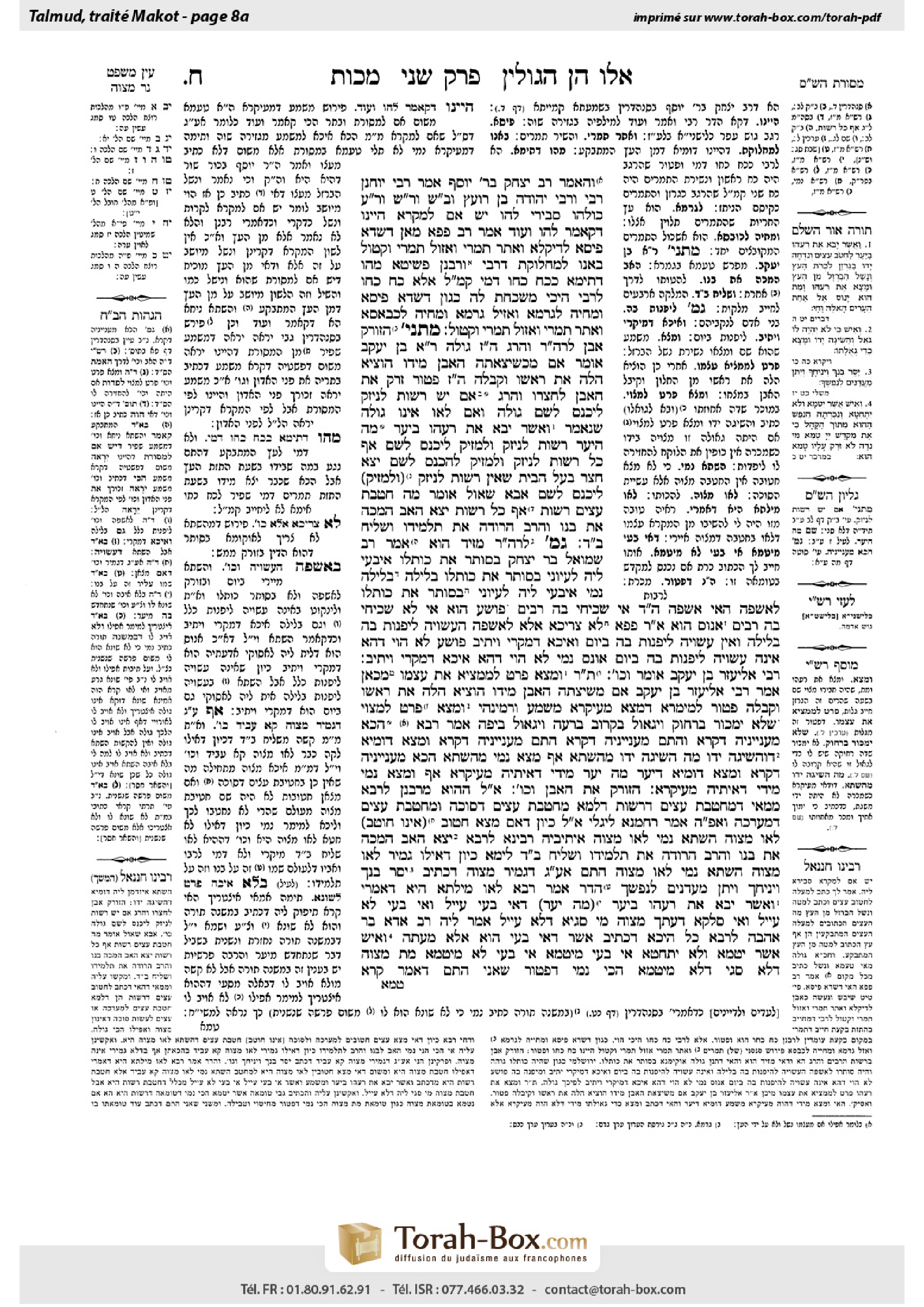
Makkot 8a: Talmud study for Daf Yomi
Daf Yomi is the daily study of one Talmud folio. Explore 37 tractates with scans, Hebrew text, Sefaria English and AI-generated French translations where annotated.
Passage selection and English or AI-generated French translation are available where the scan has annotations. Daf Study is independent of Torah-Box and Sefaria.
Browse Makkot · מכות · All tractatesMakkot 8a text and translations
This page of Makkot includes the Aramaic text, an English translation and an AI-generated French translation, alongside the scan above.
מכות ח׳ א · Aramaic and Hebrew text
וְהָאָמַר רַב יִצְחָק בְּרַבִּי יוֹסֵף אָמַר רַבִּי יוֹחָנָן: רַבִּי, וְרַבִּי יְהוּדָה בֶּן רוֹעֵץ, וּבֵית שַׁמַּאי, וְרַבִּי שִׁמְעוֹן, וְרַבִּי עֲקִיבָא, כּוּלְּהוּ סְבִירִי לְהוּ יֵשׁ אֵם לַמִּקְרָא! הַיְינוּ דְּקָאָמַר לְהוּ ״וְעוֹד״.
אָמַר רַב פָּפָּא: מַאן דִּשְׁדָא פִּיסָּא לְדִיקְלָא וְאַתַּר תַּמְרֵי, וַאֲזוּל תַּמְרֵי וּקְטוּל, בָּאנוּ לְמַחְלוֹקֶת דְּרַבִּי וְרַבָּנַן. פְּשִׁיטָא! מַהוּ דְּתֵימָא, כְּכֹחַ כֹּחוֹ דָּמֵי, קָא מַשְׁמַע לַן.
אֶלָּא כֹּחַ כֹּחוֹ לְרַבִּי הֵיכִי מַשְׁכַּחַתְּ לַהּ? כְּגוֹן דִּשְׁדָא פִּיסָּא וּמַחֲיֵהּ לְגִרְמָא, וַאֲזַל גִּרְמָא וּמַחֲיֵהּ לִכְבָאסָא וְאַתַּר תַּמְרֵי, וַאֲזוּל תַּמְרֵי וּקְטוּל.
מַתְנִי׳ הַזּוֹרֵק אֶבֶן לִרְשׁוּת הָרַבִּים וְהָרַג – הֲרֵי זֶה גּוֹלֶה. רַבִּי אֱלִיעֶזֶר בֶּן יַעֲקֹב אוֹמֵר: אִם מִכְּשֶׁיָּצָאתָה הָאֶבֶן מִיָּדוֹ הוֹצִיא הַלָּה אֶת רֹאשׁוֹ וְקִבְּלָהּ – הֲרֵי זֶה פָּטוּר.
זָרַק אֶת הָאֶבֶן לַחֲצֵרוֹ וְהָרַג, אִם יֵשׁ רְשׁוּת לַנִּיזָּק לִיכָּנֵס לְשָׁם – גּוֹלֶה, וְאִם לָאו – אֵינוֹ גּוֹלֶה, שֶׁנֶּאֱמַר: ״וַאֲשֶׁר יָבֹא אֶת רֵעֵהוּ בַיַּעַר״ – מָה הַיַּעַר רְשׁוּת לַנִּיזָּק וְלַמַּזִּיק לִיכָּנֵס לְשָׁם, אַף כֹּל רְשׁוּת לַנִּיזָּק וְלַמַּזִּיק לְהִכָּנֵס לְשָׁם. יָצָא חֲצַר בַּעַל הַבַּיִת, שֶׁאֵין רְשׁוּת לַנִּיזָּק וְלַמַּזִּיק לִיכָּנֵס לְשָׁם.
אַבָּא שָׁאוּל אוֹמֵר: מָה חֲטָבַת עֵצִים רְשׁוּת, אַף כֹּל רְשׁוּת, יָצָא הָאָב הַמַּכֶּה אֶת בְּנוֹ, וְהָרַב הָרוֹדֶה אֶת תַּלְמִידוֹ, וּשְׁלִיחַ בֵּית דִּין.
גְּמָ׳ לִרְשׁוּת הָרַבִּים, מֵזִיד הוּא! אָמַר רַב שְׁמוּאֵל בַּר יִצְחָק: בְּסוֹתֵר אֶת כּוֹתְלוֹ. אִיבְּעִי לֵיהּ לְעַיּוֹנֵי! בְּסוֹתֵר אֶת כּוֹתְלוֹ בַּלַּיְלָה. בַּלַּיְלָה נָמֵי אִיבְּעִי לֵיהּ לְעַיּוֹנֵי!
בְּסוֹתֵר אֶת כּוֹתְלוֹ לְאַשְׁפָּה. הַאי אַשְׁפָּה הֵיכִי דָמֵי? אִי שְׁכִיחִי בַּהּ רַבִּים – פּוֹשֵׁעַ הוּא, אִי לָא שְׁכִיחִי בַּהּ רַבִּים – אָנוּס הוּא!
אָמַר רַב פָּפָּא: לָא צְרִיכָא אֶלָּא לְאַשְׁפָּה הָעֲשׂוּיָה לִיפָּנוֹת בָּהּ בַּלַּיְלָה, וְאֵין עֲשׂוּיָה לִיפָּנוֹת בָּהּ בַּיּוֹם, וְאִיכָּא דְּמִקְּרֵי וְיָתֵיב. פּוֹשֵׁעַ לָא הָוֵי – דְּהָא אֵינָהּ עֲשׂוּיָה לִיפָּנוֹת בָּהּ בַּיּוֹם, אוֹנֶס נָמֵי לָא הָוֵי, דְּהָא אִיכָּא דְּמִקְּרֵי וְיָתֵיב.
רַבִּי אֱלִיעֶזֶר בֶּן יַעֲקֹב אוֹמֵר וְכוּ׳. תָּנוּ רַבָּנַן: ״וּמָצָא״ – פְּרָט לְמַמְצִיא אֶת עַצְמוֹ. מִכָּאן אָמַר רַבִּי אֱלִיעֶזֶר בֶּן יַעֲקֹב: אִם מִשֶּׁיָּצָתָה הָאֶבֶן מִיָּדוֹ הוֹצִיא הַלָּה אֶת רֹאשׁוֹ וְקִבְּלָהּ, פָּטוּר.
לְמֵימְרָא דְּ״מָצָא״ מֵעִיקָּרָא מַשְׁמַע? וּרְמִינְהִי: ״וּמָצָא״ – פְּרָט לְמָצוּי, שֶׁלֹּא יִמְכּוֹר בְּרָחוֹק וְיִגְאוֹל בְּקָרוֹב, בְּרָעָה וְיִגְאוֹל בְּיָפָה!
אָמַר רָבָא: הָכָא מֵעִנְיָינֵיהּ דִּקְרָא וְהָתָם מֵעִנְיָינֵיהּ דִּקְרָא. הָתָם מֵעִנְיָינֵיהּ דִּקְרָא, ״וּמָצָא״ דּוּמְיָא דִּ״וְהִשִּׂיגָה יָדוֹ״, מָה ״הִשִּׂיגָה יָדוֹ״ מֵהַשְׁתָּא, אַף ״מָצָא״ נָמֵי מֵהַשְׁתָּא. הָכָא מֵעִנְיָינֵיהּ דִּקְרָא, ״וּמָצָא״ דּוּמְיָא דְּיַעַר, מָה יַעַר מִידֵּי דְּאִיתֵיהּ מֵעִיקָּרָא, אַף ״וּמָצָא״ נָמֵי מִידֵּי דְּאִיתֵיהּ מֵעִיקָּרָא.
הַזּוֹרֵק אֶת הָאֶבֶן וְכוּ׳. אֲמַר לֵיהּ הָהוּא מֵרַבָּנַן לְרָבָא: מִמַּאי דְּמַחֲטָבַת עֵצִים דִּרְשׁוּת? דִּלְמָא מֵחֲטָבַת עֵצִים דְּסוּכָּה, וּמֵחֲטָבַת עֵצִים דְּמַעֲרָכָה, וַאֲפִילּוּ הָכִי אָמַר רַחֲמָנָא לִיגְלֵי! אֲמַר לֵיהּ כֵּיוָן דְּאִם מָצָא חָטוּב אֵינוֹ חוֹטֵב, לָאו מִצְוָה, הַשְׁתָּא נָמֵי – לָאו מִצְוָה.
אֵיתִיבֵיהּ רָבִינָא לְרָבָא: יָצָא הָאָב הַמַּכֶּה אֶת בְּנוֹ, וְהָרַב הָרוֹדֶה אֶת תַּלְמִידוֹ, וּשְׁלִיחַ בֵּית דִּין. לֵימָא: כֵּיוָן דְּאִילּוּ גְּמִיר לָאו מִצְוָה, הַשְׁתָּא נָמֵי, לָאו מִצְוָה! הָתָם אַף עַל גַּב דִּגְמִיר מִצְוָה, דִּכְתִיב: ״יַסֵּר בִּנְךָ וִינִיחֶךָ וְיִתֵּן מַעֲדַנִּים לְנַפְשֶׁךָ״.
הֲדַר אָמַר רָבָא: לָאו מִילְּתָא הִיא דַּאֲמַרִי. ״וַאֲשֶׁר יָבֹא אֶת רֵעֵהוּ בַיַּעַר״, מָה יַעַר דְּאִי בָּעֵי עָיֵיל וְאִי בָּעֵי לָא עָיֵיל, וְאִי סָלְקָא דַעְתָּךְ מִצְוָה, מִי סַגִּיא דְּלָא עָיֵיל?
אֲמַר לֵיהּ רַב אַדָּא בַּר אַהֲבָה לְרָבָא: כֹּל הֵיכָא דִּכְתִיב ״אֲשֶׁר״, דְּאִי בָּעֵי הוּא? אֶלָּא מֵעַתָּה ״וְאִישׁ אֲשֶׁר יִטְמָא וְלֹא יִתְחַטָּא״ – אִי בָּעֵי מִיטַּמֵּא אִי בָּעֵי לָא מִיטַּמֵּא. מֵת מִצְוָה, דְּלָא סַגִּי דְּלָא מִיטַּמֵּא, הָכִי נָמֵי דְּפָטוּר?
שָׁאנֵי הָתָם, דְּאָמַר קְרָא:
Makkot 8a · English translation
But doesn’t Rav Yitzḥak, son of Rabbi Yosef, say that Rabbi Yoḥanan says: Rabbi Yehuda HaNasi, and Rabbi Yehuda ben Roetz, and Beit Shammai, and Rabbi Shimon, and Rabbi Akiva all hold that the vocalization of the Torah is authoritative, not the manner in which it is written? How can Rav Ḥiyya bar Ashi ascribe Rabbi Yehuda HaNasi’s ruling to the contrary opinion? The Gemara answers: That is the reason that Rabbi Yehuda HaNasi said to the Rabbis: And furthermore. Rabbi Yehuda HaNasi said to them: If the tradition of the manner in which the verses in the Torah are written is authoritative, that supports my interpretation of the verse; if not, there is an additional proof.
Rav Pappa said: In the case of one who cast a clod of earth onto a palm tree, and he severed dates from the tree, and the dates went upon a person and killed him, we have arrived at the dispute between Rabbi Yehuda HaNasi and the Rabbis in a case where one was splitting wood and a wood chip flew through the air and killed a person. In that case, Rabbi Yehuda HaNasi deems him liable to be exiled, and the Rabbis deem him exempt from exile. The Gemara asks: Isn’t that obvious? The cases are identical. What novel element is Rav Pappa introducing? The Gemara answers: The parallel between the cases drawn by Rav Pappa is necessary. Lest you say that these severed dates were not propelled by the force of his action but are like an item propelled by a force generated by the force of his action, and even Rabbi Yehuda HaNasi would concede that in that case he is exempt from exile, Rav Pappa teaches us that the dates are considered to have been severed by the force of his action.
The Gemara asks: But according to Rabbi Yehuda HaNasi, how can you find circumstances of a force generated by the force of his action where he would be exempt from exile? The Gemara answers: It can be found in a case where one cast a clod of earth and it struck a branch of the palm tree, and the branch, propelled by the clod, proceeded to strike a cluster of dates [likhevasa] and severed the dates from the branch they were on and the dates proceeded to kill a person.
MISHNA: One who threw a stone into the public domain and killed a person is exiled. Rabbi Eliezer ben Ya’akov says: If after the stone left his hand the other person placed his head out into the public domain and received a blow from the stone, he is exempt, as when he cast the stone into the public domain there was no one there.
In the case of one who threw the stone into his courtyard and killed a person, if the victim had permission to enter into there, the murderer is exiled, but if not, he is not exiled, as it is stated with regard to the cities of refuge: “And as one who goes with his neighbor into the forest” (Deuteronomy 19:5), from which it is derived: Just as with regard to a forest, the victim and the assailant both have equal permission to enter there, so too, with regard to all places that the victim and the assailant have permission to enter there, the killer is liable. This serves to exclude the courtyard of the homeowner, where the victim and the assailant do not both have permission to enter there. Since the victim had no right to enter his courtyard, the unintentional murderer is exempt from exile.
Abba Shaul says: Another halakha can be derived from that verse: Just as the cutting of wood that is mentioned in the verse is optional, so too, all those liable to be exiled are examples of cases where the unintentional murderer was engaged in an activity that is optional. This serves to exclude a father who strikes his son, and a teacher who oppresses his student, and an agent of the court deputized to flog transgressors. If, in the course of performing the mitzva with which they are charged, they unintentionally murdered the son, the student, or the person being flogged, respectively, they are exempt.
GEMARA: The mishna teaches: One who threw a stone into the public domain and killed a person is exiled. The Gemara asks: If he threw the stone into the public domain, why is he exiled? He is an intentional murderer. He knows that there are generally people in the public domain and is aware that he is likely to harm someone with the stone. Rav Shmuel bar Yitzḥak says: The reference in the mishna is not to one who threw a stone for no reason; rather, it is a case where one is demolishing his wall, and one of the stones struck a person. The Gemara counters: That too is intentional, as he should have examined the other side of the wall to determine if there was anyone there. The Gemara answers: It is a case where one is demolishing his wall at night, when passersby are scarce. The Gemara asks: At night too he is required to examine the other side of the wall to determine if there is anyone there, as although it is uncommon, people are apt to walk through a public domain at all hours.
The Gemara answers: The reference in the mishna is to a case where one demolishes his wall into a scrap heap, where there is no reasonable expectation to find anyone there, as it is located out of the way. The Gemara asks: What are the circumstances of this scrap heap? If it is frequented by the multitudes because it is utilized as a bathroom, he is negligent; if it is not frequented by the multitudes, although it is a public domain in the sense that it is not private property, he is a victim of circumstances beyond his control, as there was no reason to consider the possibility that someone was there.
Rav Pappa said: It is necessary to state this halakha only in the case of a scrap heap that is utilized for people to defecate there at night but is not utilized for people to defecate there during the day, but it happens on occasion that one will sit there and defecate during the day. One who demolishes his wall into the scrap heap during the day is neither negligent, as the scrap heap is not utilized for people to defecate there during the day, nor is he a victim of circumstances beyond his control, as it happens on occasion that one will sit there and defecate during the day, which he should have considered. Therefore, his status is that of an unintentional murderer who is liable to be exiled.
§ The mishna teaches that Rabbi Eliezer ben Ya’akov says: If after the stone left his hand the other person placed his head out into the public domain and received a blow from the stone, he is exempt. The Gemara cites a related baraita. The Sages taught that it is written: “And the blade displaces from the wood and finds his neighbor and he dies” (Deuteronomy 19:5), from which it is inferred: “And finds”; this serves to exclude one who presents himself and is thereby killed by the stone. From here Rabbi Eliezer ben Ya’akov says: If after the stone left his hand the other person placed his head out into the public domain and received a blow from the stone, the murderer is exempt.
The Gemara asks: Is that to say that the term “and finds” indicates an item that was there initially, prior to the incident in question? And the Gemara raises a contradiction from that which is written with regard to one who seeks to redeem an ancestral field that he sold: “And he acquires the means and finds sufficient funds for his redemption” (Leviticus 25:26). The term “and finds” serves to exclude one who, in order to accrue funds to redeem his field, sells a field that was found in his possession when he originally sold the field. It means that he may not sell land that he owns in a distant place and redeem land that he owns in a proximate place, or sell a low-quality tract of land and redeem with the funds accrued from that sale high-quality land. One may not exploit his right to redeem his land for his own advantage. This baraita indicates that the term “and finds” indicates an item that was not there at the time but presents itself later.
Rava said: This is not difficult, as here, with regard to exile, the term is interpreted in keeping with the context of the verse, and there, with regard to the redemption of land, the term is interpreted in keeping with the context of the verse. There, the term is interpreted in keeping with the context of the verse. The term “and finds” is similar to the phrase that precedes it: “And he acquires the means.” Just as the meaning of the phrase “he acquires the means” is that he acquires the means from now, as had he possessed the means beforehand he would not have sold his ancestral field at all, so too, the meaning of the term “and finds” is also that he finds sufficient funds from now and no earlier. Here, with regard to exile, the term is interpreted in keeping with the context of the verse, as the term “and finds” is similar to a forest: Just as a forest is an entity that is there initially, so too, the term “and finds” also is referring to an entity that is there initially.
§ The mishna teaches: One who throws a stone, etc. Abba Shaul derives from the verse: “And as when one goes with his neighbor into the forest” (Deuteronomy 19:5): Just as the cutting of wood mentioned in the verse is optional, so too, all those liable to be exiled are in cases where the unintentional murderer was engaged in an activity that is optional. One of the Sages said to Rava: From where do you know that the derivation is from the cutting of wood for a purpose that is optional? Perhaps the derivation is from the cutting of wood for the purpose of building a sukka or from cutting wood for the arrangement of wood on the altar, both of which are obligatory, since they are mitzvot, and even so the Merciful One states: Let him be exiled. Rava said to him: Since if one found wood already cut he does not cut other wood, as in that case it is not a mitzva to cut, now, when there is no wood cut as well, although he is cutting wood to facilitate fulfillment of a mitzva, the act of cutting the wood itself is not a mitzva.
Ravina raised an objection to the opinion of Rava from a clause of the mishna that states that the example of the forest serves to exclude a father who strikes his son, and a teacher who oppresses his student, and an agent of the court. Let us say with regard to a father who strikes his son: Since if the son was learned, it is not a mitzva to strike him, now, in a case where the son is not learned and the father strikes him to facilitate his education too, it is not a mitzva, and therefore he should be exiled. Rava replied: There, even though the son is learned, it is a mitzva to strike him from time to time, as it is written: “Chastise your son, and he will give you rest; and he will give delight to your soul” (Proverbs 29:17).
Rava then said: That which I said is nothing, as there is a different proof that the verse is not referring to cutting wood in fulfillment of a mitzva. It is written: “And as when one [ve’asher] goes with his neighbor into the forest.” Based on the term asher, which indicates that the entering into the forest may or may not occur, what is the nature of the forest mentioned in the verse? It is a place where if one wants to, he enters the forest, and if one wants to, he does not enter. And if it enters your mind that the verse is referring to one who cuts wood to fulfill a mitzva, would it suffice if he did not enter the forest? He must enter the forest to fulfill the mitzva.
Rav Adda bar Ahava said to Rava: Is it so that wherever the term asher is written in the Torah it is a case where if he wants to he does so, and it is not referring to a mitzva or an obligation? If that is so, that which is written: “And a man who [asher] becomes impure and does not purify himself, and that soul shall be excised…as he has impurified the Sanctuary of God” (Numbers 19:20), can be referring only to a case where if he wants to he becomes impure, and if he wants to, he does not become impure. But in the case of a corpse with no one to bury it [met mitzva], where it would not suffice for him not to become impure in the process of burying it, would you say: So too, he is exempt from the punishment of karet if he enters the Temple in a state of impurity?
Rava replied: There it is different, as the verse states with regard to one impure with impurity imparted by a corpse:
Makkot 8a · Traduction française (IA)
Mais Rav Yitzḥak, fils de Rabbi Yosef, ne dit-il pas que Rabbi Yoḥanan enseigne que Rabbi Yehuda HaNasi, Rabbi Yehuda ben Roetz, Beit Shammaï, Rabbi Shimon et Rabbi Akiva considèrent tous que la vocalisation de la Torah fait autorité, et non la manière dont elle est écrite ? Comment Rav Ḥiyya bar Ashi peut-il attribuer à Rabbi Yehuda HaNasi l’opinion contraire ? La Guemara répond : C’est la raison pour laquelle Rabbi Yehuda HaNasi dit aux Sages : « Et de plus ». Il leur dit : « Si la tradition relative à la manière dont les versets de la Torah sont écrits fait autorité, cela étaye mon interprétation du verset ; sinon, il existe une preuve supplémentaire. »
Rav Pappa dit : Dans le cas de quelqu’un qui lance une motte de terre contre un palmier, en détache des dattes qui atteignent une personne et la tuent, nous retrouvons la controverse entre Rabbi Yehuda HaNasi et les Sages au sujet de celui qui fendait du bois lorsqu’un éclat de bois projeté dans les airs a tué une personne. Dans ce cas, Rabbi Yehuda HaNasi le déclare passible d’exil, tandis que les Sages le dispensent d’exil. La Guemara demande : N’est-ce pas évident ? Les cas sont identiques. Quelle nouveauté Rav Pappa apporte-t-il ? La Guemara répond : Le rapprochement établi par Rav Pappa entre les deux cas est nécessaire. De crainte que tu ne dises que les dattes détachées n’ont pas été propulsées par la force de son geste, mais qu’elles sont comme un objet propulsé par une force produite par la force de son geste, et que même Rabbi Yehuda HaNasi reconnaîtrait alors qu’il est dispensé d’exil, Rav Pappa nous enseigne que les dattes sont considérées comme ayant été détachées par la force de son geste.
La Guemara demande : Mais selon Rabbi Yehuda HaNasi, dans quelles circonstances peut-on trouver un cas où une force produite par la force de son geste le dispenserait d’exil ? La Guemara répond : Cela peut se produire dans le cas où quelqu’un lance une motte de terre qui frappe une branche du palmier ; la branche, propulsée par la motte, frappe alors une grappe de dattes [likhevasa], détache les dattes de la branche à laquelle elles étaient attachées, et celles-ci tuent ensuite une personne.
Michna : Celui qui lance une pierre sur la voie publique et tue une personne est exilé. Rabbi Eliezer ben Ya’akov dit : Si, après que la pierre a quitté sa main, l’autre personne a sorti la tête sur la voie publique et a été frappée par la pierre, il est dispensé, car, lorsqu’il a lancé la pierre sur la voie publique, personne ne s’y trouvait.
Dans le cas de celui qui lance une pierre dans sa cour et tue une personne, si la victime avait la permission d’y entrer, le meurtrier est exilé ; sinon, il ne l’est pas, comme il est dit au sujet des villes de refuge : « Et comme celui qui va avec son prochain dans la forêt » (Deutéronome 19,5). On en déduit que, de même que dans une forêt la victime et l’agresseur ont tous deux également le droit d’entrer, de même, dans tous les lieux où la victime et l’agresseur ont le droit d’entrer, le meurtrier est passible d’exil. Cela exclut la cour du propriétaire, où la victime et l’agresseur n’ont pas tous deux le droit d’entrer. Puisque la victime n’avait pas le droit d’entrer dans sa cour, l’auteur d’un homicide involontaire est dispensé d’exil.
Abba Shaul dit : On peut déduire de ce verset une autre halakha : de même que couper du bois, mentionné dans le verset, est une activité facultative, de même, tous les cas passibles d’exil concernent un meurtrier involontaire qui accomplissait une activité facultative. Cela exclut le père qui frappe son fils, l’enseignant qui maltraite son élève et l’agent du tribunal chargé de fouetter les transgresseurs. Si, alors qu’ils accomplissaient la mitsva dont ils avaient la charge, ils ont involontairement tué le fils, l’élève ou la personne fouettée, respectivement, ils sont dispensés d’exil.
Guemara : La Michna enseigne : Celui qui lance une pierre sur la voie publique et tue une personne est exilé. La Guemara demande : S’il a lancé la pierre sur la voie publique, pourquoi est-il exilé ? Il s’agit d’un meurtrier intentionnel : il sait qu’il y a généralement des gens sur la voie publique et est conscient qu’il risque de blesser quelqu’un avec la pierre. Rav Shmuel bar Yitzḥak dit : La Michna ne parle pas de quelqu’un qui a lancé une pierre sans raison ; elle traite du cas où quelqu’un démolit son mur et où l’une des pierres frappe une personne. La Guemara objecte : Là aussi, il s’agit d’un acte intentionnel, car il aurait dû examiner l’autre côté du mur pour vérifier si quelqu’un s’y trouvait. La Guemara répond : Il s’agit du cas où quelqu’un démolit son mur la nuit, alors que les passants sont rares. La Guemara demande : Même la nuit, il est tenu d’examiner l’autre côté du mur pour vérifier si quelqu’un s’y trouve, car, bien que cela soit inhabituel, des gens peuvent emprunter une voie publique à toute heure.
La Guemara répond : La Michna parle du cas où quelqu’un démolit son mur en direction d’un tas de gravats, où l’on ne peut raisonnablement s’attendre à trouver quelqu’un, car l’endroit est à l’écart. La Guemara demande : Quelles sont les circonstances concernant ce tas de gravats ? S’il est fréquenté par la foule parce qu’il sert de lieu d’aisance, il est négligent ; s’il n’est pas fréquenté par la foule, bien qu’il s’agisse d’un domaine public au sens où ce n’est pas une propriété privée, il est victime de circonstances indépendantes de sa volonté, car rien ne justifiait qu’il envisage la possibilité que quelqu’un s’y trouve.
Rav Pappa dit : Cette halakha est nécessaire dans le cas d’un tas de gravats où les gens font leurs besoins la nuit, mais pas le jour ; il arrive cependant que quelqu’un s’y installe pour faire ses besoins pendant la journée. Celui qui démolit son mur en direction du tas de gravats pendant la journée n’est ni négligent, puisque le tas ne sert pas de lieu d’aisance le jour, ni victime de circonstances indépendantes de sa volonté, puisqu’il arrive que quelqu’un s’y installe pour faire ses besoins pendant la journée, éventualité dont il aurait dû tenir compte. Il est donc considéré comme un auteur d’homicide involontaire passible d’exil.
§ La Michna enseigne que Rabbi Eliezer ben Ya’akov dit : Si, après que la pierre a quitté sa main, l’autre personne a sorti la tête sur la voie publique et a été frappée par la pierre, il est dispensé. La Guemara cite une baraïta à ce sujet. Les Sages ont enseigné qu’il est écrit : « Et le fer se détache du bois et atteint son prochain, qui meurt » (Deutéronome 19,5). On déduit du mot « atteint » que cela exclut celui qui se présente lui-même et est ainsi tué par la pierre. De là, Rabbi Eliezer ben Ya’akov dit : Si, après que la pierre a quitté sa main, l’autre personne a sorti la tête sur la voie publique et a été frappée par la pierre, le meurtrier est dispensé.
La Guemara demande : Faut-il en conclure que le terme « atteint » désigne une chose qui était déjà là avant l’incident en question ? La Guemara soulève une contradiction à partir de ce qui est écrit au sujet de celui qui cherche à racheter un champ ancestral qu’il a vendu : « Et il acquiert les moyens et trouve suffisamment d’argent pour son rachat » (Lévitique 25,26). Le terme « trouve » sert à exclure celui qui, afin de réunir les fonds nécessaires au rachat de son champ, vend un champ qui se trouvait en sa possession lorsqu’il a vendu le premier. Cela signifie qu’il ne peut pas vendre une terre qu’il possède dans un endroit éloigné pour racheter une terre qu’il possède dans un endroit proche, ni vendre une parcelle de qualité inférieure et utiliser le produit de cette vente pour racheter une terre de qualité supérieure. On ne peut pas tirer avantage de son droit de racheter sa terre. Cette baraïta indique que le terme « trouve » désigne une chose qui n’était pas là au départ, mais qui se présente par la suite.
Rava dit : Il n’y a pas de difficulté, car ici, à propos de l’exil, le terme est interprété selon le contexte du verset, et là, à propos du rachat des terres, il est interprété selon le contexte du verset. Là, le terme est interprété selon le contexte du verset : « trouve » est similaire à l’expression qui le précède, « il acquiert les moyens ». De même que « il acquiert les moyens » signifie qu’il acquiert les moyens à partir de maintenant — car s’il les avait possédés auparavant, il n’aurait pas vendu son champ ancestral —, de même, « trouve » signifie qu’il trouve suffisamment d’argent à partir de maintenant, et non auparavant. Ici, à propos de l’exil, le terme est interprété selon le contexte du verset, car « atteint » est similaire à une forêt : de même qu’une forêt existe déjà, de même, le terme « atteint » désigne une chose qui existe déjà.
§ La Michna enseigne : Celui qui lance une pierre, etc. Abba Shaul déduit du verset « Et comme celui qui va avec son prochain dans la forêt » (Deutéronome 19,5) que, de même que couper le bois mentionné dans le verset est une activité facultative, de même, tous les cas passibles d’exil concernent un meurtrier involontaire qui accomplissait une activité facultative. L’un des Sages dit à Rava : D’où sais-tu que la déduction porte sur la coupe du bois à des fins facultatives ? Peut-être porte-t-elle sur la coupe du bois pour construire une soukka ou pour préparer le bois destiné à l’autel, deux activités obligatoires puisqu’il s’agit de mitsvot ; pourtant, le Miséricordieux dit : Qu’il soit exilé. Rava lui dit : Puisque, si quelqu’un trouve du bois déjà coupé, il n’en coupe pas d’autre — car, dans ce cas, couper du bois n’est pas une mitsva —, de même, lorsqu’il n’y a pas de bois déjà coupé, même s’il en coupe pour faciliter l’accomplissement d’une mitsva, l’acte même de couper le bois n’est pas une mitsva.
Ravina objecta à l’opinion de Rava en invoquant une clause de la Michna, qui dit que l’exemple de la forêt sert à exclure le père qui frappe son fils, l’enseignant qui maltraite son élève et l’agent du tribunal. Concernant le père qui frappe son fils, ne devrait-on pas dire : puisque, si le fils était instruit, le frapper ne serait pas une mitsva, dans le cas présent également, où le fils n’est pas instruit et où le père le frappe pour faciliter son éducation, ce n’est pas une mitsva ; il devrait donc être exilé. Rava répondit : Dans ce cas, même si le fils est instruit, le frapper de temps à autre est une mitsva, comme il est écrit : « Corrige ton fils, et il te donnera du repos ; il fera les délices de ton âme » (Proverbes 29,17).
Rava dit alors : Ce que j’ai dit ne tient pas, car une autre preuve montre que le verset ne parle pas de couper du bois pour accomplir une mitsva. Il est écrit : « Et comme celui qui [ve’asher] va avec son prochain dans la forêt. » Le terme asher indique que l’on peut entrer ou non dans la forêt. Quelle est donc la nature de la forêt mentionnée dans le verset ? C’est un lieu où l’on entre si on le souhaite et où l’on peut choisir de ne pas entrer. Or, si tu penses que le verset parle de quelqu’un qui coupe du bois pour accomplir une mitsva, pourrait-il se contenter de ne pas entrer dans la forêt ? Il doit y entrer pour accomplir la mitsva.
Rav Adda bar Ahava dit à Rava : Est-il vrai que, partout où le terme asher figure dans la Torah, il s’agit d’un cas où l’on agit si on le souhaite, et qu’il n’est pas question d’une mitsva ou d’une obligation ? Si c’est le cas, ce qui est écrit : « Et un homme qui [asher] devient impur et ne se purifie pas, cette personne sera retranchée… car il a rendu impur le Sanctuaire de Dieu » (Nombres 19,20), ne peut concerner qu’un cas où il devient impur s’il le souhaite et ne le devient pas s’il ne le souhaite pas. Mais dans le cas d’un mort sans personne pour l’enterrer [met mitsva], alors qu’il ne peut pas éviter de devenir impur en l’enterrant, dirais-tu également qu’il est dispensé du châtiment du retranchement s’il entre dans le Temple en état d’impureté ?
Rava répondit : Là, c’est différent, car le verset dit à propos de celui qui est impur du fait d’un cadavre :
Traduction française générée par IA à partir de l’édition anglaise de Sefaria. Vérifie toujours un passage avec le texte source.
Text from Sefaria: William Davidson Edition - Vocalized Aramaic (CC BY NC); William Davidson Edition - English (CC BY NC).