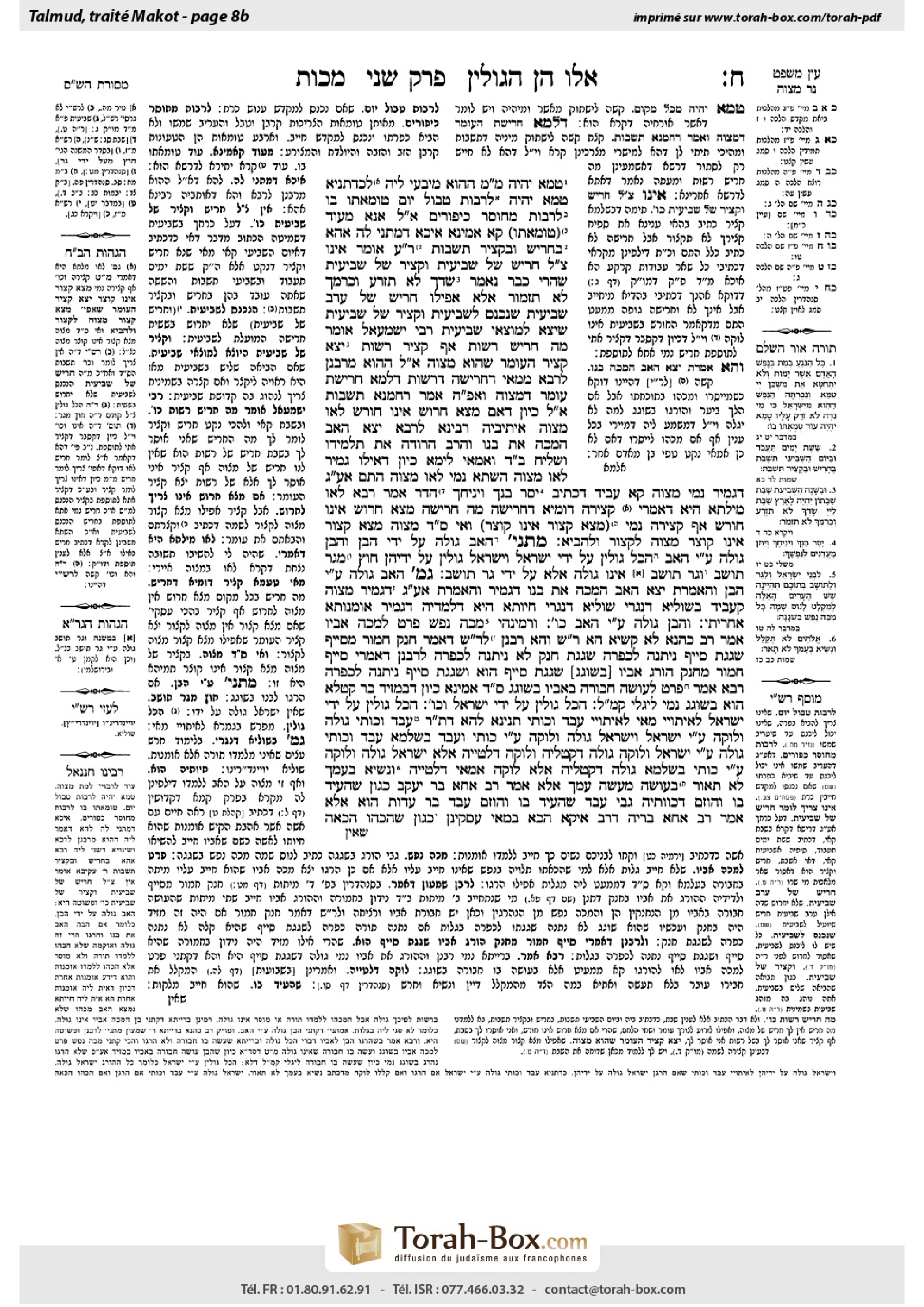
Makkot 8b: Talmud study for Daf Yomi
Daf Yomi is the daily study of one Talmud folio. Explore 37 tractates with scans, Hebrew text, Sefaria English and AI-generated French translations where annotated.
Passage selection and English or AI-generated French translation are available where the scan has annotations. Daf Study is independent of Torah-Box and Sefaria.
Browse Makkot · מכות · All tractatesMakkot 8b text and translations
This page of Makkot includes the Aramaic text, an English translation and an AI-generated French translation, alongside the scan above.
מכות ח׳ ב · Aramaic and Hebrew text
״טָמֵא יִהְיֶה״ – מִכׇּל מָקוֹם.
הָהוּא מִיבְּעֵי לֵיהּ לְכִדְתַנְיָא: ״טָמֵא יִהְיֶה״ – לְרַבּוֹת טְבוּל יוֹם, ״טוּמְאָתוֹ בוֹ״ – לְרַבּוֹת מְחוּסַּר כִּיפּוּרִים! אֲמַר לֵיהּ: אֲנָא מֵ״עוֹד טוּמְאָתוֹ״ קָא אָמֵינָא.
אִיכָּא דְּמַתְנֵי לַהּ אַהָא: ״בֶּחָרִישׁ וּבַקָּצִיר תִּשְׁבֹּת״, רַבִּי עֲקִיבָא אוֹמֵר: אֵינוֹ צָרִיךְ לוֹמַר חָרִישׁ שֶׁל שְׁבִיעִית וְקָצִיר שֶׁל שְׁבִיעִית, שֶׁהֲרֵי כְּבָר נֶאֱמַר ״שָׂדְךָ לֹא תִזְרָע וְכַרְמְךָ לֹא תִזְמֹר״, אֶלָּא אֲפִילּוּ חָרִישׁ שֶׁל עֶרֶב שְׁבִיעִית שֶׁנִּכְנַס לִשְׁבִיעִית, וְקָצִיר שֶׁל שְׁבִיעִית שֶׁיָּצָא לְמוֹצָאֵי שְׁבִיעִית.
רַבִּי יִשְׁמָעֵאל אוֹמֵר: מָה חָרִישׁ רְשׁוּת – אַף קָצִיר רְשׁוּת. יָצָא קְצִיר הָעוֹמֶר שֶׁהוּא מִצְוָה.
אֲמַר לֵיהּ הָהוּא מֵרַבָּנַן לְרָבָא: מִמַּאי דַּחֲרִישָׁה דִּרְשׁוּת? דִּלְמָא חֲרִישַׁת עוֹמֶר דְּמִצְוָה, וַאֲפִילּוּ הָכִי אָמַר רַחֲמָנָא ״תִּשְׁבֹּת״! אֲמַר לֵיהּ: כֵּיוָן דְּאִם מָצָא חָרוּשׁ אֵינוֹ חוֹרֵשׁ, לָאו מִצְוָה.
אֵיתִיבֵיהּ רָבִינָא לְרָבָא: יָצָא הָאָב הַמַּכֶּה אֶת בְּנוֹ, וְהָרַב הָרוֹדֶה אֶת תַּלְמִידוֹ, וּשְׁלִיחַ בֵּית דִּין. וְאַמַּאי? לֵימָא כֵּיוָן דְּאִילּוּ גְּמִיר לָאו מִצְוָה, הַשְׁתָּא נָמֵי – לָאו מִצְוָה! הָתָם אַף עַל גַּב דִּגְמִיר נָמֵי מִצְוָה קָא עָבֵיד, דִּכְתִיב: ״יַסֵּר בִּנְךָ וִינִיחֶךָ״.
הֲדַר אָמַר רָבָא: לָאו מִילְּתָא הִיא דַּאֲמַרִי. קְצִירָה דּוּמְיָא דַּחֲרִישָׁה, מָה חֲרִישָׁה, מָצָא חָרוּשׁ – אֵינוֹ חוֹרֵשׁ, אַף קְצִירָה נָמֵי, מָצָא קָצוּר אֵינוֹ קוֹצֵר, וְאִי סָלְקָא דַעְתָּךְ מִצְוָה, מָצָא קָצוּר אֵינוֹ קוֹצֵר?! מִצְוָה לִקְצוֹר וּלְהָבִיא!
מַתְנִי׳ הָאָב גּוֹלֶה עַל יְדֵי הַבֵּן, וְהַבֵּן גּוֹלֶה עַל יְדֵי הָאָב. הַכֹּל גּוֹלִין עַל יְדֵי יִשְׂרָאֵל, וְיִשְׂרָאֵל גּוֹלִין עַל יְדֵיהֶן, חוּץ מִגֵּר תּוֹשָׁב. וְגֵר תּוֹשָׁב אֵינוֹ גּוֹלֶה אֶלָּא עַל יְדֵי גֵּר תּוֹשָׁב.
גְּמָ׳ הָאָב גּוֹלֶה עַל יְדֵי הַבֵּן. וְהָאָמְרַתְּ: יָצָא הָאָב הַמַּכֶּה אֶת בְּנוֹ! דִּגְמִיר. הָאָמְרַתְּ אַף עַל גַּב דִּגְמִיר מִצְוָה קָעָבֵיד! בִּשְׁוַלְיָא דְּנַגָּרֵי.
שְׁוַלְיָא דְּנַגָּרֵי – חַיּוּתֵאּ הִיא דְּלַמְּדֵיהּ! דִּגְמִיר אוּמָּנוּתָא אַחֲרִיתִי.
וְהַבֵּן גּוֹלֶה עַל יְדֵי הָאָב כּוּ׳. וּרְמִינְהִי, ״מַכֵּה נֶפֶשׁ״ – פְּרָט לַמַּכָּה אָבִיו. אָמַר רַב כָּהֲנָא: לָא קַשְׁיָא, הָא רַבִּי שִׁמְעוֹן וְהָא רַבָּנַן.
לְרַבִּי שִׁמְעוֹן, דְּאָמַר חֶנֶק חָמוּר מִסַּיִיף, שִׁגְגַת סַיִיף נִיתְּנָה לְכַפָּרָה, שִׁגְגַת חֶנֶק לֹא נִיתְּנָה לְכַפָּרָה.
לְרַבָּנַן, דְּאָמְרִי סַיִיף חָמוּר מֵחֶנֶק, הוֹרֵג אָבִיו [בְּשׁוֹגֵג] שִׁגְגַת סַיִיף הוּא, וְשִׁגְגַת סַיִיף נִיתְּנָה לְכַפָּרָה.
רָבָא אָמַר: פְּרָט לְעוֹשֶׂה חַבּוּרָה בְּאָבִיו בְּשׁוֹגֵג. סָלְקָא דַּעְתָּךְ אָמֵינָא: כֵּיוָן דִּבְמֵזִיד בַּר קְטָלָא הוּא, בְּשׁוֹגֵג נָמֵי לִיגְלֵי, קָא מַשְׁמַע לַן.
הַכֹּל גּוֹלִין עַל יְדֵי יִשְׂרָאֵל וְכוּ׳. ״הַכֹּל גּוֹלִין עַל יְדֵי יִשְׂרָאֵל״ לְאֵיתוֹיֵי מַאי? לְאֵיתוֹיֵי עֶבֶד וְכוּתִי. תְּנֵינָא לְהָא דְּתָנוּ רַבָּנַן: עֶבֶד וְכוּתִי גּוֹלֶה וְלוֹקֶה עַל יְדֵי יִשְׂרָאֵל וְיִשְׂרָאֵל גּוֹלֶה וְלוֹקֶה עַל יְדֵי כּוּתִי וְעֶבֶד.
בִּשְׁלָמָא עֶבֶד וְכוּתִי גּוֹלֶה עַל יְדֵי יִשְׂרָאֵל וְלוֹקֶה, גּוֹלֶה – דְּקַטְלֵיהּ, וְלוֹקֶה – דְּלַטְיֵיהּ. אֶלָּא יִשְׂרָאֵל גּוֹלֶה וְלוֹקֶה עַל יְדֵי כּוּתִי? בִּשְׁלָמָא גּוֹלֶה – דְּקַטְלֵיהּ, אֶלָּא לוֹקֶה, אַמַּאי? דְּלַטְיֵיהּ? ״וְנָשִׂיא בְעַמְּךָ לֹא תָאֹר״ – בְּעוֹשֶׂה מַעֲשֵׂה עַמְּךָ!
אֶלָּא אָמַר רַב אַחָא בַּר יַעֲקֹב: כְּגוֹן שֶׁהֵעִיד בּוֹ וְהוּזַם. דִּכְווֹתֵיהּ גַּבֵּי עֶבֶד, שֶׁהֵעִיד בּוֹ וְהוּזַם, עֶבֶד בַּר עֵדוּת הוּא? אֶלָּא אָמַר רַב אַחָא בְּרֵיהּ דְּרַב אִיקָא: הָכָא בְּמַאי עָסְקִינַן, כְּגוֹן שֶׁהִכָּהוּ הַכָּאָה
Makkot 8b · English translation
“He shall be impure” (Numbers 19:13), indicating that the same halakhot apply in any case, unrelated to the manner in which he became impure.
The Gemara challenges: He requires that verse for a different derivation, as that which is taught in a baraita: The phrase “He shall be impure” serves to include one who immersed that day and whose purification process will be completed at nightfall. If he enters the Temple before nightfall, he is also liable to receive karet. The phrase later in that verse: “His impurity is upon him,” serves to include one who has not yet brought an atonement offering to complete the purification process, e.g., a leper or a zav. Rava said to Ravina: I said that the halakha that one rendered impure by a met mitzva is liable to receive karet is derived from the extraneous term “yet,” in the phrase later in that same verse: “His impurity is yet upon him,” which indicates that one is liable for entering the Temple in a state of impurity regardless of the manner in which he became impure. That is one version of the discussion.
Some teach this exchange with regard to this baraita: “In plowing and in harvest you shall rest” (Exodus 34:21). Rabbi Akiva says: This verse is referring to the Sabbatical Year. The Torah does not need to state the prohibition against plowing during the Sabbatical Year or harvesting during the Sabbatical Year, as it is already stated: “You shall neither sow your field, nor prune your vineyard” (Leviticus 25:4). What, then, is derived from this verse? Rather, it is derived that even plowing on the eve of the Sabbatical Year, which facilitates growth of crops when the Sabbatical Year enters, and the harvest of crops that grew during the Sabbatical Year, which emerged and were reaped after the conclusion of the Sabbatical Year, are prohibited.
Rabbi Yishmael says: This verse in Exodus is not referring to the Sabbatical Year; rather, the reference is to plowing and harvesting on Shabbat. Just as plowing is optional, as there is no case where there is a mitzva to plow per se, so too, the harvesting mentioned in the verse is optional. This serves to exclude from the prohibition the harvesting of barley for the omer offering, which is a mitzva, and is therefore permitted on Shabbat.
One of the Sages said to Rava: From where does Rabbi Yishmael ascertain that the plowing mentioned in the verse is referring to plowing that is optional? Perhaps the reference is to plowing a field to grow barley for use in the omer offering, which is a mitzva, and even so the Merciful One states: “You shall rest.” Rava said to him: Since if one found the field already plowed, he need not plow the field but he may directly proceed to sow the barley in the plowed field, clearly, even if one plows a field to facilitate fulfillment of a mitzva, plowing is not a mitzva per se.
Ravina raised an objection to the opinion of Rava from the clause of the mishna that states that the example of the forest serves to exclude a father who strikes his son, and a teacher who oppresses his student, and an agent of the court. And according to your opinion, why are a father who strikes his son and a teacher who oppresses his student excluded from exile? Let us say with regard to a father who strikes his son: Since if the son was learned, it is not a mitzva to strike him, now, in a case where the son is not learned and he strikes him to facilitate his education too, it is not a mitzva, and therefore he should be exiled. Rava replied: There, even if the son is learned, the father is performing a mitzva by striking him from time to time, as it is written: “Chastise your son, and he will give you rest; and he will give delight to your soul” (Proverbs 29:17).
Rava then said: That which I said is nothing, as there is a different proof that the verse is not referring to plowing that is a mitzva. Based on the juxtaposition of the two, it is derived that harvesting is similar to plowing: Just as in the case of plowing, if one found the field already plowed, he need not plow, as there is no case where there is a mitzva to plow per se, so too with regard to harvesting as well, as if one found the barley already harvested, he need not harvest. And if it enters your mind that the reference in the verse is to plowing and harvesting for the purpose of a mitzva, is it so that if one found the barley already harvested, he need not harvest? There is a mitzva to harvest and bring the barley for the omer offering. The prohibition in the verse applies only to harvesting that is optional.
MISHNA: The father is exiled to a city of refuge due to his unintentional murder of his son. And the son is exiled due to his unintentional murder of his father. Everyone is exiled due to their unintentional murder of a Jew, and a Jew is exiled due to his unintentional murder of any of them, except for the unintentional murder of a gentile who resides in Eretz Yisrael and observes the seven Noahide mitzvot [ger toshav]. And a ger toshav is exiled only due to his unintentional murder of a ger toshav.
GEMARA: The mishna teaches: The father is exiled to a city of refuge due to his unintentional murder of his son. The Gemara asks: But didn’t you say in the previous mishna: To exclude a father who strikes his son, who is not exiled? The Gemara answers: This mishna is referring to a son who is learned, and there is no mitzva to strike him; therefore, since the striking is optional, the father is exiled. The Gemara asks: But didn’t you say: Even if the son is learned, the father performs a mitzva by striking his son? The Gemara answers: This ruling of the mishna is stated with regard to a carpenter’s apprentice [bishevaleya]. Since the father is teaching his son carpentry, not Torah, there is no mitzva to strike him to spur him to study.
The Gemara challenges: In the case of a carpenter’s apprentice, his father is teaching him a livelihood, which is also a mitzva. The Gemara answers: The reference is to a son who has already learned another craft, and since he is able to earn his livelihood there is no mitzva to teach him a second craft.
§ The mishna teaches: And the son is exiled due to his unintentional murder of his father. And the Gemara raises a contradiction from a baraita. It is written: “And a murderer shall flee there, one who strikes a person unintentionally” (Numbers 35:11), from which it is derived that one who strikes a person is exiled. This serves to exclude one who strikes his father, whose punishment for doing so intentionally is more severe than that of the standard intentional murderer, and therefore the son is not subject to exile. Rav Kahana said: This is not difficult; this baraita is in accordance with the opinion of Rabbi Shimon, and that mishna is in accordance with the opinion of the Rabbis. Rabbi Shimon and the Rabbis disagree (Sanhedrin 50a) whether a son who kills his father intentionally is executed by strangulation or by the sword.
According to Rabbi Shimon, who says: Strangulation is more severe than execution by the sword, which is why a son who kills his father is liable to be executed by strangulation, one who commits the unwitting violation of a prohibition generally punishable by execution by the sword, i.e., intentional murder of one who is not a parent, is eligible for atonement by means of exile; one who commits the unwitting violation of a prohibition generally punishable by the more severe death of strangulation, i.e., intentional murder of a parent, is not eligible for atonement by means of exile.
By contrast, according to the Rabbis, who say: Execution by the sword is more severe than strangulation, which is why a son who kills his father is liable to be executed by the sword, a son who unintentionally kills his father has performed an unwitting violation of a prohibition generally punishable by execution by the sword. And one who commits an unwitting violation of a prohibition generally punishable by execution by the sword, i.e., intentional murder of one who is not a parent, is eligible for atonement by means of exile.
Rava says: That which was derived in the baraita that one who strikes a person is exiled, to exclude one who strikes his father, who is not exiled, is not referring to a son who unintentionally kills his father, as in that case the son is certainly exiled. Rather, it is to exclude one who inflicts a wound on his father unwittingly. The novel element of this derivation is that it enters your mind to say: Since in a case where he wounded his father intentionally, he is liable to be executed like a murderer (see Exodus 21:15), if he did so unwittingly, let him also be exiled like an unintentional murderer. Therefore, this derivation teaches us that exile is administered specifically to an unintentional murderer, but it is not administered to the unwitting performer of any other transgression.
§ The mishna teaches: Everyone is exiled due to their unintentional murder of a Jew, and a Jew is exiled due to his unintentional murder of any of them. The Gemara asks: Everyone is exiled due to their unintentional murder of a Jew: What case that was not already specified does this phrase serve to add? The Gemara answers: It serves to add a Canaanite slave and a Samaritan. The Gemara notes: We learn by inference from this mishna that which the Sages taught explicitly in a baraita: A Canaanite slave and a Samaritan are exiled and flogged due to a Jew, and a Jew is exiled and flogged due to a Samaritan and a Canaanite slave.
The Gemara analyzes the baraita: Granted, a slave and a Samaritan are exiled and flogged due to a Jew; either of them is exiled in a case where he killed a Jew unintentionally, and flogged in a case where he cursed the Jew, thereby violating a Torah prohibition. But with regard to the halakha that a Jew is exiled and flogged due to a Samaritan, granted, the Jew is exiled in a case where he killed the Samaritan unintentionally, but the Jew is flogged for violating what prohibition? For cursing the Samaritan? Isn’t that prohibition derived from the verse: “And a leader in your people you may not curse” (Exodus 22:27), from which it is inferred that the prohibition is in effect only with regard to one who performs an action characteristic of your people, who comports himself as an observant, God-fearing Jew? Even if the conversion of the Samaritans was valid, they regularly violate numerous prohibitions, and they do not comport themselves as observant Jews.
Rather, Rav Aḥa bar Ya’akov said: This baraita is not referring to lashes administered for cursing; rather, one is flogged in a case where a Jew testified against a Samaritan and a Samaritan testified against a Jew and he was rendered a conspiring witness. The Gemara asks: Does that mean that in the corresponding situation with regard to a Canaanite slave, a slave is flogged in a case where he testified against a Jew and was rendered a conspiring witness? Is a slave eligible to give testimony? Rather, Rav Aḥa, son of Rav Ika, said: What are we dealing with here? The Jew is flogged due to a slave and a Samaritan, and the slave and the Samaritan are flogged due to the Jew in a case where one struck the other with a blow
Makkot 8b · Traduction française (IA)
« Il sera impur » (Nombres 19:13), ce qui indique que les mêmes halakhot s’appliquent dans tous les cas, quelle que soit la manière dont il est devenu impur.
La Guemara objecte : Ce verset est nécessaire pour une autre déduction, comme l’enseigne une baraïta : l’expression « Il sera impur » inclut celui qui s’est immergé ce jour-là et dont le processus de purification s’achèvera à la tombée de la nuit. S’il entre dans le Temple avant la tombée de la nuit, il est lui aussi passible de karet. L’expression qui figure plus loin dans ce verset, « son impureté est sur lui », inclut celui qui n’a pas encore apporté d’offrande expiatoire pour achever son processus de purification, par exemple un lépreux ou un zav. Rava dit à Ravina : J’ai dit que la halakha selon laquelle celui qui est devenu impur à cause d’un met mitsva est passible de karet se déduit du terme superflu « encore », dans l’expression qui figure plus loin dans ce même verset : « son impureté est encore sur lui », ce qui indique qu’on est passible de karet pour être entré dans le Temple en état d’impureté, quelle que soit la manière dont on est devenu impur. Voilà une version de la discussion.
Certains rapportent cet échange à propos de cette baraïta : « Pendant les labours et la moisson, tu te reposeras » (Exode 34:21). Rabbi Akiva dit : Ce verset concerne l’année sabbatique. La Torah n’a pas besoin d’énoncer l’interdiction de labourer pendant l’année sabbatique ni celle d’y moissonner, puisqu’il est déjà dit : « Tu n’ensemenceras pas ton champ et tu ne tailleras pas ta vigne » (Lévitique 25:4). Que déduit-on donc de ce verset ? On en déduit plutôt que sont interdits même le labour à la veille de l’année sabbatique, qui favorise la croissance des cultures au début de l’année sabbatique, et la moisson des cultures qui ont poussé pendant l’année sabbatique, mais qui ont émergé et ont été récoltées après la fin de cette année.
Rabbi Yishmaël dit : Ce verset de l’Exode ne concerne pas l’année sabbatique ; il fait plutôt référence au labour et à la moisson pendant Chabbat. De même que le labour est facultatif, puisqu’il n’existe aucun cas où labourer en soi constitue une mitsva, de même la moisson mentionnée dans le verset est facultative. Cela exclut de l’interdiction la moisson de l’orge destinée à l’offrande de l’omer, qui est une mitsva et est donc permise pendant Chabbat.
Un des Sages dit à Rava : D’où Rabbi Yishmaël sait-il que le labour mentionné dans le verset désigne un labour facultatif ? Peut-être s’agit-il de labourer un champ pour y faire pousser de l’orge destinée à l’offrande de l’omer, ce qui est une mitsva, et pourtant le Miséricordieux dit : « Tu te reposeras. » Rava lui répondit : Puisque, si l’on trouve le champ déjà labouré, il n’est pas nécessaire de le labourer et l’on peut directement y semer l’orge, il est clair que même si l’on laboure un champ pour faciliter l’accomplissement d’une mitsva, labourer n’est pas une mitsva en soi.
Ravina souleva une objection contre l’opinion de Rava à partir de la clause de la Michna qui indique que l’exemple de la forêt sert à exclure le père qui frappe son fils, le maître qui opprime son élève et l’agent du tribunal. Selon ton opinion, pourquoi le père qui frappe son fils et le maître qui opprime son élève sont-ils exclus de l’exil ? À propos du père qui frappe son fils, disons : Puisque, si le fils était instruit, ce ne serait pas une mitsva de le frapper, alors, dans le cas où le fils ne l’est pas et où son père le frappe pour favoriser son éducation, ce n’est pas non plus une mitsva ; il devrait donc être envoyé en exil. Rava répondit : Dans ce cas, même si le fils est instruit, le père accomplit une mitsva en le frappant de temps à autre, comme il est écrit : « Corrige ton fils, et il te donnera du repos ; il fera les délices de ton âme » (Proverbes 29:17).
Rava ajouta : Ce que j’ai dit ne tient pas, car une autre preuve montre que le verset ne parle pas d’un labour qui constitue une mitsva. En raison du rapprochement des deux termes, on déduit que la moisson est semblable au labour : de même que, pour le labour, si l’on trouve le champ déjà labouré, il n’est pas nécessaire de le labourer, puisqu’il n’existe aucun cas où labourer en soi constitue une mitsva, de même pour la moisson : si l’on trouve l’orge déjà récoltée, il n’est pas nécessaire de la moissonner. Si tu envisages que le verset parle du labour et de la moisson à des fins de mitsva, serait-il vrai que, si l’on trouvait l’orge déjà récoltée, il ne serait pas nécessaire de la moissonner ? Il y a une mitsva de récolter l’orge et de l’apporter pour l’offrande de l’omer. L’interdiction du verset ne s’applique qu’à la moisson facultative.
MICHNA : Le père est envoyé dans une ville de refuge pour avoir tué son fils par inadvertance. Et le fils est envoyé en exil pour avoir tué son père par inadvertance. Toute personne est envoyée en exil pour avoir tué un Juif par inadvertance, et un Juif est envoyé en exil pour avoir tué par inadvertance l’une quelconque de ces personnes, à l’exception du meurtre involontaire d’un non-Juif résidant en terre d’Israël et observant les sept mitsvot noachides [ger toshav]. Et un ger toshav n’est envoyé en exil que pour avoir tué par inadvertance un autre ger toshav.
GUEMARA : La Michna enseigne : Le père est envoyé dans une ville de refuge pour avoir tué son fils par inadvertance. La Guemara demande : Mais n’as-tu pas dit dans la Michna précédente que le père qui frappe son fils est exclu et n’est pas envoyé en exil ? La Guemara répond : Cette Michna parle d’un fils instruit, qu’il n’y a pas de mitsva de frapper ; par conséquent, puisque le coup est facultatif, le père est envoyé en exil. La Guemara demande : Mais n’as-tu pas dit que même si le fils est instruit, le père accomplit une mitsva en le frappant ? La Guemara répond : Cette règle de la Michna est énoncée au sujet d’un apprenti menuisier [bishevaleya]. Puisque le père enseigne la menuiserie à son fils, et non la Torah, il n’y a pas de mitsva de le frapper pour l’inciter à étudier.
La Guemara objecte : Dans le cas d’un apprenti menuisier, son père lui enseigne un métier, ce qui est aussi une mitsva. La Guemara répond : Il s’agit d’un fils qui a déjà appris un autre métier ; puisqu’il est capable de gagner sa vie, il n’y a pas de mitsva de lui enseigner un second métier.
§ La Michna enseigne : Et le fils est envoyé en exil pour avoir tué son père par inadvertance. La Guemara soulève une contradiction à partir d’une baraïta. Il est écrit : « Qu’un meurtrier s’y enfuie, celui qui frappe une personne par inadvertance » (Nombres 35:11), d’où l’on déduit que celui qui frappe une personne est envoyé en exil. Cela sert à exclure celui qui frappe son père, dont la peine pour un acte intentionnel est plus sévère que celle du meurtrier intentionnel ordinaire ; le fils n’est donc pas soumis à l’exil. Rav Kahana dit : Il n’y a pas de difficulté : cette baraïta suit l’opinion de Rabbi Shimon, tandis que cette Michna suit celle des Rabbins. Rabbi Shimon et les Rabbins sont en désaccord (Sanhédrin 50a) sur la question de savoir si un fils qui tue intentionnellement son père est exécuté par strangulation ou par le glaive.
Selon Rabbi Shimon, qui dit que la strangulation est plus sévère que l’exécution par le glaive, raison pour laquelle un fils qui tue son père est passible de strangulation, celui qui transgresse par inadvertance une interdiction généralement passible de l’exécution par le glaive — c’est-à-dire le meurtre intentionnel d’une personne qui n’est pas son parent — peut obtenir l’expiation au moyen de l’exil ; celui qui transgresse par inadvertance une interdiction généralement passible de la peine plus sévère de strangulation — c’est-à-dire le meurtre intentionnel d’un parent — ne peut pas obtenir l’expiation au moyen de l’exil.
En revanche, selon les Rabbins, qui disent que l’exécution par le glaive est plus sévère que la strangulation, raison pour laquelle un fils qui tue son père est passible de l’exécution par le glaive, un fils qui tue son père par inadvertance a transgressé par inadvertance une interdiction généralement passible de l’exécution par le glaive. Or, celui qui transgresse par inadvertance une interdiction généralement passible de l’exécution par le glaive, c’est-à-dire le meurtre intentionnel d’une personne qui n’est pas son parent, peut obtenir l’expiation au moyen de l’exil.
Rava dit : La déduction faite dans la baraïta selon laquelle celui qui frappe une personne est envoyé en exil, à l’exclusion de celui qui frappe son père et n’est pas envoyé en exil, ne concerne pas le fils qui tue son père par inadvertance, car dans ce cas, le fils est certainement envoyé en exil. Elle vise plutôt celui qui blesse son père par inadvertance. La nouveauté de cette déduction est qu’on pourrait envisager de dire : Puisque, dans le cas où il a blessé son père intentionnellement, il est passible d’être exécuté comme un meurtrier (voir Exode 21:15), s’il l’a fait par inadvertance, qu’il soit lui aussi envoyé en exil comme un meurtrier involontaire. Cette déduction nous enseigne donc que l’exil est réservé spécifiquement au meurtrier involontaire ; on n’y envoie pas celui qui a commis par inadvertance une autre transgression.
§ La Michna enseigne : Toute personne est envoyée en exil pour avoir tué un Juif par inadvertance, et un Juif est envoyé en exil pour avoir tué par inadvertance l’une quelconque de ces personnes. La Guemara demande : « Toute personne est envoyée en exil pour avoir tué un Juif par inadvertance » : quel cas, qui n’a pas déjà été mentionné, cette expression ajoute-t-elle ? La Guemara répond : Elle ajoute un esclave cananéen et un Samaritain. La Guemara relève : Nous déduisons par inférence de cette Michna ce que les Sages ont enseigné explicitement dans une baraïta : un esclave cananéen et un Samaritain sont envoyés en exil et flagellés à cause d’un Juif, et un Juif est envoyé en exil et flagellé à cause d’un Samaritain et d’un esclave cananéen.
La Guemara analyse la baraïta : Il est compréhensible qu’un esclave et un Samaritain soient envoyés en exil et flagellés à cause d’un Juif : chacun d’eux est envoyé en exil s’il a tué un Juif par inadvertance, et reçoit la flagellation s’il a maudit le Juif, transgressant ainsi une interdiction de la Torah. Mais quant à la règle selon laquelle un Juif est envoyé en exil et flagellé à cause d’un Samaritain, il est compréhensible que le Juif soit envoyé en exil s’il a tué le Samaritain par inadvertance ; mais pour quelle interdiction le Juif reçoit-il la flagellation ? Pour avoir maudit le Samaritain ? Cette interdiction n’est-elle pas déduite du verset : « Tu ne maudiras pas un chef de ton peuple » (Exode 22:27), dont on infère que l’interdiction ne s’applique qu’à celui qui accomplit un acte caractéristique de ton peuple, c’est-à-dire qui se conduit en Juif observant et craignant Dieu ? Même si la conversion des Samaritains était valide, ils transgressent régulièrement de nombreuses interdictions et ne se conduisent pas en Juifs observants.
Rav Aḥa bar Ya’akov dit plutôt : Cette baraïta ne parle pas de la flagellation infligée pour avoir maudit ; une personne reçoit la flagellation lorsqu’un Juif a témoigné contre un Samaritain, qu’un Samaritain a témoigné contre un Juif et que le témoin a été déclaré comploteur. La Guemara demande : Cela signifie-t-il que, dans la situation correspondante concernant un esclave cananéen, un esclave reçoit la flagellation s’il a témoigné contre un Juif et a été déclaré témoin comploteur ? Un esclave peut-il témoigner ? Rav Aḥa, fils de Rav Ika, dit plutôt : De quoi parlons-nous ici ? Le Juif reçoit la flagellation à cause d’un esclave ou d’un Samaritain, et l’esclave et le Samaritain reçoivent la flagellation à cause du Juif, dans le cas où l’un a frappé l’autre d’un coup
Traduction française générée par IA à partir de l’édition anglaise de Sefaria. Vérifie toujours un passage avec le texte source.
Text from Sefaria: William Davidson Edition - Vocalized Aramaic (CC BY NC); William Davidson Edition - English (CC BY NC).