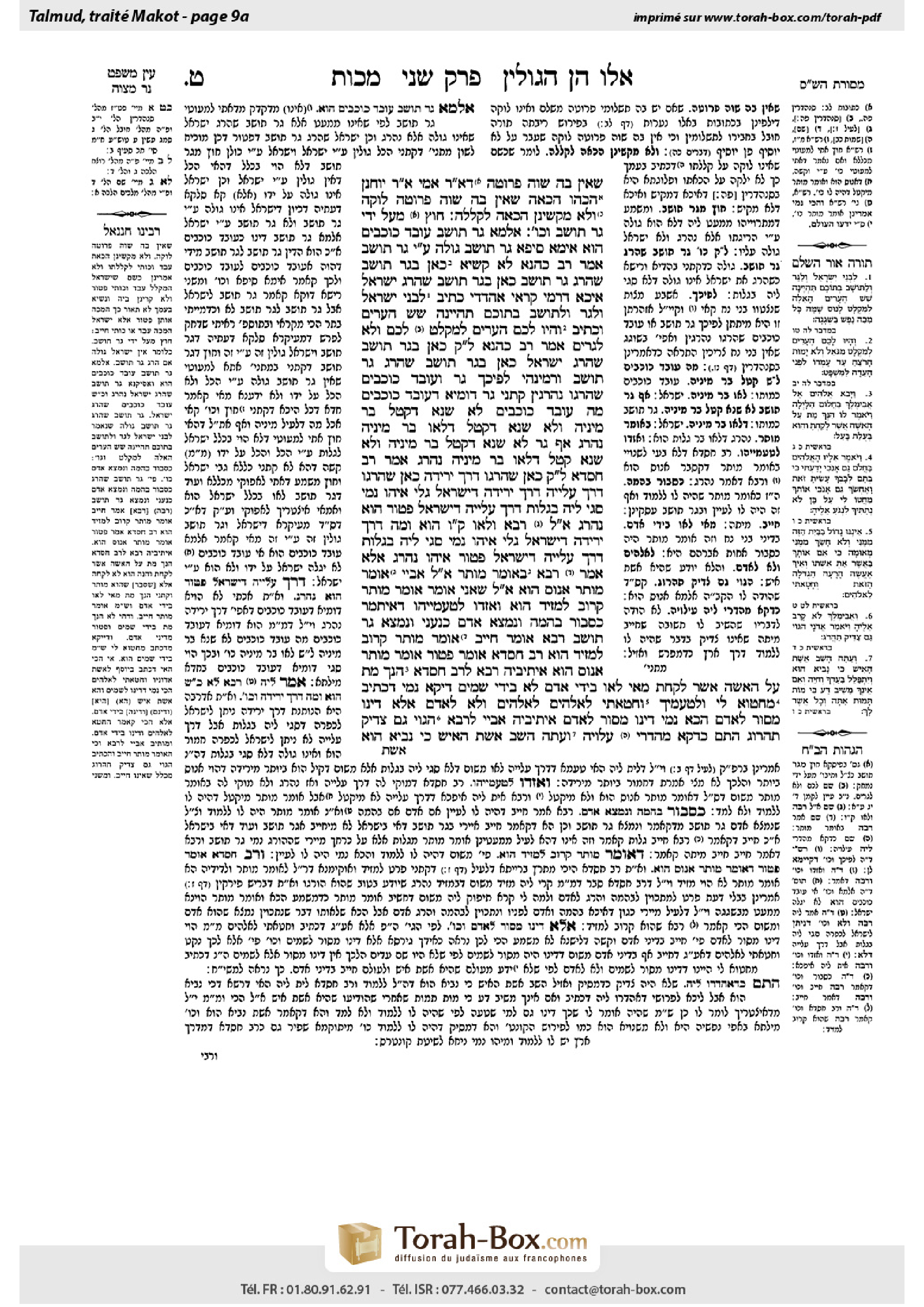
Makkot 9a: Talmud study for Daf Yomi
Daf Yomi is the daily study of one Talmud folio. Explore 37 tractates with scans, Hebrew text, Sefaria English and AI-generated French translations where annotated.
Passage selection and English or AI-generated French translation are available where the scan has annotations. Daf Study is independent of Torah-Box and Sefaria.
Browse Makkot · מכות · All tractatesMakkot 9a text and translations
This page of Makkot includes the Aramaic text, an English translation and an AI-generated French translation, alongside the scan above.
מכות ט׳ א · Aramaic and Hebrew text
שֶׁאֵין בָּהּ שָׁוֶה פְּרוּטָה. דְּאָמַר רַבִּי אַמֵּי אָמַר רַבִּי יוֹחָנָן: הִכָּהוּ הַכָּאָה שֶׁאֵין בָּהּ שָׁוֶה פְּרוּטָה – לוֹקֶה. וְלָא מַקְּשִׁינַן הַכָּאָה לִקְלָלָה.
חוּץ מֵעַל יְדֵי גֵּר תּוֹשָׁב וְכוּ׳. אַלְמָא גֵּר תּוֹשָׁב גּוֹי הוּא. אֵימָא סֵיפָא: גֵּר תּוֹשָׁב גּוֹלֶה עַל יְדֵי גֵּר תּוֹשָׁב! אָמַר רַב כָּהֲנָא: לָא קַשְׁיָא, כָּאן בְּגֵר תּוֹשָׁב שֶׁהָרַג גֵּר תּוֹשָׁב, כָּאן בְּגֵר תּוֹשָׁב שֶׁהָרַג יִשְׂרָאֵל.
אִיכָּא דְּרָמֵי קְרָאֵי אַהֲדָדֵי, כְּתִיב: ״לִבְנֵי יִשְׂרָאֵל וְלַגֵּר וְלַתּוֹשָׁב בְּתוֹכָם תִּהְיֶינָה שֵׁשׁ הֶעָרִים״, וּכְתִיב: ״וְהָיוּ לָכֶם הֶעָרִים לְמִקְלָט״, ״לָכֶם״ – וְלֹא לְגֵרִים! אָמַר רַב כָּהֲנָא: לָא קַשְׁיָא, כָּאן – בְּגֵר תּוֹשָׁב שֶׁהָרַג יִשְׂרָאֵל, כָּאן – בְּגֵר תּוֹשָׁב שֶׁהָרַג גֵּר תּוֹשָׁב.
וּרְמִינְהִי: לְפִיכָךְ גֵּר וְגוֹי שֶׁהָרְגוּ – נֶהֱרָגִין. קָתָנֵי גֵּר דּוּמְיָא דְּגוֹי: מָה גּוֹי לָא שְׁנָא דִּקְטַל בַּר מִינֵּיהּ, וְלָא שְׁנָא דִּקְטַל דְּלָאו בַּר מִינֵיהּ – נֶהֱרָג, אַף גֵּר, לָא שְׁנָא דִּקְטַל בַּר מִינֵּיהּ וְלָא שְׁנָא קְטַל דְּלָאו בַּר מִינֵיהּ – נֶהֱרָג!
אָמַר רַב חִסְדָּא: לָא קַשְׁיָא, כָּאן שֶׁהֲרָגוֹ דֶּרֶךְ יְרִידָה, כָּאן שֶׁהֲרָגוֹ דֶּרֶךְ עֲלִיָּיה. דֶּרֶךְ יְרִידָה, דְּיִשְׂרָאֵל גָּלֵי – אִיהוּ נָמֵי סַגִּי לֵיהּ בְּגָלוּת. דֶּרֶךְ עֲלִיָּיה, דְּיִשְׂרָאֵל פָּטוּר – הוּא נֶהֱרָג.
אֲמַר לֵיהּ רָבָא: וְלָאו קַל וָחוֹמֶר הוּא? וּמָה דֶּרֶךְ יְרִידָה דְּיִשְׂרָאֵל גָּלֵי, אִיהוּ נָמֵי סַגִּי לֵיהּ בְּגָלוּת, דֶּרֶךְ עֲלִיָּיה, דְּיִשְׂרָאֵל פָּטוּר, אִיהוּ נֶהֱרָג?!
אֶלָּא אָמַר רָבָא: בְּאוֹמֵר מוּתָּר. אֲמַר לֵיהּ אַבָּיֵי: אוֹמֵר מוּתָּר אָנוּס הוּא! אֲמַר לֵיהּ: שֶׁאֲנִי אוֹמֵר, אוֹמֵר מוּתָּר – קָרוֹב לְמֵזִיד הוּא.
וְאָזְדוּ לְטַעְמַיְיהוּ, דְּאִיתְּמַר: כְּסָבוּר בְּהֵמָה וְנִמְצָא אָדָם, גּוֹי וְנִמְצָא גֵּר תּוֹשָׁב. רָבָא אוֹמֵר: חַיָּיב, אוֹמֵר מוּתָּר קָרוֹב לְמֵזִיד הוּא. רַב חִסְדָּא אוֹמֵר: פָּטוּר, אוֹמֵר מוּתָּר אָנוּס הוּא.
אֵיתִיבֵיהּ רָבָא לְרַב חִסְדָּא: ״הִנְּךָ מֵת עַל הָאִשָּׁה אֲשֶׁר לָקַחְתָּ״. מַאי לָאו בִּידֵי אָדָם?
לָא, בִּידֵי שָׁמַיִם. דַּיְקָא נָמֵי, דִּכְתִיב: ״מֵחֲטוֹא לִי״.
וּלְטַעְמָיךְ, ״וְחָטָאתִי לֵאלֹהִים״ – לֵאלֹהִים וְלֹא לְאָדָם? אֶלָּא, דִּינוֹ מָסוּר לְאָדָם, הָכָא נָמֵי דִּינוֹ מָסוּר לָאָדָם.
אֵיתִיבֵיהּ אַבָּיֵי לְרָבָא: ״הֲגוֹי גַּם צַדִּיק תַּהֲרֹג״! הָתָם כִּדְקָא מְהַדְּרִי עִלָּוֵיהּ: ״וְעַתָּה הָשֵׁב אֵשֶׁת הָאִישׁ כִּי נָבִיא הוּא״ –
Makkot 9a · English translation
that does not have the capacity to cause damage worth one peruta, as Rabbi Ami says that Rabbi Yoḥanan says: Although one who strikes another pays damages and is not flogged, if he struck him with a blow that does not have the capacity to cause damage worth one peruta, since there is no payment, he is flogged for violating a Torah prohibition. The Gemara comments: And according to this opinion, contrary to those who hold that based on their virtual juxtaposition (see Exodus 21:15, 17) or on an analogy between them, the halakhot of striking and cursing are identical, we do not liken striking to cursing. Therefore, although one is flogged for cursing another only if the other comports himself as an observant, God-fearing Jew, one is liable for striking another even if the other was a sinner, e.g., a Samaritan.
§ The mishna teaches: Everyone is exiled due to their unintentional murder of a Jew, and a Jew is exiled due to all of them, except for when it is due to a ger toshav. And a ger toshav is exiled due to his unintentional murder of a ger toshav. The Gemara comments: Apparently, one may conclude that a ger toshav is a gentile, and therefore he is not exiled when he unintentionally kills a Jew. Say the latter clause of the mishna: A ger toshav is exiled due to his unintentional murder of a ger toshav, indicating that his halakhic status is not that of a gentile, as gentiles are not liable to be exiled. There is an apparent contradiction between the two clauses in the mishna. Rav Kahana said: This is not difficult. Here, in the latter clause of the mishna, it is in the case of a ger toshav who killed a ger toshav that he is exiled; there, in the first clause, it is in the case of a ger toshav who killed a Jew. In the case described in the first clause he is not exiled, as his halakhic status is not that of a Jew, for whom the sin of unintentional murder of a Jew can be atoned through exile.
There are those who raised a contradiction between two verses. It is written: “For the children of Israel and for the stranger and for the resident [velatoshav] among them, shall these six cities be for refuge” (Numbers 35:15), indicating that a ger toshav is exiled. And it is written in a previous verse: “And the cities shall be for you for refuge” (Numbers 35:12), from which it is inferred: A refuge for you but not for a ger toshav, indicating that a ger toshav is not exiled. Rav Kahana said: This is not difficult. Here, the verse that indicates that they are not exiled is concerning a ger toshav who killed a Jew; there, the verse that indicates that they are exiled is concerning a ger toshav who killed a ger toshav.
And the Gemara raises a contradiction to the halakha of the mishna from a baraita, which teaches: Therefore, a ger toshav and a gentile who killed a person are killed, even if they did so unintentionally. The Gemara infers based on the juxtaposition of a ger toshav and a gentile in the baraita: The tanna teaches the case of a ger toshav in a manner similar to the case of a gentile: Just as with regard to a gentile it is no different in a case where he killed one of his kind, a gentile, and it is no different in a case where he killed one not of his kind, a Jew, as in either case he is executed and is not exiled, so too, with regard to a ger toshav, it is no different in a case where he killed one of his kind, a ger toshav, and it is no different in a case where he killed one not of his kind, a Jew, as in either case he is executed and is not exiled.
Rav Ḥisda said: The contradiction between the mishna and the baraita is not difficult. Here, the mishna is referring to a case where he killed him in a downward motion; there, the baraita is referring to a case where he killed him in an upward motion. Rav Ḥisda elaborates: If one ger toshav killed another ger toshav in a downward motion, which is a case where if the perpetrator were a Jew, he would be exiled, the ger toshav also suffices with exile. But if the ger toshav killed his counterpart in an upward motion, which is a case where if the perpetrator were a Jew, he would be exempt from exile, the ger toshav is executed.
Rava said to him: And is it not derived by means of an a fortiori inference to the contrary? If one unintentionally kills another in a downward motion, which is a case where if the perpetrator were a Jew, he would be exiled, the ger toshav also suffices with exile and nothing more, but if he killed in an upward motion, which is a case where if the perpetrator were a Jew, he would be exempt from exile, is he killed?
Rather, Rava said: The case in the baraita where a ger toshav is killed rather than exiled is where the ger toshav who killed another ger toshav says that it is permitted to kill the victim. If he killed him unintentionally he is exiled, in accordance with the ruling in the mishna. Abaye said to him: One who says that it is permitted to kill the victim is a victim of circumstances beyond his control, as he was unaware of the prohibition. Why, then, should he be executed? Rava said to him: That is not a problem, as I say that with regard to one who says that it is permitted, since he intended to kill the other, his action borders on the intentional.
The Gemara observes: And Rava and Rav Ḥisda follow their standard line of reasoning, as is indicated by the fact that it was stated that they disagree in the case of a ger toshav who killed a person. If he thought he was killing an animal and it was discovered that it was a person, or if he thought he was killing a gentile and it was discovered that he was a ger toshav, Rava says he is liable to be executed, as with regard to one who says that it is permitted, his action borders on the intentional. Rav Ḥisda says he is exempt, as one who says that it is permitted to kill the victim is a victim of circumstances beyond his control.
Rava raised an objection to the opinion of Rav Ḥisda from that which is written with regard to Abimelech, king of Gerar, who took Sarah, Abraham’s wife: “And God came to Abimelech in a dream of the night and said to him: You shall die for the woman you took, as she is a man’s wife” (Genesis 20:3). When Abimelech took Sarah he was under the impression that she was unmarried, as Abraham said that she was his sister. Despite the fact that Abimelech was one who says that it is permitted, he was liable to be executed for his action. What, is it not that he was liable to be executed at the hand of a court composed of people, indicating that one who says that it is permitted is liable?
The Gemara rejects that conclusion: No, it means that he was liable to be executed at the hand of Heaven, but not by a court. The Gemara adds: The language of the verses is also precise in this regard, as it is written: “And I also prevented you from sinning against Me” (Genesis 20:6), indicating that it was a sin vis-à-vis God and was not in the jurisdiction of a court of men.
The Gemara asks: And according to your reasoning that based on the formulation of the verse one concludes that it was a sin exclusively vis-à-vis God, where Joseph says to Potiphar’s wife: “And how can I perform this great evil, and sin to God” (Genesis 39:9), may one also infer that it was a sin vis-à-vis God and not vis-à-vis man? Joseph is referring to adultery, which is punishable by execution according to the Noahide laws as well. Rather, in that case it means that although he performed a sin vis-à-vis God, his judgment is given over to the ruling of man; here too, in the verse about Abimelech, it can be explained that although he performed a sin vis-à-vis God, his judgment is given over to the ruling of man. There is no proof from this verse with regard to the status of one who says that it is permitted to perform a transgression.
Abaye raised an objection to the opinion of Rava from the reply of Abimelech: “Will You even slay a righteous nation?” (Genesis 20:4). God appears to accept Abimelech’s contention, as He did not respond by calling him wicked, indicating that one who says that it is permitted to perform a transgression is a victim of circumstances beyond his control. The Gemara rejects that understanding. There, the reason for the rejection of Abimelech’s contention is as they responded to him from Heaven: “And now, restore the man’s wife, as he is a prophet” (Genesis 20:7).
Makkot 9a · Traduction française (IA)
qui n’a pas la capacité de causer un dommage d’une valeur d’une perouta, comme Rabbi Ami rapporte au nom de Rabbi Yoḥanan : bien que celui qui frappe autrui doive payer des dommages et ne soit pas flagellé, s’il l’a frappé d’un coup qui ne peut causer un dommage d’une valeur d’une perouta, puisqu’il n’y a pas de paiement, il est flagellé pour avoir transgressé une interdiction de la Torah. La Guemara commente : selon cette opinion, contrairement à ceux qui soutiennent que, sur la base de leur juxtaposition virtuelle (voir Exode 21:15, 17) ou d’une analogie entre eux, les halakhot relatives au fait de frapper et de maudire sont identiques, nous n’assimilons pas le fait de frapper à celui de maudire. Par conséquent, bien qu’on ne soit flagellé pour avoir maudit autrui que si celui-ci se conduit comme un Juif pratiquant et craignant Dieu, on est passible de flagellation pour avoir frappé autrui, même si celui-ci était un pécheur, par exemple un Samaritain.
§ La Michna enseigne : Tous sont exilés pour avoir involontairement tué un Juif, et un Juif est exilé pour avoir involontairement tué n’importe lequel d’entre eux, sauf si la victime est un ger toshav. Et un ger toshav est exilé pour avoir involontairement tué un ger toshav. La Guemara commente : Il semble qu’on puisse en conclure qu’un ger toshav est un non-Juif et que, par conséquent, il n’est pas exilé lorsqu’il tue involontairement un Juif. Mais considérons la dernière clause de la Michna : un ger toshav est exilé pour avoir involontairement tué un ger toshav, ce qui indique que son statut halakhique n’est pas celui d’un non-Juif, puisque les non-Juifs ne sont pas passibles d’exil. Il y a une contradiction apparente entre les deux clauses de la Michna. Rav Kahana dit : Il n’y a pas de difficulté. Ici, dans la dernière clause de la Michna, il s’agit d’un ger toshav qui a tué un ger toshav ; là, dans la première clause, il s’agit d’un ger toshav qui a tué un Juif. Dans le cas décrit dans la première clause, il n’est pas exilé, car son statut halakhique n’est pas celui d’un Juif, pour qui l’exil peut expier le péché d’avoir involontairement tué un Juif.
Certains ont soulevé une contradiction entre deux versets. Il est écrit : « Pour les enfants d’Israël, pour l’étranger et pour le résident [velatoshav] parmi eux, ces six villes serviront de refuge » (Nombres 35:15), ce qui indique qu’un ger toshav est exilé. Et il est écrit dans un verset précédent : « Les villes seront pour vous un refuge » (Nombres 35:12), d’où l’on déduit : un refuge pour vous, mais pas pour un ger toshav, ce qui indique qu’un ger toshav n’est pas exilé. Rav Kahana dit : Il n’y a pas de difficulté. Ici, le verset qui indique qu’ils ne sont pas exilés concerne un ger toshav qui a tué un Juif ; là, le verset qui indique qu’ils sont exilés concerne un ger toshav qui a tué un ger toshav.
La Guemara soulève également une contradiction à propos de la halakha de la Michna à partir d’une baraïta qui enseigne : Par conséquent, un ger toshav et un non-Juif qui ont tué une personne sont mis à mort, même s’ils l’ont fait involontairement. La Guemara déduit de la juxtaposition d’un ger toshav et d’un non-Juif dans la baraïta que le tanna enseigne le cas du ger toshav par analogie avec celui du non-Juif : de même que, pour un non-Juif, cela ne fait aucune différence qu’il ait tué l’un des siens, un non-Juif, ou quelqu’un qui n’est pas des siens, un Juif, car dans les deux cas il est exécuté et non exilé, de même, pour un ger toshav, cela ne fait aucune différence qu’il ait tué l’un des siens, un ger toshav, ou quelqu’un qui n’est pas des siens, un Juif, car dans les deux cas il est exécuté et non exilé.
Rav Ḥisda dit : Il n’y a pas de difficulté entre la Michna et la baraïta. Ici, la Michna parle d’un cas où il l’a tué d’un mouvement descendant ; là, la baraïta parle d’un cas où il l’a tué d’un mouvement ascendant. Rav Ḥisda précise : si un ger toshav en a tué un autre d’un mouvement descendant, cas où, si l’auteur avait été un Juif, il aurait été exilé, le ger toshav est lui aussi soumis à l’exil, et cela suffit. Mais si le ger toshav a tué son semblable d’un mouvement ascendant, cas où, si l’auteur avait été un Juif, il aurait été exempté d’exil, le ger toshav est exécuté.
Rava lui dit : Ne déduit-on pas plutôt le contraire par un raisonnement a fortiori ? Si quelqu’un tue involontairement une autre personne d’un mouvement descendant, cas où, si l’auteur avait été un Juif, il aurait été exilé, le ger toshav est lui aussi soumis à l’exil, et rien de plus ; mais s’il l’a tuée d’un mouvement ascendant, cas où, si l’auteur avait été un Juif, il aurait été exempté d’exil, serait-il mis à mort ?
Rava dit plutôt : le cas de la baraïta où un ger toshav est mis à mort plutôt qu’exilé est celui où le ger toshav qui a tué un autre ger toshav affirme qu’il est permis de tuer la victime. S’il l’a tuée involontairement, il est exilé, conformément à la décision de la Michna. Abaye lui dit : celui qui affirme qu’il est permis de tuer la victime est une victime de circonstances indépendantes de sa volonté, puisqu’il ignorait l’interdiction. Pourquoi serait-il donc exécuté ? Rava lui dit : Cela ne pose pas de problème, car, selon moi, celui qui affirme que c’est permis, puisqu’il avait l’intention de tuer l’autre, commet un acte qui frôle l’intentionnel.
La Guemara fait remarquer que Rava et Rav Ḥisda suivent chacun leur raisonnement habituel, comme l’indique le fait qu’il est rapporté qu’ils sont en désaccord dans le cas d’un ger toshav qui a tué une personne. S’il pensait tuer un animal et qu’il s’avère que c’était une personne, ou s’il pensait tuer un non-Juif et qu’il s’avère que c’était un ger toshav, Rava dit qu’il est passible d’exécution, car, selon lui, celui qui affirme que c’est permis commet un acte qui frôle l’intentionnel. Rav Ḥisda dit qu’il est exempt, car celui qui affirme qu’il est permis de tuer la victime est une victime de circonstances indépendantes de sa volonté.
Rava soulève une objection à l’opinion de Rav Ḥisda à partir de ce qui est écrit au sujet d’Abimélek, roi de Guérar, qui prit Sarah, la femme d’Abraham : « Dieu vint à Abimélek en rêve, pendant la nuit, et lui dit : Tu vas mourir à cause de la femme que tu as prise, car elle est l’épouse d’un homme » (Genèse 20:3). Lorsqu’Abimélek prit Sarah, il croyait qu’elle n’était pas mariée, puisque Abraham avait dit qu’elle était sa sœur. Bien qu’Abimélek fût de ceux qui affirment que c’est permis, il était passible d’exécution pour son acte. N’était-il pas passible d’exécution par un tribunal humain, ce qui indiquerait que celui qui affirme que c’est permis est passible de cette peine ?
La Guemara rejette cette conclusion : Non, cela signifie qu’il était passible d’être mis à mort par le Ciel, mais pas par un tribunal. La Guemara ajoute que la formulation des versets est également précise à cet égard, car il est écrit : « Et moi aussi, je t’ai empêché de pécher contre moi » (Genèse 20:6), ce qui indique qu’il s’agissait d’un péché à l’égard de Dieu et qu’il ne relevait pas de la juridiction d’un tribunal humain.
La Guemara demande : Selon votre raisonnement, si l’on conclut, sur la base de la formulation du verset, qu’il s’agissait exclusivement d’un péché à l’égard de Dieu, lorsque Joseph dit à la femme de Potiphar : « Comment pourrais-je commettre un si grand mal et pécher contre Dieu ? » (Genèse 39:9), peut-on également en déduire qu’il s’agissait d’un péché à l’égard de Dieu et non des hommes ? Joseph fait référence à l’adultère, qui est également passible de la peine de mort selon les lois noahides. Dans ce cas, cela signifie plutôt que, bien qu’il ait commis un péché à l’égard de Dieu, son jugement relève de la décision des hommes ; ici aussi, dans le verset concernant Abimélek, on peut expliquer que, bien qu’il ait commis un péché à l’égard de Dieu, son jugement relève de la décision des hommes. Ce verset ne prouve donc rien quant au statut de celui qui affirme qu’il est permis de commettre une transgression.
Abaye soulève une objection à l’opinion de Rava à partir de la réponse d’Abimélek : « Vas-Tu donc faire mourir une nation même juste ? » (Genèse 20:4). Dieu semble accepter l’argument d’Abimélek, puisqu’il ne lui répond pas en le qualifiant de méchant, ce qui indique que celui qui affirme qu’il est permis de commettre une transgression est une victime de circonstances indépendantes de sa volonté. La Guemara rejette cette interprétation. Ici, la raison pour laquelle l’argument d’Abimélek est rejeté est celle que les voix venues du Ciel lui opposèrent : « Et maintenant, rends la femme de cet homme, car il est prophète » (Genèse 20:7).
Traduction française générée par IA à partir de l’édition anglaise de Sefaria. Vérifie toujours un passage avec le texte source.
Text from Sefaria: William Davidson Edition - Vocalized Aramaic (CC BY NC); William Davidson Edition - English (CC BY NC).