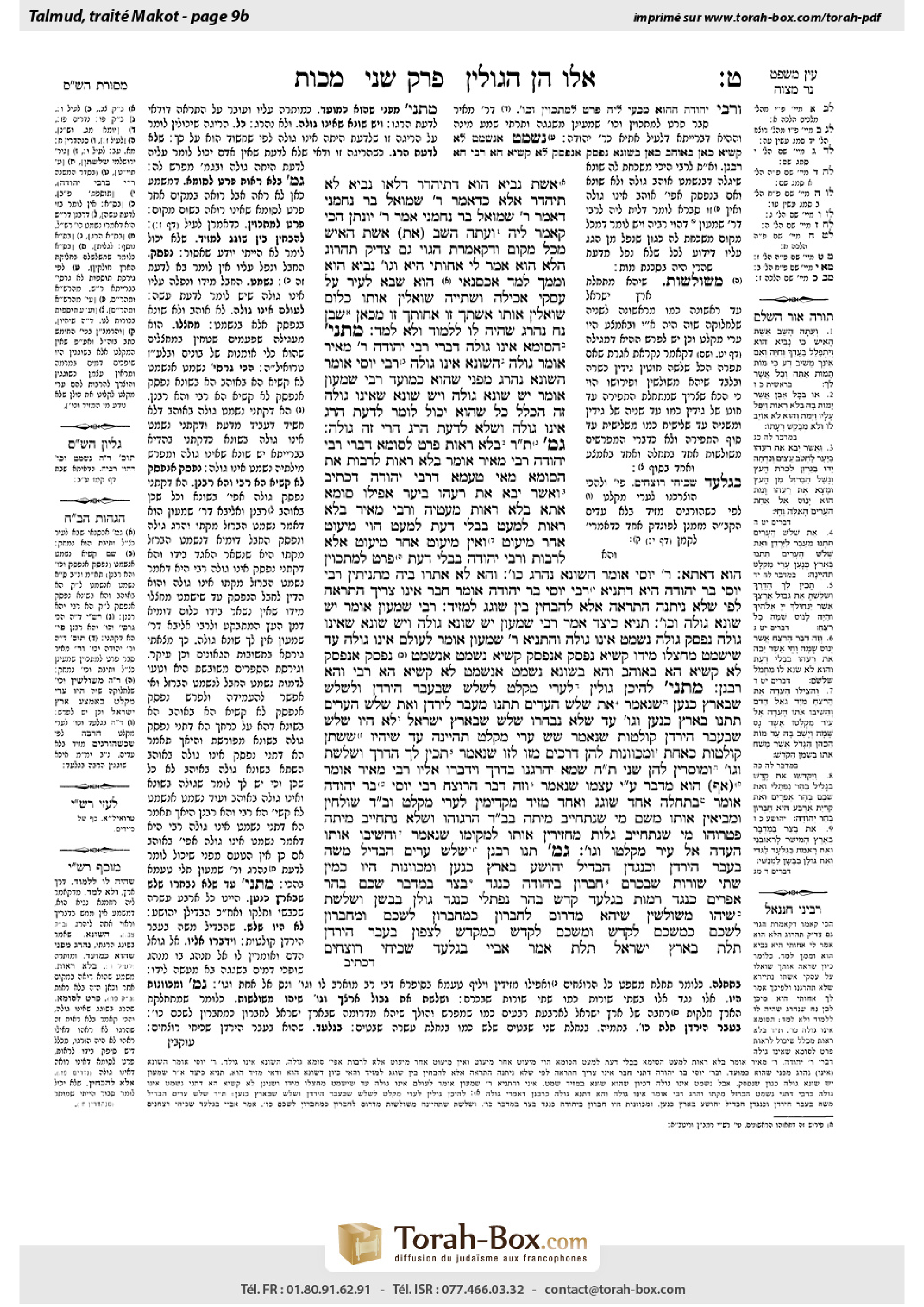
Makkot 9b: Talmud study for Daf Yomi
Daf Yomi is the daily study of one Talmud folio. Explore 37 tractates with scans, Hebrew text, Sefaria English and AI-generated French translations where annotated.
Passage selection and English or AI-generated French translation are available where the scan has annotations. Daf Study is independent of Torah-Box and Sefaria.
Browse Makkot · מכות · All tractatesMakkot 9b text and translations
This page of Makkot includes the Aramaic text, an English translation and an AI-generated French translation, alongside the scan above.
מכות ט׳ ב · Aramaic and Hebrew text
אֵשֶׁת נָבִיא הוּא דְּתֶיהְדַּר, דְּלָאו נָבִיא לָא תֶּיהְדַּר?!
אֶלָּא כִּדְאָמַר רַבִּי שְׁמוּאֵל בַּר נַחְמָנִי. דְּאָמַר רַבִּי שְׁמוּאֵל בַּר נַחְמָנִי אָמַר רַבִּי יוֹנָתָן: הָכִי קָאָמַר לֵיהּ: ״וְעַתָּה הָשֵׁב אֵשֶׁת הָאִישׁ״, מִכׇּל מָקוֹם. וּדְקָאָמְרַתְּ: ״הֲגוֹי גַּם צַדִּיק תַּהֲרֹג, הֲלֹא הוּא אָמַר לִי אֲחוֹתִי הִיא וְגוֹ׳״ – נָבִיא הוּא וּמִמְּךָ לָמַד. אַכְסְנַאי (הוּא) שֶׁבָּא לָעִיר, עַל עִסְקֵי אֲכִילָה וּשְׁתִיָּיה שׁוֹאֲלִין אוֹתוֹ, כְּלוּם שׁוֹאֲלִין אוֹתוֹ ״אִשְׁתְּךָ זוֹ״ ״אֲחוֹתְךָ זוֹ״?
מִכָּאן שֶׁבֶּן נֹחַ נֶהֱרָג, שֶׁהָיָה לוֹ לִלְמוֹד וְלֹא לָמַד.
מַתְנִי׳ הַסּוֹמֵא אֵינוֹ גּוֹלֶה, דִּבְרֵי רַבִּי יְהוּדָה. רַבִּי מֵאִיר אוֹמֵר: גּוֹלֶה. הַשּׂוֹנֵא אֵינוֹ גּוֹלֶה. רַבִּי יוֹסֵי אוֹמֵר: הַשּׂוֹנֵא נֶהֱרָג, מִפְּנֵי שֶׁהוּא כְּמוּעָד. רַבִּי שִׁמְעוֹן אוֹמֵר: יֵשׁ שׂוֹנֵא גּוֹלֶה וְיֵשׁ שׂוֹנֵא שֶׁאֵינוֹ גּוֹלֶה. זֶה הַכְּלָל: כֹּל שֶׁהוּא יָכוֹל לוֹמַר לְדַעַת הָרַג – אֵינוֹ גּוֹלֶה, וְשֶׁלֹּא לְדַעַת הָרַג – הֲרֵי זֶה גּוֹלֶה.
גְּמָ׳ תָּנוּ רַבָּנַן: ״בְּלֹא רְאוֹת״ – פְּרָט לְסוֹמֵא, דִּבְרֵי רַבִּי יְהוּדָה. רַבִּי מֵאִיר אוֹמֵר: ״בְּלֹא רְאוֹת״ – לְרַבּוֹת אֶת הַסּוֹמֵא.
מַאי טַעְמָא דְּרַבִּי יְהוּדָה – דִּכְתִיב: ״וַאֲשֶׁר יָבֹא אֶת רֵעֵהוּ בַיַּעַר״ – אֲפִילּוּ סוֹמֵא. אֲתָא ״בְּלֹא רְאוֹת״, מַעֲטֵיהּ.
וְרַבִּי מֵאִיר: ״בְּלֹא רְאוֹת״ – לְמַעֵט, ״בִּבְלִי דַּעַת״ – לְמַעֵט, הָוֵי מִיעוּט אַחַר מִיעוּט, וְאֵין מִיעוּט אַחַר מִיעוּט אֶלָּא לְרַבּוֹת.
וְרַבִּי יְהוּדָה? ״בִּבְלִי דַּעַת״ – פְּרָט לְמִתְכַּוֵּין הוּא דַּאֲתָא.
רַבִּי יוֹסֵי אוֹמֵר הַשּׂוֹנֵא נֶהֱרָג כּוּ׳. וְהָא לָא אַתְרוֹ בֵּיהּ! מַתְנִיתִין רַבִּי יוֹסֵי בַּר יְהוּדָה הִיא, דְּתַנְיָא: רַבִּי יוֹסֵי בַּר יְהוּדָה אוֹמֵר: חָבֵר אֵינוֹ צָרִיךְ הַתְרָאָה, לְפִי שֶׁלֹּא נִיתְּנָה הַתְרָאָה אֶלָּא לְהַבְחִין בֵּין שׁוֹגֵג לְמֵזִיד.
רַבִּי שִׁמְעוֹן אוֹמֵר: יֵשׁ שׂוֹנֵא גּוֹלֶה וְכוּ׳. תַּנְיָא: כֵּיצַד אָמַר רַבִּי שִׁמְעוֹן יֵשׁ שׂוֹנֵא גּוֹלֶה וְיֵשׁ שׂוֹנֵא שֶׁאֵינוֹ גּוֹלֶה? נִפְסַק – גּוֹלֶה, נִשְׁמַט – אֵינוֹ גּוֹלֶה.
וְהָתַנְיָא רַבִּי שִׁמְעוֹן אוֹמֵר: לְעוֹלָם אֵינוֹ גּוֹלֶה עַד שֶׁיִּשָּׁמֵט מַחְצָלוֹ מִיָּדוֹ. קַשְׁיָא נִפְסַק אַנִּפְסַק, קַשְׁיָא נִשְׁמַט אַנִּשְׁמַט!
נִפְסַק אַנִּפְסַק לָא קַשְׁיָא: הָא בְּאוֹהֵב, וְהָא בְּשׂוֹנֵא.
נִשְׁמַט אַנִּשְׁמַט לָא קַשְׁיָא: הָא רַבִּי, וְהָא רַבָּנַן.
מַתְנִי׳ לְהֵיכָן גּוֹלִין? לְעָרֵי מִקְלָט, לְשָׁלֹשׁ שֶׁבְּעֵבֶר הַיַּרְדֵּן וּלְשָׁלֹשׁ שֶׁבְּאֶרֶץ כְּנַעַן. שֶׁנֶּאֱמַר: ״אֵת שְׁלֹשׁ הֶעָרִים תִּתְּנוּ מֵעֵבֶר לַיַּרְדֵּן וְאֵת שְׁלֹשׁ הֶעָרִים תִּתְּנוּ בְּאֶרֶץ כְּנָעַן וְגוֹ׳״. עַד שֶׁלֹּא נִבְחֲרוּ שָׁלֹשׁ שֶׁבְּאֶרֶץ יִשְׂרָאֵל לֹא הָיוּ שָׁלֹשׁ שֶׁבְּעֵבֶר הַיַּרְדֵּן קוֹלְטוֹת, שֶׁנֶּאֱמַר: ״שֵׁשׁ עָרֵי מִקְלָט תִּהְיֶינָה״ – עַד שֶׁיִּהְיוּ שֶׁשְׁתָּן קוֹלְטוֹת כְּאַחַת.
וּמְכֻוּוֹנוֹת לָהֶן דְּרָכִים מִזּוֹ לָזוֹ, שֶׁנֶּאֱמַר: ״תָּכִין לְךָ הַדֶּרֶךְ וְשִׁלַּשְׁתָּ וְגוֹ׳״.
וּמוֹסְרִין לָהֶן שְׁנֵי תַּלְמִידֵי חֲכָמִים, שֶׁמָּא יַהַרְגֶנּוּ בַּדֶּרֶךְ, וִידַבְּרוּ אֵלָיו. רַבִּי מֵאִיר אוֹמֵר: אַף הוּא מְדַבֵּר עַל יְדֵי עַצְמוֹ, שֶׁנֶּאֱמַר: ״וְזֶה דְּבַר הָרֹצֵחַ״.
רַבִּי יוֹסֵי בַּר יְהוּדָה אוֹמֵר: בַּתְּחִלָּה, אֶחָד שׁוֹגֵג וְאֶחָד מֵזִיד מַקְדִּימִין לְעָרֵי מִקְלָט וּבֵית דִּין שׁוֹלְחִין וּמְבִיאִין אוֹתוֹ מִשָּׁם. מִי שֶׁנִּתְחַיֵּיב מִיתָה בְּבֵית דִּין – הֲרָגוּהוּ, וְשֶׁלֹּא נִתְחַיֵּיב מִיתָה – פְּטָרוּהוּ. מִי שֶׁנִּתְחַיֵּיב גָּלוּת – מַחְזִירִין אוֹתוֹ לִמְקוֹמוֹ, שֶׁנֶּאֱמַר: ״וְהֵשִׁיבוּ אֹתוֹ הָעֵדָה אֶל עִיר מִקְלָטוֹ וְגוֹ׳״.
גְּמָ׳ תָּנוּ רַבָּנַן: שָׁלֹשׁ עָרִים הִבְדִּיל מֹשֶׁה בְּעֵבֶר הַיַּרְדֵּן וּכְנֶגְדָּן הִבְדִּיל יְהוֹשֻׁעַ בְּאֶרֶץ כְּנַעַן, וּמְכֻוּוֹנוֹת הָיוּ כְּמִין שְׁתֵּי שׁוּרוֹת שֶׁבַּכֶּרֶם: חֶבְרוֹן בְּהַר יְהוּדָה כְּנֶגֶד בֶּצֶר בַּמִּדְבָּר, שְׁכֶם בְּהַר אֶפְרַיִם כְּנֶגֶד רָמוֹת בַּגִּלְעָד, קֶדֶשׁ בְּהַר נַפְתָּלִי כְּנֶגֶד גּוֹלָן בַּבָּשָׁן. ״וְשִׁלַּשְׁתָּ״ – שֶׁיְּהוּ מְשׁוּלָּשִׁין, שֶׁיְּהֵא מִדָּרוֹם לְחֶבְרוֹן כְּמֵחֶבְרוֹן לִשְׁכֶם, וּמֵחֶבְרוֹן לִשְׁכֶם כְּמִשְּׁכֶם לְקֶדֶשׁ, וּמִשְּׁכֶם לְקֶדֶשׁ כְּמִקֶּדֶשׁ לַצָּפוֹן.
בְּעֵבֶר הַיַּרְדֵּן תְּלָת, בְּאֶרֶץ יִשְׂרָאֵל תְּלָת?! אָמַר אַבָּיֵי: בְּגִלְעָד שְׁכִיחִי רוֹצְחִים,
Makkot 9b · English translation
This Gemara questions that response. Is it the wife of a prophet that is returned, and the wife of one who is not a prophet is not returned?
Rather, the explanation is as Rabbi Shmuel bar Naḥmani says, as Rabbi Shmuel bar Naḥmani says that Rabbi Yonatan says: This is what God is saying to Abimelech: “And now, restore the man’s wife” (Genesis 20:7), in any case, whether or not he is a prophet. And as for that which you said: “Will You even slay a righteous nation? Didn’t he say to me: She is my sister” (Genesis 20:4–5), claiming that you are a victim of circumstances beyond your control and exempt from punishment, that is not a valid claim. He is a prophet and it is from you that he learned to conduct himself in that manner. With regard to a stranger [akhsenai] who comes to the city, one asks him about matters of eating and drinking, e.g., whether he is hungry or thirsty. Does one ask him: Is that your wife? Is that your sister? Abraham understood from this line of questioning that you are suspect with regard to abducting women, and that is the reason that he introduced Sarah as his sister. Therefore, you are liable to be executed for her abduction.
The Gemara comments: From here it is derived that a descendant of Noah, i.e., a gentile, is executed for a capital offense even if he says that it is permitted, as he should have learned that it is prohibited and he did not learn.
MISHNA: A blind person who unintentionally murdered another is not exiled; this is the statement of Rabbi Yehuda. Rabbi Meir says: He is exiled. The enemy of the victim is not exiled, as presumably it was not a completely unintentional act. Rabbi Yosei says: Not only is an enemy not exiled, but he is executed by the court, because his halakhic status is like that of one who is forewarned by witnesses not to perform the action, as presumably he performed the action intentionally. Rabbi Shimon says: There is an enemy who is exiled and there is an enemy who is not exiled. This is the principle: In any case where an observer could say he killed knowingly, where circumstances lead to the assumption that it was an intentional act, the enemy is not exiled, even if he claims that he acted unintentionally. And if it is clear that he killed unknowingly, as circumstances indicate that he acted unintentionally, he is exiled, even though the victim is his enemy.
GEMARA: Apropos the dispute in the mishna between Rabbi Yehuda and Rabbi Meir with regard to a blind person, the Sages taught: It is written that one is exiled to a city of refuge if he killed another “without seeing” (Numbers 35:23), indicating that the reference is to one who has the capacity to see. This serves to exclude a blind person; this is the statement of Rabbi Yehuda. Rabbi Meir says: On the contrary, the term “without seeing” serves to include a blind person.
The Gemara elaborates: What is the reason for the opinion of Rabbi Yehuda? It is as it is written with regard to those who are exiled: “And as one who goes with his neighbor into the forest” (Deuteronomy 19:5), which is stated in general terms, applying even to a blind person. The phrase “without seeing” comes and excludes a blind person from this halakha.
And Rabbi Meir interprets the verses differently: “Without seeing” serves to exclude a blind person, and “without knowledge” (Deuteronomy 19:4) also serves to exclude a blind person. This is an example of a restrictive expression following a restrictive expression, and there is a hermeneutical principle that a restrictive expression following a restrictive expression serves only to amplify the halakha and include additional cases. In this case, it includes a blind person in the halakhot of exile as well.
The Gemara asks: And how does Rabbi Yehuda respond to that derivation? The Gemara answers that Rabbi Yehuda says that the phrase “without knowledge” comes to exclude one with intent, e.g., one who had intent to kill an animal and who killed a person, from the halakha of exile. Rabbi Yehuda interprets the two restrictive expressions as excluding two unrelated cases from the halakha of exile, and therefore the principle of: A restrictive expression following a restrictive expression serves only to amplify, is not relevant in this case.
§ The mishna teaches that Rabbi Yosei says: An enemy is executed because his halakhic status is like that of one who is forewarned. The Gemara asks: But why is an enemy executed? The witness did not actually forewarn him, and courts administer corporal punishment only to a defendant who was forewarned. The Gemara answers: The mishna is in accordance with the opinion of Rabbi Yosei, son of Rabbi Yehuda, as it is taught in a baraita that Rabbi Yosei, son of Rabbi Yehuda, says: One who is devoted to the meticulous observance of mitzvot [ḥaver] does not require forewarning for the court to administer corporal punishment to him, because fundamentally the obligation to issue forewarning was established only to distinguish between unwitting and intentional actions. The presumptive status of a ḥaver is that of one who knows the halakha; therefore, his action is presumed to have been intentional.
§ The mishna teaches that Rabbi Shimon says: There is an enemy who is exiled and there is an enemy who is not exiled. The Gemara adds: It is taught in a baraita: In what circumstances did Rabbi Shimon say that there is an enemy who is exiled and there is an enemy who is not exiled? He said that in a case where the rope snapped and the object attached to the rope fell and killed a person, he is exiled, as that appears to be an accident. But if an object was displaced from his hands, he is not exiled, as presumably he loosened his grip until it fell.
The Gemara asks: But isn’t it taught in a baraita that Rabbi Shimon says: One is never exiled unless his trowel with which he was working was displaced from his hand? As Rabbi Shimon stated that halakha without distinguishing between friend and enemy, therefore, the apparent contradiction between a case where the rope snapped, according to the first baraita, and a case where the rope snapped, according to the second baraita, is difficult. And the apparent contradiction between a case where the object was displaced, according to the first baraita, and a case where the object was displaced, according to the second baraita, is difficult.
The Gemara answers: The apparent contradiction between a case where the rope snapped according to the first baraita and a case where the rope snapped according to the second is not difficult. This case in the second baraita is referring to a friend of the victim, and presumably if the rope snapped it is considered a case of circumstances beyond his control and he is exempt from exile, and that case in the first baraita is referring to an enemy of the victim. In that case, although the presumption is that the act was not intentional, due to his enmity toward the victim, it is also not assumed to be the result of circumstances that were completely beyond his control. Therefore, he is exiled.
The apparent contradiction between a case where the object was displaced according to the first baraita and a case where the object was displaced according to the second baraita is not difficult, as this case in the first baraita is the opinion of Rabbi Yehuda HaNasi, who ruled in a mishna (7b) that if the blade of one’s ax was displaced from its handle and flew through the air and killed a person, he is exempt from exile, in accordance with the opinion of Rabbi Shimon, and that case in the second baraita is the opinion of the Rabbis, who rule that in that case, the person wielding the ax is exiled, in accordance with the opinion of Rabbi Shimon.
MISHNA: To where are the unintentional murderers exiled? They are exiled to cities of refuge, to three cities that were in the east bank of the Jordan and to three cities that were in the land of Canaan, i.e., Eretz Yisrael, as it is stated: “Three cities shall you give beyond the Jordan and three cities shall you give in the land of Canaan; they shall be cities of refuge” (Numbers 35:14). The mishna comments: Until the three cities of refuge that were in Eretz Yisrael were selected, an unintentional murderer would not be admitted to the three that were in the east bank of the Jordan, even though the latter three were already selected by Moses (see Deuteronomy 4:41), as it is stated: “Six cities of refuge shall they be” (Numbers 35:13), from which it is derived that they do not become cities of refuge until all six of them admit unintentional murderers as one.
The mishna continues: And roads were aligned for them from this city, i.e., all cities, to that city, i.e., they would pave and straighten the access roads to the cities of refuge, as it is stated: “Prepare for you the road, and divide the borders of your land, which the Lord your God causes you to inherit, into three parts, that every murderer may flee there” (Deuteronomy 19:3).
And the court would provide the unintentional murderers fleeing to a city of refuge with two Torah scholars, due to the concern that perhaps the blood redeemer, i.e., a relative of the murder victim seeking to avenge his death, will seek to kill him in transit, and in that case they, the scholars, will talk to the blood redeemer and dissuade him from killing the unintentional murderer. Rabbi Meir says: The unintentional murderer also speaks [medabber] on his own behalf to dissuade the blood redeemer, as it is stated: “And this is the matter [devar] of the murderer, who shall flee there and live” (Deuteronomy 19:4), indicating that the murderer himself speaks.
Rabbi Yosei bar Yehuda says: Initially, either one who killed another unintentionally or one who killed another intentionally would hurry and flee to the cities of refuge, and the court in his city would send for him and would bring him from there to stand trial. For one who was found liable to receive the death penalty in court for intentional murder, the court would execute him, and for one who was not found liable to receive the death penalty, e.g., if they deemed that the death occurred due to circumstances beyond his control, they would free him. For one who was found liable to be exiled, the court would restore him to his place in the city of refuge, as it is stated: “And the congregation shall judge between the murderer and the blood redeemer…and the congregation shall restore him to his city of refuge, that he fled there” (Numbers 35:24–25), indicating that he had been in a city of refuge before his trial.
GEMARA: The Sages taught: Moses designated three cities of refuge in the east bank of the Jordan, and corresponding to them, Joshua designated three cities of refuge in the land of Canaan. And the cities were aligned like two rows of vines in a vineyard: In Eretz Yisrael there was Hebron in Mount Judea, corresponding to Bezer in the wilderness; Shechem in Mount Ephraim, corresponding to Ramoth in the Gilead; and Kadesh in Mount Naphtali, corresponding to Golan in the Bashan. From the term “And you shall divide [veshilashta]” (Deuteronomy 19:3), it is derived that the three cities in Eretz Yisrael will serve as three [meshulashin] lines of demarcation dividing the length of the land into four equal parts, in a manner that the distance from the southern border of Eretz Yisrael to Hebron, the southernmost city of refuge, will be like the distance from Hebron to Shechem, and the distance from Hebron to Shechem will be like the distance from Shechem to Kadesh, and the distance from Shechem to Kadesh will be like the distance from Kadesh to the northern border.
The Gemara questions the distribution of the cities: Why were there three cities designated on the east bank of the Jordan, where two and a half tribes resided, and three cities designated in Eretz Yisrael, where more than nine tribes resided? Abaye said: In Gilead, which is located on the east bank of the Jordan, murderers are common.
Makkot 9b · Traduction française (IA)
La Guemara remet cette réponse en question : est-ce la femme d’un prophète qui doit être rendue, tandis que celle d’un homme qui n’est pas prophète ne doit pas l’être ?
L’explication est plutôt celle que donne Rabbi Shmuel bar Naḥmani, qui rapporte les paroles de Rabbi Yonatan : voici ce que Dieu dit à Abimélekh : « Et maintenant, rends la femme de cet homme » (Genèse 20:7), dans tous les cas, qu’il soit prophète ou non. Quant à ce que tu as dit : « Vas-tu même faire périr une nation juste ? Ne m’a-t-il pas dit : “C’est ma sœur” ? » (Genèse 20:4–5), prétendant que tu es victime de circonstances indépendantes de ta volonté et donc exempt de punition, cet argument n’est pas valable. C’est un prophète, et c’est de toi qu’il a appris à se comporter ainsi. Lorsqu’un étranger [akhsenai] arrive dans une ville, on lui pose des questions sur la nourriture et la boisson, par exemple pour savoir s’il a faim ou soif. Lui demande-t-on : « Est-ce ta femme ? Est-ce ta sœur ? » Abraham a compris, à partir de ces questions, que tu étais suspect de ravir des femmes ; c’est pourquoi il a présenté Sarah comme sa sœur. Tu es donc passible de mort pour l’avoir enlevée.
La Guemara fait remarquer : on déduit de là qu’un descendant de Noé, c’est-à-dire un non-Juif, est exécuté pour une infraction passible de la peine capitale, même s’il affirme que cela est permis, car il aurait dû apprendre que c’était interdit, mais ne l’a pas appris.
Michna : Un aveugle qui a tué quelqu’un involontairement n’est pas envoyé en exil ; telle est l’opinion de Rabbi Yehuda. Rabbi Meir dit : il est envoyé en exil. L’ennemi de la victime n’est pas envoyé en exil, car on présume que son acte n’était pas totalement involontaire. Rabbi Yosei dit : non seulement un ennemi n’est pas envoyé en exil, mais il est mis à mort par le tribunal, car son statut halakhique est celui d’un homme averti par des témoins de ne pas commettre l’acte ; on présume donc qu’il l’a commis intentionnellement. Rabbi Shimon dit : il y a un ennemi qui est envoyé en exil et un ennemi qui ne l’est pas. Voici le principe : chaque fois qu’un observateur pourrait dire qu’il a tué en connaissance de cause, c’est-à-dire lorsque les circonstances conduisent à présumer qu’il s’agissait d’un acte intentionnel, l’ennemi n’est pas envoyé en exil, même s’il affirme avoir agi involontairement. Mais s’il est clair qu’il a tué sans le savoir, c’est-à-dire lorsque les circonstances indiquent qu’il a agi involontairement, il est envoyé en exil, bien que la victime soit son ennemi.
Guemara : À propos du désaccord entre Rabbi Yehuda et Rabbi Meir dans la Michna concernant un aveugle, les Sages enseignent : il est écrit qu’on est envoyé dans une ville de refuge si l’on a tué quelqu’un « sans le voir » (Nombres 35:23), ce qui indique que le verset parle de quelqu’un qui est capable de voir. Cela exclut un aveugle ; telle est l’opinion de Rabbi Yehuda. Rabbi Meir dit : au contraire, l’expression « sans le voir » inclut un aveugle.
La Guemara développe : quelle est la raison de l’opinion de Rabbi Yehuda ? Il est écrit au sujet de ceux qui sont envoyés en exil : « Comme celui qui se rend avec son prochain dans la forêt » (Deutéronome 19:5), formulation générale qui s’applique même à un aveugle. L’expression « sans le voir » vient exclure un aveugle de cette halakha.
Rabbi Meir interprète les versets autrement : « Sans le voir » sert à exclure un aveugle, et « sans le savoir » (Deutéronome 19:4) sert également à exclure un aveugle. Il s’agit d’une expression restrictive qui suit une autre expression restrictive ; or, selon un principe herméneutique, une expression restrictive qui en suit une autre sert uniquement à élargir la halakha et à inclure des cas supplémentaires. En l’occurrence, elle inclut également un aveugle dans les halakhot de l’exil.
La Guemara demande : et comment Rabbi Yehuda répond-il à cette déduction ? La Guemara répond que, selon Rabbi Yehuda, l’expression « sans le savoir » vient exclure de la halakha de l’exil celui qui avait une intention, par exemple celui qui avait l’intention de tuer un animal mais a tué une personne. Rabbi Yehuda interprète les deux expressions restrictives comme excluant de la halakha de l’exil deux cas sans rapport entre eux ; le principe selon lequel une expression restrictive qui en suit une autre sert uniquement à élargir n’est donc pas pertinent ici.
§ La Michna enseigne que Rabbi Yosei dit : un ennemi est mis à mort, car son statut halakhique est celui d’un homme averti. La Guemara demande : mais pourquoi un ennemi est-il mis à mort ? Le témoin ne l’a pas réellement averti, et les tribunaux n’infligent de peine corporelle qu’à un accusé qui a été averti. La Guemara répond : la Michna suit l’opinion de Rabbi Yosei, fils de Rabbi Yehuda, car une baraïta enseigne que Rabbi Yosei, fils de Rabbi Yehuda, dit : celui qui s’applique avec minutie à observer les mitsvot [ḥaver] n’a pas besoin d’être averti pour que le tribunal lui inflige une peine corporelle, car, fondamentalement, l’obligation d’avertir a été instaurée uniquement afin de distinguer les actes involontaires des actes intentionnels. On présume qu’un ḥaver connaît la halakha ; son acte est donc présumé intentionnel.
§ La Michna enseigne que Rabbi Shimon dit : il y a un ennemi qui est envoyé en exil et un ennemi qui ne l’est pas. La Guemara ajoute qu’une baraïta enseigne : dans quelles circonstances Rabbi Shimon a-t-il dit qu’il y a un ennemi qui est envoyé en exil et un ennemi qui ne l’est pas ? Il l’a dit dans le cas où la corde s’est rompue et où l’objet qui y était attaché est tombé et a tué quelqu’un : l’homme est envoyé en exil, car cela paraît être un accident. Mais si un objet lui a échappé des mains, il n’est pas envoyé en exil, car on présume qu’il a relâché sa prise jusqu’à ce que l’objet tombe.
La Guemara demande : mais une baraïta n’enseigne-t-elle pas que Rabbi Shimon dit : on n’est envoyé en exil que si la truelle avec laquelle on travaillait a échappé de sa main ? Comme Rabbi Shimon a énoncé cette halakha sans distinguer entre un ami et un ennemi, la contradiction apparente entre le cas où la corde s’est rompue, selon la première baraïta, et celui où la corde s’est rompue, selon la seconde baraïta, est difficile à résoudre. Il en va de même de la contradiction apparente entre le cas où l’objet a échappé des mains, selon la première baraïta, et celui où l’objet a échappé des mains, selon la seconde baraïta.
La Guemara répond : la contradiction apparente entre le cas où la corde s’est rompue selon la première baraïta et celui où elle s’est rompue selon la seconde ne pose pas de difficulté. Le cas de la seconde baraïta concerne un ami de la victime : si la corde s’est rompue, on présume qu’il s’agit de circonstances indépendantes de sa volonté et qu’il est exempt de l’exil. Le cas de la première baraïta concerne un ennemi de la victime. Dans ce cas, même si l’on présume que l’acte n’était pas intentionnel, son hostilité envers la victime empêche de présumer que l’acte résulte de circonstances entièrement indépendantes de sa volonté. Il est donc envoyé en exil.
La contradiction apparente entre le cas où l’objet a échappé des mains selon la première baraïta et celui où il a échappé des mains selon la seconde ne pose pas de difficulté : le cas de la première baraïta suit l’opinion de Rabbi Yehuda HaNasi, qui a statué dans une Michna (7b) que si la lame d’une hache se détache de son manche, vole dans les airs et tue quelqu’un, l’homme est exempt de l’exil, conformément à l’opinion de Rabbi Shimon. Le cas de la seconde baraïta suit l’opinion des Rabbins, qui statuent que, dans ce cas, l’homme qui maniait la hache est envoyé en exil, conformément à l’opinion de Rabbi Shimon.
Michna : Où les meurtriers involontaires sont-ils envoyés en exil ? Ils sont envoyés dans des villes de refuge : trois villes situées sur la rive orientale du Jourdain et trois villes situées en terre de Canaan, c’est-à-dire en Eretz Yisrael, comme il est dit : « Vous donnerez trois villes au-delà du Jourdain et vous donnerez trois villes en terre de Canaan ; elles seront des villes de refuge » (Nombres 35:14). La Michna précise : tant que les trois villes de refuge d’Eretz Yisrael n’avaient pas été choisies, un meurtrier involontaire ne pouvait pas être admis dans les trois villes situées sur la rive orientale du Jourdain, bien que Moïse eût déjà désigné ces dernières (voir Deutéronome 4:41), comme il est dit : « Elles seront six villes de refuge » (Nombres 35:13). On en déduit qu’elles ne deviennent des villes de refuge que lorsque les six accueillent ensemble des meurtriers involontaires.
La Michna poursuit : des routes étaient aménagées entre chaque ville et les autres, c’est-à-dire qu’on pavavait et rectifiait les voies d’accès aux villes de refuge, comme il est dit : « Prépare-toi une route et divise en trois parties les frontières de ton pays dont le Seigneur ton Dieu te donne possession, afin que tout meurtrier puisse s’y enfuir » (Deutéronome 19:3).
Le tribunal fournissait également aux meurtriers involontaires qui fuyaient vers une ville de refuge deux érudits en Torah, car on craignait que le vengeur du sang, c’est-à-dire un parent de la victime cherchant à venger sa mort, ne tente de tuer le meurtrier pendant le trajet. Dans ce cas, les érudits parleraient au vengeur du sang et le dissuaderaient de tuer le meurtrier involontaire. Rabbi Meir dit : le meurtrier involontaire parle [medabber] aussi en son propre nom pour dissuader le vengeur du sang, comme il est dit : « Et voici le sujet [devar] du meurtrier, qui s’enfuira là et vivra » (Deutéronome 19:4), ce qui indique que le meurtrier lui-même parle.
Rabbi Yosei bar Yehuda dit : au début, tous ceux qui avaient tué quelqu’un, involontairement ou intentionnellement, se hâtaient de fuir vers les villes de refuge, et le tribunal de leur ville envoyait les chercher et les faisait comparaître pour leur procès. Celui qui était reconnu passible de la peine de mort par le tribunal pour meurtre intentionnel était mis à mort par le tribunal ; celui qui n’était pas reconnu passible de la peine de mort, par exemple si le tribunal estimait que le décès résultait de circonstances indépendantes de sa volonté, était libéré. Celui qui était reconnu passible d’exil était renvoyé par le tribunal à sa place dans la ville de refuge, comme il est dit : « L’assemblée jugera entre le meurtrier et le vengeur du sang… et l’assemblée le ramènera dans sa ville de refuge, où il s’était enfui » (Nombres 35:24–25), ce qui indique qu’il se trouvait dans une ville de refuge avant son procès.
Guemara : Les Sages enseignent : Moïse désigna trois villes de refuge sur la rive orientale du Jourdain et, en correspondance avec elles, Josué désigna trois villes de refuge en terre de Canaan. Les villes étaient alignées comme deux rangées de vignes dans un vignoble : en Eretz Yisrael, Hébron, dans les monts de Judée, correspondait à Bétser, dans le désert ; Sichem, dans les monts d’Éphraïm, correspondait à Ramot, en Galaad ; et Qédesh, dans les monts de Nephtali, correspondait à Golan, en Bashan. De l’expression « Et tu diviseras [veshilashta] » (Deutéronome 19:3), on déduit que les trois villes d’Eretz Yisrael formeront trois [meshulashin] lignes de démarcation divisant la longueur du pays en quatre parties égales, de sorte que la distance entre la frontière sud d’Eretz Yisrael et Hébron, la ville de refuge la plus au sud, sera égale à celle entre Hébron et Sichem ; celle entre Hébron et Sichem sera égale à celle entre Sichem et Qédesh ; et celle entre Sichem et Qédesh sera égale à celle entre Qédesh et la frontière nord.
La Guemara s’interroge sur la répartition des villes : pourquoi trois villes ont-elles été désignées sur la rive orientale du Jourdain, où résidaient deux tribus et demie, et trois villes en Eretz Yisrael, où résidaient plus de neuf tribus ? Abaye dit : en Galaad, située sur la rive orientale du Jourdain, les meurtriers sont nombreux.
Traduction française générée par IA à partir de l’édition anglaise de Sefaria. Vérifie toujours un passage avec le texte source.
Text from Sefaria: William Davidson Edition - Vocalized Aramaic (CC BY NC); William Davidson Edition - English (CC BY NC).