Megillah 24a: Talmud study for Daf Yomi
Daf Yomi is the daily study of one Talmud folio. Explore 37 tractates with scans, Hebrew text, Sefaria English and AI-generated French translations where annotated.
Passage selection and English or AI-generated French translation are available where the scan has annotations. Daf Study is independent of Torah-Box and Sefaria.
Browse Megillah · מגילה · All tractatesMegillah 24a text and translations
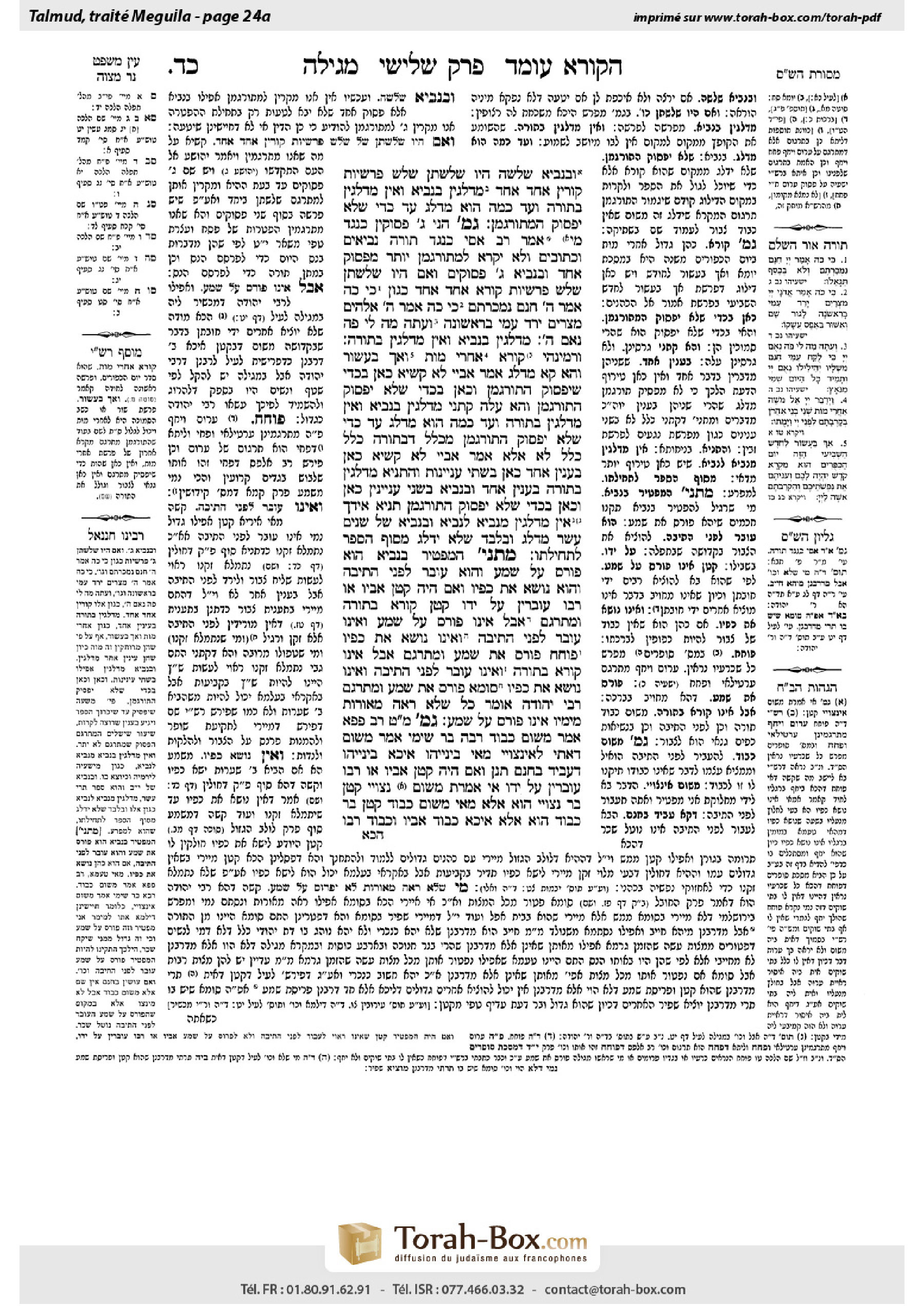
This page of Megillah includes the Aramaic text, an English translation and an AI-generated French translation, alongside the scan above.
מגילה כ״ד א · Aramaic and Hebrew text
וּבַנָּבִיא שְׁלֹשָׁה. הָיוּ שְׁלָשְׁתָּן שָׁלֹשׁ פָּרָשִׁיּוֹת — קוֹרִין אֶחָד אֶחָד.
מְדַלְּגִין בַּנָּבִיא וְאֵין מְדַלְּגִין בַּתּוֹרָה. וְעַד כַּמָּה הוּא מְדַלֵּג? עַד כְּדֵי שֶׁלֹּא יִפְסוֹק הַמְתוּרְגְּמָן.
גְּמָ׳ הָנֵי שְׁלֹשָׁה פְּסוּקִין כְּנֶגֶד מִי? אָמַר רַב אַסִּי: כְּנֶגֶד תּוֹרָה נְבִיאִים וּכְתוּבִים.
וְלֹא יִקְרָא לַמְּתוּרְגְּמָן יוֹתֵר מִפָּסוּק אֶחָד, וּבַנָּבִיא — שְׁלֹשָׁה פְּסוּקִים, וְאִם הָיוּ שְׁלָשְׁתָּן שָׁלֹשׁ פָּרָשִׁיּוֹת — קוֹרֵא אֶחָד אֶחָד. כְּגוֹן: ״כִּי כֹה אָמַר ה׳ חִנָּם נִמְכַּרְתֶּם״. ״כִּי כֹּה אָמַר ה׳ אֱלֹהִים מִצְרַיִם יָרַד עַמִּי בָרִאשׁוֹנָה״, ״וְעַתָּה מַה לִּי פֹה נְאֻם ה׳״.
מְדַלְּגִין בַּנָּבִיא וְאֵין מְדַלְּגִין בַּתּוֹרָה. וּרְמִינְהִי: קוֹרֵא ״אַחֲרֵי מוֹת״ וְ״אַךְ בֶּעָשׂוֹר״ — וְהָא קָא מְדַלֵּג!
אָמַר אַבָּיֵי, לָא קַשְׁיָא: כָּאן בִּכְדֵי שֶׁיִּפְסוֹק הַתּוּרְגְּמָן, וְכָאן בִּכְדֵי שֶׁלֹּא יִפְסוֹק הַתּוּרְגְּמָן.
וְהָא עֲלַהּ קָתָנֵי: מְדַלְּגִין בַּנָּבִיא וְאֵין מְדַלְּגִין בַּתּוֹרָה, וְעַד כַּמָּה הוּא מְדַלֵּג — עַד כְּדֵי שֶׁלֹּא יִפְסוֹק הַתּוּרְגְּמָן. מִכְלָל דְּבַתּוֹרָה כְּלָל כְּלָל לָא!
אֶלָּא אָמַר אַבָּיֵי, לָא קַשְׁיָא: כָּאן בְּעִנְיָן אֶחָד, כָּאן בִּשְׁתֵּי עִנְיָינוֹת. וְהָתַנְיָא: מְדַלְּגִין בַּתּוֹרָה בְּעִנְיָן אֶחָד, וּבַנָּבִיא בִּשְׁנֵי עִנְיָינִין. כָּאן וְכָאן, בִּכְדֵי שֶׁלֹּא יִפְסוֹק הַתּוּרְגְּמָן.
תַּנְיָא אִידַּךְ: אֵין מְדַלְּגִין מִנָּבִיא לְנָבִיא, וּבַנָּבִיא שֶׁל שְׁנֵים עָשָׂר — מְדַלֵּג, וּבִלְבַד שֶׁלֹּא יְדַלֵּג מִסּוֹף הַסֵּפֶר לִתְחִילָּתוֹ.
מַתְנִי׳ הַמַּפְטִיר בַּנָּבִיא — הוּא פּוֹרֵס עַל שְׁמַע, וְהוּא עוֹבֵר לִפְנֵי הַתֵּיבָה, וְהוּא נוֹשֵׂא אֶת כַּפָּיו. וְאִם הָיָה קָטָן — אָבִיו אוֹ רַבּוֹ עוֹבְרִין עַל יָדוֹ.
קָטָן קוֹרֵא בַּתּוֹרָה וּמְתַרְגֵּם. אֲבָל אֵינוֹ פּוֹרֵס עַל שְׁמַע, וְאֵינוֹ עוֹבֵר לִפְנֵי הַתֵּיבָה, וְאֵינוֹ נוֹשֵׂא אֶת כַּפָּיו.
פּוֹחֵחַ — פּוֹרֵס אֶת שְׁמַע וּמְתַרְגֵּם. אֲבָל אֵינוֹ קוֹרֵא בַּתּוֹרָה, וְאֵינוֹ עוֹבֵר לִפְנֵי הַתֵּיבָה, וְאֵינוֹ נוֹשֵׂא אֶת כַּפָּיו.
סוֹמֵא — פּוֹרֵס אֶת שְׁמַע וּמְתַרְגֵּם. רַבִּי יְהוּדָה אוֹמֵר: כׇּל שֶׁלֹּא רָאָה מְאוֹרוֹת מִיָּמָיו — אֵינוֹ פּוֹרֵס עַל שְׁמַע.
גְּמָ׳ מַאי טַעְמָא? רַב פָּפָּא אָמַר: מִשּׁוּם כָּבוֹד. רַבָּה בַּר שִׁימִי אָמַר: מִשּׁוּם דְּאָתֵי לְאִינְּצוֹיֵי.
מַאי בֵּינַיְיהוּ? אִיכָּא בֵּינַיְיהוּ דְּעָבֵיד בְּחִנָּם.
תְּנַן: וְאִם הָיָה קָטָן — אָבִיו אוֹ רַבּוֹ עוֹבְרִין עַל יָדוֹ. אִי אָמְרַתְּ מִשּׁוּם [אִי]נְּצוֹיֵי — קָטָן בַּר [אִי]נְּצוֹיֵי הוּא?
אֶלָּא מַאי — מִשּׁוּם כָּבוֹד? קָטָן בַּר כָּבוֹד הוּא?! אֶלָּא אִיכָּא כְּבוֹד אָבִיו וּכְבוֹד רַבּוֹ,
Megillah 24a · English translation
And with regard to the Prophets, one may read to the translator three verses at a time. With respect to the Torah, an incorrect translation might lead to an error in practice, but this concern does not apply to the Prophets. If the three verses constitute three separate paragraphs, that is to say, if each verse is a paragraph in itself, one must read them to the translator one by one.
One may skip from one place to another while reading the Prophets, but one may not skip from one place to another while reading the Torah. How far may he skip? As far as he can, provided that the translator will not conclude his translation while the reader is still rolling the scroll to the new location. The reader may not cause the congregation to wait for him after the translator has finished, as that would be disrespectful to the congregation.
GEMARA: The Gemara asks: Corresponding to what were these three verses, i.e., the minimal Torah reading, instituted? Rav Asi said: They correspond to the Torah, Prophets, and Writings.
We learned in the mishna: And when it is being translated, one should not read to the translator more than one verse at a time. And with regard to the Prophets, he may read to the translator three verses at a time. If the three verses constitute three separate paragraphs, he must read them to the translator separately, for example, the verses: “For thus says the Lord, You were sold for naught” (Isaiah 52:3); “For thus says the Lord God, at first My people went down to Egypt” (Isaiah 52:4); “Now therefore what have I here, says the Lord” (Isaiah 52:5). These are three adjacent verses, each one constituting an independent paragraph.
§ We learned further in the mishna: One may skip from one place to another while reading the Prophets, but one may not skip from one place to another while reading the Torah. The Gemara raises a contradiction from a mishna (Yoma 68b): On Yom Kippur, the High Priest reads the section beginning with the verse: “After the death” (Leviticus 16:1), and then he reads the section beginning with the verse: “Only on the tenth day” (Leviticus 23:27). Doesn’t he skip from the first section to the second section?
Abaye said: This is not difficult. Here, where it says that one may not skip in the Torah, the translator will conclude his translation before the reader is ready to continue reading. There, where it is permitted to skip, the translator will not conclude his translation before the reader is ready to continue reading.
The Gemara asks: Wasn’t it taught in the mishna with regard to that issue: One may skip while reading the Prophets, but one may not skip while reading the Torah. How far may he skip? As far as he can, provided that the translator will not conclude his translation before the reader is ready to continue reading. This applies to reading the Prophets; it therefore proves by inference that while reading the Torah one may not skip at all.
Rather, Abaye said it is not difficult for a different reason: Here, where it says that the High Priest skipped from one section to another, it was permitted because the two sections address one topic. There, where the mishna says one may not skip while reading the Torah, it is where the two sections address two distinct topics. And so it is explicitly taught in a baraita: One may skip from one section to another while reading the Torah if the two sections address one topic, and in the Prophets one may skip even if the two sections address two distinct topics. Both here and there, with regard to the Torah and the Prophets, one may skip only if the translator will not conclude his translation before the reader is ready to continue reading.
It is taught in another baraita: One may not skip from prophet to prophet, i.e., from one book of Prophets to another, even if the selections address the same topic. However, one may skip from one prophet to another among the twelve books of Prophets, which are grouped together, provided that he does not skip from the end of the book to the beginning, i.e., that he does not read a later section and then an earlier section.
MISHNA: The one who concludes with a reading from the Prophets [haftara] is also the one who is honored to recite the introductory prayers and blessing before Shema, and he passes before the ark to repeat the Amida prayer, and if he is a priest he lifts his hands to recite the Priestly Benediction. And if the one who reads the haftara is a minor, who may read the haftara but is not qualified to lead the congregation in prayer, his father or teacher is honored to pass before the ark in his place.
A minor may read the Torah in public and also translate the text for the congregation into Aramaic, but he may not recite the introductory prayers and blessing before Shema, and he may not pass before the ark to lead the congregation in prayer, and he may not lift his hands to recite the Priestly Benediction.
One whose limbs are exposed [poḥe’aḥ] may recite the introductory prayers and blessing before Shema and translate the Torah reading into Aramaic, but he may not read from the Torah out of respect for the Torah; he may not pass before the ark to lead the congregation in prayer; and he may not lift his hands to recite the Priestly Benediction out of respect for the congregation.
One who is blind may recite the introductory prayers and blessing before Shema, and he may also translate the Torah reading into Aramaic. Rabbi Yehuda says: Anyone who has not seen the luminaries, the sun, moon, and stars, in his life, i.e., he was blind from birth, may not recite the introductory prayers and blessing before Shema. The first of the blessings before Shema is the blessing over the luminaries, and one who has never seen them cannot recite the blessing at all.
GEMARA: The Gemara asks: What is the reason that the one who reads the haftara is honored with these other roles? Rav Pappa said: It is due to a desire to grant him honor. Since even minors are qualified to read the haftara, it was considered an insult for a person to be called up to read the haftara rather than be called up as one of those needed to read the Torah. Since he was willing to serve in this role, he is granted other, more honorable roles in the synagogue. Rabba bar Shimi said a different reason: It is due to a concern that they will come to quarrel, as the individual who read the haftara will quarrel with the individual honored to lead the congregation in prayer.
The Gemara asks: What is the practical difference between them? The Gemara explains: There is a practical difference between them where the one who passes before the ark does so free of charge. In that case, there is still a need to grant the one who read the haftara honor, but it is not likely that they will quarrel.
We learned in the mishna: And if the one who reads the haftara is a minor, his father or teacher is honored to pass before the ark in his place. If you say that the reason the reader of the haftara passes before the ark is due to a concern that they will quarrel, will a minor engage in quarreling? He has no valid claim to the right to pass before the ark. Consequently, the concern for strife must not be the reason for the halakha stated in the mishna.
The Gemara rejects this argument: Rather, what is the reason; is it due to honor? Does a minor have honor that is slighted when he reads the haftara and therefore must be assuaged? Rather, according to Rav Pappa it is a display of honor to his father and his teacher.
Megillah 24a · Traduction française (IA)
Concernant les Prophètes, on peut lire trois versets à la fois au traducteur. Pour la Torah, une traduction incorrecte pourrait entraîner une erreur dans la pratique, mais cette crainte ne s’applique pas aux Prophètes. Si les trois versets constituent trois paragraphes distincts, c’est-à-dire si chaque verset forme à lui seul un paragraphe, il faut les lire au traducteur un par un.
On peut passer d’un passage à un autre lors de la lecture des Prophètes, mais pas lors de la lecture de la Torah. Jusqu’où peut-on sauter ? Aussi loin que possible, à condition que le traducteur ne termine pas sa traduction pendant que le lecteur déroule encore le rouleau jusqu’au nouvel endroit. Le lecteur ne doit pas faire attendre l’assemblée une fois que le traducteur a terminé, car cela manquerait de respect à l’assemblée.
GUEMARA : La Guemara demande : À quoi correspondent ces trois versets, c’est-à-dire la lecture minimale de la Torah ? Rav Asi dit : Ils correspondent à la Torah, aux Prophètes et aux Écrits.
Nous avons appris dans la Michna : Lorsqu’on traduit, on ne doit lire au traducteur qu’un seul verset à la fois. En revanche, concernant les Prophètes, on peut lire trois versets à la fois au traducteur. Si les trois versets constituent trois paragraphes distincts, il faut les lire séparément au traducteur. Par exemple, les versets : « Car ainsi parle le Seigneur : Vous avez été vendus pour rien » (Isaïe 52,3) ; « Car ainsi parle le Seigneur Dieu : Autrefois, mon peuple descendit en Égypte » (Isaïe 52,4) ; « Et maintenant, qu’ai-je à faire ici, dit le Seigneur ? » (Isaïe 52,5). Ce sont trois versets consécutifs, dont chacun constitue un paragraphe indépendant.
§ Nous avons également appris dans la Michna : On peut passer d’un passage à un autre lors de la lecture des Prophètes, mais pas lors de la lecture de la Torah. La Guemara soulève une contradiction à partir d’une Michna (Yoma 68b) : À Yom Kippour, le Grand Prêtre lit le passage qui commence par le verset « Après la mort » (Lévitique 16,1), puis celui qui commence par le verset « Le dixième jour seulement » (Lévitique 23,27). Ne passe-t-il pas du premier passage au second ?
Abayé dit : Il n’y a pas de difficulté. Ici, lorsqu’il est dit qu’on ne peut pas sauter dans la Torah, le traducteur terminerait sa traduction avant que le lecteur ne soit prêt à poursuivre. Là, où il est permis de sauter, le traducteur ne terminerait pas sa traduction avant que le lecteur ne soit prêt à poursuivre.
La Guemara demande : N’a-t-il pas été enseigné dans la Michna à propos de cette question : On peut sauter lors de la lecture des Prophètes, mais pas lors de la lecture de la Torah. Jusqu’où peut-on sauter ? Aussi loin que possible, à condition que le traducteur ne termine pas sa traduction avant que le lecteur ne soit prêt à poursuivre. Cela concerne la lecture des Prophètes ; on en déduit donc que, lors de la lecture de la Torah, on ne peut absolument pas sauter.
Abayé dit plutôt qu’il n’y a pas de difficulté, pour une autre raison : Ici, le Grand Prêtre a pu passer d’un passage à un autre parce que les deux passages traitent d’un même sujet. Là, lorsque la Michna dit qu’on ne peut pas sauter lors de la lecture de la Torah, il s’agit de deux passages traitant de sujets distincts. Et cela est enseigné explicitement dans une baraïta : Lors de la lecture de la Torah, on peut passer d’un passage à un autre si les deux passages traitent d’un même sujet ; dans les Prophètes, on peut sauter même si les deux passages traitent de sujets distincts. Dans les deux cas, pour la Torah comme pour les Prophètes, on ne peut sauter que si le traducteur ne termine pas sa traduction avant que le lecteur ne soit prêt à poursuivre.
Il est enseigné dans une autre baraïta : On ne peut pas passer d’un prophète à un autre, c’est-à-dire d’un livre des Prophètes à un autre, même si les passages traitent du même sujet. Cependant, on peut passer d’un prophète à un autre parmi les douze livres des Prophètes, qui sont regroupés, à condition de ne pas sauter de la fin d’un livre à son début, c’est-à-dire de ne pas lire un passage ultérieur puis un passage antérieur.
MICHNA : Celui qui conclut par une lecture des Prophètes [haftara] est également celui qui a l’honneur de réciter les prières et la bénédiction introductives avant le Chéma ; il passe devant l’arche pour répéter la prière de la Amida et, s’il est prêtre, il lève les mains pour réciter la bénédiction sacerdotale. Si celui qui lit la haftara est un mineur, qui peut lire la haftara mais n’est pas habilité à diriger la prière de l’assemblée, son père ou son maître a l’honneur de passer devant l’arche à sa place.
Un mineur peut lire la Torah en public et également traduire le texte en araméen pour l’assemblée, mais il ne peut pas réciter les prières et la bénédiction introductives avant le Chéma, ni passer devant l’arche pour diriger la prière de l’assemblée, ni lever les mains pour réciter la bénédiction sacerdotale.
Celui dont les membres sont découverts [poḥe’aḥ] peut réciter les prières et la bénédiction introductives avant le Chéma et traduire en araméen la lecture de la Torah, mais il ne peut pas lire dans la Torah, par respect pour la Torah ; il ne peut pas passer devant l’arche pour diriger la prière de l’assemblée ; et il ne peut pas lever les mains pour réciter la bénédiction sacerdotale, par respect pour l’assemblée.
Un aveugle peut réciter les prières et la bénédiction introductives avant le Chéma, et il peut également traduire en araméen la lecture de la Torah. Rabbi Yehouda dit : Quiconque n’a jamais vu de sa vie les luminaires — le soleil, la lune et les étoiles —, c’est-à-dire celui qui est aveugle de naissance, ne peut pas réciter les prières et la bénédiction introductives avant le Chéma. La première des bénédictions qui précèdent le Chéma est la bénédiction sur les luminaires ; celui qui ne les a jamais vus ne peut pas réciter cette bénédiction.
GUEMARA : La Guemara demande : Pourquoi celui qui lit la haftara reçoit-il l’honneur d’assumer ces autres fonctions ? Rav Pappa dit : C’est pour lui faire honneur. Puisque même les mineurs sont habilités à lire la haftara, on considérait comme une insulte le fait qu’une personne soit appelée à lire la haftara plutôt qu’à être appelée parmi ceux qui doivent lire la Torah. Puisqu’elle a accepté d’assumer cette fonction, on lui confère d’autres rôles, plus honorables, dans la synagogue. Rabba bar Shimi donne une autre raison : c’est par crainte qu’ils en viennent à se quereller, car celui qui a lu la haftara se querellerait avec celui qui a reçu l’honneur de diriger la prière de l’assemblée.
La Guemara demande : Quelle est la différence pratique entre les deux avis ? La Guemara explique : Il y a une différence pratique lorsque celui qui passe devant l’arche le fait gratuitement. Dans ce cas, il reste nécessaire de faire honneur à celui qui a lu la haftara, mais il est peu probable qu’ils se querellent.
Nous avons appris dans la Michna : Si celui qui lit la haftara est un mineur, son père ou son maître a l’honneur de passer devant l’arche à sa place. Si l’on dit que celui qui lit la haftara passe devant l’arche par crainte qu’ils se querellent, un mineur se querellerait-il ? Il n’a aucun droit valable à faire valoir pour passer devant l’arche. Par conséquent, la crainte d’une querelle ne peut pas être la raison de la halakha énoncée dans la Michna.
La Guemara rejette cet argument : Quelle est donc la raison ? Serait-ce l’honneur ? Le mineur peut-il être offensé dans son honneur parce qu’il lit la haftara, au point qu’il faille l’apaiser ? Selon Rav Pappa, il s’agit plutôt de faire honneur à son père et à son maître.
Traduction française générée par IA à partir de l’édition anglaise de Sefaria. Vérifie toujours un passage avec le texte source.
Text from Sefaria: William Davidson Edition - Vocalized Aramaic (CC BY NC); William Davidson Edition - English (CC BY NC).