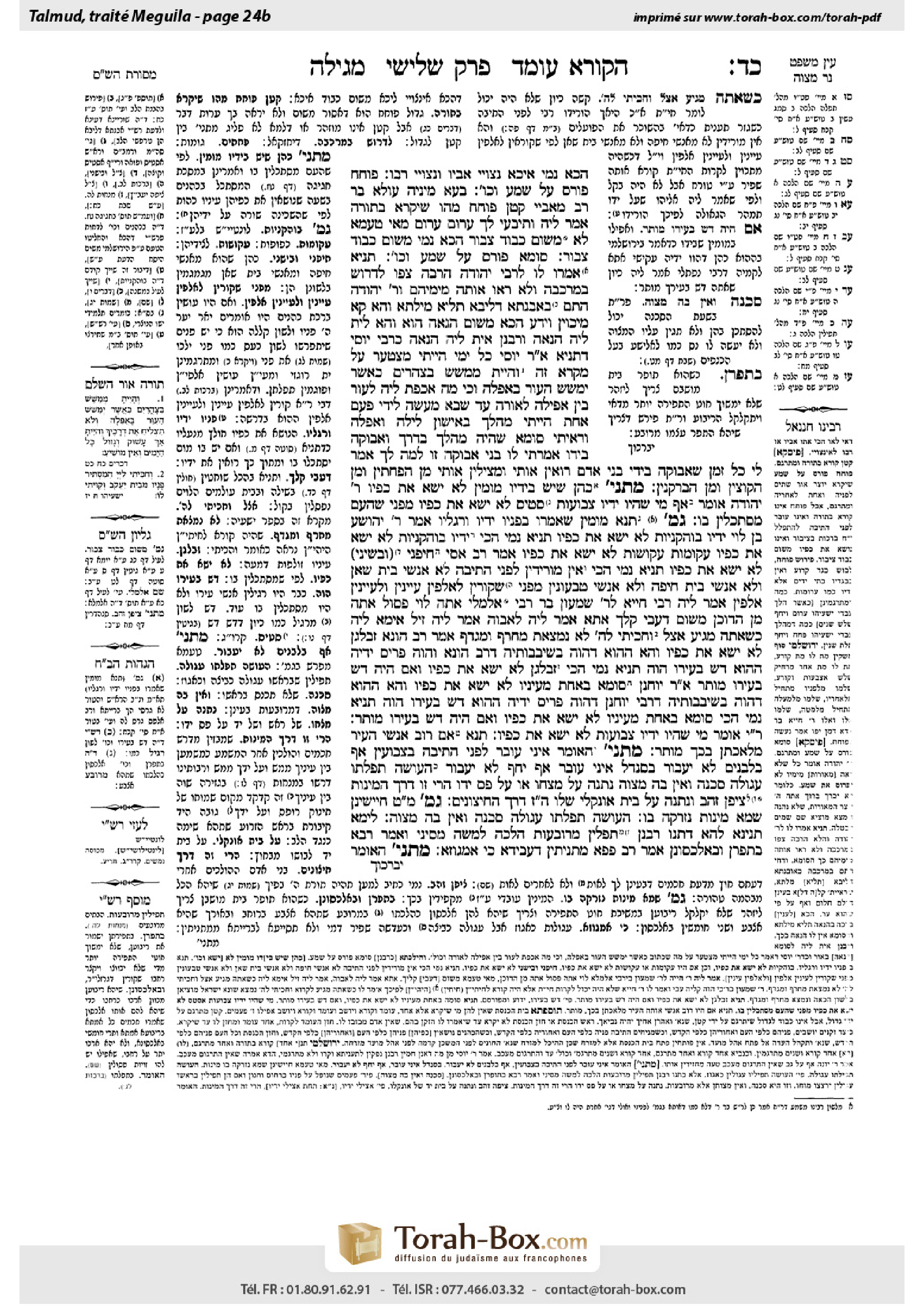
Megillah 24b: Talmud study for Daf Yomi
Daf Yomi is the daily study of one Talmud folio. Explore 37 tractates with scans, Hebrew text, Sefaria English and AI-generated French translations where annotated.
Passage selection and English or AI-generated French translation are available where the scan has annotations. Daf Study is independent of Torah-Box and Sefaria.
Browse Megillah · מגילה · All tractatesMegillah 24b text and translations
This page of Megillah includes the Aramaic text, an English translation and an AI-generated French translation, alongside the scan above.
מגילה כ״ד ב · Aramaic and Hebrew text
הָכָא נָמֵי, אִיכָּא נִצּוּיֵי אָבִיו וְנִצּוּיֵי רַבּוֹ.
פּוֹחֵחַ פּוֹרֵס עַל שְׁמַע וְכוּ׳. בְּעָא מִינֵּיהּ עוּלָּא בַּר רַב מֵאַבָּיֵי: קָטָן פּוֹחֵחַ מַהוּ שֶׁיִּקְרָא בַּתּוֹרָה?
אֲמַר לֵיהּ: וְתִיבְּעֵי לָךְ עָרוֹם! עָרוֹם מַאי טַעְמָא לָא — מִשּׁוּם כְּבוֹד צִבּוּר, הָכָא נָמֵי מִשּׁוּם כְּבוֹד צִבּוּר.
סוֹמֵא פּוֹרֵס עַל שְׁמַע וְכוּ׳. תַּנְיָא, אָמְרוּ לוֹ לְרַבִּי יְהוּדָה: הַרְבֵּה צָפוּ לִדְרוֹשׁ בַּמֶּרְכָּבָה, וְלֹא רָאוּ אוֹתָהּ מִימֵיהֶם.
וְרַבִּי יְהוּדָה, הָתָם בְּאֹבַנְתָּא דְלִיבָּא תַּלְיָא מִילְּתָא, וְהָא קָא מִיכַּוֵּין וְיָדַע. הָכָא מִשּׁוּם הֲנָאָה הוּא, וְהָא לֵית לֵיהּ הֲנָאָה.
וְרַבָּנַן — אִית לֵיהּ הֲנָאָה, כְּרַבִּי יוֹסֵי. דְּתַנְיָא, אָמַר רַבִּי יוֹסֵי: כׇּל יָמַי הָיִיתִי מִצְטַעֵר עַל מִקְרָא זֶה: ״וְהָיִיתָ מְמַשֵּׁשׁ בַּצׇּהֳרַיִם כַּאֲשֶׁר יְמַשֵּׁשׁ הָעִוֵּר בָּאֲפֵלָה״, וְכִי מָה אִכְפַּת לֵיהּ לְעִוֵּר בֵּין אֲפֵילָה לְאוֹרָה?
עַד שֶׁבָּא מַעֲשֶׂה לְיָדִי: פַּעַם אַחַת הָיִיתִי מְהַלֵּךְ בְּאִישׁוֹן לַיְלָה וַאֲפֵלָה, וְרָאִיתִי סוֹמֵא שֶׁהָיָה מְהַלֵּךְ בַּדֶּרֶךְ וַאֲבוּקָה בְּיָדוֹ. אָמַרְתִּי לוֹ: בְּנִי, אֲבוּקָה זוֹ לָמָּה לָךְ? אָמַר לִי: כׇּל זְמַן שֶׁאֲבוּקָה בְּיָדִי, בְּנֵי אָדָם רוֹאִין אוֹתִי וּמַצִּילִין אוֹתִי מִן הַפְּחָתִין וּמִן הַקּוֹצִין וּמִן הַבַּרְקָנִין.
מַתְנִי׳ כֹּהֵן שֶׁיֵּשׁ בְּיָדָיו מוּמִין לֹא יִשָּׂא אֶת כַּפָּיו. רַבִּי יְהוּדָה אוֹמֵר: אַף מִי שֶׁהָיוּ יָדָיו צְבוּעוֹת סְטֵיס לֹא יִשָּׂא אֶת כַּפָּיו, מִפְּנֵי שֶׁהָעָם מִסְתַּכְּלִין בּוֹ.
גְּמָ׳ תָּנָא: מוּמִין שֶׁאָמְרוּ, בְּפָנָיו יָדָיו וְרַגְלָיו. אָמַר רַבִּי יְהוֹשֻׁעַ בֶּן לֵוִי: יָדָיו בּוֹהֲקָנִיּוֹת — לֹא יִשָּׂא אֶת כַּפָּיו. תַּנְיָא נָמֵי הָכִי: יָדָיו בּוֹהֲקָנִיּוֹת — לֹא יִשָּׂא אֶת כַּפָּיו. עֲקוּמּוֹת עֲקוּשׁוֹת — לֹא יִשָּׂא אֶת כַּפָּיו.
אָמַר רַב אַסִּי: חֵיפָנִי וּבֵישָׁנִי — לֹא יִשָּׂא אֶת כַּפָּיו. תַּנְיָא נָמֵי הָכִי: אֵין מוֹרִידִין לִפְנֵי הַתֵּיבָה לֹא אַנְשֵׁי בֵּית שְׁאָן וְלֹא אַנְשֵׁי (בֵּית) חֵיפָה וְלֹא אַנְשֵׁי טִבְעוֹנִין, מִפְּנֵי שֶׁקּוֹרִין לָאַלְפִין עַיְינִין וְלָעַיְינִין אַלְפִין.
אֲמַר לֵיהּ רַבִּי חִיָּיא לְרַבִּי שִׁמְעוֹן בַּר רַבִּי: אִלְמָלֵי אַתָּה לֵוִי — פָּסוּל אַתָּה מִן הַדּוּכָן, מִשּׁוּם דַּעֲבֵי קָלָךְ. אֲתָא אֲמַר לֵיהּ לַאֲבוּהּ. אֲמַר לֵיהּ: זִיל אֵימָא לֵיהּ: כְּשֶׁאַתָּה מַגִּיעַ אֵצֶל ״וְחִכִּיתִי לַה׳״, לֹא נִמְצֵאת מְחָרֵף וּמְגַדֵּף?!
אָמַר רַב הוּנָא: זַבְלְגָן לֹא יִשָּׂא אֶת כַּפָּיו. וְהָא הַהוּא דַּהֲוָה בְּשִׁיבָבוּתֵיהּ דְּרַב הוּנָא, וַהֲוָה פָּרֵיס יְדֵיהּ! הָהוּא דָּשׁ בְּעִירוֹ הֲוָה. תַּנְיָא נָמֵי הָכִי: זַבְלְגָן לֹא יִשָּׂא אֶת כַּפָּיו, וְאִם הָיָה דָּשׁ בְּעִירוֹ — מוּתָּר.
אָמַר רַבִּי יוֹחָנָן: סוֹמֵא בְּאַחַת מֵעֵינָיו — לֹא יִשָּׂא אֶת כַּפָּיו. וְהָא הַהוּא דַּהֲוָה בְּשִׁיבָבוּתֵיהּ דְּרַבִּי יוֹחָנָן דַּהֲוָה פָּרֵיס יְדֵיהּ! הָהוּא דָּשׁ בְּעִירוֹ הֲוָה. תַּנְיָא נָמֵי הָכִי: סוֹמֵא בְּאַחַת מֵעֵינָיו — לֹא יִשָּׂא אֶת כַּפָּיו, וְאִם הָיָה דָּשׁ בְּעִירוֹ — מוּתָּר.
רַבִּי יְהוּדָה אוֹמֵר: מִי שֶׁהָיוּ יָדָיו צְבוּעוֹת — לֹא יִשָּׂא אֶת כַּפָּיו. תָּנָא: אִם רוֹב אַנְשֵׁי הָעִיר מְלַאכְתָּן בְּכָךְ — מוּתָּר.
מַתְנִי׳ הָאוֹמֵר: אֵינִי עוֹבֵר לִפְנֵי הַתֵּיבָה בִּצְבוּעִין — אַף בִּלְבָנִים לֹא יַעֲבוֹר. בְּסַנְדָּל אֵינִי עוֹבֵר — אַף יָחֵף לֹא יַעֲבוֹר.
הָעוֹשֶׂה תְּפִלָּתוֹ עֲגוּלָּה — סַכָּנָה, וְאֵין בָּהּ מִצְוָה. נְתָנָהּ עַל מִצְחוֹ אוֹ עַל פַּס יָדוֹ — הֲרֵי זוֹ דֶּרֶךְ הַמִּינוּת. (צִיפַּן) [צִיפָּהּ] זָהָב וּנְתָנָהּ עַל בֵּית אוּנְקְלִי שֶׁלּוֹ — הֲרֵי זוֹ דֶּרֶךְ הַחִיצוֹנִים.
גְּמָ׳ מַאי טַעְמָא — חָיְישִׁינַן שֶׁמָּא מִינוּת נִזְרְקָה בּוֹ.
הָעוֹשֶׂה תְּפִלָּתוֹ עֲגוּלָּה סַכָּנָה וְאֵין בָּהּ מִצְוָה. לֵימָא תְּנֵינָא לְהָא דְּתָנוּ רַבָּנַן, תְּפִלִּין מְרוּבָּעוֹת הֲלָכָה לְמֹשֶׁה מִסִּינַי! וְאָמַר רָבָא: בְּתִפְרָן וּבַאֲלַכְסוֹנָן!
אָמַר רַב פָּפָּא: מַתְנִיתִין דַּעֲבִידָא כִּי אַמְגּוּזָא.
מַתְנִי׳ הָאוֹמֵר:
Megillah 24b · English translation
Here, also, according to Rabba bar Shimi, it is to prevent his father or teacher from quarreling.
§ We learned in the mishna: One whose limbs are exposed [poḥe’aḥ] may recite the introductory prayers and blessing before Shema and translate the Torah reading into Aramaic, but he may not read from the Torah. Ulla bar Rav raised a dilemma before Abaye: What is the halakha with regard to whether a minor whose limbs are exposed may read from the Torah? Can it be argued that a minor’s bare limbs do not fall under the category of nakedness, and therefore it is permitted for him to read the Torah despite the fact that parts of his body are exposed?
Abaye said to him: And according to this reasoning, raise the dilemma with regard to a minor who is totally naked. What is the reason that a minor who is naked may not read the Torah? It is due to respect for the public. Here, too, a poḥe’aḥ may not read from the Torah due to respect for the public.
The mishna continues: One who is blind may recite the introductory prayers and blessing before Shema, and he may also translate the Torah reading into Aramaic. Rabbi Yehuda says: Anyone who has not seen the luminaries in his life may not recite the first of the blessings before Shema, which is the blessing over the luminaries. It is taught in a baraita that they said to Rabbi Yehuda: Many have seen enough with their mind to expound upon the Divine Chariot, although they have never actually seen it. Similarly, even one who has never seen the luminaries may recite the blessing.
And how does Rabbi Yehuda counter this argument? He can say that there, with regard to the Chariot, the matter depends upon the heart’s comprehension, and one can concentrate his mind and understand the Chariot even if he has never actually seen it. But here, with regard to the luminaries, the blessing is recited due to the benefit one derives from them, and one who is blind does not derive any benefit from them, and therefore he may not recite a blessing over them.
And the Rabbis maintain that even a blind man derives benefit from the luminaries, in accordance with the opinion of Rabbi Yosei, as it is taught in a baraita that Rabbi Yosei said: All of my life I was troubled by this verse, which I did not understand: “And you shall grope at noon as the blind man gropes in the darkness” (Deuteronomy 28:29). I was perplexed: What does it matter to a blind person whether it is dark or light? He cannot see in any event, so why does the verse speak about a blind man in the darkness?
I continued to ponder the matter until the following incident occurred to me. I was once walking in the absolute darkness of the night, and I saw a blind man who was walking on his way with a torch in his hands. I said to him: My son, why do you need this torch if you are blind? He said to me: As long as I have a torch in my hand, people see me and save me from the pits and the thorns and the thistles. Even a blind man derives at least indirect benefit from the light, and therefore he may recite the blessing over the heavenly luminaries.
MISHNA: A priest who has blemishes on his hands may not lift his hands to recite the Priestly Benediction. Because of his blemish, people will look at his hands, and it is prohibited to look at the hands of the priests during the Priestly Benediction. Rabbi Yehuda says: Even one whose hands were colored with satis, a blue dye, may not lift his hands to recite the Priestly Benediction because the congregation will look at him.
GEMARA: It is taught in a baraita: The blemishes that the Sages said disqualify a priest from reciting the Priestly Benediction include any blemishes found on his face, hands, and feet, but not blemishes that are not visible to others. Rabbi Yehoshua ben Levi said: If his hands are spotted with white blotches, he may not lift his hands to recite the Priestly Benediction. The Gemara notes that this is also taught in a baraita: If a priest’s hands are spotted, he may not lift his hands to recite the Priestly Benediction. Similarly, if his hands are curved inward or bent sideways, he may not lift his hands to recite the Priestly Benediction.
Apropos the previous discussion, Rav Asi said: A priest from Haifa or Beit She’an may not lift his hands to recite the Priestly Benediction, as he does not know how to properly pronounce the guttural letters. This is also taught in a baraita: One may not allow the people of Beit She’an, nor the people of Beit Haifa, nor the people of Tivonin to pass before the ark in order to lead the service because they pronounce alef as ayin and ayin as alef, and they thereby distort the meaning of the prayers.
The Gemara relates that Rabbi Ḥiyya once said to Rabbi Shimon, son of Rabbi Yehuda HaNasi: If you were a Levite, you would be disqualified from singing on the platform in the Temple courtyard because your voice is thick. Offended by this remark, Rabbi Shimon went and told his father, Rabbi Yehuda HaNasi, what Rabbi Ḥiyya had said. Rabbi Yehuda HaNasi said to him: Go and say to him: When you study and reach the verse: “And I will wait upon [veḥikkiti] the Lord” (Isaiah 8:17), will you not be a maligner and a blasphemer? Rabbi Ḥiyya, who was from Babylonia, was unable to differentiate between the letters ḥet and heh, and he would therefore pronounce the word veḥikkiti as vehikkiti, which means: And I will strike.
Rav Huna said: A priest whose eyes constantly run with tears may not lift his hands to recite the Priestly Benediction. The Gemara asks: Wasn’t there a certain priest with this condition in the neighborhood of Rav Huna, and he would spread his hands and recite the Priestly Benediction? The Gemara answers: That priest was a familiar figure in his town. Since the other residents were accustomed to seeing him, he would not draw their attention during the Priestly Benediction. This is also taught in a baraita: One whose eyes run should not lift his hands to recite the Priestly Benediction, but if he is a familiar figure in his town, he is permitted to do so.
Rabbi Yoḥanan said: One who is blind in one eye may not lift his hands to recite the Priestly Benediction because people will gaze at him. The Gemara asks: Wasn’t there a certain priest who was blind in one eye in the neighborhood of Rabbi Yoḥanan, and he would lift his hands and recite the Priestly Benediction? The Gemara answers: That priest was a familiar figure in his town, and therefore he would not attract attention during the Priestly Benediction. This is also taught in a baraita: One who is blind in one eye may not lift his hands and recite the Priestly Benediction, but if he is a familiar figure in his town, he is permitted to do so.
We learned in the mishna that Rabbi Yehuda said: One whose hands are colored should not lift his hands to recite the Priestly Benediction. It was taught in a baraita: If most of the townspeople are engaged in this occupation, dyeing, he is permitted to recite the Priestly Benediction, as the congregation will not pay attention to his stained hands.
MISHNA: One who says: I will not pass before the ark to lead the prayer service in colored garments, may not pass before the ark to lead the prayer service even in white garments. There is concern that one who insists on wearing clothing of a specific color during his prayers is a heretic and therefore unfit to lead the service. Similarly, if one says: I will not pass before the ark wearing sandals, he may not pass before it even barefoot, as he is not acting in accordance with the teachings of the Sages.
One who constructs his phylacteries in a round shape exposes himself to danger during times of persecution, when foreign governments impose a ban on the mitzva of phylacteries, and yet he does not fulfill the mitzva to don phylacteries, as phylacteries must be square. If one placed the phylacteries worn on the head on his forehead, and not in its proper place above his hairline, or if he placed the phylacteries worn on the arm on his palm, and not on his biceps, this is the way of the heretics, i.e., those who reject the tradition of the Sages with regard to the proper placement of the phylacteries. If one plated his phylacteries with gold or placed the phylacteries worn on the arm on the outside of his sleeve [unkeli], this is the way of the outsiders, i.e., those who do not take part in the traditions of the Jewish people.
GEMARA: What is the reason that one who wishes to pray only with white clothes or barefoot is not permitted to lead the prayer? We are concerned that perhaps he has been imbued with heresy, as these are the practices of idolaters. He is therefore barred from leading the service.
We learned in the mishna: One who constructs his phylacteries in a round shape exposes himself to danger and does not fulfill the mitzva to don phylacteries. The Gemara comments: Let us say that we already learned in this mishna that which the Sages taught in a baraita: The requirement that phylacteries must be square is a halakha transmitted to Moses from Sinai. And Rava said about this: Square means along their seams and their diagonals [alakhsonan], i.e., they must be perfectly square. It would seem that all this was already stated in the mishna, which says that round phylacteries are disqualified.
Rav Pappa said: It is possible to understand that the mishna is referring to phylacteries that one constructed to be round like a nut, i.e., in the shape of a ball. However, the mishna does not indicate that the phylacteries must be square, as it does not address the case of phylacteries that are rounded but not a true sphere.
MISHNA: If one says in his prayers:
Megillah 24b · Traduction française (IA)
Ici aussi, selon Rabba bar Shimi, c’est pour empêcher son père ou son maître de se quereller.
§ Nous avons appris dans la Michna : Celui dont certaines parties du corps sont découvertes [poḥe’aḥ] peut réciter les prières préliminaires et la bénédiction qui précèdent le Chéma, et traduire en araméen la lecture de la Torah, mais il ne peut pas lire dans la Torah. Ulla bar Rav posa à Abaye la question suivante : Quelle est la halakha concernant un mineur dont certaines parties du corps sont découvertes : peut-il lire dans la Torah ? Peut-on soutenir que les parties nues du corps d’un mineur ne relèvent pas de la catégorie de la nudité et qu’il lui est donc permis de lire dans la Torah malgré le fait que certaines parties de son corps soient découvertes ?
Abaye lui dit : Si l’on raisonne ainsi, pose aussi la question au sujet d’un mineur entièrement nu. Pourquoi un mineur nu ne peut-il pas lire dans la Torah ? Par respect pour l’assemblée. Ici aussi, un poḥe’aḥ ne peut pas lire dans la Torah par respect pour l’assemblée.
La Michna poursuit : Un aveugle peut réciter les prières préliminaires et la bénédiction qui précèdent le Chéma, et il peut aussi traduire en araméen la lecture de la Torah. Rabbi Yehuda dit : Quiconque n’a jamais vu les luminaires au cours de sa vie ne peut pas réciter la première des bénédictions qui précèdent le Chéma, c’est-à-dire la bénédiction sur les luminaires. Il est enseigné dans une baraïta qu’on répondit à Rabbi Yehuda : Beaucoup ont suffisamment vu par l’esprit pour exposer le Char divin, bien qu’ils ne l’aient jamais vu réellement. De même, même celui qui n’a jamais vu les luminaires peut réciter la bénédiction.
Et comment Rabbi Yehuda répond-il à cet argument ? Il peut dire que, dans le cas du Char, tout dépend de la compréhension du cœur : on peut concentrer son esprit et comprendre le Char même sans l’avoir jamais vu réellement. Mais, dans le cas des luminaires, on récite la bénédiction en raison du bénéfice qu’on en tire ; or un aveugle n’en tire aucun bénéfice et ne peut donc pas réciter de bénédiction à leur sujet.
Et les Rabbins soutiennent que même un aveugle tire bénéfice des luminaires, conformément à l’opinion de Rabbi Yosei. En effet, il est enseigné dans une baraïta que Rabbi Yosei dit : Toute ma vie, ce verset m’a intrigué, sans que je le comprenne : « Tu tâtonneras en plein midi comme l’aveugle tâtonne dans l’obscurité » (Deutéronome 28:29). J’étais perplexe : quelle importance cela a-t-il pour un aveugle qu’il fasse sombre ou clair ? Il ne peut voir dans aucun cas ; pourquoi le verset parle-t-il donc d’un aveugle dans l’obscurité ?
J’ai continué à y réfléchir jusqu’à ce que l’incident suivant m’arrive. Un jour, je marchais dans l’obscurité totale de la nuit et je vis un aveugle qui avançait sur son chemin, une torche à la main. Je lui dis : Mon fils, pourquoi as-tu besoin de cette torche si tu es aveugle ? Il me répondit : Tant que j’ai une torche à la main, les gens me voient et me sauvent des fosses, des épines et des chardons. Même un aveugle tire au moins un bénéfice indirect de la lumière ; il peut donc réciter la bénédiction sur les luminaires célestes.
MICHNA : Un prêtre qui a des défauts aux mains ne peut pas les lever pour réciter la bénédiction sacerdotale. À cause de son défaut, les gens regarderont ses mains, or il est interdit de regarder les mains des prêtres pendant la bénédiction sacerdotale. Rabbi Yehuda dit : Même celui dont les mains ont été colorées avec du satis, une teinture bleue, ne peut pas les lever pour réciter la bénédiction sacerdotale, car l’assemblée le regardera.
GUEMARA : Il est enseigné dans une baraïta : Les défauts dont les Sages ont dit qu’ils disqualifient un prêtre pour réciter la bénédiction sacerdotale comprennent tous ceux qui se trouvent sur son visage, ses mains et ses pieds, mais pas ceux qui ne sont pas visibles aux autres. Rabbi Yehoshua ben Levi a dit : Si ses mains sont tachetées de plaques blanches, il ne peut pas les lever pour réciter la bénédiction sacerdotale. La Guemara relève que cela est également enseigné dans une baraïta : Si les mains d’un prêtre sont tachetées, il ne peut pas les lever pour réciter la bénédiction sacerdotale. De même, si ses mains sont courbées vers l’intérieur ou déviées sur le côté, il ne peut pas les lever pour réciter la bénédiction sacerdotale.
À propos de la discussion précédente, Rav Asi a dit : Un prêtre de Haïfa ou de Beit She’an ne peut pas lever les mains pour réciter la bénédiction sacerdotale, car il ne sait pas prononcer correctement les lettres gutturales. Cela est également enseigné dans une baraïta : On ne doit pas laisser les habitants de Beit She’an, de Beit Haïfa ou de Tivonin passer devant l’arche pour diriger le service, car ils prononcent alef comme ayin et ayin comme alef, déformant ainsi le sens des prières.
La Guemara rapporte que Rabbi Ḥiyya dit un jour à Rabbi Shimon, fils de Rabbi Yehuda HaNasi : Si tu étais un Lévite, tu serais disqualifié pour chanter sur l’estrade dans la cour du Temple, car ta voix est grave. Vexé par cette remarque, Rabbi Shimon alla raconter à son père, Rabbi Yehuda HaNasi, ce que Rabbi Ḥiyya avait dit. Rabbi Yehuda HaNasi lui dit : Va lui dire : Quand tu étudies et que tu arrives au verset « Et j’attendrai [veḥikkiti] le Seigneur » (Isaïe 8:17), ne seras-tu pas un calomniateur et un blasphémateur ? Rabbi Ḥiyya, qui venait de Babylonie, était incapable de distinguer les lettres ḥet et heh ; il prononçait donc le mot veḥikkiti comme vehikkiti, ce qui signifie : « Et je frapperai ».
Rav Huna a dit : Un prêtre dont les yeux larmoient constamment ne peut pas lever les mains pour réciter la bénédiction sacerdotale. La Guemara demande : N’y avait-il pas un certain prêtre atteint de ce problème dans le voisinage de Rav Huna, qui étendait les mains et récitait la bénédiction sacerdotale ? La Guemara répond : Ce prêtre était une figure familière dans sa ville. Comme les autres habitants avaient l’habitude de le voir, il n’attirait pas leur attention pendant la bénédiction sacerdotale. Cela est également enseigné dans une baraïta : Celui dont les yeux larmoient ne doit pas lever les mains pour réciter la bénédiction sacerdotale, mais s’il est une figure familière dans sa ville, cela lui est permis.
Rabbi Yoḥanan a dit : Celui qui est aveugle d’un œil ne peut pas lever les mains pour réciter la bénédiction sacerdotale, car les gens le regarderont. La Guemara demande : N’y avait-il pas un certain prêtre aveugle d’un œil dans le voisinage de Rabbi Yoḥanan, qui levait les mains et récitait la bénédiction sacerdotale ? La Guemara répond : Ce prêtre était une figure familière dans sa ville et n’attirait donc pas l’attention pendant la bénédiction sacerdotale. Cela est également enseigné dans une baraïta : Celui qui est aveugle d’un œil ne peut pas lever les mains pour réciter la bénédiction sacerdotale, mais s’il est une figure familière dans sa ville, cela lui est permis.
Nous avons appris dans la Michna que Rabbi Yehuda a dit : Celui dont les mains sont colorées ne doit pas les lever pour réciter la bénédiction sacerdotale. Il est enseigné dans une baraïta : Si la majorité des habitants de la ville exercent cette activité, la teinture, il lui est permis de réciter la bénédiction sacerdotale, car l’assemblée ne prêtera pas attention à ses mains tachées.
MICHNA : Celui qui dit : « Je ne passerai pas devant l’arche pour diriger la prière si je porte des vêtements colorés », ne peut pas passer devant l’arche pour diriger la prière, même vêtu de blanc. On craint que celui qui insiste pour porter des vêtements d’une couleur précise pendant la prière ne soit un hérétique et soit donc inapte à diriger le service. De même, si quelqu’un dit : « Je ne passerai pas devant l’arche chaussé de sandales », il ne peut pas passer devant elle même pieds nus, car il n’agit pas conformément aux enseignements des Sages.
Celui qui fabrique ses phylactères de forme ronde s’expose au danger en période de persécution, lorsque des gouvernements étrangers interdisent la mitsva des phylactères, et pourtant il ne s’acquitte pas de la mitsva de porter les phylactères, car ceux-ci doivent être carrés. Si quelqu’un place les phylactères de la tête sur son front, au lieu de les mettre à leur place, au-dessus de la racine des cheveux, ou s’il place les phylactères du bras sur sa paume, au lieu de les mettre sur son biceps, c’est la pratique des hérétiques, c’est-à-dire de ceux qui rejettent la tradition des Sages concernant l’emplacement adéquat des phylactères. Si quelqu’un recouvre ses phylactères d’or ou place les phylactères du bras à l’extérieur de sa manche [unkeli], c’est la pratique des dissidents, c’est-à-dire de ceux qui ne prennent pas part aux traditions du peuple juif.
GUEMARA : Pourquoi celui qui souhaite prier uniquement en vêtements blancs ou pieds nus n’est-il pas autorisé à diriger la prière ? Nous craignons qu’il ait été imprégné d’hérésie, car ce sont des pratiques des idolâtres. Il lui est donc interdit de diriger le service.
Nous avons appris dans la Michna : Celui qui fabrique ses phylactères de forme ronde s’expose au danger et ne s’acquitte pas de la mitsva de porter les phylactères. La Guemara fait remarquer : Disons que nous avons déjà appris dans cette Michna ce que les Sages ont enseigné dans une baraïta : l’exigence selon laquelle les phylactères doivent être carrés est une halakha transmise à Moïse au Sinaï. Et Rava a dit à ce sujet : « Carrés » signifie que leurs côtés et leurs diagonales [alakhsonan] doivent être égaux, c’est-à-dire qu’ils doivent être parfaitement carrés. Il semblerait que tout cela soit déjà énoncé dans la Michna, qui disqualifie les phylactères ronds.
Rav Pappa a dit : On peut comprendre que la Michna parle de phylactères fabriqués ronds comme une noix, c’est-à-dire en forme de boule. Cependant, la Michna n’indique pas que les phylactères doivent être carrés, car elle ne traite pas du cas de phylactères arrondis sans être une véritable sphère.
MICHNA : Si quelqu’un dit dans ses prières :
Traduction française générée par IA à partir de l’édition anglaise de Sefaria. Vérifie toujours un passage avec le texte source.
Text from Sefaria: William Davidson Edition - Vocalized Aramaic (CC BY NC); William Davidson Edition - English (CC BY NC).