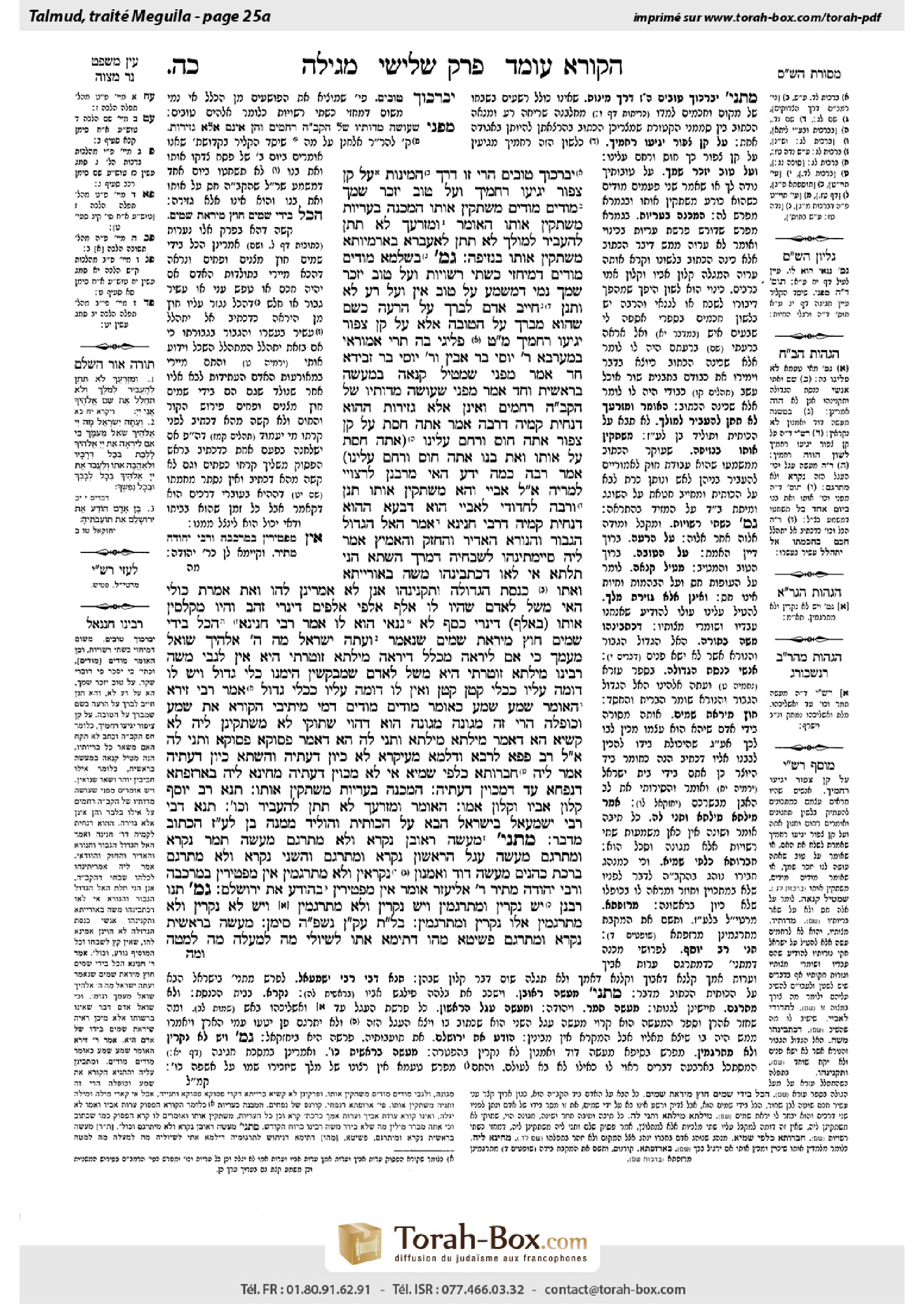
Megillah 25a: Talmud study for Daf Yomi
Daf Yomi is the daily study of one Talmud folio. Explore 37 tractates with scans, Hebrew text, Sefaria English and AI-generated French translations where annotated.
Passage selection and English or AI-generated French translation are available where the scan has annotations. Daf Study is independent of Torah-Box and Sefaria.
Browse Megillah · מגילה · All tractatesMegillah 25a text and translations
This page of Megillah includes the Aramaic text, an English translation and an AI-generated French translation, alongside the scan above.
מגילה כ״ה א · Aramaic and Hebrew text
״יְבָרְכוּךָ טוֹבִים״ — הֲרֵי זוֹ דֶּרֶךְ הַמִּינוּת. ״עַל קַן צִפּוֹר יַגִּיעוּ רַחֲמֶיךָ״, וְ״עַל טוֹב יִזָּכֵר שְׁמֶךָ״, ״מוֹדִים מוֹדִים״ — מְשַׁתְּקִין אוֹתוֹ.
הַמְכַנֶּה בַּעֲרָיוֹת — מְשַׁתְּקִין אוֹתוֹ. הָאוֹמֵר: ״׳וּמִזַּרְעֲךָ לֹא תִתֵּן לְהַעֲבִיר לַמּוֹלֶךְ׳, לֹא תִתֵּן לְאַעְבָּרָא בְּאַרְמָיוּתָא״ — מְשַׁתְּקִין אוֹתוֹ בִּנְזִיפָה.
גְּמָ׳ בִּשְׁלָמָא ״מוֹדִים מוֹדִים״ — דְּמִיחֲזֵי כִּשְׁתֵּי רָשׁוּיוֹת. ״וְעַל טוֹב יִזָּכֵר שְׁמֶךָ״ נָמֵי, דְּמַשְׁמַע: עַל טוֹב — אִין, וְעַל רַע — לָא, וּתְנַן: חַיָּיב אָדָם לְבָרֵךְ עַל הָרָעָה כְּשֵׁם שֶׁהוּא מְבָרֵךְ עַל הַטּוֹבָה. אֶלָּא: ״עַל קַן צִפּוֹר יַגִּיעוּ רַחֲמֶיךָ״ מַאי טַעְמָא?
פְּלִיגִי בַּהּ תְּרֵי אָמוֹרָאֵי בְּמַעְרְבָא: רַבִּי יוֹסֵי בַּר אָבִין וְרַבִּי יוֹסֵי בַּר זְבִידָא, חַד אָמַר: מִפְּנֵי שֶׁמֵּטִיל קִנְאָה בְּמַעֲשֵׂה בְרֵאשִׁית, וְחַד אָמַר: מִפְּנֵי שֶׁעוֹשֶׂה מִדּוֹתָיו שֶׁל הַקָּדוֹשׁ בָּרוּךְ הוּא רַחֲמִים, וְאֵינָן אֶלָּא גְּזֵירוֹת.
הַהוּא דִּנְחֵית קַמֵּיהּ דְּרַבָּה, אֲמַר: אַתָּה חַסְתָּ עַל קַן צִפּוֹר — אַתָּה חוּס וְרַחֵם עָלֵינוּ! (אַתָּה חַסְתָּ עַל ״אוֹתוֹ וְאֶת בְּנוֹ״ — אַתָּה חוּס וְרַחֵם עָלֵינוּ.) אֲמַר רַבָּה: כַּמָּה יָדַע הַאי מֵרַבָּנַן לְרַצּוֹיֵי לְמָרֵיהּ. אֲמַר לֵיהּ אַבָּיֵי: וְהָא ״מְשַׁתְּקִין אוֹתוֹ״ תְּנַן!
וְרַבָּה, לְחַדּוֹדֵי לְאַבָּיֵי הוּא דִּבְעָא.
הַהוּא דִּנְחֵית קַמֵּיהּ דְּרַבִּי חֲנִינָא, אָמַר: ״הָאֵל הַגָּדוֹל הַגִּבּוֹר וְהַנּוֹרָא הָאַדִּיר וְהֶחָזָק וְהָאַמִּיץ״.
אֲמַר לֵיהּ: סַיֵּימְתִּינְהוּ לִשְׁבָחֵיהּ דְּמָרָךְ? הַשְׁתָּא הָנֵי תְּלָתָא, אִי לָאו דְּכַתְבִינְהוּ מֹשֶׁה בְּאוֹרָיְיתָא, וַאֲתוֹ כְּנֶסֶת הַגְּדוֹלָה וְתַקְּנִינְהוּ — אֲנַן לָא אָמְרִינַן לְהוּ. וְאַתְּ אָמְרַתְּ כּוּלֵּי הַאי! מָשָׁל לְאָדָם שֶׁהָיוּ לוֹ אֶלֶף אַלְפֵי אֲלָפִים דִּינְרֵי זָהָב, וְהָיוּ מְקַלְּסִין אוֹתוֹ (בְּאֶלֶף) דִּינְרֵי כֶסֶף. לֹא גְּנַאי הוּא לוֹ?!
אָמַר רַבִּי חֲנִינָא: הַכֹּל בִּידֵי שָׁמַיִם חוּץ מִיִּרְאַת שָׁמַיִם, שֶׁנֶּאֱמַר: ״וְעַתָּה יִשְׂרָאֵל מָה ה׳ אֱלֹהֶיךָ שׁוֹאֵל מֵעִמָּךְ כִּי אִם לְיִרְאָה״.
מִכְּלָל דְּיִרְאָה מִילְּתָא זוּטַרְתִּי הִיא?! אִין, לְגַבֵּי מֹשֶׁה רַבֵּינוּ מִילְּתָא זוּטַרְתִּי הִיא. מָשָׁל לְאָדָם שֶׁמְּבַקְּשִׁין הֵימֶנּוּ כְּלִי גָּדוֹל וְיֵשׁ לוֹ — דּוֹמֶה עָלָיו כִּכְלִי קָטָן. קָטָן וְאֵין לוֹ — דּוֹמֶה עָלָיו כִּכְלִי גָּדוֹל.
אָמַר רַבִּי זֵירָא: הָאוֹמֵר ״שְׁמַע שְׁמַע״ — כְּאוֹמֵר ״מוֹדִים מוֹדִים״ דָּמֵי.
מֵיתִיבִי: הַקּוֹרֵא אֶת שְׁמַע וְכוֹפְלָהּ — הֲרֵי זֶה מְגוּנֶּה. מְגוּנֶּה הוּא דְּהָוֵי, שַׁתּוֹקֵי לָא מְשַׁתְּקִינַן לֵיהּ?! לָא קַשְׁיָא: הָא דְּאָמַר מִילְּתָא מִילְּתָא וְתָנֵי לַהּ, הָא דְּאָמַר פְּסוּקָא פְּסוּקָא וְתָנֵי לֵהּ.
אֲמַר לֵיהּ רַב פָּפָּא לְרָבָא: וְדִלְמָא מֵעִיקָּרָא לָא כַּוֵּין דַּעְתֵּיהּ וְהַשְׁתָּא כַּוֵּין דַּעְתֵּיהּ? אֲמַר לֵיהּ: חַבְרוּתָא כְּלַפֵּי שְׁמַיָּא? אִי לָא מְכַוֵּין דַּעְתֵּיהּ, מָחֵינָא לֵיהּ בְּאַרְזַפְתָּא דְנַפָּחָא עַד דִּמְכַוֵּין דַּעְתֵּיהּ.
הַמְכַנֶּה בַּעֲרָיוֹת מְשַׁתְּקִין אוֹתוֹ. תָּנֵי רַב יוֹסֵף: קְלוֹן אָבִיו וּקְלוֹן אִמּוֹ.
הָאוֹמֵר: ״וּמִזַּרְעֲךָ לֹא תִתֵּן לְהַעֲבִיר וְכוּ׳״. תָּנָא דְּבֵי רַבִּי יִשְׁמָעֵאל: בְּיִשְׂרָאֵל הַבָּא עַל הַגּוֹיָה וְהוֹלִיד מִמֶּנָּה בֵּן לַעֲבוֹדָה זָרָה הַכָּתוּב מְדַבֵּר.
מַתְנִי׳ מַעֲשֵׂה רְאוּבֵן — נִקְרָא וְלֹא מִתַּרְגֵּם. מַעֲשֵׂה תָמָר — נִקְרָא וּמִתַּרְגֵּם. מַעֲשֵׂה עֵגֶל הָרִאשׁוֹן — נִקְרָא וּמִתַּרְגֵּם, וְהַשֵּׁנִי — נִקְרָא וְלֹא מִתַּרְגֵּם. בִּרְכַּת כֹּהֲנִים, מַעֲשֵׂה דָוִד וְאַמְנוֹן — נִקְרָאִין וְלֹא מִתַּרְגְּמִין.
אֵין מַפְטִירִין בַּמֶּרְכָּבָה, וְרַבִּי יְהוּדָה מַתִּיר. רַבִּי אֱלִיעֶזֶר אוֹמֵר: אֵין מַפְטִירִין בְּ״הוֹדַע אֶת יְרוּשָׁלַםִ״.
גְּמָ׳ תָּנוּ רַבָּנַן: יֵשׁ נִקְרִין וּמִתַּרְגְּמִין, וְיֵשׁ נִקְרִין וְלֹא מִתַּרְגְּמִין, וְיֵשׁ לֹא נִקְרִין וְלֹא מִתַּרְגְּמִין. אֵלּוּ נִקְרִין וּמִתַּרְגְּמִין. בָּלַ״ת עָקָ״ן נִשְׁפֶּ״ה סִימָן.
מַעֲשֵׂה בְרֵאשִׁית נִקְרָא וּמִתַּרְגֵּם. פְּשִׁיטָא! מַהוּ דְּתֵימָא: אָתוּ לְשַׁיּוֹלֵי מָה לְמַעְלָה מָה לְמַטָּה,
Megillah 25a · English translation
May the good bless You, this is a path of heresy, as heretics divide the world into two domains, good and evil. If one says the following in his prayers: Just as Your mercy is extended to a bird’s nest, as You have commanded us to send away the mother before taking her chicks or eggs (see Deuteronomy 22:6–7), so too extend Your mercy to us; or: May Your name be mentioned with the good; or: We give thanks, we give thanks, twice, he is suspected of heretical beliefs and they silence him.
If one modifies the text while reading the laws of forbidden sexual relations, i.e., he introduces euphemisms out of a sense of propriety, they silence him. Similarly, if one says while translating the verse: “And you shall not give any of your seed to set them apart to Molekh” (Leviticus 18:21): And you shall not give any of your seed to impregnate an Aramean woman, he is silenced with rebuke.
GEMARA: The mishna cites three instances where the communal prayer leader is silenced. The Gemara clarifies: Granted, they silence one who repeats: We give thanks, we give thanks, as it appears like he is acknowledging and praying to two authorities. And, granted, they also silence one who says: May Your name be mentioned with the good, as this formulation indicates one is thanking God only for the good and not for the bad, and we learned in a mishna (Berakhot 54a): One is obligated to bless God for the bad just as he blesses Him for the good. However, in the case of one who recites: Just as Your mercy is extended to a bird’s nest, what is the reason that they silence him?
Two amora’im in the West, Eretz Yisrael, disagree about this question, Rabbi Yosei bar Avin and Rabbi Yosei bar Zevida. One said that this was because one who says this engenders jealousy among God’s creations, as it appears as though he is indicating that God favored one creature over all others. And one said that saying this is prohibited because one transforms the attributes of the Holy One, Blessed be He, into expressions of mercy, and they are nothing but decrees of the King that must be fulfilled without inquiring into the reasons behind them.
The Gemara relates that a particular individual descended before the ark as prayer leader in the presence of Rabba, and said in his prayers: You have shown mercy to birds, as expressed through the mitzva to chase away the mother bird before taking eggs from its nest; have mercy and pity upon us. You have shown mercy to animals, as expressed through the prohibition against slaughtering an animal and its offspring on the same day; have mercy and pity upon us. Rabba said: How much does this rabbi know to appease the Lord, his Master! Abaye said to him: Didn’t we learn in the mishna that they silence him?
The Gemara explains: And Rabba, too, held in accordance with this mishna but merely acted this way because he wanted to hone Abaye’s intellect. Rabba did not make his statement to praise the rabbi, but simply to test his nephew and student, Abaye, and to encourage him to articulate what he knows about the mishna.
With regard to additions to prayers formulated by the Sages, the Gemara relates that a particular individual descended before the ark as prayer leader in the presence of Rabbi Ḥanina. He extended his prayer and said: God, the great, the mighty, and the awesome, the powerful, and the strong, and the fearless.
When he finished, Rabbi Ḥanina said to him: Have you concluded all of the praises of your Master? Even these three praises that we recite: The great, the mighty, and the awesome, had Moses our teacher not written them in the Torah (Deuteronomy 10:17), and had the members of the Great Assembly not come and incorporated them into the Amida prayer (see Nehemiah 9:32), we would not be permitted to recite them. And you went on and recited all of these. It is comparable to a man who possessed many thousands of golden dinars, yet they were praising him for owning a thousand silver ones. Isn’t that deprecatory toward him? All of the praises one can lavish upon the Lord are nothing but a few silver dinars relative to many thousands of gold dinars. Reciting a litany of praise does not enhance God’s honor.
Tangentially, the Gemara cites an additional statement by Rabbi Ḥanina, concerning principles of faith. Rabbi Ḥanina said: Everything is in the hands of Heaven, except for fear of Heaven. Man has free will to serve God or not, as it is stated: “And now, Israel, what does the Lord your God ask of you other than to fear the Lord your God” (Deuteronomy 10:12). The fact that God asks man to fear Him indicates that it is in man’s ability to do so.
The Gemara notes: This proves by inference that fear of Heaven is a minor matter, as the verse is formulated as though God is not asking anything significant. Can it in fact be maintained that fear of Heaven is a minor matter? The Gemara responds: Indeed, for Moses our teacher, fear of Heaven is a minor matter. It is comparable to one who is asked for a large vessel and he has one; it seems to him like a small vessel because he owns it. However, one who is asked for just a small vessel and he does not have one, it seems to him like a large vessel. Therefore, Moses could say: What does the Lord your God ask of you other than to fear, because in his eyes it was a minor matter.
Rabbi Zeira said: One who repeats himself while reciting Shema and says: Listen Israel, listen Israel, is like one who says: We give thanks, we give thanks.
The Gemara raises an objection: It was taught in a baraita: One who recites Shema and repeats it, it is reprehensible. One may infer: It is reprehensible, but they do not silence him. The Gemara answers: This is not difficult. This case, where one repeats Shema and it is reprehensible but they do not silence him, is referring to one who recites and repeats each individual word. In so doing, he ruins the recitation of Shema. However, that case, where Rabbi Zeira holds that they silence one who repeats Shema, is referring to one who recites and repeats an entire verse, as it appears that he is worshipping separate authorities.
Rav Pappa said to Rava with regard to this halakha: And perhaps initially he did not focus his attention on the recitation of Shema and therefore had to repeat it, and now he focused his attention. Rava said to him: Can one have that degree of familiarity with Heaven, to the extent that he can take his words lightly and say them however he likes? If he did not focus his attention, we beat him with a blacksmith’s hammer until he focuses his attention, as conduct of that sort is unacceptable.
We learned in the mishna: If one modifies the text while reading the laws of forbidden sexual relations, they silence him. Rav Yosef taught that this is referring to one who says: The shame of his father and the shame of his mother, instead of: “The nakedness of your father and the nakedness of your mother you shall not uncover” (Leviticus 18:7).
We learned in the mishna: If one says, while translating the verse: “And you shall not give any of your seed to set them apart to Molekh” (Leviticus 18:21): And you shall not give any of your seed to impregnate an Aramean woman, he is silenced with rebuke. A Sage from the school of Rabbi Yishmael taught: One who translates the verse in this manner maintains that the verse speaks of a Jew who has relations with a gentile woman and fathered from her a son who will be raised to engage in idol worship.
MISHNA: The incident of Reuben, about which it says: “And Reuben went and lay with Bilhah, his father’s concubine” (Genesis 35:22), is read from the Torah in public but not translated, so that the uneducated not come to denigrate Reuben. The incident of Tamar (Genesis, chapter 38) is read in public and also translated. The first report of the incident of the Golden Calf, i.e., the Torah’s account of the incident itself (Exodus 32:1–20), is read and translated, but the second narrative, i.e., Aaron’s report to Moses of what had taken place (Exodus 32:21–24) is read but not translated. The verses constituting the Priestly Benediction (Numbers 6:24–26) and the incident of David and Amnon (II Samuel, chapter 13) are read, but not translated.
One may not conclude the Torah reading with by reading from the Prophets the account of the Divine Chariot (Ezekiel, chapter 1), so as not to publicize that which was meant to remain hidden. And Rabbi Yehuda permits it. Rabbi Eliezer says: One may not conclude with section from the Prophets beginning with: “Make known to Jerusalem her abominations” (Ezekiel 16:2), because it speaks derogatively of the Jewish people.
GEMARA: The Sages taught in the Tosefta (3:31): There are portions of the Bible that are read and translated; there are portions that are read but not translated; and there are portions that are neither read nor translated. The following are read and translated: The Hebrew acronym bet, lamed, tav; ayin, kuf, nun; nun, shin, peh, heh comprise a mnemonic for the sections included in this category, as the Gemara will explain.
The Gemara enumerates the sections indicated by the letters of the mnemonic. The section of the act of Creation [bereshit], alluded to by the letter bet, is read and translated. The Gemara comments: This is obvious. Why might one think otherwise? The Gemara answers: Lest you say that if the story of the Creation is read in public people will come to ask questions that should not be asked, for instance: What is above and what is below,
Megillah 25a · Traduction française (IA)
« Que le Bon te bénisse » : cette formule relève de l’hérésie, car les hérétiques divisent le monde en deux domaines, le bien et le mal. Si quelqu’un dit dans ses prières : « De même que Tu as étendu Ta miséricorde au nid d’un oiseau, puisque Tu nous as ordonné de renvoyer la mère avant de prendre ses petits ou ses œufs » (voir Deutéronome 22, 6-7), « étends également Ta miséricorde à nous » ; ou : « Que Ton nom soit mentionné avec le bien » ; ou encore : « Nous rendons grâce, nous rendons grâce », en le répétant deux fois, il est soupçonné d’avoir des croyances hérétiques, et on le fait taire.
Si quelqu’un modifie le texte en lisant les lois relatives aux unions interdites, c’est-à-dire s’il introduit des euphémismes par souci de bienséance, on le fait taire. De même, si quelqu’un dit en traduisant le verset : « Tu ne donneras aucun de tes descendants pour les livrer à Molekh » (Lévitique 18, 21) : « Tu ne donneras aucun de tes descendants pour qu’il féconde une Araméenne », on le fait taire en le réprimandant.
GUEMARA : La Michna cite trois cas où l’on fait taire l’officiant qui dirige la prière communautaire. La Guemara précise : Il est compréhensible que l’on fasse taire celui qui répète : « Nous rendons grâce, nous rendons grâce », car cela donne l’impression qu’il reconnaît et prie deux autorités. Il est également compréhensible que l’on fasse taire celui qui dit : « Que Ton nom soit mentionné avec le bien », car cette formulation indique qu’il ne remercie Dieu que pour le bien et non pour le mal ; or nous avons appris dans une Michna (Berakhot 54a) qu’on est tenu de bénir Dieu pour le mal comme on Le bénit pour le bien. Mais, dans le cas de celui qui récite : « De même que Ta miséricorde s’étend au nid d’un oiseau », pour quelle raison le fait-on taire ?
Deux amoraïm de l’Ouest, en Terre d’Israël, sont en désaccord sur cette question : Rabbi Yossei bar Avin et Rabbi Yossei bar Zevida. L’un dit que c’est parce que celui qui prononce cette formule suscite la jalousie parmi les créatures de Dieu, puisqu’il semble indiquer que Dieu a favorisé une créature par rapport à toutes les autres. L’autre dit que cette formule est interdite parce qu’elle transforme les attributs du Saint, béni soit-Il, en expressions de miséricorde, alors qu’ils ne sont que des décrets du Roi, qui doivent être accomplis sans chercher à en connaître les raisons.
La Guemara rapporte qu’un certain individu s’avança devant l’arche comme officiant, en présence de Rabba, et dit dans ses prières : « Tu as eu pitié des oiseaux, comme l’exprime la mitsva de renvoyer la mère avant de prendre les œufs de son nid ; aie pitié de nous et prends-nous en compassion. Tu as eu pitié des animaux, comme l’exprime l’interdiction d’abattre un animal et son petit le même jour ; aie pitié de nous et prends-nous en compassion. » Rabba dit : « Comme ce rabbin sait bien apaiser le Seigneur, son Maître ! » Abayé lui dit : « N’avons-nous pas appris dans la Michna qu’on le fait taire ? »
La Guemara explique : Rabba aussi était d’accord avec cette Michna, mais il a agi ainsi uniquement parce qu’il voulait aiguiser l’intelligence d’Abayé. Rabba ne voulait pas louer le rabbin, mais simplement mettre à l’épreuve son neveu et élève, Abayé, et l’inciter à formuler ce qu’il sait de la Michna.
À propos des ajouts aux prières établies par les Sages, la Guemara rapporte qu’un certain individu s’avança devant l’arche comme officiant, en présence de Rabbi Ḥanina. Il prolongea sa prière et dit : « Dieu, le grand, le puissant et le redoutable, le puissant, le fort et l’intrépide. »
Lorsqu’il eut terminé, Rabbi Ḥanina lui dit : « As-tu achevé de louer ton Maître ? Même ces trois louanges que nous récitons — le grand, le puissant et le redoutable —, si Moïse notre maître ne les avait pas écrites dans la Torah (Deutéronome 10, 17) et si les membres de la Grande Assemblée ne les avaient pas reprises dans la prière de la Amida (voir Néhémie 9, 32), nous n’aurions pas eu le droit de les réciter. Et toi, tu es allé jusqu’à réciter tout cela ! C’est comme un homme qui possédait plusieurs milliers de dinars d’or, mais qu’on louait pour en posséder mille d’argent. N’est-ce pas le déprécier ? Toutes les louanges que l’on peut prodiguer au Seigneur ne sont que quelques dinars d’argent, comparées aux milliers de dinars d’or. Énumérer une longue série de louanges n’accroît pas l’honneur de Dieu. »
À titre incident, la Guemara cite une autre déclaration de Rabbi Ḥanina concernant les principes de la foi. Rabbi Ḥanina dit : « Tout est entre les mains du Ciel, sauf la crainte du Ciel. » L’homme est libre de servir Dieu ou non, comme il est dit : « Et maintenant, Israël, que te demande le Seigneur ton Dieu, sinon de craindre le Seigneur ton Dieu ? » (Deutéronome 10, 12). Le fait que Dieu demande à l’homme de Le craindre indique que celui-ci en a la capacité.
La Guemara remarque : On en déduit que la crainte du Ciel est une chose mineure, puisque le verset est formulé comme si Dieu ne demandait rien d’important. Peut-on réellement soutenir que la crainte du Ciel est une chose mineure ? La Guemara répond : En effet, pour Moïse notre maître, la crainte du Ciel est une chose mineure. C’est comme si l’on demandait un grand récipient à quelqu’un qui en possède un : à ses yeux, cela semble être un petit récipient, puisqu’il en a un. En revanche, si l’on demande un petit récipient à quelqu’un qui n’en possède pas, cela lui semble être un grand récipient. Ainsi, Moïse pouvait dire : « Que te demande le Seigneur ton Dieu, sinon de craindre », car à ses yeux, c’était une chose mineure.
Rabbi Zeira dit : Celui qui se répète en récitant le Chéma et dit : « Écoute, Israël, écoute, Israël », est comme celui qui dit : « Nous rendons grâce, nous rendons grâce. »
La Guemara soulève une objection : Il a été enseigné dans une baraïta : Celui qui récite le Chéma et le répète agit de manière répréhensible. On peut en déduire que c’est répréhensible, mais qu’on ne le fait pas taire. La Guemara répond : Il n’y a pas de difficulté. Le cas où celui qui répète le Chéma agit de manière répréhensible sans qu’on le fasse taire concerne celui qui récite puis répète chaque mot pris individuellement. Ce faisant, il détériore la récitation du Chéma. En revanche, le cas où Rabbi Zeira considère qu’on fait taire celui qui répète le Chéma concerne celui qui récite puis répète un verset entier, ce qui donne l’impression qu’il adore des autorités distinctes.
Rav Pappa dit à Rava au sujet de cette halakha : « Peut-être n’a-t-il pas prêté attention à sa récitation du Chéma au début, et a-t-il donc dû la répéter ; à présent, il y prête attention. » Rava lui dit : « Peut-on avoir une telle familiarité avec le Ciel, au point de traiter ses paroles à la légère et de les dire comme bon lui semble ? S’il n’a pas prêté attention, nous le frappons avec un marteau de forgeron jusqu’à ce qu’il y prête attention, car un tel comportement est inadmissible. »
Nous avons appris dans la Michna : Si quelqu’un modifie le texte en lisant les lois relatives aux unions interdites, on le fait taire. Rav Yossef enseignait que cela concerne celui qui dit : « La honte de son père et la honte de sa mère », au lieu de : « Tu ne découvriras pas la nudité de ton père ni la nudité de ta mère » (Lévitique 18, 7).
Nous avons appris dans la Michna : Si quelqu’un dit en traduisant le verset : « Tu ne donneras aucun de tes descendants pour les livrer à Molekh » (Lévitique 18, 21) : « Tu ne donneras aucun de tes descendants pour qu’il féconde une Araméenne », on le fait taire en le réprimandant. Un Sage de l’école de Rabbi Yishmaël enseignait : Celui qui traduit le verset de cette manière soutient que le verset parle d’un Juif qui a des relations avec une femme non juive et engendre avec elle un fils qui sera élevé pour pratiquer le culte des idoles.
MICHNA : L’épisode de Réouven, à propos duquel il est dit : « Réouven alla coucher avec Bilha, la concubine de son père » (Genèse 35, 22), est lu publiquement dans la Torah, mais n’est pas traduit, afin que les ignorants ne viennent pas dénigrer Réouven. L’épisode de Tamar (Genèse, chapitre 38) est lu publiquement et également traduit. Le premier récit de l’épisode du Veau d’or, c’est-à-dire le récit de l’épisode lui-même dans la Torah (Exode 32, 1-20), est lu et traduit, mais le second récit, c’est-à-dire le compte rendu d’Aaron à Moïse de ce qui s’était passé (Exode 32, 21-24), est lu mais n’est pas traduit. Les versets de la bénédiction sacerdotale (Nombres 6, 24-26) et l’épisode de David et Amnon (II Samuel, chapitre 13) sont lus, mais ne sont pas traduits.
On ne peut pas conclure la lecture de la Torah par la lecture, dans les Prophètes, du récit du Char divin (Ézéchiel, chapitre 1), afin de ne pas divulguer ce qui devait rester caché. Rabbi Yehouda le permet. Rabbi Eliezer dit : On ne peut pas conclure par un passage des Prophètes commençant par : « Fais connaître à Jérusalem ses abominations » (Ézéchiel 16, 2), car il parle de manière dépréciative du peuple juif.
GUEMARA : Les Sages ont enseigné dans la Tosefta (3, 31) : Certains passages de la Bible sont lus et traduits ; d’autres sont lus mais non traduits ; et d’autres encore ne sont ni lus ni traduits. Voici ceux qui sont lus et traduits : les lettres hébraïques beit, lamed, tav ; ayin, qof, noun ; noun, chin, pé, hé forment un moyen mnémotechnique pour les passages relevant de cette catégorie, comme la Guemara l’expliquera.
La Guemara énumère les passages désignés par les lettres du moyen mnémotechnique. Le passage de l’acte de la Création [bereshit], indiqué par la lettre beit, est lu et traduit. La Guemara remarque : cela va de soi. Pourquoi aurait-on pu penser le contraire ? La Guemara répond : De peur que, si le récit de la Création était lu publiquement, les gens ne viennent poser des questions qu’il ne convient pas de poser, par exemple : « Qu’y a-t-il au-dessus et qu’y a-t-il au-dessous… »
Traduction française générée par IA à partir de l’édition anglaise de Sefaria. Vérifie toujours un passage avec le texte source.
Text from Sefaria: William Davidson Edition - Vocalized Aramaic (CC BY NC); William Davidson Edition - English (CC BY NC).