Megillah 26a: Talmud study for Daf Yomi
Daf Yomi is the daily study of one Talmud folio. Explore 37 tractates with scans, Hebrew text, Sefaria English and AI-generated French translations where annotated.
Passage selection and English or AI-generated French translation are available where the scan has annotations. Daf Study is independent of Torah-Box and Sefaria.
Browse Megillah · מגילה · All tractatesMegillah 26a text and translations
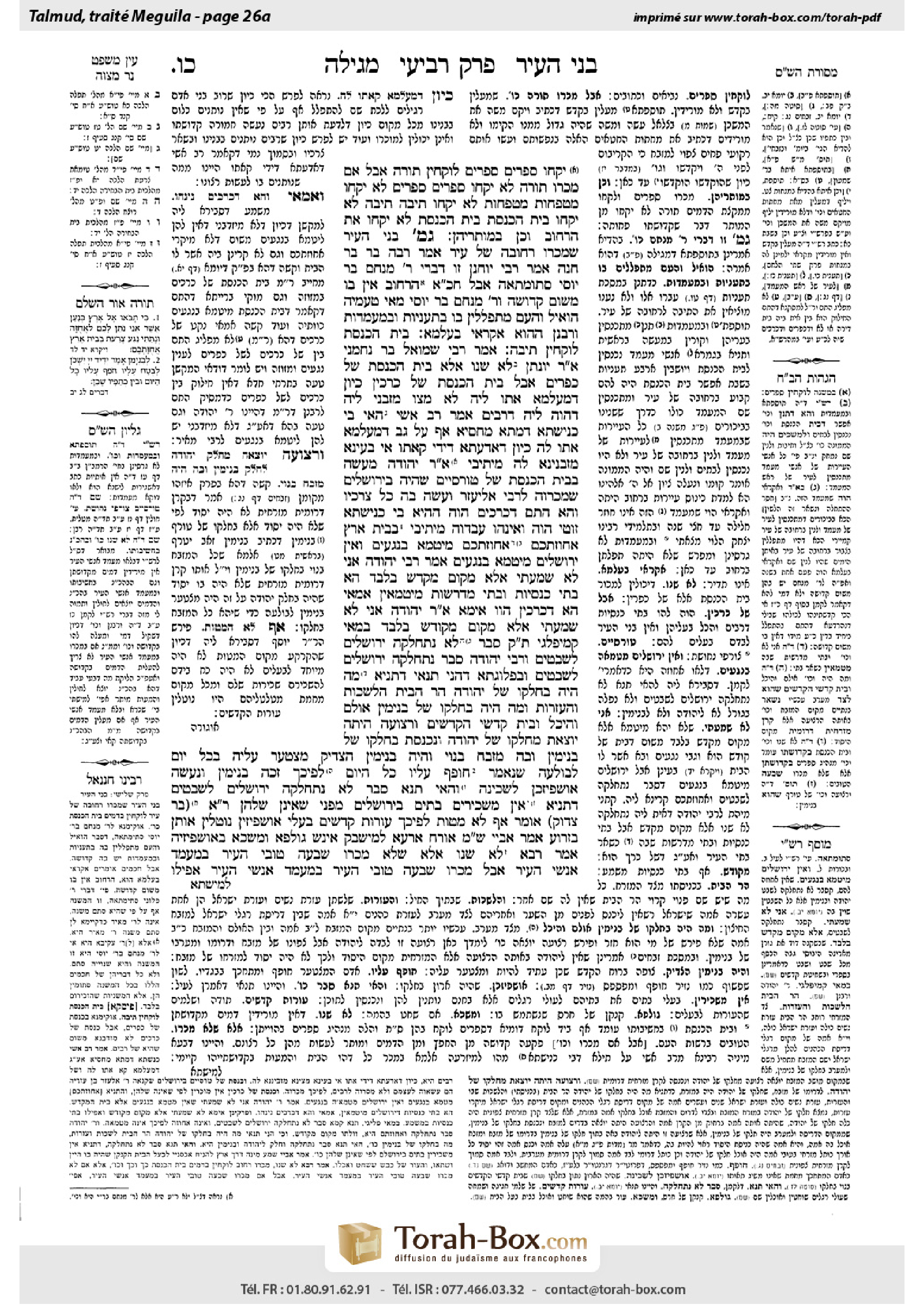
This page of Megillah includes the Aramaic text, an English translation and an AI-generated French translation, alongside the scan above.
מגילה כ״ו א · Aramaic and Hebrew text
יִקְחוּ סְפָרִים. סְפָרִים — לוֹקְחִין תּוֹרָה.
אֲבָל אִם מָכְרוּ תּוֹרָה — לֹא יִקְחוּ סְפָרִים. סְפָרִים — לֹא יִקְחוּ מִטְפָּחוֹת. מִטְפָּחוֹת — לֹא יִקְחוּ תֵּיבָה. תֵּיבָה — לֹא יִקְחוּ בֵּית הַכְּנֶסֶת. בֵּית הַכְּנֶסֶת — לֹא יִקְחוּ אֶת הָרְחוֹב.
וְכֵן בְּמוֹתְרֵיהֶן.
גְּמָ׳ בְּנֵי הָעִיר שֶׁמָּכְרוּ רְחוֹבָהּ שֶׁל עִיר. אָמַר רַבָּה בַּר בַּר חָנָה אָמַר רַבִּי יוֹחָנָן: זוֹ דִּבְרֵי רַבִּי מְנַחֵם בַּר יוֹסֵי סְתִומְתָּאָה, אֲבָל חֲכָמִים אוֹמְרִים: הָרְחוֹב אֵין בּוֹ מִשּׁוּם קְדוּשָּׁה.
וְרַבִּי מְנַחֵם בַּר יוֹסֵי, מַאי טַעְמֵיהּ? הוֹאִיל וְהָעָם מִתְפַּלְּלִין בּוֹ בְּתַעֲנִיּוֹת וּבְמַעֲמָדוֹת. וְרַבָּנַן — הַהוּא אַקְרַאי בְּעָלְמָא.
בֵּית הַכְּנֶסֶת — לוֹקְחִין תֵּיבָה. אָמַר רַבִּי שְׁמוּאֵל בַּר נַחְמָנִי אָמַר רַבִּי יוֹנָתָן: לֹא שָׁנוּ אֶלָּא בֵּית הַכְּנֶסֶת שֶׁל כְּפָרִים, אֲבָל בֵּית הַכְּנֶסֶת שֶׁל כְּרַכִּין, כֵּיוָן דְּמֵעָלְמָא אָתוּ לֵיהּ — לָא מָצוּ מְזַבְּנִי לֵיהּ, דְּהָוֵה לֵיהּ דְּרַבִּים.
אָמַר רַב אָשֵׁי: הַאי בֵּי כְנִישְׁתָּא דְּמָתָא מַחְסֵיָא, אַף עַל גַּב דְּמֵעָלְמָא אָתוּ לַהּ, כֵּיוָן דְּאַדַּעְתָּא דִּידִי קָאָתוּ — אִי בָּעֵינָא מְזַבֵּינְנָא לַהּ.
מֵיתִיבִי, אָמַר רַבִּי יְהוּדָה: מַעֲשֶׂה בְּבֵית הַכְּנֶסֶת שֶׁל טוּרְסִיִּים שֶׁהָיָה בִּירוּשָׁלַיִם שֶׁמְּכָרוּהָ לְרַבִּי אֱלִיעֶזֶר וְעָשָׂה בָּהּ כׇּל צְרָכָיו, וְהָא הָתָם דִּכְרַכִּים הֲוָה! הָהִיא, בֵּי כְנִישְׁתָּא זוּטֵי הֲוָה, וְאִינְהוּ עַבְדוּהּ.
מֵיתִיבִי: ״בְּבֵית אֶרֶץ אֲחוּזַּתְכֶם״, אֲחוּזַּתְכֶם מִיטַּמָּא בִּנְגָעִים, וְאֵין יְרוּשָׁלָיִם מִיטַּמָּא בִּנְגָעִים. אָמַר רַבִּי יְהוּדָה: אֲנִי לֹא שָׁמַעְתִּי אֶלָּא מְקוֹם מִקְדָּשׁ בִּלְבַד.
הָא בָּתֵּי כְנֵסִיּוֹת וּבָתֵּי מִדְרָשׁוֹת מִיטַּמְּאִין, אַמַּאי? הָא דִּכְרַכִּין הָווּ! אֵימָא, אָמַר רַבִּי יְהוּדָה: אֲנִי לֹא שָׁמַעְתִּי אֶלָּא מְקוֹם מְקוּדָּשׁ בִּלְבַד.
בְּמַאי קָמִיפַּלְגִי? תַּנָּא קַמָּא סָבַר: לֹא נִתְחַלְּקָה יְרוּשָׁלַיִם לִשְׁבָטִים, וְרַבִּי יְהוּדָה סָבַר: נִתְחַלְּקָה יְרוּשָׁלַיִם לִשְׁבָטִים.
וּבִפְלוּגְתָּא דְהָנֵי תַנָּאֵי.
דְּתַנְיָא: מָה הָיָה בְּחֶלְקוֹ שֶׁל יְהוּדָה — הַר הַבַּיִת, הַלְּשָׁכוֹת, וְהָעֲזָרוֹת. וּמָה הָיָה בְּחֶלְקוֹ שֶׁל בִּנְיָמִין — אוּלָם, וְהֵיכָל, וּבֵית קׇדְשֵׁי הַקֳּדָשִׁים.
וּרְצוּעָה הָיְתָה יוֹצֵאת מֵחֶלְקוֹ שֶׁל יְהוּדָה וְנִכְנֶסֶת בְּחֶלְקוֹ שֶׁל בִּנְיָמִין, וּבָהּ מִזְבֵּחַ בָּנוּי, וְהָיָה בִּנְיָמִין הַצַּדִּיק מִצְטַעֵר עָלֶיהָ בְּכׇל יוֹם לְבוֹלְעָהּ, שֶׁנֶּאֱמַר: ״חוֹפֵף עָלָיו כׇּל הַיּוֹם״, לְפִיכָךְ זָכָה בִּנְיָמִין וְנַעֲשָׂה אוּשְׁפִּיזְכָן לַשְּׁכִינָה.
וְהַאי תַּנָּא סָבַר לֹא נִתְחַלְּקָה יְרוּשָׁלַיִם לִשְׁבָטִים. דְּתַנְיָא: אֵין מַשְׂכִּירִים בָּתִּים בִּירוּשָׁלַיִם, מִפְּנֵי שֶׁאֵינָן שֶׁלָּהֶן. רַבִּי אֶלְעָזָר (בַּר צָדוֹק) אוֹמֵר: אַף לֹא מִטּוֹת. לְפִיכָךְ, עוֹרוֹת קָדָשִׁים — בַּעֲלֵי אוּשְׁפִּיזִין נוֹטְלִין אוֹתָן בִּזְרוֹעַ.
אָמַר אַבָּיֵי: שְׁמַע מִינַּהּ אוֹרַח אַרְעָא לְמִישְׁבַּק אִינָשׁ גּוּלְפָּא וּמַשְׁכָּא בְּאוּשְׁפִּיזֵיהּ.
אָמַר רָבָא: לֹא שָׁנוּ אֶלָּא שֶׁלֹּא מָכְרוּ שִׁבְעָה טוֹבֵי הָעִיר בְּמַעֲמַד אַנְשֵׁי הָעִיר, אֲבָל מָכְרוּ שִׁבְעָה טוֹבֵי הָעִיר בְּמַעֲמַד אַנְשֵׁי הָעִיר, אֲפִילּוּ
Megillah 26a · English translation
they may purchase scrolls of the Prophets and the Writings. If they sold scrolls of the Prophets and Writings, they may purchase a Torah scroll.
However, the proceeds of a sale of a sacred item may not be used to purchase an item of a lesser degree of sanctity. Therefore, if they sold a Torah scroll, they may not use the proceeds to purchase scrolls of the Prophets and the Writings. If they sold scrolls of the Prophets and Writings, they may not purchase wrapping cloths. If they sold wrapping cloths, they may not purchase an ark. If they sold an ark, they may not purchase a synagogue. If they sold a synagogue, they may not purchase a town square.
And similarly, the same limitation applies to any surplus funds from the sale of sacred items, i.e., if after selling an item and purchasing something of a greater degree of sanctity there remain additional, unused funds, the leftover funds are subject to the same principle and may be used to purchase only something of a degree of sanctity greater than that of the original item.
GEMARA: The mishna states: Residents of a town who sold the town square may purchase a synagogue with the proceeds. Concerning this mishna, Rabba bar bar Ḥana said that Rabbi Yoḥanan said: This is the statement of Rabbi Menaḥem bar Yosei, cited unattributed. However, the Rabbis say: The town square does not have any sanctity. Therefore, if it is sold, the residents may use the money from the sale for any purpose.
And Rabbi Menaḥem bar Yosei, what is his reason for claiming that the town square has sanctity? Since the people pray in the town square on communal fast days and on non-priestly watches, it is defined as a place of prayer and as such has sanctity. And the Rabbis, why do they disagree? They maintain that use of the town square is merely an irregular occurrence. Consequently, the town square is not to be defined as a place of prayer, and so it has no sanctity.
§ The mishna states: If they sold a synagogue, they may purchase an ark. The Gemara cites a qualification to this halakha: Rabbi Shmuel bar Naḥmani said that Rabbi Yonatan said: They taught this only with regard to a synagogue of a village, which is considered the property of the residents of that village. However, with regard to a synagogue of a city, since people come to it from the outside world, the residents of the city are not able to sell it, because it is considered to be the property of the public at large and does not belong exclusively to the residents of the city.
Rav Ashi said: This synagogue of Mata Meḥasya, although people from the outside world come to it, since they come at my discretion, as I established it, and everything is done there in accordance with my directives, if I wish, I can sell it.
The Gemara raises an objection to Rabbi Shmuel bar Naḥmani’s statement, from a baraita: Rabbi Yehuda said: There was an incident involving a synagogue of bronze workers [tursiyyim] that was in Jerusalem, which they sold to Rabbi Eliezer, and he used it for all his own needs. The Gemara asks: But wasn’t the synagogue there one of cities, as Jerusalem is certainly classified as a city; why were they permitted to sell it? The Gemara explains: That one was a small synagogue, and it was the bronze workers themselves who built it. Therefore, it was considered exclusively theirs, and they were permitted to sell it.
The Gemara raises an objection from another baraita: The verse states with regard to leprosy of houses: “And I put the plague of leprosy in a house of the land of your possession” (Leviticus 14:34), from which it may be inferred: “Your possession,” i.e., a privately owned house, can become ritually impure with leprosy, but a house in Jerusalem cannot become ritually impure with leprosy, as property there belongs collectively to the Jewish people and is not privately owned. Rabbi Yehuda said: I heard this distinction stated only with regard to the site of the Temple alone, but not with regard to the entire city of Jerusalem.
The Gemara explains: From Rabbi Yehuda’s statement, it is apparent that only the site of the Temple cannot become ritually impure, but synagogues and study halls in Jerusalem can become ritually impure. Why should this be true given that they are owned by the city? The Gemara answers: Emend the baraita and say as follows: Rabbi Yehuda said: I heard this distinction stated only with regard to a sacred site, which includes the Temple, synagogues, and study halls.
With regard to what principle do the first tanna and Rabbi Yehuda disagree? The first tanna holds that Jerusalem was not apportioned to the tribes, i.e., it was never assigned to any particular tribe, but rather it belongs collectively to the entire nation. And Rabbi Yehuda holds: Jerusalem was apportioned to the tribes, and it is only the site of the Temple itself that belongs collectively to the entire nation.
The Gemara notes: They each follow a different opinion in the dispute between these tanna’im:
One tanna holds that Jerusalem was apportioned to the tribes, as it is taught in a baraita: What part of the Temple was in the tribal portion of Judah? The Temple mount, the Temple chambers, and the Temple courtyards. And what was in the tribal portion of Benjamin? The Entrance Hall, the Sanctuary, and the Holy of Holies.
And a strip of land issued forth from the portion of Judah and entered into the portion of Benjamin, and upon that strip the altar was built, and the tribe of Benjamin, the righteous, would agonize over it every day desiring to absorb it into its portion, due to its unique sanctity, as it is stated in Moses’ blessing to Benjamin: “He covers it throughout the day, and he dwells between his shoulders” (Deuteronomy 33:12). The phrase “covers it” is understood to mean that Benjamin is continually focused upon that site. Therefore, Benjamin was privileged by becoming the host [ushpizekhan] of the Divine Presence, as the Holy of Holies was built in his portion.
And this other tanna holds that Jerusalem was not apportioned to the tribes, as it is taught in a baraita: One may not rent out houses in Jerusalem, due to the fact that the houses do not belong to those occupying them. Rather, as is true for the entire city, they are owned collectively by the nation. Rabbi Elazar bar Tzadok says: Even beds may not be hired out. Therefore, in the case of the hides of the renter’s offerings that the innkeepers take in lieu of payment, the innkeepers are considered to be taking them by force, as they did not have a right to demand payment.
Apropos the topic of inns, the Gemara reports: Abaye said: Learn from this baraita that it is proper etiquette for a person to leave his wine flask and the hide of the animal that he slaughtered at his inn, i.e., the inn where he stayed, as a gift for the service he received.
§ The Gemara returns its discussion of the mishna: Rava said: They taught that there is a limitation on what may be purchased with the proceeds of the sale of a synagogue only when the seven representatives of the town who were appointed to administer the town’s affairs had not sold the synagogue in an assembly of the residents of the town. However, if the seven representatives of the town had sold it in an assembly of the residents of the town, then even
Megillah 26a · Traduction française (IA)
ils peuvent acheter des rouleaux des Prophètes et des Écrits. S’ils ont vendu des rouleaux des Prophètes et des Écrits, ils peuvent acheter un rouleau de la Torah.
Cependant, le produit de la vente d’un objet sacré ne peut pas servir à acheter un objet d’un degré de sainteté inférieur. Ainsi, s’ils ont vendu un rouleau de la Torah, ils ne peuvent pas utiliser le produit de la vente pour acheter des rouleaux des Prophètes et des Écrits. S’ils ont vendu des rouleaux des Prophètes et des Écrits, ils ne peuvent pas acheter des étoffes d’enveloppement. S’ils ont vendu des étoffes d’enveloppement, ils ne peuvent pas acheter une arche. S’ils ont vendu une arche, ils ne peuvent pas acheter une synagogue. S’ils ont vendu une synagogue, ils ne peuvent pas acheter une place publique.
De même, la même restriction s’applique à tout excédent provenant de la vente d’objets sacrés : si, après avoir vendu un objet et acheté quelque chose d’un degré de sainteté supérieur, il reste des fonds inutilisés, ceux-ci sont soumis au même principe et ne peuvent servir qu’à acheter un objet dont le degré de sainteté est supérieur à celui de l’objet initial.
GUEMARA : La Michna enseigne : Les habitants d’une ville qui ont vendu la place publique peuvent acheter une synagogue avec le produit de la vente. À propos de cette Michna, Rabba bar bar Ḥana a dit que Rabbi Yoḥanan a dit : C’est l’opinion de Rabbi Menaḥem bar Yosei, citée sans attribution. Mais les Sages disent : La place publique n’a aucune sainteté. Par conséquent, si elle est vendue, les habitants peuvent utiliser le produit de la vente à n’importe quelle fin.
Et quelle est la raison de Rabbi Menaḥem bar Yosei, qui affirme que la place publique possède une sainteté ? Puisque les gens y prient lors des jeûnes communautaires et des gardes non sacerdotales, elle est considérée comme un lieu de prière et possède donc une sainteté. Et pourquoi les Sages sont-ils en désaccord ? Ils estiment que l’utilisation de la place publique n’est qu’occasionnelle. Par conséquent, la place publique ne doit pas être considérée comme un lieu de prière et ne possède donc aucune sainteté.
§ La Michna enseigne : S’ils ont vendu une synagogue, ils peuvent acheter une arche. La Guemara apporte une précision à cette halakha : Rabbi Shmuel bar Naḥmani a dit que Rabbi Yonatan a dit : Ils n’ont enseigné cela qu’à propos d’une synagogue de village, considérée comme appartenant aux habitants de ce village. En revanche, s’agissant d’une synagogue de ville, puisque des gens viennent de l’extérieur, les habitants de la ville ne peuvent pas la vendre, car elle est considérée comme appartenant à l’ensemble du public et non exclusivement aux habitants de la ville.
Rav Ashi a dit : Cette synagogue de Mata Meḥasya, bien que des gens venant de l’extérieur s’y rendent, puisque ces gens viennent à ma discrétion, car c’est moi qui l’ai fondée et que tout s’y fait selon mes directives, je peux la vendre si je le souhaite.
La Guemara soulève une objection à l’affirmation de Rabbi Shmuel bar Naḥmani à partir d’une baraïta : Rabbi Yehuda a dit : Il est arrivé qu’une synagogue des bronziers [tursiyyim], à Jérusalem, soit vendue à Rabbi Eliezer, qui l’utilisa pour tous ses besoins personnels. La Guemara demande : Mais cette synagogue ne se trouvait-elle pas dans une ville, puisque Jérusalem est certainement considérée comme une ville ? Pourquoi ont-ils eu le droit de la vendre ? La Guemara explique : C’était une petite synagogue, que les bronziers eux-mêmes avaient construite. Elle était donc considérée comme leur appartenant exclusivement, et ils avaient le droit de la vendre.
La Guemara soulève une objection à partir d’une autre baraïta : À propos de la lèpre des maisons, le verset dit : « Et Je mettrai une plaie de lèpre dans une maison du pays que vous possédez » (Lévitique 14:34). On peut en déduire que « votre possession », c’est-à-dire une maison privée, peut devenir impure du fait de la lèpre, mais qu’une maison à Jérusalem ne peut pas devenir impure du fait de la lèpre, car les biens qui s’y trouvent appartiennent collectivement au peuple juif et ne sont pas des propriétés privées. Rabbi Yehuda a dit : Je n’ai entendu énoncer cette distinction que pour le seul emplacement du Temple, et non pour toute la ville de Jérusalem.
La Guemara explique : Il ressort de la déclaration de Rabbi Yehuda que seul l’emplacement du Temple ne peut pas devenir impur, tandis que les synagogues et les maisons d’étude de Jérusalem peuvent devenir impures. Pourquoi en serait-il ainsi, puisqu’elles appartiennent à la ville ? La Guemara répond : Corrige la baraïta et dis plutôt : Rabbi Yehuda a dit : Je n’ai entendu énoncer cette distinction que pour un lieu sacré, ce qui inclut le Temple, les synagogues et les maisons d’étude.
Sur quel principe le premier tanna et Rabbi Yehuda sont-ils en désaccord ? Le premier tanna estime que Jérusalem n’a pas été attribuée aux tribus, c’est-à-dire qu’elle n’a jamais été assignée à une tribu particulière, mais qu’elle appartient collectivement à toute la nation. Rabbi Yehuda, lui, estime que Jérusalem a été attribuée aux tribus et que seul l’emplacement même du Temple appartient collectivement à toute la nation.
La Guemara relève : Chacun d’eux suit une opinion différente dans le débat entre ces tannaïm :
Un tanna estime que Jérusalem a été attribuée aux tribus, comme il est enseigné dans une baraïta : Quelle partie du Temple se trouvait dans le territoire de la tribu de Yehuda ? Le mont du Temple, les salles du Temple et les cours du Temple. Et qu’est-ce qui se trouvait dans le territoire de la tribu de Benjamin ? Le Vestibule, le Sanctuaire et le Saint des Saints.
Une bande de terre sortait du territoire de Yehuda et pénétrait dans celui de Benjamin ; l’autel fut construit sur cette bande. La tribu de Benjamin, le juste, en souffrait chaque jour, désirant l’intégrer à son territoire en raison de sa sainteté particulière, comme il est dit dans la bénédiction de Moïse à Benjamin : « Il le couvre tout le jour, et il demeure entre ses épaules » (Deutéronome 33:12). L’expression « il le couvre » est comprise comme signifiant que Benjamin porte constamment son attention sur cet endroit. Ainsi, Benjamin eut le mérite d’être l’hôte [ushpizekhan] de la Présence divine, car le Saint des Saints fut construit sur son territoire.
Et cet autre tanna estime que Jérusalem n’a pas été attribuée aux tribus, comme il est enseigné dans une baraïta : On ne peut pas louer de maisons à Jérusalem, car elles n’appartiennent pas à ceux qui les occupent. Au contraire, comme toute la ville, elles appartiennent collectivement à la nation. Rabbi Elazar bar Tzadok dit : On ne peut même pas louer de lits. Par conséquent, dans le cas des peaux des animaux offerts en sacrifice par les locataires, que les aubergistes prennent en guise de paiement, les aubergistes sont considérés comme les prenant de force, puisqu’ils n’avaient pas le droit d’exiger un paiement.
À propos des auberges, la Guemara rapporte : Abaye a dit : Apprends de cette baraïta qu’il convient, par bienséance, qu’une personne laisse à l’auberge où elle a séjourné sa gourde de vin et la peau de l’animal qu’elle a abattu, en cadeau pour les services qu’elle a reçus.
§ La Guemara reprend sa discussion de la Michna : Rava a dit : Ils n’ont enseigné qu’il existe une restriction concernant les achats permis avec le produit de la vente d’une synagogue que lorsque les sept représentants de la ville, nommés pour administrer ses affaires, n’ont pas vendu la synagogue lors d’une assemblée des habitants de la ville. Mais si les sept représentants de la ville l’ont vendue lors d’une assemblée des habitants de la ville, alors même
Traduction française générée par IA à partir de l’édition anglaise de Sefaria. Vérifie toujours un passage avec le texte source.
Text from Sefaria: William Davidson Edition - Vocalized Aramaic (CC BY NC); William Davidson Edition - English (CC BY NC).