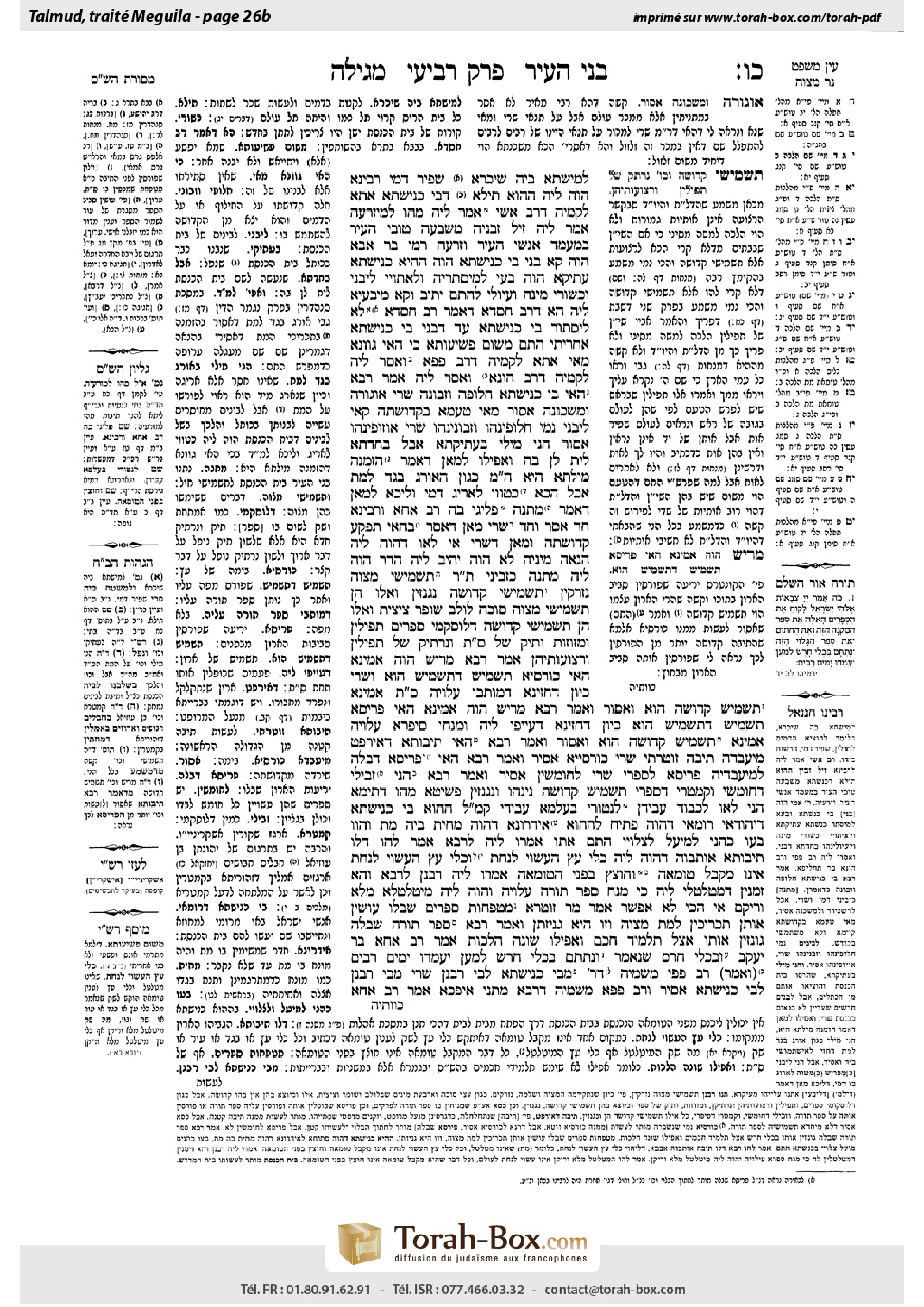
Megillah 26b: Talmud study for Daf Yomi
Daf Yomi is the daily study of one Talmud folio. Explore 37 tractates with scans, Hebrew text, Sefaria English and AI-generated French translations where annotated.
Passage selection and English or AI-generated French translation are available where the scan has annotations. Daf Study is independent of Torah-Box and Sefaria.
Browse Megillah · מגילה · All tractatesMegillah 26b text and translations
This page of Megillah includes the Aramaic text, an English translation and an AI-generated French translation, alongside the scan above.
מגילה כ״ו ב · Aramaic and Hebrew text
לְמִישְׁתֵּא בֵּיהּ שִׁיכְרָא — שַׁפִּיר דָּמֵי.
רָבִינָא הֲוָה לֵיהּ הָהוּא תִּילָּא דְּבֵי כְנִישְׁתָּא. אֲתָא לְקַמֵּיהּ דְּרַב אָשֵׁי, אֲמַר לֵיהּ: מַהוּ לְמִיזְרְעֵהּ? אֲמַר לֵיהּ: זִיל זַבְנֵיהּ מִשִּׁבְעָה טוֹבֵי הָעִיר בְּמַעֲמַד אַנְשֵׁי הָעִיר, וְזַרְעֵהּ.
רָמֵי בַּר אַבָּא הֲוָה קָא בָנֵי בֵּי כְנִישְׁתָּא. הֲוָה הָהִיא כְּנִישְׁתָּא עַתִּיקָא, הֲוָה בָּעֵי לְמִיסְתְּרַיהּ וּלְאֵתוֹיֵי לִיבְנֵי וּכְשׁוּרֵי מִינַּהּ וְעַיּוֹלֵי לְהָתָם. יָתֵיב וְקָא מִיבַּעְיָא לֵיהּ הָא דְּרַב חִסְדָּא, דְּאָמַר רַב חִסְדָּא: לָא לִיסְתּוֹר בֵּי כְנִישְׁתָּא עַד דְּבָנֵי בֵּי כְנִישְׁתָּא אַחֲרִיתִי — הָתָם מִשּׁוּם פְּשִׁיעוּתָא, כִּי הַאי גַוְונָא מַאי? אֲתָא לְקַמֵּיהּ דְּרַב פָּפָּא וַאֲסַר לֵיהּ. לְקַמֵּיהּ דְּרַב הוּנָא וַאֲסַר לֵיהּ.
אָמַר רָבָא: הַאי בֵּי כְנִישְׁתָּא, חַלּוֹפַהּ וְזַבּוֹנַהּ — שְׁרֵי, אוֹגוֹרַהּ וּמַשְׁכּוֹנַהּ — אֲסִיר. מַאי טַעְמָא: בִּקְדוּשְׁתַּהּ קָאֵי.
לִיבְנֵי נָמֵי, חַלּוֹפִינְהוּ וְזַבּוֹנִינְהוּ — שְׁרֵי, אוֹזוֹפִינְהוּ — אֲסִיר. הָנֵי מִילֵּי בְּעַתִּיקָתָא, אֲבָל בְּחַדְתָּ[תָ]א — לֵית לַן בַּהּ.
וַאֲפִילּוּ לְמַאן דְּאָמַר הַזְמָנָה מִילְּתָא הִיא, הָנֵי מִילֵּי כְּגוֹן הָאוֹרֵג בֶּגֶד לַמֵּת. אֲבָל הָכָא, כְּטָווּי לְאָרִיג דָּמֵי, וְלֵיכָּא לְמַאן דְּאָמַר.
מַתָּנָה, פְּלִיגִי בַּהּ רַב אַחָא וְרָבִינָא, חַד אָסַר, וְחַד שָׁרֵי. מַאן דְּאָסַר: בְּמַאי תִּפְקַע קְדוּשְׁתַּהּ?! וּמַאן דְּשָׁרֵי: אִי לָאו דַּהֲוָה לֵיהּ הֲנָאָה מִינֵּיהּ — לָא הֲוָה יָהֵיב לֵיהּ, הֲדַר הָוֵה לַיהּ מַתָּנָה כִּזְבִינֵי.
תָּנוּ רַבָּנַן: תַּשְׁמִישֵׁי מִצְוָה — נִזְרָקִין. תַּשְׁמִישֵׁי קְדוּשָּׁה — נִגְנָזִין. וְאֵלּוּ הֵן תַּשְׁמִישֵׁי מִצְוָה: סוּכָּה, לוּלָב, שׁוֹפָר, צִיצִית. וְאֵלּוּ הֵן תַּשְׁמִישֵׁי קְדוּשָּׁה: דְּלוֹסְקְמֵי סְפָרִים, תְּפִילִּין וּמְזוּזוֹת, וְתִיק שֶׁל סֵפֶר תּוֹרָה, וְנַרְתִּיק שֶׁל תְּפִילִּין וּרְצוּעוֹתֵיהֶן.
אָמַר רָבָא, מֵרֵישׁ הֲוָה אָמֵינָא: הַאי כּוּרְסְיָא, תַּשְׁמִישׁ דְּתַשְׁמִישׁ הוּא, וּשְׁרֵי. כֵּיוָן דַּחֲזֵינָא דְּמוֹתְבִי עִלָּוֵיהּ סֵפֶר תּוֹרָה, אָמֵינָא: תַּשְׁמִישׁ קְדוּשָּׁה הוּא, וַאֲסִיר.
וְאָמַר רָבָא, מֵרֵישׁ הֲוָה אָמֵינָא: הַאי פְּרִיסָא, תַּשְׁמִישׁ דְּתַשְׁמִישׁ הוּא. כֵּיוָן דַּחֲזֵינָא דְּעָיְיפִי לֵיהּ וּמַנְּחִי סִיפְרָא עִלָּוֵיהּ, אָמֵינָא: תַּשְׁמִישׁ קְדוּשָּׁה הוּא, וַאֲסִיר.
וְאָמַר רָבָא: הַאי תֵּיבוּתָא דְּאִירְפַט, מִיעְבְּדַהּ תֵּיבָה זוּטַרְתִּי — שְׁרֵי, כּוּרְסְיָיא — אֲסִיר. וְאָמַר רָבָא: הַאי פְּרִיסָא דִּבְלָה, לְמִיעְבְּדֵיהּ פְּרִיסָא לְסִפְרֵי — שְׁרֵי, לְחוּמְשִׁין — אֲסִיר.
וְאָמַר רָבָא: הָנֵי זְבִילֵי דְחוּמָּשֵׁי וְקַמְטְרֵי דְסִפְרֵי — תַּשְׁמִישׁ קְדוּשָּׁה נִינְהוּ, וְנִגְנָזִין. פְּשִׁיטָא! מַהוּ דְּתֵימָא: הָנֵי לָאו לְכָבוֹד עֲבִידָן, לְנַטּוֹרֵי בְּעָלְמָא עֲבִידִי, קָא מַשְׁמַע לַן.
הָהוּא בֵּי כְנִישְׁתָּא (דִּיהוּדָאֵי) [דְּ]רוֹמָאֵי דַּהֲוָה פְּתִיחַ לְהָהוּא אִידְּרוֹנָא דַּהֲוָה מַחֵית בֵּיהּ מֵת, וַהֲווֹ בָּעוּ כָּהֲנֵי לְמֵיעַל לְצַלּוֹיֵי הָתָם. אֲתוֹ, אֲמַרוּ לֵיהּ לְרָבָא. אֲמַר לְהוּ: דַּלּוֹ תֵּיבוּתָא אוֹתְבוּהָ, דְּהָוֵה לֵיהּ כְּלִי עֵץ הֶעָשׂוּי לְנַחַת, וּכְלִי עֵץ הֶעָשׂוּי לְנַחַת אֵינוֹ מְקַבֵּל טוּמְאָה וְחוֹצֵץ בִּפְנֵי הַטּוּמְאָה.
אֲמַרוּ לֵיהּ רַבָּנַן לְרָבָא: וְהָא זִמְנִין דִּמְטַלְטְלִי לֵיהּ כִּי מַנַּח סֵפֶר תּוֹרָה עִלָּוֵיהּ, וְהָוֵה לֵיהּ מִיטַּלְטֵל מָלֵא וְרֵיקָם! אִי הָכִי לָא אֶפְשָׁר.
אָמַר מָר זוּטְרָא: מִטְפְּחוֹת סְפָרִים שֶׁבָּלוּ — עוֹשִׂין אוֹתָן תַּכְרִיכִין לְמֵת מִצְוָה, וְזוֹ הִיא גְּנִיזָתָן.
וְאָמַר רָבָא: סֵפֶר תּוֹרָה שֶׁבָּלָה — גּוֹנְזִין אוֹתוֹ אֵצֶל תַּלְמִיד חָכָם, וַאֲפִילּוּ שׁוֹנֶה הֲלָכוֹת. אָמַר רַב אַחָא בַּר יַעֲקֹב: וּבִכְלִי חֶרֶס, שֶׁנֶּאֱמַר: ״וּנְתַתָּם בִּכְלִי חָרֶשׂ לְמַעַן יַעַמְדוּ יָמִים רַבִּים״.
(וְאָמַר) רַב פַּפִּי מִשְּׁמֵיהּ דְּרָבָא: מִבֵּי כְנִישְׁתָּא לְבֵי רַבָּנַן — שְׁרֵי, מִבֵּי רַבָּנַן לְבֵי כְנִישְׁתָּא — אֲסִיר. וְרַב פָּפָּא מִשְּׁמֵיהּ דְּרָבָא מַתְנִי אִיפְּכָא. אָמַר רַב אַחָא:
Megillah 26b · English translation
to drink beer with the proceeds seems well and is permitted. The seven representatives have the authority to annul the sanctity of the synagogue, and therefore the proceeds of its sale do not retain any sanctity.
The Gemara relates: Ravina had a certain piece of land on which stood a mound of the ruins of a synagogue. He came before Rav Ashi and said to him: What is the halakha with regard to sowing the land? He said to him: Go, purchase it from the seven representatives of the town in an assembly of the residents of the town, and then you may sow it.
Rami bar Abba was once building a synagogue. There was a certain old synagogue that he wished to demolish, and bring bricks and beams from it, and bring them to there, to construct a new synagogue. He sat and considered that which Rav Ḥisda said, as Rav Ḥisda said: One should not demolish a synagogue until one has built another synagogue. Rami bar Abba reasoned that Rav Ḥisda’s ruling there is due to a concern of negligence, as perhaps after the first synagogue is demolished, people will be negligent and a new one will never be built. However, in a case like this, where the new synagogue is to be built directly from the materials of the old one, what is the halakha? He came before Rav Pappa to ask his opinion, and he prohibited him from doing so. He then came before Rav Huna, and he also prohibited him from doing so.
Rava said: With regard to this synagogue, exchanging it for a different building or selling it for money is permitted, but renting it out or mortgaging it is prohibited. What is the reason for this? When a synagogue is rented out or mortgaged, it remains in its sacred state. Therefore, it is prohibited to rent it out or mortgage it, because it will then be used for a non-sacred purpose. However, if it is exchanged or sold, its sanctity is transferred to the other building or to the proceeds of the sale, and therefore the old synagogue building may be used for any purpose.
The same halakha is also true of the bricks of a synagogue; exchanging them or selling them is permitted, but renting them out is prohibited. The Gemara comments: This applies to old bricks that have already been part of a synagogue, but as for new bricks that have only been designated to be used in a synagogue, we have no problem with it if they are rented out for a non-sacred purpose.
And even according to the one who said that mere designation is significant, i.e., although a certain object was not yet used for the designated purpose, the halakhic ramifications of using it for that purpose already take hold, this applies only in a case where it was created from the outset for that purpose, for example, one who weaves a garment to be used as shrouds for a corpse. However, here the bricks are comparable to already spun thread that was then designated to be used to weave burial shrouds. Concerning such designation, where nothing was specifically created for the designated purpose, there is no one who said that the designation is significant.
Rav Aḥa and Ravina disagree about whether it is permitted to give away a synagogue as a gift to then be used for a non-sacred purpose. One of them prohibited it, and the other one permitted it. The one who prohibits it says: Is it possible that with this act of giving alone its sanctity is removed? This cannot be the case. Since the synagogue was not exchanged for anything else, there is nothing to which the sanctity may be transferred. Consequently, the synagogue remains sacred. And the one who permitted it does so because he reasons that if the donor did not receive any benefit from giving the synagogue, he would not have given it. Therefore, the gift has reverted to being like a sale, and the sanctity is transferred to the benefit received.
§ The Sages taught in a baraita: Articles used in the performance of a mitzva may be thrown out after use. Although these items were used in the performance of a mitzva, they are not thereby sanctified. However, articles associated with the sanctity of God’s name, i.e. articles on which God’s name is written, and articles that serve an article that has God’s name written on it, even after they are no longer used, must be interred in a respectful manner. And these items are considered articles of a mitzva: A sukka; a lulav; a shofar; and ritual fringes. And these items are considered articles of sanctity: Cases of scrolls, i.e. of Torah scrolls; phylacteries; and mezuzot; and a container for a Torah scroll; and a cover for phylacteries; and their straps.
Rava said: Initially, I used to say that this lectern in the synagogue upon which the Torah is read is only an article of an article of sanctity, as the Torah scroll does not rest directly upon the lectern but rather upon the cloth that covers it. And the halakha is that once an article of an article of sanctity is no longer used, it is permitted to throw it out. However, once I saw that the Torah scroll is sometimes placed directly upon the lectern without an intervening cloth. I said that it is an article used directly for items of sanctity, and as such it is prohibited to simply discard it after use.
And Rava similarly said: Initially, I used to say that this curtain, which is placed at the opening to the ark as a decoration, is only an article of an article of sanctity, as it serves to beautify the ark but is not directly used for the Torah scroll. However, once I saw that sometimes the curtain is folded over and a Torah scroll is placed upon it. I said that it is an article used directly for items of sanctity and as such it is prohibited to simply discard it after use.
And Rava further said: With regard to this ark that has fallen apart, constructing a smaller ark from its materials is permitted, as both have the same level of sanctity, but to use the materials to construct a lectern is prohibited because the lectern has a lesser degree of sanctity. And Rava similarly said: With regard to this curtain used to decorate an ark that has become worn out, to fashion it into a wrapping cloth for Torah scrolls is permitted, but to fashion it into a wrapping cloth for a scroll of one of the five books of the Torah is prohibited.
And Rava also said: With regard to these cases for storing scrolls of one of the five books of the Torah and sacks for storing Torah scrolls, they are classified as articles of sanctity. Therefore, they are to be interred when they are no longer in use. The Gemara asks: Isn’t that obvious? The Gemara answers: Lest you say that since these items are not made for the honor of the scrolls but rather are made merely to provide protection, they should not be classified as articles of sanctity, Rava therefore teaches us that although they are indeed made to protect the scrolls, they also provide honor and are therefore to be classified as articles of sanctity.
The Gemara relates: There was a certain synagogue of the Jews of Rome that opened out into a room in which a corpse was lying, thereby spreading the ritual impurity of the corpse throughout the synagogue. And the priests wished to enter the synagogue in order to pray there. However, it was prohibited for them to do so because a priest may not come in contact with ritual impurity of a corpse. They came and spoke to Rava, about what to do. He said to them: Lift up the ark and put it down in the opening between the two rooms, as it is a wooden utensil that is designated to rest in one place and not be moved from there, and the halakha is that a wooden utensil that is designated to rest is not susceptible to ritual impurity, and therefore it serves as a barrier to prevent ritual impurity from spreading.
The Rabbis said to Rava: But isn’t the ark sometimes moved when a Torah scroll is still resting inside it, and therefore it is a utensil that is moved both when it is full and when it is empty; such a utensil is susceptible to ritual impurity and cannot prevent ritual impurity from spreading. He said to them: If so, if it is as you claim, then it is not possible to remedy the situation.
Mar Zutra said: With regard to wrapping cloths of Torah scrolls that have become worn out, they may be made into shrouds for a corpse with no one to bury it [met mitzva], and this is their most appropriate manner for being interred.
And Rava said: A Torah scroll that became worn out is interred and buried next to a Torah scholar, and in this regard, a Torah scholar is defined even as one who only studies the halakhot in the Mishna and the baraitot but is not proficient in their analysis. Rav Aḥa bar Ya’akov said: And when it is buried, it is first placed in an earthenware vessel, as it is stated: “And put them in an earthenware vessel, that they may last for many days” (Jeremiah 32:14).
§ And Rav Pappi said in the name of Rava: To convert a building from a synagogue into a study hall is permitted, but from a study hall into a synagogue is prohibited, as he holds that a study hall has a higher degree of sanctity than a synagogue. And Rav Pappa in the name of Rava teaches the opposite, as he holds that a synagogue has a higher degree of sanctity than a study hall. Rav Aḥa said:
Megillah 26b · Traduction française (IA)
Boire de la bière avec le produit de la vente semble donc convenable et est permis. Les sept représentants ont le pouvoir de lever la sainteté de la synagogue ; le produit de sa vente ne conserve donc aucune sainteté.
La Guemara rapporte : Ravina possédait un terrain sur lequel se trouvait un monticule de ruines d’une synagogue. Il se présenta devant Rav Ashi et lui demanda : « Quelle est la halakha concernant l’ensemencement de ce terrain ? » Rav Ashi lui répondit : « Va l’acheter aux sept représentants de la ville, lors d’une assemblée des habitants de la ville, et tu pourras ensuite l’ensemencer. »
Rami bar Abba construisait un jour une synagogue. Il y avait une ancienne synagogue qu’il souhaitait démolir, pour en récupérer les briques et les poutres et les transporter sur le site afin d’y bâtir une nouvelle synagogue. Il s’assit et réfléchit à ce qu’avait dit Rav Ḥisda, car Rav Ḥisda avait dit : « On ne doit pas démolir une synagogue avant d’en avoir construit une autre. » Rami bar Abba estima que la décision de Rav Ḥisda s’expliquait par la crainte que les gens fassent preuve de négligence : après la démolition de la première synagogue, ils pourraient négliger les travaux et ne jamais en construire une nouvelle. Mais dans un cas comme celui-ci, où la nouvelle synagogue devait être bâtie directement avec les matériaux de l’ancienne, quelle était la halakha ? Il se présenta devant Rav Pappa pour lui demander son avis, mais celui-ci le lui interdit. Il se présenta ensuite devant Rav Huna, qui le lui interdit également.
Rava dit : Il est permis d’échanger cette synagogue contre un autre bâtiment ou de la vendre contre de l’argent, mais il est interdit de la louer ou de la donner en hypothèque. Pour quelle raison ? Lorsqu’une synagogue est louée ou donnée en hypothèque, elle conserve son statut sacré. Il est donc interdit de la louer ou de la donner en hypothèque, car elle serait alors utilisée à une fin profane. En revanche, si elle est échangée ou vendue, sa sainteté est transférée à l’autre bâtiment ou au produit de la vente ; l’ancien bâtiment de la synagogue peut donc être affecté à n’importe quel usage.
La même halakha s’applique aux briques d’une synagogue : il est permis de les échanger ou de les vendre, mais il est interdit de les louer. La Guemara précise : cela concerne les vieilles briques qui ont déjà fait partie d’une synagogue ; quant aux briques neuves, qui ont seulement été destinées à servir dans une synagogue, il n’y a aucun problème à les louer pour un usage profane.
Même selon celui qui dit que la simple destination a une portée — c’est-à-dire que, bien qu’un objet n’ait pas encore été utilisé à la fin prévue, les conséquences halakhiques liées à cet usage s’appliquent déjà —, cela ne vaut que dans le cas où l’objet a été créé dès le départ à cette fin, par exemple lorsqu’on tisse un vêtement destiné à servir de linceul pour un mort. Mais ici, les briques sont comparables à du fil déjà filé, que l’on a ensuite destiné au tissage de linceuls. À propos d’une telle destination, lorsqu’aucun objet n’a été créé spécialement pour l’usage prévu, personne ne dit que cette destination a une portée.
Rav Aḥa et Ravina sont en désaccord sur la question de savoir s’il est permis de donner une synagogue pour qu’elle soit ensuite utilisée à une fin profane. L’un l’interdit, l’autre le permet. Celui qui l’interdit dit : « Est-il possible que sa sainteté soit levée par ce seul acte de don ? » Cela ne saurait être le cas. Puisque la synagogue n’a pas été échangée contre autre chose, il n’y a rien à quoi transférer sa sainteté. Par conséquent, la synagogue demeure sacrée. Celui qui le permet estime que, si le donateur n’avait tiré aucun avantage de son don, il n’aurait pas donné la synagogue. Le don est donc assimilé à une vente, et la sainteté est transférée à l’avantage reçu.
§ Les Sages ont enseigné dans une baraïta : Les objets servant à l’accomplissement d’une mitsva peuvent être jetés après usage. Bien qu’ils aient servi à l’accomplissement d’une mitsva, ils ne sont pas pour autant sanctifiés. En revanche, les objets associés à la sainteté du nom de Dieu — c’est-à-dire ceux sur lesquels le nom de Dieu est écrit, ainsi que ceux qui servent un objet sur lequel le nom de Dieu est écrit — doivent être enterrés avec respect, même lorsqu’ils ne sont plus utilisés. Voici les objets considérés comme des accessoires de mitsva : la soukka, le loulav, le chofar et les franges rituelles. Voici les objets considérés comme des accessoires de sainteté : les étuis des rouleaux, c’est-à-dire des rouleaux de la Torah ; les tefillin ; les mezouzot ; un étui pour un rouleau de la Torah ; un étui pour les tefillin ; et leurs lanières.
Rava dit : Au début, je pensais que ce lutrin de la synagogue, sur lequel on lit la Torah, n’était qu’un accessoire d’un accessoire de sainteté, puisque le rouleau de la Torah ne repose pas directement sur le lutrin, mais sur le tissu qui le recouvre. Or, la halakha est qu’une fois qu’un accessoire d’un accessoire de sainteté n’est plus utilisé, il est permis de le jeter. Cependant, lorsque j’ai vu qu’il arrivait que le rouleau de la Torah soit posé directement sur le lutrin, sans tissu interposé, j’ai dit qu’il s’agissait d’un accessoire servant directement à un objet de sainteté et qu’il était donc interdit de simplement le jeter après usage.
Rava dit également : Au début, je pensais que ce rideau, placé à l’entrée de l’arche comme décoration, n’était qu’un accessoire d’un accessoire de sainteté, car il embellit l’arche, mais ne sert pas directement au rouleau de la Torah. Cependant, lorsque j’ai vu qu’il arrivait que le rideau soit replié et qu’un rouleau de la Torah soit posé dessus, j’ai dit qu’il s’agissait d’un accessoire servant directement à un objet de sainteté et qu’il était donc interdit de simplement le jeter après usage.
Rava dit encore : Pour cette arche qui s’est désagrégée, il est permis d’utiliser les matériaux pour en construire une plus petite, car les deux ont le même degré de sainteté ; mais il est interdit de les utiliser pour construire un lutrin, car celui-ci a un degré de sainteté inférieur. Rava dit également : Pour ce rideau qui servait à décorer une arche et qui est devenu usé, il est permis d’en faire une étoffe d’enveloppement pour des rouleaux de la Torah, mais il est interdit d’en faire une étoffe d’enveloppement pour un rouleau de l’un des cinq livres de la Torah.
Rava dit aussi : Les étuis destinés à ranger les rouleaux de l’un des cinq livres de la Torah et les sacs destinés à ranger les rouleaux de la Torah sont classés parmi les accessoires de sainteté. Par conséquent, lorsqu’ils ne sont plus utilisés, ils doivent être enterrés. La Guemara demande : « N’est-ce pas évident ? » La Guemara répond : De peur que tu ne dises que, puisque ces objets ne sont pas faits pour honorer les rouleaux, mais seulement pour les protéger, ils ne devraient pas être classés parmi les accessoires de sainteté, Rava nous enseigne que, bien qu’ils soient effectivement destinés à protéger les rouleaux, ils leur rendent également honneur et doivent donc être classés parmi les accessoires de sainteté.
La Guemara rapporte : Une synagogue des Juifs de Rome s’ouvrait sur une pièce où gisait un mort, de sorte que l’impureté rituelle du mort se répandait dans toute la synagogue. Les prêtres souhaitaient entrer dans la synagogue pour y prier. Il leur était toutefois interdit de le faire, car un prêtre ne peut pas entrer en contact avec l’impureté rituelle d’un mort. Ils vinrent trouver Rava pour lui demander ce qu’ils devaient faire. Il leur dit : « Soulevez l’arche et placez-la dans l’ouverture entre les deux pièces, car c’est un ustensile en bois destiné à rester en un seul endroit, sans être déplacé ; or, un ustensile en bois destiné à rester immobile n’est pas susceptible de contracter l’impureté rituelle et peut donc faire obstacle à sa propagation. »
Les Rabbins dirent à Rava : « Mais l’arche n’est-elle pas parfois déplacée alors qu’un rouleau de la Torah repose encore à l’intérieur ? Elle est donc un ustensile que l’on déplace aussi bien lorsqu’il est plein que lorsqu’il est vide ; un tel ustensile est susceptible de contracter l’impureté rituelle et ne peut empêcher sa propagation. » Il leur répondit : « Si c’est ainsi, si les choses sont comme vous le prétendez, il est alors impossible de remédier à la situation. »
Mar Zutra dit : Les étoffes d’enveloppement des rouleaux de la Torah qui sont devenues usées peuvent être transformées en linceuls pour un mort que personne ne peut enterrer [met mitsva] ; c’est là la manière la plus appropriée de les ensevelir.
Rava dit : Un rouleau de la Torah devenu usé est enseveli et enterré à côté d’un érudit de la Torah ; à cet égard, est même considéré comme un érudit de la Torah celui qui n’étudie que les halakhot de la Michna et des baraïtot, sans être versé dans leur analyse. Rav Aḥa bar Ya’akov dit : Lorsqu’on l’enterre, on le place d’abord dans un récipient en terre cuite, comme il est dit : « Mets-les dans un récipient en terre cuite, afin qu’ils durent de nombreux jours » (Jérémie 32, 14).
§ Rav Pappi dit au nom de Rava : Il est permis de transformer une synagogue en maison d’étude, mais il est interdit de transformer une maison d’étude en synagogue, car il considère qu’une maison d’étude a un degré de sainteté supérieur à celui d’une synagogue. Rav Pappa enseigne au nom de Rava le contraire, car il considère qu’une synagogue a un degré de sainteté supérieur à celui d’une maison d’étude. Rav Aḥa dit :
Traduction française générée par IA à partir de l’édition anglaise de Sefaria. Vérifie toujours un passage avec le texte source.
Text from Sefaria: William Davidson Edition - Vocalized Aramaic (CC BY NC); William Davidson Edition - English (CC BY NC).