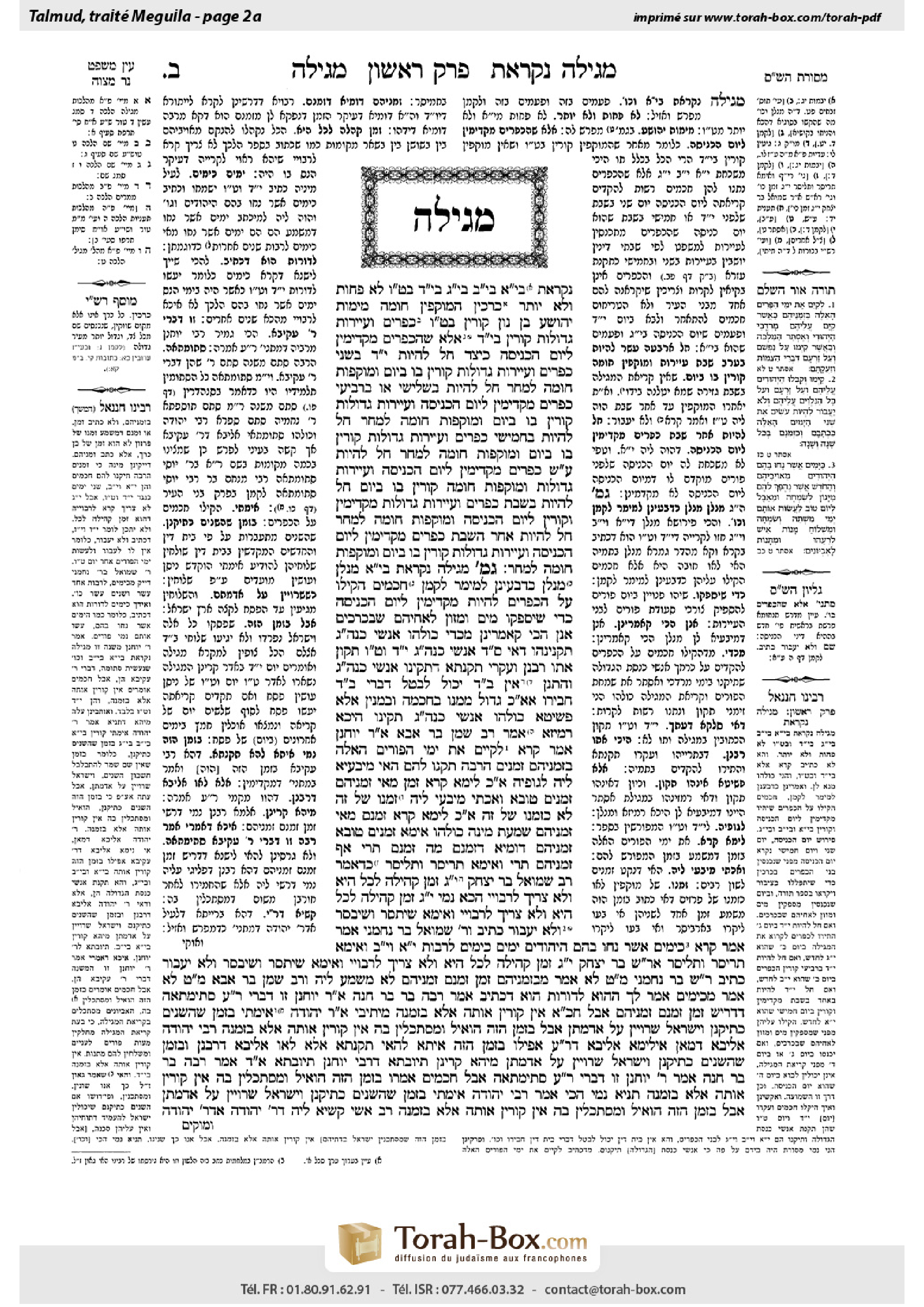
Megillah 2a: Talmud study for Daf Yomi
Daf Yomi is the daily study of one Talmud folio. Explore 37 tractates with scans, Hebrew text, Sefaria English and AI-generated French translations where annotated.
Passage selection and English or AI-generated French translation are available where the scan has annotations. Daf Study is independent of Torah-Box and Sefaria.
Browse Megillah · מגילה · All tractatesMegillah 2a text and translations
This page of Megillah includes the Aramaic text, an English translation and an AI-generated French translation, alongside the scan above.
מגילה ב׳ א · Aramaic and Hebrew text
מְגִילָּה נִקְרֵאת בְּאַחַד עָשָׂר, בִּשְׁנֵים עָשָׂר, בִּשְׁלֹשָׁה עָשָׂר, בְּאַרְבָּעָה עָשָׂר, בַּחֲמִשָּׁה עָשָׂר. לֹא פָּחוֹת, וְלֹא יוֹתֵר. כְּרַכִּין הַמּוּקָּפִין חוֹמָה מִימוֹת יְהוֹשֻׁעַ בִּן נוּן — קוֹרִין בַּחֲמִשָּׁה עָשָׂר, כְּפָרִים וַעֲיָירוֹת גְּדוֹלוֹת — קוֹרִין בְּאַרְבָּעָה עָשָׂר, אֶלָּא שֶׁהַכְּפָרִים מַקְדִּימִין לְיוֹם הַכְּנִיסָה.
כֵּיצַד: חָל לִהְיוֹת אַרְבָּעָה עָשָׂר בַּשֵּׁנִי — כְּפָרִים וַעֲיָירוֹת גְּדוֹלוֹת קוֹרִין בּוֹ בַיּוֹם, וּמוּקָּפוֹת חוֹמָה לְמָחָר. חָל לִהְיוֹת בַּשְּׁלִישִׁי אוֹ בָּרְבִיעִי — כְּפָרִים מַקְדִּימִין לְיוֹם הַכְּנִיסָה, וַעֲיָירוֹת גְּדוֹלוֹת קוֹרִין בּוֹ בַיּוֹם, וּמוּקָּפוֹת חוֹמָה לְמָחָר.
חָל לִהְיוֹת בַּחֲמִישִׁי — כְּפָרִים וַעֲיָירוֹת גְּדוֹלוֹת קוֹרִין בּוֹ בַיּוֹם, וּמוּקָּפוֹת חוֹמָה לְמָחָר. חָל לִהְיוֹת עֶרֶב שַׁבָּת — כְּפָרִים מַקְדִּימִין לְיוֹם הַכְּנִיסָה, וַעֲיָירוֹת גְּדוֹלוֹת וּמוּקָּפוֹת חוֹמָה קוֹרִין בּוֹ בַיּוֹם.
חָל לִהְיוֹת בַּשַּׁבָּת — כְּפָרִים וַעֲיָירוֹת גְּדוֹלוֹת מַקְדִּימִין וְקוֹרִין לְיוֹם הַכְּנִיסָה, וּמוּקָּפוֹת חוֹמָה לְמָחָר. חָל לִהְיוֹת אַחַר הַשַּׁבָּת — כְּפָרִים מַקְדִּימִין לְיוֹם הַכְּנִיסָה, וַעֲיָירוֹת גְּדוֹלוֹת קוֹרִין בּוֹ בַיּוֹם, וּמוּקָּפוֹת חוֹמָה לְמָחָר.
גְּמָ׳ מְגִילָּה נִקְרֵאת בְּאַחַד עָשָׂר. מְנָלַן? מְנָלַן?! כִּדְבָעֵינַן לְמֵימַר לְקַמַּן: חֲכָמִים הֵקֵילּוּ עַל הַכְּפָרִים לִהְיוֹת מַקְדִּימִין לְיוֹם הַכְּנִיסָה, כְּדֵי שֶׁיְּסַפְּקוּ מַיִם וּמָזוֹן לַאֲחֵיהֶם שֶׁבַּכְּרַכִּים.
אֲנַן הָכִי קָאָמְרִינַן: מִכְּדִי כּוּלְּהוּ אַנְשֵׁי כְּנֶסֶת הַגְּדוֹלָה תַּקְּנִינְהוּ, דְּאִי סָלְקָא דַעְתָּךְ אַנְשֵׁי כְּנֶסֶת הַגְּדוֹלָה אַרְבָּעָה עָשָׂר וַחֲמִשָּׁה עָשָׂר תַּקּוּן — אָתוּ רַבָּנַן וְעָקְרִי תַּקַּנְתָּא דְּתַקִּינוּ אַנְשֵׁי כְּנֶסֶת הַגְּדוֹלָה? וְהָתְנַן: אֵין בֵּית דִּין יָכוֹל לְבַטֵּל דִּבְרֵי בֵּית דִּין חֲבֵירוֹ אֶלָּא אִם כֵּן גָּדוֹל מִמֶּנּוּ בְּחָכְמָה וּבְמִנְיָן.
אֶלָּא פְּשִׁיטָא כּוּלְּהוּ אַנְשֵׁי כְּנֶסֶת הַגְּדוֹלָה תַּקִּינוּ. הֵיכָא רְמִיזָא?
אָמַר רַב שֶׁמֶן בַּר אַבָּא אָמַר רַבִּי יוֹחָנָן, אָמַר קְרָא: ״לְקַיֵּים אֵת יְמֵי הַפּוּרִים הָאֵלֶּה בִּזְמַנֵּיהֶם״, זְמַנִּים הַרְבֵּה תִּקְּנוּ לָהֶם.
הַאי מִיבַּעְיָא לֵיהּ לְגוּפֵיהּ! אִם כֵּן לֵימָא קְרָא ״זְמַן״, מַאי ״זְמַנֵּיהֶם״ — זְמַנִּים טוּבָא.
וְאַכַּתִּי מִיבְּעֵי לֵיהּ: זְמַנּוֹ שֶׁל זֶה לֹא כִּזְמַנּוֹ שֶׁל זֶה! אִם כֵּן, לֵימָא קְרָא ״זְמַנָּם״, מַאי ״זְמַנֵּיהֶם״ — שָׁמְעַתְּ מִינַּהּ כּוּלְּהוּ.
אֵימָא זְמַנִּים טוּבָא! ״זְמַנֵּיהֶם״ דּוּמְיָא דִּ״זְמַנָּם״: מָה ״זְמַנָּם״ תְּרֵי — אַף ״זְמַנֵּיהֶם״ תְּרֵי.
וְאֵימָא תְּרֵיסַר וּתְלֵיסַר? כִּדְאָמַר רַב שְׁמוּאֵל בַּר יִצְחָק: שְׁלֹשָׁה עָשָׂר זְמַן קְהִילָּה לַכֹּל הִיא, וְלָא צְרִיךְ לְרַבּוֹיֵי, הָכָא נָמֵי: שְׁלֹשָׁה עָשָׂר זְמַן קְהִילָּה לַכֹּל הִיא, וְלָא צְרִיךְ לְרַבּוֹיֵי.
וְאֵימָא שִׁיתְּסַר וְשִׁיבְסַר! ״וְלֹא יַעֲבוֹר״ כְּתִיב.
וְרַבִּי שְׁמוּאֵל בַּר נַחְמָנִי אָמַר, אָמַר קְרָא: ״כַּיָּמִים אֲשֶׁר נָחוּ בָהֶם הַיְּהוּדִים״. ״יָמִים״, ״כַּיָּמִים״ — לְרַבּוֹת אַחַד עָשָׂר וּשְׁנֵים עָשָׂר.
וְאֵימָא תְּרֵיסַר וּתְלֵיסַר! אָמַר רַב שְׁמוּאֵל בַּר יִצְחָק: שְׁלֹשָׁה עָשָׂר זְמַן קְהִילָּה לַכֹּל הִיא, וְלָא צְרִיךְ לְרַבּוֹיֵי. וְאֵימָא שִׁיתְּסַר וְשִׁיבְסַר! ״וְלֹא יַעֲבוֹר״ כְּתִיב.
רַבִּי שְׁמוּאֵל בַּר נַחְמָנִי מַאי טַעְמָא לָא אָמַר מִ״בִּזְמַנֵּיהֶם״? ״זְמַן״ ״זְמַנָּם״ ״זְמַנֵּיהֶם״ לָא מַשְׁמַע לֵיהּ.
וְרַב שֶׁמֶן בַּר אַבָּא מַאי טַעְמָא לָא אָמַר מִ״כַּיָּמִים״? אָמַר לָךְ: הָהוּא לְדוֹרוֹת הוּא דִּכְתִיב.
אָמַר רַבָּה בַּר בַּר חָנָה אָמַר רַבִּי יוֹחָנָן: זוֹ דִּבְרֵי רַבִּי עֲקִיבָא סְתִימְתָּאָה, דְּדָרֵישׁ ״זְמַן״ ״זְמַנָּם״ ״זְמַנֵּיהֶם״, אֲבָל חֲכָמִים אוֹמְרִים: אֵין קוֹרִין אוֹתָהּ אֶלָּא בִּזְמַנָּהּ.
מֵיתִיבִי, אָמַר רַבִּי יְהוּדָה: אֵימָתַי — בִּזְמַן שֶׁהַשָּׁנִים כְּתִיקְנָן וְיִשְׂרָאֵל שְׁרוּיִין עַל אַדְמָתָן, אֲבָל בִּזְמַן הַזֶּה, הוֹאִיל וּמִסְתַּכְּלִין בָּהּ — אֵין קוֹרִין אוֹתָהּ אֶלָּא בִּזְמַנָּהּ.
רַבִּי יְהוּדָה אַלִּיבָּא דְמַאן? אִילֵימָא אַלִּיבָּא דְּרַבִּי עֲקִיבָא — אֲפִילּוּ בִּזְמַן הַזֶּה אִיתָא לְהַאי תַּקַּנְתָּא!
אֶלָּא לָאו, אַלִּיבָּא דְרַבָּנַן, וּבִזְמַן שֶׁהַשָּׁנִים כְּתִיקְנָן וְיִשְׂרָאֵל שְׁרוּיִין עַל אַדְמָתָן — מִיהָא קָרֵינַן, תְּיוּבְתָּא דְּרַבִּי יוֹחָנָן תְּיוּבְתָּא.
אִיכָּא דְּאָמְרִי: אָמַר רַבָּה בַּר בַּר חָנָה אָמַר רַבִּי יוֹחָנָן: זוֹ דִּבְרֵי רַבִּי עֲקִיבָא סְתִימְתָּאָה, אֲבָל חֲכָמִים אָמְרוּ: בִּזְמַן הַזֶּה, הוֹאִיל וּמִסְתַּכְּלִין בָּהּ — אֵין קוֹרִין אוֹתָהּ אֶלָּא בִּזְמַנָּהּ.
תַּנְיָא נָמֵי הָכִי, אָמַר רַבִּי יְהוּדָה: אֵימָתַי — בִּזְמַן שֶׁהַשָּׁנִים כְּתִיקְנָן וְיִשְׂרָאֵל שְׁרוּיִין עַל אַדְמָתָן, אֲבָל בִּזְמַן הַזֶּה, הוֹאִיל וּמִסְתַּכְּלִין בָּהּ — אֵין קוֹרִין אוֹתָהּ אֶלָּא בִּזְמַנָּהּ.
רַב אָשֵׁי קַשְׁיָא לֵיהּ דְּרַבִּי יְהוּדָה אַדְּרַבִּי יְהוּדָה,
Megillah 2a · English translation
MISHNA: The Megilla is read on the eleventh, on the twelfth, on the thirteenth, on the fourteenth, or on the fifteenth of the month of Adar, not earlier and not later. The mishna explains the circumstances when the Megilla is read on each of these days. Cities [kerakin] that have been surrounded by a wall since the days of Joshua, son of Nun, read the Megilla on the fifteenth of Adar, whereas villages and large towns that have not been walled since the days of Joshua, son of Nun, read it on the fourteenth. However, the Sages instituted that the villages may advance their reading to the day of assembly, i.e., Monday or Thursday, when the rabbinical courts are in session and the Torah is read publicly, and the villagers therefore come to the larger towns.
How so? If the fourteenth of Adar occurs on Monday, the villages and large towns read it on that day, and the walled cities read it on the next day, the fifteenth. If the fourteenth occurs on Tuesday or Wednesday, the villages advance their reading to the day of assembly, i.e., Monday, the twelfth or thirteenth of Adar; the large towns read it on that day, i.e., the fourteenth of Adar, and the walled cities read it on the next day, the fifteenth.
If the fourteenth occurs on Thursday, the villages and large towns read it on that day, the fourteenth, and the walled cities read it on the next day, the fifteenth. If the fourteenth occurs on Shabbat eve, the villages advance their reading to the day of assembly, i.e., Thursday, the thirteenth of Adar; and the large towns and the walled cities read it on that day, i.e., the fourteenth of Adar. Even the walled cities read the Megilla on the fourteenth rather than on the fifteenth, as they do not read it on Shabbat.
If the fourteenth occurs on Shabbat, both the villages and large towns advance their reading to the day of assembly, i.e., Thursday, the twelfth of Adar; and the walled cities read it on the day after Purim, the fifteenth. If the fourteenth occurs on Sunday, the villages advance their reading to the day of assembly, i.e., Thursday, the eleventh of Adar; and the large towns read it on that day, i.e., the fourteenth of Adar; and the walled cities read it on the next day, the fifteenth.
GEMARA: We learned in the mishna: The Megilla is read on the eleventh of Adar. The Gemara asks: From where do we derive this halakha? The Gemara expresses surprise at the question: What room is there to ask: From where do we derive this halakha? The reason is as we intend to say further on: The Sages were lenient with the villages and allowed them to advance their reading of the Megilla to the day of assembly, so that they would be free to supply water and food to their brethren in the cities on the day of Purim. Accordingly, the Megilla is read on the eleventh due to a rabbinic enactment.
The Gemara explains: This is what we said, i.e., this is what we meant when we asked the question: Now, all of these days when the Megilla may be read were enacted by the members of the Great Assembly when they established the holiday of Purim itself. As, if it enters your mind to say that the members of the Great Assembly enacted only the fourteenth and fifteenth as days for reading the Megilla, is it possible that the later Sages came and uprooted an ordinance that was enacted by the members of the Great Assembly? Didn’t we learn in a mishna (Eduyyot 1:5) that a rabbinical court cannot rescind the statements of another rabbinical court, unless it is superior to it in wisdom and in number? No subsequent court was ever greater than the members of the Great Assembly, so it would be impossible for another court to rescind the enactments of the members of the Great Assembly.
Rather, it is obvious that all these days were enacted by the members of the Great Assembly, and the question is: Where is the allusion to this in the Bible? The Megilla itself, which was approved by the members of the Great Assembly, mentions only the fourteenth and fifteenth of Adar.
Rav Shemen bar Abba said that Rabbi Yoḥanan said: It is alluded to when the verse states: “To confirm these days of Purim in their times” (Esther 9:31). The phrase “in their times” indicates that they enacted many times for them and not only two days.
The Gemara objects: This verse is necessary for its own purpose, to teach that the days of Purim must be observed at the proper times. The Gemara responds: If so, let the verse say: To confirm these days of Purim in its time. What is the significance of the term “their times,” in the plural? It indicates that many times were established for the reading of the Megilla.
The Gemara objects: But still, the plural term is necessary to indicate that the time of this walled city is not the same as the time of that unwalled town, i.e., Purim is celebrated on different days in different places. The Gemara answers: If so, let the verse say: Their time, indicating that each place celebrates Purim on its respective day. What is the significance of the compound plural “their times”? Learn from this term that although the verse (Esther 9:21) specifies only two days, the Megilla may, at times, be read on all of the days enumerated in the mishna.
The Gemara asks: If so, say that the plural term indicates many times, and the Megilla may be read even earlier than the eleventh of Adar. The Gemara rejects this argument: The compound plural “their times,” should be understood as similar to the simple plural term, their time. Just as the term their time can be understood to refer to two days, indicating that each location reads the Megilla in its respective time on the fourteenth or the fifteenth of Adar, so too, “their times” should be understood as referring to only two additional days when the Megilla may be read.
The Gemara asks: Say that these two added days are the twelfth and the thirteenth of Adar. How is it derived that the Megilla may be read on the eleventh as well? The Gemara answers: It is as Rav Shmuel bar Yitzḥak said in a different context: The thirteenth of Adar is a time of assembly for all, as it was on that day that the Jews assembled to fight their enemies, and the main miracle was performed on that day. Consequently, there is no need for a special derivation to include it as a day that is fit for reading the Megilla. Here too, since the thirteenth of Adar is a time of assembly for all, there is no need for a special derivation to include it among the days when the Megilla may be read.
The Gemara objects: And say that the two additional days are the sixteenth and the seventeenth of Adar. The Gemara responds: It is written: “And it shall not pass” (Esther 9:27), indicating that the celebration of Purim is not delayed until a later date.
Having cited and discussed the opinion of Rav Shemen bar Abba, the Gemara cites another answer to the question of where the verses allude to the permissibility of reading the Megilla on the days enumerated in the mishna. And Rabbi Shmuel bar Naḥmani said: These dates are alluded to when the verse states: “As the days on which the Jews rested from their enemies” (Esther 9:22). The term “days” is referring to the two days that are explicitly mentioned in the previous verse, i.e., the fourteenth and the fifteenth. The term “as the days” comes to include two additional days, i.e., the eleventh and twelfth of Adar.
The Gemara asks: And say that the two additional days are the twelfth and thirteenth of Adar. How is it derived that the Megilla may be read on the eleventh as well? In answer to this question, Rav Shmuel bar Yitzḥak said: The thirteenth of Adar is a time of assembly for all, and there is no need for a special derivation to include it as a day fit for reading. The Gemara objects: Say that these additional days are the sixteenth and seventeenth of Adar. This suggestion is rejected: It is written: “And it shall not pass.”
Since two derivations were offered for the same matter, the Gemara asks: What is the reason that Rabbi Shmuel bar Naḥmani did not state that the days enumerated in the mishna are fit for reading the Megilla based upon the term “in their times,” in accordance with the opinion of Rav Shemen bar Abba? The Gemara answers: He does not learn anything from the distinction between the terms time, their time, and their times. Therefore, the verse indicates only that there are two days when the Megilla may be read.
The Gemara asks: And what is the reason that Rav Shemen bar Abba did not state that the days enumerated in the mishna are fit for reading the Megilla based upon the term “as the days,” in accordance with the opinion of Rabbi Shmuel bar Naḥmani? The Gemara answers: He could have said to you: That verse is written as a reference to future generations, and it indicates that just as the Jews rested on these days at that time, they shall rest and celebrate on these days for all generations.
§ With regard to the mishna’s ruling that the Megilla may be read on the day of assembly, Rabba bar bar Ḥana said that Rabbi Yoḥanan said: This is the statement of Rabbi Akiva the unattributed. Most unattributed statements of tanna’im were formulated by Rabbi Akiva’s students and reflect his opinions. As, he derives halakhot based on the distinction that he draws between the terms time, their time, and their times. However, the Sages say: One may read the Megilla only in its designated time, i.e., the fourteenth of Adar.
The Gemara raises an objection based upon the following baraita. Rabbi Yehuda said: When is one permitted to read the Megilla from the eleventh to the fifteenth of Adar? One may read on these dates at a time when the years are established properly and the Jewish people dwell securely in their own land. However, nowadays, since people look to the reading of the Megilla and use it to calculate when Passover begins, one may read the Megilla only in its designated time, so as not to cause confusion with regard to the date of Passover, which is exactly one month from the day after Purim.
The Gemara analyzes this baraita: In accordance with whose opinion did Rabbi Yehuda issue his ruling? If we say that it is in accordance with the opinion of Rabbi Akiva, whose opinion is expressed in the mishna, there is a difficulty, as Rabbi Akiva holds that even nowadays this ordinance applies. According to Rabbi Akiva, it is permitted for residents of villages to read the Megilla on the day of assembly even nowadays, as he did not limit his ruling to times when the Jewish people dwell securely in their land.
Rather, is it not in accordance with the opinion of the Sages, who disagreed with Rabbi Akiva? And, nevertheless, at least when the years are established properly and the Jewish people dwell securely in their land, the Megilla is read even prior to the fourteenth, as the Sages disagree only about the halakha nowadays. This contradicts the statement of Rabbi Yoḥanan, who holds that the Megilla could never be read earlier than the fourteenth of Adar. The Gemara concludes: The refutation of the opinion of Rabbi Yoḥanan is indeed a conclusive refutation.
There are those who say a different version of the previous passage. Rabba bar bar Ḥana said that Rabbi Yoḥanan said: This is the statement of Rabbi Akiva, the unattributed. However, the Sages said: Nowadays, since people look to the reading of the Megilla and use it to calculate when Passover begins, one may read the Megilla only in its designated time.
The Gemara comments: This is also taught in a baraita: Rabbi Yehuda said: When is one permitted to read the Megilla from the eleventh to the fifteenth of Adar? At a time when the years are established properly and the Jewish people dwell securely in their own land. However, nowadays, since people look to the reading of the Megilla and use it to calculate when Passover begins, one may read the Megilla only in its designated time. According to this version, Rabbi Yehuda’s statement is consistent with the opinion of the Sages, as cited by Rabbi Yoḥanan.
The Gemara adds: Rav Ashi poses a difficulty based on an apparent contradiction between the opinion of Rabbi Yehuda in the aforementioned baraita and a ruling cited in a mishna in the name of Rabbi Yehuda,
Megillah 2a · Traduction française (IA)
MICHNA : La Meguila est lue le onze, le douze, le treize, le quatorze ou le quinze du mois d’Adar, ni avant ni après. La Michna explique dans quelles circonstances la Meguila est lue chacun de ces jours. Les villes [kerakin] entourées d’une muraille depuis l’époque de Josué, fils de Noun, lisent la Meguila le quinze Adar, tandis que les villages et les grandes villes qui ne sont pas entourés d’une muraille depuis l’époque de Josué, fils de Noun, la lisent le quatorze. Toutefois, les Sages ont institué que les villages puissent avancer leur lecture au jour de rassemblement, c’est-à-dire le lundi ou le jeudi, lorsque les tribunaux rabbiniques siègent et que la Torah est lue en public ; les villageois se rendent alors dans les grandes villes.
Qu’en est-il exactement ? Si le quatorze Adar tombe un lundi, les villages et les grandes villes lisent la Meguila ce jour-là, et les villes fortifiées la lisent le lendemain, le quinze. Si le quatorze tombe un mardi ou un mercredi, les villages avancent leur lecture au jour de rassemblement, c’est-à-dire au lundi, le douze ou le treize Adar ; les grandes villes la lisent ce jour-là, c’est-à-dire le quatorze Adar, et les villes fortifiées la lisent le lendemain, le quinze.
Si le quatorze tombe un jeudi, les villages et les grandes villes lisent la Meguila ce jour-là, le quatorze, et les villes fortifiées la lisent le lendemain, le quinze. Si le quatorze tombe la veille de Chabbat, les villages avancent leur lecture au jour de rassemblement, c’est-à-dire au jeudi, le treize Adar ; les grandes villes et les villes fortifiées lisent la Meguila ce jour-là, c’est-à-dire le quatorze Adar. Même les villes fortifiées lisent la Meguila le quatorze plutôt que le quinze, car elles ne la lisent pas Chabbat.
Si le quatorze tombe un Chabbat, les villages comme les grandes villes avancent leur lecture au jour de rassemblement, c’est-à-dire au jeudi, le douze Adar ; les villes fortifiées la lisent le lendemain de Pourim, le quinze. Si le quatorze tombe un dimanche, les villages avancent leur lecture au jour de rassemblement, c’est-à-dire au jeudi, le onze Adar ; les grandes villes lisent la Meguila ce jour-là, c’est-à-dire le quatorze Adar, et les villes fortifiées la lisent le lendemain, le quinze.
GUEMARA : Nous avons appris dans la Michna : La Meguila est lue le onze Adar. La Guemara demande : D’où déduisons-nous cette halakha ? La Guemara s’étonne de la question : Pourquoi demander : « D’où déduisons-nous cette halakha ? » La raison est celle que nous exposerons plus loin : les Sages ont été indulgents envers les villages et leur ont permis d’avancer la lecture de la Meguila au jour de rassemblement, afin qu’ils soient libres de fournir de l’eau et de la nourriture à leurs frères dans les villes le jour de Pourim. Ainsi, la Meguila est lue le onze en vertu d’une ordonnance rabbinique.
La Guemara explique : Voici ce que nous avons dit, c’est-à-dire ce que nous voulions dire en posant la question : Or, tous ces jours où la Meguila peut être lue ont été institués par les membres de la Grande Assemblée lorsqu’ils ont établi la fête de Pourim elle-même. Car, si l’on envisage de dire que les membres de la Grande Assemblée n’ont institué que le quatorze et le quinze comme jours de lecture de la Meguila, est-il possible que les Sages des générations suivantes soient venus abroger une ordonnance instituée par les membres de la Grande Assemblée ? N’avons-nous pas appris dans une Michna (Édouyot 1:5) qu’un tribunal rabbinique ne peut annuler les décisions d’un autre tribunal rabbinique, à moins d’être supérieur à celui-ci en sagesse et en nombre ? Aucun tribunal ultérieur n’a jamais surpassé la Grande Assemblée ; il serait donc impossible qu’un autre tribunal annule les ordonnances de ses membres.
Au contraire, il est évident que tous ces jours ont été institués par les membres de la Grande Assemblée, et la question est : où la Bible y fait-elle allusion ? La Meguila elle-même, qui a été approuvée par les membres de la Grande Assemblée, ne mentionne que les quatorze et quinze Adar.
Rav Shemen bar Abba a dit au nom de Rabbi Yoḥanan : Cela est évoqué par le verset : « Pour confirmer ces jours de Pourim en leurs temps » (Esther 9:31). L’expression « en leurs temps » indique qu’ils ont institué de nombreuses dates pour les célébrer, et pas seulement deux jours.
La Guemara objecte : Ce verset est nécessaire pour son propos même, afin d’enseigner que les jours de Pourim doivent être observés aux dates qui leur conviennent. La Guemara répond : Dans ce cas, que le verset dise : « Pour confirmer ces jours de Pourim en son temps ». Quelle est alors la portée de l’expression « en leurs temps », au pluriel ? Elle indique que plusieurs dates ont été fixées pour la lecture de la Meguila.
La Guemara objecte : Mais le pluriel est encore nécessaire pour indiquer que la date de cette ville fortifiée n’est pas la même que celle de cette ville non fortifiée, c’est-à-dire que Pourim est célébré à des jours différents selon les lieux. La Guemara répond : Dans ce cas, que le verset dise : « Leur temps », indiquant que chaque lieu célèbre Pourim à la date qui lui revient. Quelle est alors la portée de l’expression composée « leurs temps », au pluriel ? Déduis de cette expression que, bien que le verset (Esther 9:21) ne précise que deux jours, la Meguila peut parfois être lue chacun des jours énumérés dans la Michna.
La Guemara demande : Dans ce cas, disons que le pluriel indique de nombreuses dates et que la Meguila peut être lue même avant le onze Adar. La Guemara rejette cet argument : L’expression composée « leurs temps » doit être comprise comme l’expression simple « leur temps ». De même que l’expression « leur temps » peut être comprise comme désignant deux jours, indiquant que chaque lieu lit la Meguila à sa date respective, le quatorze ou le quinze Adar, de même « leurs temps » doit être comprise comme désignant seulement deux jours supplémentaires où la Meguila peut être lue.
La Guemara demande : Supposons que ces deux jours ajoutés soient les douze et treize Adar. Comment déduire que la Meguila peut également être lue le onze ? La Guemara répond : Comme Rav Shmuel bar Yitzḥak l’a dit dans un autre contexte, le treize Adar est un jour de rassemblement pour tous, car c’est ce jour-là que les Juifs se sont rassemblés pour combattre leurs ennemis et que le miracle principal s’est produit. Il n’est donc pas nécessaire d’apporter une déduction particulière pour l’inclure parmi les jours où la Meguila peut être lue. De même ici, puisque le treize Adar est un jour de rassemblement pour tous, il n’est pas nécessaire d’apporter une déduction particulière pour l’inclure parmi les jours où la Meguila peut être lue.
La Guemara objecte : Et supposons que les deux jours supplémentaires soient les seize et dix-sept Adar. La Guemara répond : Il est écrit : « Et cela ne passera pas » (Esther 9:27), ce qui indique que la célébration de Pourim n’est pas reportée à une date ultérieure.
Après avoir cité et examiné l’opinion de Rav Shemen bar Abba, la Guemara présente une autre réponse à la question de savoir où les versets font allusion à la permission de lire la Meguila les jours énumérés dans la Michna. Rabbi Shmuel bar Naḥmani a dit : Ces dates sont évoquées par le verset : « Comme les jours où les Juifs se reposèrent de leurs ennemis » (Esther 9:22). Le terme « les jours » désigne les deux jours explicitement mentionnés dans le verset précédent, c’est-à-dire les quatorze et quinze Adar. L’expression « comme les jours » vient inclure deux jours supplémentaires, c’est-à-dire les onze et douze Adar.
La Guemara demande : Et supposons que les deux jours supplémentaires soient les douze et treize Adar. Comment déduire que la Meguila peut aussi être lue le onze ? En réponse à cette question, Rav Shmuel bar Yitzḥak a dit : Le treize Adar est un jour de rassemblement pour tous ; il n’est donc pas nécessaire d’apporter une déduction particulière pour l’inclure parmi les jours propices à la lecture. La Guemara objecte : Supposons que ces jours supplémentaires soient les seize et dix-sept Adar. Cette proposition est rejetée : il est écrit : « Et cela ne passera pas ».
Puisque deux déductions ont été proposées à propos de la même question, la Guemara demande : Pourquoi Rabbi Shmuel bar Naḥmani n’a-t-il pas dit que les jours énumérés dans la Michna sont propices à la lecture de la Meguila sur la base de l’expression « en leurs temps », conformément à l’opinion de Rav Shemen bar Abba ? La Guemara répond : Il ne tire aucune déduction de la distinction entre les termes « temps », « leur temps » et « leurs temps ». Par conséquent, le verset indique seulement qu’il existe deux jours où la Meguila peut être lue.
La Guemara demande : Et pourquoi Rav Shemen bar Abba n’a-t-il pas dit que les jours énumérés dans la Michna sont propices à la lecture de la Meguila sur la base de l’expression « comme les jours », conformément à l’opinion de Rabbi Shmuel bar Naḥmani ? La Guemara répond : Il aurait pu te dire que ce verset fait référence aux générations futures et indique que, de même que les Juifs se sont reposés ces jours-là à cette époque, ils se reposeront et célébreront ces jours-là dans toutes les générations.
§ À propos de la décision de la Michna selon laquelle la Meguila peut être lue le jour de rassemblement, Rabba bar bar Ḥana a dit au nom de Rabbi Yoḥanan : C’est l’opinion de Rabbi Akiva, telle qu’elle est énoncée sans attribution. La plupart des enseignements anonymes des tannaim ont été formulés par les élèves de Rabbi Akiva et reflètent ses opinions. En effet, il déduit des halakhot en s’appuyant sur la distinction qu’il établit entre les termes « temps », « leur temps » et « leurs temps ». Cependant, les Sages disent : On ne peut lire la Meguila qu’à la date qui lui est assignée, c’est-à-dire le quatorze Adar.
La Guemara soulève une objection fondée sur la baraïta suivante. Rabbi Yehuda a dit : Quand est-il permis de lire la Meguila entre le onze et le quinze Adar ? On peut la lire à ces dates lorsque les années sont fixées correctement et que le peuple juif réside en sécurité sur sa terre. Toutefois, de nos jours, comme les gens se fondent sur la lecture de la Meguila pour calculer la date de Pessaḥ, on ne peut lire la Meguila qu’à la date qui lui est assignée, afin de ne pas créer de confusion quant à la date de Pessaḥ, qui tombe exactement un mois après le lendemain de Pourim.
La Guemara analyse cette baraïta : Selon quelle opinion Rabbi Yehuda a-t-il rendu sa décision ? Si l’on dit qu’elle est conforme à l’opinion de Rabbi Akiva, dont l’avis est exprimé dans la Michna, une difficulté se pose, car Rabbi Akiva estime que cette ordonnance s’applique même de nos jours. Selon Rabbi Akiva, les habitants des villages peuvent lire la Meguila le jour de rassemblement même de nos jours, car il n’a pas limité sa décision aux périodes où le peuple juif réside en sécurité sur sa terre.
Au contraire, n’est-elle pas conforme à l’opinion des Sages, qui étaient en désaccord avec Rabbi Akiva ? Et pourtant, au moins lorsque les années sont fixées correctement et que le peuple juif réside en sécurité sur sa terre, la Meguila est lue avant le quatorze, car les Sages ne sont en désaccord qu’au sujet de la halakha de nos jours. Cela contredit l’enseignement de Rabbi Yoḥanan, selon lequel la Meguila ne peut jamais être lue avant le quatorze Adar. La Guemara conclut : La réfutation de l’opinion de Rabbi Yoḥanan est bel et bien concluante.
Certains rapportent une autre version du passage précédent. Rabba bar bar Ḥana a dit au nom de Rabbi Yoḥanan : C’est l’opinion de Rabbi Akiva, telle qu’elle est énoncée sans attribution. Cependant, les Sages ont dit : De nos jours, comme les gens se fondent sur la lecture de la Meguila pour calculer la date de Pessaḥ, on ne peut lire la Meguila qu’à la date qui lui est assignée.
La Guemara fait remarquer : Cela est également enseigné dans une baraïta : Rabbi Yehuda a dit : Quand est-il permis de lire la Meguila entre le onze et le quinze Adar ? Lorsque les années sont fixées correctement et que le peuple juif réside en sécurité sur sa terre. Toutefois, de nos jours, comme les gens se fondent sur la lecture de la Meguila pour calculer la date de Pessaḥ, on ne peut lire la Meguila qu’à la date qui lui est assignée. Selon cette version, l’enseignement de Rabbi Yehuda concorde avec l’opinion des Sages citée par Rabbi Yoḥanan.
La Guemara ajoute : Rav Ashi soulève une difficulté fondée sur une contradiction apparente entre l’opinion de Rabbi Yehuda dans la baraïta susmentionnée et une décision attribuée à Rabbi Yehuda dans une Michna.
Traduction française générée par IA à partir de l’édition anglaise de Sefaria. Vérifie toujours un passage avec le texte source.
Text from Sefaria: William Davidson Edition - Vocalized Aramaic (CC BY NC); William Davidson Edition - English (CC BY NC).