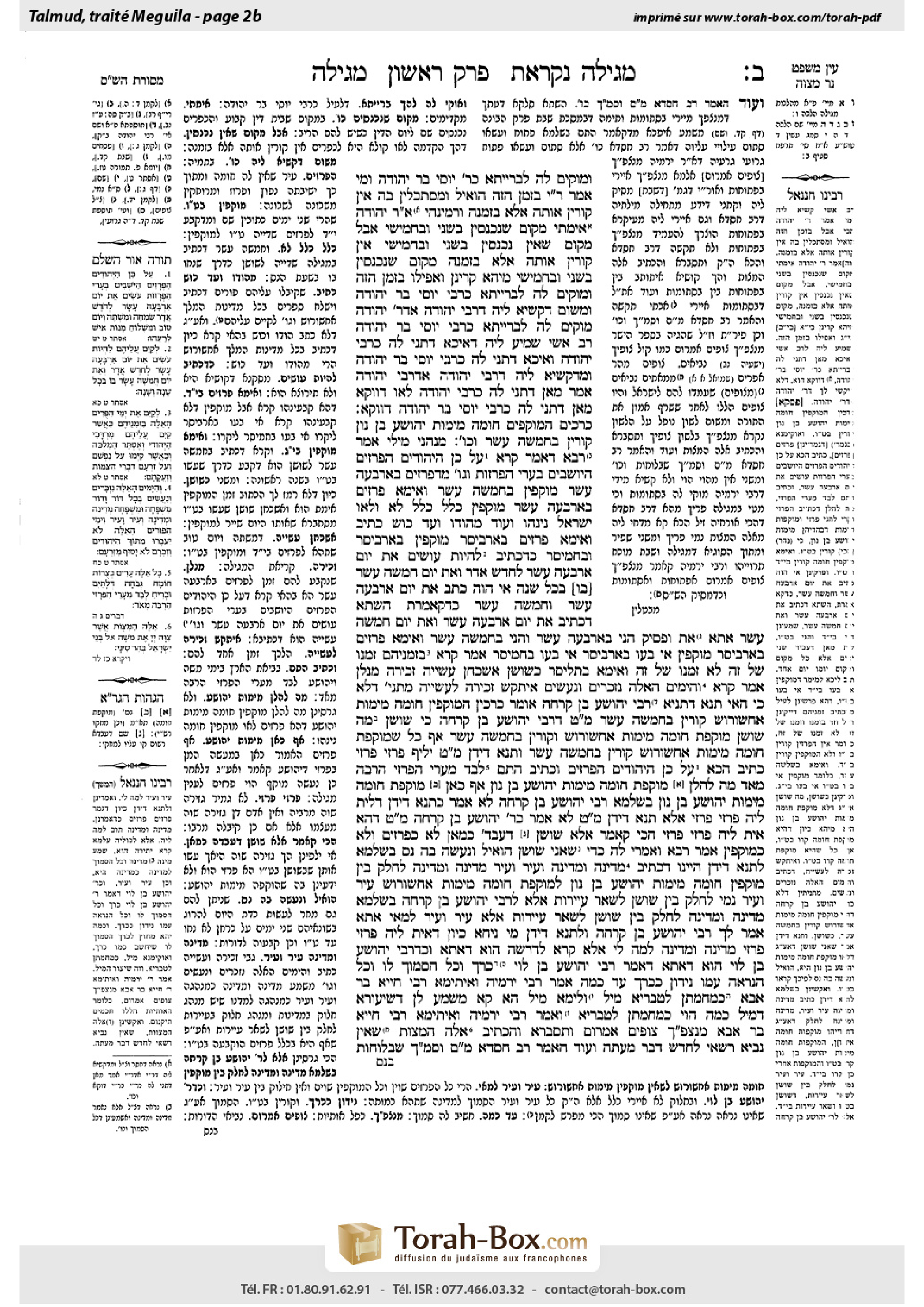
Megillah 2b: Talmud study for Daf Yomi
Daf Yomi is the daily study of one Talmud folio. Explore 37 tractates with scans, Hebrew text, Sefaria English and AI-generated French translations where annotated.
Passage selection and English or AI-generated French translation are available where the scan has annotations. Daf Study is independent of Torah-Box and Sefaria.
Browse Megillah · מגילה · All tractatesMegillah 2b text and translations
This page of Megillah includes the Aramaic text, an English translation and an AI-generated French translation, alongside the scan above.
מגילה ב׳ ב · Aramaic and Hebrew text
וּמוֹקֵים לַהּ לְבָרַיְיתָא כְּרַבִּי יוֹסֵי בַּר יְהוּדָה.
וּמִי אָמַר רַבִּי יְהוּדָה ״בִּזְמַן הַזֶּה, הוֹאִיל וּמִסְתַּכְּלִין בָּהּ — אֵין קוֹרִין אוֹתָהּ אֶלָּא בִּזְמַנָּהּ״? וּרְמִינְהִי, אָמַר רַבִּי יְהוּדָה: אֵימָתַי — מָקוֹם שֶׁנִּכְנָסִין בַּשֵּׁנִי וּבַחֲמִישִׁי. אֲבָל מָקוֹם שֶׁאֵין נִכְנָסִין בַּשֵּׁנִי וּבַחֲמִישִׁי — אֵין קוֹרִין אוֹתָהּ אֶלָּא בִּזְמַנָּהּ.
מְקוֹם שֶׁנִּכְנָסִין בַּשֵּׁנִי וּבַחֲמִישִׁי מִיהָא קָרֵינַן, וַאֲפִילּוּ בִּזְמַן הַזֶּה! וּמוֹקֵים לַהּ לְבָרַיְיתָא כְּרַבִּי יוֹסֵי בַּר יְהוּדָה.
וּמִשּׁוּם דְּקַשְׁיָא לֵיהּ דְּרַבִּי יְהוּדָה אַדְּרַבִּי יְהוּדָה מוֹקֵים לָהּ לְבָרַיְיתָא כְּרַבִּי יוֹסֵי בַּר יְהוּדָה?!
רַב אָשֵׁי שְׁמִיעַ לֵיהּ דְּאִיכָּא דְּתָנֵי לַהּ כְּרַבִּי יְהוּדָה וְאִיכָּא דְּתָנֵי לַהּ כְּרַבִּי יוֹסֵי בַּר יְהוּדָה, וּמִדְּקַשְׁיָא לֵיהּ דְּרַבִּי יְהוּדָה אַדְּרַבִּי יְהוּדָה, אָמַר: מַאן דְּתָנֵי לַהּ כְּרַבִּי יְהוּדָה — לָאו דַּוְוקָא, מַאן דְּתָנֵי לַהּ כְּרַבִּי יוֹסֵי בַּר יְהוּדָה — דַּוְוקָא.
כְּרַכִּים הַמּוּקָּפִים חוֹמָה מִימוֹת יְהוֹשֻׁעַ בִּן נוּן קוֹרִין בַּחֲמִשָּׁה עָשָׂר וְכוּ׳. מְנָהָנֵי מִילֵּי? אָמַר רָבָא, דְּאָמַר קְרָא: ״עַל כֵּן הַיְּהוּדִים הַפְּרָזִים הַיּוֹשְׁבִים בְּעָרֵי הַפְּרָזוֹת וְגוֹ׳״. מִדִּפְרָזִים בְּאַרְבָּעָה עָשָׂר — מוּקָּפִין בַּחֲמִשָּׁה עָשָׂר.
וְאֵימָא: פְּרָזִים בְּאַרְבָּעָה עָשָׂר, מוּקָּפִין כְּלָל כְּלָל לָא! וְלָאו יִשְׂרָאֵל נִינְהוּ? וְעוֹד: ״מֵהוֹדּוּ וְעַד כּוּשׁ״ כְּתִיב.
וְאֵימָא: פְּרָזִים בְּאַרְבֵּיסַר מוּקָּפִין בְּאַרְבֵּיסַר וּבַחֲמֵיסַר, כְּדִכְתִיב: ״לִהְיוֹת עוֹשִׂים אֵת יוֹם אַרְבָּעָה עָשָׂר לְחֹדֶשׁ אֲדָר וְאֵת יוֹם חֲמִשָּׁה עָשָׂר [בּוֹ] בְּכׇל שָׁנָה״!
אִי הֲוָה כְּתִב ״אֵת יוֹם אַרְבָּעָה עָשָׂר וַחֲמִשָּׁה עָשָׂר״ — כִּדְקָאָמְרַתְּ, הַשְׁתָּא דִּכְתִיב ״אֵת יוֹם אַרְבָּעָה עָשָׂר וְאֵת יוֹם חֲמִשָּׁה עָשָׂר״ — אֲתָא ״אֵת״ וּפָסֵיק: הָנֵי בְּאַרְבָּעָה עָשָׂר, וְהָנֵי בַּחֲמִשָּׁה עָשָׂר.
וְאֵימָא: פְּרָזִים — בְּאַרְבֵּיסַר, מוּקָּפִין — אִי בָּעוּ בְּאַרְבֵּיסַר, אִי בָּעוּ בַּחֲמֵיסַר! אָמַר קְרָא ״בִּזְמַנֵּיהֶם״, זְמַנּוֹ שֶׁל זֶה לֹא זְמַנּוֹ שֶׁל זֶה.
וְאֵימָא בִּתְלֵיסַר! כְּשׁוּשָׁן.
אַשְׁכְּחַן עֲשִׂיָּיה, זְכִירָה מְנָלַן? אָמַר קְרָא: ״וְהַיָּמִים הָאֵלֶּה נִזְכָּרִים וְנַעֲשִׂים״, אִיתַּקַּשׁ זְכִירָה לַעֲשִׂיָּיה.
מַתְנִיתִין דְּלָא כִּי הַאי תַּנָּא. דְּתַנְיָא, רַבִּי יְהוֹשֻׁעַ בֶּן קׇרְחָה אוֹמֵר: כְּרַכִּין הַמּוּקָּפִין חוֹמָה מִימוֹת אֲחַשְׁוֵרוֹשׁ קוֹרִין בַּחֲמִשָּׁה עָשָׂר.
מַאי טַעְמָא דְּרַבִּי יְהוֹשֻׁעַ בֶּן קׇרְחָה? כִּי שׁוּשָׁן. מָה שׁוּשָׁן מוּקֶּפֶת חוֹמָה מִימוֹת אֲחַשְׁוֵרוֹשׁ וְקוֹרִין בַּחֲמִשָּׁה עָשָׂר — אַף כֹּל שֶׁמּוּקֶּפֶת חוֹמָה מִימוֹת אֲחַשְׁוֵרוֹשׁ קוֹרִין בַּחֲמִשָּׁה עָשָׂר.
וְתַנָּא דִּידַן, מַאי טַעְמָא? יָלֵיף ״פְּרָזִי״ ״פְּרָזִי״. כְּתִיב הָכָא: ״עַל כֵּן הַיְּהוּדִים הַפְּרָזִים״, וּכְתִיב הָתָם: ״לְבַד מֵעָרֵי הַפְּרָזִי הַרְבֵּה מְאֹד״. מָה לְהַלָּן מוּקֶּפֶת חוֹמָה מִימוֹת יְהוֹשֻׁעַ בִּן נוּן, אַף כָּאן מוּקֶּפֶת חוֹמָה מִימוֹת יְהוֹשֻׁעַ בִּן נוּן.
בִּשְׁלָמָא רַבִּי יְהוֹשֻׁעַ בֶּן קׇרְחָה לָא אָמַר כְּתַנָּא דִּידַן — דְּלֵית לֵיהּ ״פְּרָזִי״ ״פְּרָזִי״, אֶלָּא תַּנָּא דִּידַן מַאי טַעְמָא לָא אָמַר כְּרַבִּי יְהוֹשֻׁעַ בֶּן קׇרְחָה?
מַאי טַעְמָא?! דְּהָא אִית לֵיהּ ״פְּרָזִי״ ״פְּרָזִי״! הָכִי קָאָמַר: אֶלָּא שׁוּשָׁן, דְּעָבְדָא כְּמַאן? לָא כִּפְרָזִים וְלָא כְּמוּקָּפִין!
אָמַר רָבָא, וְאָמְרִי לַהּ כְּדִי: שָׁאנֵי שׁוּשָׁן — הוֹאִיל וְנַעֲשָׂה בָּהּ נֵס.
בִּשְׁלָמָא לְתַנָּא דִּידַן, הַיְינוּ דִּכְתִיב: ״מְדִינָה וּמְדִינָה וְעִיר וָעִיר״. ״מְדִינָה וּמְדִינָה״ — לְחַלֵּק בֵּין מוּקָּפִין חוֹמָה מִימוֹת יְהוֹשֻׁעַ בִּן נוּן לְמוּקֶּפֶת חוֹמָה מִימוֹת אֲחַשְׁוֵרוֹשׁ.
״עִיר וְעִיר״ נָמֵי, לְחַלֵּק בֵּין שׁוּשָׁן לִשְׁאָר עֲיָירוֹת. אֶלָּא לְרַבִּי יְהוֹשֻׁעַ בֶּן קׇרְחָה, בִּשְׁלָמָא ״מְדִינָה וּמְדִינָה״ — לְחַלֵּק בֵּין שׁוּשָׁן לִשְׁאָר עֲיָירוֹת, אֶלָּא ״עִיר וְעִיר״ לְמַאי אֲתָא?
אָמַר לְךָ רַבִּי יְהוֹשֻׁעַ בֶּן קׇרְחָה: וּלְתַנָּא דִּידַן מִי נִיחָא? כֵּיוָן דְּאִית לֵיהּ ״פְּרָזִי״ ״פְּרָזִי״ — ״מְדִינָה וּמְדִינָה״ לְמָה לִי? אֶלָּא קְרָא לִדְרָשָׁה הוּא דַּאֲתָא, וְכִדְרַבִּי יְהוֹשֻׁעַ בֶּן לֵוִי הוּא דַּאֲתָא. דְּאָמַר רַבִּי יְהוֹשֻׁעַ בֶּן לֵוִי: כְּרַךְ, וְכׇל הַסָּמוּךְ לוֹ, וְכׇל הַנִּרְאֶה עִמּוֹ — נִידּוֹן כִּכְרַךְ.
עַד כַּמָּה? אָמַר רַבִּי יִרְמְיָה וְאִיתֵּימָא רַבִּי חִיָּיא בַּר אַבָּא: כְּמֵחַמָּתָן לִטְבֶרְיָא — מִיל. וְלֵימָא מִיל! הָא קָא מַשְׁמַע לַן: דְּשִׁיעוּרָא דְמִיל כַּמָּה הָוֵי — כְּמֵחַמָּתָן לִטְבֶרְיָא.
וְאָמַר רַבִּי יִרְמְיָה וְאִיתֵּימָא רַבִּי חִיָּיא בַּר אַבָּא: מַנְצְפַךְ — צוֹפִים אֲמָרוּם.
וְתִסְבְּרָא? וְהָכְתִיב: ״אֵלֶּה הַמִּצְוֹת״, שֶׁאֵין נָבִיא רַשַּׁאי לְחַדֵּשׁ דָּבָר מֵעַתָּה? וְעוֹד, הָאָמַר רַב חִסְדָּא: מֵם וְסָמֶךְ שֶׁבַּלּוּחוֹת
Megillah 2b · English translation
and he establishes the baraita in accordance with the opinion of Rabbi Yosei bar Yehuda, rather than Rabbi Yehuda.
The Gemara explains the apparent contradiction: And did Rabbi Yehuda actually say that nowadays, since people look to the reading of the Megilla and use it to calculate when Passover begins, one may read the Megilla only in its designated time? The Gemara raises a contradiction from a mishna (5a): Rabbi Yehuda said: When is one permitted to read the Megilla from the eleventh of Adar? In a place where the villagers generally enter town on Monday and Thursday. However, in a place where they do not generally enter town on Monday and Thursday, one may read the Megilla only in its designated time, the fourteenth of Adar.
The mishna indicates that, at least in a place where the villagers enter town on Monday and Thursday, one may read the Megilla from the eleventh of Adar even nowadays. And due to this contradiction, Rav Ashi establishes the baraita in accordance with the opinion of Rabbi Yosei bar Yehuda.
The Gemara expresses surprise: Because Rav Ashi poses a difficulty due to the apparent contradiction between the opinion of Rabbi Yehuda in the baraita and the opinion cited in a mishna in the name of Rabbi Yehuda, he establishes the baraita in accordance with the opinion of Rabbi Yosei bar Yehuda? How could he have emended the text just because he had a difficulty that he did not know how to resolve?
The Gemara explains: Rav Ashi heard that there were those who taught the baraita in the name of Rabbi Yehuda, and there were those who taught it in the name of Rabbi Yosei bar Yehuda. And since he had a difficulty with the apparent contradiction between one ruling of Rabbi Yehuda and another ruling of Rabbi Yehuda, he said: The one who taught it in the name of Rabbi Yehuda is not precise, whereas the one who taught it in the name of Rabbi Yosei bar Yehuda is precise, and in this way he eliminated the contradiction.
§ We learned in the mishna: Cities that have been surrounded by a wall since the days of Joshua, son of Nun, read the Megilla on the fifteenth of Adar. The Gemara asks: From where are these matters derived, as they are not stated explicitly in the Megilla? Rava said: It is as the verse states: “Therefore the Jews of the villages, who dwell in the unwalled towns, make the fourteenth day of the month of Adar a day of gladness and feasting” (Esther 9:19). From the fact that the unwalled towns celebrate Purim on the fourteenth, it may be derived that the walled cities celebrate Purim on the fifteenth.
The Gemara challenges this answer: Say that the unwalled towns celebrate Purim on the fourteenth, as indicated in the verse, and the walled cities do not celebrate it at all. The Gemara expresses astonishment: And are they not Jews? And furthermore: It is written that the kingdom of Ahasuerus was “from Hodu until Cush” (Esther 1:1), and the celebration of Purim was accepted in all of the countries of his kingdom (Esther 9:20–23).
Rather, the following challenge may be raised: Say that the unwalled towns celebrate Purim on the fourteenth and the walled cities celebrate it on the fourteenth and on the fifteenth, as it is written: “That they should keep the fourteenth day of the month of Adar and the fifteenth day of the same, in every year” (Esther 9:21). This verse can be understood to mean that there are places where Purim is celebrated on both days.
The Gemara rejects this argument: If it had been written in the verse: The fourteenth day and [ve] the fifteenth, it would be as you originally said. However, now that it is written: The fourteenth day and [ve’et] the fifteenth day, the particle et used here to denote the accusative comes and interrupts, indicating that the two days are distinct. Therefore, residents of these locations celebrate Purim on the fourteenth, and residents of those locations celebrate it on the fifteenth.
The Gemara suggests: Say that residents of unwalled towns celebrate Purim on the fourteenth, as stated in the verse, and with regard to residents of walled cities, if they wish they may celebrate it on the fourteenth, and if they wish they may celebrate it on the fifteenth. The Gemara responds: The verse states: “In their times” (Esther 9:31), indicating that the time when the residents of this place celebrate Purim is not the time when the residents of that place celebrate Purim.
The Gemara raises another challenge: Say that the walled cities should celebrate Purim on the thirteenth of Adar and not on the fifteenth. The Gemara answers: It stands to reason that the residents of walled cities, who do not celebrate Purim on the fourteenth, celebrate it as it is celebrated in Shushan, and it is explicitly stated that Purim was celebrated in Shushan on the fifteenth.
The Gemara comments: We found a source for observing the holiday of Purim on the fourteenth of Adar in unwalled towns and on the fifteenth of Adar in walled cities; from where do we derive that remembering the story of Purim through the reading of the Megilla takes place on these days? The Gemara explains that the verse states: “That these days should be remembered and observed” (Esther 9:28), from which it is derived that remembering is compared to observing.
§ The Gemara notes that the mishna is not in accordance with the opinion of this tanna, as it is taught in the Tosefta (1:1) that Rabbi Yehoshua ben Korḥa says: Cities that have been surrounded by a wall since the days of Ahasuerus read the Megilla on the fifteenth. According to the Tosefta, the status of walled cities is determined based upon whether they were walled in the time of Ahasuerus rather than the time of Joshua.
The Gemara asks: What is the reason for the opinion of Rabbi Yehoshua ben Korḥa? The Gemara explains that the Megilla is read on the fifteenth in cities that are like Shushan: Just as Shushan is a city that was surrounded by a wall since the days of Ahasuerus, and one reads the Megilla there on the fifteenth, so too every city that was walled since the days of Ahasuerus reads the Megilla on the fifteenth.
The Gemara asks: What is the reason for the opinion of the tanna of our mishna? The Gemara explains: It is derived through a verbal analogy between one instance of the word unwalled and another instance of the word unwalled. It is written here: “Therefore the Jews of the villages, who dwell in the unwalled towns” (Esther 9:19), and it is written there, in Moses’ statement to Joshua before the Jewish people entered Eretz Yisrael: “All these cities were fortified with high walls, gates and bars; besides unwalled towns, a great many” (Deuteronomy 3:5). Just as there, in Deuteronomy, the reference is to a city that was surrounded by a wall from the days of Joshua, son of Nun, so too here it is referring to a city that was surrounded by a wall from the days of Joshua, son of Nun.
The Gemara continues: Granted that Rabbi Yehoshua ben Korḥa did not state his explanation in accordance with the opinion of the tanna of our mishna because he did not hold that a verbal analogy can be established between one verse that employs the word unwalled and the other verse that employs the word unwalled. However, what is the reason that the tanna of our mishna did not state his explanation in accordance with the opinion of Rabbi Yehoshua ben Korḥa?
The Gemara expresses astonishment: What is the reason? Isn’t it because he holds that it is derived from the verbal analogy between one usage of the word unwalled and the other usage of the word unwalled? The Gemara explains: This is what he said, i.e., this was the question: According to the tanna of our mishna, in accordance with whom does Shushan observe Purim? Shushan is not like the unwalled towns and not like the walled cities, as residents of Shushan celebrate Purim on the fifteenth, but the city was not surrounded by a wall since the days of Joshua.
Rava said, and some say it unattributed to any particular Sage: Shushan is different since the miracle occurred in it on the fifteenth of Adar, and therefore Purim is celebrated on that day. However, other cities are only considered walled cities and read the Megilla on the fifteenth of Adar if they were walled since the days of Joshua.
The Gemara asks: Granted, according to the tanna of our mishna, this is the meaning of what is written: “And these days should be remembered and observed throughout every generation, every family, every province, and every city” (Esther 9:28). The phrase “every province [medina]” is expressed in the verse using repetition, so that it reads literally: Every province and province, and therefore contains a superfluous usage of the word province, is meant to distinguish between cities that were surrounded by a wall since the days of Joshua, son of Nun, where the Megilla is read on the fifteenth, and a city that was surrounded by a wall since the days of Ahasuerus, where the Megilla is read on the fourteenth.
The phrase “every city,” which is similarly expressed through repetition and contains a superfluous usage of the word city, also serves to distinguish between Shushan and other cities, as Purim is celebrated in Shushan on the fifteenth despite the fact that it was not walled since the time of Joshua. However, according to Rabbi Yehoshua ben Korḥa, granted that the phrase “every province” comes to distinguish between Shushan and other cities that were not walled since the days of Ahasuerus; but what does the phrase “every city” come to teach?
The Gemara explains that Rabbi Yehoshua ben Korḥa could have said to you: According to the tanna of our mishna, does it work out well? Since he holds that it is derived from the verbal analogy between one verse that employs the word unwalled and the other verse that employs the word unwalled, why do I need the phrase “every province”? Rather, the verse comes for a midrashic exposition, and it comes to indicate that the halakha is in accordance with the ruling issued by Rabbi Yehoshua ben Levi. As Rabbi Yehoshua ben Levi said: A walled city, and all settlements adjacent to it, and all settlements that can be seen with it, i.e., that can be seen from the walled city, are considered like the walled city, and the Megilla is read there on the fifteenth.
The Gemara asks: Up to what distance is considered adjacent? Rabbi Yirmeya said, and some say that it was Rabbi Ḥiyya bar Abba who said: The limit is like the distance from the town of Ḥamtan to Tiberias, a mil. The Gemara asks: Let him say simply that the limit is a mil; why did he have to mention these places? The Gemara answers that the formulation of the answer teaches us this: How much distance comprises the measure of a mil? It is like the distance from Ḥamtan to Tiberias.
§ Having cited a statement of Rabbi Yirmeya, which some attribute to Rabbi Ḥiyya bar Abba, the Gemara cites other statements attributed to these Sages. Rabbi Yirmeya said, and some say that it was Rabbi Ḥiyya bar Abba who said: The Seers, i.e., the prophets, were the ones who said that the letters mem, nun, tzadi, peh, and kaf [mantzepakh], have a different form when they appear at the end of a word.
The Gemara asks: And how can you understand it that way? Isn’t it written: “These are the commandments that the Lord commanded Moses for the children of Israel in Mount Sinai” (Leviticus 27:34), which indicates that a prophet is not permitted to initiate or change any matter of halakha from now on? Consequently, how could the prophets establish new forms for the letters? And furthermore, didn’t Rav Ḥisda say: The letters mem and samekh in the tablets of the covenant given at Sinai
Megillah 2b · Traduction française (IA)
et il établit la baraïta conformément à l’opinion de Rabbi Yosei bar Yehuda, et non à celle de Rabbi Yehuda.
La Guemara explique la contradiction apparente : Rabbi Yehuda a-t-il vraiment dit qu’à notre époque, puisque les gens se fondent sur la lecture de la Meguila pour calculer la date de Pessa’h, on ne peut lire la Meguila qu’à la date prévue ? La Guemara soulève une contradiction à partir d’une Michna (5a) : Rabbi Yehuda a dit : Dans quel cas est-il permis de lire la Meguila dès le onze Adar ? Dans un lieu où les villageois ont l’habitude de se rendre en ville le lundi et le jeudi. En revanche, dans un lieu où ils n’ont pas l’habitude de s’y rendre le lundi et le jeudi, on ne peut lire la Meguila qu’à la date prévue, le quatorze Adar.
La Michna indique que, du moins dans un lieu où les villageois se rendent en ville le lundi et le jeudi, on peut lire la Meguila dès le onze Adar, même à notre époque. En raison de cette contradiction, Rav Ashi établit la baraïta conformément à l’opinion de Rabbi Yosei bar Yehuda.
La Guemara exprime son étonnement : Rav Ashi rencontre une difficulté en raison de la contradiction apparente entre l’opinion de Rabbi Yehuda dans la baraïta et celle qui lui est attribuée dans une Michna ; est-ce pour cela qu’il établit la baraïta conformément à l’opinion de Rabbi Yosei bar Yehuda ? Comment a-t-il pu corriger le texte simplement parce qu’il rencontrait une difficulté qu’il ne savait pas résoudre ?
La Guemara explique : Rav Ashi avait entendu que certains enseignaient la baraïta au nom de Rabbi Yehuda, tandis que d’autres l’enseignaient au nom de Rabbi Yosei bar Yehuda. Comme la contradiction apparente entre deux décisions de Rabbi Yehuda lui posait problème, il dit : Celui qui l’enseignait au nom de Rabbi Yehuda ne rapportait pas la tradition avec précision, tandis que celui qui l’enseignait au nom de Rabbi Yosei bar Yehuda la rapportait avec précision. C’est ainsi qu’il résolut la contradiction.
§ Nous avons appris dans la Michna : Les villes entourées d’une muraille depuis l’époque de Josué, fils de Noun, lisent la Meguila le quinze Adar. La Guemara demande : De quoi ces règles découlent-elles, puisqu’elles ne sont pas énoncées explicitement dans la Meguila ? Rava dit : C’est ce qu’indique le verset : « C’est pourquoi les Juifs des villages, qui habitent dans les villes sans murailles, font du quatorzième jour du mois d’Adar un jour de joie et de festin » (Esther 9:19). Du fait que les villes sans murailles célèbrent Pourim le quatorze, on peut déduire que les villes fortifiées le célèbrent le quinze.
La Guemara conteste cette réponse : Disons que les villes sans murailles célèbrent Pourim le quatorze, comme l’indique le verset, et que les villes fortifiées ne le célèbrent pas du tout. La Guemara s’étonne : Ne sont-ils pas juifs ? Et de plus, il est écrit que le royaume d’Assuérus s’étendait « de l’Inde jusqu’à l’Éthiopie » (Esther 1:1), et que la célébration de Pourim fut adoptée dans tous les pays de son royaume (Esther 9:20–23).
On peut plutôt soulever l’objection suivante : Disons que les villes sans murailles célèbrent Pourim le quatorze et que les villes fortifiées le célèbrent le quatorze et le quinze, comme il est écrit : « Qu’ils observent le quatorzième jour du mois d’Adar et le quinzième jour du même mois, chaque année » (Esther 9:21). On peut comprendre ce verset comme signifiant que Pourim est célébré en certains lieux ces deux jours-là.
La Guemara rejette cet argument : Si le verset avait dit « le quatorzième jour et [ve] le quinzième », cela aurait été comme tu l’as dit au départ. Cependant, puisqu’il est écrit « le quatorzième jour et [ve’et] le quinzième jour », la particule et, qui marque ici le complément d’objet direct, vient interrompre l’énoncé et indique que les deux jours sont distincts. Par conséquent, les habitants de certains lieux célèbrent Pourim le quatorze, et ceux d’autres lieux le célèbrent le quinze.
La Guemara propose : Disons que les habitants des villes sans murailles célèbrent Pourim le quatorze, comme l’indique le verset, et que les habitants des villes fortifiées peuvent, s’ils le souhaitent, le célébrer le quatorze ou, s’ils le souhaitent, le quinze. La Guemara répond : Le verset dit : « en leurs temps » (Esther 9:31), ce qui indique que le moment où les habitants d’un lieu célèbrent Pourim n’est pas celui où les habitants d’un autre lieu le célèbrent.
La Guemara soulève une autre objection : Disons que les villes fortifiées devraient célébrer Pourim le treize Adar, et non le quinze. La Guemara répond : Il est logique que les habitants des villes fortifiées, qui ne célèbrent pas Pourim le quatorze, le célèbrent comme à Suse ; or il est explicitement indiqué que Pourim fut célébré à Suse le quinze.
La Guemara remarque : Nous avons trouvé une source indiquant que la fête de Pourim est célébrée le quatorze Adar dans les villes sans murailles et le quinze Adar dans les villes fortifiées. D’où déduit-on que le souvenir de l’histoire de Pourim, par la lecture de la Meguila, a lieu ces jours-là ? La Guemara explique que le verset dit : « afin que ces jours soient rappelés et observés » (Esther 9:28), d’où l’on déduit que le souvenir est mis en parallèle avec l’observance.
§ La Guemara relève que la Michna n’est pas conforme à l’opinion de ce tanna, car il est enseigné dans la Tossefta (1:1) que Rabbi Yehoshua ben Korḥa dit : Les villes entourées d’une muraille depuis l’époque d’Assuérus lisent la Meguila le quinze. Selon la Tossefta, le statut des villes fortifiées est déterminé en fonction de leur fortification à l’époque d’Assuérus, et non à celle de Josué.
La Guemara demande : Quelle est la raison de l’opinion de Rabbi Yehoshua ben Korḥa ? La Guemara explique que la Meguila est lue le quinze dans les villes semblables à Suse : de même que Suse est une ville entourée d’une muraille depuis l’époque d’Assuérus et que l’on y lit la Meguila le quinze, de même toute ville entourée d’une muraille depuis l’époque d’Assuérus lit la Meguila le quinze.
La Guemara demande : Quelle est la raison de l’opinion du tanna de notre Michna ? La Guemara explique : On la déduit par une analogie verbale entre deux occurrences du mot « sans murailles ». Il est écrit ici : « C’est pourquoi les Juifs des villages, qui habitent dans les villes sans murailles » (Esther 9:19), et il est écrit là, dans les paroles de Moïse à Josué, avant que le peuple juif n’entre en Eretz Yisrael : « Toutes ces villes étaient fortifiées par de hautes murailles, des portes et des barres ; sans compter les villes sans murailles, en très grand nombre » (Deutéronome 3:5). De même que là, dans le Deutéronome, il s’agit d’une ville entourée d’une muraille depuis l’époque de Josué, fils de Noun, de même, ici, il s’agit d’une ville entourée d’une muraille depuis l’époque de Josué, fils de Noun.
La Guemara poursuit : On comprend que Rabbi Yehoshua ben Korḥa n’ait pas donné son explication conformément à l’opinion du tanna de notre Michna, puisqu’il ne considérait pas qu’on puisse établir une analogie verbale entre un verset qui emploie le mot « sans murailles » et un autre verset qui emploie le même mot. Mais pourquoi le tanna de notre Michna n’a-t-il pas donné son explication conformément à l’opinion de Rabbi Yehoshua ben Korḥa ?
La Guemara exprime son étonnement : Pourquoi ? N’est-ce pas parce qu’il considère que cela se déduit de l’analogie verbale entre une occurrence du mot « sans murailles » et l’autre occurrence de ce mot ? La Guemara explique : Voici ce qu’il disait, c’est-à-dire la question qu’il posait : Selon le tanna de notre Michna, en vertu de quoi Suse célèbre-t-elle Pourim ? Suse ne ressemble ni aux villes sans murailles ni aux villes fortifiées, car ses habitants célèbrent Pourim le quinze, alors que la ville n’était pas entourée d’une muraille depuis l’époque de Josué.
Rava dit, et certains rapportent cette parole sans l’attribuer à un Sage en particulier : Suse constitue un cas particulier, car le miracle s’y produisit le quinze Adar ; Pourim y est donc célébré ce jour-là. Les autres villes, en revanche, ne sont considérées comme des villes fortifiées et ne lisent la Meguila le quinze Adar que si elles étaient fortifiées depuis l’époque de Josué.
La Guemara demande : Il est compréhensible que, selon le tanna de notre Michna, le sens de ce qui est écrit soit le suivant : « Ces jours doivent être rappelés et observés à travers toutes les générations, chaque famille, chaque province et chaque ville » (Esther 9:28). L’expression « chaque province [medina] » est formulée dans le verset de manière répétitive, de sorte qu’elle se lit littéralement « chaque province et province » ; elle comporte donc une occurrence superflue du mot « province », destinée à distinguer les villes entourées d’une muraille depuis l’époque de Josué, fils de Noun, où l’on lit la Meguila le quinze, de celles qui étaient entourées d’une muraille depuis l’époque d’Assuérus, où l’on lit la Meguila le quatorze.
L’expression « chaque ville », également formulée de manière répétitive et comportant une occurrence superflue du mot « ville », sert aussi à distinguer Suse des autres villes, car Pourim y est célébré le quinze, bien qu’elle n’ait pas été fortifiée depuis l’époque de Josué. Mais selon Rabbi Yehoshua ben Korḥa, on comprend que l’expression « chaque province » serve à distinguer Suse des autres villes qui n’étaient pas fortifiées depuis l’époque d’Assuérus ; mais que vient enseigner l’expression « chaque ville » ?
La Guemara explique que Rabbi Yehoshua ben Korḥa aurait pu te répondre : Selon le tanna de notre Michna, cela convient-il ? Puisqu’il considère que cela se déduit de l’analogie verbale entre un verset qui emploie le mot « sans murailles » et un autre verset qui emploie le même mot, pourquoi ai-je besoin de l’expression « chaque province » ? Cette expression vient plutôt faire l’objet d’une interprétation midrachique et indiquer que la halakha est conforme à la décision de Rabbi Yehoshua ben Levi. Car Rabbi Yehoshua ben Levi a dit : Une ville fortifiée, toutes les localités qui lui sont adjacentes et toutes celles que l’on peut voir depuis cette ville sont considérées comme cette ville fortifiée, et l’on y lit la Meguila le quinze.
La Guemara demande : Jusqu’à quelle distance une localité est-elle considérée comme adjacente ? Rabbi Yirmeya a dit, et certains disent que c’est Rabbi Ḥiyya bar Abba qui l’a dit : la limite correspond à la distance entre Ḥamtan et Tibériade, soit un mil. La Guemara demande : Pourquoi ne pas dire simplement que la limite est d’un mil ? Pourquoi fallait-il mentionner ces lieux ? La Guemara répond que cette formulation nous enseigne ceci : Quelle distance représente un mil ? Elle correspond à la distance entre Ḥamtan et Tibériade.
§ Après avoir cité une parole de Rabbi Yirmeya, que certains attribuent à Rabbi Ḥiyya bar Abba, la Guemara cite d’autres paroles attribuées à ces Sages. Rabbi Yirmeya a dit, et certains disent que c’est Rabbi Ḥiyya bar Abba qui l’a dit : Ce sont les Voyants, c’est-à-dire les prophètes, qui ont dit que les lettres mem, noun, tsadi, pé et kaf [mantzepakh] ont une forme différente lorsqu’elles apparaissent à la fin d’un mot.
La Guemara demande : Comment peut-on comprendre cela ainsi ? N’est-il pas écrit : « Telles sont les mitsvot que l’Éternel a ordonnées à Moïse pour les enfants d’Israël, au mont Sinaï » (Lévitique 27:34), ce qui indique qu’un prophète n’est plus autorisé à instituer ni à modifier aucun élément de la halakha ? Comment les prophètes auraient-ils donc pu établir de nouvelles formes pour les lettres ? Et de plus, Rav Ḥisda n’a-t-il pas dit : Les lettres mem et samekh, sur les Tables de l’Alliance données au Sinaï
Traduction française générée par IA à partir de l’édition anglaise de Sefaria. Vérifie toujours un passage avec le texte source.
Text from Sefaria: William Davidson Edition - Vocalized Aramaic (CC BY NC); William Davidson Edition - English (CC BY NC).