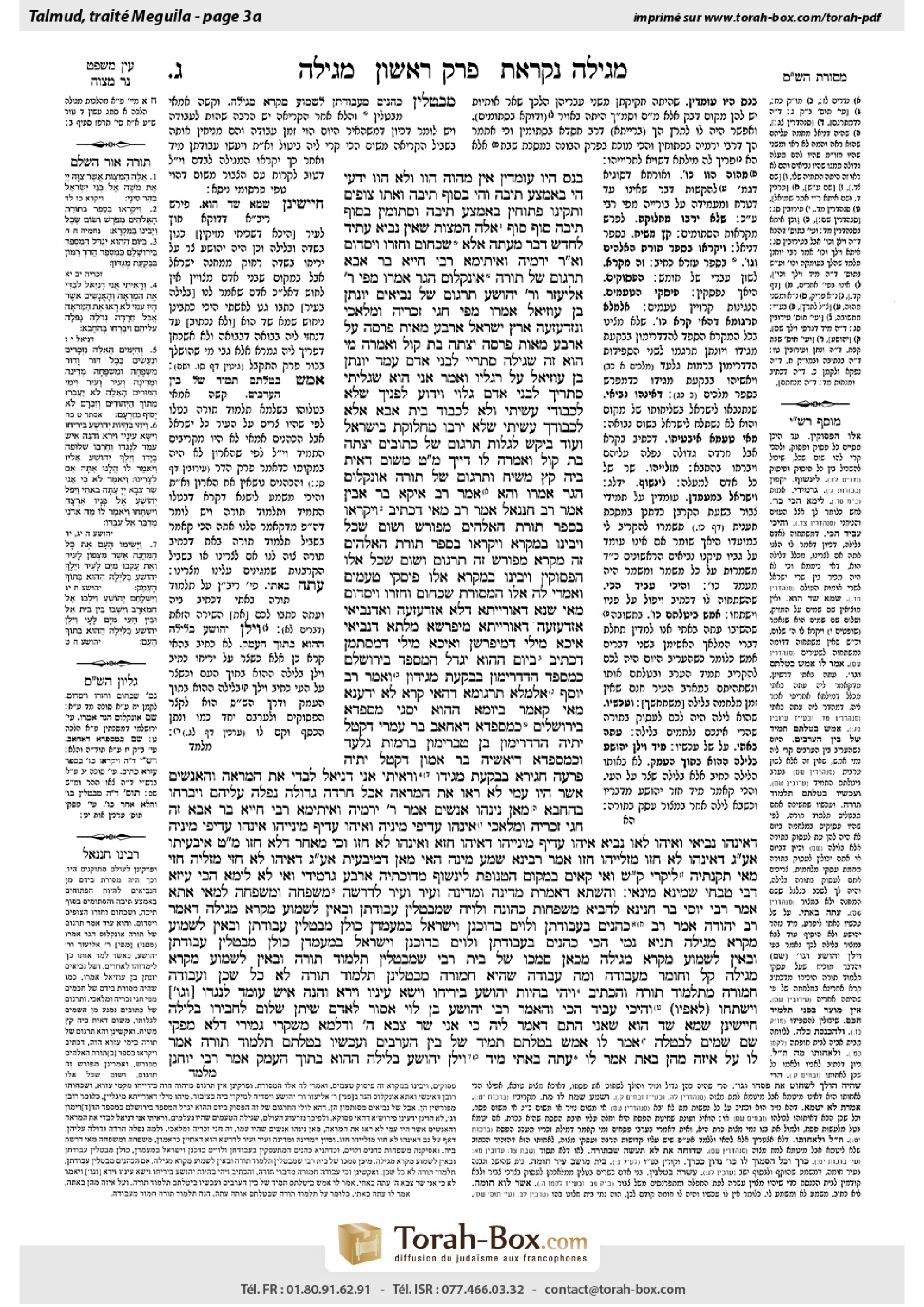
Megillah 3a: Talmud study for Daf Yomi
Daf Yomi is the daily study of one Talmud folio. Explore 37 tractates with scans, Hebrew text, Sefaria English and AI-generated French translations where annotated.
Passage selection and English or AI-generated French translation are available where the scan has annotations. Daf Study is independent of Torah-Box and Sefaria.
Browse Megillah · מגילה · All tractatesMegillah 3a text and translations
This page of Megillah includes the Aramaic text, an English translation and an AI-generated French translation, alongside the scan above.
מגילה ג׳ א · Aramaic and Hebrew text
בְּנֵס הָיוּ עוֹמְדִין!
אִין, מִהְוָה הֲווֹ, וְלָא הֲווֹ יָדְעִי הֵי בְּאֶמְצַע תֵּיבָה וְהֵי בְּסוֹף תֵּיבָה, וַאֲתוֹ צוֹפִים וְתַקִּינוּ פְּתוּחִין בְּאֶמְצַע תֵּיבָה וּסְתוּמִין בְּסוֹף תֵּיבָה.
סוֹף סוֹף ״אֵלֶּה הַמִּצְוֹת״, שֶׁאֵין נָבִיא עָתִיד לְחַדֵּשׁ דָּבָר מֵעַתָּה! אֶלָּא שְׁכָחוּם וְחָזְרוּ וְיִסְּדוּם.
וְאָמַר רַבִּי יִרְמְיָה וְאִיתֵּימָא רַבִּי חִיָּיא בַּר אַבָּא: תַּרְגּוּם שֶׁל תּוֹרָה — אוּנְקְלוֹס הַגֵּר אֲמָרוֹ מִפִּי רַבִּי אֱלִיעֶזֶר וְרַבִּי יְהוֹשֻׁעַ. תַּרְגּוּם שֶׁל נְבִיאִים — יוֹנָתָן בֶּן עוּזִּיאֵל אֲמָרוֹ מִפִּי חַגַּי זְכַרְיָה וּמַלְאָכִי, וְנִזְדַּעְזְעָה אֶרֶץ יִשְׂרָאֵל אַרְבַּע מֵאוֹת פַּרְסָה עַל אַרְבַּע מֵאוֹת פַּרְסָה. יָצְתָה בַּת קוֹל וְאָמְרָה: מִי הוּא זֶה שֶׁגִּילָּה סְתָרַיי לִבְנֵי אָדָם?
עָמַד יוֹנָתָן בֶּן עוּזִּיאֵל עַל רַגְלָיו וְאָמַר: אֲנִי הוּא שֶׁגִּלִּיתִי סְתָרֶיךָ לִבְנֵי אָדָם, גָּלוּי וְיָדוּעַ לְפָנֶיךָ שֶׁלֹּא לִכְבוֹדִי עָשִׂיתִי, וְלֹא לִכְבוֹד בֵּית אַבָּא, אֶלָּא לִכְבוֹדְךָ עָשִׂיתִי, שֶׁלֹּא יִרְבּוּ מַחֲלוֹקֹת בְּיִשְׂרָאֵל.
וְעוֹד בִּיקֵּשׁ לְגַלּוֹת תַּרְגּוּם שֶׁל כְּתוּבִים, יָצְתָה בַּת קוֹל וְאָמְרָה לוֹ: דַּיֶּיךָּ! מַאי טַעְמָא — מִשּׁוּם דְּאִית בֵּיהּ קֵץ מָשִׁיחַ.
וְתַרְגּוּם שֶׁל תּוֹרָה, אוּנְקְלוֹס הַגֵּר אֲמָרוֹ? וְהָא אָמַר רַב אִיקָא בַּר אָבִין אָמַר רַב חֲנַנְאֵל אָמַר רַב: מַאי דִּכְתִיב: ״וַיִּקְרְאוּ בְּסֵפֶר תּוֹרַת הָאֱלֹהִים מְפוֹרָשׁ וְשׂוֹם שֶׂכֶל וַיָּבִינוּ בַּמִּקְרָא״. ״וַיִּקְרְאוּ בְּסֵפֶר תּוֹרַת הָאֱלֹהִים״ — זֶה מִקְרָא; ״מְפוֹרָשׁ״ — זֶה תַּרְגּוּם;
״וְשׂוֹם שֶׂכֶל״ — אֵלּוּ הַפְּסוּקִין; ״וַיָּבִינוּ בַּמִּקְרָא״ — אֵלּוּ פִּיסְקֵי טְעָמִים, וְאָמְרִי לַהּ — אֵלּוּ הַמָּסוֹרֹת! — שְׁכָחוּם וְחָזְרוּ וְיִסְּדוּם.
מַאי שְׁנָא דְּאוֹרָיְיתָא דְּלָא אִזְדַּעְזְעָה וְאַדִּנְבִיאֵי אִזְדַּעְזְעָה? דְּאוֹרָיְיתָא — מִיפָּרְשָׁא מִלְּתָא, דִּנְבִיאֵי — אִיכָּא מִילֵּי דְּמִיפָּרְשָׁן וְאִיכָּא מִילֵּי דִּמְסַתְּמָן, דִּכְתִיב: ״בַּיּוֹם הַהוּא יִגְדַּל הַמִּסְפֵּד בִּירוּשָׁלִַם כְּמִסְפַּד הֲדַדְרִימּוֹן בְּבִקְעַת מְגִידּוֹן״,
וְאָמַר רַב יוֹסֵף: אִלְמָלֵא תַּרְגּוּמָא דְּהַאי קְרָא — לָא יָדַעְנָא מַאי קָאָמַר: בְּיוֹמָא הַהוּא יִסְגֵּי מִסְפְּדָא בִּירוּשְׁלֶים כְּמִסְפְּדָא דְּאַחְאָב בַּר עָמְרִי דִּקְטַל יָתֵיהּ הֲדַדְרִימּוֹן בֶּן טַבְרִימּוֹן בְּרָמוֹת גִּלְעָד וּכְמִסְפְּדָא דְּיֹאשִׁיָּה בַּר אָמוֹן דִּקְטַל יָתֵיהּ פַּרְעֹה חֲגִירָא בְּבִקְעַת מְגִידּוֹ.
״וְרָאִיתִי אֲנִי דָנִיֵּאל לְבַדִּי אֶת הַמַּרְאָה וְהָאֲנָשִׁים אֲשֶׁר הָיוּ עִמִּי לֹא רָאוּ אֶת הַמַּרְאָה אֲבָל חֲרָדָה גְדוֹלָה נָפְלָה עֲלֵיהֶם וַיִּבְרְחוּ בְּהֵחָבֵא״. מַאן נִינְהוּ אֲנָשִׁים? אָמַר רַבִּי יִרְמְיָה וְאִיתֵּימָא רַבִּי חִיָּיא בַּר אַבָּא: זֶה חַגַּי זְכַרְיָה וּמַלְאָכִי.
אִינְהוּ עֲדִיפִי מִינֵּיהּ, וְאִיהוּ עֲדִיף מִינַּיְיהוּ. אִינְהוּ עֲדִיפִי מִינֵּיהּ — דְּאִינְהוּ נְבִיאֵי וְאִיהוּ לָאו נָבִיא. אִיהוּ עֲדִיף מִינַּיְיהוּ — דְּאִיהוּ חֲזָא וְאִינְהוּ לָא חֲזוֹ.
וְכִי מֵאַחַר דְּלָא חֲזוֹ, מַאי טַעְמָא אִיבְּעִיתוּ? אַף עַל גַּב דְּאִינְהוּ לָא חֲזוֹ, מַזָּלַיְיהוּ חֲזוֹ.
אָמַר רָבִינָא: שְׁמַע מִינַּהּ: הַאי מַאן דְּמִיבְּעִית, אַף עַל גַּב דְּאִיהוּ לָא חָזֵי, מַזָּלֵיהּ חָזֵי. מַאי תַּקַּנְתֵּיהּ? לִיקְרֵי קְרִיאַת שְׁמַע. וְאִי קָאֵים בִּמְקוֹם הַטִּנּוֹפֶת — לִינְשׁוֹף מִדּוּכְתֵּיהּ אַרְבַּע גַּרְמִידֵי. וְאִי לָא — לֵימָא הָכִי: ״עִיזָּא דְּבֵי טַבָּחֵי שַׁמִּינָא מִינַּאי״.
וְהַשְׁתָּא דְּאָמְרַתְּ ״מְדִינָה וּמְדִינָה וְעִיר וָעִיר״ — לִדְרָשָׁה, ״מִשְׁפָּחָה וּמִשְׁפָּחָה״ לְמַאי אֲתָא? אָמַר רַבִּי יוֹסֵי בַּר חֲנִינָא: לְהָבִיא מִשְׁפְּחוֹת כְּהוּנָּה וּלְוִיָּה, שֶׁמְּבַטְּלִין עֲבוֹדָתָן וּבָאִין לִשְׁמוֹעַ מִקְרָא מְגִילָּה.
דְּאָמַר רַב יְהוּדָה אָמַר רַב: כֹּהֲנִים בַּעֲבוֹדָתָן וּלְוִיִּם בְּדוּכָנָן וְיִשְׂרָאֵל בְּמַעֲמָדָן — כּוּלָּן מְבַטְּלִין עֲבוֹדָתָן וּבָאִין לִשְׁמוֹעַ מִקְרָא מְגִילָּה.
תַּנְיָא נָמֵי הָכִי: כֹּהֲנִים בַּעֲבוֹדָתָן, וּלְוִיִּם בְּדוּכָנָן, וְיִשְׂרָאֵל בְּמַעֲמָדָן — כּוּלָּן מְבַטְּלִין עֲבוֹדָתָן וּבָאִין לִשְׁמוֹעַ מִקְרָא מְגִילָּה. מִכָּאן סָמְכוּ שֶׁל בֵּית רַבִּי שֶׁמְּבַטְּלִין תַּלְמוּד תּוֹרָה וּבָאִין לִשְׁמוֹעַ מִקְרָא מְגִילָּה, קַל וָחוֹמֶר מֵעֲבוֹדָה: וּמָה עֲבוֹדָה שֶׁהִיא חֲמוּרָה — מְבַטְּלִינַן, תַּלְמוּד תּוֹרָה לֹא כׇּל שֶׁכֵּן.
וַעֲבוֹדָה חֲמוּרָה מִתַּלְמוּד תּוֹרָה? וְהָכְתִיב: ״וַיְהִי בִּהְיוֹת יְהוֹשֻׁעַ בִּירִיחוֹ וַיִּשָּׂא עֵינָיו וַיַּרְא וְהִנֵּה אִישׁ עוֹמֵד לְנֶגְדּוֹ [וְגוֹ׳] וַיִּשְׁתָּחוּ (לְאַפָּיו)״.
וְהֵיכִי עָבֵיד הָכִי? וְהָאָמַר רַבִּי יְהוֹשֻׁעַ בֶּן לֵוִי: אָסוּר לְאָדָם שֶׁיִּתֵּן שָׁלוֹם לַחֲבֵירוֹ בַּלַּיְלָה, חָיְישִׁינַן שֶׁמָּא שֵׁד הוּא! שָׁאנֵי הָתָם דְּאָמַר לֵיהּ: ״כִּי אֲנִי שַׂר צְבָא ה׳״.
וְדִלְמָא מְשַׁקְּרִי? גְּמִירִי דְּלָא מַפְּקִי שֵׁם שָׁמַיִם לְבַטָּלָה.
אָמַר לוֹ: אֶמֶשׁ בִּטַּלְתֶּם תָּמִיד שֶׁל בֵּין הָעַרְבַּיִם, וְעַכְשָׁיו בִּטַּלְתֶּם תַּלְמוּד תּוֹרָה. אָמַר לוֹ: עַל אֵיזֶה מֵהֶן בָּאתָ? אָמַר לוֹ: ״עַתָּה בָאתִי״, מִיָּד: ״וַיָּלֶן יְהוֹשֻׁעַ בַּלַּיְלָה הַהוּא בְּתוֹךְ הָעֵמֶק״, אָמַר רַבִּי יוֹחָנָן:
Megillah 3a · English translation
stood by way of a miracle?
The Gemara answers: Yes, two forms of these letters did exist at that time, but the people did not know which one of them was to be used in the middle of the word and which at the end of the word, and the Seers came and established that the open forms are to used be in the middle of the word and the closed forms at the end of the word.
The Gemara asks: Ultimately, however, doesn’t the phrase “these are the commandments” (Leviticus 27:34) indicate that a prophet is not permitted to initiate any matter of halakha from now on? Rather, it may be suggested that the final letters already existed at the time of the giving of the Torah, but over the course of time the people forgot them, and the prophets then came and reestablished them.
§ The Gemara cites another ruling of Rabbi Yirmeya or Rabbi Ḥiyya bar Abba. Rabbi Yirmeya said, and some say that it was Rabbi Ḥiyya bar Abba who said: The Aramaic translation of the Torah used in the synagogues was composed by Onkelos the convert based on the teachings of Rabbi Eliezer and Rabbi Yehoshua. The Aramaic translation of the Prophets was composed by Yonatan ben Uzziel based on a tradition going back to the last prophets, Haggai, Zechariah, and Malachi. The Gemara relates that when Yonatan ben Uzziel wrote his translation, Eretz Yisrael quaked over an area of four hundred parasangs [parsa] by four hundred parasangs, and a Divine Voice emerged and said: Who is this who has revealed My secrets to mankind?
Yonatan ben Uzziel stood up on his feet and said: I am the one who has revealed Your secrets to mankind through my translation. However, it is revealed and known to You that I did this not for my own honor, and not for the honor of the house of my father, but rather it was for Your honor that I did this, so that discord not increase among the Jewish people. In the absence of an accepted translation, people will disagree about the meaning of obscure verses, but with a translation, the meaning will be clear.
And Yonatan ben Uzziel also sought to reveal a translation of the Writings, but a Divine Voice emerged and said to him: It is enough for you that you translated the Prophets. The Gemara explains: What is the reason that he was denied permission to translate the Writings? Because it has in it a revelation of the end, when the Messiah will arrive. The end is foretold in a cryptic manner in the book of Daniel, and were the book of Daniel translated, the end would become manifestly revealed to all.
The Gemara asks: Was the translation of the Torah really composed by Onkelos the convert? Didn’t Rav Ika bar Avin say that Rav Ḥananel said that Rav said: What is the meaning of that which is written with respect to the days of Ezra: “And they read in the book, the Torah of God, distinctly; and they gave the sense, and they caused them to understand the reading” (Nehemiah 8:8)? The verse should be understood as follows: “And they read in the book, the Torah of God,” this is the scriptural text; “distinctly,” this is the translation, indicating that they immediately translated the text into Aramaic, as was customary during public Torah readings.
“And they gave the sense,” these are the divisions of the text into separate verses. “And they caused them to understand the reading,” these are the cantillation notes, through which the meaning of the text is further clarified. And some say that these are the Masoretic traditions with regard to the manner in which each word is to be written. This indicates that the Aramaic translation already existed at the beginning of the Second Temple period, well before the time of Onkelos. The Gemara answers: The ancient Aramaic translation was forgotten and then Onkelos came and reestablished it.
The Gemara asks: What is different about the translation of Prophets? Why is it that when Onkelos revealed the translation of the Torah, Eretz Yisrael did not quake, and when he revealed the translation of the Prophets, it quaked? The Gemara explains: The meaning of matters discussed in the Torah is clear, and therefore its Aramaic translation did not reveal the meaning of passages that had not been understood previously. Conversely, in the Prophets, there are matters that are clear and there are matters that are obscure, and the Aramaic translation revealed the meaning of obscure passages. The Gemara cites an example of an obscure verse that is clarified by the Aramaic translation: As it is written: “On that day shall there be a great mourning in Jerusalem, like the mourning of Hadadrimmon in the valley of Megiddon” (Zechariah 12:11).
And with regard to that verse, Rav Yosef said: Were it not for the Aramaic translation of this verse, we would not have known what it is saying, as the Bible does not mention any incident involving Hadadrimmon in the valley of Megiddon. The Aramaic translation reads as follows: On that day, the mourning in Jerusalem will be as great as the mourning for Ahab, son of Omri, who was slain by Hadadrimmon, son of Tavrimon, in Ramoth-Gilead, and like the mourning for Josiah, son of Amon, who was slain by Pharaoh the lame in the valley of Megiddon. The translation clarifies that the verse is referring to two separate incidents of mourning, and thereby clarifies the meaning of this verse.
§ The Gemara introduces another statement from the same line of tradition. The verse states: “And I, Daniel, alone saw the vision, for the men who were with me did not see the vision; but a great trembling fell upon them, so that they fled to hide themselves” (Daniel 10:7). Who were these men? The term “men” in the Bible indicates important people; who were they? Rabbi Yirmeya said, and some say that it was Rabbi Ḥiyya bar Abba who said: These are the prophets Haggai, Zechariah, and Malachi.
The Gemara comments: In certain ways they, the prophets, were greater than him, Daniel, and in certain ways he, Daniel, was greater than them. They were greater than him, as they were prophets and he was not a prophet. Haggai, Zechariah, and Malachi were sent to convey the word of God to the Jewish people, while Daniel was not sent to reveal his visions to others. In another way, however, he was greater than them, as he saw this vision, and they did not see this vision, indicating that his ability to perceive obscure and cryptic visions was greater than theirs.
The Gemara asks: Since they did not see the vision, what is the reason that they were frightened? The Gemara answers: Even though they did not see the vision, their guardian angels saw it, and therefore they sensed that there was something fearful there and they fled.
Ravina said: Learn from this incident that with regard to one who is frightened for no apparent reason, although he does not see anything menacing, his guardian angel sees it, and therefore he should take steps in order to escape the danger. The Gemara asks: What is his remedy? He should recite Shema, which will afford him protection. And if he is standing in a place of filth, where it is prohibited to recite verses from the Torah, he should distance himself four cubits from his current location in order to escape the danger. And if he is not able to do so, let him say the following incantation: The goat of the slaughterhouse is fatter than I am, and if a calamity must fall upon something, it should fall upon it.
§ After this digression, the Gemara returns to the exposition of a verse cited above. Now that you have said that the phrases “every province” and “every city” appear for the purposes of midrashic exposition, for what exposition do the words “every family” appear in that same verse (Esther 9:28)? Rabbi Yosei bar Ḥanina said: These words come to include the priestly and Levitical families, and indicate that they cancel their service in the Temple and come to hear the reading of the Megilla.
As Rav Yehuda said that Rav said: The priests at their Temple service, the Levites on their platform in the Temple, where they sung the daily psalm, and the Israelites at their watches, i.e., the group of Israelites, corresponding to the priestly watches, who would come to Jerusalem and gather in other locations as representatives of the entire nation to observe or pray for the success of the Temple service, all cancel their service and come to hear the reading of the Megilla.
This is also taught in a baraita: The priests at their service, the Levites on the platform, and the Israelites at their watches, all cancel their service and come to hear the reading of the Megilla. The Sages of the house of Rabbi Yehuda HaNasi relied upon the halakha stated here and determined that one cancels his Torah study and comes to hear the reading of the Megilla. They derived this principle by means of an a fortiori inference from the Temple service: Just as one who is engaged in performing service in the Temple, which is very important, cancels his service in order to hear the Megilla, is it not all the more so obvious that one who is engaged in Torah study cancels his study to hear the Megilla?
The Gemara asks: Is the Temple service more important than Torah study? Isn’t it written: “And it came to pass when Joshua was by Jericho that he lifted up his eyes and looked, and behold, a man stood over against him with his sword drawn in his hand. And Joshua went over to him and said to him: Are you for us, or for our adversaries? And he said, No, but I am captain of the host of the Lord, I have come now. And Joshua fell on his face to the earth, and bowed down” (Joshua 5:13–14).
The Gemara first seeks to clarify the incident described in the verse. How did Joshua do this, i.e., how could he bow to a figure he did not recognize? Didn’t Rabbi Yehoshua ben Levi say: It is prohibited for a person to greet his fellow at night if he does not recognize him, as we are concerned that perhaps it is a demon? How did Joshua know that it was not a demon? The Gemara answers: There it was different, as the visitor said to him: But I am captain of the host of the Lord.
The Gemara asks: Perhaps this was a demon and he lied? The Gemara answers: It is learned as a tradition that demons do not utter the name of Heaven for naught, and therefore since the visitor had mentioned the name of God, Joshua was certain that this was indeed an angel.
As for the angel’s mission, the Gemara explains that the angel said to Joshua: Yesterday, i.e., during the afternoon, you neglected the afternoon daily offering due to the impending battle, and now, at night, you have neglected Torah study, and I have come to rebuke you. Joshua said to him: For which of these sins have you come? He said to him: I have come now, indicating that neglecting Torah study is more severe than neglecting to sacrifice the daily offering. Joshua immediately determined to rectify the matter, as the verses states: “And Joshua lodged that night” (Joshua 8:9) “in the midst of the valley [ha’emek]” (Joshua 8:13), and Rabbi Yoḥanan said:
Megillah 3a · Traduction française (IA)
tenaient-ils par miracle ?
La Guemara répond : Oui, ces deux formes de lettres existaient à cette époque, mais les gens ne savaient pas laquelle employer au milieu d’un mot et laquelle à la fin. Les Voyants vinrent alors et établirent que les formes ouvertes s’emploient au milieu des mots et les formes fermées à la fin.
Cependant, demande la Guemara, l’expression « voici les commandements » (Lévitique 27:34) n’indique-t-elle pas qu’un prophète n’est plus autorisé, désormais, à instituer aucune règle de halakha ? Il faut plutôt suggérer que les lettres finales existaient déjà au moment du don de la Torah, mais que le peuple les oublia au fil du temps ; les prophètes vinrent alors les rétablir.
§ La Guemara cite un autre enseignement de Rabbi Yirmeya ou de Rabbi Ḥiyya bar Abba. Rabbi Yirmeya dit — certains rapportent que c’est Rabbi Ḥiyya bar Abba qui l’a dit — que la traduction araméenne de la Torah utilisée dans les synagogues fut composée par Onkelos le converti, d’après les enseignements de Rabbi Eliezer et de Rabbi Yehoshua. La traduction araméenne des Prophètes fut composée par Yonatan ben Uzziel, selon une tradition remontant aux derniers prophètes, Haggai, Zechariah et Malachi. La Guemara rapporte que, lorsque Yonatan ben Uzziel écrivit sa traduction, Eretz Yisrael trembla sur une étendue de quatre cents parasanges [parsa] sur quatre cents parasanges, et qu’une Voix divine se fit entendre et dit : « Qui est celui qui a révélé Mes secrets aux hommes ? »
Yonatan ben Uzziel se leva et dit : « C’est moi qui ai révélé Tes secrets aux hommes par ma traduction. Toutefois, il est révélé et connu de Toi que je n’ai pas agi pour mon propre honneur ni pour celui de la maison de mon père ; je l’ai fait pour Ton honneur, afin que les dissensions ne se multiplient pas au sein du peuple juif. En l’absence d’une traduction reconnue, les gens seraient en désaccord sur le sens des versets obscurs ; grâce à une traduction, leur sens sera clair. »
Yonatan ben Uzziel chercha également à révéler une traduction des Écrits, mais une Voix divine se fit entendre et lui dit : « Il te suffit d’avoir traduit les Prophètes. » La Guemara explique : Pourquoi lui refusa-t-on l’autorisation de traduire les Écrits ? Parce que ceux-ci révèlent la fin, c’est-à-dire le moment où le Messie arrivera. La fin est annoncée de manière cryptique dans le livre de Daniel ; si ce livre était traduit, la fin serait clairement dévoilée à tous.
La Guemara demande : La traduction de la Torah fut-elle vraiment composée par Onkelos le converti ? Rav Ika bar Avin n’a-t-il pas dit que Rav Ḥananel avait dit au nom de Rav : Que signifie ce qui est écrit au sujet de l’époque d’Ezra : « Ils lisaient dans le livre, la Torah de Dieu, distinctement ; ils en donnaient le sens et faisaient comprendre la lecture » (Néhémie 8:8) ? Le verset doit s’entendre ainsi : « Ils lisaient dans le livre, la Torah de Dieu » désigne le texte de la Torah écrite ; « distinctement » désigne la traduction, ce qui indique qu’ils traduisaient aussitôt le texte en araméen, comme il était d’usage lors des lectures publiques de la Torah.
« Ils en donnaient le sens » désigne la division du texte en versets distincts. « Ils faisaient comprendre la lecture » désigne les signes de cantillation, qui précisent davantage le sens du texte. Certains disent qu’il s’agit des traditions massorétiques concernant la manière dont chaque mot doit être écrit. Cela indique que la traduction araméenne existait déjà au début de la période du Second Temple, bien avant l’époque d’Onkelos. La Guemara répond : L’ancienne traduction araméenne fut oubliée, puis Onkelos vint la rétablir.
La Guemara demande : Qu’est-ce qui distingue la traduction des Prophètes ? Pourquoi Eretz Yisrael ne trembla-t-elle pas quand Onkelos révéla la traduction de la Torah, alors qu’elle trembla quand il révéla celle des Prophètes ? La Guemara explique : Le sens des sujets abordés dans la Torah est clair ; sa traduction araméenne ne révéla donc pas le sens de passages qui n’avaient pas été compris auparavant. En revanche, dans les Prophètes, certains sujets sont clairs et d’autres obscurs, et la traduction araméenne dévoila le sens des passages obscurs. La Guemara donne l’exemple d’un verset obscur que la traduction araméenne clarifie, comme il est écrit : « En ce jour, il y aura à Jérusalem un grand deuil, comme le deuil de Hadadrimmon dans la vallée de Megiddon » (Zacharie 12:11).
Au sujet de ce verset, Rav Yosef dit : Sans sa traduction araméenne, nous n’aurions pas su ce qu’il signifie, car la Bible ne mentionne aucun événement impliquant Hadadrimmon dans la vallée de Megiddon. La traduction araméenne dit : « En ce jour, le deuil à Jérusalem sera aussi grand que celui d’Achab, fils d’Omri, tué par Hadadrimmon, fils de Tavrimon, à Ramoth-Galaad, et que celui de Josias, fils d’Amon, tué par Pharaon le boiteux dans la vallée de Megiddon. » La traduction précise que le verset fait référence à deux événements distincts marqués par le deuil, et clarifie ainsi son sens.
§ La Guemara introduit un autre enseignement issu de la même tradition. Le verset dit : « Et moi, Daniel, je fus seul à voir la vision ; les hommes qui étaient avec moi ne la virent pas, mais une grande terreur s’abattit sur eux, et ils s’enfuirent pour se cacher » (Daniel 10:7). Qui étaient ces hommes ? Dans la Bible, le terme « hommes » désigne des personnages importants ; qui étaient-ils ? Rabbi Yirmeya dit — certains rapportent que c’est Rabbi Ḥiyya bar Abba qui l’a dit — qu’il s’agit des prophètes Haggai, Zechariah et Malachi.
La Guemara fait remarquer : À certains égards, eux, les prophètes, étaient supérieurs à Daniel, et à d’autres égards, Daniel leur était supérieur. Ils lui étaient supérieurs parce qu’ils étaient prophètes, tandis que lui ne l’était pas. Haggai, Zechariah et Malachi avaient été envoyés pour transmettre la parole de Dieu au peuple juif, tandis que Daniel n’avait pas été envoyé pour révéler ses visions à autrui. Cependant, sous un autre rapport, Daniel leur était supérieur, car il vit cette vision, tandis qu’eux ne la virent pas, ce qui indique qu’il était plus apte qu’eux à percevoir des visions obscures et cryptiques.
La Guemara demande : Puisqu’ils n’ont pas vu la vision, pourquoi furent-ils effrayés ? La Guemara répond : Bien qu’ils n’aient pas vu la vision, leurs anges gardiens l’ont vue ; ils sentirent donc qu’il y avait là quelque chose d’effrayant et s’enfuirent.
Ravina dit : On apprend de cet épisode que lorsqu’une personne est effrayée sans raison apparente, bien qu’elle ne voie rien de menaçant, son ange gardien voit quelque chose ; elle doit donc prendre des mesures pour échapper au danger. La Guemara demande : Quel remède peut-elle appliquer ? Elle doit réciter le Chéma, qui la protégera. Si elle se trouve dans un lieu de souillure, où il est interdit de réciter des versets de la Torah, elle doit s’éloigner de quatre coudées de l’endroit où elle se trouve afin d’échapper au danger. Et si elle ne peut pas le faire, qu’elle prononce cette formule : « Le bouc de l’abattoir est plus gras que moi ; si un malheur doit s’abattre sur quelque chose, qu’il s’abatte sur lui. »
§ Après cette digression, la Guemara revient à l’explication d’un verset cité plus haut. Maintenant que vous avez dit que les expressions « chaque province » et « chaque ville » apparaissent à des fins d’exégèse, à quelle exégèse sert l’expression « chaque famille » dans ce même verset (Esther 9:28) ? Rabbi Yosei bar Ḥanina dit : Ces mots incluent les familles sacerdotales et lévitiques, et indiquent qu’elles interrompent leur service au Temple pour venir écouter la lecture de la Meguila.
Car Rav Yehuda a dit au nom de Rav : Les prêtres interrompent leur service au Temple, les Lévites quittent leur estrade dans le Temple, où ils chantaient le psaume quotidien, et les Israélites interrompent leurs gardes — c’est-à-dire les groupes d’Israélites correspondant aux gardes sacerdotales, qui venaient à Jérusalem et se rassemblaient en d’autres lieux en tant que représentants de toute la nation, pour observer le service du Temple ou prier pour sa réussite — ; tous interrompent leur service et viennent écouter la lecture de la Meguila.
Cela est également enseigné dans une baraïta : Les prêtres interrompent leur service, les Lévites quittent l’estrade et les Israélites leurs gardes ; tous interrompent leur service et viennent écouter la lecture de la Meguila. Les Sages de la maison de Rabbi Yehuda HaNasi s’appuyèrent sur la halakha énoncée ici et déterminèrent que l’on interrompt son étude de la Torah pour venir écouter la lecture de la Meguila. Ils déduisirent ce principe au moyen d’un raisonnement a fortiori à partir du service du Temple : si celui qui accomplit le service dans le Temple, qui est très important, l’interrompt pour écouter la Meguila, n’est-il pas d’autant plus évident que celui qui étudie la Torah interrompt son étude pour écouter la Meguila ?
La Guemara demande : Le service du Temple est-il plus important que l’étude de la Torah ? N’est-il pas écrit : « Or, il arriva, alors que Josué se trouvait près de Jéricho, qu’il leva les yeux et regarda : voici qu’un homme se tenait devant lui, son épée dégainée à la main. Josué s’approcha de lui et lui dit : “Es-tu avec nous ou avec nos adversaires ?” Il répondit : “Non, mais je suis le chef de l’armée du Seigneur ; je viens d’arriver.” Josué tomba face contre terre et se prosterna » (Josué 5:13–14).
La Guemara cherche d’abord à clarifier l’épisode décrit dans le verset. Comment Josué a-t-il pu faire cela, c’est-à-dire se prosterner devant une figure qu’il ne reconnaissait pas ? Rabbi Yehoshua ben Levi n’a-t-il pas dit qu’il est interdit à une personne de saluer son prochain la nuit si elle ne le reconnaît pas, car on craint qu’il ne s’agisse d’un démon ? Comment Josué sut-il qu’il ne s’agissait pas d’un démon ? La Guemara répond : Dans ce cas, la situation était différente, car le visiteur lui dit : « Non, mais je suis le chef de l’armée du Seigneur. »
La Guemara demande : Peut-être était-ce un démon qui mentait ? La Guemara répond : La tradition enseigne que les démons ne prononcent pas le nom du Ciel sans raison ; puisque le visiteur avait mentionné le nom de Dieu, Josué était donc certain qu’il s’agissait bien d’un ange.
Quant à la mission de l’ange, la Guemara explique que celui-ci dit à Josué : « Hier, c’est-à-dire dans l’après-midi, tu as négligé le sacrifice quotidien de l’après-midi en raison de la bataille imminente, et maintenant, pendant la nuit, tu as négligé l’étude de la Torah. Je suis venu te réprimander. » Josué lui demanda : « Pour laquelle de ces fautes es-tu venu ? » L’ange lui répondit : « Je viens d’arriver », indiquant que négliger l’étude de la Torah est plus grave que négliger d’offrir le sacrifice quotidien. Josué s’empressa de remédier à la situation, comme l’indiquent les versets : « Et Josué passa la nuit » (Josué 8:9), « au milieu de la vallée [ha’emek] » (Josué 8:13). Et Rabbi Yoḥanan dit :
Traduction française générée par IA à partir de l’édition anglaise de Sefaria. Vérifie toujours un passage avec le texte source.
Text from Sefaria: William Davidson Edition - Vocalized Aramaic (CC BY NC); William Davidson Edition - English (CC BY NC).