Megillah 3b: Talmud study for Daf Yomi
Daf Yomi is the daily study of one Talmud folio. Explore 37 tractates with scans, Hebrew text, Sefaria English and AI-generated French translations where annotated.
Passage selection and English or AI-generated French translation are available where the scan has annotations. Daf Study is independent of Torah-Box and Sefaria.
Browse Megillah · מגילה · All tractatesMegillah 3b text and translations
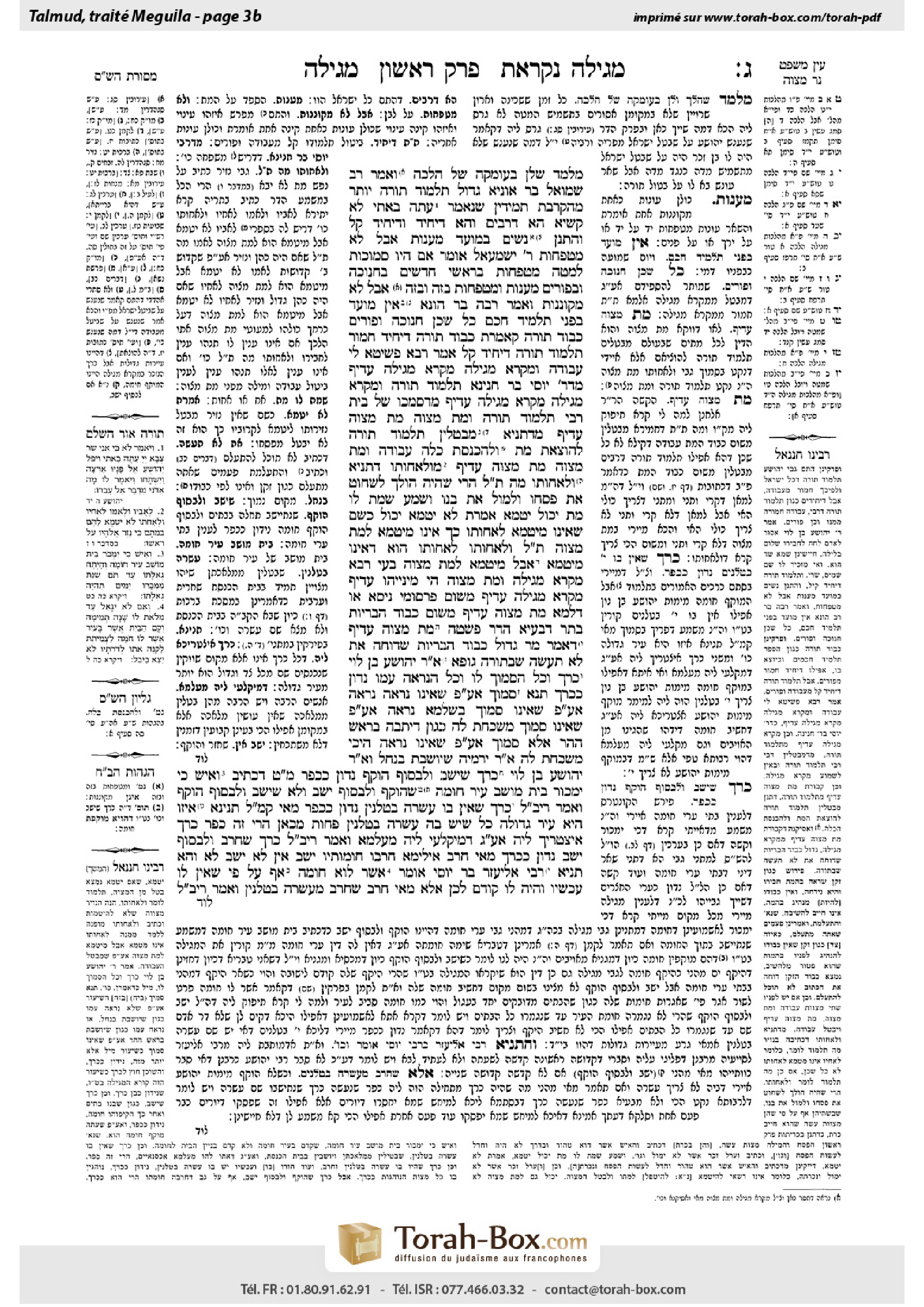
This page of Megillah includes the Aramaic text, an English translation and an AI-generated French translation, alongside the scan above.
מגילה ג׳ ב · Aramaic and Hebrew text
מְלַמֵּד שֶׁלָּן בְּעוּמְקָהּ שֶׁל הֲלָכָה. וְאָמַר רַב שְׁמוּאֵל בַּר אוּנְיָא: גָּדוֹל תַּלְמוּד תּוֹרָה יוֹתֵר מֵהַקְרָבַת תְּמִידִין, שֶׁנֶּאֱמַר: ״עַתָּה בָאתִי״!
לָא קַשְׁיָא: הָא דְּרַבִּים, וְהָא דְּיָחִיד.
וּדְיָחִיד קַל? וְהָתְנַן: נָשִׁים בַּמּוֹעֵד מְעַנּוֹת אֲבָל לֹא מְטַפְּחוֹת, רַבִּי יִשְׁמָעֵאל אוֹמֵר: אִם הָיוּ סְמוּכוֹת לַמִּטָּה — מְטַפְּחוֹת. בְּרָאשֵׁי חֳדָשִׁים בַּחֲנוּכָּה וּבְפוּרִים, מְעַנּוֹת וּמְטַפְּחוֹת בָּזֶה וּבָזֶה, אֲבָל לֹא מְקוֹנְנוֹת.
וְאָמַר רַבָּה בַּר הוּנָא: אֵין מוֹעֵד בִּפְנֵי תַּלְמִיד חָכָם — כׇּל שֶׁכֵּן חֲנוּכָּה וּפוּרִים.
כְּבוֹד תּוֹרָה קָאָמְרַתְּ. כְּבוֹד תּוֹרָה דְּיָחִיד — חָמוּר, תַּלְמוּד תּוֹרָה דְּיָחִיד — קַל.
אָמַר רָבָא, פְּשִׁיטָא לִי: עֲבוֹדָה וּמִקְרָא מְגִילָּה — מִקְרָא מְגִילָּה עֲדִיף, מִדְּרַבִּי יוֹסֵי בַּר חֲנִינָא. תַּלְמוּד תּוֹרָה וּמִקְרָא מְגִילָּה — מִקְרָא מְגִילָּה עֲדִיף, מִדְּסָמְכוּ שֶׁל בֵּית רַבִּי.
תַּלְמוּד תּוֹרָה וּמֵת מִצְוָה — מֵת מִצְוָה עֲדִיף, מִדְּתַנְיָא: מְבַטְּלִין תַּלְמוּד תּוֹרָה לְהוֹצָאַת מֵת, וּלְהַכְנָסַת כַּלָּה. עֲבוֹדָה וּמֵת מִצְוָה — מֵת מִצְוָה עֲדִיף, מִ״וּלְאַחוֹתוֹ״.
דְּתַנְיָא: ״וּלְאַחוֹתוֹ״ מַה תַּלְמוּד לוֹמַר? הֲרֵי שֶׁהָיָה הוֹלֵךְ לִשְׁחוֹט אֶת פִּסְחוֹ וְלָמוּל אֶת בְּנוֹ, וְשָׁמַע שֶׁמֵּת לוֹ מֵת, יָכוֹל יִטַּמָּא —
אָמַרְתָּ: ״לֹא יִטַּמָּא״. יָכוֹל כְּשֵׁם שֶׁאֵינוֹ מִיטַּמֵּא לַאֲחוֹתוֹ, כָּךְ אֵינוֹ מִיטַּמֵּא לְמֵת מִצְוָה — תַּלְמוּד לוֹמַר: ״וּלְאַחוֹתוֹ״. לַאֲחוֹתוֹ הוּא דְּאֵינוֹ מִיטַּמֵּא, אֲבָל מִיטַּמֵּא לְמֵת מִצְוָה.
בָּעֵי רָבָא: מִקְרָא מְגִילָּה וּמֵת מִצְוָה הֵי מִינַּיְיהוּ עֲדִיף? מִקְרָא מְגִילָּה עֲדִיף מִשּׁוּם פַּרְסוֹמֵי נִיסָּא, אוֹ דִּלְמָא מֵת מִצְוָה עֲדִיף מִשּׁוּם כְּבוֹד הַבְּרִיּוֹת? בָּתַר דְּבַעְיָא הֲדַר פַּשְׁטַהּ: מֵת מִצְוָה עֲדִיף, דְּאָמַר מָר: גָּדוֹל כְּבוֹד הַבְּרִיּוֹת שֶׁדּוֹחֶה אֶת לֹא תַעֲשֶׂה שֶׁבַּתּוֹרָה.
גּוּפָא, אָמַר רַבִּי יְהוֹשֻׁעַ בֶּן לֵוִי: כְּרַךְ, וְכׇל הַסָּמוּךְ לוֹ, וְכׇל הַנִּרְאֶה עִמּוֹ — נִדּוֹן כִּכְרַךְ. תָּנָא: סָמוּךְ — אַף עַל פִּי שֶׁאֵינוֹ נִרְאֶה, נִרְאֶה — אַף עַל פִּי שֶׁאֵינוֹ סָמוּךְ.
בִּשְׁלָמָא נִרְאֶה אַף עַל פִּי שֶׁאֵינוֹ סָמוּךְ, מַשְׁכַּחַתְּ לַהּ כְּגוֹן דְּיָתְבָה בְּרֹאשׁ הָהָר. אֶלָּא סָמוּךְ אַף עַל פִּי שֶׁאֵינוֹ נִרְאֶה הֵיכִי מַשְׁכַּחַתְּ לַהּ? אָמַר רַבִּי יִרְמְיָה: שֶׁיּוֹשֶׁבֶת בַּנַּחַל.
וְאָמַר רַבִּי יְהוֹשֻׁעַ בֶּן לֵוִי: כְּרַךְ שֶׁיָּשַׁב וּלְבַסּוֹף הוּקַּף — נִדּוֹן כִּכְפָר. מַאי טַעְמָא? דִּכְתִיב: ״וְאִישׁ כִּי יִמְכּוֹר בֵּית מוֹשַׁב עִיר חוֹמָה״, שֶׁהוּקַּף וּלְבַסּוֹף יָשַׁב, וְלֹא שֶׁיָּשַׁב וּלְבַסּוֹף הוּקַּף.
וְאָמַר רַבִּי יְהוֹשֻׁעַ בֶּן לֵוִי: כְּרַךְ שֶׁאֵין בּוֹ עֲשָׂרָה בַּטְלָנִין — נִדּוֹן כִּכְפָר. מַאי קָא מַשְׁמַע לַן? תְּנֵינָא: אֵיזוֹ הִיא עִיר גְּדוֹלָה — כֹּל שֶׁיֵּשׁ בָּהּ עֲשָׂרָה בַּטְלָנִין. פָּחוֹת מִכָּאן, הֲרֵי זֶה כְּפָר? כְּרַךְ אִיצְטְרִיךְ לֵיהּ, אַף עַל גַּב דְּמִיקַּלְעִי לֵיהּ מֵעָלְמָא.
וְאָמַר רַבִּי יְהוֹשֻׁעַ בֶּן לֵוִי: כְּרַךְ שֶׁחָרַב וּלְבַסּוֹף יָשַׁב נִדּוֹן כִּכְרַךְ. מַאי חָרַב? אִילֵּימָא חָרְבוּ חוֹמוֹתָיו: יָשַׁב — אִין, לֹא יָשַׁב — לָא? וְהָא תַּנְיָא, רַבִּי אֱלִיעֶזֶר בַּר יוֹסֵי אוֹמֵר: ״אֲשֶׁר לוֹא חוֹמָה״, אַף עַל פִּי שֶׁאֵין לוֹ עַכְשָׁיו וְהָיָה לוֹ קוֹדֶם לָכֵן.
אֶלָּא מַאי ״חָרַב״ — שֶׁחָרַב מֵעֲשָׂרָה בַּטְלָנִין.
וְאָמַר רַבִּי יְהוֹשֻׁעַ בֶּן לֵוִי:
Megillah 3b · English translation
This teaches that he spent the night in the depths [be’umeka] of halakha, i.e., that he spent the night studying Torah with the Jewish people. And Rav Shmuel bar Unya said: Torah study is greater than sacrificing the daily offerings, as it is stated: “I have come now” (Joshua 5:14), indicating that the angel came to rebuke Joshua for neglecting Torah study and not for neglecting the daily offering. Consequently, how did the Sages of the house of Rabbi Yehuda HaNasi determine that the Temple service is more important than Torah study?
The Gemara explains that it is not difficult. This statement, with regard to the story of Joshua, is referring to Torah study by the masses, which is greater than the Temple service. That statement of the Sages of the house of Rabbi Yehuda HaNasi is referring to Torah study by an individual, which is less significant than the Temple service.
The Gemara asks: Is the Torah study of an individual a light matter? Didn’t we learn in a mishna: On the intermediate days of a Festival, women may lament the demise of the deceased in unison, but they may not clap their hands in mourning? Rabbi Yishmael says: Those that are close to the bier may clap. On the New Moon, on Hanukkah, and on Purim, which are not mandated by Torah law, they may both lament and clap their hands in mourning. However, on both groups of days, they may not wail responsively, a form of wailing where one woman wails and the others repeat after her.
And Rabba bar Huna said: All these regulations were said with regard to an ordinary person, but there are no restrictions on expressions of mourning on the intermediate days of a Festival in the presence of a deceased Torah scholar. If a Torah scholar dies on the intermediate days of a Festival, the women may lament, clap, and wail responsively as on any other day, and all the more so on Hanukkah and Purim. This indicates that even the Torah study of an individual is of great importance.
The Gemara rejects this argument: You speak of the honor that must be shown to the Torah, and indeed, the honor that must be shown to the Torah in the case of an individual Torah scholar is important; but the Torah study of an individual in itself is light and is less significant than the Temple service.
§ Rava said: It is obvious to me that if one must choose between Temple service and reading the Megilla, reading the Megilla takes precedence, based upon the exposition of Rabbi Yosei bar Ḥanina with regard to the phrase “every family” (Esther 9:28). Similarly, if one must choose between Torah study and reading the Megilla, reading the Megilla takes precedence, based upon the fact that the Sages of the house of Rabbi Yehuda HaNasi relied on Rabbi Yosei bar Ḥanina’s exposition to rule that one interrupts Torah study to hear the reading of the Megilla.
Furthermore, it is obvious that if one must choose between Torah study and tending to a corpse with no one to bury it [met mitzva], the task of burying the met mitzva takes precedence. This is derived from that which is taught in a baraita: One cancels his Torah study to bring out a corpse for burial, and to join a wedding procession and bring in the bride. Similarly, if one must choose between the Temple service and tending to a met mitzva, tending to the met mitzva takes precedence, based upon the halakha derived from the term “or for his sister” (Numbers 6:7).
As it is taught in a baraita with regard to verses addressing the laws of a nazirite: “All the days that he consecrates himself to the Lord, he shall not come near to a dead body. For his father, or for his mother, for his brother, or for his sister, he shall not make himself ritually impure for them when they die” (Numbers 6:6–7). What is the meaning when the verse states “or for his sister”? The previous verse, which states that the nazirite may not come near a dead body, already prohibits him from becoming impure through contact with his sister. Therefore, the second verse is understood to be teaching a different halakha: One who was going to slaughter his Paschal lamb or to circumcise his son, and he heard that a relative of his died, one might have thought that he should return and become ritually impure with the impurity imparted by a corpse.
You said: He shall not become impure; the death of his relative will not override so significant a mitzva from the Torah. One might have thought: Just as he does not become impure for his sister, so he does not become impure for a corpse with no one to bury it [met mitzva]. The verse states: “Or for his sister”; he may not become impure for his sister, as someone else can attend to her burial, but he does become impure for a met mitzva.
On the basis of these premises, Rava raised a dilemma: If one must choose between reading the Megilla and tending to a met mitzva, which of them takes precedence? Does reading the Megilla take precedence due to the value of publicizing the miracle, or perhaps burying the met mitzva takes precedence due to the value of preserving human dignity? After he raised the dilemma, Rava then resolved it on his own and ruled that attending to a met mitzva takes precedence, as the Master said: Great is human dignity, as it overrides a prohibition in the Torah. Consequently, it certainly overrides the duty to read the Megilla, despite the fact that reading the Megilla publicizes the miracle.
§ The Gemara examines the matter itself cited in the course of the previous discussion. Rabbi Yehoshua ben Levi said: A walled city, and all settlements adjacent to it, and all settlements that can be seen with it, i.e., that can be seen from the walled city, are considered like the walled city, and the Megilla is read on the fifteenth. It was taught in the Tosefta: This is the halakha with regard to a settlement adjacent to a walled city, although it cannot be seen from it, and also a place that can be seen from the walled city, although it is not adjacent to it.
The Gemara examines the Tosefta: Granted that with regard to a place that can be seen from the walled city, although it is not adjacent to it, you find it where the place is located on the top of a mountain, and therefore it can be seen from the walled city, although it is at some distance from it. However, with regard to a settlement that is adjacent to a walled city although it cannot be seen from it, how can you find these circumstances? Rabbi Yirmeya said: You find it, for example, where the place is located in a valley, and therefore it is possible that it cannot be seen from the walled city, although it is very close to it.
And Rabbi Yehoshua ben Levi said: A walled city that was initially settled and only later surrounded by a wall is considered a village rather than a walled city. What is the reason? As it is written: “And if a man sells a residential house in a walled city” (Leviticus 25:29). The wording of the verse indicates that it is referring to a place that was first surrounded by a wall and only later settled, and not to a place that was first settled and only later surrounded by a wall.
And Rabbi Yehoshua ben Levi said: A walled city that does not have ten idlers, i.e., individuals who do not work and are available to attend to communal needs, is treated as a village. The Gemara asks: What is he teaching us? We already learned in a mishna (5a): What is a large city? Any city in which there are ten idlers; however, if there are fewer than that, it is a village. The Gemara answers: Nevertheless, it was necessary for Rabbi Yehoshua ben Levi to teach this halakha with regard to a large city, to indicate that even if idlers happen to come there from elsewhere, since they are not local residents, it is still considered a village.
And Rabbi Yehoshua ben Levi also said: A walled city that was destroyed and then later settled is considered a city. The Gemara asks: What is meant by the term destroyed? If we say that the city’s walls were destroyed, and Rabbi Yehoshua ben Levi comes to teach us that if it was settled, yes it is treated as a walled city, but if it was not settled, it is not treated that way, there is a difficulty. Isn’t it taught in a baraita that Rabbi Eliezer bar Yosei says: The verse states: “Which has [lo] a wall (Leviticus 25:30),” and the word lo is written with an alef, which means no, but in context the word lo is used as though it was written with a vav, meaning that it has a wall. This indicates that even though the city does not have a wall now, as the wall was destroyed, if it had a wall before, it retains its status as a walled city.
Rather, what is meant by the term destroyed? That it was destroyed in the sense that it no longer has ten idlers, and therefore it is treated like a village. However, once it has ten idlers again, it is treated like a city.
And Rabbi Yehoshua ben Levi said:
Megillah 3b · Traduction française (IA)
Cela enseigne qu’il passa la nuit dans les profondeurs [be’umeka] de la halakha, c’est-à-dire qu’il passa la nuit à étudier la Torah avec le peuple juif. Rav Shmuel bar Unya dit : L’étude de la Torah est supérieure à l’offrande des sacrifices quotidiens, comme il est dit : « Je suis venu maintenant » (Josué 5:14), ce qui indique que l’ange vint réprimander Josué pour avoir négligé l’étude de la Torah, et non pour avoir négligé l’offrande quotidienne. Dès lors, comment les Sages de la maison de Rabbi Yehuda HaNasi ont-ils déterminé que le service du Temple est supérieur à l’étude de la Torah ?
La Guemara explique que ce n’est pas difficile. La déclaration concernant l’épisode de Josué se rapporte à l’étude de la Torah par le grand public, qui est supérieure au service du Temple. La déclaration des Sages de la maison de Rabbi Yehuda HaNasi, elle, se rapporte à l’étude de la Torah par un particulier, qui est moins importante que le service du Temple.
La Guemara demande : L’étude de la Torah par un particulier est-elle donc chose négligeable ? N’avons-nous pas appris dans une Michna : Pendant les jours intermédiaires d’une fête, les femmes peuvent se lamenter ensemble sur le décès d’un défunt, mais elles ne peuvent pas frapper dans leurs mains en signe de deuil ? Rabbi Yishmael dit : Celles qui se trouvent près du cercueil peuvent frapper dans leurs mains. À Roch ‘Hodech, à Hanoucca et à Pourim, qui ne sont pas prescrits par la Torah, elles peuvent à la fois se lamenter et frapper dans leurs mains en signe de deuil. Toutefois, ces deux catégories de jours, elles ne peuvent pas pousser des lamentations en réponse, une forme de lamentation où une femme se lamente et où les autres répètent après elle.
Rabba bar Huna dit : Toutes ces règles ont été énoncées au sujet d’une personne ordinaire, mais il n’y a aucune restriction aux manifestations de deuil pendant les jours intermédiaires d’une fête en présence d’un érudit de la Torah décédé. Si un érudit de la Torah meurt pendant les jours intermédiaires d’une fête, les femmes peuvent se lamenter, frapper dans leurs mains et pousser des lamentations en réponse comme n’importe quel autre jour, et à plus forte raison à Hanoucca et à Pourim. Cela indique que même l’étude de la Torah par un particulier revêt une grande importance.
La Guemara rejette cet argument : tu parles de l’honneur dû à la Torah, et, effectivement, l’honneur dû à la Torah dans le cas d’un érudit de la Torah pris individuellement est important ; mais l’étude de la Torah par un particulier, en elle-même, est chose négligeable et moins importante que le service du Temple.
§ Rava dit : Il m’est évident que, s’il faut choisir entre le service du Temple et la lecture de la Meguila, la lecture de la Meguila a priorité, selon l’exégèse de Rabbi Yosei bar Ḥanina concernant l’expression « toute famille » (Esther 9:28). De même, s’il faut choisir entre l’étude de la Torah et la lecture de la Meguila, la lecture de la Meguila a priorité, puisque les Sages de la maison de Rabbi Yehuda HaNasi se sont appuyés sur l’exégèse de Rabbi Yosei bar Ḥanina pour statuer qu’on interrompt l’étude de la Torah afin d’entendre la lecture de la Meguila.
De plus, il est évident que, s’il faut choisir entre l’étude de la Torah et la prise en charge d’un défunt que personne ne peut enterrer [met mitsva], l’enterrement du met mitsva a priorité. Cela se déduit de ce qui est enseigné dans une baraïta : on interrompt son étude de la Torah pour sortir un défunt afin de l’enterrer, ainsi que pour se joindre à un cortège nuptial et conduire la mariée. De même, s’il faut choisir entre le service du Temple et la prise en charge d’un met mitsva, celle-ci a priorité, selon la halakha déduite de l’expression « ou pour sa sœur » (Nombres 6:7).
Comme on l’enseigne dans une baraïta au sujet des versets relatifs aux lois du nazir : « Tous les jours où il se consacre à l’Éternel, il ne s’approchera pas d’un mort. Pour son père, pour sa mère, pour son frère ou pour sa sœur, il ne se rendra pas impur à leur égard lorsqu’ils meurent » (Nombres 6:6–7). Que vient enseigner l’Écriture en disant « ou pour sa sœur » ? Le verset précédent, qui stipule que le nazir ne peut pas s’approcher d’un mort, lui interdit déjà de devenir impur par contact avec sa sœur. Le second verset est donc compris comme enseignant une autre halakha : un homme qui s’apprêtait à égorger son agneau pascal ou à circoncire son fils, et qui apprenait qu’un de ses proches était mort, aurait pu penser qu’il devait revenir et se rendre impur au contact d’un cadavre.
On pourrait dire : il ne se rendra pas impur ; le décès de son proche ne l’emportera pas sur une mitsva de la Torah aussi importante. On aurait pu penser : de même qu’il ne se rend pas impur pour sa sœur, il ne se rend pas non plus impur pour un défunt que personne ne peut enterrer [met mitsva]. L’Écriture dit : « Ou pour sa sœur » ; il ne se rend pas impur pour sa sœur, car quelqu’un d’autre peut s’occuper de son enterrement, mais il se rend impur pour un met mitsva.
Sur la base de ces prémisses, Rava souleva une question : s’il faut choisir entre la lecture de la Meguila et la prise en charge d’un met mitsva, laquelle a priorité ? La lecture de la Meguila a-t-elle priorité en raison de l’importance de faire connaître le miracle, ou bien l’enterrement du met mitsva a-t-il priorité en raison de l’importance de préserver la dignité humaine ? Après avoir soulevé cette question, Rava la résolut lui-même et statua que la prise en charge d’un met mitsva a priorité, car le Maître a dit : la dignité humaine est grande, puisqu’elle l’emporte sur une interdiction de la Torah. Elle l’emporte donc à plus forte raison sur l’obligation de lire la Meguila, bien que la lecture de la Meguila fasse connaître le miracle.
§ La Guemara examine la question elle-même, citée au cours de la discussion précédente. Rabbi Yehoshua ben Levi dit : une ville entourée d’une muraille, toutes les localités qui lui sont contiguës et toutes celles que l’on peut voir depuis elle sont considérées comme faisant partie de la ville entourée d’une muraille, et la Meguila y est lue le quinze. Il a été enseigné dans la Tosefta : cette règle concerne une localité contiguë à une ville entourée d’une muraille, même si l’on ne peut pas la voir depuis celle-ci, ainsi qu’un lieu que l’on peut voir depuis la ville entourée d’une muraille, même s’il ne lui est pas contigu.
La Guemara examine la Tosefta : il est compréhensible que, pour un lieu que l’on peut voir depuis la ville entourée d’une muraille, bien qu’il ne lui soit pas contigu, le cas puisse être celui d’un lieu situé au sommet d’une montagne, d’où l’on peut voir la ville entourée d’une muraille, même s’il en est éloigné. Mais, pour une localité contiguë à une ville entourée d’une muraille, bien qu’on ne puisse pas la voir depuis celle-ci, comment trouver une telle situation ? Rabbi Yirmeya dit : on peut envisager, par exemple, un lieu situé dans une vallée ; il est alors possible qu’on ne le voie pas depuis la ville entourée d’une muraille, bien qu’il en soit très proche.
Rabbi Yehoshua ben Levi dit aussi : une ville entourée d’une muraille qui a été habitée d’abord et entourée d’une muraille seulement par la suite est considérée comme un village plutôt que comme une ville entourée d’une muraille. Pour quelle raison ? Comme il est écrit : « Si un homme vend une maison d’habitation dans une ville entourée d’une muraille » (Lévitique 25:29). La formulation du verset indique qu’il s’agit d’un lieu d’abord entouré d’une muraille, puis habité, et non d’un lieu d’abord habité, puis entouré d’une muraille.
Rabbi Yehoshua ben Levi dit aussi : une ville entourée d’une muraille qui ne compte pas dix oisifs, c’est-à-dire des personnes qui ne travaillent pas et sont disponibles pour s’occuper des besoins de la communauté, est traitée comme un village. La Guemara demande : Que nous enseigne-t-il ? Nous avons déjà appris dans une Michna (5a) : qu’est-ce qu’une grande ville ? Toute ville qui compte dix oisifs ; si elle en compte moins, c’est un village. La Guemara répond : néanmoins, il était nécessaire que Rabbi Yehoshua ben Levi enseigne cette halakha au sujet d’une grande ville, pour indiquer que même si des oisifs y viennent d’ailleurs, puisqu’ils ne sont pas des résidents locaux, elle reste considérée comme un village.
Rabbi Yehoshua ben Levi dit aussi : une ville entourée d’une muraille qui a été détruite puis habitée de nouveau est considérée comme une ville. La Guemara demande : que signifie le terme « détruite » ? Si l’on dit que les murailles de la ville ont été détruites et que Rabbi Yehoshua ben Levi vient nous enseigner que, si elle a été habitée, elle est traitée comme une ville entourée d’une muraille, mais que, si elle n’a pas été habitée, elle ne l’est pas, une difficulté se pose. N’est-il pas enseigné dans une baraïta que Rabbi Eliezer bar Yosei dit : le verset dit : « Qui a [lo] une muraille » (Lévitique 25:30), et le mot lo est écrit avec un alef, ce qui signifie « non », mais dans son contexte, le mot lo est employé comme s’il était écrit avec un vav, signifiant « qui a une muraille ». Cela indique que, même si la ville n’a pas de muraille à présent, parce que celle-ci a été détruite, si elle en avait une auparavant, elle conserve son statut de ville entourée d’une muraille.
Il faut plutôt comprendre par « détruite » qu’elle a été détruite au sens où elle ne compte plus dix oisifs et est donc traitée comme un village. Toutefois, dès qu’elle compte de nouveau dix oisifs, elle est traitée comme une ville.
Et Rabbi Yehoshua ben Levi dit :
Traduction française générée par IA à partir de l’édition anglaise de Sefaria. Vérifie toujours un passage avec le texte source.
Text from Sefaria: William Davidson Edition - Vocalized Aramaic (CC BY NC); William Davidson Edition - English (CC BY NC).