Megillah 4a: Talmud study for Daf Yomi
Daf Yomi is the daily study of one Talmud folio. Explore 37 tractates with scans, Hebrew text, Sefaria English and AI-generated French translations where annotated.
Passage selection and English or AI-generated French translation are available where the scan has annotations. Daf Study is independent of Torah-Box and Sefaria.
Browse Megillah · מגילה · All tractatesMegillah 4a text and translations
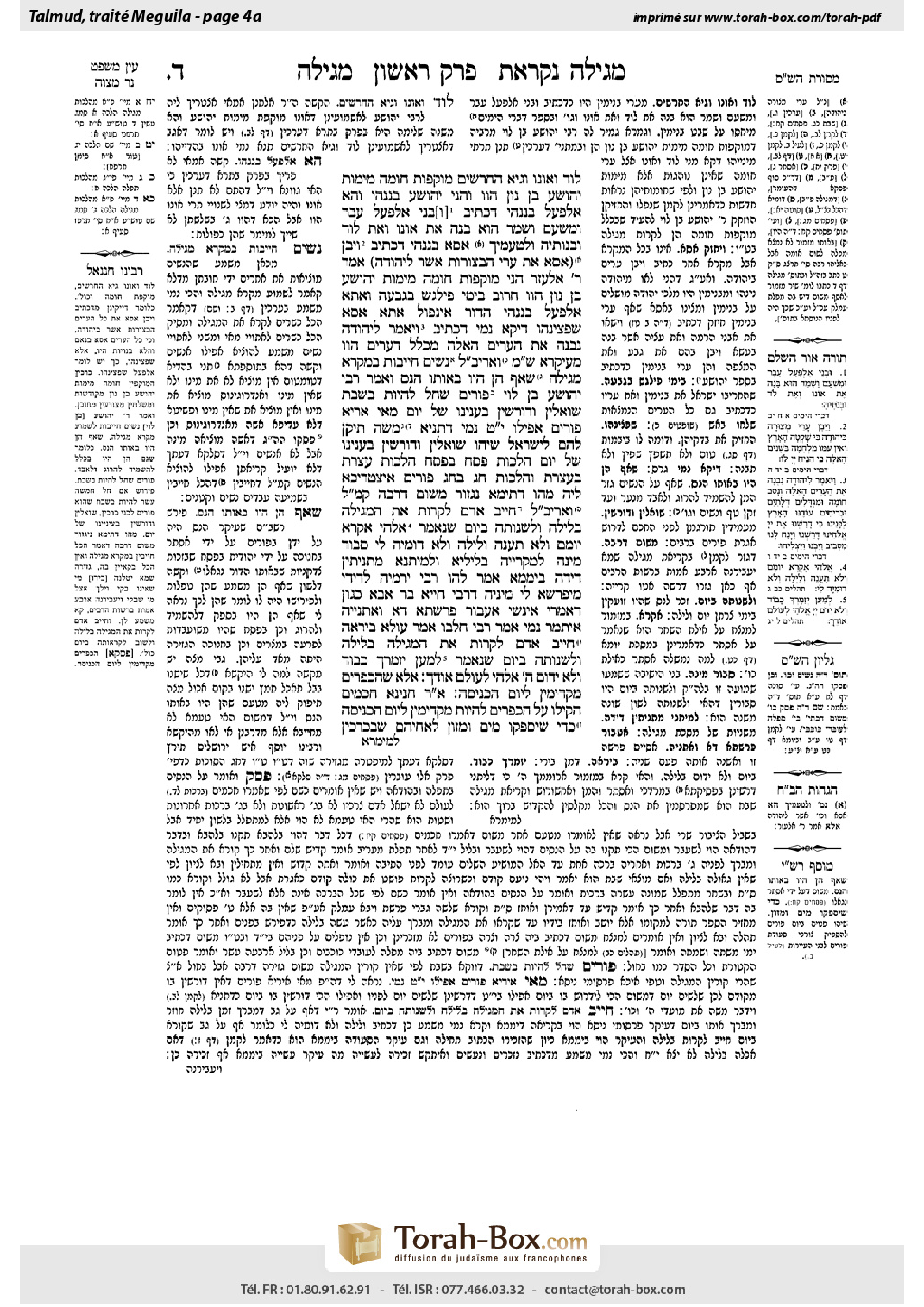
This page of Megillah includes the Aramaic text, an English translation and an AI-generated French translation, alongside the scan above.
מגילה ד׳ א · Aramaic and Hebrew text
לוֹד וְאוֹנוֹ וְגֵיא הַחֲרָשִׁים — מוּקָּפוֹת חוֹמָה מִימוֹת יְהוֹשֻׁעַ בִּן נוּן הֲווֹ.
וְהָנֵי יְהוֹשֻׁעַ בְּנַנְהִי? וְהָא אֶלְפַּעַל בְּנַנְהִי, דִּכְתִיב: ״[וּ]בְנֵי אֶלְפַּעַל עֵבֶר וּמִשְׁעָם וָשָׁמֶר הוּא בָּנָה אֶת אוֹנוֹ וְאֶת לוֹד וּבְנוֹתֶיהָ״! וּלְטַעְמָיךְ, אָסָא בְּנַנְהִי, דִּכְתִיב: ״וַיִּבֶן (אָסָא אֶת עָרֵי הַבְּצוּרוֹת אֲשֶׁר לִיהוּדָה)״.
אָמַר רַבִּי אֶלְעָזָר: הָנֵי מוּקָּפוֹת חוֹמָה מִימוֹת יְהוֹשֻׁעַ בִּן נוּן הֲווֹ. חֲרוּב בִּימֵי פִּילֶגֶשׁ בְּגִבְעָה, וַאֲתָא אֶלְפַּעַל בְּנַנְהִי. הֲדוּר אִינְּפוּל, אֲתָא אָסָא שַׁפְּצִינְהוּ.
דַּיְקָא נָמֵי, דִּכְתִיב: ״וַיֹּאמֶר לִיהוּדָה נִבְנֶה אֶת הֶעָרִים הָאֵלֶּה״, מִכְּלָל דְּעָרִים הֲווֹ מֵעִיקָּרָא. שְׁמַע מִינַּהּ.
וְאָמַר רַבִּי יְהוֹשֻׁעַ בֶּן לֵוִי: נָשִׁים חַיָּיבוֹת בְּמִקְרָא מְגִילָּה, שֶׁאַף הֵן הָיוּ בְּאוֹתוֹ הַנֵּס. וְאָמַר רַבִּי יְהוֹשֻׁעַ בֶּן לֵוִי: פּוּרִים שֶׁחָל לִהְיוֹת בְּשַׁבָּת, שׁוֹאֲלִין וְדוֹרְשִׁין בְּעִנְיָנוֹ שֶׁל יוֹם.
מַאי אִרְיָא פּוּרִים? אֲפִילּוּ יוֹם טוֹב נָמֵי! דְּתַנְיָא: מֹשֶׁה תִּיקֵּן לָהֶם לְיִשְׂרָאֵל שֶׁיְּהוּ שׁוֹאֲלִין וְדוֹרְשִׁין בְּעִנְיָנוֹ שֶׁל יוֹם: הִלְכוֹת פֶּסַח בַּפֶּסַח, הִלְכוֹת עֲצֶרֶת בָּעֲצֶרֶת, וְהִלְכוֹת חַג בֶּחָג!
פּוּרִים אִיצְטְרִיכָא לֵיהּ, מַהוּ דְּתֵימָא: נִגְזוֹר מִשּׁוּם דְּרַבָּה, קָא מַשְׁמַע לַן.
וְאָמַר רַבִּי יְהוֹשֻׁעַ בֶּן לֵוִי: חַיָּיב אָדָם לִקְרוֹת אֶת הַמְּגִילָּה בַּלַּיְלָה וְלִשְׁנוֹתָהּ בַּיּוֹם, שֶׁנֶּאֱמַר: ״אֱלֹהַי אֶקְרָא יוֹמָם וְלֹא תַעֲנֶה וְלַיְלָה וְלֹא דוּמִיָּה לִי״.
סְבוּר מִינָּה לְמִקְרְיַיהּ בְּלֵילְיָא וּלְמִיתְנֵא מַתְנִיתִין דִּידַהּ בִּימָמָא. אֲמַר לְהוּ רַבִּי יִרְמְיָה: לְדִידִי מִיפָּרְשָׁא לִי מִינֵּיהּ דְּרַבִּי חִיָּיא בַּר אַבָּא, כְּגוֹן דְּאָמְרִי אִינָשֵׁי: אֶעֱבוֹר פָּרַשְׁתָּא דָּא וְאֶתְנְיַיהּ.
אִיתְּמַר נָמֵי, אָמַר רַבִּי חֶלְבּוֹ אָמַר עוּלָּא בִּירָאָה: חַיָּיב אָדָם לִקְרוֹת אֶת הַמְּגִילָּה בַּלַּיְלָה וְלִשְׁנוֹתָהּ בַּיּוֹם, שֶׁנֶּאֱמַר: ״לְמַעַן יְזַמֶּרְךָ כָבוֹד וְלֹא יִדּוֹם ה׳ אֱלֹהַי לְעוֹלָם אוֹדֶךָּ״.
אֶלָּא שֶׁהַכְּפָרִים מַקְדִּימִין לְיוֹם הַכְּנִיסָה. אָמַר רַבִּי חֲנִינָא: חֲכָמִים הֵקֵילּוּ עַל הַכְּפָרִים לִהְיוֹת מַקְדִּימִין לְיוֹם הַכְּנִיסָה כְּדֵי שֶׁיְּסַפְּקוּ מַיִם וּמָזוֹן לַאֲחֵיהֶם שֶׁבַּכְּרַכִּין.
Megillah 4a · English translation
The cities Lod, and Ono, and Gei HeḤarashim are cities that have been surrounded by walls since the days of Joshua, son of Nun.
The Gemara asks: Did Joshua, son of Nun, really build these cities? Didn’t Elpaal build them at a later date, as it is written: “And the sons of Elpaal: Eber, and Misham, and Shemed, who built Ono and Lod, with its hamlets” (I Chronicles 8:12)? The Gemara counters: According to your reasoning, that this verse proves that these cities were built later, you can also say that Asa, king of Judah, built them, as it is written: “And he, Asa, built fortified cities in Judah” (see II Chronicles 14:5). Therefore, it is apparent that these cities were built more than once.
Rabbi Elazar said: These cities were surrounded by a wall since the days of Joshua, son of Nun, and they were destroyed in the days of the concubine in Gibea, as they stood in the tribal territory of Benjamin, and in that war all of the cities of Benjamin were destroyed (see Judges, chapters 19–21). Elpaal then came and built them again. They then fell in the wars between Judah and Israel, and Asa came and restored them.
The Gemara comments: The language of the verse is also precise according to this explanation, as it is written with regard to Asa: “And he said to Judah: Let us build these cities” (II Chronicles 14:6), which proves by inference that they had already been cities at the outset, and that he did not build new cities. The Gemara concludes: Indeed, learn from this that it is so.
§ And Rabbi Yehoshua ben Levi also said: Women are obligated in the reading of the Megilla, as they too were significant partners in that miracle. And Rabbi Yehoshua ben Levi also said: When Purim occurs on Shabbat, one asks questions and expounds upon the subject of the day.
The Gemara raises a question with regard to the last halakha: Why was it necessary to specify Purim? The same principle applies also to the Festivals, as it is taught in a baraita: Moses enacted for the Jewish people that they should ask questions about and expound upon the subject of the day: They should occupy themselves with the halakhot of Passover on Passover, with the halakhot of Shavuot on Shavuot, and with the halakhot of the festival of Sukkot on the festival of Sukkot.
The Gemara answers: It was necessary for Rabbi Yehoshua ben Levi to mention Purim, lest you say that when Purim falls on Shabbat we should decree that it is prohibited to expound upon the halakhot of the day due to the concern of Rabba, who said that the reason the Megilla is not read on a Purim that falls on Shabbat is due to a concern that one carry the Megilla in the public domain. Rabbi Yehoshua ben Levi therefore teaches us that expounding the halakhot of the day is not prohibited as a preventive measure lest one read the Megilla on Shabbat.
And Rabbi Yehoshua ben Levi further said with regard to Purim: A person is obligated to read the Megilla at night and then to repeat it [lishnota] during the day, as it is stated: “O my God, I call by day but You do not answer; and at night, and there is no surcease for me” (Psalms 22:3), which alludes to reading the Megilla both by day and by night.
Some of the students who heard this statement understood from it that one is obligated to read the Megilla at night and to study its relevant tractate of Mishna by day, as the term lishnota can be understood to mean studying Mishna. Rabbi Yirmeya said to them: It was explained to me personally by Rabbi Ḥiyya bar Abba himself that the term lishnota here has a different connotation, for example, as people say: I will conclude this section and repeat it, i.e., I will review my studies. Similarly, Rabbi Yehoshua ben Levi’s statement means that one must repeat the reading of the Megilla by day after reading it at night.
The Gemara notes that this ruling was also stated by another amora, as Rabbi Ḥelbo said that Ulla Bira’a said: A person is obligated to read the Megilla at night and then repeat it during the day, as it is stated: “So that my glory may sing praise to You and not be silent; O Lord, my God, I will give thanks to You forever” (Psalms 30:13). The dual formulation of singing praise and not being silent alludes to reading the Megilla both by night and by day.
§ We learned in the mishna that residents of unwalled towns read the Megilla on the fourteenth of Adar; however, residents of villages may advance their reading to the day of assembly, the Monday or Thursday preceding Purim. Rabbi Ḥanina said: The Sages were lenient with the villages and allowed them to advance their reading of the Megilla to the day of assembly, so that they could be free to provide water and food to their brethren in the cities on the day of Purim. If everyone would be busy reading the Megilla on the fourteenth, the residents of the cities would not have enough to eat.
Megillah 4a · Traduction française (IA)
Les villes de Lod, d’Ono et de Gei HeḤarashim sont entourées de murailles depuis l’époque de Josué, fils de Noun.
La Guemara demande : Josué, fils de Noun, a-t-il vraiment bâti ces villes ? Elpaal ne les a-t-il pas bâties plus tard, comme il est écrit : « Les fils d’Elpaal : Eber, Misham et Shemed, qui bâtit Ono et Lod avec ses hameaux » (I Chroniques 8:12) ? La Guemara réplique : Selon ton raisonnement, si ce verset prouve que ces villes furent bâties plus tard, tu pourrais aussi dire qu’Asa, roi de Juda, les bâtit, comme il est écrit : « Et Asa bâtit des villes fortifiées en Juda » (voir II Chroniques 14:5). Il apparaît donc que ces villes furent bâties plus d’une fois.
Rabbi Elazar dit : Ces villes étaient entourées de murailles depuis l’époque de Josué, fils de Noun, mais elles furent détruites à l’époque de la concubine de Guibéa, puisqu’elles se trouvaient sur le territoire de la tribu de Benjamin et que, lors de cette guerre, toutes les villes de Benjamin furent détruites (voir Juges, chapitres 19 à 21). Elpaal vint ensuite les rebâtir. Elles furent alors détruites lors des guerres entre Juda et Israël, et Asa vint les restaurer.
La Guemara fait remarquer que la formulation du verset est également précise selon cette explication, car il est écrit au sujet d’Asa : « Et il dit à Juda : “Bâtissons ces villes” » (II Chroniques 14:6). Cela implique qu’elles étaient déjà des villes auparavant et qu’il ne bâtissait pas de nouvelles villes. La Guemara conclut : En effet, déduis-en que c’est bien ainsi.
§ Rabbi Yehoshua ben Levi dit également : Les femmes sont tenues de lire la Meguila, car elles aussi ont joué un rôle important dans ce miracle. Rabbi Yehoshua ben Levi dit encore : Lorsque Pourim tombe un Chabbat, on pose des questions et on expose le sujet du jour.
La Guemara soulève une question au sujet de cette dernière halakha : Pourquoi fallait-il préciser le cas de Pourim ? Le même principe s’applique aussi aux fêtes, comme l’enseigne une baraïta : Moïse institua pour le peuple juif qu’il pose des questions sur le sujet du jour et l’expose : qu’il étudie les halakhot de Pessa’h à Pessa’h, les halakhot de Chavouot à Chavouot et les halakhot de la fête de Souccot pendant la fête de Souccot.
La Guemara répond : Rabbi Yehoshua ben Levi devait mentionner Pourim, de peur que tu ne dises que, lorsque Pourim tombe un Chabbat, il faut décréter qu’il est interdit d’exposer les halakhot du jour, par crainte de ce qu’a dit Rabba : si l’on ne lit pas la Meguila lorsque Pourim tombe un Chabbat, c’est par crainte que quelqu’un ne transporte la Meguila dans le domaine public. Rabbi Yehoshua ben Levi nous enseigne donc qu’il n’est pas interdit d’exposer les halakhot du jour à titre de mesure préventive, de peur que quelqu’un ne lise la Meguila le Chabbat.
Rabbi Yehoshua ben Levi dit encore au sujet de Pourim : On est tenu de lire la Meguila la nuit, puis de la relire [lishnota] pendant la journée, comme il est dit : « Mon Dieu, je crie le jour, mais Tu ne réponds pas ; la nuit aussi, et il n’y a pas de répit pour moi » (Psaumes 22:3), ce qui fait allusion à la lecture de la Meguila aussi bien le jour que la nuit.
Certains élèves qui avaient entendu cette déclaration en déduisirent qu’il est obligatoire de lire la Meguila la nuit et d’étudier le traité correspondant de la Michna pendant la journée, car le terme lishnota peut être compris comme signifiant étudier la Michna. Rabbi Yirmeya leur dit : Rabbi Ḥiyya bar Abba lui-même m’a expliqué que le terme lishnota a ici un autre sens, comme dans l’expression : « Je vais terminer cette section et la répéter », c’est-à-dire : je vais réviser mes études. De même, la déclaration de Rabbi Yehoshua ben Levi signifie qu’il faut relire la Meguila pendant la journée après l’avoir lue la nuit.
La Guemara note qu’un autre amora a également enseigné cette halakha, car Rabbi Ḥelbo dit au nom d’Ulla Bira’a : On est tenu de lire la Meguila la nuit, puis de la relire pendant la journée, comme il est dit : « Afin que ma gloire Te chante des louanges et ne se taise pas ; Seigneur, mon Dieu, je Te rendrai grâce à jamais » (Psaumes 30:13). La formulation double — chanter des louanges et ne pas se taire — fait allusion à la lecture de la Meguila aussi bien la nuit que le jour.
§ Nous avons appris dans la Michna que les habitants des villes non entourées de murailles lisent la Meguila le quatorzième jour d’Adar ; toutefois, les habitants des villages peuvent avancer leur lecture au jour de l’assemblée, le lundi ou le jeudi précédant Pourim. Rabbi Ḥanina dit : Les Sages se montrèrent indulgents envers les habitants des villages et leur permirent d’avancer la lecture de la Meguila au jour de l’assemblée, afin qu’ils soient libres d’apporter de l’eau et de la nourriture à leurs frères des villes le jour de Pourim. Si tous étaient occupés à lire la Meguila le quatorzième jour, les habitants des villes n’auraient pas assez à manger.
Traduction française générée par IA à partir de l’édition anglaise de Sefaria. Vérifie toujours un passage avec le texte source.
Text from Sefaria: William Davidson Edition - Vocalized Aramaic (CC BY NC); William Davidson Edition - English (CC BY NC).