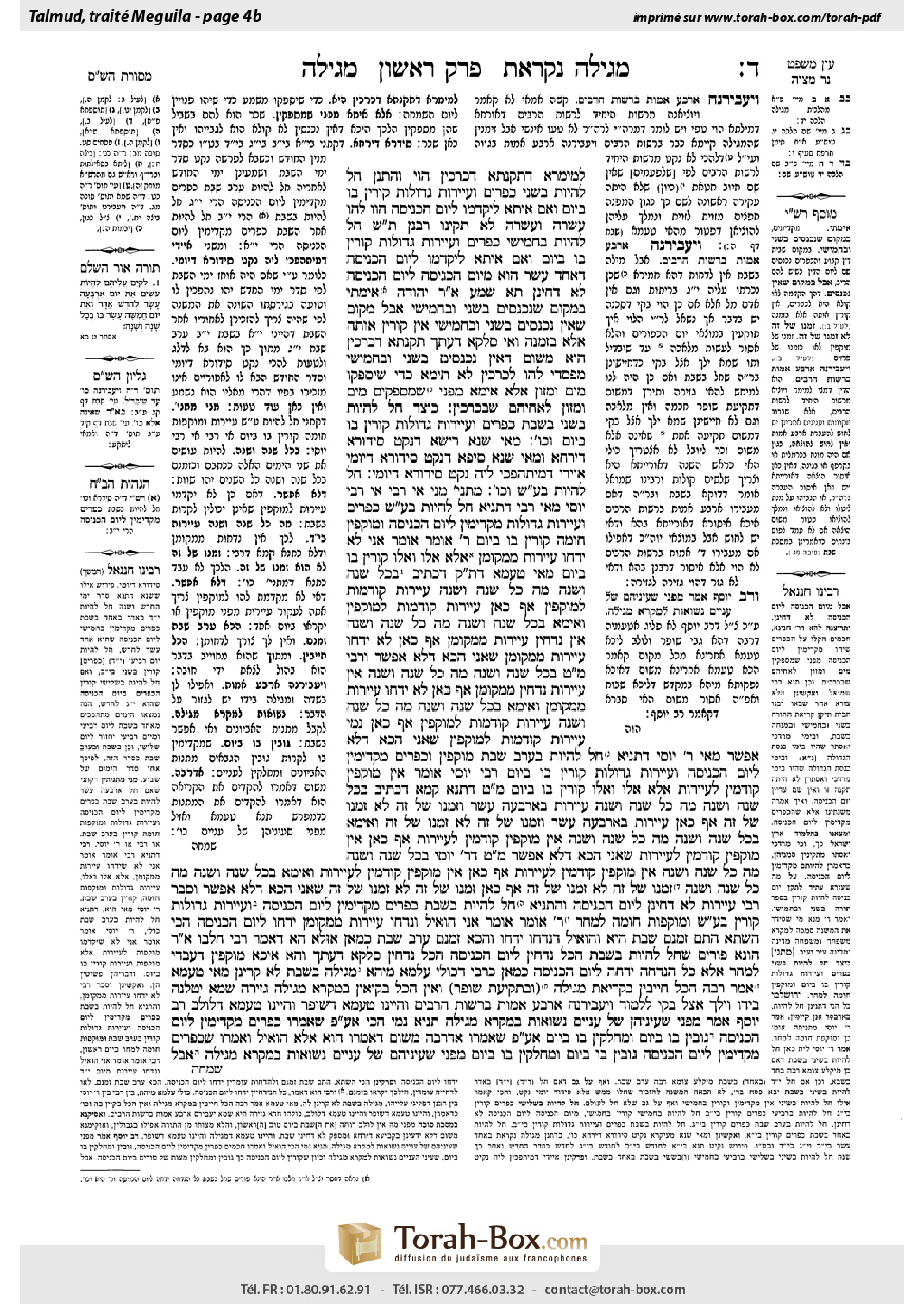
Megillah 4b: Talmud study for Daf Yomi
Daf Yomi is the daily study of one Talmud folio. Explore 37 tractates with scans, Hebrew text, Sefaria English and AI-generated French translations where annotated.
Passage selection and English or AI-generated French translation are available where the scan has annotations. Daf Study is independent of Torah-Box and Sefaria.
Browse Megillah · מגילה · All tractatesMegillah 4b text and translations
This page of Megillah includes the Aramaic text, an English translation and an AI-generated French translation, alongside the scan above.
מגילה ד׳ ב · Aramaic and Hebrew text
לְמֵימְרָא דְּתַקַּנְתָּא דִכְרַכִּין הָוֵי? וְהָתְנַן: חָל לִהְיוֹת בַּשֵּׁנִי — כְּפָרִים וַעֲיָירוֹת גְּדוֹלוֹת קוֹרִין בּוֹ בַיּוֹם. וְאִם אִיתָא, לַיקְדְּמוּ לְיוֹם הַכְּנִיסָה! הָווּ לְהוּ עֲשָׂרָה, וַעֲשָׂרָה לָא תַּקִּינוּ רַבָּנַן.
תָּא שְׁמַע: חָל לִהְיוֹת בַּחֲמִישִׁי — כְּפָרִים וַעֲיָירוֹת גְּדוֹלוֹת קוֹרִין בּוֹ בַיּוֹם, וְאִם אִיתָא, לַיקְדְּמוּ לְיוֹם הַכְּנִיסָה דְּאַחַד עָשָׂר הוּא! מִיּוֹם הַכְּנִיסָה לְיוֹם הַכְּנִיסָה לָא דָּחֵינַן.
תָּא שְׁמַע, אָמַר רַבִּי יְהוּדָה: אֵימָתַי — בִּמְקוֹם שֶׁנִּכְנָסִים בַּשֵּׁנִי וּבַחֲמִישִׁי, אֲבָל מְקוֹם שֶׁאֵין נִכְנָסִים בַּשֵּׁנִי וּבַחֲמִישִׁי — אֵין קוֹרִין אוֹתָהּ אֶלָּא בִּזְמַנָּהּ. וְאִי סָלְקָא דַעְתָּךְ תַּקַּנְתָּא דִכְרַכִּין הִיא — מִשּׁוּם דְּאֵין נִכְנָסִים בַּשֵּׁנִי וּבַחֲמִישִׁי מַפְסְדִי לְהוּ לִכְרַכִּין?
לָא תֵּימָא כְּדֵי שֶׁיְּסַפְּקוּ מַיִם וּמָזוֹן, אֶלָּא אֵימָא: מִפְּנֵי שֶׁמְּסַפְּקִים מַיִם וּמָזוֹן לַאֲחֵיהֶם שֶׁבַּכְּרַכִּין.
כֵּיצַד? חָל לִהְיוֹת בַּשֵּׁנִי בַּשַּׁבָּת — כְּפָרִים וַעֲיָירוֹת גְּדוֹלוֹת קוֹרִין בּוֹ בַיּוֹם וְכוּ׳. מַאי שְׁנָא רֵישָׁא דְּנָקֵט סִידּוּרָא דְיַרְחָא, וּמַאי שְׁנָא סֵיפָא דְּנָקֵט סִידּוּרָא דְיוֹמֵי?
אַיְּידֵי דְּמִיתְהַפְכִי לֵיהּ נָקֵט סִידּוּרָא דְיוֹמֵי.
חָל לִהְיוֹת בְּעֶרֶב שַׁבָּת וְכוּ׳. מַתְנִיתִין מַנִּי? אִי רַבִּי, אִי רַבִּי יוֹסֵי.
מַאי רַבִּי? דְּתַנְיָא: חָל לִהְיוֹת בְּעֶרֶב שַׁבָּת — כְּפָרִים וַעֲיָירוֹת גְּדוֹלוֹת מַקְדִּימִין לְיוֹם הַכְּנִיסָה, וּמוּקָּפִין חוֹמָה קוֹרִין בּוֹ בַיּוֹם. רַבִּי אוֹמֵר, אוֹמֵר אֲנִי: לֹא יִדָּחוּ עֲיָירוֹת מִמְּקוֹמָן, אֶלָּא אֵלּוּ וָאֵלּוּ קוֹרִין בּוֹ בַיּוֹם.
מַאי טַעְמָא דְּתַנָּא קַמָּא? דִּכְתִיב: ״בְּכׇל שָׁנָה וְשָׁנָה״. מָה כׇּל שָׁנָה וְשָׁנָה עֲיָירוֹת קוֹדְמוֹת לַמּוּקָּפִין, אַף כָּאן עֲיָירוֹת קוֹדְמוֹת לַמּוּקָּפִין.
וְאֵימָא: ״בְּכׇל שָׁנָה וְשָׁנָה״, מָה כׇּל שָׁנָה וְשָׁנָה אֵין נִדְחִין עֲיָירוֹת מִמְּקוֹמָן — אַף כָּאן לֹא יִדָּחוּ עֲיָירוֹת מִמְּקוֹמָן! שָׁאנֵי הָכָא דְּלָא אֶפְשָׁר.
וְרַבִּי, מַאי טַעְמֵיהּ? ״בְּכׇל שָׁנָה וְשָׁנָה״, מָה כׇּל שָׁנָה וְשָׁנָה אֵין עֲיָירוֹת נִדְחִין מִמְּקוֹמָן — אַף כָּאן לֹא יִדָּחוּ עֲיָירוֹת מִמְּקוֹמָן.
וְאֵימָא: ״בְּכׇל שָׁנָה וְשָׁנָה״, מָה כׇּל שָׁנָה וְשָׁנָה עֲיָירוֹת קוֹדְמוֹת לַמּוּקָּפִין — אַף כָּאן נָמֵי עֲיָירוֹת קוֹדְמוֹת לַמּוּקָּפִין! שָׁאנֵי הָכָא דְּלָא אֶפְשָׁר.
מַאי רַבִּי יוֹסֵי? דְּתַנְיָא: חָל לִהְיוֹת בְּעֶרֶב שַׁבָּת — מוּקָּפִין וּכְפָרִים מַקְדִּימִין לְיוֹם הַכְּנִיסָה, וַעֲיָירוֹת גְּדוֹלוֹת קוֹרִין בּוֹ בַיּוֹם. רַבִּי יוֹסֵי אוֹמֵר: אֵין מוּקָּפִין קוֹדְמִין לַעֲיָירוֹת, אֶלָּא אֵלּוּ וָאֵלּוּ קוֹרִין בּוֹ בַיּוֹם.
מַאי טַעְמָא דְּתַנָּא קַמָּא? דִּכְתִיב: ״בְּכׇל שָׁנָה וְשָׁנָה״, מָה כׇּל שָׁנָה וְשָׁנָה עֲיָירוֹת בְּאַרְבָּעָה עָשָׂר, וּזְמַנּוֹ שֶׁל זֶה לֹא זְמַנּוֹ שֶׁל זֶה — אַף כָּאן עֲיָירוֹת בְּאַרְבָּעָה עָשָׂר, וּזְמַנּוֹ שֶׁל זֶה לֹא זְמַנּוֹ שֶׁל זֶה.
וְאֵימָא: ״בְּכׇל שָׁנָה וְשָׁנָה״, מָה כׇּל שָׁנָה וְשָׁנָה אֵין מוּקָּפִין קוֹדְמִין לָעֲיָירוֹת, אַף כָּאן אֵין מוּקָּפִין קוֹדְמִין לָעֲיָירוֹת! שָׁאנֵי הָכָא דְּלָא אֶפְשָׁר.
מַאי טַעְמֵיהּ דְּרַבִּי יוֹסֵי? ״בְּכׇל שָׁנָה וְשָׁנָה״, מָה כׇּל שָׁנָה וְשָׁנָה אֵין מוּקָּפִין קוֹדְמִין לָעֲיָירוֹת — אַף כָּאן אֵין מוּקָּפִין קוֹדְמִין לָעֲיָירוֹת.
וְאֵימָא: ״בְּכׇל שָׁנָה וְשָׁנָה״, מָה כׇּל שָׁנָה וְשָׁנָה זְמַנּוֹ שֶׁל זֶה לֹא זְמַנּוֹ שֶׁל זֶה — אַף כָּאן זְמַנּוֹ שֶׁל זֶה לֹא זְמַנּוֹ שֶׁל זֶה! שָׁאנֵי הָכָא דְּלָא אֶפְשָׁר.
וְסָבַר רַבִּי עֲיָירוֹת לָא דָּחִינַן לְיוֹם הַכְּנִיסָה? וְהָתַנְיָא: חָל לִהְיוֹת בְּשַׁבָּת — כְּפָרִים מַקְדִּימִין לְיוֹם הַכְּנִיסָה, וַעֲיָירוֹת גְּדוֹלוֹת קוֹרִין בָּעֶרֶב שַׁבָּת, וּמוּקָּפוֹת חוֹמָה לְמָחָר. רַבִּי אוֹמֵר, אוֹמֵר אֲנִי: הוֹאִיל וְנִדְחוּ עֲיָירוֹת מִמְּקוֹמָן — יִדָּחוּ לְיוֹם הַכְּנִיסָה.
הָכִי הַשְׁתָּא? הָתָם זְמַנָּם שַׁבָּת הִיא, וְהוֹאִיל דְּנִדְחוּ — יִדָּחוּ. וְהָכָא, זְמַנָּם עֶרֶב שַׁבָּת!
כְּמַאן אָזְלָא הָא דְּאָמַר רַבִּי חֶלְבּוֹ אָמַר רַב הוּנָא: פּוּרִים שֶׁחָל לִהְיוֹת בְּשַׁבָּת — הַכֹּל נִדְחִין לְיוֹם הַכְּנִיסָה. הַכֹּל נִדְחִין סָלְקָא דַּעְתָּךְ?! וְהָא אִיכָּא מוּקָּפִין דְּעָבְדִי לִמְחַר! אֶלָּא: כׇּל הַנִּדְחֶה יִדָּחֶה לְיוֹם הַכְּנִיסָה. כְּמַאן — כְּרַבִּי.
דְּכוּלֵּי עָלְמָא מִיהָא מְגִילָּה בְּשַׁבָּת לָא קָרִינַן. מַאי טַעְמָא? אָמַר רַבָּה: הַכֹּל חַיָּיבִין בִּקְרִיאַת מְגִילָּה (וּבִתְקִיעַת שׁוֹפָר), וְאֵין הַכֹּל בְּקִיאִין בְּמִקְרָא מְגִילָּה. גְּזֵירָה שֶׁמָּא יִטְּלֶנָּה בְּיָדוֹ וְיֵלֵךְ אֵצֶל בָּקִי לִלְמוֹד, וְיַעֲבִירֶנָּה אַרְבַּע אַמּוֹת בִּרְשׁוּת הָרַבִּים.
וְהַיְינוּ טַעְמָא דְשׁוֹפָר. וְהַיְינוּ טַעְמָא דְלוּלָב.
רַב יוֹסֵף אָמַר: מִפְּנֵי שֶׁעֵינֵיהֶן שֶׁל עֲנִיִּים נְשׂוּאוֹת בְּמִקְרָא מְגִילָּה. תַּנְיָא נָמֵי הָכִי: אַף עַל פִּי שֶׁאָמְרוּ כְּפָרִים מַקְדִּימִין לְיוֹם הַכְּנִיסָה — גּוֹבִין בּוֹ בַיּוֹם, וּמְחַלְּקִין בּוֹ בַיּוֹם.
אַף עַל פִּי שֶׁאָמְרוּ? אַדְּרַבָּה, מִשּׁוּם דְּאָמְרוּ הוּא! אֶלָּא: הוֹאִיל וְאָמְרוּ שֶׁכְּפָרִים מַקְדִּימִין לְיוֹם הַכְּנִיסָה — גּוֹבִין בּוֹ בַיּוֹם, וּמְחַלְּקִין בּוֹ בַיּוֹם, מִפְּנֵי שֶׁעֵינֵיהֶם שֶׁל עֲנִיִּים נְשׂוּאוֹת בְּמִקְרָא מְגִילָּה. אֲבָל
Megillah 4b · English translation
The Gemara asks: Is that to say that this ordinance is for the benefit of the cities? Didn’t we learn in the mishna that if the fourteenth occurred on a Monday, the residents of villages and large towns read it on that very day? If it is so, that the ordinance allowing the villagers to sometimes advance their reading of the Megilla is for the benefit of the cities, let the villagers advance their reading to the previous day of assembly even when the fourteenth occurs on a Monday. The Gemara responds: That would mean that Megilla reading for them would take place on the tenth of Adar, and the Sages did not establish the tenth of Adar as a day that is fit to read the Megilla.
The Gemara continues: Come and hear a proof from a different statement of the mishna: If the fourteenth occurs on a Thursday, the villages and large towns read it on that day, the fourteenth, and the walled cities read it on the next day, the fifteenth. If it is so, that the ordinance is for the benefit of the cities, let the villagers advance their reading of the Megilla to the previous day of assembly, i.e., the previous Monday, as it is the eleventh of Adar. The Gemara responds: We do not defer the reading of the Megilla from one day of assembly to another day of assembly.
The Gemara continues: Come and hear that which was taught in the following mishna (5a): Rabbi Yehuda said: When is the Megilla read from the eleventh of Adar and onward? In a place where the villagers generally enter town on Monday and Thursday. However, in a place where they do not generally enter town on Monday and Thursday, one may read the Megilla only in its designated time, the fourteenth of Adar. The Gemara infers: If it enters your mind to say that the ordinance is for the benefit of the cities, would it be reasonable to suggest that because the villagers do not enter town on Monday and Thursday the residents of the cities should lose out and not be provided with food and water?
The Gemara accepts this argument: Do not say that the Sages allowed the villages to advance their reading of the Megilla to the day of assembly so that they can be free to provide water and food to their brethren in the cities on the day of Purim. Rather, say that the Sages were lenient with them because the villages supply water and food to their brethren in the cities. This ordinance was established for the benefit of the villagers so that they should not have to make an extra trip to the cities to hear the reading of the Megilla. However, in a place where the villages do not go to the cities, advancing their reading of the Megilla to the day of assembly will not benefit them, and therefore they must read on the fourteenth.
§ We learned in the mishna: How so? If the fourteenth of Adar occurs on Monday, the villages and large towns read it on that day. The mishna continues to explain the days on which the Megilla is read. The Gemara asks: What is different about the first clause of the mishna, which employs the order of the dates of the month, i.e., the eleventh of Adar, and the latter clause, which employs the order of the days of the week, i.e., Monday?
The Gemara answers: Since the days of the week would be reversed if the latter clause was organized according to the dates of the month, as the mishna would first have to mention a case where the fourteenth occurs on a Sunday, then a case where it occurs on a Wednesday or Shabbat, and then a case where it occurs on a Friday or Tuesday, the mishna employed the order of the days of the week in order to avoid confusion.
§ We learned in the mishna: If the fourteenth occurs on Shabbat eve, Friday, the villages advance their reading to the day of assembly, i.e., Thursday, and the large towns and walled cities read it on Friday, the fourteenth of Adar. The Gemara asks: Whose opinion is expressed in the mishna? It can be either Rabbi Yehuda HaNasi or Rabbi Yosei.
The Gemara explains: What is the opinion of Rabbi Yehuda HaNasi? As it is taught in a baraita: If the fourteenth occurs on Shabbat eve, villages and large towns advance their reading to the day of assembly, i.e., Thursday, and walled cities read it on the day of Purim, Friday. Rabbi Yehuda HaNasi disagrees and says: I say that the readings in the large towns should not be deferred from their usual date, i.e., the fourteenth of Adar. Rather, both these, the large towns and those, the walled cities, read the Megilla on the day of Purim.
The Gemara asks: What is the reason of the first tanna? The Gemara explains that it is as it is written: “To keep these two days, according to their writing and according to their time, in every year” (Esther 9:27), which indicates that Purim must be celebrated every year in similar fashion. Just as in every other year the large towns precede the walled cities by one day, so too here the large towns precede the walled cities by one day. Consequently, since the walled cities cannot read the Megilla on Shabbat and they are required to advance the reading to Friday, the large towns must also advance their reading a day to Thursday.
The Gemara raises an objection: Say that the words “in every year” indicate that just as in every other year the Megilla readings in the large towns are not deferred from their usual date and they read the Megilla on the fourteenth, so too here the Megilla readings in the large towns should not be deferred from their usual date and they too should read on the fourteenth. The Gemara answers: Here it is different, as it is not possible for the large towns to fulfill all of the conditions at the same time, i.e., to read on the fourteenth and to read a day before the walled cities.
The Gemara asks: And Rabbi Yehuda HaNasi, what is his reason? The Gemara explains that it is also based upon the words “in every year”; just as in every other year the readings in the large towns are not deferred from their usual date and they read on the fourteenth, so too here, the readings in the large towns are not deferred from their usual date, but rather they read on the fourteenth.
The Gemara raises an objection: Say that the words “in every year” indicate that just as every year the large towns precede the walled cities by one day, and read on the fourteenth, so too here the large towns precede the walled cities by one day, and read on the thirteenth. The Gemara answers: Here it is different, as it is not possible to fulfill all of the conditions at the same time, i.e., to read on the fourteenth and to read a day before the walled cities.
The Gemara asks: What is the opinion of Rabbi Yosei? As it is taught in a baraita: If the fourteenth occurs on Shabbat eve, the walled cities and villages advance their reading of the Megilla to the day of assembly, and the large towns read it on the day of Purim itself. Rabbi Yosei says: The walled cities never precede the large towns; rather, both these, the large towns, and those, the walled cities, read on that day, i.e., Friday, the fourteenth of Adar.
The Gemara asks: What is the reason of the first tanna? As it is written: “In every year”; just as in every other year the large towns read the Megilla on the fourteenth, and the time for this type of settlement to read the Megilla is not the time for that type of settlement to read the Megilla, as the large towns and walled cities never read the Megilla on the same day, so too here, the large towns read the Megilla on the fourteenth, and the time for this type of settlement to read the Megilla is not the time for that type of settlement to read the Megilla. Therefore, the walled cities must advance their reading of the Megilla by two days to the day of assembly, Thursday.
The Gemara raises an objection: Say that the words “in every year” indicate that just as in every other year the walled cities do not precede the large towns, so too here, the walled cities do not precede the large towns. The Gemara answers: Here it is different, as it is not possible to fulfill all of the conditions at the same time, i.e., that the large towns should read on the fourteenth, the large towns and the walled cities should read on different days, and the walled cities should not precede the large towns.
What is the reason of Rabbi Yosei? It is based upon the words “in every year”; just as in every other year the walled cities do not precede the large towns, so too here, the walled cities do not precede the large towns.
The Gemara raises a difficulty: Say that the words “in every year” indicate that just as in every other year, the time for this type of settlement to read the Megilla is not the time for that type of settlement to read the Megilla, so too here, the time for this type of settlement to read the Megilla is not the time for that type of settlement to read the Megilla. Therefore, since the large towns read on the fourteenth, the walled cities read on the thirteenth. The Gemara answers: Here it is different, as it is not possible to fulfill all the conditions. It is clear from these baraitot that the tanna of the mishna can either be Rabbi Yehuda HaNasi or Rabbi Yosei, but not either of two anonymous tanna’im.
The Gemara asks: Does Rabbi Yehuda HaNasi really hold that one does not defer the reading of the Megilla in large towns to the day of assembly? Isn’t it taught in a baraita: If the fourteenth occurs on Shabbat, the villages advance their reading of the Megilla to the day of assembly, the large towns read it on Shabbat eve, and the walled cities read it the next day, i.e., on Sunday. Rabbi Yehuda HaNasi says: I say that since the readings in the large towns were already deferred from their usual date, i.e., the fourteenth, they are deferred to the day of assembly, i.e., to Thursday. Consequently, even Rabbi Yehuda HaNasi agrees that the reading in the large towns can be shifted to the day of assembly. Why doesn’t he also hold that large towns read the Megilla on the day of assembly when the fourteenth occurs on a Friday?
The Gemara responds: How can these cases be compared? There, in the second baraita, the designated time for them to read the Megilla is Shabbat, but the Megilla is not read on Shabbat, and therefore they must read it on a different day. Therefore, since the readings in the large towns have been deferred, they are deferred an additional day, and take place on Thursday, the day of assembly, at the same time as the readings in the villages. Here, their designated time is Shabbat eve, and there is no reason to move the reading from that day.
The Gemara asks: In accordance with whose opinion is that which Rabbi Ḥelbo said that Rav Huna said: When Purim occurs on Shabbat, the reading of the Megilla in all places is deferred to the day of assembly? The Gemara corrects the wording of Rav Huna’s statement: Can it enter your mind to say that the reading of the Megilla in all places is deferred to the day of assembly? Aren’t there walled cities that perform this ceremony the next day, i.e., on Sunday? Rather, Rav Huna’s statement should say as follows: All readings that are deferred are deferred to the day of assembly. In accordance with whose opinion was this stated? It is in accordance with the opinion of Rabbi Yehuda HaNasi.
In any case, it is apparent from the mishna and the baraitot that everyone agrees that one does not read the Megilla on Shabbat. What is the reason for this? Rabba said: Everyone is obligated to participate in reading the Megilla on Purim and blowing the shofar on Rosh HaShana, and not everyone is proficient in reading the Megilla. Therefore, the Sages issued a rabbinic decree that the Megilla is not read on Shabbat, lest one take the Megilla in his hand and go to an expert to learn how to read it or to hear the expert read it, and, due to his preoccupation, he will carry it four cubits in the public domain, and thereby desecrate Shabbat.
The Gemara comments: And this same concern for the sanctity of Shabbat is the reason that the Sages decreed that the shofar is not blown when Rosh HaShana occurs on Shabbat. And this same concern is the reason that the Sages decreed that one may not take the lulav on Shabbat.
Rav Yosef said that there is another reason the Megilla is not read on Shabbat: Because the eyes of the poor are raised to the reading of the Megilla. The poor await the day on which the Megilla is read, because on that day gifts are distributed to the poor. If the Megilla is read on Shabbat, it will not be possible to distribute gifts to the poor, who will be deeply disappointed. The Gemara notes that this is also taught in a baraita: Even though the Sages said that the villages advance their reading of the Megilla to the day of assembly, they also collect the gifts for the poor on that day, and they distribute them to the poor on that day.
The Gemara is troubled by the wording of this baraita. Does the baraita read: Even though the Sages said? On the contrary, it is because they said that the villages advance their reading to the day of assembly that the gifts must be collected and distributed to the poor on that very day. Rather, the baraita should read as follows: Since the Sages said that the villages advance their reading of the Megilla to the day of assembly, they collect the gifts for the poor on that day and they distribute them on that day, because the eyes of the poor are raised to the reading of the Megilla, and they should not be disappointed. However,
Megillah 4b · Traduction française (IA)
La Guemara demande : Faut-il en conclure que cette ordonnance vise l’intérêt des villes ? N’avons-nous pas appris dans la Michna que, si le quatorze tombe un lundi, les habitants des villages et des grandes villes lisent la Meguila ce jour même ? Si l’ordonnance qui permet parfois aux villageois d’avancer la lecture de la Meguila vise l’intérêt des villes, pourquoi les villageois n’avanceraient-ils pas leur lecture au jour de rassemblement précédent, même lorsque le quatorze tombe un lundi ? La Guemara répond : Cela signifierait qu’ils liraient la Meguila le dix Adar, et les Sages n’ont pas institué le dix Adar comme jour propice à la lecture de la Meguila.
La Guemara poursuit : Viens et entends une preuve tirée d’un autre passage de la Michna : si le quatorze tombe un jeudi, les habitants des villages et des grandes villes lisent la Meguila ce jour-là, le quatorze, et ceux des villes fortifiées la lisent le lendemain, le quinze. Si l’ordonnance vise l’intérêt des villes, pourquoi les villageois n’avanceraient-ils pas la lecture de la Meguila au jour de rassemblement précédent, c’est-à-dire au lundi précédent, qui est le onze Adar ? La Guemara répond : Nous ne déplaçons pas la lecture de la Meguila d’un jour de rassemblement à un autre.
La Guemara poursuit : Viens et entends ce qui a été enseigné dans la Michna suivante (5a) : Rabbi Yehuda dit : À partir de quand lit-on la Meguila dès le onze Adar ? Dans un lieu où les villageois se rendent habituellement en ville le lundi et le jeudi. Toutefois, dans un lieu où ils ne se rendent pas habituellement en ville le lundi et le jeudi, on ne peut lire la Meguila qu’à la date fixée, le quatorze Adar. La Guemara en déduit : Si l’on envisage que l’ordonnance vise l’intérêt des villes, serait-il raisonnable de suggérer que, parce que les villageois ne se rendent pas en ville le lundi et le jeudi, les habitants des villes devraient en pâtir et être privés de nourriture et d’eau ?
La Guemara accepte cet argument : Ne dis pas que les Sages ont permis aux villageois d’avancer la lecture de la Meguila au jour de rassemblement afin qu’ils soient libres d’apporter de l’eau et de la nourriture à leurs frères des villes le jour de Pourim. Dis plutôt que les Sages ont fait preuve d’indulgence envers eux parce que les villageois fournissent de l’eau et de la nourriture à leurs frères des villes. Cette ordonnance a été instituée dans l’intérêt des villageois, afin qu’ils n’aient pas à faire un déplacement supplémentaire jusqu’aux villes pour entendre la lecture de la Meguila. Toutefois, dans un lieu où les villageois ne se rendent pas dans les villes, avancer la lecture de la Meguila au jour de rassemblement ne leur serait d’aucun avantage ; ils doivent donc la lire le quatorze.
§ Nous avons appris dans la Michna : Comment cela ? Si le quatorze Adar tombe un lundi, les habitants des villages et des grandes villes lisent la Meguila ce jour-là. La Michna poursuit en expliquant les jours où l’on lit la Meguila. La Guemara demande : Pourquoi le premier passage de la Michna suit-il l’ordre des dates du mois, c’est-à-dire le onze Adar, tandis que le passage suivant suit l’ordre des jours de la semaine, c’est-à-dire le lundi ?
La Guemara répond : Si le passage suivant était organisé selon les dates du mois, l’ordre des jours de la semaine serait inversé : la Michna devrait d’abord mentionner le cas où le quatorze tombe un dimanche, puis celui où il tombe un mercredi ou un Chabbat, et enfin celui où il tombe un vendredi ou un mardi. La Michna suit donc l’ordre des jours de la semaine afin d’éviter toute confusion.
§ Nous avons appris dans la Michna : Si le quatorze tombe la veille de Chabbat, c’est-à-dire un vendredi, les villageois avancent leur lecture au jour de rassemblement, autrement dit au jeudi, et les habitants des grandes villes et des villes fortifiées lisent la Meguila le vendredi, le quatorze Adar. La Guemara demande : De qui la Michna exprime-t-elle l’opinion ? Il pourrait s’agir soit de Rabbi Yehuda HaNassi, soit de Rabbi Yosei.
La Guemara explique : Quelle est l’opinion de Rabbi Yehuda HaNassi ? Comme il est enseigné dans une baraïta : si le quatorze tombe la veille de Chabbat, les villageois et les habitants des grandes villes avancent leur lecture au jour de rassemblement, autrement dit au jeudi, et ceux des villes fortifiées lisent la Meguila le jour de Pourim, le vendredi. Rabbi Yehuda HaNassi n’est pas d’accord et dit : À mon avis, la lecture dans les grandes villes ne doit pas être déplacée de sa date habituelle, c’est-à-dire le quatorze Adar. Au contraire, les uns, les habitants des grandes villes, comme les autres, ceux des villes fortifiées, lisent la Meguila le jour de Pourim.
La Guemara demande : Quelle est la raison du premier tanna ? La Guemara explique qu’elle tient aux mots : « Pour observer ces deux jours, selon leur prescription écrite et selon leur date, chaque année » (Esther 9,27), qui indiquent que Pourim doit être célébré de la même manière chaque année. De même que, chaque année, les grandes villes précèdent les villes fortifiées d’un jour, de même, ici, les grandes villes précèdent les villes fortifiées d’un jour. Par conséquent, puisque les habitants des villes fortifiées ne peuvent pas lire la Meguila le Chabbat et doivent avancer la lecture au vendredi, les habitants des grandes villes doivent eux aussi avancer leur lecture d’un jour, au jeudi.
La Guemara soulève une objection : On pourrait dire que les mots « chaque année » indiquent que, de même que chaque année, la lecture de la Meguila dans les grandes villes n’est pas déplacée de sa date habituelle et qu’on y lit la Meguila le quatorze, de même, ici, les grandes villes ne doivent pas déplacer leur lecture de sa date habituelle et doivent elles aussi lire le quatorze. La Guemara répond : Ici, la situation est différente, car il est impossible pour les grandes villes de satisfaire simultanément à toutes les conditions, c’est-à-dire de lire le quatorze et de lire un jour avant les villes fortifiées.
La Guemara demande : Et quelle est la raison de Rabbi Yehuda HaNassi ? La Guemara explique qu’elle tient elle aussi aux mots « chaque année » : de même que, chaque année, la lecture dans les grandes villes n’est pas déplacée de sa date habituelle et a lieu le quatorze, de même, ici, la lecture dans les grandes villes n’est pas déplacée de sa date habituelle ; elle a au contraire lieu le quatorze.
La Guemara soulève une objection : On pourrait dire que les mots « chaque année » indiquent que, de même que chaque année, les grandes villes précèdent les villes fortifiées d’un jour et lisent le quatorze, de même, ici, les grandes villes précèdent les villes fortifiées d’un jour et lisent le treize. La Guemara répond : Ici, la situation est différente, car il est impossible de satisfaire simultanément à toutes les conditions, c’est-à-dire de lire le quatorze et de lire un jour avant les villes fortifiées.
La Guemara demande : Quelle est l’opinion de Rabbi Yosei ? Comme il est enseigné dans une baraïta : si le quatorze tombe la veille de Chabbat, les habitants des villes fortifiées et les villageois avancent leur lecture de la Meguila au jour de rassemblement, et les habitants des grandes villes la lisent le jour même de Pourim. Rabbi Yosei dit : Les villes fortifiées ne précèdent jamais les grandes villes ; au contraire, les uns, les habitants des grandes villes, comme les autres, ceux des villes fortifiées, lisent ce jour-là, c’est-à-dire le vendredi, le quatorze Adar.
La Guemara demande : Quelle est la raison du premier tanna ? Comme il est écrit : « Chaque année » ; de même que, chaque année, les habitants des grandes villes lisent la Meguila le quatorze et que la date à laquelle ce type d’agglomération lit la Meguila n’est pas celle à laquelle l’autre type d’agglomération la lit, puisque les grandes villes et les villes fortifiées ne lisent jamais la Meguila le même jour, de même, ici, les habitants des grandes villes lisent la Meguila le quatorze, et la date à laquelle ce type d’agglomération la lit n’est pas celle à laquelle l’autre type d’agglomération la lit. Les habitants des villes fortifiées doivent donc avancer de deux jours leur lecture de la Meguila, au jour de rassemblement, le jeudi.
La Guemara soulève une objection : On pourrait dire que les mots « chaque année » indiquent que, de même que chaque année, les villes fortifiées ne précèdent pas les grandes villes, de même, ici, les villes fortifiées ne précèdent pas les grandes villes. La Guemara répond : Ici, la situation est différente, car il est impossible de satisfaire simultanément à toutes les conditions : les grandes villes doivent lire le quatorze, les grandes villes et les villes fortifiées doivent lire des jours différents, et les villes fortifiées ne doivent pas précéder les grandes villes.
Quelle est la raison de Rabbi Yosei ? Elle tient aux mots « chaque année » : de même que, chaque année, les villes fortifiées ne précèdent pas les grandes villes, de même, ici, les villes fortifiées ne précèdent pas les grandes villes.
La Guemara soulève une difficulté : On pourrait dire que les mots « chaque année » indiquent que, de même que chaque année, la date à laquelle ce type d’agglomération lit la Meguila n’est pas celle à laquelle l’autre type d’agglomération la lit, de même, ici, la date à laquelle ce type d’agglomération lit la Meguila n’est pas celle à laquelle l’autre type d’agglomération la lit. Par conséquent, puisque les grandes villes lisent le quatorze, les villes fortifiées lisent le treize. La Guemara répond : Ici, la situation est différente, car il est impossible de satisfaire à toutes les conditions. Il ressort clairement de ces baraïtot que le tanna de la Michna peut être Rabbi Yehuda HaNassi ou Rabbi Yosei, mais qu’il ne peut s’agir de l’un de deux tannaïm anonymes.
La Guemara demande : Rabbi Yehuda HaNassi soutient-il vraiment qu’on ne déplace pas la lecture de la Meguila dans les grandes villes au jour de rassemblement ? N’est-il pas enseigné dans une baraïta : si le quatorze tombe un Chabbat, les villageois avancent la lecture de la Meguila au jour de rassemblement, les habitants des grandes villes la lisent la veille de Chabbat et ceux des villes fortifiées la lisent le lendemain, c’est-à-dire le dimanche. Rabbi Yehuda HaNassi dit : À mon avis, puisque les lectures dans les grandes villes ont déjà été déplacées de leur date habituelle, c’est-à-dire le quatorze, elles sont déplacées au jour de rassemblement, autrement dit au jeudi. Par conséquent, même Rabbi Yehuda HaNassi reconnaît que la lecture dans les grandes villes peut être déplacée au jour de rassemblement. Pourquoi ne soutient-il pas aussi que les grandes villes lisent la Meguila le jour de rassemblement lorsque le quatorze tombe un vendredi ?
La Guemara répond : Comment comparer ces cas ? Là, dans la seconde baraïta, la date fixée pour leur lecture de la Meguila est le Chabbat, mais on ne lit pas la Meguila le Chabbat ; ils doivent donc la lire un autre jour. Par conséquent, puisque les lectures dans les grandes villes ont été déplacées, elles sont déplacées d’un jour supplémentaire et ont lieu le jeudi, jour de rassemblement, en même temps que les lectures dans les villages. Ici, la date fixée pour leur lecture est la veille de Chabbat, et il n’y a aucune raison de la déplacer.
La Guemara demande : Selon l’opinion de qui faut-il comprendre ce que Rabbi Ḥelbo a dit au nom de Rav Huna : lorsque Pourim tombe un Chabbat, la lecture de la Meguila en tous lieux est déplacée au jour de rassemblement ? La Guemara rectifie la formulation de la déclaration de Rav Huna : Peut-on envisager de dire que la lecture de la Meguila en tous lieux est déplacée au jour de rassemblement ? Les habitants des villes fortifiées ne célèbrent-ils pas Pourim le lendemain, c’est-à-dire le dimanche ? Il faut plutôt formuler ainsi la déclaration de Rav Huna : toutes les lectures qui sont déplacées le sont au jour de rassemblement. Selon l’opinion de qui cela a-t-il été dit ? Selon celle de Rabbi Yehuda HaNassi.
Quoi qu’il en soit, il ressort de la Michna et des baraïtot que tous s’accordent à dire qu’on ne lit pas la Meguila le Chabbat. Pour quelle raison ? Rabba dit : Tous sont tenus de participer à la lecture de la Meguila à Pourim et à la sonnerie du chofar à Roch Hachana, or tous ne savent pas lire la Meguila. Les Sages ont donc décrété qu’on ne lise pas la Meguila le Chabbat, de peur que quelqu’un ne prenne la Meguila et ne se rende chez un expert pour apprendre à la lire ou pour entendre l’expert la lire ; absorbé par cela, il pourrait la transporter sur quatre coudées dans le domaine public et profaner ainsi le Chabbat.
La Guemara commente : Cette même préoccupation pour la sainteté du Chabbat explique aussi pourquoi les Sages ont décrété qu’on ne sonne pas du chofar lorsque Roch Hachana tombe un Chabbat. C’est également pour cette raison qu’ils ont décrété qu’on ne prend pas le loulav le Chabbat.
Rav Yosef dit qu’il existe une autre raison pour laquelle on ne lit pas la Meguila le Chabbat : les pauvres attendent avec impatience la lecture de la Meguila. Ils attendent le jour où elle est lue, car c’est ce jour-là que des dons sont distribués aux pauvres. Si la Meguila est lue le Chabbat, il sera impossible de distribuer ces dons aux pauvres, qui en seront profondément déçus. La Guemara note que cela est également enseigné dans une baraïta : bien que les Sages aient dit que les villageois avancent la lecture de la Meguila au jour de rassemblement, ils recueillent aussi les dons destinés aux pauvres ce jour-là et les leur distribuent le même jour.
La Guemara s’interroge sur la formulation de cette baraïta. Dit-elle : « Bien que les Sages aient dit » ? Au contraire, c’est précisément parce qu’ils ont dit que les villageois avancent leur lecture au jour de rassemblement que les dons doivent être recueillis et distribués aux pauvres ce jour même. La baraïta devrait plutôt être formulée ainsi : puisque les Sages ont dit que les villageois avancent la lecture de la Meguila au jour de rassemblement, ils recueillent les dons destinés aux pauvres ce jour-là et les leur distribuent ce jour-là, car les pauvres attendent avec impatience la lecture de la Meguila et ne doivent pas être déçus. Toutefois,
Traduction française générée par IA à partir de l’édition anglaise de Sefaria. Vérifie toujours un passage avec le texte source.
Text from Sefaria: William Davidson Edition - Vocalized Aramaic (CC BY NC); William Davidson Edition - English (CC BY NC).