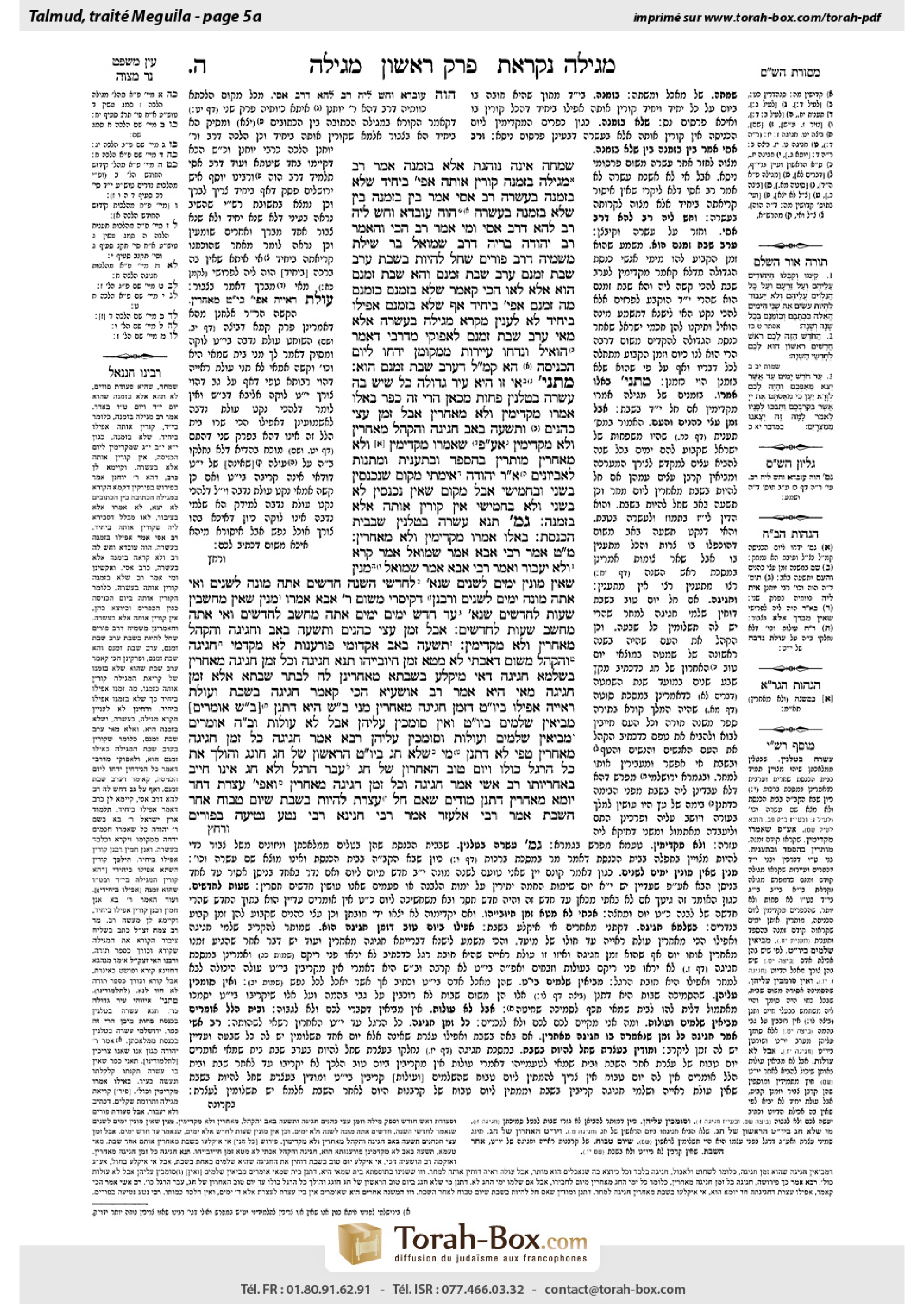
Megillah 5a: Talmud study for Daf Yomi
Daf Yomi is the daily study of one Talmud folio. Explore 37 tractates with scans, Hebrew text, Sefaria English and AI-generated French translations where annotated.
Passage selection and English or AI-generated French translation are available where the scan has annotations. Daf Study is independent of Torah-Box and Sefaria.
Browse Megillah · מגילה · All tractatesMegillah 5a text and translations
This page of Megillah includes the Aramaic text, an English translation and an AI-generated French translation, alongside the scan above.
מגילה ה׳ א · Aramaic and Hebrew text
שִׂמְחָה, אֵינָהּ נוֹהֶגֶת אֶלָּא בִּזְמַנָּהּ.
אָמַר רַב: מְגִילָּה בִּזְמַנָּהּ — קוֹרִין אוֹתָהּ אֲפִילּוּ בְּיָחִיד, שֶׁלֹּא בִּזְמַנָּהּ — בַּעֲשָׂרָה. רַב אַסִּי אָמַר: בֵּין בִּזְמַנָּהּ בֵּין שֶׁלֹּא בִּזְמַנָּהּ — בַּעֲשָׂרָה. הֲוָה עוֹבָדָא, וְחַשׁ לֵיהּ רַב לְהָא דְּרַב אַסִּי.
וּמִי אָמַר רַב הָכִי? וְהָאָמַר רַב יְהוּדָה בְּרֵיהּ דְּרַב שְׁמוּאֵל בַּר שִׁילַת מִשְּׁמֵיהּ דְּרַב: פּוּרִים שֶׁחָל לִהְיוֹת בְּשַׁבָּת — עֶרֶב שַׁבָּת זְמַנָּם. עֶרֶב שַׁבָּת זְמַנָּם?! וְהָא שַׁבָּת זְמַנָּם הוּא! אֶלָּא לָאו הָכִי קָאָמַר: שֶׁלֹּא בִּזְמַנָּם כִּזְמַנָּם. מָה זְמַנָּם — אֲפִילּוּ בְּיָחִיד, אַף שֶׁלֹּא בִּזְמַנָּם — אֲפִילּוּ בְּיָחִיד?
לָא, לְעִנְיַן מִקְרָא מְגִילָּה בַּעֲשָׂרָה. אֶלָּא מַאי ״עֶרֶב שַׁבָּת זְמַנָּם״ — לְאַפּוֹקֵי מִדְּרַבִּי, דְּאָמַר: הוֹאִיל וְנִדְחוּ עֲיָירוֹת מִמְּקוֹמָן — יִדָּחוּ לְיוֹם הַכְּנִיסָה, הָא קָא מַשְׁמַע לַן דְּעֶרֶב שַׁבָּת זְמַנָּם הוּא.
מַתְנִי׳ אִי זוֹ הִיא עִיר גְּדוֹלָה — כֹּל שֶׁיֵּשׁ בָּהּ עֲשָׂרָה בַּטְלָנִין. פָּחוֹת מִכָּאן — הֲרֵי זֶה כְּפָר.
בְּאֵלּוּ אָמְרוּ מַקְדִּימִין וְלֹא מְאַחֲרִין. אֲבָל זְמַן עֲצֵי כֹּהֲנִים, וְתִשְׁעָה בְּאָב, חֲגִיגָה, וְהַקְהֵל — מְאַחֲרִין וְלֹא מַקְדִּימִין.
אַף עַל פִּי שֶׁאָמְרוּ מַקְדִּימִין וְלֹא מְאַחֲרִין — מוּתָּרִין בְּהֶסְפֵּד וּבְתַעֲנִית, וּמַתָּנוֹת לָאֶבְיוֹנִים. אָמַר רַבִּי יְהוּדָה: אֵימָתַי? מְקוֹם שֶׁנִּכְנָסִין בְּשֵׁנִי וּבַחֲמִישִׁי. אֲבָל מְקוֹם שֶׁאֵין נִכְנָסִין לֹא בַּשֵּׁנִי וְלֹא בַּחֲמִישִׁי — אֵין קוֹרִין אוֹתָהּ אֶלָּא בִּזְמַנָּהּ.
גְּמָ׳ תָּנָא: עֲשָׂרָה בַּטְלָנִין שֶׁבְּבֵית הַכְּנֶסֶת.
בְּאֵלּוּ, אָמְרוּ מַקְדִּימִין וְלֹא מְאַחֲרִין. מַאי טַעְמָא? אָמַר רַבִּי אַבָּא אָמַר שְׁמוּאֵל: אָמַר קְרָא ״וְלֹא יַעֲבוֹר״.
וְאָמַר רַבִּי אַבָּא אָמַר שְׁמוּאֵל: מִנַּיִן שֶׁאֵין מוֹנִין יָמִים לַשָּׁנִים — שֶׁנֶּאֱמַר: ״לְחׇדְשֵׁי הַשָּׁנָה״ — חֳדָשִׁים אַתָּה מוֹנֶה לַשָּׁנִים, וְאִי אַתָּה מוֹנֶה יָמִים לַשָּׁנִים.
וְרַבָּנַן דְּקֵיסָרִי מִשּׁוּם רַבִּי אַבָּא אָמְרוּ: מִנַּיִן שֶׁאֵין מְחַשְּׁבִין שָׁעוֹת לֶחֳדָשִׁים, שֶׁנֶּאֱמַר: ״עַד חֹדֶשׁ יָמִים״. יָמִים אַתָּה מְחַשֵּׁב לֶחֳדָשִׁים, וְאִי אַתָּה מְחַשֵּׁב שָׁעוֹת לֶחֳדָשִׁים.
אֲבָל זְמַן עֲצֵי כֹהֲנִים וְתִשְׁעָה בְּאָב וַחֲגִיגָה וְהַקְהֵל — מְאַחֲרִין וְלֹא מַקְדִּימִין. תִּשְׁעָה בְּאָב — אַקְדּוֹמֵי פּוּרְעָנוּת לָא מַקְדְּמִי. חֲגִיגָה וְהַקְהֵל — מִשּׁוּם דְּאַכַּתִּי לָא מְטָא זְמַן חִיּוּבַיְיהוּ.
תָּנָא: חֲגִיגָה וְכׇל זְמַן חֲגִיגָה מְאַחֲרִין. בִּשְׁלָמָא חֲגִיגָה, דְּאִי מִיקְּלַע בְּשַׁבְּתָא מְאַחֲרִינַן לַהּ לְבָתַר שַׁבְּתָא. אֶלָּא זְמַן חֲגִיגָה מַאי הִיא?
אָמַר רַב אוֹשַׁעְיָא, הָכִי קָאָמַר: חֲגִיגָה בְּשַׁבָּת, וְעוֹלַת רְאִיָּיה אֲפִילּוּ בְּיוֹם טוֹב, דִּזְמַן חֲגִיגָה — מְאַחֲרִין.
מַנִּי — בֵּית שַׁמַּאי הִיא, דִּתְנַן, [בֵּית שַׁמַּאי אוֹמְרִים]: מְבִיאִין שְׁלָמִים בְּיוֹם טוֹב, וְאֵין סוֹמְכִין עֲלֵיהֶן,
אֲבָל לֹא עוֹלוֹת. וּבֵית הִלֵּל אוֹמְרִים: מְבִיאִין שְׁלָמִים וְעוֹלוֹת וְסוֹמְכִין עֲלֵיהֶן.
רָבָא אָמַר: חֲגִיגָה, כׇּל זְמַן חֲגִיגָה — מְאַחֲרִין, טְפֵי — לָא. דִּתְנַן: מִי שֶׁלֹּא חָג בְּיוֹם טוֹב הָרִאשׁוֹן שֶׁל חַג — חוֹגֵג וְהוֹלֵךְ אֶת כָּל הָרֶגֶל כּוּלּוֹ, וְיוֹם טוֹב הָאַחֲרוֹן שֶׁל חַג. עָבַר הָרֶגֶל וְלֹא חָג — אֵינוֹ חַיָּיב בְּאַחְרָיוּתוֹ.
רַב אָשֵׁי אָמַר: חֲגִיגָה וְכׇל זְמַן חֲגִיגָה — מְאַחֲרִין, וַאֲפִילּוּ עֲצֶרֶת דְּחַד יוֹמָא — מְאַחֲרִין, דִּתְנַן: מוֹדִים שֶׁאִם חָל עֲצֶרֶת לִהְיוֹת בְּשַׁבָּת — שֶׁיּוֹם טְבוֹחַ אַחַר הַשַּׁבָּת.
אָמַר רַבִּי אֶלְעָזָר אָמַר רַבִּי חֲנִינָא: רַבִּי נָטַע נְטִיעָה בְּפוּרִים,
Megillah 5a · English translation
the rejoicing that takes place on Purim is practiced only in its designated time, the fourteenth of Adar.
§ Rav said: One may read the Megilla in its proper time, i.e., on the fourteenth of Adar, even privately. However, when it is read not at its proper time, e.g., when the villages advance their reading to the day of assembly, it must be read with a quorum of ten, because the enactment allowing the Megilla to be read before its proper time was only made for a community. Rav Asi disagreed and said: Both at its proper time and not at its proper time, the Megilla must be read with a quorum of ten. The Gemara relates that there was an incident where Rav had to read the Megilla on Purim, and he was concerned for this opinion of Rav Asi and gathered ten men even though he was reading the Megilla in its proper time, on the fourteenth of Adar.
The Gemara asks: And did Rav actually say this, that when the Megilla is read not at its proper time, it can only be read with a quorum of ten? Didn’t Rav Yehuda, son of Rav Shmuel bar Sheilat, say in the name of Rav: If Purim occurs on Shabbat, Shabbat eve is the proper time for reading the Megilla? The Gemara expresses surprise with regard to the wording of Rav’s statement: Is Shabbat eve the proper time for reading the Megilla? Isn’t Shabbat itself its proper time? Rather, is it not true that this is what he said, i.e., that this is the way his statement should be understood: Reading the Megilla not at its proper time is like reading it at its proper time; just as at its proper time, it can be read even privately, so too, not at its proper time, it can be read even privately.
The Gemara rejects this argument: Rav’s statement was not made with regard to reading the Megilla with a quorum of ten. Rather, what is the meaning of Rav’s statement that Shabbat eve is the proper time? It was meant to exclude the opinion of Rabbi Yehuda HaNasi, who said: Since the readings in the large towns were already deferred from their usual date and the Megilla was not read on the fourteenth, they are deferred to the day of assembly. This statement of Rav teaches us that Shabbat eve is the proper time for these towns to read the Megilla, as stated in the mishna.
MISHNA: What is considered a large city, where the Megilla is read on the fourteenth of Adar? Any city in which there are ten idlers. However, if there are fewer than that, it is considered a village, even if it has many inhabitants.
It was with regard to these times for reading the Megilla that the Sages said that one advances the reading of the Megilla before the fourteenth of Adar and one does not postpone the reading to after its proper time. However, with regard to the time when families of priests donate wood for the fire on the altar, which were times those families would treat as Festivals; as well as the fast of the Ninth of Av; the Festival peace-offering that was brought on the Festivals; and the commandment of assembly [hakhel] of the entire Jewish people in the Temple courtyard on Sukkot in the year following the Sabbatical year to hear the king read the book of Deuteronomy; one postpones their observance until after Shabbat and does not advance their observance to before Shabbat.
The mishna continues: Even though the Sages said that one advances the time for reading the Megilla and one does not postpone the reading, one is permitted to eulogize and fast on these days, as they are not actually Purim; nevertheless, gifts for the poor are distributed on this day. Rabbi Yehuda said: When is the Megilla read on the day of assembly, before the fourteenth of Adar? In a place where the villagers generally enter town on Monday and Thursday. However, in a place where they do not generally enter town on Monday and Thursday, one may read the Megilla only in its designated time, the fourteenth of Adar.
GEMARA: We learned in the mishna that a large city is one that has ten idlers. It was taught in a baraita: The ten idlers that are mentioned here are ten idlers that are in the synagogue, i.e., men who do not have professional responsibilities other than to sit in the synagogue and attend to communal religious needs. The presence of ten such men establishes a location as a prominent city.
We learned in the mishna: It was with regard to these times for reading the Megilla that the Sages said that one advances the reading of the Megilla and one does not postpone it. The Gemara asks: What is the reason for this? Rabbi Abba said that Shmuel said: The verse states: “The Jews ordained, and took upon them, and upon their seed, and upon all who joined themselves to them, and it shall not pass, that they should keep these two days” (Esther 9:27), which indicates that the designated time must not pass without the reading of the Megilla.
Having mentioned a teaching of Rabbi Abba in the name of Shmuel, the Gemara cites another of his statements: And Rabbi Abba said that Shmuel said: From where is it derived that one does not count days to make up years, i.e., a year is considered to be comprised of either twelve or thirteen lunar months, and not 365 days? As it is stated: “Of the months of the year” (Exodus 12:2), which indicates that you count months to make up years, but you do not count days to make up years.
The Gemara adds: And the Sages of Caesarea said in the name of Rabbi Abba: From where is it derived that one does not calculate hours to reckon the months? A lunar cycle takes approximately twenty-nine and a half days, but a calendar month is considered to be twenty-nine or thirty full days and not precisely a lunar cycle. As it is stated: “Until a month of days” (Numbers 11:20), which indicates that you calculate days to reckon the months, but you do not calculate hours to reckon the months.
§ We learned in the mishna: However, with regard to the time when families of priests donate wood for the fire on the altar, the fast of the Ninth of Av, the Festival peace-offering, and the commandment of assembly [hakhel], one postpones their observance until after Shabbat and does not advance their observance to before Shabbat. The Gemara explains the reason for this halakha with respect to each item mentioned in the mishna. The fast of the Ninth of Av is not advanced because one does not advance calamity; since the Ninth of Av is a tragic time, its observance is postponed as long as possible. The Festival peace-offering and the commandment of assembly [hakhel] are not advanced because the time of their obligation has not yet arrived, and it is impossible to fulfill mitzvot before the designated time has arrived.
It was taught in a baraita: One postpones the Festival peace-offering and the entire time period of the Festival peace-offering. The Gemara attempts to clarify this statement: Granted that when the baraita says that the Festival peace-offering is postponed, it means that if a Festival occurs on Shabbat, when the Festival peace-offering cannot be sacrificed, one postpones it until after Shabbat and sacrifices the offering on the intermediate days of the Festival. However, what is the meaning of the phrase: The time period of the Festival peace-offering?
Rav Oshaya said: This is what the baraita is saying: One postpones the Festival peace-offering if the Festival occurs on Shabbat, and one postpones the burnt-offering of appearance even due to the Festival itself. Despite the fact that a Festival day is the time for sacrificing a Festival peace-offering, the burnt-offering of appearance may not be sacrificed until after the Festival day.
The Gemara adds: Whose opinion is reflected in the mishna according to Rav Oshaya’s explanation? It is the opinion of Beit Shammai, as we learned in a mishna (Beitza 19a) that Beit Shammai say: One may bring peace-offerings on a Festival day to be sacrificed in the Temple. Most portions of a peace-offering are eaten by the priests and the individual who brought the offering. Consequently, its slaughter is considered food preparation, which is permitted on a Festival day. And one may not place his hands on the head of the offering, as that includes leaning with all one’s might upon the animal, which is prohibited on a Festival.
However, burnt-offerings may not be brought at all on the Festival. Since they are not eaten, their slaughter is not considered food preparation, and it therefore constitutes a prohibited labor on the Festival. Beit Hillel disagree and say: One may bring both peace-offerings and burnt-offerings on a Festival day, and one may even place his hands on them.
Rava said that the baraita should be understood as follows: One postpones the Festival peace-offering for the entire time period of the Festival peace-offering, i.e., for the entire duration of the Festival. However, it may not be postponed for longer than this. As we learned in a mishna (Ḥagiga 9a): One who did not offer the Festival peace-offering on the first Festival day of the festival of Sukkot may offer the Festival peace-offering for the duration of the entire pilgrimage Festival, including the intermediate days and the last day of the Festival. If the pilgrimage Festival has passed and he did not yet bring the Festival peace-offering, he is not obligated to pay restitution for it. The obligation is no longer in force, and he therefore is not liable to bring another offering as compensation.
Rav Ashi said that the baraita should be understood as follows: The Festival peace-offering may be postponed for the entire time period of a Festival peace-offering. This indicates that even if Shavuot, which is one day, occurs on Shabbat, one postpones the Festival peace-offering and offers it on one of the six days after Shavuot. As we learned in a mishna (Ḥagiga 17a): Beit Hillel concede that if Shavuot occurs on Shabbat, the day of slaughter is after Shabbat. Since the Festival peace-offering and the burnt-offering of appearance cannot be sacrificed on Shabbat, they are slaughtered after Shabbat. This indicates that the Festival peace-offering may be slaughtered after the Festival day of Shavuot, as is the case on the other Festivals.
Rabbi Elazar said that Rabbi Ḥanina said: Rabbi Yehuda HaNasi did several unusual things: He planted a sapling on Purim, and was not concerned about performing labor and thereby possibly denigrating the day.
Megillah 5a · Traduction française (IA)
la réjouissance de Pourim n’a lieu qu’à la date qui lui est fixée, le quatorze Adar.
§ Rav a dit : On peut lire la Meguila à la date qui lui est fixée, c’est-à-dire le quatorze Adar, même seul. En revanche, lorsqu’on la lit en dehors de cette date, par exemple lorsque les villages avancent leur lecture au jour de rassemblement, elle doit être lue en présence d’un quorum de dix hommes, car la disposition autorisant la lecture de la Meguila avant la date qui lui est fixée n’a été instituée que pour une communauté. Rav Asi n’était pas d’accord et a dit : Que la Meguila soit lue à la date qui lui est fixée ou en dehors de celle-ci, elle doit être lue en présence d’un quorum de dix hommes. La Guemara rapporte qu’un jour, Rav dut lire la Meguila à Pourim et, par égard pour l’opinion de Rav Asi, il rassembla dix hommes, bien qu’il la lût à la date qui lui était fixée, le quatorze Adar.
La Guemara demande : Rav a-t-il réellement dit que lorsque la Meguila est lue en dehors de la date qui lui est fixée, elle ne peut être lue qu’en présence d’un quorum de dix hommes ? Rav Yehouda, fils de Rav Shmuel bar Sheilat, n’a-t-il pas dit au nom de Rav : Si Pourim tombe un Chabbat, la veille de Chabbat est le moment approprié pour lire la Meguila ? La Guemara s’étonne de la formulation de la déclaration de Rav : La veille de Chabbat est-elle le moment approprié pour lire la Meguila ? N’est-ce pas le Chabbat même qui est le moment fixé ? N’est-il pas plutôt vrai que voici ce qu’il a dit, autrement dit, que telle est la manière de comprendre sa déclaration : lire la Meguila en dehors de la date qui lui est fixée équivaut à la lire à la date qui lui est fixée ; de même qu’à la date qui lui est fixée on peut la lire même seul, de même, en dehors de cette date, on peut la lire même seul.
La Guemara rejette cet argument : la déclaration de Rav ne concernait pas la lecture de la Meguila en présence d’un quorum de dix hommes. Que signifie donc la déclaration de Rav selon laquelle la veille de Chabbat est le moment approprié ? Elle visait à exclure l’opinion de Rabbi Yehouda HaNassi, qui disait : Puisque les lectures dans les grandes villes avaient déjà été reportées de leur date habituelle et que la Meguila n’avait pas été lue le quatorze, elles sont reportées au jour de rassemblement. La déclaration de Rav nous enseigne que la veille de Chabbat est le moment approprié pour que les habitants de ces villes lisent la Meguila, comme l’indique la Michna.
MICHNA : Qu’est-ce qui est considéré comme une grande ville, où l’on lit la Meguila le quatorze Adar ? Toute ville où se trouvent dix oisifs. En revanche, s’il y en a moins, elle est considérée comme un village, même si elle compte de nombreux habitants.
C’est au sujet de ces dates de lecture de la Meguila que les Sages ont dit qu’on avance la lecture avant le quatorze Adar et qu’on ne la reporte pas après la date qui lui est fixée. En revanche, pour les dates auxquelles les familles de prêtres apportent du bois destiné au feu de l’autel — dates que ces familles considéraient comme des fêtes —, ainsi que pour le jeûne du neuf Av, le sacrifice de paix de fête offert lors des fêtes et le commandement du rassemblement [hakhel] de tout le peuple juif dans le parvis du Temple, à Soukkot de l’année suivant l’année sabbatique, afin d’entendre le roi lire le livre du Deutéronome, on reporte leur observance après Chabbat et on ne l’avance pas avant Chabbat.
La Michna poursuit : bien que les Sages aient dit qu’on avance la date de lecture de la Meguila et qu’on ne reporte pas la lecture, il est permis de prononcer des oraisons funèbres et de jeûner ces jours-là, car ce n’est pas Pourim à proprement parler ; néanmoins, on distribue ce jour-là des dons aux pauvres. Rabbi Yehouda a dit : Quand lit-on la Meguila le jour de rassemblement, avant le quatorze Adar ? Dans un endroit où les villageois ont l’habitude de venir en ville le lundi et le jeudi. En revanche, là où ils n’ont pas l’habitude de venir en ville le lundi et le jeudi, on ne peut lire la Meguila qu’à la date qui lui est fixée, le quatorze Adar.
GUEMARA : Nous avons appris dans la Michna qu’une grande ville est une ville qui compte dix oisifs. Il a été enseigné dans une baraïta : les dix oisifs mentionnés ici sont dix oisifs qui se trouvent dans la synagogue, c’est-à-dire des hommes qui n’ont pas d’activité professionnelle autre que de s’asseoir dans la synagogue et de répondre aux besoins religieux de la communauté. La présence de ces dix hommes établit qu’un lieu est une ville importante.
Nous avons appris dans la Michna que c’est au sujet de ces dates de lecture de la Meguila que les Sages ont dit qu’on avance la lecture et qu’on ne la reporte pas. La Guemara demande : Quelle en est la raison ? Rabbi Abba a dit que Shmuel a dit : Le verset énonce : « Les Juifs établirent et prirent sur eux, ainsi que sur leur descendance et sur tous ceux qui se joindraient à eux, de ne pas laisser passer ces deux jours sans les observer » (Esther 9,27), ce qui indique que la date fixée ne doit pas passer sans que la Meguila soit lue.
Après avoir mentionné un enseignement de Rabbi Abba au nom de Shmuel, la Guemara en cite un autre : Rabbi Abba a dit que Shmuel a dit : D’où déduit-on qu’on ne compte pas les jours pour constituer les années, c’est-à-dire qu’une année est considérée comme composée de douze ou de treize mois lunaires, et non de 365 jours ? Car il est dit : « Des mois de l’année » (Exode 12,2), ce qui indique qu’on compte les mois pour constituer les années, mais qu’on ne compte pas les jours pour constituer les années.
La Guemara ajoute : Les Sages de Césarée ont dit au nom de Rabbi Abba : D’où déduit-on qu’on ne calcule pas les heures pour déterminer la durée des mois ? Un cycle lunaire dure environ vingt-neuf jours et demi, mais un mois du calendrier est considéré comme comptant vingt-neuf ou trente jours entiers, et non comme correspondant exactement à un cycle lunaire. Car il est dit : « Jusqu’à un mois de jours » (Nombres 11,20), ce qui indique qu’on calcule les jours pour déterminer la durée des mois, mais qu’on ne calcule pas les heures pour déterminer leur durée.
§ Nous avons appris dans la Michna qu’en ce qui concerne les dates auxquelles les familles de prêtres apportent du bois destiné au feu de l’autel, le jeûne du neuf Av, le sacrifice de paix de fête et le commandement du rassemblement [hakhel], on reporte leur observance après Chabbat et on ne l’avance pas avant Chabbat. La Guemara explique la raison de cette halakha pour chacun des éléments mentionnés dans la Michna. Le jeûne du neuf Av n’est pas avancé, car on n’avance pas une calamité ; puisque le neuf Av est une période tragique, on reporte son observance aussi longtemps que possible. Le sacrifice de paix de fête et le commandement du rassemblement [hakhel] ne sont pas avancés, car le moment où ils deviennent obligatoires n’est pas encore arrivé, et il est impossible d’accomplir des mitsvot avant que la date qui leur est fixée ne soit arrivée.
Il a été enseigné dans une baraïta : On reporte le sacrifice de paix de fête, ainsi que toute la période prévue pour ce sacrifice. La Guemara tente de clarifier cette déclaration : Il est compréhensible que, lorsque la baraïta dit que le sacrifice de paix de fête est reporté, cela signifie que si une fête tombe un Chabbat, auquel cas le sacrifice de paix de fête ne peut être offert, on le reporte après Chabbat et on offre le sacrifice pendant les jours intermédiaires de la fête. Mais que signifie l’expression : toute la période prévue pour le sacrifice de paix de fête ?
Rav Oshaya a dit : Voici ce que dit la baraïta : On reporte le sacrifice de paix de fête si la fête tombe un Chabbat, et on reporte l’holocauste de pèlerinage même en raison de la fête elle-même. Bien qu’un jour de fête soit le moment où l’on peut offrir un sacrifice de paix de fête, l’holocauste de pèlerinage ne peut être offert qu’après le jour de fête.
La Guemara ajoute : Selon l’explication de Rav Oshaya, quelle opinion la Michna reflète-t-elle ? Celle de Beit Shammaï, comme nous l’avons appris dans une Michna (Beitsa 19a) : Beit Shammaï disent qu’on peut apporter des sacrifices de paix le jour d’une fête pour les offrir au Temple. La plupart des portions d’un sacrifice de paix sont consommées par les prêtres et par la personne qui a apporté le sacrifice. Par conséquent, son abattage est considéré comme une préparation de nourriture, ce qui est permis un jour de fête. Et on ne peut pas poser les mains sur la tête du sacrifice, car cela implique de s’appuyer de tout son poids sur l’animal, ce qui est interdit pendant une fête.
En revanche, on ne peut apporter aucun holocauste pendant la fête. Puisqu’on ne le consomme pas, son abattage n’est pas considéré comme une préparation de nourriture et constitue donc un travail interdit pendant la fête. Beit Hillel ne sont pas d’accord et disent qu’on peut apporter des sacrifices de paix et des holocaustes un jour de fête, et qu’on peut même poser les mains sur eux.
Rava a dit qu’il faut comprendre la baraïta ainsi : on reporte le sacrifice de paix de fête pendant toute la période prévue pour ce sacrifice, c’est-à-dire pendant toute la durée de la fête. Toutefois, on ne peut pas le reporter au-delà de cette période. En effet, nous avons appris dans une Michna (Haguiga 9a) : Celui qui n’a pas offert le sacrifice de paix de fête le premier jour de la fête de Soukkot peut l’offrir pendant toute la durée de la fête de pèlerinage, y compris les jours intermédiaires et le dernier jour de la fête. Si la fête de pèlerinage est passée sans qu’il ait apporté le sacrifice de paix de fête, il n’est pas tenu de le remplacer. L’obligation n’est plus en vigueur et il n’est donc pas tenu d’apporter un autre sacrifice à titre de compensation.
Rav Ashi a dit qu’il faut comprendre la baraïta ainsi : le sacrifice de paix de fête peut être reporté pendant toute la période prévue pour un tel sacrifice. Cela indique que même si Chavouot, qui dure un jour, tombe un Chabbat, on reporte le sacrifice de paix de fête et on l’offre l’un des six jours suivant Chavouot. En effet, nous avons appris dans une Michna (Haguiga 17a) : Beit Hillel reconnaissent que si Chavouot tombe un Chabbat, le jour de l’abattage est après Chabbat. Puisque le sacrifice de paix de fête et l’holocauste de pèlerinage ne peuvent être offerts le Chabbat, ils sont abattus après Chabbat. Cela indique que le sacrifice de paix de fête peut être abattu après le jour de fête de Chavouot, comme c’est le cas lors des autres fêtes.
Rabbi Elazar a dit que Rabbi Ḥanina a dit : Rabbi Yehouda HaNassi a fait plusieurs choses inhabituelles : il a planté un jeune arbre à Pourim, sans se soucier d’accomplir un travail et de risquer ainsi de déprécier ce jour.
Traduction française générée par IA à partir de l’édition anglaise de Sefaria. Vérifie toujours un passage avec le texte source.
Text from Sefaria: William Davidson Edition - Vocalized Aramaic (CC BY NC); William Davidson Edition - English (CC BY NC).