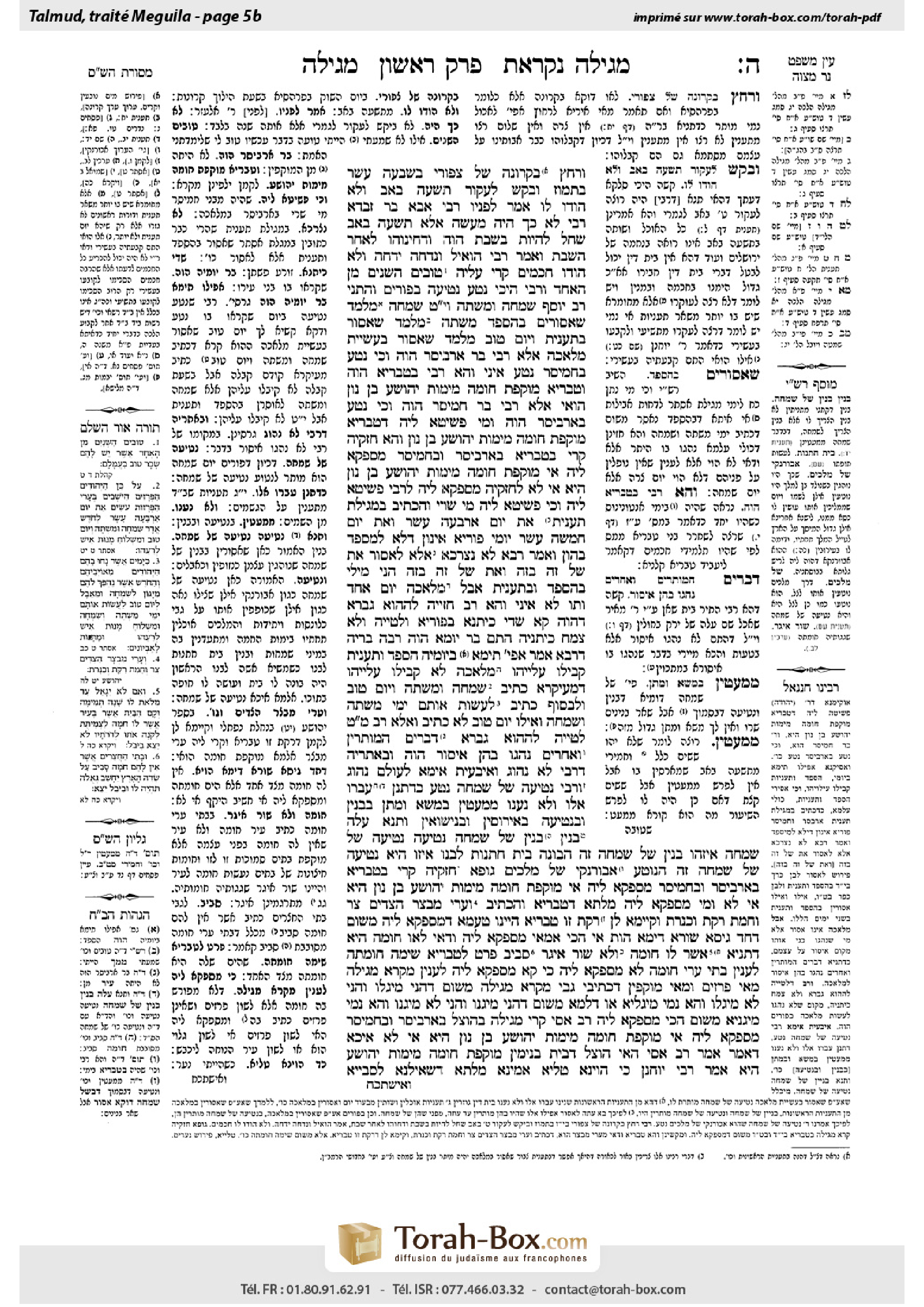
Megillah 5b: Talmud study for Daf Yomi
Daf Yomi is the daily study of one Talmud folio. Explore 37 tractates with scans, Hebrew text, Sefaria English and AI-generated French translations where annotated.
Passage selection and English or AI-generated French translation are available where the scan has annotations. Daf Study is independent of Torah-Box and Sefaria.
Browse Megillah · מגילה · All tractatesMegillah 5b text and translations
This page of Megillah includes the Aramaic text, an English translation and an AI-generated French translation, alongside the scan above.
מגילה ה׳ ב · Aramaic and Hebrew text
וְרָחַץ בִּקְרוֹנָהּ שֶׁל צִפּוֹרִי בְּשִׁבְעָה עָשָׂר בְּתַמּוּז, וּבִקֵּשׁ לַעֲקוֹר תִּשְׁעָה בְּאָב — וְלֹא הוֹדוּ לוֹ.
אָמַר לְפָנָיו רַבִּי אַבָּא בַּר זַבְדָּא: רַבִּי, לֹא כָּךְ הָיָה מַעֲשֶׂה. אֶלָּא תִּשְׁעָה בְּאָב שֶׁחָל לִהְיוֹת בְּשַׁבָּת הֲוָה, וּדְחִינוּהוּ לְאַחַר הַשַּׁבָּת. וְאָמַר רַבִּי: הוֹאִיל וְנִדְחָה — יִדָּחֶה, וְלֹא הוֹדוּ חֲכָמִים. קָרֵי עֲלֵיהּ: ״טוֹבִים הַשְּׁנַיִם מִן הָאֶחָד״.
וְרַבִּי הֵיכִי נָטַע נְטִיעָה בְּפוּרִים? וְהָתָנֵי רַב יוֹסֵף: ״שִׂמְחָה וּמִשְׁתֶּה וְיוֹם טוֹב״, ״שִׂמְחָה״ — מְלַמֵּד שֶׁאֲסוּרִים בְּהֶסְפֵּד, ״מִשְׁתֶּה״ — מְלַמֵּד שֶׁאָסוּר בְּתַעֲנִית, ״וְיוֹם טוֹב״ — מְלַמֵּד שֶׁאָסוּר בַּעֲשִׂיַּית מְלָאכָה! אֶלָּא: רַבִּי, בַּר אַרְבֵּיסַר הֲוָה, וְכִי נְטַע — בַּחֲמֵיסַר נְטַע.
אִינִי? וְהָא רַבִּי בִּטְבֶרְיָא הֲוָה, וּטְבֶרְיָא מוּקֶּפֶת חוֹמָה מִימוֹת יְהוֹשֻׁעַ בִּן נוּן הֲוַאי! אֶלָּא, רַבִּי בַּר חֲמֵיסָר הֲוָה, וְכִי נְטַע — בְּאַרְבֵּיסַר הֲוָה.
וּמִי פְּשִׁיטָא לֵיהּ דִּטְבֶרְיָא מוּקֶּפֶת חוֹמָה מִימוֹת יְהוֹשֻׁעַ בִּן נוּן? וְהָא חִזְקִיָּה קָרֵי בִּטְבֶרְיָא בְּאַרְבֵּיסַר וּבַחֲמֵיסַר? מְסַפְּקָא לֵיהּ אִי מוּקֶּפֶת חוֹמָה מִימוֹת יְהוֹשֻׁעַ בִּן נוּן הִיא אִי לָא. לְחִזְקִיָּה מְסַפְּקָא לֵיהּ, לְרַבִּי פְּשִׁיטָא לֵיהּ.
וְכִי פְּשִׁיטָא לֵיהּ, מִי שְׁרֵי? וְהָכְתִיב בִּמְגִילַּת תַּעֲנִית: אֵת יוֹם אַרְבָּעָה עָשָׂר וְאֵת יוֹם חֲמִשָּׁה עָשָׂר יוֹמֵי פּוּרַיָּא אִינּוּן, דְּלָא לְמִסְפַּד בְּהוֹן,
וְאָמַר רָבָא: לֹא נִצְרְכָא, אֶלָּא לֶאֱסוֹר אֶת שֶׁל זֶה בָּזֶה וְאֶת שֶׁל זֶה בָּזֶה? הָנֵי מִילֵּי בְּהֶסְפֵּד וּבְתַעֲנִית, אֲבָל מְלָאכָה — יוֹם אֶחָד וְתוּ לָא.
אִינִי? וְהָא רַב חַזְיֵיהּ לְהָהוּא גַּבְרָא דַּהֲוָה קָא שָׁדֵי כִּיתָּנָא בְּפוּרַיָּא, וְלַטְיֵיהּ וְלָא צְמַח כִּיתָּנֵיהּ! הָתָם, בַּר יוֹמָא הֲוָה.
רַבָּה בְּרֵיהּ דְּרָבָא אָמַר: אֲפִילּוּ תֵּימָא בְּיוֹמֵיהּ — הֶסְפֵּד וְתַעֲנִית קַבִּילוּ עֲלַיְיהוּ, מְלָאכָה לָא קַבִּילוּ עֲלַיְיהוּ.
דְּמֵעִיקָּרָא כְּתִיב: ״שִׂמְחָה וּמִשְׁתֶּה וְיוֹם טוֹב״, וּלְבַסּוֹף כְּתִיב: ״לַעֲשׂוֹת אוֹתָם יְמֵי מִשְׁתֶּה וְשִׂמְחָה״, וְאִילּוּ ״יוֹם טוֹב״ לָא כְּתִיב.
וְאֶלָּא רַב מַאי טַעְמָא לַטְיֵיהּ לְהָהוּא גַּבְרָא? דְּבָרִים הַמּוּתָּרִין וַאֲחֵרִים נָהֲגוּ בָּהֶן אִיסּוּר הֲוָה. וּבְאַתְרֵיהּ דְּרַבִּי לָא נְהוּג.
וְאִיבָּעֵית אֵימָא: לְעוֹלָם נְהוּג — וְרַבִּי נְטִיעָה שֶׁל שִׂמְחָה נָטַע. כְּדִתְנַן: עָבְרוּ אֵלּוּ וְלֹא נַעֲנוּ — מְמַעֲטִין בְּמַשָּׂא וּמַתָּן, בְּבִנְיָן וּבִנְטִיעָה, בְּאֵירוּסִין וּבְנִישּׂוּאִין.
וְתָנָא עֲלַהּ: בִּנְיָן — בִּנְיָן שֶׁל שִׂמְחָה, נְטִיעָה — נְטִיעָה שֶׁל שִׂמְחָה. אֵיזֶהוּ בִּנְיָן שֶׁל שִׂמְחָה? זֶה הַבּוֹנֶה בֵּית חַתְנוּת לִבְנוֹ. אֵיזוֹ הִיא נְטִיעָה שֶׁל שִׂמְחָה? זֶה הַנּוֹטֵעַ אַבְוָרַנְקֵי שֶׁל מְלָכִים.
גּוּפָא: חִזְקִיָּה קָרֵי בִּטְבֶרְיָא בְּאַרְבֵּיסַר וּבַחֲמֵיסַר, מְסַפְּקָא לֵיהּ אִי מוּקֶּפֶת חוֹמָה מִימוֹת יְהוֹשֻׁעַ בִּן נוּן הִיא אִי לָא. וּמִי מְסַפְּקָא לֵיהּ מִלְּתָא דִטְבֶרְיָא? וְהָכְתִיב: ״וְעָרֵי מִבְצָר הַצִּדִּים צֵר וְחַמַּת רַקַּת וְכִנָּרֶת״, וְקַיְימָא לַן רַקַּת זוֹ טְבֶרְיָא! הַיְינוּ טַעְמָא דִּמְסַפְּקָא לֵיהּ, מִשּׁוּם דְּחַד גִּיסָא שׁוּרָא דְיַמָּא הֲוָת.
אִי הָכִי, אַמַּאי מְסַפְּקָא לֵיהּ? וַדַּאי לָאו חוֹמָה הִיא! דְּתַנְיָא: ״אֲשֶׁר לוֹ חוֹמָה״ — וְלֹא שׁוּר אִיגַּר. ״סָבִיב״ — פְּרָט לִטְבֶרְיָא שֶׁיַּמָּהּ חוֹמָתָהּ.
לְעִנְיַן בָּתֵּי עָרֵי חוֹמָה לָא מְסַפְּקָא לֵיהּ. כִּי קָא מְסַפְּקָא לֵיהּ לְעִנְיַן מִקְרָא מְגִילָּה, מַאי פְּרָזִים וּמַאי מוּקָּפִין דִּכְתִיבִי גַּבֵּי מִקְרָא מְגִילָּה? מִשּׁוּם דְּהָנֵי מִיגַּלּוּ וְהָנֵי לָא מִיגַּלּוּ — וְהָא נָמֵי מִיגַּלְּיָא, אוֹ דִּלְמָא: מִשּׁוּם דְּהָנֵי מִיגְּנוּ וְהָנֵי לָא מִיגְּנוּ — וְהָא נָמֵי מִיגַּנְיָא. מִשּׁוּם הָכִי מְסַפְּקָא לֵיהּ.
רַב אַסִּי קָרֵי מְגִילָּה בְּהוּצָל בְּאַרְבֵּיסַר וּבַחֲמֵיסַר. מְסַפְּקָא לֵיהּ אִי מוּקֶּפֶת חוֹמָה מִימוֹת יְהוֹשֻׁעַ בִּן נוּן הִיא, אִי לָא. אִיכָּא דְּאָמַר, אָמַר רַב אַסִּי: הַאי הוּצָל דְּבֵית בִּנְיָמִין, מוּקֶּפֶת חוֹמָה מִימוֹת יְהוֹשֻׁעַ הִיא.
אָמַר רַבִּי יוֹחָנָן: כִּי הֲוֵינָא טַלְיָא אָמֵינָא מִלְּתָא דִּשְׁאֵילְנָא לְסָבַיָּיא
Megillah 5b · English translation
And he bathed at the time when the wagons [kerona] were traveling through Tzippori, i.e., on the market day, when the public would know about it, on the seventeenth of Tammuz, to show that bathing is permitted on that day. And he sought to abolish the fast of the Ninth of Av. And with respect to the Ninth of Av, the Sages did not agree with him.
Rabbi Abba bar Zavda said to Rabbi Elazar: My teacher, the incident did not occur in this fashion. Rabbi Yehuda HaNasi never sought to abolish the fast of the Ninth of Av. Rather, it was a year when the Ninth of Av occurred on Shabbat, and they postponed it until after Shabbat. And Rabbi Yehuda HaNasi said about that case: Since it has already been deferred from its usual time, let it be altogether deferred this year. And the Rabbis did not agree with him. Rabbi Elazar read the verse about Rabbi Abba bar Zavda: “Two are better than one” (Ecclesiastes 4:9), meaning, it is good that you were here to provide an accurate report about that incident.
The Gemara asks: And how could Rabbi Yehuda HaNasi plant a sapling on Purim? Didn’t Rav Yosef teach with regard to the verse: “Therefore the Jews of the villages, who dwell in the unwalled towns, make the fourteenth day of the month of Adar a day of gladness and feasting, and a good day [yom tov]” (Esther 9:19), that the term “gladness” teaches that it is prohibited to eulogize on Purim; “feasting” teaches that it is prohibited to fast; and the term “good day” [yom tov] teaches that it is prohibited to perform labor, just as on a Festival, which is also referred to as a yom tov? Rather, what happened was as follows: Rabbi Yehuda HaNasi was in a place that observed Purim on the fourteenth, and when he planted the sapling, he planted it on the fifteenth.
The Gemara asks: Is that so? Wasn’t Rabbi Yehuda HaNasi in Tiberias, and Tiberias was surrounded by a wall since the days of Joshua, son of Nun. Consequently, he was obligated to observe Purim on the fifteenth. Rather, say just the opposite: Rabbi Yehuda HaNasi lived in a place that observed Purim on the fifteenth, and when he planted the sapling, he planted it on the fourteenth.
The Gemara asks: Was it obvious to Rabbi Yehuda HaNasi that the city of Tiberias was surrounded by a wall since the days of Joshua, son of Nun? Didn’t Hezekiah read the Megilla in Tiberias both on the fourteenth and on the fifteenth of Adar, because he was uncertain if it had been surrounded by a wall since the days of Joshua, son of Nun, or not? The Gemara answers: Hezekiah was indeed uncertain about the matter, whereas it was obvious to Rabbi Yehuda HaNasi that Tiberias had been surrounded by a wall in the time of Joshua.
The Gemara asks further: And when it was obvious to Rabbi Yehuda HaNasi that the Megilla should be read in Tiberias on the fifteenth, was it permitted to plant there on the fourteenth? Isn’t it written in Megillat Ta’anit that the fourteenth day and the fifteenth day of Adar are the days of Purim, and one is not permitted to eulogize on them?
And Rava said: This statement is necessary only to prohibit those who observe Purim on this day to eulogize on that day, and those who observe Purim on that day to eulogize on this day. Since the two days are mentioned in the Bible, it was only necessary to mention them in Megillat Ta’anit in order to indicate that the prohibition against eulogizing applies to both days. Presumably, the same should apply to the prohibition against performing labor. Consequently, how could Rabbi Yehuda HaNasi plant a sapling on the fourteenth of Adar? The Gemara answers: That applies only to eulogies and fasting. However, labor is prohibited for only one day, either the fourteenth or the fifteenth, and no more.
The Gemara asks: Is that so? Didn’t Rav see a certain man planting flax on Purim, and cursed him, and the man’s flax never grew. The Gemara answers: There, the man was obligated to observe Purim on that day that he planted the flax. Therefore, it was certainly prohibited to perform labor.
Rabba, son of Rava, said a different answer to the question: Even if you say that Rabbi Yehuda HaNasi planted the sapling on his own day of Purim, i.e., on the day that the Megilla was read in his location, it was still permitted to plant the sapling. This is because the Jewish people accepted upon themselves the prohibitions against eulogizing and fasting on Purim, but they did not accept upon themselves the prohibition against performing labor.
This can be proven from the fact that initially, when Mordecai and Esther proposed the celebration of Purim, it is written: “A day of gladness and feasting and a good day [yom tov]” (Esther 9:19), and at the end, when the celebration of Purim was accepted by the Jewish people, it is written: “That they should make them days of feasting and gladness” (Esther 9:22), whereas the term good day [yom tov], which alludes to a day when it is prohibited to perform labor, is not written. The people never accepted upon themselves the prohibition against performing labor on Purim as if it were a Festival, and therefore the prohibition never took effect.
The Gemara asks: If labor is permitted on Purim, what is the reason that Rav cursed that man who planted the flax? The Gemara answers: It was a case of matters that are permitted by halakha, but others were accustomed to treat them as a prohibition, in which case one may not permit these actions in their presence, lest they come to treat other prohibitions lightly. In the place where that man planted his flax, it was customary to abstain from labor on Purim. However, in Rabbi Yehuda HaNasi’s place, it was not the custom to abstain from labor on Purim, and therefore it was permitted for him to plant the sapling even in public.
And if you wish, say an alternative answer: Actually, it was the custom to abstain from labor on Purim in Rabbi Yehuda HaNasi’s place, and Rabbi Yehuda HaNasi engaged in a joyful act of planting, for pleasure rather than for financial benefit. As we learned in a mishna with regard to public fasts: If these fasts for rain have passed and the community’s prayers have still not been answered, and the drought continues, one decreases his business activities, as well as construction, planting, betrothals, and marriages.
And it was taught in a baraita about this mishna: When the Sages said that construction must be decreased on public fasts, they were not referring to the construction of homes for people who have nowhere to live, but to joyful construction. Similarly, when they said that planting must be decreased, they were not referring to planting food crops, but to joyful planting. What is meant by joyful construction? This is referring to one who builds a wedding chamber for his son. It was customary to build a special house where the wedding would take place, and at times the couple would also live there. What is meant by joyful planting? This is referring to one who plants trees for shade and pleasure such as one might find in a royal garden [avurneki]. Rabbi Yehuda HaNasi engaged in joyful planting on Purim, in keeping with the joyous nature of the day.
§ The Gemara examines the matter itself cited in the previous discussion. Hezekiah read the Megilla in Tiberias both on the fourteenth and on the fifteenth of Adar, because he was uncertain if it had been surrounded by a wall since the days of Joshua, son of Nun, or not. The Gemara asks: Was he really uncertain about the matter of Tiberias? Isn’t it written: “And the fortified cities were Ziddim-zer, and Hammath, Rakkath, and Chinnereth” (Joshua 19:35), and we maintain that Rakkath is Tiberias? The Gemara answers: This is the reason that he was uncertain: Although Tiberias was surrounded by a wall in the time of Joshua, Hezekiah was uncertain about the halakha due to the fact that on one side, there was a wall of the sea, i.e., there was no physical wall, but the city was protected due to the fact that it adjoined the sea.
The Gemara asks: If so, why was he uncertain? The sea is certainly not a wall. As it is taught in a baraita with regard to the sale of houses in walled cities, the phrase: “Which has a wall” (Leviticus 25:30), indicates that the city has a bona fide wall and not merely a wall of roofs. If a city is completely encircled by attached houses but there is no separate wall, it is not considered a walled city. The next verse, which is referring to cities that have no wall “round about them” (Leviticus 25:31), excludes Tiberias from being considered a walled city, as the sea is its wall on one side and it is not fully encircled by a physical wall. Consequently, Tiberias is not considered a walled city.
The Gemara answers: With regard to the sale of houses of walled cities, Hezekiah was not uncertain. Where he was uncertain was with regard to the reading of the Megilla: What are the unwalled towns and what are the walled cities that are written with regard to the reading of the Megilla? Is the difference between them due to the fact that these unwalled towns are exposed, whereas those walled cities are not exposed? If so, since Tiberias is also exposed, as it is not entirely surrounded by a wall, it should be considered unwalled. Or perhaps the difference is due to the fact that these walled cities are protected, whereas those unwalled towns are not protected, and Tiberias is also protected by the sea and should be treated as a walled city. It was due to that reason that Hezekiah was uncertain when to read the Megilla.
The Gemara relates that Rav Asi read the Megilla in the city of Huzal in Babylonia on both the fourteenth and the fifteenth of Adar, because he was uncertain if it had been surrounded by a wall since the days of Joshua, son of Nun, or not. Huzal was an ancient city, and it was possible that it had been surrounded by a wall in the time of Joshua. Some say a different version of this report, according to which there was no uncertainty. Rav Asi said: This city of Huzal of the house of Benjamin was walled since the days of Joshua, son of Nun.
Incidental to the previous discussion concerning Tiberias, the Gemara relates that Rabbi Yoḥanan said: When I was a child I said something that I later asked the Elders about,
Megillah 5b · Traduction française (IA)
Il se baigna au moment où les chariots [kerona] traversaient Tsippori, c’est-à-dire le jour du marché, lorsque tout le monde en serait informé, le dix-sept Tammouz, afin de montrer qu’il est permis de se baigner ce jour-là. Il chercha aussi à abolir le jeûne du Neuf Av. Mais les Sages ne furent pas d’accord avec lui au sujet du Neuf Av.
Rabbi Abba bar Zavda dit à Rabbi Elazar : « Mon maître, l’incident ne s’est pas déroulé ainsi. Rabbi Yehuda HaNasi n’a jamais cherché à abolir le jeûne du Neuf Av. C’était plutôt une année où le Neuf Av tombait un Chabbat et où le jeûne fut reporté après Chabbat. Rabbi Yehuda HaNasi dit alors à propos de ce cas : “Puisqu’il a déjà été reporté de sa date habituelle, reportons-le entièrement cette année.” Les Sages ne furent pas d’accord avec lui. » Rabbi Elazar lui appliqua, à propos de Rabbi Abba bar Zavda, le verset : « Deux valent mieux qu’un » (Ecclésiaste 4, 9), c’est-à-dire qu’il était bon que tu sois là pour rapporter fidèlement cet incident.
La Guemara demande : Comment Rabbi Yehuda HaNasi a-t-il pu planter un jeune arbre à Pourim ? Rav Yosef n’a-t-il pas enseigné, à propos du verset : « C’est pourquoi les Juifs des villages, qui habitent dans les villes sans murailles, font du quatorzième jour du mois d’Adar un jour de réjouissance et de festin, un jour férié [yom tov] » (Esther 9, 19), que le terme « réjouissance » enseigne qu’il est interdit de prononcer une oraison funèbre à Pourim, que « festin » enseigne qu’il est interdit de jeûner, et que « jour férié » [yom tov] enseigne qu’il est interdit d’accomplir un travail, comme lors d’une fête, également appelée yom tov ? Il faut plutôt comprendre que Rabbi Yehuda HaNasi se trouvait dans un lieu où l’on observait Pourim le quatorze, et que, lorsqu’il planta le jeune arbre, il le fit le quinze.
La Guemara demande : Est-ce possible ? Rabbi Yehuda HaNasi ne se trouvait-il pas à Tibériade, et cette ville n’était-elle pas entourée d’une muraille depuis l’époque de Josué, fils de Noun ? Il était donc tenu d’observer Pourim le quinze. Il faut plutôt dire exactement le contraire : Rabbi Yehuda HaNasi vivait dans un lieu où l’on observait Pourim le quinze et, lorsqu’il planta le jeune arbre, il le fit le quatorze.
La Guemara demande : Était-il évident pour Rabbi Yehuda HaNasi que la ville de Tibériade était entourée d’une muraille depuis l’époque de Josué, fils de Noun ? Hizkiya n’a-t-il pas lu la Meguila à Tibériade aussi bien le quatorze que le quinze Adar, parce qu’il ne savait pas si la ville avait été entourée d’une muraille depuis l’époque de Josué, fils de Noun ? La Guemara répond : Hizkiya avait effectivement un doute à ce sujet, tandis qu’il était évident pour Rabbi Yehuda HaNasi que Tibériade avait été entourée d’une muraille à l’époque de Josué.
La Guemara demande encore : Puisqu’il était évident pour Rabbi Yehuda HaNasi que la Meguila devait être lue à Tibériade le quinze, était-il permis d’y planter le quatorze ? N’est-il pas écrit dans la Meguilat Ta’anit que les quatorze et quinze Adar sont les jours de Pourim et qu’il est interdit d’y prononcer une oraison funèbre ?
Rava dit : Cette mention est nécessaire uniquement pour interdire à ceux qui observent Pourim un jour de prononcer une oraison funèbre l’autre jour, et à ceux qui observent Pourim l’autre jour d’en prononcer une ce jour-là. Puisque les deux jours sont mentionnés dans la Bible, il était nécessaire de les mentionner dans la Meguilat Ta’anit uniquement pour indiquer que l’interdiction de prononcer une oraison funèbre s’applique aux deux jours. On pourrait supposer que la même règle s’applique à l’interdiction d’accomplir un travail. Comment Rabbi Yehuda HaNasi a-t-il donc pu planter un jeune arbre le quatorze Adar ? La Guemara répond : Cela ne s’applique qu’aux oraisons funèbres et au jeûne. En revanche, l’interdiction d’accomplir un travail ne vaut que pour un seul jour, le quatorze ou le quinze, et pas davantage.
La Guemara demande : Est-ce possible ? Rav n’a-t-il pas vu un homme planter du lin à Pourim, l’a-t-il maudit, et le lin de cet homme n’a-t-il jamais poussé ? La Guemara répond : Dans ce cas, l’homme était tenu d’observer Pourim le jour où il avait planté le lin. Il était donc certainement interdit d’accomplir un travail.
Rabba, fils de Rava, donna une autre réponse à la question : même si l’on affirme que Rabbi Yehuda HaNasi planta le jeune arbre le jour de Pourim observé dans son lieu de résidence, c’est-à-dire le jour où l’on y lisait la Meguila, il lui était tout de même permis de le planter. En effet, le peuple juif accepta sur lui-même les interdictions de prononcer une oraison funèbre et de jeûner à Pourim, mais il n’accepta pas l’interdiction d’accomplir un travail.
On peut le démontrer par le fait qu’au début, lorsque Mordekhaï et Esther proposèrent la célébration de Pourim, il est écrit : « Un jour de réjouissance, de festin et un jour férié [yom tov] » (Esther 9, 19), tandis qu’à la fin, lorsque le peuple juif accepta la célébration de Pourim, il est écrit : « Qu’ils en fassent des jours de festin et de réjouissance » (Esther 9, 22), sans que figure le terme « jour férié » [yom tov], qui fait allusion à un jour où il est interdit d’accomplir un travail. Le peuple n’accepta jamais l’interdiction d’accomplir un travail à Pourim comme lors d’une fête ; cette interdiction ne prit donc jamais effet.
La Guemara demande : Si le travail est permis à Pourim, pourquoi Rav a-t-il maudit cet homme qui plantait du lin ? La Guemara répond : Il s’agissait d’actes autorisés par la halakha, mais que certains avaient coutume de considérer comme interdits. Dans ce cas, on ne doit pas autoriser ces actes en leur présence, de peur qu’ils ne finissent par prendre à la légère d’autres interdictions. Dans le lieu où cet homme avait planté son lin, on avait coutume de s’abstenir de travailler à Pourim. Cependant, dans le lieu de Rabbi Yehuda HaNasi, on n’avait pas coutume de s’abstenir de travailler à Pourim ; il lui était donc permis de planter le jeune arbre, même en public.
Et si tu veux, donne une autre réponse : en réalité, on avait coutume de s’abstenir de travailler à Pourim dans le lieu de Rabbi Yehuda HaNasi, mais celui-ci se livra à une plantation festive, pour le plaisir et non dans un but lucratif. Car nous avons appris dans une Michna, au sujet des jeûnes publics : si les jeûnes pour la pluie sont passés sans que la communauté ait été exaucée par ses prières et que la sécheresse persiste, chacun réduit ses activités commerciales, ainsi que les travaux de construction, les plantations, les fiançailles et les mariages.
Et une baraïta enseigne à propos de cette Michna : lorsque les Sages ont dit qu’il fallait réduire les travaux de construction pendant les jeûnes publics, ils ne parlaient pas de la construction de logements pour ceux qui n’ont nulle part où habiter, mais de constructions festives. De même, lorsqu’ils ont dit qu’il fallait réduire les plantations, ils ne parlaient pas de cultures vivrières, mais de plantations festives. Qu’entend-on par « construction festive » ? Il s’agit de quelqu’un qui construit une chambre nuptiale pour son fils. On avait coutume de bâtir une maison spéciale où le mariage aurait lieu et où, parfois, le couple habiterait également. Qu’entend-on par « plantation festive » ? Il s’agit de quelqu’un qui plante des arbres pour l’ombre et le plaisir, comme ceux que l’on trouve dans un jardin royal [avurneki]. Rabbi Yehuda HaNasi se livra à une plantation festive à Pourim, conformément au caractère joyeux de la journée.
§ La Guemara examine le sujet même cité dans la discussion précédente. Hizkiya lut la Meguila à Tibériade aussi bien le quatorze que le quinze Adar, parce qu’il ne savait pas si la ville avait été entourée d’une muraille depuis l’époque de Josué, fils de Noun. La Guemara demande : Avait-il vraiment un doute au sujet de Tibériade ? N’est-il pas écrit : « Les villes fortifiées étaient Tsiddim-Tser, Hammath, Rakkath et Kinnereth » (Josué 19, 35), et ne considérons-nous pas que Rakkath est Tibériade ? La Guemara répond : Voici pourquoi il avait un doute : bien que Tibériade ait été entourée d’une muraille à l’époque de Josué, Hizkiya doutait de la halakha parce que, d’un côté, la mer lui servait de muraille ; autrement dit, il n’y avait pas de muraille physique, mais la ville était protégée du fait qu’elle jouxtait la mer.
La Guemara demande : Dans ce cas, pourquoi avait-il un doute ? La mer n’est certainement pas une muraille. En effet, une baraïta enseigne, à propos de la vente des maisons situées dans les villes fortifiées, que l’expression « qui a une muraille » (Lévitique 25, 30) signifie que la ville possède une véritable muraille, et pas seulement une muraille formée par les toits. Si une ville est entièrement entourée de maisons mitoyennes, mais qu’elle ne possède pas de muraille distincte, elle n’est pas considérée comme une ville fortifiée. Le verset suivant, qui traite des villes dépourvues de muraille « tout autour » (Lévitique 25, 31), exclut Tibériade de la catégorie des villes fortifiées, car la mer lui sert de muraille d’un côté et elle n’est pas entièrement entourée d’une muraille physique. Tibériade n’est donc pas considérée comme une ville fortifiée.
La Guemara répond : Hizkiya n’avait aucun doute concernant la vente des maisons des villes fortifiées. Son doute portait sur la lecture de la Meguila : que désignent les villes sans murailles et les villes fortifiées dont il est question à propos de la lecture de la Meguila ? La différence tient-elle au fait que les villes sans murailles sont exposées, tandis que les villes fortifiées ne le sont pas ? Si tel est le cas, puisque Tibériade est elle aussi exposée, car elle n’est pas entièrement entourée d’une muraille, elle devrait être considérée comme une ville sans murailles. Ou bien la différence tient-elle au fait que les villes fortifiées sont protégées, tandis que les villes sans murailles ne le sont pas ? Dans ce cas, Tibériade est également protégée par la mer et devrait être considérée comme une ville fortifiée. C’est pour cette raison que Hizkiya ne savait pas quand lire la Meguila.
La Guemara rapporte que Rav Assi lut la Meguila dans la ville de Huzal, en Babylonie, aussi bien le quatorze que le quinze Adar, parce qu’il ne savait pas si elle avait été entourée d’une muraille depuis l’époque de Josué, fils de Noun. Huzal était une ville ancienne, et il était possible qu’elle ait été entourée d’une muraille à l’époque de Josué. Certains rapportent une autre version de cet enseignement, selon laquelle il n’y avait pas de doute. Rav Assi dit : « Cette ville de Huzal, appartenant à la maison de Benjamin, était entourée d’une muraille depuis l’époque de Josué, fils de Noun. »
Dans le prolongement de la discussion précédente au sujet de Tibériade, la Guemara rapporte que Rabbi Yoḥanan dit : « Lorsque j’étais enfant, j’ai dit quelque chose sur lequel j’ai ensuite interrogé les Anciens. »
Traduction française générée par IA à partir de l’édition anglaise de Sefaria. Vérifie toujours un passage avec le texte source.
Text from Sefaria: William Davidson Edition - Vocalized Aramaic (CC BY NC); William Davidson Edition - English (CC BY NC).