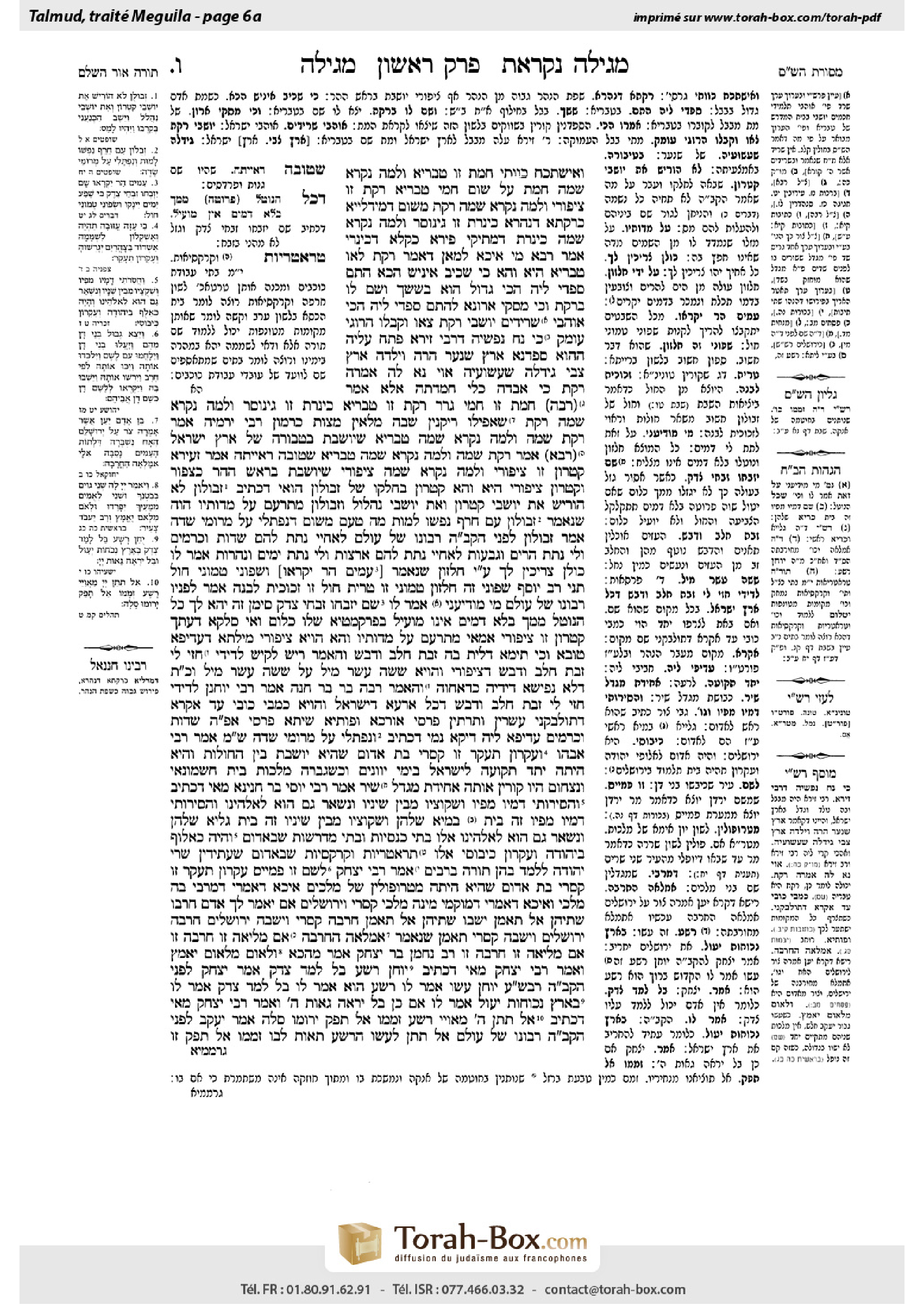
Megillah 6a: Talmud study for Daf Yomi
Daf Yomi is the daily study of one Talmud folio. Explore 37 tractates with scans, Hebrew text, Sefaria English and AI-generated French translations where annotated.
Passage selection and English or AI-generated French translation are available where the scan has annotations. Daf Study is independent of Torah-Box and Sefaria.
Browse Megillah · מגילה · All tractatesMegillah 6a text and translations
This page of Megillah includes the Aramaic text, an English translation and an AI-generated French translation, alongside the scan above.
מגילה ו׳ א · Aramaic and Hebrew text
וְאִישְׁתְּכַח כְּווֹתִי. חַמַּת זוֹ טְבֶרְיָא, וְלָמָּה נִקְרָא שְׁמָהּ חַמַּת? עַל שׁוּם חַמֵּי טְבֶרְיָא. רַקַּת זוֹ צִיפּוֹרִי, וְלָמָּה נִקְרָא שְׁמָהּ רַקַּת? מִשּׁוּם דְּמִידַּלְיָיא כְּרַקְתָּא דְנַהְרָא. כִּינֶּרֶת זוֹ גִּינּוֹסַר, וְלָמָּה נִקְרָא שְׁמָהּ כִּינֶּרֶת? דִּמְתִיקִי פֵּירָא כְּקָלָא דְכִינָּרֵי.
אָמַר רָבָא: מִי אִיכָּא לְמַאן דְּאָמַר רַקַּת לָאו טְבֶרְיָא הִיא? וְהָא כִּי שָׁכֵיב אִינִישׁ הָכָא, הָתָם סָפְדִי לֵיהּ הָכִי: ״גָּדוֹל הוּא בְּשֵׁשַׁךְ, וְשֵׁם לוֹ בְּרַקַּת״. וְכִי מַסְּקִי אֲרוֹנָא לְהָתָם, סָפְדִי לֵיהּ הָכִי: אוֹהֲבֵי שְׂרִידִים יוֹשְׁבֵי רַקַּת, צְאוּ וְקַבְּלוּ הֲרוּגֵי עוֹמֶק.
כִּי נָח נַפְשֵׁיהּ דְּרַבִּי זֵירָא, פְּתַח עֲלֵיהּ הַהוּא סַפְדָנָא: אֶרֶץ שִׁנְעָר הָרָה וְיָלְדָה, אֶרֶץ צְבִי גִּידְּלָה שַׁעֲשׁוּעֶיהָ. אוֹי נָא לָהּ, אָמְרָה רַקַּת, כִּי אִבְּדָה כְּלִי חֶמְדָּתָהּ.
אֶלָּא אָמַר (רַבָּה): חַמַּת זוֹ חַמֵּי גְרָר, רַקַּת זוֹ טְבֶרְיָא, כִּינֶּרֶת זוֹ גִּינּוֹסַר. וְלָמָּה נִקְרָא שְׁמָהּ רַקַּת? שֶׁאֲפִילּוּ רֵיקָנִין שֶׁבָּהּ מְלֵאִין מִצְוֹת כְּרִמּוֹן. רַבִּי יִרְמְיָה אָמַר: רַקַּת שְׁמָהּ, וְלָמָּה נִקְרָא שְׁמָהּ טְבֶרְיָא? שֶׁיּוֹשֶׁבֶת בְּטַבּוּרָהּ שֶׁל אֶרֶץ יִשְׂרָאֵל. (רָבָא) אָמַר: רַקַּת שְׁמָהּ, וְלָמָּה נִקְרָא שְׁמָהּ טְבֶרְיָא? שֶׁטּוֹבָה רְאִיָּיתָהּ.
אָמַר זְעֵירָא: קִטְרוֹן זוֹ צִיפּוֹרִי. וְלָמָּה נִקְרָא שְׁמָהּ צִיפּוֹרִי? שֶׁיּוֹשֶׁבֶת בְּרֹאשׁ הָהָר כְּצִפּוֹר.
וְקִטְרוֹן, צִיפּוֹרִי הִיא? וְהָא קִטְרוֹן בְּחֶלְקוֹ שֶׁל זְבוּלוּן הֲוַאי, דִּכְתִיב: ״זְבוּלוּן לֹא הוֹרִישׁ אֶת יוֹשְׁבֵי קִטְרוֹן וְאֶת יוֹשְׁבֵי נַהֲלוֹל״, וּזְבוּלוּן מִתְרַעֵם עַל מִדּוֹתָיו הֲוָה, שֶׁנֶּאֱמַר: ״זְבוּלוּן עַם חֵרֵף נַפְשׁוֹ לָמוּת״, מַה טַּעַם? מִשּׁוּם דְּ״נַפְתָּלִי עַל מְרוֹמֵי שָׂדֶה״.
אָמַר זְבוּלוּן לִפְנֵי הַקָּדוֹשׁ בָּרוּךְ הוּא: רִבּוֹנוֹ שֶׁל עוֹלָם, לְאַחַיי נָתַתָּ לָהֶם שָׂדוֹת וּכְרָמִים, וְלִי נָתַתָּ הָרִים וְגִבְעוֹת! לְאַחַיי נָתַתָּ לָהֶם אֲרָצוֹת, וְלִי נָתַתָּ יַמִּים וּנְהָרוֹת! אָמַר לוֹ: כּוּלָּן צְרִיכִין לָךְ עַל יְדֵי חִלָּזוֹן, שֶׁנֶּאֱמַר: ״[עַמִּים הַר יִקְרָאוּ] וּשְׂפוּנֵי טְמוּנֵי חוֹל״.
תָּנֵי רַב יוֹסֵף: ״שְׂפוּנֵי״ — זֶה חִלָּזוֹן, ״טְמוּנֵי״ — זוֹ טָרִית, ״חוֹל״ — זוֹ זְכוּכִית לְבָנָה. אָמַר לְפָנָיו: רִבּוֹנוֹ שֶׁל עוֹלָם מִי מוֹדִיעֵנִי? אָמַר לוֹ: ״שָׁם יִזְבְּחוּ זִבְחֵי צֶדֶק״, סִימָן זֶה יְהֵא לְךָ: כׇּל הַנּוֹטֵל מִמְּךָ בְּלֹא דָּמִים — אֵינוֹ מוֹעִיל בִּפְרַקְמַטְיָא שֶׁלּוֹ כְּלוּם.
וְאִי סָלְקָא דַעְתָּךְ קִטְרוֹן זוֹ צִיפּוֹרִי, אַמַּאי מִתְרַעֵם עַל מִדּוֹתָיו? וְהָא הָוְיָא צִיפּוֹרִי מִילְּתָא דַּעֲדִיפָא טוּבָא! וְכִי תֵּימָא דְּלֵית בַּהּ זָבַת חָלָב וּדְבָשׁ, וְהָאָמַר רֵישׁ לָקִישׁ: לְדִידִי חֲזֵי לִי זָבַת חָלָב וּדְבָשׁ דְּצִיפּוֹרִי, וְהָוְיָא שִׁשָּׁה עָשָׂר מִיל עַל שִׁשָּׁה עָשָׂר מִיל!
וְכִי תֵּימָא דְּלָא נְפִישָׁא דִּידֵיהּ כְּדַאֲחוּהּ, וְהָאָמַר רַבָּה בַּר בַּר חָנָה אָמַר רַבִּי יוֹחָנָן: לְדִידִי חֲזֵי לִי זָבַת חָלָב וּדְבָשׁ דְּכׇל אַרְעָא דְיִשְׂרָאֵל, וְהָוְיָא כְּמִבֵּי כוּבֵּי עַד אַקְרָא דְתוּלְבַּקְנֵי, עֶשְׂרִין וְתַרְתֵּין פַּרְסֵי אוּרְכָּא, וּפוּתְיָא שִׁיתָּא פַּרְסֵי!
אֲפִילּוּ הָכִי, שָׂדוֹת וּכְרָמִים עֲדִיפָא לֵיהּ. דַּיְקָא נָמֵי, דִּכְתִיב: ״וְנַפְתָּלִי עַל מְרוֹמֵי שָׂדֶה״. שְׁמַע מִינַּהּ.
אָמַר רַבִּי אֲבָהוּ: ״וְעֶקְרוֹן תֵּעָקֵר״ — זוֹ קֵסָרִי בַּת אֱדוֹם, שֶׁהִיא יוֹשֶׁבֶת בֵּין הַחוֹלוֹת, וְהִיא הָיְתָה יָתֵד תְּקוּעָה לְיִשְׂרָאֵל בִּימֵי יְווֹנִים. וּכְשֶׁגָּבְרָה מַלְכוּת בֵּית חַשְׁמוֹנַאי וְנִצְּחוּם, הָיוּ קוֹרִין אוֹתָהּ ״אַחִידַת מִגְדַּל שִׁיר״.
אָמַר רַבִּי יוֹסֵי בַּר חֲנִינָא, מַאי דִּכְתִיב: ״וַהֲסִירוֹתִי דָמָיו מִפִּיו וְשִׁקּוּצָיו מִבֵּין שִׁינָּיו וְנִשְׁאַר גַּם הוּא לֵאלֹהֵינוּ״. ״וַהֲסִירוֹתִי דָּמָיו מִפִּיו״ — זֶה בֵּית בָּמַיָּא שֶׁלָּהֶן. ״וְשִׁקּוּצָיו מִבֵּין שִׁינָּיו״ — זֶה בֵּית גַּלְיָא שֶׁלָּהֶן.
״וְנִשְׁאַר גַּם הוּא לֵאלֹהֵינוּ״ — אֵלּוּ בָּתֵּי כְנֵסִיּוֹת וּבָתֵּי מִדְרָשׁוֹת שֶׁבֶּאֱדוֹם. ״וְהָיָה כְּאַלּוּף בִּיהוּדָה וְעֶקְרוֹן כִּיבוּסִי״ — אֵלּוּ תֵּרַאטְרָיוֹת וְקִרְקְסָיוֹת שֶׁבֶּאֱדוֹם, שֶׁעֲתִידִין שָׂרֵי יְהוּדָה לְלַמֵּד בָּהֶן תּוֹרָה בָּרַבִּים.
אָמַר רַבִּי יִצְחָק: לֶשֶׁם זוֹ פַּמְיָיס, ״עֶקְרוֹן תֵּעָקֵר״ — זוֹ קֵסָרִי בַּת אֱדוֹם, שֶׁהִיא הָיְתָה מֶטְרוֹפּוֹלִין שֶׁל מְלָכִים. אִיכָּא דְּאָמְרִי: דִּמְרַבִּי בָּהּ מַלְכֵי, וְאִיכָּא דְּאָמְרִי: דְּמוֹקְמִי מִינָּה מַלְכֵי.
קֵסָרִי וִירוּשָׁלַיִם, אִם יֹאמַר לְךָ אָדָם: חָרְבוּ שְׁתֵּיהֶן — אַל תַּאֲמֵן. יָשְׁבוּ שְׁתֵּיהֶן — אַל תַּאֲמֵן. חָרְבָה קֵסָרִי וְיָשְׁבָה יְרוּשָׁלַיִם, חָרְבָה יְרוּשָׁלַיִם וְיָשְׁבָה קֵסָרִי — תַּאֲמֵן, שֶׁנֶּאֱמַר: ״אִמָּלְאָה הָחֳרָבָה״. אִם מְלֵיאָה זוֹ — חֲרֵבָה זוֹ, אִם מְלֵיאָה זוֹ — חֲרֵבָה זוֹ.
רַב נַחְמָן בַּר יִצְחָק אָמַר מֵהָכָא: ״וּלְאוֹם מִלְאוֹם יֶאֱמָץ״.
וְאָמַר רַבִּי יִצְחָק, מַאי דִּכְתִיב: ״יוּחַן רָשָׁע בַּל לָמַד צֶדֶק״. אָמַר יִצְחָק לִפְנֵי הַקָּדוֹשׁ בָּרוּךְ הוּא: רִבּוֹנוֹ שֶׁל עוֹלָם, יוּחַן עֵשָׂו. אָמַר לוֹ: רָשָׁע הוּא! אָמַר לוֹ: ״בַּל לָמַד צֶדֶק״. אָמַר לוֹ: ״בְּאֶרֶץ נְכוֹחוֹת יְעַוֵּל״. אָמַר לוֹ: אִם כֵּן, ״בַּל יִרְאֶה גֵּאוּת ה׳״.
וְאָמַר רַבִּי יִצְחָק, מַאי דִּכְתִיב: ״אַל תִּתֵּן ה׳ מַאֲוַיֵּי רָשָׁע זְמָמוֹ אַל תָּפֵק יָרוּמוּ סֶלָה״ — אָמַר יַעֲקֹב לִפְנֵי הַקָּדוֹשׁ בָּרוּךְ הוּא: רִבּוֹנוֹ שֶׁל עוֹלָם, אַל תִּתֵּן לְעֵשָׂו הָרָשָׁע תַּאֲוַת לִבּוֹ. ״זְמָמוֹ אַל תָּפֵק״ — זוֹ
Megillah 6a · English translation
and it was found in accordance with my opinion. I said that Hammath is Tiberias. And why was it called Hammath? On account of the hot springs of [ḥammei] Tiberias that are located there. And I said that Rakkath is Tzippori. And why was it called Rakkath? Because it is raised above the surrounding areas like the bank [rakta] of a river. And I said that Chinnereth is Ginosar. And why was it called Chinnereth? Because its fruit are sweet like the sound of a harp [kinnor].
Rava said: Is there anyone who says that Rakkath is not Tiberias? Isn’t it true that when a great man dies here, in Babylonia, they lament his demise there, in Tiberias, as follows: Great was he in Sheshakh, i.e., Babylonia (see Jeremiah 25:26), and he had a name in Rakkath? Furthermore, when they bring up the casket of an important person to there, to Tiberias, they lament his demise as follows: You lovers of the remnants of the Jewish people, residents of Rakkath, go out and receive the dead from the deep, i.e., the low-lying lands of Babylonia.
Similarly, the Gemara relates that when Rabbi Zeira died, a certain eulogizer opened his eulogy for him with these words: The land of Shinar, i.e., Babylonia, Rabbi Zeira’s birthplace, conceived and bore him; the land of the deer, i.e., Eretz Yisrael, where Rabbi Zeira lived as an adult and rose to prominence, raised her delights. Woe unto her, said Rakkath, for she has lost her precious instrument. It is apparent from these examples that Rakkath is Tiberias.
Rather, Rabba said: Hammath is the hot springs of Gerar that are adjacent to Tiberias; Rakkath is Tiberias; and Chinnereth is Ginosar. And why was Tiberias called Rakkath? Because even the empty ones [reikanin] of Tiberias are as full of mitzvot as a pomegranate is full of seeds. Rabbi Yirmeya said: In fact, Rakkath is its real name; and why was it called Tiberias? Because it sits in the very center [tabbur] of Eretz Yisrael. Rava said: Rakkath is its real name, and why was it called Tiberias? Because its appearance is good [tova re’iyyata].
§ While continuing to identify places that are mentioned in the Bible, Zeira said: The city of Kitron that is mentioned in the Bible is the city of Tzippori. And why was it called Tzippori? Because it sits on top of a mountain like a bird [tzippor].
The Gemara asks: Is Kitron really Tzippori? Wasn’t Kitron in the tribal territory of Zebulun, as it is written: “Neither did Zebulun drive out the inhabitants of Kitron, nor the inhabitants of Nahalol” (Judges 1:30)? And the tribe of Zebulun was resentful of its portion, as it is stated: “Zebulun was a people that jeopardized their lives to the death” (Judges 5:18). What is the reason for their resentfulness? Because “Naphtali was on the high places of the field” (Judges 5:18).
The verse should be interpreted as follows: Zebulun said before the Holy One, Blessed be He: Master of the Universe! To my brothers, the tribes whose territory is adjacent to mine, You gave fields and vineyards, whereas to me You gave mountains and hills; to my brothers You gave lands, whereas to me You gave seas and rivers. God said back to him: Nevertheless, all will need you due to the ḥilazon, the small sea creature residing in your territory that is the source of the dye used in the ritual fringes [tzitzit]. As it is stated in Moses’ blessing to Zebulun: “They shall call the people to the mountain: There they shall sacrifice offerings of righteousness; for they shall suck of the abundance of the seas, and of the hidden treasures of the sand” (Deuteronomy 33:19).
Rav Yosef teaches about this: “Treasures”; this is referring to the ḥilazon, which is found in the waters of Zebulun. “Hidden”; this is referring to the tarit, a type of sardine, which is also found in Zebulun’s coastal waters. “Sand”; this is referring to the sand from which white glass is made. Zebulun said to Him: All of these resources are indeed found in my territory, but Master of the Universe, who will inform me if others take them without permission? He said to the tribe of Zebulun: “There they shall sacrifice offerings of righteousness.” This shall be a sign for you that anyone who takes these items from you without making payment will not prosper at all in his business.
It is clear from the exposition of the verse in Judges that the territory of Zebulun did not contain fields and vineyards. And if it enters your mind to say that Kitron is Tzippori, why was Zebulun resentful of his portion? Wasn’t Tzippori in his territory, which was land that was vastly superior with regard to its produce? And if you would say that Zebulun’s portion did not have quality land flowing with milk and honey, didn’t Reish Lakish say: I myself have seen the land flowing with milk and honey around Tzippori, and it was sixteen mil by sixteen mil?
And if you would say that the part of his territory that flowed with milk and honey was not as vast as that of his brothers, the other tribes, didn’t Rabba bar bar Ḥana say that Rabbi Yoḥanan said: I myself have seen the land flowing with milk and honey over all of Eretz Yisrael. And the size of the fertile land was like the distance from Bei Kovei to the fortress of Tulbakni, a total of twenty-two parasangs [parsa] in length and six parasangs in width. A parasang is four mil; consequently, the area flowing with milk and honey around Tzippori was four by four parasangs, which is more than the fair share of one tribe among twelve.
The Gemara answers: Even so, fields and vineyards were preferable to Zebulun. The fertile land in Zebulun’s territory is in a mountainous region, which makes it more difficult to cultivate. The Gemara comments: The language of the verse is also precise according to this explanation, as it is written: “And Naphtali was on the high places of the field,” which indicates that Zebulun’s complaint was due to the fact that Naphtali had fields. The Gemara concludes: Indeed, learn from here that this is so.
§ The Gemara continues its discussion with regard to identifying places mentioned in the Bible. Rabbi Abbahu said: “And Ekron shall be uprooted” (Zephaniah 2:4). This is an allusion to Caesarea, daughter of Edom, which is situated among the sands. Caesarea was primarily populated by Greeks and Romans, and it served as the seat of Roman rule when the Romans, who are identified with Edom in Jewish literature, ruled Eretz Yisrael. And it was a spike stuck in the side of the Jewish people already in the days of the Greeks, as it was an obstacle to the spread of Jewish settlement. When the Hasmonean monarchy prevailed and triumphed over them, they called it: The captured tower of Shir.
Rabbi Yosei bar Ḥanina said: What is the meaning of that which is written: “And I will take away his blood out of his mouth, and his detestable things from between his teeth, and he also shall be a remnant for our God; and he shall be as a chief in Judah, and Ekron as a Jebusite” (Zechariah 9:7)? The verse should be understood as follows: “And I will take away his blood out of his mouth”; this is referring to their house of altars, where they sacrifice offerings. “And his detestable things from between his teeth”; this is referring to their house of piles, where they heap their ritual stones.
“And he also shall be a remnant for our God,” these words are referring to the synagogues and study halls in Edom. “And he shall be as a chief [aluf] in Judah, and Ekron as a Jebusite,” these words are referring to the theaters [tere’atrayot] and the circuses [kirkesayot] in Edom where the officers of Judah are destined to teach Torah in public.
Rabbi Yitzḥak said: “And the children of Dan went up and fought against Leshem” (Joshua 19:47); this is referring to the city that was known in the Talmudic period as Pamyas. “Ekron shall be uprooted” (Zephaniah 2:4); this is referring to Caesarea, the daughter of Edom, which was a metropolis [metropolin], i.e., a capital city, of kings. There are those who say this means that kings were raised there, and there are those who say it means that kings were appointed from there, meaning the kings of Edom were appointed from among the residents of this city.
The Sages said that the fortunes of Caesarea, which represents Rome, and Jerusalem are diametric opposites. If, therefore, someone says to you that both cities are destroyed, do not believe him. Similarly, if he says to you that they are both settled in tranquility, do not believe him. If, however, he says to you that Caesarea is destroyed and Jerusalem is settled, or that Jerusalem is destroyed and Caesarea is settled, believe him. As it is stated: “Because Tyre has said against Jerusalem: Aha, the gates of the people have been broken; she is turned to me; I shall be filled with her that is laid waste” (Ezekiel 26:2), and Tyre, like Caesarea, represents Rome. Consequently, the verse indicates that if this city is filled, that one is laid waste, and if that city is filled, this one is laid waste. The two cities cannot coexist.
Rav Naḥman bar Yitzḥak said: The same idea may be derived from here, a verse dealing with Jacob and Esau: “And the one people shall be stronger than the other people” (Genesis 25:23), teaching that when one nation rises, the other necessarily falls.
§ Having mentioned Edom, the Gemara cites what Rabbi Yitzḥak said: What is the meaning of that which is written: “Let favor be shown to the wicked, yet will he not learn righteousness; in the land of uprightness he will deal wrongfully, and will not behold the majesty of the Lord” (Isaiah 26:10)? Isaac said before the Holy One, Blessed be He: Master of the Universe, let favor be shown to Esau, my beloved son. God said to him: Esau is wicked. Isaac said to God: “Yet will he not learn righteousness,” i.e., is there no one who can find merit in him? God said to him: “In the land of uprightness he will deal wrongfully,” meaning that he is destined to destroy Eretz Yisrael. Isaac said to God: If it is so that he is that wicked, “he will not behold the majesty of the Lord.”
And Rabbi Yitzḥak also said: What is the meaning of that which is written: “Grant not, O Lord, the desires of the wicked; further not his evil device, so that they not exalt themselves. Selah” (Psalms 140:9)? Jacob said before the Holy One, Blessed be He: Master of the Universe, grant not to the wicked Esau the desires of his heart, as he wishes to destroy us. Further not his evil device [zemamo]; do not remove the muzzle [zamam] that constrains him and prevents him from breaking out and gathering further strength. This is a reference to
Megillah 6a · Traduction française (IA)
et cela s’accordait avec mon opinion. J’ai dit que Hammath est Tibériade. Et pourquoi l’appelait-on Hammath ? À cause des sources chaudes [ḥammei] de Tibériade qui s’y trouvent. J’ai dit que Rakkath est Tzippori. Et pourquoi l’appelait-on Rakkath ? Parce qu’elle s’élève au-dessus des environs comme la berge [rakta] d’un fleuve. J’ai dit que Chinnereth est Ginosar. Et pourquoi l’appelait-on Chinnereth ? Parce que ses fruits sont doux comme le son d’une harpe [kinnor].
Rava dit : Y a-t-il quelqu’un qui prétende que Rakkath n’est pas Tibériade ? N’est-il pas vrai que, lorsqu’un grand homme meurt ici, en Babylonie, on déplore là-bas, à Tibériade, sa disparition en disant : « Il était grand à Sheshakh », c’est-à-dire en Babylonie (voir Jérémie 25:26), « et il avait un nom à Rakkath » ? De plus, lorsqu’on apporte là-bas, à Tibériade, le cercueil d’une personne importante, on déplore sa disparition en disant : « Vous qui chérissez les survivants du peuple juif, habitants de Rakkath, sortez accueillir le mort venu des profondeurs », c’est-à-dire des terres basses de Babylonie.
De même, la Guemara rapporte qu’à la mort de Rabbi Zeira, un orateur funèbre commença son éloge par ces mots : « Le pays de Shinar », c’est-à-dire la Babylonie, lieu de naissance de Rabbi Zeira, « l’a conçu et mis au monde ; le pays de la biche », c’est-à-dire Eretz Israël, où Rabbi Zeira vécut à l’âge adulte et acquit sa renommée, « a élevé ses délices. Malheur à elle, dit Rakkath, car elle a perdu son précieux instrument. » Il ressort de ces exemples que Rakkath est Tibériade.
Rabba dit plutôt : Hammath, ce sont les sources chaudes de Gerar, voisines de Tibériade ; Rakkath, c’est Tibériade ; et Chinnereth, c’est Ginosar. Et pourquoi Tibériade était-elle appelée Rakkath ? Parce que même les gens vides [reikanin] de Tibériade sont aussi remplis de mitsvot qu’une grenade est remplie de graines. Rabbi Yirmeya dit : En réalité, Rakkath est son vrai nom ; et pourquoi était-elle appelée Tibériade ? Parce qu’elle se trouve au centre [tabbur] même d’Eretz Israël. Rava dit : Rakkath est son vrai nom ; et pourquoi était-elle appelée Tibériade ? Parce que son apparence est belle [tova re’iyyata].
§ Poursuivant l’identification des lieux mentionnés dans la Bible, Zeira dit : La ville de Kitron mentionnée dans la Bible est la ville de Tzippori. Et pourquoi était-elle appelée Tzippori ? Parce qu’elle est située au sommet d’une montagne, comme un oiseau [tzippor].
La Guemara demande : Kitron est-elle vraiment Tzippori ? Kitron ne se trouvait-elle pas dans le territoire de la tribu de Zabulon, comme il est écrit : « Zabulon ne chassa pas les habitants de Kitron, ni ceux de Nahalol » (Juges 1:30) ? Or la tribu de Zabulon était mécontente de son lot, comme il est dit : « Zabulon était un peuple qui risqua sa vie jusqu’à la mort » (Juges 5:18). Quelle était la raison de son mécontentement ? C’est que « Nephtali était sur les hauteurs du champ » (Juges 5:18).
Le verset doit être interprété ainsi : Zabulon dit devant le Saint, béni soit-Il : « Maître de l’Univers ! À mes frères, les tribus dont le territoire est limitrophe du mien, Tu as donné des champs et des vignes, tandis qu’à moi Tu as donné des montagnes et des collines ; à mes frères Tu as donné des terres, tandis qu’à moi Tu as donné des mers et des fleuves. » Dieu lui répondit : « Pourtant, tous auront besoin de toi à cause du ḥilazon, la petite créature marine qui vit sur ton territoire et fournit la teinture utilisée pour les franges rituelles [tzitzit]. » Comme il est dit dans la bénédiction de Moïse à Zabulon : « Ils appelleront les peuples à la montagne ; là, ils offriront des sacrifices de justice, car ils puiseront dans l’abondance des mers et dans les trésors cachés du sable » (Deutéronome 33:19).
Rav Yosef enseigne à ce sujet : « Trésors » désigne le ḥilazon, que l’on trouve dans les eaux de Zabulon. « Cachés » désigne le tarit, une sorte de sardine, que l’on trouve également dans les eaux côtières de Zabulon. « Sable » désigne le sable dont on fabrique du verre blanc. Zabulon lui dit : « Toutes ces ressources se trouvent effectivement sur mon territoire, mais, Maître de l’Univers, qui m’informera si d’autres les prennent sans permission ? » Il dit à la tribu de Zabulon : « Là, ils offriront des sacrifices de justice. » Ce sera pour toi un signe : quiconque prendra ces produits chez toi sans les payer ne réussira nullement dans ses affaires.
Il ressort de l’interprétation du verset des Juges que le territoire de Zabulon ne comportait ni champs ni vignes. Et si l’on pense que Kitron est Tzippori, pourquoi Zabulon était-il mécontent de son lot ? Tzippori ne se trouvait-elle pas sur son territoire, une terre nettement supérieure par la qualité de ses produits ? Et si tu dis que le lot de Zabulon ne comprenait pas de terres de qualité où coulent le lait et le miel, Reish Lakish n’a-t-il pas dit : « J’ai moi-même vu, autour de Tzippori, la terre où coulent le lait et le miel, sur une étendue de seize mil sur seize mil » ?
Et si tu dis que la partie de son territoire où coulaient le lait et le miel n’était pas aussi vaste que celle de ses frères, les autres tribus, Rabba bar bar Ḥana n’a-t-il pas rapporté que Rabbi Yoḥanan a dit : « J’ai moi-même vu la terre où coulent le lait et le miel sur toute l’étendue d’Eretz Israël. » La superficie de cette terre fertile équivalait à la distance entre Bei Kovei et la forteresse de Tulbakni, soit vingt-deux parasanges [parsa] de long et six parasanges de large. Un parasange équivaut à quatre mil ; par conséquent, la superficie de la terre où coulent le lait et le miel autour de Tzippori était de quatre parasanges sur quatre, ce qui dépasse la juste part d’une seule tribu sur douze.
La Guemara répond : Malgré tout, les champs et les vignes étaient préférables pour Zabulon. Les terres fertiles du territoire de Zabulon se trouvent dans une région montagneuse, ce qui les rend plus difficiles à cultiver. La Guemara remarque que le texte du verset est également précis selon cette explication, puisqu’il est écrit : « Et Nephtali était sur les hauteurs du champ », ce qui indique que la plainte de Zabulon était due au fait que Nephtali avait des champs. La Guemara conclut : En effet, on peut en déduire que c’est bien le cas.
§ La Guemara poursuit son examen des lieux mentionnés dans la Bible. Rabbi Abbahu dit : « Et Ékron sera déracinée » (Sophonie 2:4). Cela fait allusion à Césarée, fille d’Édom, située au milieu des sables. Césarée était principalement peuplée de Grecs et de Romains, et servait de siège au pouvoir romain lorsque les Romains, identifiés à Édom dans la littérature juive, régnaient sur Eretz Israël. Elle était déjà une épine dans le flanc du peuple juif à l’époque des Grecs, car elle faisait obstacle à l’expansion de l’implantation juive. Lorsque la monarchie hasmonéenne prit le dessus et triompha d’eux, ils l’appelèrent : « La tour conquise de Shir ».
Rabbi Yosei bar Ḥanina dit : Que signifie ce qui est écrit : « J’ôterai son sang de sa bouche et ses abominations d’entre ses dents ; lui aussi sera un reste pour notre Dieu ; il sera comme un chef en Juda, et Ékron comme un Jébuséen » (Zacharie 9:7) ? Le verset doit être compris ainsi : « J’ôterai son sang de sa bouche » désigne leur maison des autels, où ils offrent des sacrifices. « Et ses abominations d’entre ses dents » désigne leur maison des amas, où ils entassent leurs pierres rituelles.
« Lui aussi sera un reste pour notre Dieu » désigne les synagogues et les maisons d’étude d’Édom. « Il sera comme un chef [aluf] en Juda, et Ékron comme un Jébuséen » désigne les théâtres [tere’atrayot] et les cirques [kirkesayot] d’Édom, où les officiers de Juda enseigneront un jour la Torah en public.
Rabbi Yitzḥak dit : « Les fils de Dan montèrent et combattirent contre Leshem » (Josué 19:47) désigne la ville appelée Pamyas à l’époque talmudique. « Ékron sera déracinée » (Sophonie 2:4) désigne Césarée, fille d’Édom, qui était une métropole [metropolin], c’est-à-dire une capitale royale. Selon certains, cela signifie que des rois y étaient élevés ; selon d’autres, que des rois en étaient nommés, autrement dit que les rois d’Édom étaient choisis parmi les habitants de cette ville.
Les Sages ont dit que les fortunes de Césarée, qui représente Rome, et de Jérusalem sont diamétralement opposées. Si donc quelqu’un te dit que les deux villes sont détruites, ne le crois pas. De même, s’il te dit qu’elles vivent toutes deux en paix, ne le crois pas. En revanche, s’il te dit que Césarée est détruite et que Jérusalem est prospère, ou que Jérusalem est détruite et que Césarée est prospère, crois-le. Comme il est dit : « Parce que Tyr a dit contre Jérusalem : “Ah ! Les portes des peuples sont brisées ; elle s’est tournée vers moi ; je serai comblée de ses ruines” » (Ézéchiel 26:2). Tyr, comme Césarée, représente Rome. Le verset indique donc que si l’une est comblée, l’autre est dévastée, et que si l’autre est comblée, celle-ci est dévastée. Les deux villes ne peuvent coexister.
Rav Naḥman bar Yitzḥak dit : La même idée peut se déduire d’un verset concernant Jacob et Ésaü : « Un peuple sera plus fort que l’autre peuple » (Genèse 25:23), ce qui enseigne que lorsqu’une nation s’élève, l’autre tombe nécessairement.
§ Après avoir mentionné Édom, la Guemara cite ce que Rabbi Yitzḥak a dit : Que signifie ce qui est écrit : « Qu’on fasse grâce au méchant, mais il n’apprendra pas la justice ; dans le pays de la droiture, il commettra l’injustice et ne verra pas la majesté du Seigneur » (Isaïe 26:10) ? Isaac dit devant le Saint, béni soit-Il : « Maître de l’Univers, fais grâce à Ésaü, mon fils bien-aimé. » Dieu lui dit : « Ésaü est méchant. » Isaac dit à Dieu : « Pourtant, il n’apprendra pas la justice » : n’y a-t-il donc personne qui puisse lui trouver un mérite ? Dieu lui dit : « Dans le pays de la droiture, il commettra l’injustice », ce qui signifie qu’il est destiné à détruire Eretz Israël. Isaac dit à Dieu : « S’il est donc si méchant, “il ne verra pas la majesté du Seigneur”. »
Rabbi Yitzḥak dit également : Que signifie ce qui est écrit : « N’accorde pas, Seigneur, les désirs du méchant ; ne favorise pas son mauvais dessein, de peur qu’ils ne s’élèvent. Sélah » (Psaumes 140:9) ? Jacob dit devant le Saint, béni soit-Il : « Maître de l’Univers, n’accorde pas au méchant Ésaü les désirs de son cœur, car il veut nous détruire. Ne favorise pas son mauvais dessein [zemamo] : ne retire pas la muselière [zamam] qui le retient et l’empêche de se déchaîner et d’accroître encore sa puissance. » Cela fait référence à
Traduction française générée par IA à partir de l’édition anglaise de Sefaria. Vérifie toujours un passage avec le texte source.
Text from Sefaria: William Davidson Edition - Vocalized Aramaic (CC BY NC); William Davidson Edition - English (CC BY NC).