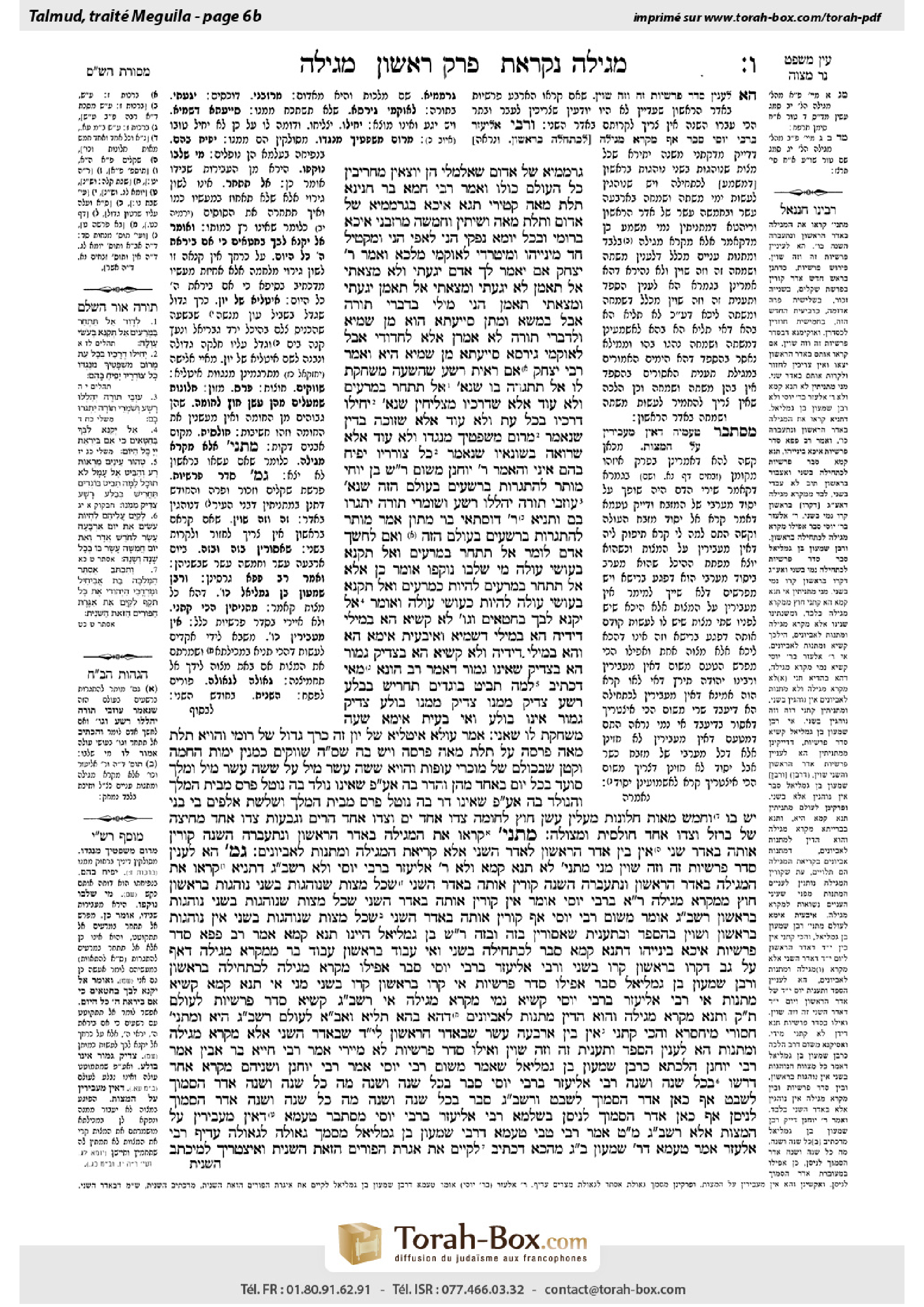
Megillah 6b: Talmud study for Daf Yomi
Daf Yomi is the daily study of one Talmud folio. Explore 37 tractates with scans, Hebrew text, Sefaria English and AI-generated French translations where annotated.
Passage selection and English or AI-generated French translation are available where the scan has annotations. Daf Study is independent of Torah-Box and Sefaria.
Browse Megillah · מגילה · All tractatesMegillah 6b text and translations
This page of Megillah includes the Aramaic text, an English translation and an AI-generated French translation, alongside the scan above.
מגילה ו׳ ב · Aramaic and Hebrew text
גֶּרְמַמְיָא שֶׁל אֱדוֹם, שֶׁאִלְמָלֵי הֵן יוֹצְאִין, מַחֲרִיבִין כָּל הָעוֹלָם כּוּלּוֹ.
וְאָמַר רַבִּי חָמָא בַּר חֲנִינָא: תְּלָת מְאָה קְטִירֵי תָגָא אִיכָּא בְּגֶרְמַמְיָא שֶׁל אֱדוֹם, וּתְלָת מְאָה וְשִׁיתִּין וְחַמְשָׁה מַרְזְבָּנֵי אִיכָּא בְּרוֹמִי, וּבְכׇל יוֹמָא נָפְקִי הָנֵי לְאַפֵּי הָנֵי וּמִקְּטִיל חַד מִינַּיְיהוּ, וּמִיטַּרְדִי לְאוֹקֹמֵי מַלְכָּא.
וְאָמַר רַבִּי יִצְחָק, אִם יֹאמַר לְךָ אָדָם: יָגַעְתִּי וְלֹא מָצָאתִי — אַל תַּאֲמֵן. לֹא יָגַעְתִּי וּמָצָאתִי — אַל תַּאֲמֵן. יָגַעְתִּי וּמָצָאתִי — תַּאֲמֵן.
הָנֵי מִילֵּי בְּדִבְרֵי תוֹרָה, אֲבָל בְּמַשָּׂא וּמַתָּן — סִיַּיעְתָּא הוּא מִן שְׁמַיָּא. וּלְדִבְרֵי תוֹרָה לָא אֲמַרַן אֶלָּא לְחַדּוֹדֵי, אֲבָל לְאוֹקֹמֵי גִּירְסָא — סִיַּיעְתָּא מִן שְׁמַיָּא הִיא.
וְאָמַר רַבִּי יִצְחָק: אִם רָאִיתָ רָשָׁע שֶׁהַשָּׁעָה מְשַׂחֶקֶת לוֹ — אַל תִּתְגָּרֶה בּוֹ, שֶׁנֶּאֱמַר: ״אַל תִּתְחַר בַּמְּרֵעִים״. וְלֹא עוֹד, אֶלָּא שֶׁדְּרָכָיו מַצְלִיחִין, שֶׁנֶּאֱמַר: ״יָחִילוּ דְּרָכָיו בְּכׇל עֵת״. וְלֹא עוֹד, אֶלָּא שֶׁזּוֹכֶה בַּדִּין, שֶׁנֶּאֱמַר: ״מָרוֹם מִשְׁפָּטֶיךָ מִנֶּגְדּוֹ״. וְלֹא עוֹד, אֶלָּא שֶׁרוֹאֶה בְּשׂוֹנְאָיו, שֶׁנֶּאֱמַר: ״כׇּל צוֹרְרָיו יָפִיחַ בָּהֶם״.
אִינִי? וְהָאָמַר רַבִּי יוֹחָנָן מִשּׁוּם רַבִּי שִׁמְעוֹן בֶּן יוֹחַי: מוּתָּר לְהִתְגָּרוֹת בָּרְשָׁעִים בָּעוֹלָם הַזֶּה, שֶׁנֶּאֱמַר: ״עוֹזְבֵי תוֹרָה יְהַלְלוּ רָשָׁע וְשׁוֹמְרֵי תוֹרָה יִתְגָּרוּ בָם״, וְתַנְיָא, רַבִּי דּוֹסְתַּאי בַּר מָתוּן אָמַר: מוּתָּר לְהִתְגָּרוֹת בָּרְשָׁעִים בָּעוֹלָם הַזֶּה, וְאִם לְחָשְׁךָ אָדָם לוֹמַר ״אַל תִּתְחַר בַּמְּרֵעִים וְאַל תְּקַנֵּא בְּעוֹשֵׂי עַוְלָה״ — מִי שֶׁלִּבּוֹ נוֹקְפוֹ אוֹמֵר כֵּן.
אֶלָּא: ״אַל תִּתְחַר בַּמְּרֵעִים״ — לִהְיוֹת כַּמְּרֵעִים, ״וְאַל תְּקַנֵּא בְּעוֹשֵׂי עַוְלָה״ — לִהְיוֹת כְּעוֹשֵׂי עַוְלָה. וְאוֹמֵר: ״אַל יְקַנֵּא לִבְּךָ בַּחַטָּאִים וְגוֹ׳!
לָא קַשְׁיָא: הָא בְּמִילֵּי דִידֵיהּ, הָא בְּמִילֵּי דִשְׁמַיָּא.
וְאִיבָּעֵית אֵימָא: הָא וְהָא בְּמִילֵּי דִידֵיהּ. וְלָא קַשְׁיָא: הָא בְּצַדִּיק גָּמוּר, הָא בְּצַדִּיק שֶׁאֵינוֹ גָּמוּר. דְּאָמַר רַב הוּנָא, מַאי דִּכְתִיב: ״לָמָּה תַבִּיט בּוֹגְדִים תַּחֲרִישׁ בְּבַלַּע רָשָׁע צַדִּיק מִמֶּנּוּ״, צַדִּיק מִמֶּנּוּ — בּוֹלֵעַ, צַדִּיק גָּמוּר — אֵינוֹ בּוֹלֵעַ.
וְאִי בָּעֵית אֵימָא: שָׁעָה מְשַׂחֶקֶת לוֹ שָׁאנֵי.
אָמַר עוּלָּא: אִיטַלְיָא שֶׁל יָוָן, זֶה כְּרַךְ גָּדוֹל שֶׁל רוֹמִי. וְהָוְיָא תְּלָת מְאָה פַּרְסָה עַל תְּלָת מְאָה פַּרְסָה. וְיֵשׁ בָּהּ שְׁלוֹשׁ מֵאוֹת שִׁשִּׁים וַחֲמִשָּׁה שְׁווֹקִים, כְּמִנְיַן יְמוֹת הַחַמָּה. וְקָטָן שֶׁבְּכוּלָּם שֶׁל מוֹכְרֵי עוֹפוֹת, וְהָוְיָא שִׁשָּׁה עָשָׂר מִיל עַל שִׁשָּׁה עָשָׂר מִיל. וּמֶלֶךְ סוֹעֵד בְּכׇל יוֹם בְּאֶחָד מֵהֶן.
וְהַדָּר בָּהּ, אַף עַל פִּי שֶׁאֵינוֹ נוֹלָד בָּהּ — נוֹטֵל פְּרָס מִבֵּית הַמֶּלֶךְ. וְהַנּוֹלָד בָּהּ, אַף עַל פִּי שֶׁאֵינוֹ דָּר בָּהּ — נוֹטֵל פְּרָס מִבֵּית הַמֶּלֶךְ. וּשְׁלֹשֶׁת אֲלָפִים בֵּי בָנֵי יֵשׁ בּוֹ, וַחֲמֵשׁ מֵאוֹת חַלּוֹנוֹת מַעֲלִין עָשָׁן חוּץ לַחוֹמָה. צִדּוֹ אֶחָד יָם וְצִדּוֹ אֶחָד הָרִים וּגְבָעוֹת, צִדּוֹ אֶחָד מְחִיצָה שֶׁל בַּרְזֶל וְצִדּוֹ אֶחָד חוֹלְסִית וּמְצוּלָה.
מַתְנִי׳ קָרְאוּ אֶת הַמְּגִילָּה בַּאֲדָר הָרִאשׁוֹן וְנִתְעַבְּרָה הַשָּׁנָה — קוֹרִין אוֹתָהּ בַּאֲדָר שֵׁנִי. אֵין בֵּין אֲדָר הָרִאשׁוֹן לַאֲדָר הַשֵּׁנִי אֶלָּא קְרִיאַת הַמְּגִילָּה וּמַתָּנוֹת לָאֶבְיוֹנִים.
גְּמָ׳ הָא לְעִנְיַן סֵדֶר פָּרָשִׁיּוֹת, זֶה וָזֶה שָׁוִין.
מַנִּי מַתְנִיתִין? לָא תַּנָּא קַמָּא, וְלָא רַבִּי אֱלִיעֶזֶר בְּרַבִּי יוֹסֵי, וְלָא רַבָּן שִׁמְעוֹן בֶּן גַּמְלִיאֵל. דְּתַנְיָא: קָרְאוּ אֶת הַמְּגִילָּה בַּאֲדָר הָרִאשׁוֹן וְנִתְעַבְּרָה הַשָּׁנָה — קוֹרִין אוֹתָהּ בַּאֲדָר הַשֵּׁנִי, שֶׁכׇּל מִצְוֹת שֶׁנּוֹהֲגוֹת בַּשֵּׁנִי נוֹהֲגוֹת בָּרִאשׁוֹן, חוּץ מִמִּקְרָא מְגִילָּה.
רַבִּי אֱלִיעֶזֶר בְּרַבִּי יוֹסֵי אוֹמֵר: אֵין קוֹרִין אוֹתָהּ בַּאֲדָר הַשֵּׁנִי, שֶׁכׇּל מִצְוֹת שֶׁנּוֹהֲגוֹת בַּשֵּׁנִי נוֹהֲגוֹת בָּרִאשׁוֹן.
רַבָּן שִׁמְעוֹן בֶּן גַּמְלִיאֵל אוֹמֵר מִשּׁוּם רַבִּי יוֹסֵי: אַף קוֹרִין אוֹתָהּ בַּאֲדָר הַשֵּׁנִי, שֶׁכׇּל מִצְוֹת שֶׁנּוֹהֲגוֹת בַּשֵּׁנִי אֵין נוֹהֲגוֹת בָּרִאשׁוֹן. וְשָׁוִין בְּהֶסְפֵּד וּבְתַעֲנִית שֶׁאֲסוּרִין בָּזֶה וּבָזֶה.
רַבָּן שִׁמְעוֹן בֶּן גַּמְלִיאֵל הַיְינוּ תַּנָּא קַמָּא? אָמַר רַב פָּפָּא: סֵדֶר פָּרָשִׁיּוֹת אִיכָּא בֵּינַיְיהוּ, דְּתַנָּא קַמָּא סָבַר לְכַתְּחִילָּה בַּשֵּׁנִי, וְאִי עֲבוּד בָּרִאשׁוֹן — עֲבוּד. בַּר מִמִּקְרָא מְגִילָּה, דְּאַף עַל גַּב דְּקָרוּ בָּרִאשׁוֹן — קָרוּ בַּשֵּׁנִי.
וְרַבִּי אֱלִיעֶזֶר בְּרַבִּי יוֹסֵי סָבַר: אֲפִילּוּ מִקְרָא מְגִילָּה לְכַתְּחִילָּה בָּרִאשׁוֹן. וְרַבָּן שִׁמְעוֹן בֶּן גַּמְלִיאֵל סָבַר: אֲפִילּוּ סֵדֶר פָּרָשִׁיּוֹת, אִי קָרוּ בָּרִאשׁוֹן קָרוּ בַּשֵּׁנִי.
מַנִּי? אִי תַּנָּא קַמָּא — קַשְׁיָא מַתָּנוֹת, אִי רַבִּי אֱלִיעֶזֶר בְּרַבִּי יוֹסֵי — קַשְׁיָא נָמֵי מִקְרָא מְגִילָּה, אִי רַבָּן שִׁמְעוֹן בֶּן גַּמְלִיאֵל — קַשְׁיָא סֵדֶר פָּרָשִׁיּוֹת!
לְעוֹלָם תַּנָּא קַמָּא, וּתְנָא מִקְרָא מְגִילָּה וְהוּא הַדִּין מַתָּנוֹת לָאֶבְיוֹנִים, דְּהָא בְּהָא תַּלְיָא.
וְאִיבָּעֵית אֵימָא: לְעוֹלָם רַבָּן שִׁמְעוֹן בֶּן גַּמְלִיאֵל הִיא, וּמַתְנִיתִין חַסּוֹרֵי מִיחַסְּרָא וְהָכִי קָתָנֵי: אֵין בֵּין אַרְבָּעָה עָשָׂר שֶׁבַּאֲדָר הָרִאשׁוֹן לְאַרְבָּעָה עָשָׂר שֶׁבַּאֲדָר הַשֵּׁנִי אֶלָּא מִקְרָא מְגִילָּה וּמַתָּנוֹת. הָא לְעִנְיַן הֶסְפֵּד וְתַעֲנִית — זֶה וָזֶה שָׁוִין, וְאִילּוּ סֵדֶר פָּרָשִׁיּוֹת לָא מַיְירֵי.
אָמַר רַבִּי חִיָּיא בַּר אָבִין אָמַר רַבִּי יוֹחָנָן: הִלְכְתָא כְּרַבָּן שִׁמְעוֹן בֶּן גַּמְלִיאֵל שֶׁאָמַר מִשּׁוּם רַבִּי יוֹסֵי.
אָמַר רַבִּי יוֹחָנָן, וּשְׁנֵיהֶם מִקְרָא אֶחָד דָּרְשׁוּ: ״בְּכׇל שָׁנָה וְשָׁנָה״, רַבִּי אֱלִיעֶזֶר בְּרַבִּי יוֹסֵי סָבַר: ״בְּכׇל שָׁנָה וְשָׁנָה״, מָה כׇּל שָׁנָה וְשָׁנָה — אֲדָר הַסָּמוּךְ לִשְׁבָט, אַף כָּאן — אֲדָר הַסָּמוּךְ לִשְׁבָט.
וְרַבָּן שִׁמְעוֹן בֶּן גַּמְלִיאֵל סָבַר: ״בְּכׇל שָׁנָה וְשָׁנָה״, מָה כָּל שָׁנָה וְשָׁנָה — אֲדָר הַסָּמוּךְ לְנִיסָן, אַף כָּאן — אֲדָר הַסָּמוּךְ לְנִיסָן.
בִּשְׁלָמָא רַבִּי אֱלִיעֶזֶר בְּרַבִּי יוֹסֵי מִסְתַּבֵּר טַעְמָא, דְּאֵין מַעֲבִירִין עַל הַמִּצְוֹת. אֶלָּא רַבָּן שִׁמְעוֹן בֶּן גַּמְלִיאֵל מַאי טַעְמָא?
אָמַר רַבִּי טָבִי: טַעְמָא דְּרַבִּי שִׁמְעוֹן בֶּן גַּמְלִיאֵל, מִסְמָךְ גְּאוּלָּה לִגְאוּלָּה עָדִיף.
רַבִּי אֶלְעָזָר אָמַר: טַעְמָא דְּרַבָּן שִׁמְעוֹן בֶּן גַּמְלִיאֵל מֵהָכָא, דִּכְתִיב: ״לְקַיֵּים אֵת אִגֶּרֶת הַפּוּרִים הַזֹּאת הַשֵּׁנִית״.
וְאִיצְטְרִיךְ לְמִיכְתַּב
Megillah 6b · English translation
Germamya of Edom, i.e., Germany, which is near the land of Edom, i.e., Rome. As, if the Germans would go forth, they would destroy the entire world.
And Rabbi Ḥama Bar Ḥanina said: There are three hundred young princes with crowns tied to their heads in Germamya of Edom, and there are three hundred and sixty-five chieftains [marzavnei] in Rome. Every day these go out to battle against those, and one of them is killed, and they are preoccupied with appointing a new king in his place. Since neither side is united, neither side is able to achieve a decisive victory. It is these wars between Rome and the Germanic tribes that act as a muzzle upon Esau-Edom-Rome and prevent it from becoming too strong.
§ Rabbi Yitzḥak said in the style of a previous passage: If a person says to you: I have labored and not found success, do not believe him. Similarly, if he says to you: I have not labored but nevertheless I have found success, do not believe him. If, however, he says to you: I have labored and I have found success, believe him.
The Gemara comments: This applies only to matters of Torah, as success with respect to Torah study is in accordance with the toil and effort invested. But with regard to success in business, it all depends upon assistance from Heaven, as there is no correlation between success and effort. And even with regard to matters of Torah, we said this only with regard to sharpening one’s understanding of Torah, as the more one labors, the deeper the understanding of the material he achieves. However, to preserve what one has learned, it is dependent upon assistance from Heaven. Not everyone achieves this, even with much effort.
And Rabbi Yitzḥak also said: If you see a wicked man whom the hour is smiling upon, i.e., who is enjoying good fortune, do not provoke him, as it is stated: “Contend not with evildoers” (Psalms 37:1). And not only that, but if you provoke him, his undertakings will be successful, as it is stated: “His ways prosper at all times” (Psalms 10:5). And not only that, but even if he is brought to court, he emerges victorious in judgment, as it is stated: “Your judgments are far above him” (Psalms 10:5), as though the trial is far removed from him and does not affect him. And not only that, but he will see his enemies fall, as it is stated: “As for all his enemies, he hisses at them” (Psalms 10:5).
The Gemara asks: Is that so? Didn’t Rabbi Yoḥanan say in the name of Rabbi Shimon ben Yoḥai: It is permitted to provoke the wicked in this world, as it is stated: “They that forsake the Torah praise the wicked; but they who keep the Torah contend with them” (Proverbs 28:4)? And furthermore, it is taught in a baraita that Rabbi Dostai bar Matun said: It is permitted to provoke the wicked in this world, and if a person whispers to you to say that this is not so, relying on the verse: “Contend not with evildoers, nor be envious against the workers of iniquity” (Psalms 37:1), know that only one whose heart strikes him with pangs of conscience over sins that he committed says this.
Rather, the true meaning of that verse is: “Contend not with evildoers,” to be like the evildoers; “nor be envious against the workers of iniquity,” to be like the workers of iniquity. And it says elsewhere: “Let not your heart envy sinners, but be in the fear of the Lord all the day” (Proverbs 23:17). In this context, to be envious of sinners means to desire to be like them. Rabbi Yoḥanan and Rabbi Dostai indicate that one is permitted to provoke the wicked, against the opinion of Rabbi Yitzḥak.
The Gemara explains: This is not difficult, as it can be understood that this, Rabbi Yitzḥak’s statement that one may not provoke the wicked, is referring to his personal matters, while that, the statements of Rabbi Yoḥanan and Rabbi Dostai that it is permitted to provoke them, is referring to matters of Heaven, i.e., religious matters.
And if you wish, say: Both this statement and that statement are stated with regard to his own affairs, and still it is not difficult. This statement, that it is permitted to provoke the wicked, applies to a completely righteous individual; that statement, that one may not provoke them, applies to an individual who is not completely righteous. As Rav Huna said: What is the meaning of that which is written: “Why do you look upon them that deal treacherously, and remain silent when the wicked devours the man that is more righteous than he” (Habakkuk 1:13)? This verse indicates that the wicked devours one who is more righteous than he; however, he does not devour one who is completely righteous.
And if you wish, say instead: When the hour is smiling upon him, i.e., when the wicked individual is enjoying good fortune, it is different. He is receiving divine assistance, and even the completely righteous should not provoke him.
§ Having mentioned Rome, the Gemara cites what Ulla said. Greek Italy, i.e., southern Italy, is the great city of Rome, and it is three hundred parasang [parsa] by three hundred parasang. It has three hundred and sixty-five markets, corresponding to the number of days in the solar year, and the smallest of them all is the market of poultry sellers, which is sixteen mil by sixteen mil. And the king, i.e., the Roman emperor, dines every day in one of them.
And one who resides in the city, even if he was not born there, receives an allowance for his living expenses from the king’s palace. And one who was born there, even if he does not reside there, also receives an allowance from the king’s palace. And there are three thousand bathhouses in the city, and five hundred apertures that let the smoke from the bathhouses out beyond the walls in a way that doesn’t blacken the walls themselves. One side of the city is bordered by the sea, one side by mountains and hills, one side by a barrier of iron and one side by gravel [ḥulsit] and swamp.
MISHNA: If the people read the Megilla during the first Adar and subsequently the year was then intercalated by the court and now the following month will be the second Adar, one reads the Megilla again during the second Adar. The Sages formulated a principle: The difference between the first Adar and the second Adar with regard to the mitzvot that are performed during those months is only that the reading of the Megilla and distributing gifts to the poor are performed in the second Adar and not in the first Adar.
GEMARA: The Gemara infers that with regard to the matter of the sequence of Torah portions read each year on two Shabbatot before Purim, the portions of Shekalim and Zakhor, and on two Shabbatot after Purim, Para and HaḤodesh, this, the first Adar, and that, the second Adar are equal, in that reading them during the first Adar exempts one from reading them in the second Adar.
The Gemara asks: If so, whose opinion is taught in the mishna? It is neither the opinion of the anonymous first tanna of the following baraita, nor that of Rabbi Eliezer, son of Rabbi Yosei, nor that of Rabban Shimon ben Gamliel, as it is taught in a baraita: If they read the Megilla during the first Adar and the year was then intercalated, they read it during the second Adar, as all mitzvot that are practiced during the second Adar are practiced in the first Adar, except for the reading of the Megilla.
Rabbi Eliezer, son of Rabbi Yosei, says: They do not read it again during the second Adar, as all mitzvot that are practiced during the second Adar are practiced during the first Adar. Once the Megilla was read during the first Adar, one need not read it again during the second Adar.
Rabban Shimon ben Gamliel says in the name of Rabbi Yosei: They even read it again during the second Adar, as all mitzvot that are practiced during the second Adar are not practiced during the first Adar. And they all agree with regard to eulogy and with regard to fasting that they are prohibited on the fourteenth and the fifteenth days of this month of the first Adar and on that month of the second Adar.
The Gemara analyzes the baraita. The opinion of Rabban Shimon ben Gamliel is identical to that of the first tanna. What novel element does he introduce? Rav Pappa said: There is a practical difference between them with regard to the sequence of four Torah portions, as the first tanna maintains: They should read those portions during the second Adar, ab initio. However, if they did so during the first Adar, they did so; and they fulfilled their obligation and need not read them again during the second Adar, except for the reading of the Megilla, as even though they already read it during the first Adar, they read it again during the second Adar.
And Rabbi Eliezer, son of Rabbi Yosei, maintains that even the reading of the Megilla may be performed during the first Adar, ab initio, and they need not read it again during the second Adar. And Rabban Shimon ben Gamliel maintains: Even with regard to the sequence of four Torah portions, if they read them during the first Adar, they read them again during the second Adar.
Returning to the original question, according to whose opinion is the mishna taught? If it is the opinion of the first tanna, the halakha of gifts to the poor is difficult. The first tanna does not mention these gifts, indicating that he maintains that if gifts were distributed during the first Adar one need not distribute gifts to the poor during the second Adar. And if the mishna was taught according to the opinion of Rabbi Eliezer, son of Rabbi Yosei, the reading of the Megilla is also difficult. And if it is the opinion of Rabban Shimon ben Gamliel, the sequence of Torah portions is difficult.
The Gemara answers: Actually, the mishna is according to the opinion of the first tanna, and he taught the halakha with regard to the reading of the Megilla, and the same is true with regard to gifts to the poor, as this mitzva is dependent upon that one. The Gemara already explained that the gifts to the poor are distributed on the day that the Megilla is read.
And if you wish, say instead: Actually, the mishna is according to the opinion of Rabban Shimon ben Gamliel, and the mishna is incomplete and is teaching the following: The difference between the fourteenth day of the first Adar and the fourteenth day of the second Adar is only with regard to the reading of the Megilla and distributing gifts to the poor. The Gemara infers that with regard to the matter of eulogy and fasting, this, the first Adar, and that, the second Adar are equal, while about the sequence of Torah portions, the mishna does not speak at all. The mishna limits its discussion to the halakhot of Purim.
Rabbi Ḥiyya bar Avin said that Rabbi Yoḥanan said: The halakha is in accordance with the opinion of Rabban Shimon ben Gamliel, who said it in the name of Rabbi Yosei.
Rabbi Yoḥanan said: And both of them, Rabban Shimon ben Gamliel and Rabbi Eliezer, son of Rabbi Yosei, interpreted the same verse differently, leading them to their conclusions. It is written: “To enjoin upon them that they should keep the fourteenth day of the month of Adar and the fifteenth day of the same, in each and every year” (Esther 9:21). Rabbi Eliezer, son of Rabbi Yosei, maintains: “In each and every year” teaches that Purim must be celebrated the same way each year, even if it is intercalated: Just as each and every year Purim is celebrated during Adar that is adjacent to Shevat, so too here in an intercalated year Purim is celebrated during Adar that is adjacent to Shevat.
And Rabban Shimon ben Gamliel maintains: “In each and every year” teaches that just as each and every year Purim is celebrated in Adar that is adjacent to Nisan, so too here, in an intercalated year, Purim is celebrated during Adar that is adjacent to Nisan.
The Gemara asks: Granted, according to Rabbi Eliezer, son of Rabbi Yosei, the reason for his opinion is logical, based on the principle that one does not forego performance of the mitzvot; rather, when presented with the opportunity to perform a mitzva, one should do so immediately. However, with regard to Rabban Shimon ben Gamliel, what is the reason for his opinion?
Rabbi Tavi said: The reason for the opinion of Rabban Shimon ben Gamliel is that juxtaposing the celebration of one redemption, Purim, to the celebration of another redemption, Passover, is preferable.
Rabbi Elazar said: The reason for the opinion of Rabban Shimon ben Gamliel is derived from here, as it is written: “To confirm this second letter of Purim” (Esther 9:29), indicating that there are circumstances where the Megilla is read a second time (Jerusalem Talmud), i.e., when the year was intercalated after the Megilla was read in the first Adar.
The Gemara comments: And it was necessary to write
Megillah 6b · Traduction française (IA)
La Germamya d’Édom, c’est-à-dire l’Allemagne, qui est proche du pays d’Édom, c’est-à-dire de Rome. Car si les Germains en sortaient, ils détruiraient le monde entier.
Et Rabbi Ḥama bar Ḥanina a dit : Il y a trois cents jeunes princes portant des couronnes attachées à leur tête en Germamya d’Édom, et trois cent soixante-cinq chefs [marzavnei] à Rome. Chaque jour, les uns partent combattre les autres ; l’un d’eux est tué, et ils sont alors occupés à nommer un nouveau roi à sa place. Puisqu’aucun des deux camps n’est uni, aucun ne peut remporter une victoire décisive. Ces guerres entre Rome et les tribus germaniques servent de muselière à Ésaü-Édom-Rome et l’empêchent de devenir trop puissant.
§ Rabbi Yitzḥak a dit, dans le style d’un passage précédent : Si quelqu’un te dit : « J’ai travaillé et je n’ai pas réussi », ne le crois pas. De même, s’il te dit : « Je n’ai pas travaillé, mais j’ai pourtant réussi », ne le crois pas. Mais s’il te dit : « J’ai travaillé et j’ai réussi », crois-le.
La Guemara précise : Cela ne s’applique qu’aux sujets de Torah, car la réussite dans l’étude de la Torah est proportionnelle au labeur et aux efforts investis. Mais la réussite dans les affaires dépend entièrement de l’aide du Ciel, car il n’y a pas de corrélation entre la réussite et l’effort. Et même pour les sujets de Torah, cela ne s’applique qu’à l’affinement de la compréhension : plus on travaille, plus on approfondit sa compréhension du sujet. En revanche, conserver ce que l’on a appris dépend de l’aide du Ciel. Tout le monde n’y parvient pas, même en faisant de grands efforts.
Et Rabbi Yitzḥak a également dit : Si tu vois un méchant à qui la fortune sourit, c’est-à-dire qui jouit d’une bonne fortune, ne le provoque pas, ainsi qu’il est dit : « Ne t’irrite pas à cause des malfaiteurs » (Psaumes 37, 1). Et non seulement cela : si tu le provoques, ses entreprises réussiront, ainsi qu’il est dit : « Ses voies réussissent en tout temps » (Psaumes 10, 5). Et non seulement cela : même s’il comparaît en justice, il en sort victorieux, ainsi qu’il est dit : « Tes jugements sont trop élevés pour lui » (Psaumes 10, 5), comme si le procès était loin de lui et ne l’atteignait pas. Et non seulement cela : il verra ses ennemis tomber, ainsi qu’il est dit : « Tous ses ennemis, il les siffle » (Psaumes 10, 5).
La Guemara demande : Est-ce bien le cas ? Rabbi Yoḥanan n’a-t-il pas dit au nom de Rabbi Shimon ben Yoḥai : Il est permis de provoquer les méchants en ce monde, ainsi qu’il est dit : « Ceux qui abandonnent la Torah louent les méchants, mais ceux qui gardent la Torah les combattent » (Proverbes 28, 4) ? De plus, il est enseigné dans une baraïta que Rabbi Dostai bar Matun a dit : Il est permis de provoquer les méchants en ce monde. Et si quelqu’un te souffle que ce n’est pas le cas, en s’appuyant sur le verset : « Ne t’irrite pas à cause des malfaiteurs, ne sois pas jaloux de ceux qui commettent l’iniquité » (Psaumes 37, 1), sache que seul celui dont le cœur le tourmente de remords pour les fautes qu’il a commises dit cela.
Il faut plutôt comprendre ainsi le sens véritable de ce verset : « Ne t’irrite pas à cause des malfaiteurs », c’est-à-dire ne sois pas comme les malfaiteurs ; « ne sois pas jaloux de ceux qui commettent l’iniquité », c’est-à-dire ne sois pas comme ceux qui commettent l’iniquité. Et il est dit ailleurs : « Que ton cœur ne soit pas jaloux des pécheurs, mais crains le Seigneur tout le jour » (Proverbes 23, 17). Dans ce contexte, être jaloux des pécheurs signifie désirer leur ressembler. Rabbi Yoḥanan et Rabbi Dostai indiquent qu’il est permis de provoquer les méchants, contrairement à l’avis de Rabbi Yitzḥak.
La Guemara explique : Il n’y a pas de difficulté, car on peut comprendre que cette déclaration de Rabbi Yitzḥak, selon laquelle on ne doit pas provoquer les méchants, concerne les affaires personnelles, tandis que ces déclarations de Rabbi Yoḥanan et de Rabbi Dostai, selon lesquelles il est permis de les provoquer, concernent les affaires du Ciel, c’est-à-dire les questions religieuses.
Et si tu veux, dis plutôt : Les deux déclarations, celle-ci et celle-là, concernent les affaires personnelles, et pourtant il n’y a pas de difficulté. Cette déclaration, selon laquelle il est permis de provoquer les méchants, s’applique à un juste parfait ; celle selon laquelle on ne doit pas les provoquer s’applique à quelqu’un qui n’est pas un juste parfait. Car Rav Huna a dit : Quel est le sens de ce qui est écrit : « Pourquoi regardes-tu ceux qui agissent avec perfidie et gardes-tu le silence quand le méchant dévore celui qui est plus juste que lui » (Habacuc 1, 13) ? Ce verset indique que le méchant dévore celui qui est plus juste que lui, mais qu’il ne dévore pas celui qui est un juste parfait.
Et si tu veux, dis plutôt : Lorsque la fortune lui sourit, c’est-à-dire lorsque le méchant jouit d’une bonne fortune, la situation est différente. Il reçoit une aide divine, et même un juste parfait ne doit pas le provoquer.
§ La Guemara ayant mentionné Rome, elle rapporte ce qu’a dit Ulla. La Grande-Grèce, c’est-à-dire le sud de l’Italie, est la grande ville de Rome, qui s’étend sur trois cents parasanges [parsa] dans chaque direction. Elle compte trois cent soixante-cinq marchés, correspondant au nombre de jours de l’année solaire, et le plus petit d’entre eux est le marché des marchands de volailles, qui mesure seize milles sur seize milles. Le roi, c’est-à-dire l’empereur romain, prend chaque jour son repas dans l’un de ces marchés.
Celui qui réside dans la ville, même s’il n’y est pas né, reçoit du palais du roi une allocation pour ses frais de subsistance. Celui qui y est né, même s’il n’y réside pas, reçoit lui aussi une allocation du palais du roi. La ville compte trois mille bains et cinq cents ouvertures qui évacuent la fumée des bains au-delà des remparts, de sorte que ceux-ci ne noircissent pas. Un côté de la ville est bordé par la mer, un autre par des montagnes et des collines, un autre par une barrière de fer et un autre par du gravier [ḥulsit] et un marécage.
MICHNA : Si le peuple a lu la Meguila pendant le premier mois d’Adar, puis que le tribunal a ensuite décidé d’intercaler l’année, de sorte que le mois suivant sera le second mois d’Adar, on lit de nouveau la Meguila pendant le second mois d’Adar. Les Sages ont formulé un principe : la seule différence entre le premier mois d’Adar et le second mois d’Adar concernant les mitsvot accomplies pendant ces mois est que la lecture de la Meguila et la distribution de dons aux pauvres ont lieu pendant le second mois d’Adar, et non pendant le premier.
GUEMARA : La Guemara en déduit que, concernant l’ordre des sections de la Torah lues chaque année lors des deux Chabbatot précédant Pourim — les sections de Shekalim et de Zakhor — et des deux Chabbatot suivant Pourim — Para et HaḤodesh —, le premier mois d’Adar et le second mois d’Adar sont équivalents : lire ces sections pendant le premier mois d’Adar dispense de les lire pendant le second.
La Guemara demande : De qui est l’avis enseigné dans la Michna ? Ce n’est ni celui du premier tanna anonyme de la baraïta suivante, ni celui de Rabbi Eliezer, fils de Rabbi Yosei, ni celui de Rabban Shimon ben Gamliel. Car il est enseigné dans une baraïta : Si l’on a lu la Meguila pendant le premier mois d’Adar et que l’année a ensuite été intercalée, on la lit pendant le second mois d’Adar, car toutes les mitsvot observées pendant le second mois d’Adar le sont aussi pendant le premier, à l’exception de la lecture de la Meguila.
Rabbi Eliezer, fils de Rabbi Yosei, dit : On ne la lit pas de nouveau pendant le second mois d’Adar, car toutes les mitsvot observées pendant le second mois d’Adar le sont aussi pendant le premier. Une fois la Meguila lue pendant le premier mois d’Adar, il n’est pas nécessaire de la lire de nouveau pendant le second mois d’Adar.
Rabban Shimon ben Gamliel dit au nom de Rabbi Yosei : On la lit même de nouveau pendant le second mois d’Adar, car aucune des mitsvot observées pendant le second mois d’Adar n’est observée pendant le premier. Et tous sont d’accord pour ce qui est des oraisons funèbres et du jeûne : ils sont interdits les quatorzième et quinzième jours de ce mois, le premier mois d’Adar, comme de ce mois, le second mois d’Adar.
La Guemara analyse la baraïta. L’avis de Rabban Shimon ben Gamliel est identique à celui du premier tanna. Quel élément nouveau apporte-t-il ? Rav Pappa a dit : Il y a une différence pratique entre eux concernant l’ordre des quatre sections de la Torah. Le premier tanna estime qu’il faut lire ces sections pendant le second mois d’Adar, a priori. Toutefois, si on les a lues pendant le premier mois d’Adar, c’est valable : on s’est acquitté de son obligation et il n’est pas nécessaire de les lire de nouveau pendant le second mois d’Adar, à l’exception de la lecture de la Meguila ; même si on l’a déjà lue pendant le premier mois d’Adar, on la lit de nouveau pendant le second mois d’Adar.
Et Rabbi Eliezer, fils de Rabbi Yosei, estime que même la lecture de la Meguila peut être faite pendant le premier mois d’Adar, a priori, et qu’il n’est pas nécessaire de la lire de nouveau pendant le second mois d’Adar. Rabban Shimon ben Gamliel estime que même pour l’ordre des quatre sections de la Torah, si on les a lues pendant le premier mois d’Adar, on les lit de nouveau pendant le second mois d’Adar.
Revenant à la question initiale, de qui la Michna exprime-t-elle l’avis ? Si c’est celui du premier tanna, la halakha des dons aux pauvres pose problème. Le premier tanna ne mentionne pas ces dons, ce qui indique qu’il estime que si les dons ont été distribués pendant le premier mois d’Adar, il n’est pas nécessaire de les distribuer de nouveau aux pauvres pendant le second mois d’Adar. Si la Michna suit l’avis de Rabbi Eliezer, fils de Rabbi Yosei, la lecture de la Meguila pose également problème. Et si elle suit l’avis de Rabban Shimon ben Gamliel, l’ordre des sections de la Torah pose problème.
La Guemara répond : En réalité, la Michna suit l’avis du premier tanna. Il a enseigné la halakha concernant la lecture de la Meguila ; il en va de même pour les dons aux pauvres, car cette mitsva dépend de celle-là. La Guemara a déjà expliqué que les dons aux pauvres sont distribués le jour où l’on lit la Meguila.
Et si tu veux, dis plutôt : En réalité, la Michna suit l’avis de Rabban Shimon ben Gamliel, et elle est incomplète ; voici ce qu’elle enseigne : la seule différence entre le quatorzième jour du premier mois d’Adar et le quatorzième jour du second mois d’Adar concerne la lecture de la Meguila et la distribution de dons aux pauvres. La Guemara en déduit que, concernant les oraisons funèbres et le jeûne, le premier mois d’Adar et le second mois d’Adar sont équivalents ; quant à l’ordre des sections de la Torah, la Michna n’en parle pas du tout. La Michna limite sa discussion aux halakhot de Pourim.
Rabbi Ḥiyya bar Avin a dit au nom de Rabbi Yoḥanan : La halakha est conforme à l’avis de Rabban Shimon ben Gamliel, qui l’a exprimé au nom de Rabbi Yosei.
Rabbi Yoḥanan a dit : Tous deux, Rabban Shimon ben Gamliel et Rabbi Eliezer, fils de Rabbi Yosei, ont interprété différemment le même verset, ce qui les a conduits à leurs conclusions. Il est écrit : « Pour leur imposer de garder le quatorzième jour du mois d’Adar et le quinzième jour de ce même mois, chaque année » (Esther 9, 21). Rabbi Eliezer, fils de Rabbi Yosei, estime que l’expression « chaque année » enseigne que Pourim doit être célébré de la même manière chaque année, même si l’année est intercalée : de même que, chaque année, Pourim est célébré pendant le mois d’Adar qui jouxte Shevat, de même, lors d’une année intercalée, Pourim est célébré pendant le mois d’Adar qui jouxte Shevat.
Et Rabban Shimon ben Gamliel estime que l’expression « chaque année » enseigne que, de même que chaque année Pourim est célébré pendant le mois d’Adar qui jouxte Nisan, de même, lors d’une année intercalée, Pourim est célébré pendant le mois d’Adar qui jouxte Nisan.
La Guemara demande : Certes, selon Rabbi Eliezer, fils de Rabbi Yosei, son avis se justifie logiquement, conformément au principe selon lequel on ne doit pas laisser passer l’occasion d’accomplir une mitsva ; au contraire, lorsqu’on a l’occasion d’accomplir une mitsva, il faut le faire immédiatement. Mais quelle est la raison de l’avis de Rabban Shimon ben Gamliel ?
Rabbi Tavi a dit : La raison de l’avis de Rabban Shimon ben Gamliel est qu’il est préférable de rapprocher la célébration d’une délivrance, Pourim, de la célébration d’une autre délivrance, Pessaḥ.
Rabbi Elazar a dit : La raison de l’avis de Rabban Shimon ben Gamliel se déduit de ce verset, car il est écrit : « Pour confirmer cette seconde lettre de Pourim » (Esther 9, 29), ce qui indique qu’il existe des circonstances où l’on lit la Meguila une seconde fois (Talmud de Jérusalem), c’est-à-dire lorsque l’année a été intercalée après la lecture de la Meguila pendant le premier mois d’Adar.
La Guemara fait remarquer : Et il était nécessaire d’écrire
Traduction française générée par IA à partir de l’édition anglaise de Sefaria. Vérifie toujours un passage avec le texte source.
Text from Sefaria: William Davidson Edition - Vocalized Aramaic (CC BY NC); William Davidson Edition - English (CC BY NC).