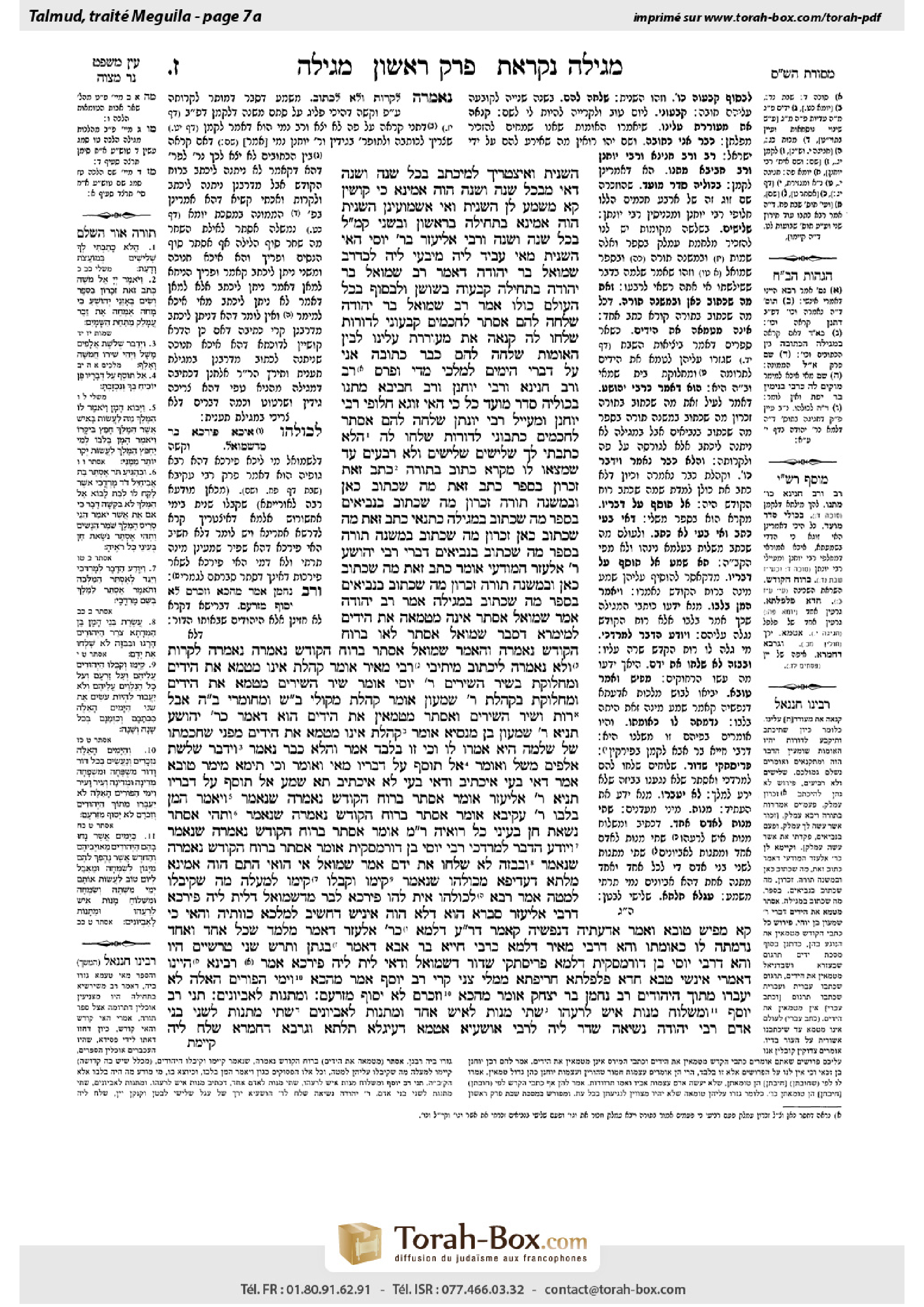
Megillah 7a: Talmud study for Daf Yomi
Daf Yomi is the daily study of one Talmud folio. Explore 37 tractates with scans, Hebrew text, Sefaria English and AI-generated French translations where annotated.
Passage selection and English or AI-generated French translation are available where the scan has annotations. Daf Study is independent of Torah-Box and Sefaria.
Browse Megillah · מגילה · All tractatesMegillah 7a text and translations
This page of Megillah includes the Aramaic text, an English translation and an AI-generated French translation, alongside the scan above.
מגילה ז׳ א · Aramaic and Hebrew text
״הַשֵּׁנִית״ וְאִיצְטְרִיךְ לְמִיכְתַּב ״בְּכׇל שָׁנָה וְשָׁנָה״. דְּאִי מִ״בְּכׇל שָׁנָה וְשָׁנָה״ הֲוָה אָמֵינָא כִּי קוּשְׁיַן, קָא מַשְׁמַע לַן ״הַשֵּׁנִית״. וְאִי אַשְׁמוֹעִינַן ״הַשֵּׁנִית״ הֲוָה אָמֵינָא בַּתְּחִילָּה בָּרִאשׁוֹן וּבַשֵּׁנִי, קָא מַשְׁמַע לַן ״בְּכׇל שָׁנָה וְשָׁנָה״.
וְרַבִּי אֱלִיעֶזֶר בְּרַבִּי יוֹסֵי הַאי ״הַשֵּׁנִית״ מַאי עָבֵיד לֵיהּ? מִיבְּעֵי לֵיהּ לְכִדְרַב שְׁמוּאֵל בַּר יְהוּדָה, דְּאָמַר רַב שְׁמוּאֵל בַּר יְהוּדָה: בַּתְּחִילָּה קְבָעוּהָ בְּשׁוּשַׁן, וּלְבַסּוֹף בְּכׇל הָעוֹלָם כּוּלּוֹ.
אָמַר רַב שְׁמוּאֵל בַּר יְהוּדָה: שָׁלְחָה לָהֶם אֶסְתֵּר לַחֲכָמִים: קִבְעוּנִי לְדוֹרוֹת! שָׁלְחוּ לָהּ: קִנְאָה אַתְּ מְעוֹרֶרֶת עָלֵינוּ לְבֵין הָאוּמּוֹת. שָׁלְחָה לָהֶם: כְּבָר כְּתוּבָה אֲנִי עַל דִּבְרֵי הַיָּמִים לְמַלְכֵי מָדַי וּפָרָס.
רַב וְרַב חֲנִינָא וְרַבִּי יוֹחָנָן וְרַב חֲבִיבָא מַתְנוּ. בְּכוּלֵּיהּ סֵדֶר מוֹעֵד כָּל כִּי הַאי זוּגָא חַלּוֹפֵי רַבִּי יוֹחָנָן וּמְעַיֵּיל רַבִּי יוֹנָתָן. שָׁלְחָה לָהֶם אֶסְתֵּר לַחֲכָמִים: כִּתְבוּנִי לְדוֹרוֹת. שָׁלְחוּ לָהּ: ״הֲלֹא כָתַבְתִּי לְךָ שָׁלִישִׁים״, שִׁלֵּישִׁים וְלֹא רִבֵּעִים,
עַד שֶׁמָּצְאוּ לוֹ מִקְרָא כָּתוּב בַּתּוֹרָה: ״כְּתֹב זֹאת זִכָּרוֹן בַּסֵּפֶר״. ״כְּתֹב זֹאת״ — מַה שֶּׁכָּתוּב כָּאן וּבְמִשְׁנֵה תוֹרָה. ״זִכָּרוֹן״ — מַה שֶּׁכָּתוּב בַּנְּבִיאִים, ״בַּסֵּפֶר״ — מַה שֶּׁכָּתוּב בַּמְּגִלָּה.
כְּתַנָּאֵי: ״כְּתֹב זֹאת״ — מַה שֶּׁכָּתוּב כָּאן, ״זִכָּרוֹן״ — מַה שֶּׁכָּתוּב בְּמִשְׁנֵה תוֹרָה, ״בַּסֵּפֶר״ — מַה שֶּׁכָּתוּב בַּנְּבִיאִים. דִּבְרֵי רַבִּי יְהוֹשֻׁעַ. רַבִּי אֶלְעָזָר הַמּוֹדָעִי אוֹמֵר: ״כְּתֹב זֹאת״ — מַה שֶּׁכָּתוּב כָּאן וּבְמִשְׁנֵה תוֹרָה, ״זִכָּרוֹן״ — מַה שֶּׁכָּתוּב בַּנְּבִיאִים, ״בְּסֵפֶר״ — מַה שֶּׁכָּתוּב בִּמְגִילָּה.
אָמַר רַב יְהוּדָה אָמַר שְׁמוּאֵל: אֶסְתֵּר אֵינָהּ מְטַמְּאָה אֶת הַיָּדַיִם.
לְמֵימְרָא דְּסָבַר שְׁמוּאֵל אֶסְתֵּר לָאו בְּרוּחַ הַקּוֹדֶשׁ נֶאֶמְרָה? וְהָאָמַר שְׁמוּאֵל: אֶסְתֵּר בְּרוּחַ הַקּוֹדֶשׁ נֶאֶמְרָה! נֶאֶמְרָה לִקְרוֹת, וְלֹא נֶאֶמְרָה לִיכְתּוֹב.
מֵיתִיבִי, רַבִּי מֵאִיר אוֹמֵר: קֹהֶלֶת אֵינוֹ מְטַמֵּא אֶת הַיָּדַיִם, וּמַחְלוֹקֶת בְּשִׁיר הַשִּׁירִים. רַבִּי יוֹסֵי אוֹמֵר: שִׁיר הַשִּׁירִים מְטַמֵּא אֶת הַיָּדַיִם, וּמַחְלוֹקֶת בְּקֹהֶלֶת. רַבִּי שִׁמְעוֹן אוֹמֵר: קֹהֶלֶת מִקּוּלֵּי בֵּית שַׁמַּאי וּמֵחוּמְרֵי בֵּית הִלֵּל, אֲבָל רוּת וְשִׁיר הַשִּׁירִים וְאֶסְתֵּר מְטַמְּאִין אֶת הַיָּדַיִם! הוּא דְּאָמַר כְּרַבִּי יְהוֹשֻׁעַ.
תַּנְיָא, רַבִּי שִׁמְעוֹן בֶּן מְנַסְיָא אוֹמֵר: קֹהֶלֶת אֵינוֹ מְטַמֵּא אֶת הַיָּדַיִם, מִפְּנֵי שֶׁחׇכְמָתוֹ שֶׁל שְׁלֹמֹה הִיא. אָמְרוּ לוֹ: וְכִי זוֹ בִּלְבַד אָמַר? וַהֲלֹא כְּבָר נֶאֱמַר: ״וַיְדַבֵּר שְׁלֹשֶׁת אֲלָפִים מָשָׁל״, וְאוֹמֵר: ״אַל תּוֹסְףְּ עַל דְּבָרָיו״.
מַאי ״וְאוֹמֵר״? וְכִי תֵּימָא: מֵימָר טוּבָא אֲמַר, דְּאִי בָּעֵי — אִיכְּתִיב, וּדְאִי בָּעֵי — לָא אִיכְּתִיב. תָּא שְׁמַע: ״אַל תּוֹסְףְּ עַל דְּבָרָיו״.
תַּנְיָא רַבִּי אֱלִיעֶזֶר אוֹמֵר: אֶסְתֵּר בְּרוּחַ הַקּוֹדֶשׁ נֶאֶמְרָה, שֶׁנֶּאֱמַר: ״וַיֹּאמֶר הָמָן בְּלִבּוֹ״. רַבִּי עֲקִיבָא אוֹמֵר: אֶסְתֵּר בְּרוּחַ הַקּוֹדֶשׁ נֶאֶמְרָה, שֶׁנֶּאֱמַר: ״וַתְּהִי אֶסְתֵּר נֹשֵׂאת חֵן בְּעֵינֵי כׇּל רוֹאֶיהָ״.
רַבִּי מֵאִיר אוֹמֵר: אֶסְתֵּר בְּרוּחַ הַקּוֹדֶשׁ נֶאֶמְרָה, שֶׁנֶּאֱמַר: ״וַיִּוָּדַע הַדָּבָר לְמׇרְדֳּכַי״. רַבִּי יוֹסֵי בֶּן דּוֹרְמַסְקִית אוֹמֵר: אֶסְתֵּר בְּרוּחַ הַקּוֹדֶשׁ נֶאֶמְרָה, שֶׁנֶּאֱמַר: ״וּבַבִּזָּה לֹא שָׁלְחוּ אֶת יָדָם״.
אָמַר שְׁמוּאֵל: אִי הֲוַאי הָתָם, הֲוָה אָמֵינָא מִלְּתָא דַּעֲדִיפָא מִכּוּלְּהוּ, שֶׁנֶּאֱמַר: ״קִיְּמוּ וְקִבְּלוּ״ — קִיְּמוּ לְמַעְלָה מַה שֶּׁקִּיבְּלוּ לְמַטָּה.
אָמַר רָבָא: לְכוּלְּהוּ אִית לְהוּ פִּירְכָא, לְבַר מִדִּשְׁמוּאֵל דְּלֵית לֵיהּ פִּירְכָא: דְּרַבִּי אֱלִיעֶזֶר — סְבָרָא הוּא דְּלָא הֲוָה אִינִישׁ דַּחֲשִׁיב לְמַלְכָּא כְּווֹתֵיהּ, וְהַאי כִּי קָא מַפֵּישׁ טוּבָא וְאָמַר — אַדַּעְתֵּיהּ דְּנַפְשֵׁיהּ קָאָמַר.
דְּרַבִּי עֲקִיבָא — דִּלְמָא כְּרַבִּי אֶלְעָזָר, דְּאָמַר: מְלַמֵּד שֶׁכׇּל אֶחָד וְאֶחָד נִדְמְתָה לוֹ כְּאוּמָּתוֹ.
וְהָא דְּרַבִּי מֵאִיר — דִּלְמָא כְּרַבִּי חִיָּיא בַּר אַבָּא, דְּאָמַר: בִּגְתָן וָתֶרֶשׁ שְׁנֵי טַרְשִׂיִּים הָיוּ.
וְהָא דְּרַבִּי יוֹסֵי בֶּן דּוֹרְמַסְקִית — דִּלְמָא פְּרִיסְתָּקֵי שַׁדּוּר. דִּשְׁמוּאֵל, וַדַּאי לֵית לֵיהּ פִּירְכָא. אָמַר רָבִינָא: הַיְינוּ דְּאָמְרִי אִינָשֵׁי: טָבָא חֲדָא פִּלְפַּלְתָּא חֲרִיפְתָּא מִמְּלֵי צַנֵּי קָרֵי.
רַב יוֹסֵף אָמַר מֵהָכָא: ״וִימֵי הַפּוּרִים הָאֵלֶּה לֹא יַעַבְרוּ מִתּוֹךְ הַיְּהוּדִים״. רַב נַחְמָן בַּר יִצְחָק אוֹמֵר מֵהָכָא: ״וְזִכְרָם לֹא יָסוּף מִזַּרְעָם״.
וּמַתָּנוֹת לָאֶבְיוֹנִים. תָּנֵי רַב יוֹסֵף: ״וּמִשְׁלוֹחַ מָנוֹת אִישׁ לְרֵעֵהוּ״ — שְׁתֵּי מָנוֹת לְאִישׁ אֶחָד. ״וּמַתָּנוֹת לָאֶבְיוֹנִים״ — שְׁתֵּי מַתָּנוֹת לִשְׁנֵי בְּנֵי אָדָם.
רַבִּי יְהוּדָה נְשִׂיאָה שַׁדַּר לֵיהּ לְרַבִּי אוֹשַׁעְיָא אַטְמָא דְּעִיגְלָא תִּלְתָּא וְגַרְבָּא דְחַמְרָא, שְׁלַח לֵיהּ:
Megillah 7a · English translation
the term: The second, and it was also necessary to write the phrase: In each and every year; proof from one of the verses would have been insufficient. As, if I had derived the halakha only from the phrase: In each and every year, I would have said my conclusion according to our question raised earlier: Why not celebrate Purim in the Adar adjacent to Shevat? Therefore, it teaches us using the term: The second. And had it taught us only the term: The second, I would have said that Purim must be celebrated both in the first Adar and in the second Adar, ab initio. Therefore, it teaches us: In each and every year, indicating that even in an intercalated year, just as in an ordinary year, Purim is to be celebrated only once.
The Gemara asks: And Rabbi Eliezer, son of Rabbi Yosei, what does he do with this term: The second? Since he holds that the Megilla is read in the first Adar, what does he derive from the verse? The Gemara answers: He requires the term to derive that statement of Rav Shmuel bar Yehuda, as Rav Shmuel bar Yehuda said: Initially, they established the observance of Purim in the city of Shushan alone, and ultimately they established it throughout the world, according to the second letter of Purim.
Apropos the statement of Rav Shmuel bar Yehuda with regard to the establishment of the holiday of Purim, the Gemara cites a related statement. Rav Shmuel bar Yehuda said: Esther sent to the Sages: Establish me for future generations. Esther requested that the observance of Purim and the reading of the Megilla be instituted as an ordinance for all generations. They sent to her: You will thereby arouse the wrath of the nations upon us, as the Megilla recounts the victory of the Jews over the gentiles, and it is best not to publicize that victory. She sent back to them: I am already written in the chronicles of the kings of Media and Persia, and so the Megilla will not publicize anything that is not already known worldwide.
It was related that Rav and Rabbi Ḥanina and Rabbi Yoḥanan and Rav Ḥaviva taught the statement cited below. The Gemara comments: Throughout the order of Moed, wherever this latter pair of Sages is mentioned, exchange Rabbi Yoḥanan and insert Rabbi Yonatan in his place. They said: Esther sent to the Sages: Write me for future generations and canonize my book as part of the Bible. They sent to her that it is written: “Have I not written for you three times” (Proverbs 22:20), indicating that Israel’s battle with Amalek is to be mentioned three times in the Bible and not four times? Since it is already mentioned three times (Exodus 17:8–16; Deuteronomy 25:17–19; I Samuel 15), there is no need to add a fourth source.
The Sages did not accede to Esther’s request until they found a verse written in the Torah: “Write this for a memorial in the book, and rehearse it in the ears of Joshua: That I will utterly blot out the remembrance of Amalek from under the heavens” (Exodus 17:14). The Sages interpreted the verse: “Write this,” that which is written in the Torah here in Exodus, and in Deuteronomy; “a memorial,” that which is written in the Prophets, i.e., in I Samuel, on this matter; “in the book,” that which is written in the Megilla. The Megilla is the third mention of Amalek and not the fourth, as both mentions in the Torah pertaining to Amalek are considered one; therefore, Esther would be the third, not the fourth source.
The Gemara comments: This matter is parallel to a dispute between the tanna’im, as it was taught in a baraita: “Write this,” that which is written here, in the book of Exodus; “a memorial,” that which is written in Deuteronomy; “in the book,” that which is written in the Prophets; this is the statement of Rabbi Yehoshua. Rabbi Elazar HaModa’i disagrees and says: “Write this,” that which is written in the Torah here in Exodus, and in Deuteronomy; “a memorial,” that which is written in the Prophets on this matter; “in the book,” that which is written in the Megilla. Here too, the tanna’im disagreed whether or not the book of Esther has the same force and sanctity as that of the canonized books of the Bible.
Rav Yehuda said that Shmuel said: The book of Esther does not render the hands ritually impure. Although the Sages issued a decree that sacred scrolls render hands ritually impure, the book of Esther was not accorded the sanctity of sacred scrolls.
The Gemara asks: Is this to say that Shmuel maintains that the book of Esther was not stated with the inspiration of the Divine Spirit? But didn’t Shmuel himself say elsewhere that the book of Esther was stated with the inspiration of the Divine Spirit? The Gemara answers: It was stated with the Divine Spirit that it is to be read in public; however, it was not stated that it is to be written. Therefore, the text was not accorded the sanctity of sacred scrolls.
The Gemara raises an objection from a baraita. Rabbi Meir says: The book of Ecclesiastes does not render the hands ritually impure, as it was not accorded the sanctity of sacred scrolls; however, there is a dispute with regard to whether or not the Song of Songs renders the hands impure. Rabbi Yosei says: The Song of Songs renders the hands ritually impure, but there is a dispute with regard to the book of Ecclesiastes. Rabbi Shimon says: The ruling with regard to Ecclesiastes is among the leniencies of Beit Shammai and among the stringencies of Beit Hillel, as according to Beit Hillel it renders the hands impure and according to Beit Shammai it does not. However, everyone agrees that the books of Ruth, and the Song of Songs, and Esther render the hands ritually impure, contrary to the opinion of Shmuel. The Gemara answers: It was Shmuel who stated his opinion in accordance with the opinion of Rabbi Yehoshua cited earlier that the book of Esther was not accorded the sanctity of sacred scrolls.
It is taught in a baraita: Rabbi Shimon ben Menasya says: The book of Ecclesiastes does not render the hands ritually impure because it is the wisdom of Solomon, and not divinely inspired. They said to him: It was certainly divinely inspired and that is the reason that the book of Ecclesiastes was added to the canon; as was it this alone that Solomon said? Wasn’t it already stated: “And he spoke three thousand proverbs, and his poems were a thousand and five” (I Kings 5:12)? Solomon spoke many proverbs, but only a portion of them were canonized in the Bible. Apparently, what is unique about those in Ecclesiastes is that they were divinely inspired. And it says: “Add you not unto his words” (Proverbs 30:6).
The Gemara asks: What is added by the proof introduced with the phrase: And it says? Why wasn’t the first proof sufficient? The Gemara answers: And if you would say that in terms of what he said, he said a great deal, with regard to which, if he so desired, it was written, and if he so desired, it was not written; then that is why not all of his statements were preserved. Therefore, come and hear: Add you not unto his words. Apparently, the reason that it is prohibited to add to the proverbs is that the book of Ecclesiastes was divinely inspired.
It is taught in a baraita that Rabbi Eliezer says: The book of Esther was said with the inspiration of the Divine Spirit, as it is stated: “And Haman thought in his heart” (Esther 6:6). If the book of Esther was not divinely inspired, how was it known what Haman thought in his heart? Rabbi Akiva says: The book of Esther was said with the inspiration of the Divine Spirit, as it is stated: “And Esther obtained favor in the sight of all those who looked upon her” (Esther 2:15); this could have been known only through divine inspiration.
Rabbi Meir says: The book of Esther was said with the inspiration of the Divine Spirit, as it is stated with regard to the conspiracy of Bigtan and Teresh against Ahasuerus: “And the thing became known to Mordecai” (Esther 2:22). This too could have been known only through divine inspiration. Rabbi Yosei ben Durmaskit says: The book of Esther was said with the inspiration of the Divine Spirit, as it is stated: “But they did not lay their hands on the plunder” (Esther 9:15). The only way that could have been stated with certainty is through divine inspiration.
Shmuel said: Had I been there among the tanna’im, I would have stated a matter that is superior to them all, as it is stated: “They confirmed, and took upon themselves” (Esther 9:27), which was interpreted to mean: They confirmed above in heaven what they took upon themselves below on earth. Clearly, it is only through divine inspiration that this could have been ascertained.
Rava said: There is a refutation for all of these proofs, except for the proof cited by Shmuel, for which there is no refutation. The Gemara elaborates. That which Rabbi Eliezer said with regard to knowledge of what Haman was thinking in his heart can be refuted, as it is based on logical reasoning to conclude that this was his thinking. There was no other person as important to the king as he was; and the fact is that when he elaborated extensively and said: “Let the royal apparel be brought” (Esther 6:8), he said it with himself in mind.
That which Rabbi Akiva said with regard to the knowledge that Esther found favor in the eyes of all, perhaps it can be understood and refuted in accordance with the opinion of Rabbi Elazar, who said: This teaches that she appeared to each and every one as one of his nation, and they expressed that sentiment aloud.
And that which Rabbi Meir said, i.e., that the divine inspiration of the book of Esther is clear from the fact that Mordecai exposed the conspiracy against Ahasuerus, perhaps this can be explained and refuted in accordance with the opinion of Rabbi Ḥiyya bar Abba, who said: Bigtan and Teresh were both members of the Tarsi people and conversed in their own language. Mordecai, who was a member of the Sanhedrin and therefore fluent in many languages, understood what they were saying.
And that which Rabbi Yosei ben Durmaskit said with regard to the knowledge that no spoils were taken, perhaps this can be explained and refuted by the fact that they dispatched messengers who informed them of the situation. However, with regard to Shmuel’s proof from the fact that they confirmed above what they took upon themselves below, there is certainly no refutation. Ravina said: This explains the folk saying that people say: One sharp pepper is better than a basketful of pumpkins, as the quality of the pepper’s taste is more significant than the quantity of the pumpkins.
Rav Yosef said: Proof that the book of Esther was divinely inspired may be cited from here: “And these days of Purim shall not cease from among the Jews” (Esther 9:28), an assertion that could have been made only with divine inspiration. Rav Naḥman bar Yitzḥak says: Proof may be cited from here, at the end of that verse: “Nor the memorial of them perish from their seed” (Esther 9:28).
The mishna mentions: And gifts distributed to the poor. Rav Yosef taught a baraita that the verse states: “And of sending portions one to another” (Esther 9:22), indicating two portions to one person. The verse continues: “And gifts to the poor” (Esther 9:22), indicating two gifts to two people.
The Gemara relates that, on Purim, Rabbi Yehuda Nesia sent to Rabbi Oshaya the leg of a third-born calf and a jug of wine. Rabbi Oshaya sent him a message of gratitude:
Megillah 7a · Traduction française (IA)
Le terme « la seconde » était également nécessaire, tout comme l’expression « chaque année » ; la preuve tirée d’un seul de ces versets n’aurait pas suffi. En effet, si j’avais déduit la halakha uniquement de l’expression « chaque année », j’aurais conclu, conformément à la question soulevée précédemment : pourquoi ne pas célébrer Pourim au mois d’Adar qui suit Chevat ? Le texte nous enseigne donc cette halakha au moyen du terme « la seconde ». Et si le texte ne nous avait enseigné que le terme « la seconde », j’aurais dit qu’a priori, Pourim doit être célébré à la fois au premier Adar et au second Adar. Le texte nous enseigne donc l’expression « chaque année », indiquant que même lors d’une année embolismique, comme lors d’une année ordinaire, Pourim ne doit être célébré qu’une seule fois.
La Guemara demande : Que fait Rabbi Eliezer, fils de Rabbi Yosei, de ce terme « la seconde » ? Puisqu’il soutient que la Meguila se lit au premier Adar, que déduit-il du verset ? La Guemara répond : Il a besoin de ce terme pour déduire l’enseignement de Rav Shmuel bar Yehuda. En effet, Rav Shmuel bar Yehuda a dit : Au début, ils avaient institué la célébration de Pourim dans la seule ville de Suse, puis ils l’instituèrent dans le monde entier, conformément à la seconde lettre de Pourim.
À propos de l’enseignement de Rav Shmuel bar Yehuda concernant l’institution de la fête de Pourim, la Guemara cite un enseignement connexe. Rav Shmuel bar Yehuda a dit : Esther envoya ce message aux Sages : « Instituez-moi pour les générations futures. » Esther demandait que la célébration de Pourim et la lecture de la Meguila soient instituées pour toutes les générations. Ils lui répondirent : « Tu provoqueras ainsi la colère des nations contre nous », car la Meguila raconte la victoire des Juifs sur les non-Juifs, et il vaut mieux ne pas faire connaître cette victoire. Elle leur répondit : « Je figure déjà dans les chroniques des rois de Médie et de Perse ; la Meguila ne fera donc connaître rien qui ne soit déjà connu dans le monde entier. »
Il fut rapporté que Rav, Rabbi Ḥanina, Rabbi Yoḥanan et Rav Ḥaviva enseignèrent l’énoncé cité ci-dessous. La Guemara précise : partout dans l’ordre de Moed où ce dernier couple de Sages est mentionné, il faut remplacer Rabbi Yoḥanan par Rabbi Yonatan. Ils dirent : Esther envoya ce message aux Sages : « Inscrivez-moi pour les générations futures et canonisez mon livre. » Ils lui répondirent qu’il est écrit : « Ne t’ai-je pas écrit trois fois ? » (Proverbes 22,20), ce qui indique que la bataille d’Israël contre Amalek doit être mentionnée trois fois dans la Bible, et non quatre fois. Puisqu’elle est déjà mentionnée trois fois (Exode 17,8-16 ; Deutéronome 25,17-19 ; I Samuel 15), il n’est pas nécessaire d’ajouter une quatrième source.
Les Sages n’accédèrent à la demande d’Esther qu’après avoir trouvé un verset écrit dans la Torah : « Écris ceci comme mémorial dans le livre, et fais-le entendre à Josué : j’effacerai entièrement le souvenir d’Amalek de dessous les cieux » (Exode 17,14). Les Sages interprétèrent le verset ainsi : « Écris ceci » : ce qui est écrit ici dans la Torah, dans l’Exode et dans le Deutéronome ; « comme mémorial » : ce qui est écrit à ce sujet dans les Prophètes, c’est-à-dire dans I Samuel ; « dans le livre » : ce qui est écrit dans la Meguila. La Meguila constitue la troisième mention d’Amalek, et non la quatrième, car les deux mentions d’Amalek dans la Torah sont considérées comme une seule ; la Meguila serait donc la troisième source, et non la quatrième.
La Guemara fait remarquer que cette question correspond à une controverse entre les tannaïm, comme il a été enseigné dans une baraïta : « Écris ceci » : ce qui est écrit ici, dans le livre de l’Exode ; « comme mémorial » : ce qui est écrit dans le Deutéronome ; « dans le livre » : ce qui est écrit dans les Prophètes. Telle est l’opinion de Rabbi Yehoshua. Rabbi Elazar HaModa’i n’est pas d’accord et dit : « Écris ceci » : ce qui est écrit ici dans la Torah, dans l’Exode et dans le Deutéronome ; « comme mémorial » : ce qui est écrit à ce sujet dans les Prophètes ; « dans le livre » : ce qui est écrit dans la Meguila. Ici aussi, les tannaïm étaient en désaccord sur la question de savoir si le livre d’Esther possède la même autorité et la même sainteté que les livres canoniques de la Bible.
Rav Yehuda a dit au nom de Shmuel : Le livre d’Esther ne rend pas les mains rituellement impures. Bien que les Sages aient décrété que les rouleaux sacrés rendent les mains rituellement impures, le livre d’Esther n’a pas reçu la sainteté des rouleaux sacrés.
La Guemara demande : Cela signifie-t-il que Shmuel soutient que le livre d’Esther n’a pas été révélé sous l’inspiration de l’Esprit divin ? Mais Shmuel lui-même n’a-t-il pas dit ailleurs que le livre d’Esther a été révélé sous l’inspiration de l’Esprit divin ? La Guemara répond : Il a été révélé sous l’inspiration de l’Esprit divin pour être lu en public ; cependant, il n’a pas été révélé pour être mis par écrit. C’est pourquoi le texte n’a pas reçu la sainteté des rouleaux sacrés.
La Guemara soulève une objection à partir d’une baraïta. Rabbi Meir dit : Le livre de l’Ecclésiaste ne rend pas les mains rituellement impures, car il n’a pas reçu la sainteté des rouleaux sacrés ; toutefois, il existe un désaccord sur la question de savoir si le Cantique des cantiques rend les mains impures. Rabbi Yosei dit : Le Cantique des cantiques rend les mains rituellement impures, mais il existe un désaccord au sujet du livre de l’Ecclésiaste. Rabbi Shimon dit : La décision concernant l’Ecclésiaste compte parmi les indulgences de Beit Shammaï et les rigueurs de Beit Hillel : selon Beit Hillel, il rend les mains impures, et selon Beit Shammaï, il ne les rend pas impures. Toutefois, tous s’accordent à dire que les livres de Ruth, du Cantique des cantiques et d’Esther rendent les mains rituellement impures, contrairement à l’opinion de Shmuel. La Guemara répond : Shmuel a exprimé son opinion conformément à celle de Rabbi Yehoshua, citée précédemment, selon laquelle le livre d’Esther n’a pas reçu la sainteté des rouleaux sacrés.
Il est enseigné dans une baraïta que Rabbi Shimon ben Menasya dit : Le livre de l’Ecclésiaste ne rend pas les mains rituellement impures, car il contient la sagesse de Salomon et n’est pas inspiré par Dieu. On lui répondit : Il a certainement été inspiré par Dieu, et c’est la raison pour laquelle le livre de l’Ecclésiaste a été ajouté au canon. Est-ce là tout ce que Salomon a dit ? N’est-il pas déjà écrit : « Il prononça trois mille proverbes, et ses chants furent au nombre de mille cinq » (I Rois 5,12) ? Salomon prononça de nombreux proverbes, mais seule une partie d’entre eux fut incluse dans la Bible. Il semble donc que ce qui distingue ceux de l’Ecclésiaste, c’est qu’ils ont été inspirés par Dieu. Et il est dit : « N’ajoute rien à ses paroles » (Proverbes 30,6).
La Guemara demande : Qu’apporte la preuve introduite par l’expression « et il est dit » ? Pourquoi la première preuve ne suffisait-elle pas ? La Guemara répond : Si tu disais que Salomon a prononcé beaucoup de paroles, dont certaines, s’il le voulait, étaient écrites et d’autres, s’il le voulait, ne l’étaient pas, et que c’est pourquoi toutes ses paroles n’ont pas été conservées, viens donc entendre : « N’ajoute rien à ses paroles. » Il semble que la raison pour laquelle il est interdit d’ajouter aux proverbes est que le livre de l’Ecclésiaste a été inspiré par Dieu.
Il est enseigné dans une baraïta que Rabbi Eliezer dit : Le livre d’Esther a été révélé sous l’inspiration de l’Esprit divin, comme il est dit : « Haman se dit en son cœur » (Esther 6,6). Si le livre d’Esther n’avait pas été inspiré par Dieu, comment aurait-on pu savoir ce que Haman pensait en son cœur ? Rabbi Akiva dit : Le livre d’Esther a été révélé sous l’inspiration de l’Esprit divin, comme il est dit : « Esther obtint la faveur de tous ceux qui la regardaient » (Esther 2,15) ; cela n’aurait pu être connu que par l’inspiration divine.
Rabbi Meir dit : Le livre d’Esther a été révélé sous l’inspiration de l’Esprit divin, comme il est dit au sujet du complot de Bigtan et Teresh contre Assuérus : « La chose fut connue de Mordekhaï » (Esther 2,22). Cela aussi n’aurait pu être connu que par l’inspiration divine. Rabbi Yosei ben Durmaskit dit : Le livre d’Esther a été révélé sous l’inspiration de l’Esprit divin, comme il est dit : « Mais ils ne mirent pas la main sur le butin » (Esther 9,15). Cela n’aurait pu être affirmé avec certitude que par l’inspiration divine.
Shmuel dit : Si j’avais été là parmi les tannaïm, j’aurais avancé un argument supérieur à tous les leurs, comme il est dit : « Ils confirmèrent et prirent sur eux » (Esther 9,27), ce qui fut interprété ainsi : ils confirmèrent au ciel ce qu’ils avaient pris sur eux ici-bas. Il est clair que cela n’aurait pu être établi que par l’inspiration divine.
Rava dit : Tous ces arguments peuvent être réfutés, à l’exception de celui de Shmuel, qui, lui, ne peut être réfuté. La Guemara développe : L’argument de Rabbi Eliezer concernant la connaissance des pensées de Haman peut être réfuté, car on peut déduire par raisonnement que telle était sa pensée. Personne n’était plus important que lui auprès du roi ; de fait, lorsqu’il développa longuement son propos et dit : « Qu’on apporte le vêtement royal » (Esther 6,8), il pensait à lui-même.
Quant à l’argument de Rabbi Akiva, selon lequel Esther avait trouvé grâce aux yeux de tous, peut-être peut-on l’expliquer et le réfuter conformément à l’opinion de Rabbi Elazar, qui a dit : Cela enseigne qu’elle apparaissait à chacun comme appartenant à sa nation, et que chacun exprimait ce sentiment à voix haute.
Quant à l’argument de Rabbi Meir, selon lequel l’inspiration divine du livre d’Esther ressort clairement du fait que Mordekhaï dévoila le complot contre Assuérus, peut-être peut-on l’expliquer et le réfuter conformément à l’opinion de Rabbi Ḥiyya bar Abba, qui a dit : Bigtan et Teresh appartenaient tous deux au peuple des Tarsi et conversaient dans leur propre langue. Mordekhaï, qui était membre du Sanhédrin et parlait donc de nombreuses langues, comprit ce qu’ils disaient.
Quant à l’argument de Rabbi Yosei ben Durmaskit concernant le fait qu’il était connu qu’aucun butin n’avait été pris, peut-être peut-on l’expliquer et le réfuter en disant qu’ils avaient envoyé des messagers qui les informèrent de la situation. En revanche, l’argument de Shmuel, fondé sur le fait qu’ils confirmèrent au ciel ce qu’ils avaient pris sur eux ici-bas, ne peut certainement pas être réfuté. Ravina dit : Cela explique le dicton populaire : « Un piment fort vaut mieux qu’un panier de citrouilles », car la qualité du goût du piment importe davantage que la quantité de citrouilles.
Rav Yosef dit : On peut tirer d’ici la preuve que le livre d’Esther a été inspiré par Dieu : « Ces jours de Pourim ne disparaîtront pas du milieu des Juifs » (Esther 9,28), affirmation qui n’aurait pu être faite que par inspiration divine. Rav Naḥman bar Yitzḥak dit : On peut tirer la preuve d’ici, à la fin de ce verset : « Et leur souvenir ne périra pas parmi leurs descendants » (Esther 9,28).
La Michna mentionne : « Et des dons distribués aux pauvres. » Rav Yosef enseigna une baraïta selon laquelle le verset dit : « Et l’envoi de portions l’un à l’autre » (Esther 9,22), ce qui indique deux portions destinées à une seule personne. Le verset poursuit : « Et des dons aux pauvres » (Esther 9,22), ce qui indique deux dons destinés à deux personnes.
La Guemara rapporte que, le jour de Pourim, Rabbi Yehuda Nesia envoya à Rabbi Oshaya la cuisse d’un veau né d’une troisième portée et une cruche de vin. Rabbi Oshaya lui envoya un message de remerciement :
Traduction française générée par IA à partir de l’édition anglaise de Sefaria. Vérifie toujours un passage avec le texte source.
Text from Sefaria: William Davidson Edition - Vocalized Aramaic (CC BY NC); William Davidson Edition - English (CC BY NC).