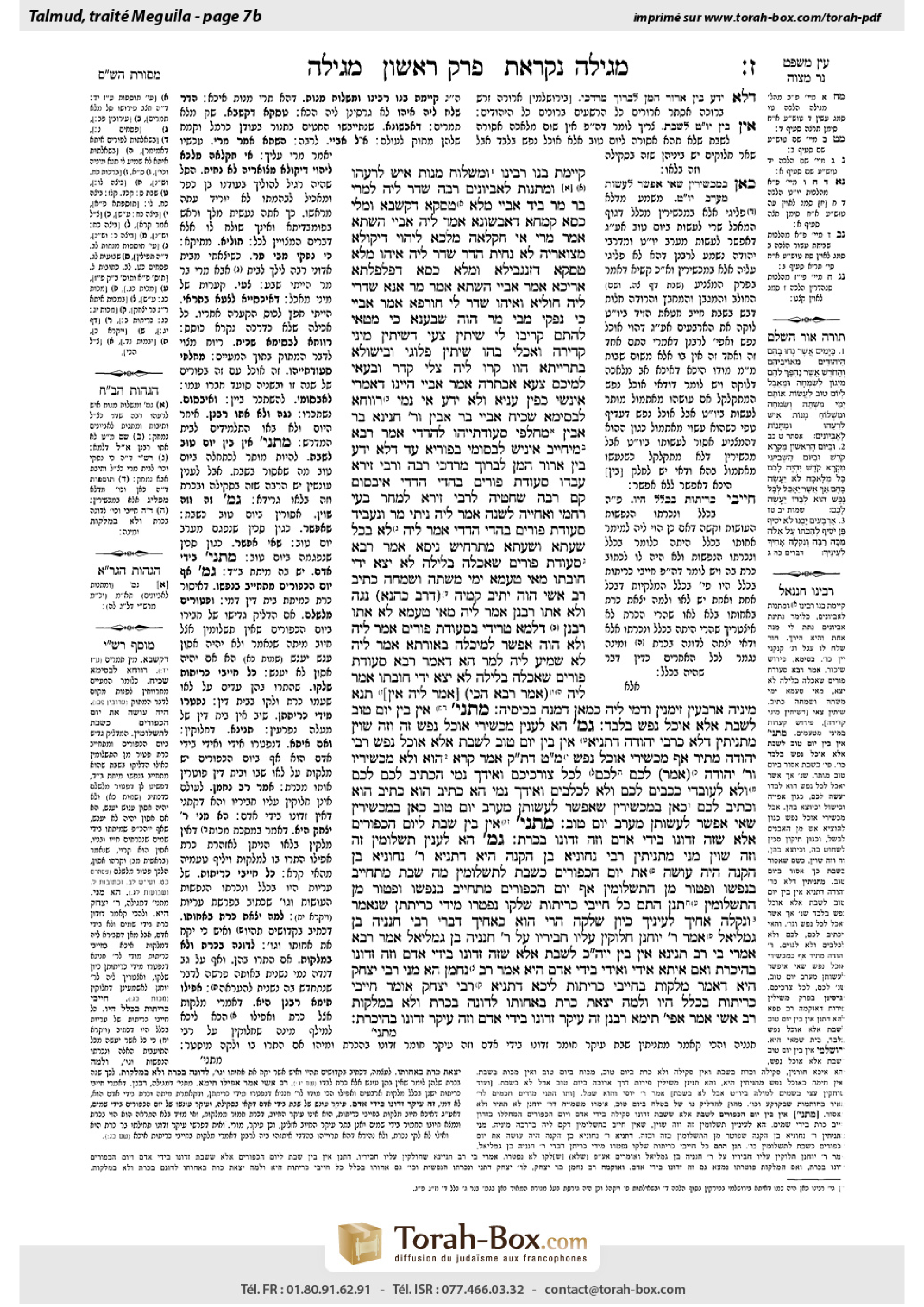
Megillah 7b: Talmud study for Daf Yomi
Daf Yomi is the daily study of one Talmud folio. Explore 37 tractates with scans, Hebrew text, Sefaria English and AI-generated French translations where annotated.
Passage selection and English or AI-generated French translation are available where the scan has annotations. Daf Study is independent of Torah-Box and Sefaria.
Browse Megillah · מגילה · All tractatesMegillah 7b text and translations
This page of Megillah includes the Aramaic text, an English translation and an AI-generated French translation, alongside the scan above.
מגילה ז׳ ב · Aramaic and Hebrew text
קִיַּימְתָּ בָּנוּ רַבֵּינוּ, ״וּמִשְׁלוֹחַ מָנוֹת אִישׁ לְרֵעֵהוּ וּמַתָּנוֹת לָאֶבְיוֹנִים״.
רַבָּה שַׁדַּר לֵיהּ לְמָרֵי בַּר מָר בְּיַד אַבָּיֵי מְלֵא טַסְקָא דְקַשְׁבָּא וּמְלֵי כָּסָא קִמְחָא דַאֲבִשׁוּנָא. אֲמַר לֵיהּ אַבָּיֵי: הַשְׁתָּא אָמַר מָרִי: אִי חַקְלָאָה מַלְכָּא לֶיהֱוֵי — דִּיקּוּלָא מִצַּוְּארֵיהּ לָא נָחֵית.
הֲדַר שַׁדַּר לֵיהּ אִיהוּ מְלֵא טַסְקָא דְזַנְגְּבִילָא וּמְלֵא כָּסָא דְּפִלְפְּלָתָא אֲרִיכָתָא. אֲמַר אַבָּיֵי: הַשְׁתָּא אָמַר מָר: אֲנָא שַׁדַּרִי לֵיהּ חוּלְיָא, וְאִיהוּ שַׁדַּר לִי חוּרְפָּא.
אֲמַר אַבָּיֵי: כִּי נְפַקִי מִבֵּי מָר, הֲוָה שָׂבַעְנָא. כִּי מְטַאי לְהָתָם, קָרִיבוּ לִי שִׁיתִּין צָעֵי דְּשִׁיתִּין מִינֵי קְדֵירָה, וַאֲכַלִי בְּהוּ שִׁיתִּין פְּלוּגֵי. וּבִישּׁוּלָא בָּתְרָיְיתָא הֲווֹ קָרוּ לֵיהּ צְלִי קֵדָר, וּבְעַאי לְמִיכַּס צָעָא אַבָּתְרֵהּ.
אָמַר אַבָּיֵי, הַיְינוּ דְּאָמְרִי אִינָשֵׁי: כָּפֵין עַנְיָא וְלָא יָדַע. אִי נָמֵי: רַוְוחָא לִבְסִימָא שְׁכִיחַ.
אַבָּיֵי בַּר אָבִין וְרַבִּי חֲנִינָא בַּר אָבִין מְחַלְּפִי סְעוֹדְתַּיְיהוּ לַהֲדָדֵי.
אָמַר רָבָא: מִיחַיַּיב אִינִישׁ לְבַסּוֹמֵי בְּפוּרַיָּא עַד דְּלָא יָדַע בֵּין אָרוּר הָמָן לְבָרוּךְ מָרְדֳּכַי.
רַבָּה וְרַבִּי זֵירָא עֲבַדוּ סְעוּדַת פּוּרִים בַּהֲדֵי הֲדָדֵי. אִיבַּסּוּם. קָם רַבָּה שַׁחְטֵיהּ לְרַבִּי זֵירָא. לְמָחָר, בָּעֵי רַחֲמֵי וְאַחֲיֵיהּ. לְשָׁנָה, אֲמַר לֵיהּ: נֵיתֵי מָר וְנַעֲבֵיד סְעוּדַת פּוּרִים בַּהֲדֵי הֲדָדֵי. אֲמַר לֵיהּ: לָא בְּכֹל שַׁעְתָּא וְשַׁעְתָּא מִתְרְחִישׁ נִיסָּא.
אָמַר רָבָא: סְעוּדַת פּוּרִים שֶׁאֲכָלָהּ בַּלַּיְלָה — לֹא יָצָא יְדֵי חוֹבָתוֹ. מַאי טַעְמָא — ״יְמֵי מִשְׁתֶּה וְשִׂמְחָה״, כְּתִיב: רַב אָשֵׁי הֲוָה יָתֵיב קַמֵּיהּ (דְּרַב כָּהֲנָא), נְגַהּ וְלָא אֲתוֹ רַבָּנַן. אֲמַר לֵיהּ: מַאי טַעְמָא לָא אֲתוֹ רַבָּנַן? דִּלְמָא טְרִידִי בִּסְעוּדַת פּוּרִים. אֲמַר לֵיהּ: וְלָא הֲוָה אֶפְשָׁר לְמֵיכְלַהּ בְּאוּרְתָּא? אָמַר לֵיהּ: לָא שְׁמִיעַ לֵיהּ לְמָר הָא דְּאָמַר רָבָא: סְעוּדַת פּוּרִים שֶׁאֲכָלָהּ בַּלַּיְלָה לֹא יָצָא יְדֵי חוֹבָתוֹ? אָמַר לֵיהּ: (אָמַר רָבָא הָכִי?) [אֲמַר לֵיהּ: אִין]. תְּנָא מִינֵּיהּ אַרְבְּעִין זִימְנִין וְדָמֵי לֵיהּ כְּמַאן דְּמַנַּח בְּכִיסֵיהּ.
מַתְנִי׳ אֵין בֵּין יוֹם טוֹב לַשַּׁבָּת אֶלָּא אוֹכֶל נֶפֶשׁ בִּלְבָד.
גְּמָ׳ הָא לְעִנְיַן מַכְשִׁירֵי אוֹכֶל נֶפֶשׁ — זֶה וָזֶה שָׁוִין.
מַתְנִיתִין דְּלָא כְּרַבִּי יְהוּדָה, דְּתַנְיָא: אֵין בֵּין יוֹם טוֹב לַשַּׁבָּת אֶלָּא אוֹכֶל נֶפֶשׁ, רַבִּי יְהוּדָה מַתִּיר אַף מַכְשִׁירֵי אוֹכֶל נֶפֶשׁ.
מַאי טַעְמָא דְּתַנָּא קַמָּא? אָמַר קְרָא: ״הוּא״ — וְלֹא מַכְשִׁירָיו, וְרַבִּי יְהוּדָה (אָמַר): ״לָכֶם״ — לָכֶם לְכׇל צוֹרְכֵיכֶם.
וְאִידַּךְ נָמֵי, הָכְתִיב ״לָכֶם״? לָכֶם וְלֹא לְגוֹיִם, לָכֶם וְלֹא לִכְלָבִים.
וְאִידַּךְ נָמֵי, הָא כְּתִיב ״הוּא״? כְּתִיב ״הוּא״ וּכְתִיב ״לָכֶם״. כָּאן בְּמַכְשִׁירִין שֶׁאֶפְשָׁר לַעֲשׂוֹתָן מֵעֶרֶב יוֹם טוֹב, כָּאן בְּמַכְשִׁירִין שֶׁאִי אֶפְשָׁר לַעֲשׂוֹתָן מֵעֶרֶב יוֹם טוֹב.
מַתְנִי׳ אֵין בֵּין שַׁבָּת לְיוֹם הַכִּפּוּרִים, אֶלָּא שֶׁזֶּה — זְדוֹנוֹ בִּידֵי אָדָם, וְזֶה — זְדוֹנוֹ בְּכָרֵת.
גְּמָ׳ הָא לְעִנְיַן תַּשְׁלוּמִין — זֶה וָזֶה שָׁוִין.
מַנִּי מַתְנִיתִין? רַבִּי נְחוּנְיָא בֶּן הַקָּנָה הִיא, דְּתַנְיָא: רַבִּי נְחוּנְיָא בֶּן הַקָּנָה הָיָה עוֹשֶׂה אֶת יוֹם הַכִּפּוּרִים כַּשַּׁבָּת לְתַשְׁלוּמִין, מָה שַׁבָּת — מִתְחַיֵּיב בְּנַפְשׁוֹ וּפָטוּר מִן הַתַּשְׁלוּמִין, אַף יוֹם הַכִּפּוּרִים — מִתְחַיֵּיב בְּנַפְשׁוֹ וּפָטוּר מִן הַתַּשְׁלוּמִין.
תְּנַן הָתָם: כׇּל חַיָּיבֵי כָרֵיתוֹת שֶׁלָּקוּ — נִפְטְרוּ מִידֵי כְּרִיתָתָן, שֶׁנֶּאֱמַר: ״וְנִקְלָה אָחִיךָ לְעֵינֶיךָ״, כֵּיוָן שֶׁלָּקָה — הֲרֵי הוּא כְּאָחִיךָ. דִּבְרֵי רַבִּי חֲנַנְיָה בֶּן גַּמְלִיאֵל. אָמַר רַבִּי יוֹחָנָן: חֲלוּקִין עָלָיו חֲבֵירָיו עַל רַבִּי חֲנַנְיָה בֶּן גַּמְלִיאֵל.
אָמַר רָבָא: אָמְרִי בֵּי רַב, תְּנֵינָא: אֵין בֵּין יוֹם הַכִּפּוּרִים לַשַּׁבָּת אֶלָּא שֶׁזֶּה — זְדוֹנוֹ בִּידֵי אָדָם, וְזֶה — זְדוֹנוֹ בְּהִיכָּרֵת. וְאִם אִיתָא — אִידֵּי וְאִידֵּי בִּידֵי אָדָם הִיא!
אָמַר רַב נַחְמָן: הָא מַנִּי — רַבִּי יִצְחָק הִיא, דְּאָמַר: מַלְקוֹת בְּחַיָּיבֵי כָרֵיתוֹת לֵיכָּא. דְּתַנְיָא, רַבִּי יִצְחָק אוֹמֵר: חַיָּיבֵי כָרֵיתוֹת בַּכְּלָל הָיוּ, וְלָמָּה יָצָאת כָּרֵת בַּאֲחוֹתוֹ — לְדוּנָהּ בְּכָרֵת וְלֹא בְּמַלְקוֹת.
רַב אָשֵׁי אָמַר: אֲפִילּוּ תֵּימָא רַבָּנַן, זֶה — עִיקַּר זְדוֹנוֹ בִּידֵי אָדָם, וְזֶה — עִיקָּר זְדוֹנוֹ בְּהִיכָּרֵת.
Megillah 7b · English translation
You have fulfilled two mitzvot through us, our teacher: The mitzva of: “And sending portions one to another,” and the mitzva of: “And gifts to the poor,” as Rabbi Oshaya was poor and this was a substantial gift.
The Gemara relates that Rabba sent Purim portions from the house of the Exilarch to Marei bar Mar in the hands of Abaye, who was his nephew and student. The Purim portions consisted of a sack [taska] full of dates [kashva] and a cupful of roasted flour [kimḥa de’avshuna]. Abaye said to him: Now, Mari will say the popular expression: Even if a farmer becomes the king, the basket does not descend from his neck. Rabba was named the head of the yeshiva in Pumbedita, and nevertheless, he continued to send very plain gifts, because he was impoverished.
Marei bar Mar sent back to him a sack full of ginger and a cupful of long peppers [pilpalta arikha], a much more expensive gift. Abaye said to him: The master, Rabba, will now say: I sent him sweet items and he sent me pungent ones.
In describing that same incident, Abaye said: When I left the house of the master, Rabba, to go to Marei bar Mar, I was already satiated. However, when I arrived there at Marei bar Mar’s house, they served me sixty plates of sixty kinds of cooked dishes, and I ate sixty portions from each of them. The last dish was called pot roast, and I was still so hungry that I wanted to chew the plate afterward.
And in continuation Abaye said: This explains the folk saying that people say: The poor man is hungry and does not know it, as Abaye was unaware how hungry he had been in his master’s house. Alternatively, there is another appropriate, popular expression: Room in the stomach for sweets can always be found.
The Gemara relates that Abaye bar Avin and Rabbi Ḥanina bar Avin would exchange their meals with each other to fulfill their obligation of sending portions on Purim.
Rava said: A person is obligated to become intoxicated with wine on Purim until he is so intoxicated that he does not know how to distinguish between cursed is Haman and blessed is Mordecai.
The Gemara relates that Rabba and Rabbi Zeira prepared a Purim feast with each other, and they became intoxicated to the point that Rabba arose and slaughtered Rabbi Zeira. The next day, when he became sober and realized what he had done, Rabba asked God for mercy, and revived him. The next year, Rabba said to Rabbi Zeira: Let the Master come and let us prepare the Purim feast with each other. He said to him: Miracles do not happen each and every hour, and I do not want to undergo that experience again.
Rava said: A Purim feast that one ate at night did not fulfill his obligation. What is the reason? “Days of feasting and gladness” (Esther 9:22) is written, i.e., days and not nights. The Gemara relates: Rav Ashi was sitting before Rav Kahana his teacher on Purim, and it grew dark and the Sages who usually came to study with him did not come. Rav Ashi said to him: What is the reason that the Sages did not come today? Rav Kahana answered: Perhaps they are preoccupied with the Purim feast. Rav Ashi said to him: Wasn’t it possible for them to eat the feast at night on Purim, instead of being derelict in their Torah study on Purim day? Rav Kahana said to him: Didn’t the master learn that which Rava said: A Purim feast that one ate at night did not fulfill his obligation? Rav Ashi said to him: Did Rava say that? Rav Kahana said to him: Yes. Rav Ashi then learned it from him forty times until he remembered it so well that it seemed to him as if it were placed in his purse.
MISHNA: The previous mishna concluded with the formula: The difference between…is only, thereby distinguishing between the halakhot in two different cases. The following mishnayot employ the same formula and distinguish between the halakhot in cases unrelated to Purim and the Megilla. The first is: The difference between Festivals and Shabbat with regard to the labor prohibited on those days is only in preparing food alone. It is permitted to cook and bake in order to prepare food on Festivals; however, on Shabbat it is prohibited.
GEMARA: The Gemara infers that with regard to the matter of actions that facilitate preparation of food, e.g., sharpening a knife for slaughter, this, Shabbat, and that, Festivals, are equal, in that actions that facilitate preparation of food are prohibited.
The Gemara comments: If so, the mishna is not in accordance with the opinion of Rabbi Yehuda, as it is taught in a baraita: The difference between Festivals and Shabbat is only preparing food. Rabbi Yehuda permits even actions that facilitate preparation of food on Festivals.
The Gemara elaborates. What is the reason for the opinion of the first tanna? It is as the verse states: “Except that which every person must eat, only that may be done for you” (Exodus 12:16). “That” is permitted, and not actions that facilitate it. And Rabbi Yehuda says: “For you” means for you, for all your needs.
The Gemara asks: And for the other, first, tanna too, isn’t it written: “For you”? The Gemara answers: He infers: For you, and not for gentiles; for you, and not for dogs. It is forbidden to perform labors for the sake of gentiles, or for animals, even if it is to feed them.
The Gemara asks further: And for the other tanna, Rabbi Yehuda, too, isn’t it written: “That,” which is a restrictive term that limits the application of a particular halakha? The Gemara answers: It is written: “That,” which is restrictive, and it is written: “For you,” which is inclusive. Rabbi Yehuda resolves the conflict between the two: Here, the word: “That,” is referring to actions that facilitate, in which it is possible to perform them on the Festival eve but which are prohibited on the Festival; there, the phrase: “For you,” is referring to actions that facilitate, in which it is impossible to perform them on the Festival eve and which are permitted even on the Festival.
MISHNA: The difference between Shabbat and Yom Kippur with regard to the labor prohibited on those days is only that in this case, i.e., Shabbat, its intentional desecration is punishable at the hand of Man, as he is stoned by a court based on the testimony of witnesses who forewarned the transgressor; and in that case, i.e., Yom Kippur, its intentional desecration is punishable at the hand of God, with karet.
GEMARA: The Gemara infers that with regard to the matter of payment of damages, both this, Shabbat, and that, Yom Kippur, are equal in that one is exempt in both cases. If one performs an action on Shabbat that entails both a prohibited labor and damage to another’s property, since his transgression is punishable by death, he is exempt from paying damages. Apparently, according to the mishna, the same halakha applies to Yom Kippur.
The Gemara asks: According to whose opinion is the mishna taught? The Gemara answers: It is according to the opinion of Rabbi Neḥunya ben HaKana, as it is taught in a baraita: Rabbi Neḥunya ben HaKana would render Yom Kippur like Shabbat with regard to payment of damages. Just as in the case of one who intentionally desecrates Shabbat he is liable to receive the death penalty and is therefore exempt from the obligation of payment of damages caused while desecrating Shabbat, so too, in the case of one who intentionally desecrates Yom Kippur, he is liable to receive the death penalty and is therefore exempt from the obligation of payment of damages caused while desecrating Yom Kippur.
We learned there in a mishna (Makkot 23a): All those liable to receive karet who were flogged in court were exempted from their karet, which is imposed by heaven. Most transgressors are liable to receive karet for violating prohibitions that are punishable by flogging. If they are flogged, they are exempt from karet, as it is stated with regard to one liable to receive lashes: “Then your brother shall be dishonored before you” (Deuteronomy 25:3), indicating that once he was flogged he is like your brother, and his sins have been pardoned; this is the statement of Rabbi Ḥananya ben Gamliel. Rabbi Yoḥanan said: Rabbi Ḥananya ben Gamliel’s colleagues disagree with him on this issue.
Rava said that the Sages of the school of Rav said: We learned: The difference between Yom Kippur and Shabbat is only that in this case, Shabbat, its intentional desecration is punishable at the hand of Man; and in that case, Yom Kippur, its intentional desecration is punishable with karet. And if the statement of Rabbi Ḥananya ben Gamliel is so, in both this case, Shabbat, and that case, Yom Kippur, the punishment is at the hand of Man.
Rav Naḥman said: There is no proof from here that Rabbi Ḥananya ben Gamliel’s colleagues disagree with him, as in accordance with whose opinion is this mishna taught? It is according to the opinion of Rabbi Yitzḥak, who said: There are no lashes in cases of those liable to receive karet, as it is taught in a baraita that Rabbi Yitzḥak says: All those liable to receive karet in cases of incest were included in the principle: “For whoever shall commit any of these abominations, even the persons that commit them shall be cut off from among their people” (Leviticus 18:29). And why was karet administered to one’s sister excluded from this verse and mentioned independently (Leviticus 20:17)? It is to sentence her to the punishment of karet and not to the punishment of lashes. This serves as a paradigm; wherever one is liable to receive karet, there are no lashes.
Rav Ashi said: Even if you say that the mishna is according to the opinion of the Rabbis who disagree with Rabbi Yitzḥak and hold that there are lashes even in cases where there is liability for karet, there is no proof that Rabbi Ḥananya ben Gamliel’s colleagues disagree with him. The mishna can be understood as follows: In this case, Shabbat, the primary punishment for its intentional desecration is at the hand of Man; and in that case, Yom Kippur, the primary punishment for its intentional desecration is with karet. If, however, he was flogged, he is exempt from karet.
Megillah 7b · Traduction française (IA)
Grâce à nous, tu as accompli deux mitsvot, notre maître : la mitsva de « l’envoi de portions l’un à l’autre » et celle des « dons aux pauvres », car Rabbi Oshaya était pauvre et il s’agissait d’un don substantiel.
La Guemara rapporte que Rabba envoya des portions de Pourim depuis la maison de l’exilarque à Marei bar Mar, par l’intermédiaire d’Abaye, qui était son neveu et son élève. Ces portions de Pourim consistaient en un sac [taska] rempli de dattes [kashva] et une coupe de farine grillée [kimḥa de’avshuna]. Abaye lui dit : « À présent, Mari va dire le proverbe populaire : Même si un cultivateur devient roi, le panier ne quitte pas son cou. » Rabba avait été nommé à la tête de la yéchiva de Poumbedita et, pourtant, il continuait à envoyer des présents très modestes, car il était pauvre.
Marei bar Mar lui renvoya un sac rempli de gingembre et une coupe de poivre long [pilpalta arikha], un présent bien plus coûteux. Abaye lui dit : « Le maître, Rabba, dira maintenant : Je lui ai envoyé des mets doux, et il m’a envoyé des mets piquants. »
À propos de ce même épisode, Abaye dit : « Lorsque j’ai quitté la maison de mon maître, Rabba, pour me rendre chez Marei bar Mar, j’étais déjà rassasié. Pourtant, à mon arrivée chez Marei bar Mar, on m’a servi soixante plats, composés de soixante sortes de mets cuisinés, et j’ai mangé soixante portions de chacun d’eux. Le dernier plat s’appelait rôti en cocotte, et j’avais encore tellement faim que j’aurais voulu mâcher le plat ensuite. »
Abaye poursuivit : « Cela explique le proverbe populaire : Le pauvre a faim sans le savoir », car Abaye ignorait à quel point il avait eu faim chez son maître. On peut aussi citer un autre proverbe populaire qui convient : « Il y a toujours de la place dans l’estomac pour les douceurs. »
La Guemara rapporte qu’Abaye bar Avin et Rabbi Ḥanina bar Avin échangeaient leurs repas afin de s’acquitter de leur obligation d’envoyer des portions à Pourim.
Rava dit : On est tenu de s’enivrer de vin à Pourim au point de ne plus savoir distinguer entre « Maudit soit Haman » et « Béni soit Mordekhaï ».
La Guemara rapporte que Rabba et Rabbi Zeira préparèrent ensemble un festin de Pourim et s’enivrèrent au point que Rabba se leva et égorgea Rabbi Zeira. Le lendemain, une fois dégrisé et ayant compris ce qu’il avait fait, Rabba implora la miséricorde divine et le ramena à la vie. L’année suivante, Rabba dit à Rabbi Zeira : « Que le maître vienne et préparons ensemble le festin de Pourim. » Celui-ci lui répondit : « Les miracles ne se produisent pas à chaque instant, et je ne veux pas revivre cette expérience. »
Rava dit : Celui qui a pris son repas de Pourim la nuit ne s’est pas acquitté de son obligation. Pour quelle raison ? Il est écrit : « Des jours de festin et de réjouissance » (Esther 9,22), c’est-à-dire des jours et non des nuits. La Guemara rapporte que Rav Ashi était assis devant son maître Rav Kahana à Pourim. La nuit tomba et les Sages qui avaient l’habitude de venir étudier avec lui ne vinrent pas. Rav Ashi lui demanda : « Pourquoi les Sages ne sont-ils pas venus aujourd’hui ? » Rav Kahana lui répondit : « Peut-être sont-ils occupés par le festin de Pourim. » Rav Ashi lui dit : « Ne pouvaient-ils pas prendre leur repas de Pourim la nuit, au lieu de négliger l’étude de la Torah le jour de Pourim ? » Rav Kahana lui répondit : « Le maître n’a-t-il pas appris ce que Rava a dit : Celui qui a pris son repas de Pourim la nuit ne s’est pas acquitté de son obligation ? » Rav Ashi lui demanda : « Rava a-t-il dit cela ? » Rav Kahana répondit : « Oui. » Rav Ashi l’apprit alors de lui quarante fois, jusqu’à s’en souvenir si parfaitement qu’il lui semblait que cela était déposé dans sa bourse.
MICHNA : La Michna précédente se terminait par la formule : « La différence entre… ne concerne que… », distinguant ainsi les halakhot de deux cas différents. Les Michnayot suivantes emploient la même formule pour distinguer les halakhot dans des cas sans rapport avec Pourim ni avec la Meguila. La première est la suivante : La seule différence entre les fêtes et le Chabbat, concernant les travaux interdits ces jours-là, porte sur la préparation des aliments. Il est permis de cuisiner et de cuire au four pour préparer des aliments pendant les fêtes ; en revanche, cela est interdit le Chabbat.
GUEMARA : La Guemara déduit que, pour ce qui est des actes facilitant la préparation des aliments, par exemple aiguiser un couteau pour l’abattage rituel, le Chabbat et les fêtes sont équivalents : ces actes sont interdits.
La Guemara fait remarquer : Si tel est le cas, la Michna ne suit pas l’opinion de Rabbi Yehouda, car il est enseigné dans une baraïta : « La seule différence entre les fêtes et le Chabbat porte sur la préparation des aliments. » Rabbi Yehouda permet même les actes facilitant la préparation des aliments pendant les fêtes.
La Guemara développe : Quelle est la raison de l’opinion du premier tanna ? C’est ce qu’indique le verset : « Sauf ce que chacun doit manger, cela seul peut être fait pour vous » (Exode 12,16). « Cela » est permis, mais non les actes qui en facilitent la préparation. Rabbi Yehouda, lui, dit que « pour vous » signifie : pour vous, pour tous vos besoins.
La Guemara demande : Mais le premier tanna ne trouve-t-il pas, lui aussi, l’expression « pour vous » dans le verset ? La Guemara répond : Il en déduit que « pour vous » signifie pour vous, et non pour les non-Juifs ; pour vous, et non pour les chiens. Il est interdit d’accomplir des travaux au profit des non-Juifs ou des animaux, même pour les nourrir.
La Guemara demande encore : Mais Rabbi Yehouda ne trouve-t-il pas, lui aussi, le mot « cela », qui restreint l’application d’une halakha particulière ? La Guemara répond : Le mot restrictif « cela » est écrit, tout comme l’expression inclusive « pour vous ». Rabbi Yehouda résout la contradiction entre les deux ainsi : ici, le mot « cela » se rapporte aux actes facilitant la préparation qu’il est possible d’accomplir la veille de la fête, mais qui sont interdits pendant la fête ; là, l’expression « pour vous » se rapporte aux actes facilitant la préparation qu’il est impossible d’accomplir la veille de la fête et qui sont donc permis même pendant la fête.
MICHNA : La seule différence entre le Chabbat et Yom Kippour, concernant les travaux interdits ces jours-là, est que, dans le premier cas, c’est-à-dire le Chabbat, la profanation intentionnelle est punie par les hommes : le transgresseur est lapidé par décision d’un tribunal, sur la déposition de témoins qui l’avaient averti ; tandis que, dans le second cas, c’est-à-dire Yom Kippour, la profanation intentionnelle est punie par Dieu, par le retranchement [karet].
GUEMARA : La Guemara déduit que, pour ce qui est du paiement des dommages, le Chabbat et Yom Kippour sont équivalents : dans les deux cas, on en est exempté. Si quelqu’un accomplit le Chabbat un acte qui constitue à la fois un travail interdit et un dommage causé aux biens d’autrui, comme sa transgression est passible de la peine de mort, il est exempté du paiement des dommages. Il semble donc que, selon la Michna, la même halakha s’applique à Yom Kippour.
La Guemara demande : Selon l’opinion de qui la Michna a-t-elle été enseignée ? La Guemara répond : Selon l’opinion de Rabbi Neḥounya ben HaKana, car il est enseigné dans une baraïta : Rabbi Neḥounya ben HaKana assimilait Yom Kippour au Chabbat en matière de paiement des dommages. De même que celui qui profane intentionnellement le Chabbat encourt la peine de mort et est donc exempté de l’obligation de payer les dommages causés en profanant le Chabbat, de même celui qui profane intentionnellement Yom Kippour encourt la peine de mort et est donc exempté de l’obligation de payer les dommages causés en profanant Yom Kippour.
Nous avons appris dans une Michna (Makkot 23a) : Tous ceux qui encourent le retranchement [karet] et qui ont reçu des coups de fouet devant un tribunal sont exemptés du retranchement, peine infligée par le Ciel. La plupart des transgresseurs encourent le retranchement pour avoir violé des interdits passibles de flagellation. S’ils reçoivent les coups de fouet, ils sont exemptés du retranchement, comme il est dit au sujet de celui qui encourt la flagellation : « Alors ton frère sera déshonoré à tes yeux » (Deutéronome 25,3). Cela indique qu’une fois flagellé, il est comme ton frère et ses péchés lui sont pardonnés. Telle est l’opinion de Rabbi Ḥananya ben Gamliel. Rabbi Yoḥanan dit : Les collègues de Rabbi Ḥananya ben Gamliel sont en désaccord avec lui sur cette question.
Rava dit, au nom des Sages de l’école de Rav : Nous avons appris : La seule différence entre Yom Kippour et le Chabbat est que, dans le premier cas, le Chabbat, la profanation intentionnelle est punie par les hommes, tandis que, dans le second cas, Yom Kippour, elle est punie par le retranchement [karet]. Or, si l’affirmation de Rabbi Ḥananya ben Gamliel est exacte, dans les deux cas, celui du Chabbat comme celui de Yom Kippour, la peine est infligée par les hommes.
Rav Naḥman dit : Rien ne prouve ici que les collègues de Rabbi Ḥananya ben Gamliel soient en désaccord avec lui, car selon l’opinion de qui cette Michna a-t-elle été enseignée ? Selon celle de Rabbi Yitzḥak, qui a dit qu’il n’y a pas de flagellation dans les cas passibles du retranchement. Il est enseigné dans une baraïta que Rabbi Yitzḥak dit : Tous les cas d’inceste passibles du retranchement sont inclus dans le principe : « Quiconque commet l’une de ces abominations, les personnes qui les commettent seront retranchées du sein de leur peuple » (Lévitique 18,29). Pourquoi le cas du retranchement encouru pour une relation avec sa sœur a-t-il été exclu de ce verset et mentionné séparément (Lévitique 20,17) ? Afin de lui assigner la peine du retranchement et non celle de la flagellation. Cela sert de modèle : partout où l’on encourt le retranchement, il n’y a pas de flagellation.
Rav Ashi dit : Même si l’on affirme que la Michna suit l’opinion des rabbins, en désaccord avec Rabbi Yitzḥak, qui estiment qu’il y a flagellation même dans les cas passibles du retranchement, rien ne prouve que les collègues de Rabbi Ḥananya ben Gamliel soient en désaccord avec lui. On peut comprendre la Michna ainsi : dans le premier cas, le Chabbat, la peine principale pour sa profanation intentionnelle est infligée par les hommes ; dans le second cas, Yom Kippour, la peine principale pour sa profanation intentionnelle est le retranchement [karet]. Toutefois, s’il a reçu des coups de fouet, il est exempté du retranchement.
Traduction française générée par IA à partir de l’édition anglaise de Sefaria. Vérifie toujours un passage avec le texte source.
Text from Sefaria: William Davidson Edition - Vocalized Aramaic (CC BY NC); William Davidson Edition - English (CC BY NC).