Megillah 8a: Talmud study for Daf Yomi
Daf Yomi is the daily study of one Talmud folio. Explore 37 tractates with scans, Hebrew text, Sefaria English and AI-generated French translations where annotated.
Passage selection and English or AI-generated French translation are available where the scan has annotations. Daf Study is independent of Torah-Box and Sefaria.
Browse Megillah · מגילה · All tractatesMegillah 8a text and translations
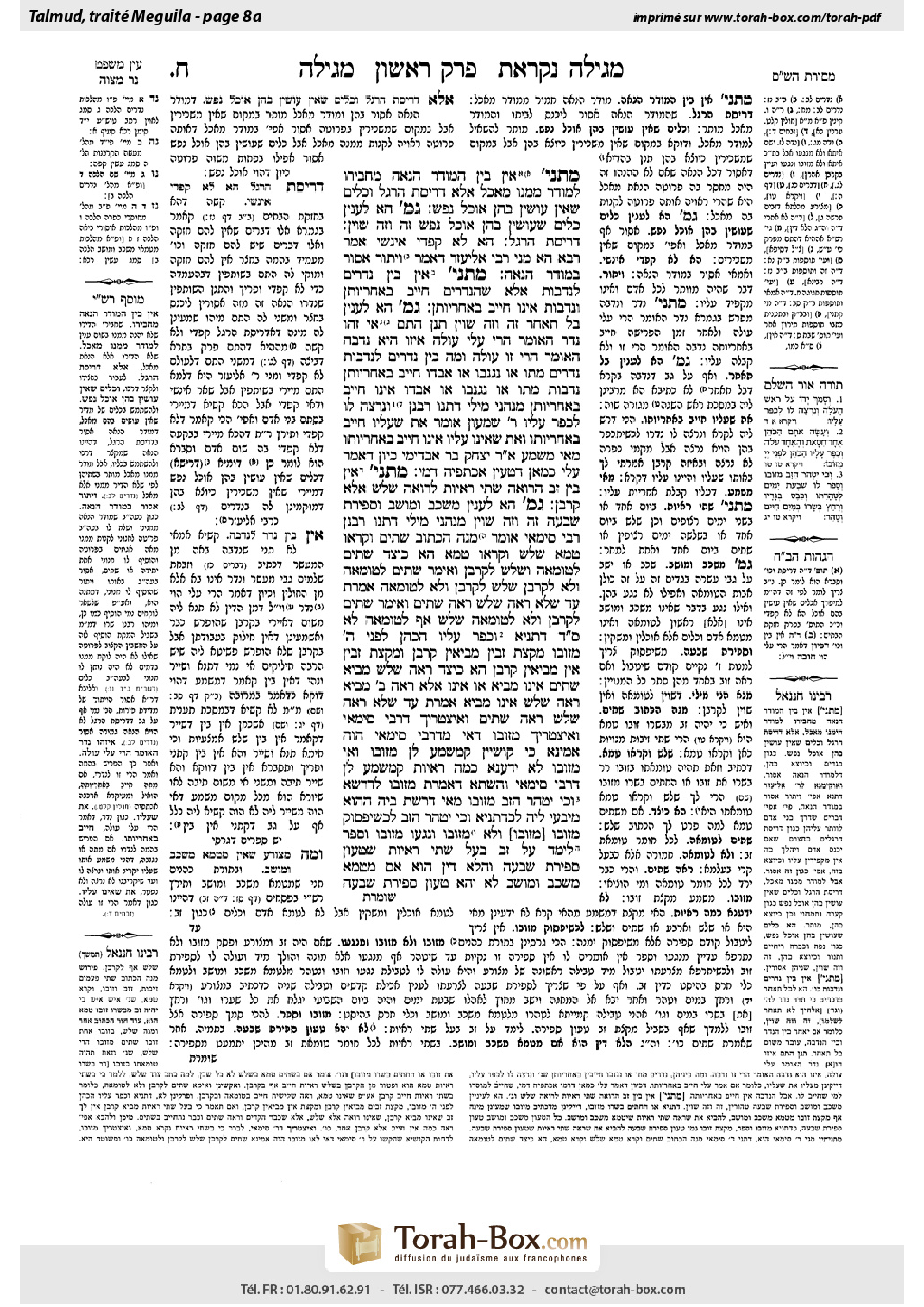
This page of Megillah includes the Aramaic text, an English translation and an AI-generated French translation, alongside the scan above.
מגילה ח׳ א · Aramaic and Hebrew text
מַתְנִי׳ אֵין בֵּין הַמּוּדָּר הֲנָאָה מֵחֲבֵירוֹ לַמּוּדָּר מִמֶּנּוּ מַאֲכָל, אֶלָּא דְּרִיסַת הָרֶגֶל וְכֵלִים שֶׁאֵין עוֹשִׂין בָּהֶן אוֹכֶל נֶפֶשׁ.
גְּמָ׳ הָא לְעִנְיַן כֵּלִים שֶׁעוֹשִׂין בָּהֶן אוֹכֶל נֶפֶשׁ — זֶה וָזֶה שָׁוִין.
דְּרִיסַת הָרֶגֶל? הָא לָא קָפְדִי אִינָשֵׁי! אֲמַר רָבָא: הָא מַנִּי — רַבִּי אֱלִיעֶזֶר, דְּאָמַר: וִיתּוּר אָסוּר בְּמוּדַּר הֲנָאָה.
מַתְנִי׳ אֵין בֵּין נְדָרִים לִנְדָבוֹת, אֶלָּא שֶׁהַנְּדָרִים חַיָּיב בְּאַחְרָיוּתָן, וּנְדָבוֹת אֵינוֹ חַיָּיב בְּאַחְרָיוּתָן.
גְּמָ׳ הָא לְעִנְיַן ״בַּל תְּאַחֵר״ — זֶה וָזֶה שָׁוִין.
תְּנַן הָתָם: אֵי זֶהוּ נֶדֶר? הָאוֹמֵר: ״הֲרֵי עָלַי עוֹלָה״. אֵיזוֹ הִיא נְדָבָה? הָאוֹמֵר: ״הֲרֵי זוֹ עוֹלָה״, וּמָה בֵּין נְדָרִים לִנְדָבוֹת? נְדָרִים, מֵתוּ אוֹ נִגְנְבוּ אוֹ אָבְדוּ — חַיָּיב בְּאַחְרָיוּתָן, נְדָבוֹת, מֵתוּ אוֹ נִגְנְבוּ אוֹ אָבְדוּ — אֵינוֹ חַיָּיב בְּאַחְרָיוּתָן.
מְנָהָנֵי מִילֵּי? דְּתָנוּ רַבָּנַן: ״וְנִרְצָה לוֹ לְכַפֵּר עָלָיו״, רַבִּי שִׁמְעוֹן אוֹמֵר: אֶת שֶׁעָלָיו — חַיָּיב בְּאַחְרָיוּתוֹ, וְאֶת שֶׁאֵינוֹ עָלָיו — אֵינוֹ חַיָּיב בְּאַחְרָיוּתוֹ.
מַאי מַשְׁמַע? אָמַר רַבִּי יִצְחָק בַּר אַבְדִּימִי: כֵּיוָן דְּאָמַר ״עָלַי״ — כְּמַאן דִּטְעִין אַכַּתְפֵּיהּ דָּמֵי.
מַתְנִי׳ אֵין בֵּין זָב הָרוֹאֶה שְׁתֵּי רְאִיּוֹת לָרוֹאֶה שָׁלֹשׁ אֶלָּא קׇרְבָּן.
גְּמָ׳ הָא לְעִנְיַן מִשְׁכָּב וּמוֹשָׁב וּסְפִירַת שִׁבְעָה — זֶה וָזֶה שָׁוִין.
מְנָהָנֵי מִילֵּי? דְּתָנוּ רַבָּנַן: רַבִּי סִימַאי אוֹמֵר: מָנָה הַכָּתוּב שְׁתַּיִם, וּקְרָאוֹ ״טָמֵא״. שָׁלֹשׁ, וּקְרָאוֹ ״טָמֵא״. הָא כֵּיצַד? שְׁתַּיִם לַטּוּמְאָה וְשָׁלֹשׁ לַקׇּרְבָּן.
וְאֵימַר: שְׁתַּיִם לְטוּמְאָה וְלֹא לְקׇרְבָּן, שָׁלֹשׁ לְקׇרְבָּן וְלֹא לְטוּמְאָה! אָמְרַתְּ: עַד שֶׁלֹּא רָאָה שָׁלֹשׁ רָאָה שְׁתַּיִם.
וְאֵימַר: שְׁתַּיִם לְקׇרְבָּן וְלֹא לְטוּמְאָה, שָׁלֹשׁ אַף לְטוּמְאָה! לָא סָלְקָא דַּעְתָּךְ, דְּתַנְיָא: ״וְכִפֶּר עָלָיו הַכֹּהֵן לִפְנֵי ה׳ מִזּוֹבוֹ״, מִקְצָת זָבִין מְבִיאִין קׇרְבָּן וּמִקְצָת זָבִין אֵין מְבִיאִין קׇרְבָּן. הָא כֵּיצַד? רָאָה שָׁלֹשׁ — מֵבִיא, שְׁתַּיִם — אֵינוֹ מֵבִיא.
אוֹ אֵינוֹ אֶלָּא: רָאָה שְׁתַּיִם — מֵבִיא, רָאָה שָׁלֹשׁ — אֵינוֹ מֵבִיא, אָמְרַתְּ: עַד שֶׁלֹּא רָאָה שָׁלֹשׁ רָאָה שְׁתַּיִם.
וְאִיצְטְרִיךְ דְּרַבִּי סִימַאי וְאִיצְטְרִיךְ ״מִזּוֹבוֹ״, דְּאִי מִדְּרַבִּי סִימַאי — הֲוָה אָמֵינָא כִּי קוּשְׁיַין, קָמַשְׁמַע לַן ״מִזּוֹבוֹ״. וְאִי ״מִזּוֹבוֹ״ — לָא יָדַעְנָא כַּמָּה רְאִיּוֹת, קָמַשְׁמַע לַן דְּרַבִּי סִימַאי.
וְהַשְׁתָּא דְּאָמְרַתְּ ״מִזּוֹבוֹ״ לִדְרָשָׁא, ״וְכִי יִטְהַר הַזָּב מִזּוֹבוֹ״ מַאי דָּרְשַׁתְּ בֵּיהּ?
הַהוּא מִיבְּעֵי לֵיהּ לְכִדְתַנְיָא: ״וְכִי יִטְהַר הַזָּב״ — לִכְשֶׁיִּפְסוֹק מִזּוֹבוֹ, [״מִזּוֹבוֹ״ —] וְלֹא מִזּוֹבוֹ וְנִגְעוֹ. ״מִזּוֹבוֹ וְסָפַר״ — לִימֵּד עַל זָב בַּעַל שְׁתֵּי רְאִיּוֹת שֶׁטָּעוּן סְפִירַת שִׁבְעָה.
וַהֲלֹא דִּין הוּא, אִם מְטַמֵּא מִשְׁכָּב וּמוֹשָׁב לֹא יְהֵא טָעוּן סְפִירַת שִׁבְעָה?
Megillah 8a · English translation
MISHNA: The difference between one for whom benefit from another is forbidden by vow and one for whom benefit from another’s food is forbidden by vow is only with regard to stepping foot on his property, and with regard to borrowing utensils from him that one does not use in the preparation of food, but for other purposes; as those two benefits are prohibited to the former, but permitted to the latter.
GEMARA: The Gemara infers that with regard to the matter of utensils that one uses in preparation of food, both this, one who vowed that any benefit is forbidden, and that, one who vowed that benefit from food is forbidden, are equal. It is prohibited for both to derive benefit from utensils used in the preparation of food.
The mishna stated that for one for whom benefit from another is forbidden by vow, stepping foot on the latter’s property is prohibited. The Gemara asks: What benefit is that? Aren’t people not particular about other people treading on their property? Rava said: In accordance with whose opinion is this mishna taught? It is the opinion of Rabbi Eliezer, who said: Overlooking is prohibited in the case of one for whom benefit is forbidden by vow. For one for whom benefit from another is forbidden by vow, benefit is forbidden even in matters with regard to which one is typically not particular and overlooks others’ use of his property, e.g., stepping foot on it.
MISHNA: The difference between animals consecrated to the Temple as vow offerings and animals consecrated as gift offerings is only that in the case of vow offerings, if they died or were lost before being sacrificed on the altar, one is obligated in the responsibility to replace them, and in the case of gift offerings, if they died or were lost, one is not obligated in the responsibility to replace them.
GEMARA: The Gemara infers that with regard to the matter of the prohibition: Do not be slack to pay one’s pledges, both this, a vow offering, and that, a gift offering, are equal. If one delayed bringing either a vow offering or a gift offering, he violates the prohibition.
We learned in a mishna there: Which is the case of a vow offering? It is one who says: It is incumbent upon me to bring a burnt-offering. Which is the case of a gift offering? It is one who says: This animal is a burnt-offering. And what is the difference between a vow offering and a gift offering? With regard to vow offerings, if the animals died or were stolen or were lost, the one who vowed is obligated in the responsibility to replace them, as he undertook to bring a burnt-offering and he is not absolved of his obligation until he brings the offering. With regard to gift offerings, however, if the animals died or were stolen or were lost, the one who vowed is not obligated in the responsibility to replace them.
The Gemara asks: From where are these matters derived? The Gemara answers: It is as the Sages taught in a baraita with regard to a burnt-offering, that the verse states: “And it shall be accepted for him to make atonement upon him” (Leviticus 1:4). Rabbi Shimon says: That which is incumbent upon him, i.e., which he accepted as a personal obligation, he bears responsibility to replace it if it died or was stolen; however, that which is not incumbent upon him, i.e., that which he did not accept as a personal obligation but which he designated as an offering, he does not bear responsibility to replace it.
The Gemara asks: From where may that conclusion be inferred from the verse? Rabbi Yitzḥak bar Avdimi said: Since he said it is incumbent upon me to bring a burnt-offering, he is considered as one who bears it upon his shoulders. The expression: Upon me, indicates an assumption of responsibility to bring an offering.
MISHNA: The difference between a zav who experiences two emissions of a pus-like discharge from his penis and one who experiences three emissions is only that the zav who experienced three emissions is obligated to bring an offering after he recovers, in order to complete his purification process.
GEMARA: The Gemara infers that with regard to the matter of transmitting ritual impurity to a surface designated for lying and a surface designated for sitting, and similarly with regard to the counting of seven days clean of emissions so that he may immerse in a ritual bath as part of the purification process, both this, i.e., one who experienced two emissions, and that, one who experienced three emissions, are equal.
The Gemara asks: From where are these matters derived? The Gemara answers: It is as the Sages taught in a baraita that Rabbi Simai says: The verse enumerated two emissions: “When any man has an emission out of his flesh, due to his emission he is impure” (Leviticus 15:2), and it called the zav impure. Another verse enumerated three emissions: “And this shall be his impurity in his emission: Whether his flesh runs with his emission, or his flesh be stopped from his emission, it is his impurity” (Leviticus 15:3), and it too called him impure. How so? If he is impure after two emissions, for what purpose does the Torah mention three? It is to teach: Two emissions to establish impurity and three to render him liable to bring an offering.
The Gemara raises an alternative. And say instead: Two emissions to establish impurity but not to render him liable to bring an offering; three emissions to render him liable to bring an offering, but not to establish impurity. The Gemara rejects this: That is impossible, as you can say that until he experienced three emissions, he already experienced two, and therefore he is impure in the case of three emissions as well.
The Gemara raises a different alternative. And say instead: Two emissions to render him liable to bring an offering, but not to establish impurity; three emissions to establish impurity as well. The Gemara answers that this suggestion cannot enter your mind, as it is taught in a baraita that the verse states: “And the priest shall make atonement for him before the Lord from his emission” (Leviticus 15:15). The preposition “from” that precedes the words “his emissions” indicates that some with the status of a zav bring an offering and some with the status of a zav do not bring an offering. How so? If he experienced three emissions, he brings an offering; if he experienced two emissions, he does not bring an offering.
The baraita suggests: Or perhaps, it means nothing other than that if one experienced two emissions, he brings an offering; if he experienced three emissions, he does not bring an offering. The baraita rejects this: That is impossible, as you can say that until he experienced three emissions, he already experienced two, and therefore he is obligated to bring an offering in the case of three emissions as well.
The Gemara comments: It was necessary to cite the proof of Rabbi Simai based on the number of mentions of the word emissions in the two verses, and it was necessary to cite the proof from the words: From his emission. As if the difference between two and three emissions was derived from the statement of Rabbi Simai, I would have said in accordance with our question: Perhaps one who experiences two emissions brings an offering, and one who experiences three emissions is impure and brings an offering. Therefore, it teaches us: From his emission. And if the difference between two and three emissions was derived from the term: From his emission, I would not have known how many emissions render him liable to bring an offering, only that some with the status of a zav are not required to bring an offering. Therefore, it teaches us the proof cited by Rabbi Simai.
The Gemara asks: And now that you said that the term: From his emission, is exclusionary and comes for derivation, what do you derive from the verse: “And when the zav is cleansed from his emission” (Leviticus 15:13)?
The Gemara answers: That verse is needed to derive that which was taught in a baraita. It is written: “And when the zav is cleansed from his emission, then he shall count to himself seven days for his purification” (Leviticus 15:13), when his emissions cease. The baraita infers from the term: From his emission, that he needs to be cleansed only from his emission, but not from his emission and his leprosy. If one was both a zav and also had leprosy, he need not wait until he is asymptomatic of his leprosy before counting seven clean days. Rather, he counts seven clean days, and after the leprosy symptoms cease, he immerses for both impurities. “From his emission, then he shall count”: This teaches concerning a zav who experienced two emissions, that he too requires a count of seven clean days.
The baraita continues: But in order to derive that halakha, the verse is unnecessary, as isn’t it only logical? If a zav who experienced two emissions renders a surface designated for lying and a surface designated for sitting ritually impure and all strictures of a zav apply to him, wouldn’t he require a count of seven clean days to become purified?
Megillah 8a · Traduction française (IA)
Michna : La différence entre celui à qui il est interdit par vœu de tirer profit d’autrui et celui à qui il est interdit par vœu de tirer profit de la nourriture d’autrui concerne uniquement le fait de fouler le domaine de l’autre et d’emprunter auprès de lui des ustensiles qui ne servent pas à la préparation des aliments, mais à d’autres usages ; car ces deux avantages sont interdits au premier, mais permis au second.
Guemara : La Guemara déduit que, concernant les ustensiles utilisés pour la préparation des aliments, les deux cas sont identiques : celui qui a fait vœu de s’interdire tout profit et celui qui a fait vœu de s’interdire le profit tiré de la nourriture. Il est interdit à tous deux de tirer profit des ustensiles utilisés pour la préparation des aliments.
La Michna indique que celui à qui il est interdit par vœu de tirer profit d’autrui n’a pas le droit de fouler le domaine de l’autre. La Guemara demande : Quel profit cela représente-t-il ? Les gens ne sont-ils pas peu regardants lorsque d’autres foulent leur domaine ? Rava dit : Selon l’opinion de qui cette Michna a-t-elle été enseignée ? Selon celle de Rabbi Eliezer, qui a dit que la tolérance est interdite dans le cas de celui à qui il est interdit par vœu de tirer profit d’autrui. Pour celui à qui il est interdit par vœu de tirer profit d’autrui, tout profit est interdit, même dans des situations où l’on n’est généralement pas regardant et où l’on tolère que d’autres utilisent son bien, par exemple en le foulant.
Michna : La différence entre les animaux consacrés au Temple comme offrandes de vœu et ceux consacrés comme offrandes de don tient uniquement au fait que, dans le cas des offrandes de vœu, si les animaux meurent ou se perdent avant d’être sacrifiés sur l’autel, on est tenu de les remplacer ; dans le cas des offrandes de don, s’ils meurent ou se perdent, on n’est pas tenu de les remplacer.
Guemara : La Guemara déduit que, concernant l’interdiction « Ne tarde pas à t’acquitter de tes vœux », les deux cas sont identiques : l’offrande de vœu et l’offrande de don. Si quelqu’un tarde à apporter l’une ou l’autre, il transgresse l’interdiction.
Nous avons appris dans une Michna, là-bas : Quel est le cas d’une offrande de vœu ? C’est celui qui dit : « Je suis tenu d’apporter un holocauste. » Quel est le cas d’une offrande de don ? C’est celui qui dit : « Cet animal est un holocauste. » Quelle est la différence entre une offrande de vœu et une offrande de don ? Dans le cas des offrandes de vœu, si les animaux meurent, sont volés ou se perdent, celui qui a fait le vœu est tenu de les remplacer, car il s’est engagé à apporter un holocauste et n’est quitte de son obligation qu’une fois l’offrande apportée. En revanche, dans le cas des offrandes de don, si les animaux meurent, sont volés ou se perdent, celui qui a fait le vœu n’est pas tenu de les remplacer.
La Guemara demande : D’où tire-t-on ces règles ? Elle répond : C’est ce que les Sages ont enseigné dans une baraïta au sujet d’un holocauste, car le verset dit : « Il sera agréé pour lui afin de lui obtenir l’expiation » (Lévitique 1,4). Rabbi Shimon dit : Pour ce qui lui incombe, c’est-à-dire ce qu’il a accepté comme obligation personnelle, il est tenu de le remplacer si l’animal meurt ou est volé ; mais pour ce qui ne lui incombe pas, c’est-à-dire ce qu’il n’a pas accepté comme obligation personnelle, mais qu’il a désigné comme offrande, il n’est pas tenu de le remplacer.
La Guemara demande : Comment peut-on déduire cette conclusion du verset ? Rabbi Yitzḥak bar Avdimi dit : Puisqu’il a dit : « Je suis tenu d’apporter un holocauste », il est considéré comme portant cette obligation sur ses épaules. L’expression « sur moi » indique qu’il assume la responsabilité d’apporter une offrande.
Michna : La différence entre un zav qui a eu deux écoulements d’une sécrétion purulente de son pénis et celui qui en a eu trois tient uniquement au fait que le zav qui en a eu trois est tenu d’apporter une offrande après sa guérison, afin d’achever son processus de purification.
Guemara : La Guemara déduit que, concernant la transmission de l’impureté rituelle à une surface destinée à servir de couche et à une surface destinée à servir de siège, et de même concernant le décompte de sept jours sans écoulement avant qu’il puisse s’immerger dans un bain rituel dans le cadre de son processus de purification, les deux cas sont identiques : celui qui a eu deux écoulements et celui qui en a eu trois.
La Guemara demande : D’où tire-t-on ces règles ? Elle répond : C’est ce que les Sages ont enseigné dans une baraïta. Rabbi Simai dit que le verset mentionne deux écoulements : « Si un homme a un écoulement de son corps, son écoulement le rend impur » (Lévitique 15,2), et déclare le zav impur. Un autre verset mentionne trois écoulements : « Voici son impureté lors de son écoulement : que sa chair laisse couler son écoulement ou que sa chair soit obstruée par son écoulement, c’est son impureté » (Lévitique 15,3), et le déclare lui aussi impur. Comment comprendre cela ? S’il est impur après deux écoulements, pourquoi la Torah en mentionne-t-elle trois ? Pour enseigner que deux écoulements établissent l’impureté, et que trois le rendent passible d’apporter une offrande.
La Guemara propose une autre possibilité : disons plutôt que deux écoulements établissent l’impureté, mais ne le rendent pas passible d’apporter une offrande, et que trois écoulements le rendent passible d’apporter une offrande, mais n’établissent pas l’impureté. La Guemara rejette cette possibilité : cela est impossible, car, lorsqu’il a eu trois écoulements, il en avait déjà eu deux ; il est donc également impur dans le cas de trois écoulements.
La Guemara propose une autre possibilité : disons plutôt que deux écoulements le rendent passible d’apporter une offrande, mais n’établissent pas l’impureté, et que trois écoulements établissent aussi l’impureté. La Guemara répond qu’on ne peut pas envisager cette proposition, car une baraïta enseigne que le verset dit : « Le prêtre fera pour lui expiation devant l’Éternel à cause de son écoulement » (Lévitique 15,15). La préposition « de », qui précède les mots « son écoulement », indique que certains ayant le statut de zav apportent une offrande et que d’autres n’en apportent pas. Comment comprendre cela ? S’il a eu trois écoulements, il apporte une offrande ; s’il en a eu deux, il n’en apporte pas.
La baraïta propose : Ou peut-être cela signifie-t-il uniquement que, si quelqu’un a eu deux écoulements, il apporte une offrande, et que, s’il en a eu trois, il n’en apporte pas. La baraïta rejette cette possibilité : cela est impossible, car, lorsqu’il a eu trois écoulements, il en avait déjà eu deux ; il est donc également tenu d’apporter une offrande dans le cas de trois écoulements.
La Guemara fait remarquer qu’il fallait citer la preuve de Rabbi Simai, fondée sur le nombre d’occurrences du mot « écoulement » dans les deux versets, et qu’il fallait aussi citer la preuve tirée des mots « de son écoulement ». En effet, si la différence entre deux et trois écoulements était déduite de l’enseignement de Rabbi Simai, j’aurais dit, conformément à notre question : peut-être celui qui a deux écoulements apporte-t-il une offrande, tandis que celui qui en a trois est impur et apporte une offrande. C’est pourquoi le texte nous enseigne « de son écoulement ». Et si la différence entre deux et trois écoulements était déduite de l’expression « de son écoulement », je n’aurais pas su combien d’écoulements le rendent passible d’apporter une offrande ; j’aurais seulement su que certains ayant le statut de zav ne sont pas tenus d’en apporter une. C’est pourquoi le texte nous enseigne la preuve citée par Rabbi Simai.
La Guemara demande : Et maintenant que tu as dit que l’expression « de son écoulement » sert à exclure un cas et à en tirer une déduction, que déduis-tu du verset : « Lorsque le zav sera purifié de son écoulement » (Lévitique 15,13) ?
La Guemara répond : Ce verset est nécessaire pour déduire la règle enseignée dans une baraïta. Il est écrit : « Lorsque le zav sera purifié de son écoulement, il comptera alors pour lui-même sept jours pour sa purification » (Lévitique 15,13), lorsque ses écoulements cessent. La baraïta déduit de l’expression « de son écoulement » qu’il doit être purifié uniquement de son écoulement, mais pas à la fois de son écoulement et de sa lèpre. Si quelqu’un est à la fois zav et atteint de lèpre, il n’a pas besoin d’attendre que les symptômes de sa lèpre disparaissent avant de compter sept jours sans écoulement. Il compte plutôt sept jours sans écoulement et, après la disparition des symptômes de la lèpre, il s’immerge pour les deux impuretés. « De son écoulement, il comptera alors » : cela enseigne qu’un zav qui a eu deux écoulements doit lui aussi compter sept jours sans écoulement.
La baraïta poursuit : Toutefois, pour déduire cette halakha, le verset n’est pas nécessaire, car n’est-ce pas une conclusion logique ? Si un zav qui a eu deux écoulements rend rituellement impures une surface destinée à servir de couche et une surface destinée à servir de siège, et que toutes les rigueurs applicables à un zav s’appliquent à lui, n’aurait-il pas besoin de compter sept jours sans écoulement pour être purifié ?
Traduction française générée par IA à partir de l’édition anglaise de Sefaria. Vérifie toujours un passage avec le texte source.
Text from Sefaria: William Davidson Edition - Vocalized Aramaic (CC BY NC); William Davidson Edition - English (CC BY NC).