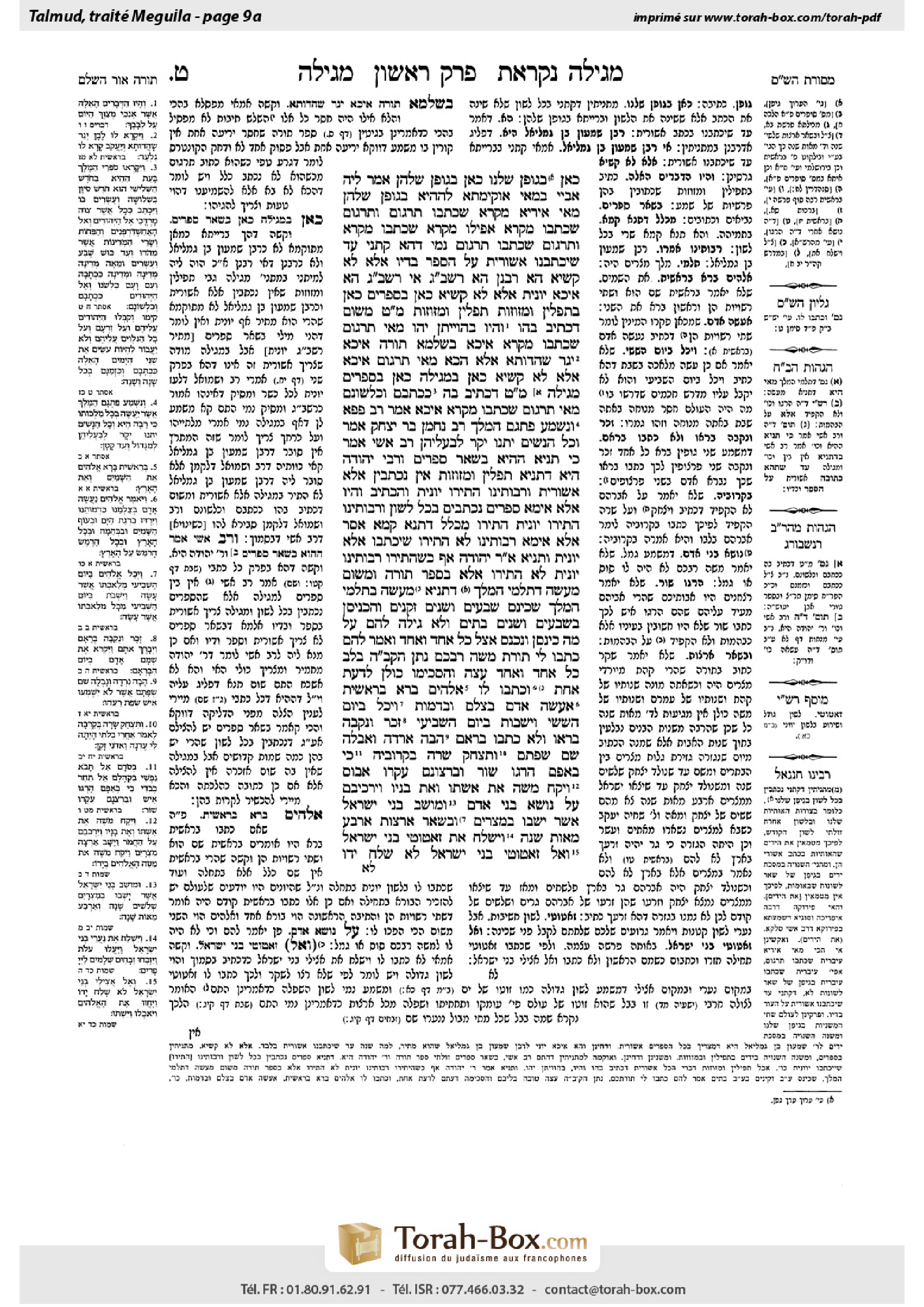
Megillah 9a: Talmud study for Daf Yomi
Daf Yomi is the daily study of one Talmud folio. Explore 37 tractates with scans, Hebrew text, Sefaria English and AI-generated French translations where annotated.
Passage selection and English or AI-generated French translation are available where the scan has annotations. Daf Study is independent of Torah-Box and Sefaria.
Browse Megillah · מגילה · All tractatesMegillah 9a text and translations
This page of Megillah includes the Aramaic text, an English translation and an AI-generated French translation, alongside the scan above.
מגילה ט׳ א · Aramaic and Hebrew text
כָּאן בְּגּוֹפָן שֶׁלָּנוּ, כָּאן בְּגּוֹפָן שֶׁלָּהֶן.
אֲמַר לֵיהּ אַבָּיֵי: בְּמַאי אוֹקֵימְתָּא לְהַהִיא? בְּגּוֹפָן שֶׁלָּהֶן, מַאי אִירְיָא מִקְרָא שֶׁכְּתָבוֹ תַּרְגּוּם וְתַרְגּוּם שֶׁכְּתָבוֹ מִקְרָא? אֲפִילּוּ מִקְרָא שֶׁכְּתָבוֹ מִקְרָא וְתַרְגּוּם שֶׁכְּתָבוֹ תַּרְגּוּם נָמֵי. דְּהָא קָתָנֵי: עַד שֶׁיִּכְתְּבֶנּוּ אַשּׁוּרִית עַל הַסֵּפֶר בִּדְיוֹ!
אֶלָּא, לָא קַשְׁיָא: הָא רַבָּנַן, הָא רַבָּן שִׁמְעוֹן בֶּן גַּמְלִיאֵל.
אִי רַבָּן שִׁמְעוֹן בֶּן גַּמְלִיאֵל הָא אִיכָּא יְוָנִית! אֶלָּא, לָא קַשְׁיָא: כָּאן בִּסְפָרִים, כָּאן בִּתְפִלִּין וּמְזוּזוֹת.
תְּפִלִּין וּמְזוּזוֹת מַאי טַעְמָא? מִשּׁוּם דִּכְתִיב בְּהוּ: ״וְהָיוּ״ — בַּהֲוָיָיתָן יְהוּ, מַאי תַּרְגּוּם שֶׁכְּתָבוֹ מִקְרָא אִיכָּא? בִּשְׁלָמָא תּוֹרָה — אִיכָּא ״יְגַר שָׂהֲדוּתָא״, אֶלָּא הָכָא מַאי תַּרְגּוּם אִיכָּא?
אֶלָּא, לָא קַשְׁיָא: כָּאן בִּמְגִילָּה, כָּאן בִּסְפָרִים. מְגִילָּה מַאי טַעְמָא, דִּכְתִיב בַּהּ: ״כִּכְתָבָם וְכִלְשׁוֹנָם״. מַאי תַּרְגּוּם שֶׁכְּתָבוֹ מִקְרָא אִיכָּא?
אָמַר רַב פָּפָּא: ״וְנִשְׁמַע פִּתְגָם הַמֶּלֶךְ״. רַב נַחְמָן בַּר יִצְחָק אָמַר: ״וְכׇל הַנָּשִׁים יִתְּנוּ יְקָר לְבַעְלֵיהֶן״.
רַב אָשֵׁי אָמַר: כִּי תַּנְיָא הָהִיא בִּשְׁאָר סְפָרִים, וְרַבִּי יְהוּדָה הִיא. דְּתַנְיָא: תְּפִלִּין וּמְזוּזוֹת אֵין נִכְתָּבִין אֶלָּא אַשּׁוּרִית, וְרַבּוֹתֵינוּ הִתִּירוּ יְוָנִית.
וְהָכְתִיב ״וְהָיוּ״! אֶלָּא אֵימָא: סְפָרִים נִכְתָּבִים בְּכׇל לָשׁוֹן, וְרַבּוֹתֵינוּ הִתִּירוּ יְוָנִית. הִתִּירוּ?! מִכְּלָל דְּתַנָּא קַמָּא אָסַר!
אֶלָּא אֵימָא: רַבּוֹתֵינוּ לֹא הִתִּירוּ שֶׁיִּכָּתְבוּ אֶלָּא יְוָנִית. וְתַנְיָא אָמַר רַבִּי יְהוּדָה: אַף כְּשֶׁהִתִּירוּ רַבּוֹתֵינוּ יְוָנִית — לֹא הִתִּירוּ אֶלָּא בְּסֵפֶר תּוֹרָה,
וּמִשּׁוּם מַעֲשֶׂה דְּתַלְמַי הַמֶּלֶךְ. דְּתַנְיָא: מַעֲשֶׂה בְּתַלְמַי הַמֶּלֶךְ שֶׁכִּינֵּס שִׁבְעִים וּשְׁנַיִם זְקֵנִים וְהִכְנִיסָן בְּשִׁבְעִים וּשְׁנַיִם בָּתִּים וְלֹא גִּילָּה לָהֶם עַל מָה כִּינְסָן. וְנִכְנַס אֵצֶל כׇּל אֶחָד וְאֶחָד, וְאָמַר לָהֶם: כִּתְבוּ לִי תּוֹרַת מֹשֶׁה רַבְּכֶם. נָתַן הַקָּדוֹשׁ בָּרוּךְ הוּא בְּלֵב כׇּל אֶחָד וְאֶחָד עֵצָה וְהִסְכִּימוּ כּוּלָּן לְדַעַת אַחַת.
וְכָתְבוּ לוֹ: ״אֱלֹהִים בָּרָא בְּרֵאשִׁית״. ״אֶעֱשֶׂה אָדָם בְּצֶלֶם וּבִדְמוּת״.
״וַיְכַל בְּיוֹם הַשִּׁשִּׁי וַיִּשְׁבּוֹת בְּיוֹם הַשְּׁבִיעִי״. ״זָכָר וּנְקֵבָה בְּרָאוֹ״, וְלֹא כָּתְבוּ ״בְּרָאָם״.
״הָבָה אֵרְדָה וְאָבְלָה שָׁם שְׂפָתָם״. ״וַתִּצְחַק שָׂרָה בִּקְרוֹבֶיהָ״.
״כִּי בְאַפָּם הָרְגוּ שׁוֹר וּבִרְצוֹנָם עִקְּרוּ אֵבוּס״. ״וַיִּקַּח מֹשֶׁה אֶת אִשְׁתּוֹ וְאֶת בָּנָיו וַיַּרְכִּיבֵם עַל נוֹשֵׂא בְּנֵי אָדָם״.
״וּמוֹשַׁב בְּנֵי יִשְׂרָאֵל אֲשֶׁר יָשְׁבוּ בְּמִצְרָיִם וּבִשְׁאָר אֲרָצוֹת אַרְבַּע מֵאוֹת שָׁנָה״. ״וַיִּשְׁלַח אֶת זַאֲטוּטֵי בְּנֵי יִשְׂרָאֵל״. ״וְאֶל זַאֲטוּטֵי בְּנֵי יִשְׂרָאֵל לֹא שָׁלַח יָדוֹ״.
Megillah 9a · English translation
Here, the mishna is referring to Torah scrolls written in another language in our script, i.e., in Hebrew letters. There, the baraita is referring to Torah scrolls written in another language in their script, in the letters of another alphabet.
Abaye said to Rava: How did you establish that baraita, i.e., that it is referring to Torah scrolls written in another language in their script? If it is so, why did the baraita specifically teach that the legal status of a Hebrew verse in the Bible that one wrote in Aramaic translation, or a verse written in Aramaic translation that one wrote in the Hebrew of the Bible, is not that of sacred writings? The legal status of even a Hebrew verse in the Bible that one wrote in the Hebrew of the Bible and a verse written in Aramaic translation that one wrote in Aramaic translation are also not that of sacred writings, as it is taught at the end of the baraita: A Torah scroll renders the hands impure only if one writes it in Ashurit script, on a parchment scroll, and in ink.
Rather, the matter must be explained differently. This is not difficult. This ruling in the mishna is according to the Rabbis, who permit writing Torah scrolls in any language, and that ruling in the baraita is according to Rabban Shimon ben Gamliel.
The Gemara asks: If the baraita is according to Rabban Shimon ben Gamliel, in addition to Ashurit, isn’t there Greek in which the Torah may also be written? Rather, say this is not difficult. Here, the mishna is referring to Torah scrolls, which may be written in any language; there, the baraita is referring to phylacteries and mezuzot, which may be written only in Hebrew, using Hebrew script.
The Gemara asks: With regard to phylacteries and mezuzot, what is the reason that they must be written in Hebrew? The Gemara explains: It is because it is written with regard to them: “And these words shall be” (Deuteronomy 6:6), indicating that as they are so shall they be, without change. The Gemara raises a difficulty: If the baraita is referring to phylacteries and mezuzot, what Aramaic translation that one wrote in the Hebrew of the Bible is there? Granted, in the Torah there is a verse written in Aramaic translation: “Yegar sahaduta” (Genesis 31:47); however, here, in phylacteries and mezuzot, what verses in Aramaic translation are there that could be written in Hebrew?
Rather, say this is not difficult. Here, the baraita is referring to the Megilla, the Scroll of Esther, which must be written in Hebrew; there, the mishna is referring to Torah scrolls, which may be written in any language. The Gemara asks: What is the reason that the Megilla must be written in Hebrew? It is due to the fact that it is written with regard to the Megilla: “According to their writing, and according to their language” (Esther 8:9), without change. The Gemara asks: But if the baraita is referring to the Megilla, what Aramaic translation that one wrote in the Hebrew of the Bible is there? The entire Megilla is written in Hebrew.
Rav Pappa said that it is written: “And when the king’s decree [pitgam] shall be publicized” (Esther 1:20), and that pitgam is essentially an Aramaic word. Rav Naḥman bar Yitzḥak said that it is written: “And all the wives will give honor [yekar] to their husbands” (Esther 1:20), and yekar is Aramaic for honor.
Rav Ashi suggested a different explanation and said: When that baraita is taught it is taught with regard to the rest of the books of the Bible, other than the Torah. And it is in accordance with the opinion of Rabbi Yehuda, as it is taught in a baraita: Phylacteries and mezuzot are written only in Ashurit; and our Rabbis permitted writing them in Greek as well.
The Gemara asks: How did our Rabbis permit this? Isn’t it written with regard to phylacteries and mezuzot: “And these words shall be” (Deuteronomy 6:6), indicating that their language may not be changed. Rather, say that this is what the baraita is saying: Torah scrolls are written in any language; and our Rabbis permitted writing them in Greek as well. Once again the Gemara asks: Our Rabbis permitted? By inference, apparently the first tanna prohibits writing a Torah scroll in Greek. However, he explicitly permits writing a Torah scroll in any language.
Rather, say in explanation of the baraita: And our Rabbis permitted them to be written only in Greek. And it is taught in another baraita that Rabbi Yehuda said: Even when our Rabbis permitted Greek, they permitted it only in a Torah scroll, and not for other books of the Bible, which must be written only in Hebrew.
The Gemara continues: And this was due to the incident of King Ptolemy, as it is taught in a baraita: There was an incident involving King Ptolemy of Egypt, who assembled seventy-two Elders from the Sages of Israel, and put them into seventy-two separate rooms, and did not reveal to them for what purpose he assembled them, so that they would not coordinate their responses. He entered and approached each and every one, and said to each of them: Write for me a translation of the Torah of Moses your teacher. The Holy One, Blessed be He, placed wisdom in the heart of each and every one, and they all agreed to one common understanding. Not only did they all translate the text correctly, they all introduced the same changes into the translated text.
And they wrote for him: God created in the beginning [bereshit], reversing the order of the words in the first phrase in the Torah that could be misinterpreted as: “Bereshit created God” (Genesis 1:1). They did so to negate those who believe in the preexistence of the world and those who maintain that there are two powers in the world: One is Bereshit, who created the second, God. And they wrote: I shall make man in image and in likeness, rather than: “Let us make man in our image and in our likeness” (Genesis 1:26), as from there too one could mistakenly conclude that there are multiple powers and that God has human form.
Instead of: “And on the seventh day God concluded His work” (Genesis 2:2), which could have been understood as though some of His work was completed on Shabbat itself, they wrote: And on the sixth day He concluded His work, and He rested on the seventh day. They also wrote: Male and female He created him, and they did not write as it is written in the Torah: “Male and female He created them” (Genesis 5:2), to avoid the impression that there is a contradiction between this verse and the verse: “And God created man” (Genesis 1:27), which indicates that God created one person.
Instead of: “Come, let us go down, and there confound their language” (Genesis 11:7), which indicates multiple authorities, they wrote in the singular: Come, let me go down, and there confound their language. In addition, they replaced the verse: “And Sarah laughed within herself [bekirba]” (Genesis 18:12), with: And Sarah laughed among her relatives [bikroveha]. They made this change to distinguish between Sarah’s laughter, which God criticized, and Abraham’s laughter, to which no reaction is recorded. Based on the change, Sarah’s laughter was offensive because she voiced it to others.
They also altered the verse: “For in their anger they slew a man and in their self-will they slaughtered an ox” (Genesis 49:6), to read: For in their anger they slew an ox and in their self-will they uprooted a trough, to avoid the charge that Jacob’s sons were murderers. Instead of: “And Moses took his wife and his sons, and set them upon a donkey” (Exodus 4:20), they wrote: And Moses took his wife and his sons, and set them upon a carrier of people, which could be understood as referring to a horse or a camel rather than the lowly donkey.
Instead of: “And the residence of the children of Israel, who resided in Egypt, was four hundred and thirty years” (Exodus 12:40), which when read literally is imprecise, for they did not dwell in Egypt that long, they wrote: And the residence of the children of Israel, who resided in Egypt and in other lands, was four hundred years. Instead of: “And he sent the youth of the children of Israel, who brought burnt-offerings” (Exodus 24:5), which evokes the question of why young men were sent to perform that service, they wrote: And he sent the elect [za’atutei] of the children of Israel. The same term was substituted again several verses later, rendering the verse: “And upon the nobles of the children of Israel He laid not His hand” (Exodus 24:11), as: And upon the elect of the children of Israel He laid not His hand.
Megillah 9a · Traduction française (IA)
Ici, la Michna parle de rouleaux de Torah écrits dans une autre langue au moyen de notre écriture, c’est-à-dire en lettres hébraïques. Là, la baraïta parle de rouleaux de Torah écrits dans une autre langue au moyen de leur écriture, c’est-à-dire avec les lettres d’un autre alphabet.
Abayé dit à Rava : Comment as-tu compris cette baraïta, c’est-à-dire comme parlant de rouleaux de Torah écrits dans une autre langue au moyen de leur écriture ? Si c’est le cas, pourquoi la baraïta enseigne-t-elle précisément qu’un verset de la Torah écrit en hébreu puis transcrit en araméen, ou un verset écrit en araméen puis transcrit en hébreu biblique, n’a pas le statut d’écrit sacré ? Même un verset de la Torah écrit en hébreu biblique et un verset écrit en araméen puis transcrit en araméen n’ont pas le statut d’écrits sacrés, comme l’enseigne la fin de la baraïta : un rouleau de Torah ne rend les mains impures que s’il est écrit en caractères assyriens, sur parchemin et à l’encre.
Il faut plutôt expliquer la chose autrement. Il n’y a pas de difficulté : la décision de la Michna est conforme à l’avis des Rabbins, qui autorisent l’écriture de rouleaux de Torah dans n’importe quelle langue, tandis que celle de la baraïta est conforme à l’avis de Rabban Shimon ben Gamliel.
La Guemara demande : Si la baraïta suit l’avis de Rabban Shimon ben Gamliel, outre les caractères assyriens, n’y a-t-il pas aussi le grec, dans lequel la Torah peut être écrite ? Il faut plutôt dire qu’il n’y a pas de difficulté : ici, la Michna parle de rouleaux de Torah, qui peuvent être écrits dans n’importe quelle langue ; là, la baraïta parle des téfilines et des mezouzot, qui ne peuvent être écrites qu’en hébreu, avec des caractères hébraïques.
La Guemara demande : Pour quelle raison les téfilines et les mezouzot doivent-elles être écrites en hébreu ? La Guemara explique : c’est parce qu’il est écrit à leur sujet : « Et ces paroles seront » (Deutéronome 6:6), ce qui indique qu’elles doivent rester telles quelles, sans changement. La Guemara soulève une difficulté : si la baraïta parle des téfilines et des mezouzot, quel texte araméen pourrait-on y écrire en hébreu biblique ? Certes, la Torah contient un verset en araméen : « Yegar sahaduta » (Genèse 31:47) ; mais ici, dans les téfilines et les mezouzot, quels versets en araméen pourrait-on écrire en hébreu ?
Il faut plutôt dire qu’il n’y a pas de difficulté : ici, la baraïta parle de la Méguila, le Rouleau d’Esther, qui doit être écrit en hébreu ; là, la Michna parle des rouleaux de Torah, qui peuvent être écrits dans n’importe quelle langue. La Guemara demande : Pour quelle raison la Méguila doit-elle être écrite en hébreu ? C’est parce qu’il est écrit à son sujet : « Selon leur écriture et selon leur langue » (Esther 8:9), sans changement. La Guemara demande : Mais si la baraïta parle de la Méguila, quel texte araméen pourrait-on y écrire en hébreu biblique ? Toute la Méguila est écrite en hébreu.
Rav Pappa dit qu’il est écrit : « Et lorsque le décret [pitgam] du roi sera publié » (Esther 1:20), et que pitgam est essentiellement un mot araméen. Rav Naḥman bar Yitzḥak dit qu’il est écrit : « Et toutes les femmes rendront honneur [yekar] à leurs maris » (Esther 1:20), et que yekar signifie « honneur » en araméen.
Rav Ashi proposa une autre explication et dit : lorsque cette baraïta est enseignée, elle porte sur les autres livres de la Bible, à l’exception de la Torah. Elle suit l’avis de Rabbi Yehuda, comme l’enseigne une baraïta : les téfilines et les mezouzot ne s’écrivent qu’en caractères assyriens, mais nos Rabbins ont également autorisé qu’on les écrive en grec.
La Guemara demande : Comment nos Rabbins ont-ils pu l’autoriser ? N’est-il pas écrit au sujet des téfilines et des mezouzot : « Et ces paroles seront » (Deutéronome 6:6), ce qui indique que leur langue ne peut être changée ? Il faut plutôt dire que voici ce qu’enseigne la baraïta : les rouleaux de Torah peuvent être écrits dans n’importe quelle langue, et nos Rabbins ont également autorisé qu’on les écrive en grec. La Guemara demande de nouveau : « Nos Rabbins ont autorisé » ? Cela implique apparemment que le premier tanna interdit d’écrire un rouleau de Torah en grec. Pourtant, il autorise explicitement l’écriture d’un rouleau de Torah dans n’importe quelle langue.
Il faut plutôt expliquer la baraïta ainsi : nos Rabbins ont autorisé qu’ils soient écrits uniquement en grec. Une autre baraïta enseigne que Rabbi Yehuda a dit : même lorsque nos Rabbins ont autorisé le grec, ils ne l’ont autorisé que pour un rouleau de Torah, et non pour les autres livres de la Bible, qui doivent être écrits uniquement en hébreu.
La Guemara poursuit : cela s’explique par l’épisode du roi Ptolémée, comme l’enseigne une baraïta : un jour, le roi Ptolémée d’Égypte réunit soixante-douze Anciens parmi les Sages d’Israël et les plaça dans soixante-douze pièces séparées, sans leur révéler dans quel but il les avait réunis, afin qu’ils ne puissent pas coordonner leurs réponses. Il entra et s’adressa à chacun d’eux : « Écrivez-moi une traduction de la Torah de Moïse, votre maître. » Le Saint, béni soit-Il, plaça la sagesse dans le cœur de chacun d’eux, et ils parvinrent tous à une même compréhension. Non seulement ils traduisirent tous le texte correctement, mais ils y introduisirent tous les mêmes modifications.
Ils écrivirent pour lui : « Dieu créa au commencement [bereshit] », inversant l’ordre des mots de la première expression de la Torah, qui aurait pu être mal comprise comme signifiant : « Bereshit créa Dieu » (Genèse 1:1). Ils le firent pour réfuter ceux qui croient à la préexistence du monde et ceux qui soutiennent qu’il y a deux puissances dans le monde : l’une serait Bereshit, qui aurait créé la seconde, Dieu. Ils écrivirent aussi : « Je ferai l’homme à l’image et à la ressemblance », au lieu de : « Faisons l’homme à notre image et à notre ressemblance » (Genèse 1:26), car on aurait également pu en conclure à tort qu’il existe plusieurs puissances et que Dieu a une forme humaine.
Au lieu de : « Et le septième jour, Dieu acheva Son œuvre » (Genèse 2:2), ce qui aurait pu laisser entendre qu’une partie de Son œuvre avait été achevée pendant Chabbat même, ils écrivirent : « Et le sixième jour, Il acheva Son œuvre, et Il se reposa le septième jour. » Ils écrivirent aussi : « Mâle et femelle, Il le créa », au lieu de ce qui est écrit dans la Torah : « Mâle et femelle, Il les créa » (Genèse 5:2), afin d’éviter de donner l’impression qu’il y a une contradiction entre ce verset et celui-ci : « Et Dieu créa l’homme » (Genèse 1:27), qui indique que Dieu créa une seule personne.
Au lieu de : « Allons, descendons et confondons là leur langue » (Genèse 11:7), ce qui suggère l’existence de plusieurs autorités, ils écrivirent au singulier : « Allons, que je descende et que je confonde là leur langue. » En outre, ils remplacèrent le verset : « Et Sarah rit en elle-même [bekirba] » (Genèse 18:12), par : « Et Sarah rit parmi ses proches [bikroveha]. » Ils firent ce changement pour distinguer le rire de Sarah, que Dieu réprouva, de celui d’Abraham, auquel aucune réaction n’est rapportée. Selon cette modification, le rire de Sarah était offensant parce qu’elle l’avait exprimé devant d’autres personnes.
Ils modifièrent également le verset : « Car dans leur colère, ils ont tué un homme et, dans leur volonté arbitraire, ils ont égorgé un bœuf » (Genèse 49:6), en écrivant : « Car dans leur colère, ils ont tué un bœuf et, dans leur volonté arbitraire, ils ont déraciné une auge », afin d’éviter l’accusation selon laquelle les fils de Jacob étaient des meurtriers. Au lieu de : « Moïse prit sa femme et ses fils et les installa sur un âne » (Exode 4:20), ils écrivirent : « Moïse prit sa femme et ses fils et les installa sur un porteur de personnes », ce qui pouvait désigner un cheval ou un chameau plutôt qu’un âne, animal modeste.
Au lieu de : « Le séjour des enfants d’Israël, qui avaient séjourné en Égypte, fut de quatre cent trente ans » (Exode 12:40), formulation inexacte si on la prend au sens littéral, car ils n’avaient pas séjourné aussi longtemps en Égypte, ils écrivirent : « Le séjour des enfants d’Israël, qui avaient séjourné en Égypte et dans d’autres pays, fut de quatre cents ans. » Au lieu de : « Il envoya les jeunes gens des enfants d’Israël, qui offrirent des holocaustes » (Exode 24:5), ce qui soulève la question de savoir pourquoi de jeunes hommes furent envoyés accomplir ce service, ils écrivirent : « Il envoya les élus [za’atutei] des enfants d’Israël. » Le même terme fut substitué de nouveau quelques versets plus loin, de sorte que le verset : « Il ne porta pas la main sur les nobles des enfants d’Israël » (Exode 24:11), fut rendu ainsi : « Il ne porta pas la main sur les élus des enfants d’Israël. »
Traduction française générée par IA à partir de l’édition anglaise de Sefaria. Vérifie toujours un passage avec le texte source.
Text from Sefaria: William Davidson Edition - Vocalized Aramaic (CC BY NC); William Davidson Edition - English (CC BY NC).