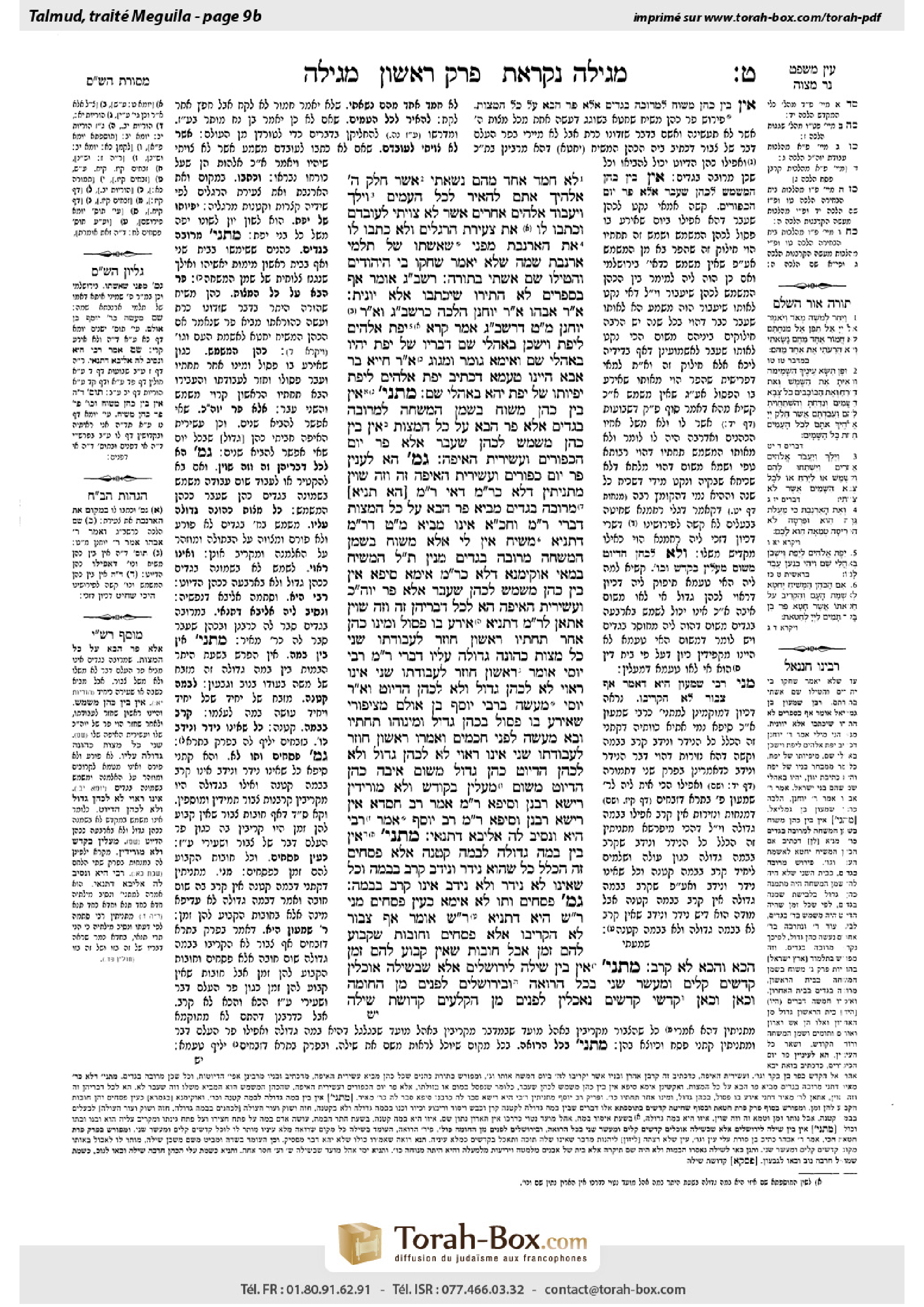
Megillah 9b: Talmud study for Daf Yomi
Daf Yomi is the daily study of one Talmud folio. Explore 37 tractates with scans, Hebrew text, Sefaria English and AI-generated French translations where annotated.
Passage selection and English or AI-generated French translation are available where the scan has annotations. Daf Study is independent of Torah-Box and Sefaria.
Browse Megillah · מגילה · All tractatesMegillah 9b text and translations
This page of Megillah includes the Aramaic text, an English translation and an AI-generated French translation, alongside the scan above.
מגילה ט׳ ב · Aramaic and Hebrew text
״לֹא חֶמֶד אֶחָד מֵהֶם נָשָׂאתִי״. ״אֲשֶׁר חָלַק ה׳ אֱלֹהֶיךָ אֹתָם לְהָאִיר לְכׇל הָעַמִּים״.
״וַיֵּלֶךְ וַיַּעֲבוֹד אֱלֹהִים אֲחֵרִים אֲשֶׁר לֹא צִוִּיתִי לְעוֹבְדָם״.
וְכָתְבוּ לוֹ: ״אֶת צְעִירַת הָרַגְלַיִם״, וְלֹא כָּתְבוּ לוֹ ״אֶת הָאַרְנֶבֶת״, מִפְּנֵי שֶׁאִשְׁתּוֹ שֶׁל תַּלְמַי אַרְנֶבֶת שְׁמָהּ, שֶׁלֹּא יֹאמַר שָׂחֲקוּ בִּי הַיְּהוּדִים וְהֵטִילוּ שֵׁם אִשְׁתִּי בַּתּוֹרָה.
רַבָּן שִׁמְעוֹן בֶּן גַּמְלִיאֵל אוֹמֵר: אַף בַּסְּפָרִים לֹא הִתִּירוּ שֶׁיִּכָּתְבוּ אֶלָּא יְוָנִית. אָמַר רַבִּי אֲבָהוּ אָמַר רַבִּי יוֹחָנָן: הֲלָכָה כְּרַבָּן שִׁמְעוֹן בֶּן גַּמְלִיאֵל. וְאָמַר רַבִּי יוֹחָנָן: מַאי טַעְמָא דְּרַבָּן שִׁמְעוֹן בֶּן גַּמְלִיאֵל, אָמַר קְרָא: ״יַפְתְּ אֱלֹהִים לְיֶפֶת וְיִשְׁכֹּן בְּאׇהֳלֵי שֵׁם״, דְּבָרָיו שֶׁל יֶפֶת יִהְיוּ בְּאׇהֳלֵי שֵׁם.
וְאֵימָא גּוֹמֶר וּמָגוֹג? אָמַר רַבִּי חִיָּיא בַּר אַבָּא: הַיְינוּ טַעְמָא, דִּכְתִיב: ״יַפְתְּ אֱלֹהִים לְיֶפֶת״, יַפְיוּתוֹ שֶׁל יֶפֶת יְהֵא בְּאׇהֳלֵי שֵׁם.
מַתְנִי׳ אֵין בֵּין כֹּהֵן מָשׁוּחַ בְּשֶׁמֶן הַמִּשְׁחָה לִמְרוּבֵּה בְגָדִים אֶלָּא פַּר הַבָּא עַל כׇּל הַמִּצְוֹת.
אֵין בֵּין כֹּהֵן מְשַׁמֵּשׁ לְכֹהֵן שֶׁעָבַר אֶלָּא פַּר יוֹם הַכִּפּוּרִים וַעֲשִׂירִית הָאֵיפָה.
גְּמָ׳ הָא לְעִנְיַן פַּר יוֹם כִּפּוּרִים וַעֲשִׂירִית הָאֵיפָה — זֶה וָזֶה שָׁוִין.
מַתְנִיתִין דְּלָא כְּרַבִּי מֵאִיר, דְּאִי רַבִּי מֵאִיר, [הָא תַּנְיָא]: מְרוּבֵּה בְגָדִים מֵבִיא פַּר הַבָּא עַל כׇּל הַמִּצְוֹת, דִּבְרֵי רַבִּי מֵאִיר, וַחֲכָמִים אוֹמְרִים: אֵינוֹ מֵבִיא.
מַאי טַעְמֵיהּ דְּרַבִּי מֵאִיר — דְּתַנְיָא: ״מָשִׁיחַ״, אֵין לִי אֶלָּא מָשׁוּחַ בְּשֶׁמֶן הַמִּשְׁחָה, מְרוּבֵּה בְגָדִים מִנַּיִן? תַּלְמוּד לוֹמַר: ״הַמָּשִׁיחַ״.
בְּמַאי אוֹקֵימְנָא — דְּלָא כְּרַבִּי מֵאִיר. אֵימָא סֵיפָא: אֵין בֵּין כֹּהֵן מְשַׁמֵּשׁ לְכֹהֵן שֶׁעָבַר אֶלָּא פַּר יוֹם הַכִּפּוּרִים וַעֲשִׂירִית הָאֵיפָה. הָא לְכׇל דִּבְרֵיהֶן — זֶה וָזֶה שָׁוִין, אֲתָאן לְרַבִּי מֵאִיר, דְּתַנְיָא: אֵירַע בּוֹ פְּסוּל וּמִינּוּ כֹּהֵן אַחֵר תַּחְתָּיו, רִאשׁוֹן — חוֹזֵר לַעֲבוֹדָתוֹ, שֵׁנִי — כׇּל מִצְוֹת כְּהוּנָּה גְּדוֹלָה עָלָיו, דִּבְרֵי רַבִּי מֵאִיר. רַבִּי יוֹסֵי אוֹמֵר: רִאשׁוֹן — חוֹזֵר לַעֲבוֹדָתוֹ, שֵׁנִי — אֵינוֹ רָאוּי לֹא לְכֹהֵן גָּדוֹל וְלֹא לְכֹהֵן הֶדְיוֹט.
וְאָמַר רַבִּי יוֹסֵי: מַעֲשֶׂה בְּרַבִּי יוֹסֵף בֶּן אִלֵּם מִצִּיפּוֹרִי שֶׁאֵירַע בּוֹ פְּסוּל בְּכֹהֵן גָּדוֹל וּמִינּוּהוּ תַּחְתָּיו, וּבָא מַעֲשֶׂה לִפְנֵי חֲכָמִים, וְאָמְרוּ: רִאשׁוֹן — חוֹזֵר לַעֲבוֹדָתוֹ, שֵׁנִי — אֵינוֹ רָאוּי לֹא לְכֹהֵן גָּדוֹל וְלֹא לְכֹהֵן הֶדְיוֹט.
כֹּהֵן גָּדוֹל — מִשּׁוּם אֵיבָה, כֹּהֵן הֶדְיוֹט — מִשּׁוּם מַעֲלִין בַּקּוֹדֶשׁ וְלֹא מוֹרִידִין. רֵישָׁא רַבָּנַן, וְסֵיפָא רַבִּי מֵאִיר!
אָמַר רַב חִסְדָּא, אִין: רֵישָׁא רַבָּנַן וְסֵיפָא רַבִּי מֵאִיר. רַב יוֹסֵף אָמַר: רַבִּי הִיא, וְנָסֵיב לַהּ אַלִּיבָּא דְתַנָּאֵי.
מַתְנִי׳ אֵין בֵּין בָּמָה גְּדוֹלָה לַבָּמָה קְטַנָּה אֶלָּא פְּסָחִים. זֶה הַכְּלָל: כֹּל שֶׁהוּא נִידָּר וְנִידָּב — קָרֵב בְּבָמָה, וְכֹל שֶׁאֵינוֹ לֹא נִידָּר וְלֹא נִידָּב — אֵינוֹ קָרֵב בְּבָמָה.
גְּמָ׳ פְּסָחִים וְתוּ לָא? אֵימָא כְּעֵין פְּסָחִים.
מַנִּי — רַבִּי שִׁמְעוֹן הִיא. דְּתַנְיָא, רַבִּי שִׁמְעוֹן אוֹמֵר: אַף צִבּוּר לֹא הִקְרִיבוּ אֶלָּא פְּסָחִים וְחוֹבוֹת שֶׁקָּבוּעַ לָהֶם זְמַן, אֲבָל חוֹבוֹת שֶׁאֵין קָבוּעַ לָהֶם זְמַן — הָכָא וְהָכָא לָא קְרוּב.
מַתְנִי׳ אֵין בֵּין שִׁילֹה לִירוּשָׁלַיִם, אֶלָּא שֶׁבְּשִׁילֹה אוֹכְלִין קָדָשִׁים קַלִּים וּמַעֲשֵׂר שֵׁנִי בְּכׇל הָרוֹאֶה, וּבִירוּשָׁלַיִם לִפְנִים מִן הַחוֹמָה.
וְכָאן וְכָאן, קׇדְשֵׁי קֳדָשִׁים נֶאֱכָלִין לִפְנִים מִן הַקְּלָעִים. קְדוּשַּׁת שִׁילֹה —
Megillah 9b · English translation
Instead of Moses’ assertion: “I have not taken one donkey [ḥamor] from them” (Numbers 16:15), they wrote in more general terms: “I have not taken one item of value [ḥemed] from them,” to prevent the impression that Moses took other items. To the verse that discusses the worship of the sun and the moon, about which it is written: “Which the Lord your God has allotted to all the nations” (Deuteronomy 4:19), they added a word to make it read: “Which the Lord your God has allotted to give light to all the nations,” to prevent the potential misinterpretation that the heavenly bodies were given to the gentiles so that they may worship them.
The verse: “And has gone and served other gods, and worshipped them, either the sun, or the moon, or any of the host of heaven, which I have not commanded” (Deuteronomy 17:3), could be understood as indicating that God did not command their existence, i.e., these entities created themselves. Therefore, when these Elders translated the verse they added a word to the end of the verse to make it read: Which I have not commanded to serve them.
And in the list of unclean animals they wrote for him: The short-legged beast [tze’irat haraglayim]. And they did not write for him: “And the hare [arnevet]” (Leviticus 11:6), since the name of Ptolemy’s wife was Arnevet, so that he would not say: The Jews have mocked me and inserted my wife’s name in the Torah. Therefore, they did not refer to the hare by name, but by one of its characteristic features.
The mishna cites that Rabban Shimon ben Gamliel says: Even with regard to Torah scrolls, the Sages permitted them to be written only in Greek. Rabbi Abbahu said that Rabbi Yoḥanan said: The halakha is in accordance with the opinion of Rabban Shimon ben Gamliel. And Rabbi Yoḥanan said: What is the reason for the opinion of Rabban Shimon ben Gamliel? He based his opinion on an allusion in the Torah, as the verse states: “God shall enlarge Japheth, and He shall dwell in the tents of Shem” (Genesis 9:27), indicating that the words of Japheth shall be in the tents of Shem. The language of Javan, who is the forbear of the Greek nation and one of the descendants of Japheth, will also serve as a sacred language in the tents of Shem, where Torah is studied.
The Gemara asks: And say that it is the languages of Gomer and Magog that serve as sacred languages, as they too were descendants of Japheth (see Genesis 10:2). The Gemara answers that Rabbi Ḥiyya bar Abba said: This is the reason, as it is written: “God shall enlarge [yaft] Japheth [Yefet].” Yaft is etymologically similar to the Hebrew term for beauty [yofi]. The verse teaches that the beauty of Japheth shall be in the tents of Shem, and Greek is the most beautiful of the languages of the descendants of Japheth.
MISHNA: The difference between a High Priest anointed with the oil of anointing, which was the method through which High Priests were consecrated until the oil was sequestered toward the end of the First Temple period, and one consecrated by donning multiple garments unique to the High Priest, which was the practice during the Second Temple period, is only that the latter does not bring the bull that comes for transgression of any of the mitzvot. An anointed High Priest who unwittingly issued an erroneous halakhic ruling and acted upon that ruling, and transgressed a mitzva whose unwitting violation renders one liable to bring a sin-offering, is obligated to bring a sin-offering unique to one in his position.
The difference between a High Priest currently serving in that capacity and a former High Priest, who temporarily filled that position when the High Priest was unfit for service, is only with regard to the bull brought by the High Priest on Yom Kippur, and the tenth of an ephah meal-offering brought daily by the High Priest. Each of these offerings is brought only by the current High Priest, and not by a former High Priest.
GEMARA: The Gemara infers that with regard to the matter of the bull brought by the High Priest on Yom Kippur, and with regard to the tenth of an ephah meal-offering, both this, the anointed High Priest, and that, the High Priest consecrated by donning multiple garments, are equal.
The Gemara comments: The mishna is not in accordance with the opinion of Rabbi Meir, as if it were in accordance with the opinion of Rabbi Meir, it would be difficult. Isn’t it taught in a baraita: A High Priest consecrated by donning the multiple garments unique to the High Priest brings the bull brought for the unwitting violation of any of the mitzvot; this is the statement of Rabbi Meir. And the Rabbis say: He does not bring that offering.
The Gemara asks: What is the reason for the opinion of Rabbi Meir? It is as it is taught in a baraita that it is written: “If the anointed priest shall sin” (Leviticus 4:3). From the word anointed, I have derived only that this halakha applies to a High Priest who was actually anointed with the oil of anointing. From where do I derive that even a High Priest consecrated by donning the multiple garments is also included in this halakha? The verse states: “The anointed,” with the definite article, indicating that the halakha applies to every High Priest.
The Gemara asks: How did we establish the mishna? We established that it is not in accordance with the opinion of Rabbi Meir. Say the latter clause of the mishna: The difference between a High Priest currently serving in that capacity and a former High Priest is only with regard to the bull brought on Yom Kippur, and the tenth of an ephah meal-offering. The Gemara infers that with regard to all other matters, both this, a High Priest currently serving, and that, a former High Priest, are equal. If so we have arrived at the opinion of Rabbi Meir, as it is taught in a baraita: If temporary disqualification befell the High Priest, and they appointed another priest in his stead, then after the cause of disqualification of the first priest passes, he returns to his service as High Priest. With regard to the second priest, all of the mitzvot of the High Priest are incumbent upon him; this is the statement of Rabbi Meir. Rabbi Yosei says: The first returns to his service; the second is fit to serve neither as a High Priest nor as a common priest.
And Rabbi Yosei said: There was an incident involving the priest Rabbi Yosef ben Elem of Tzippori, who, when disqualification befell a High Priest, the priests appointed him in his stead. And after the cause of the disqualification was resolved, the incident came before the Sages for a ruling with regard to the status of Rabbi Yosef ben Elem. And the Sages said: The original High Priest returns to his service, while the second is fit to serve neither as High Priest nor as a common priest.
The Gemara explains: Neither as a High Priest, due to hatred, jealousy, and bitterness that would arise if there were two High Priests with equal standing in the Temple; nor as a common priest, because the principle is: One elevates to a higher level in matters of sanctity and one does not downgrade. Once he has served as a High Priest he cannot be restored to the position of a common priest. Is that to say that the first clause of the mishna is in accordance with the opinion of the Rabbis, who disagree with Rabbi Meir, and the latter clause is in accordance with the opinion of Rabbi Meir?
Rav Ḥisda said: Indeed, the first clause of the mishna is in accordance with the opinion of the Rabbis, and the latter clause is in accordance with the opinion of Rabbi Meir. Rav Yosef said: The entire mishna is according to Rabbi Yehuda HaNasi, and he formulates it according to the opinions of different tanna’im, that is to say, resulting in a third opinion, in accordance with the opinion of the Rabbis with regard to a High Priest consecrated by donning multiple garments, and the opinion of Rabbi Meir with regard to a former High Priest.
MISHNA: The difference between a great, public altar, such as the altars established at Nob and Gibeon, which served as religious centers following the destruction of the Tabernacle in Shiloh, and a small, personal altar on which individuals would sacrifice their offerings, is only with regard to Paschal lambs, which may not be sacrificed on a small altar. This is the principle: Any offering that is vowed or contributed voluntarily is sacrificed on a small altar, and any offering that is neither vowed nor contributed voluntarily, but rather is compulsory, e.g., a sin-offering, is not sacrificed on a small altar.
GEMARA: The Gemara asks: Is the difference only Paschal lambs and nothing more? The continuation of the mishna indicates that there are additional differences. The Gemara answers: Say that the difference between them is only with regard to offerings that are similar to Paschal lambs.
The Gemara asks: According to whose opinion is the mishna taught? The Gemara answers: It is according to the opinion of Rabbi Shimon, as it is taught in a baraita that Rabbi Shimon says: Even the public sacrificed only Paschal lambs and compulsory offerings for which there is a set time, like fixed communal offerings. However, compulsory offerings for which there is not a set time, e.g., sin-offerings brought for an unwitting transgression committed by the community, are sacrificed neither here on a small altar nor here on a great altar; they are sacrificed only in the Temple.
MISHNA: The difference between the Tabernacle in Shilo and the Temple in Jerusalem is only that in Shiloh one eats offerings of lesser sanctity, e.g., individual peace-offerings, thanks-offerings, and the Paschal lamb, and also the second tithe, in any place that overlooks Shiloh, as Shiloh was not a walled city and any place within its Shabbat boundary was regarded as part of the city. And in Jerusalem one eats those consecrated items only within the walls.
And here, in Shiloh, and there, in Jerusalem, offerings of the most sacred order are eaten only within the hangings. The Tabernacle courtyard in Shiloh was surrounded by hangings and the Temple courtyard in Jerusalem was surrounded by a wall. There is another difference: With regard to the sanctity of Shiloh,
Megillah 9b · Traduction française (IA)
Au lieu de l’affirmation de Moïse : « Je ne leur ai pas pris un seul âne [ḥamor] » (Nombres 16:15), ils écrivirent en termes plus généraux : « Je ne leur ai pris aucun objet de valeur [ḥemed] », afin d’éviter de donner l’impression que Moïse leur avait pris d’autres biens. Pour le verset qui traite du culte du soleil et de la lune, où il est écrit : « que le Seigneur ton Dieu a attribués à tous les peuples » (Deutéronome 4:19), ils ajoutèrent un mot pour obtenir : « que le Seigneur ton Dieu a attribués pour éclairer tous les peuples », afin d’éviter que le texte puisse être mal interprété comme signifiant que les astres avaient été donnés aux nations pour qu’elles les adorent.
Le verset : « Il est allé servir d’autres dieux et se prosterner devant eux, devant le soleil, la lune ou toute l’armée du ciel, ce que je n’ai pas ordonné » (Deutéronome 17:3), pourrait être compris comme indiquant que Dieu n’a pas ordonné leur existence, c’est-à-dire que ces entités se seraient créées elles-mêmes. C’est pourquoi, lorsqu’ils traduisirent le verset, ces Anciens ajoutèrent un mot à la fin, de sorte qu’il se lise : « ce que je n’ai pas ordonné d’adorer ».
Et dans la liste des animaux impurs, ils écrivirent pour lui : « la bête aux pattes courtes [tze’irat haraglayim] ». Ils ne lui écrivirent pas : « Et le lièvre [arnevet] » (Lévitique 11:6), car l’épouse de Ptolémée s’appelait Arnevet ; ainsi, il n’aurait pas dit : « Les Juifs se sont moqués de moi et ont inséré le nom de mon épouse dans la Torah. » Ils ne désignèrent donc pas le lièvre par son nom, mais par l’une de ses caractéristiques.
La Michna rapporte que Rabban Shimon ben Gamliel dit : Même les rouleaux de la Torah, les Sages n’ont permis de les écrire qu’en grec. Rabbi Abbahou dit au nom de Rabbi Yoḥanan : La halakha suit l’avis de Rabban Shimon ben Gamliel. Et Rabbi Yoḥanan dit : Quelle est la raison de l’avis de Rabban Shimon ben Gamliel ? Il fonde son avis sur une allusion dans la Torah, car le verset dit : « Que Dieu élargisse Japhet et qu’il réside dans les tentes de Sem » (Genèse 9:27), ce qui indique que les paroles de Japhet se trouveront dans les tentes de Sem. La langue de Javan, ancêtre de la nation grecque et descendant de Japhet, servira elle aussi de langue sacrée dans les tentes de Sem, où l’on étudie la Torah.
La Guemara demande : Ne pourrait-on pas dire que ce sont les langues de Gomer et de Magog qui servent de langues sacrées, puisqu’eux aussi descendaient de Japhet (voir Genèse 10:2) ? La Guemara répond que Rabbi Ḥiyya bar Abba a dit : La raison est la suivante, comme il est écrit : « Que Dieu élargisse [yaft] Japhet [Yefet]. » Yaft est étymologiquement apparenté au terme hébreu désignant la beauté [yofi]. Le verset enseigne que la beauté de Japhet se trouvera dans les tentes de Sem, et le grec est la plus belle des langues des descendants de Japhet.
Michna : La différence entre un grand prêtre oint avec l’huile d’onction — méthode par laquelle les grands prêtres étaient consacrés jusqu’à ce que l’huile soit mise à l’abri vers la fin de la période du Premier Temple — et un grand prêtre consacré par le port de plusieurs vêtements propres au grand prêtre — pratique en vigueur durant la période du Second Temple — tient uniquement au fait que ce dernier n’apporte pas le taureau prévu pour la transgression de l’une quelconque des mitsvot. Un grand prêtre oint qui a rendu involontairement une décision halakhique erronée, l’a mise en pratique et a ainsi transgressé une mitsva dont la violation involontaire rend passible d’un sacrifice expiatoire, est tenu d’apporter le sacrifice expiatoire propre à une personne de sa fonction.
La différence entre un grand prêtre qui exerce actuellement cette fonction et un ancien grand prêtre, qui a occupé temporairement cette fonction lorsque le grand prêtre était inapte au service, tient uniquement au taureau apporté par le grand prêtre à Yom Kippour et à l’offrande de farine quotidienne d’un dixième d’épha apportée par le grand prêtre. Chacune de ces offrandes est apportée uniquement par le grand prêtre en fonction, et non par un ancien grand prêtre.
Guemara : La Guemara déduit que, pour ce qui est du taureau apporté par le grand prêtre à Yom Kippour et de l’offrande de farine d’un dixième d’épha, celui-ci, le grand prêtre oint, et celui-là, le grand prêtre consacré par le port de plusieurs vêtements, sont égaux.
La Guemara fait remarquer : La Michna ne suit pas l’avis de Rabbi Meïr, car si elle suivait son avis, une difficulté se poserait. N’est-il pas enseigné dans une baraïta : Un grand prêtre consacré par le port de plusieurs vêtements propres au grand prêtre apporte le taureau prévu pour la transgression involontaire de l’une quelconque des mitsvot ; telle est la parole de Rabbi Meïr. Et les Sages disent : Il n’apporte pas cette offrande.
La Guemara demande : Quelle est la raison de l’avis de Rabbi Meïr ? Elle est exposée dans une baraïta : il est écrit : « Si le prêtre oint commet une faute » (Lévitique 4:3). Du mot « oint », j’ai seulement appris que cette halakha s’applique à un grand prêtre qui a effectivement été oint avec l’huile d’onction. D’où déduis-je qu’un grand prêtre consacré par le port de plusieurs vêtements est lui aussi inclus dans cette halakha ? Le verset dit : « le prêtre oint », avec l’article défini, ce qui indique que la halakha s’applique à tout grand prêtre.
La Guemara demande : Comment avons-nous établi la Michna ? Nous avons établi qu’elle ne suit pas l’avis de Rabbi Meïr. Examinons la dernière partie de la Michna : La différence entre un grand prêtre en fonction et un ancien grand prêtre tient uniquement au taureau apporté à Yom Kippour et à l’offrande de farine d’un dixième d’épha. La Guemara en déduit que, pour toutes les autres questions, celui-ci, le grand prêtre en fonction, et celui-là, l’ancien grand prêtre, sont égaux. Si tel est le cas, nous en arrivons à l’avis de Rabbi Meïr, car il est enseigné dans une baraïta : Si le grand prêtre est frappé d’une incapacité temporaire et qu’on nomme un autre prêtre à sa place, lorsque la cause de l’incapacité du premier prêtre disparaît, celui-ci reprend son service de grand prêtre. Quant au second prêtre, toutes les mitsvot du grand prêtre lui incombent ; telle est la parole de Rabbi Meïr. Rabbi Yossei dit : Le premier reprend son service ; le second n’est apte à servir ni comme grand prêtre ni comme prêtre ordinaire.
Et Rabbi Yossei dit : Un incident s’est produit avec le prêtre Rabbi Yosef ben Elem de Tzippori : lorsqu’un grand prêtre fut frappé d’incapacité, les prêtres le nommèrent à sa place. Une fois la cause de l’incapacité résolue, l’affaire fut soumise aux Sages afin qu’ils statuent sur le statut de Rabbi Yosef ben Elem. Les Sages dirent : Le grand prêtre initial reprend son service, tandis que le second n’est apte à servir ni comme grand prêtre ni comme prêtre ordinaire.
La Guemara explique : Il n’est apte ni à servir comme grand prêtre, en raison de la haine, de la jalousie et de l’amertume qui naîtraient si deux grands prêtres avaient un statut égal dans le Temple ; ni comme prêtre ordinaire, car le principe est le suivant : dans les questions de sainteté, on élève à un degré supérieur et l’on ne rétrograde pas. Dès lors qu’il a servi comme grand prêtre, il ne peut pas être rétabli dans la fonction de prêtre ordinaire. Faut-il en conclure que la première partie de la Michna suit l’avis des Sages, qui sont en désaccord avec Rabbi Meïr, tandis que la dernière partie suit l’avis de Rabbi Meïr ?
Rav Ḥisda dit : En effet, la première partie de la Michna suit l’avis des Sages, tandis que la dernière partie suit l’avis de Rabbi Meïr. Rav Yosef dit : La Michna entière suit l’avis de Rabbi Yehouda HaNassi, qui la formule selon les avis de différents tannaïm, ce qui revient à énoncer un troisième avis : celui des Sages concernant le grand prêtre consacré par le port de plusieurs vêtements, et celui de Rabbi Meïr concernant un ancien grand prêtre.
Michna : La différence entre un grand autel public, tel que les autels établis à Nob et à Gabaon, qui servirent de centres religieux après la destruction du Tabernacle de Shilo, et un petit autel privé, sur lequel les particuliers offraient leurs sacrifices, tient uniquement aux agneaux pascals, qui ne peuvent pas être sacrifiés sur un petit autel. Voici le principe : tout sacrifice qui est voué ou offert volontairement est sacrifié sur un petit autel ; tout sacrifice qui n’est ni voué ni offert volontairement, mais qui est obligatoire, par exemple un sacrifice expiatoire, n’est pas sacrifié sur un petit autel.
Guemara : La Guemara demande : La différence ne concerne-t-elle que les agneaux pascals, et rien d’autre ? La suite de la Michna indique qu’il existe d’autres différences. La Guemara répond : Il faut dire que leur différence concerne uniquement les sacrifices comparables aux agneaux pascals.
La Guemara demande : Selon l’avis de qui la Michna est-elle enseignée ? La Guemara répond : Selon l’avis de Rabbi Shimon, car il est enseigné dans une baraïta que Rabbi Shimon dit : Même la communauté ne sacrifiait que les agneaux pascals et les sacrifices obligatoires dont l’échéance est fixée, comme les sacrifices communautaires périodiques. En revanche, les sacrifices obligatoires dont l’échéance n’est pas fixée, par exemple les sacrifices expiatoires apportés pour une transgression involontaire commise par la communauté, ne sont sacrifiés ni ici, sur un petit autel, ni là, sur un grand autel ; ils ne sont sacrifiés que dans le Temple.
Michna : La différence entre le Tabernacle de Shilo et le Temple de Jérusalem tient uniquement au fait qu’à Shilo, on consomme les sacrifices de moindre sainteté, par exemple les sacrifices de paix individuels, les sacrifices de gratitude et l’agneau pascal, ainsi que la seconde dîme, en tout lieu d’où l’on peut voir Shilo, puisque Shilo n’était pas une ville fortifiée et que tout lieu situé à l’intérieur de son périmètre sabbatique était considéré comme faisant partie de la ville. À Jérusalem, en revanche, on ne consomme ces éléments consacrés qu’à l’intérieur des murailles.
Ici, à Shilo, comme là, à Jérusalem, les sacrifices de sainteté suprême ne sont consommés qu’à l’intérieur des tentures. La cour du Tabernacle de Shilo était entourée de tentures, et la cour du Temple de Jérusalem était entourée d’une muraille. Il existe une autre différence : concernant la sainteté de Shilo,
Traduction française générée par IA à partir de l’édition anglaise de Sefaria. Vérifie toujours un passage avec le texte source.
Text from Sefaria: William Davidson Edition - Vocalized Aramaic (CC BY NC); William Davidson Edition - English (CC BY NC).