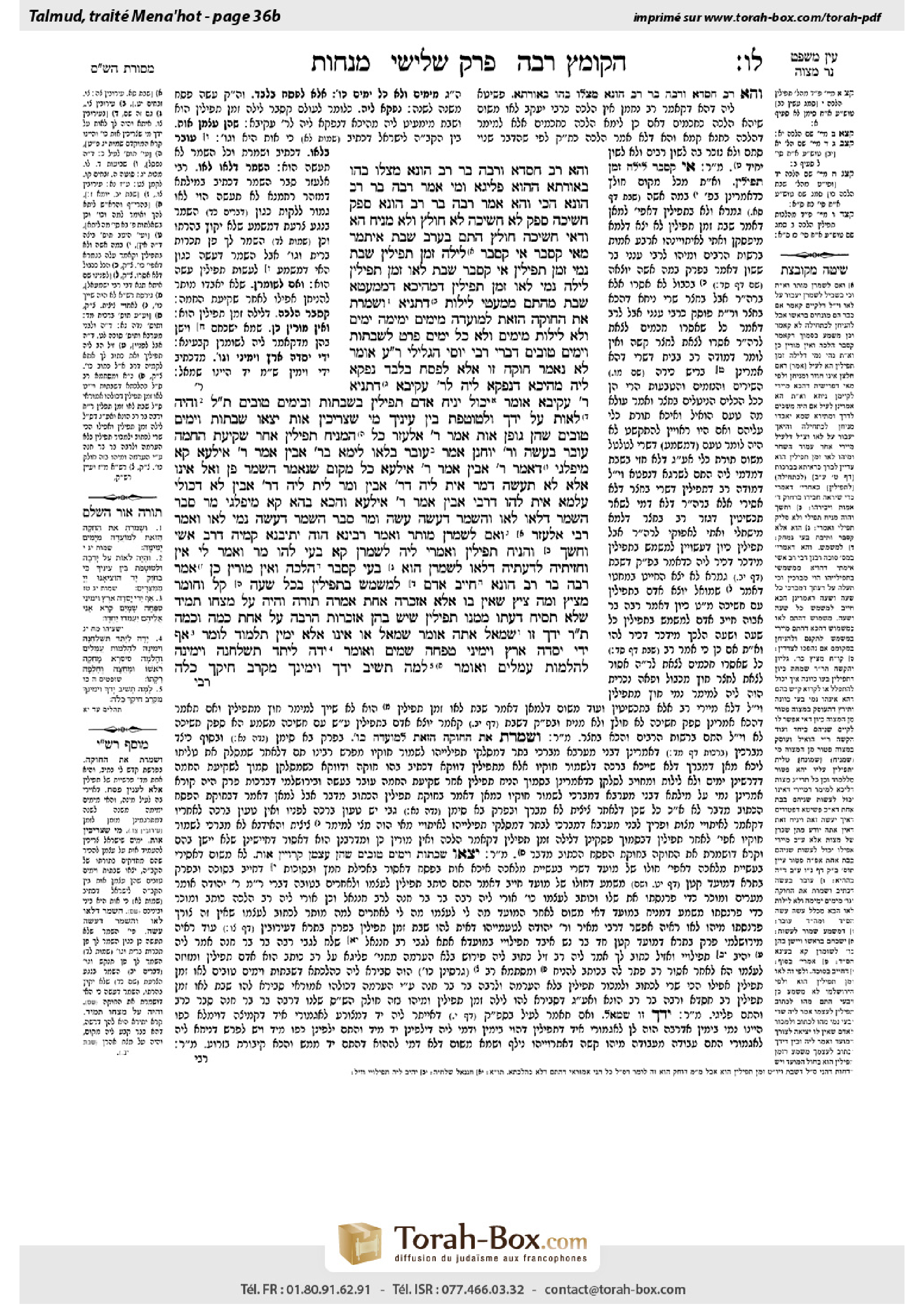
Menachot 36b: Talmud study for Daf Yomi
Daf Yomi is the daily study of one Talmud folio. Explore 37 tractates with scans, Hebrew text, Sefaria English and AI-generated French translations where annotated.
Passage selection and English or AI-generated French translation are available where the scan has annotations. Daf Study is independent of Torah-Box and Sefaria.
Browse Menachot · מנחות · All tractatesMenachot 36b text and translations
This page of Menachot includes the Aramaic text, an English translation and an AI-generated French translation, alongside the scan above.
מנחות ל״ו ב · Aramaic and Hebrew text
וְהָא רַב חִסְדָּא וְרַבָּה בַּר רַב הוּנָא מְצַלּוּ בְּהוּ בְּאוּרְתָּא? הָהוּא פְּלִיגָא.
וּמִי אָמַר רַבָּה בַּר רַב הוּנָא הָכִי? וְהָא אָמַר רַבָּה בַּר רַב הוּנָא: סָפֵק חֲשֵׁיכָה סָפֵק (לָא) [אֵין] חֲשֵׁיכָה – לֹא חוֹלֵץ וְלֹא מַנִּיחַ, הָא וַדַּאי חֲשֵׁיכָה – חוֹלֵץ! הָתָם בְּעֶרֶב שַׁבָּת אִיתְּמַר.
מַאי קָסָבַר? אִי קָסָבַר לַיְלָה זְמַן תְּפִילִּין, שַׁבָּת נָמֵי זְמַן תְּפִילִּין. אִי קָסָבַר שַׁבָּת לָאו זְמַן תְּפִילִּין, לַיְלָה נָמֵי לָאו זְמַן תְּפִילִּין, דְּמֵהֵיכָא דְּמִמַּעֲטָא שַׁבָּת מֵהָתָם מִמַּעֲטִי לֵילוֹת.
דְּתַנְיָא: ״וְשָׁמַרְתָּ אֶת הַחֻקָּה הַזֹּאת לְמוֹעֲדָהּ מִיָּמִים יָמִימָה״ – ״יָמִים״ וְלֹא לֵילוֹת, ״מִיָּמִים״ וְלֹא כׇּל יָמִים, פְּרָט לְשַׁבָּתוֹת וְיָמִים טוֹבִים, דִּבְרֵי רַבִּי יוֹסֵי הַגְּלִילִי. רַבִּי עֲקִיבָא אוֹמֵר: לֹא נֶאֶמְרָה חוּקָּה זוֹ אֶלָּא לְפֶסַח בִּלְבָד.
נָפְקָא לֵיהּ מֵהֵיכָא דְּנָפְקָא לֵיהּ לְרַבִּי עֲקִיבָא, דְּתַנְיָא: רַבִּי עֲקִיבָא אוֹמֵר: יָכוֹל יַנִּיחַ אָדָם תְּפִילִּין בְּשַׁבָּתוֹת וּבְיָמִים טוֹבִים? תַּלְמוּד לוֹמַר: ״וְהָיָה לְאוֹת עַל יָדְךָ וּלְטוֹטָפֹת בֵּין עֵינֶיךָ״ – מִי שֶׁצְּרִיכִין אוֹת, יָצְאוּ שַׁבָּתוֹת וְיָמִים טוֹבִים שֶׁהֵן גּוּפָן אוֹת.
אָמַר רַבִּי אֶלְעָזָר: כׇּל הַמַּנִּיחַ תְּפִילִּין אַחַר שְׁקִיעַת הַחַמָּה עוֹבֵר בַּעֲשֵׂה, וְרַבִּי יוֹחָנָן אָמַר: עוֹבֵר בְּלָאו. לֵימָא בְּרַבִּי אָבִין אָמַר רַבִּי אִילְעָא קָא מִיפַּלְגִי, דְּאָמַר רַבִּי אָבִין אָמַר רַבִּי אִילְעָא: כׇּל מָקוֹם שֶׁנֶּאֱמַר ״הִשָּׁמֶר״ ״פֶּן״ וְ״אַל״ אֵינוֹ אֶלָּא לֹא תַעֲשֶׂה.
דְּמָר אִית לֵיהּ דְּרַבִּי אָבִין, וּמָר לֵית לֵיהּ דְּרַבִּי אָבִין.
לָא, דְּכוּלֵּי עָלְמָא אִית לְהוּ דְּרַבִּי אָבִין אָמַר רַבִּי אִילְעָא, וְהָכָא בְּהָא קָא מִיפַּלְגִי: מָר סָבַר ״הִשָּׁמֶר״ דְּלָאו – לָאו, וְ״הִשָּׁמֶר״ דַּעֲשֵׂה – עֲשֵׂה, וּמָר סָבַר ״הִשָּׁמֶר״ דַּעֲשֵׂה נָמֵי לָאו.
וְאָמַר רַבִּי אֶלְעָזָר: וְאִם לְשׇׁמְרָן – מוּתָּר. וְאָמַר רָבִינָא: הֲוָה יָתֵיבְנָא קַמֵּיהּ דְּרַב אָשֵׁי וְחָשַׁךְ, וְהִנִּיחַ תְּפִילִּין, וַאֲמַרִי לֵיהּ: לְשׇׁמְרָן קָא בָעֵי לְהוּ מָר? וַאֲמַר לִי: אִין. וַחֲזֵיתֵיהּ לְדַעְתֵּיהּ דְּלָאו לְשׇׁמְרָן הוּא בָּעֵי, קָסָבַר: הֲלָכָה וְאֵין מוֹרִין כֵּן.
אָמַר רַבָּה בַּר רַב הוּנָא: חַיָּיב אָדָם לְמַשְׁמֵשׁ בַּתְּפִילִּין בְּכׇל שָׁעָה, קַל וָחוֹמֶר מִצִּיץ, וּמָה צִיץ שֶׁאֵין בּוֹ אֶלָּא אַזְכָּרָה אַחַת, אָמְרָה תּוֹרָה: ״וְהָיָה עַל מִצְחוֹ תָּמִיד״, שֶׁלֹּא (תַּסִּיחַ) [יַסִּיחַ] דַּעְתּוֹ מִמֶּנּוּ, תְּפִילִּין שֶׁיֵּשׁ בָּהֶן אַזְכָּרוֹת הַרְבֵּה, עַל אַחַת כַּמָּה וְכַמָּה!
תָּנוּ רַבָּנַן: ״יָדְךָ״ – זוֹ שְׂמֹאל. אַתָּה אוֹמֵר שְׂמֹאל, אוֹ אֵינוֹ אֶלָּא יָמִין? תַּלְמוּד לוֹמַר: ״אַף יָדִי יָסְדָה אֶרֶץ וִימִינִי טִפְּחָה שָׁמָיִם״, וְאוֹמֵר: ״יָדָהּ לַיָּתֵד תִּשְׁלַחְנָה וִימִינָהּ לְהַלְמוּת עֲמֵלִים״, וְאוֹמֵר: ״לָמָּה תָשִׁיב יָדְךָ וִימִינֶךָ מִקֶּרֶב חֵיקְךָ כַלֵּה״.
Menachot 36b · English translation
The Gemara raises a difficulty: But Rav Ḥisda and Rabba bar Rav Huna would pray in the evening with phylacteries. The Gemara explains: That opinion represented in this incident disagrees with the ruling of Rav Naḥman.
The Gemara asks: And did Rabba bar Rav Huna actually say this, that the mitzva of phylacteries applies at night? But doesn’t Rabba bar Rav Huna say: If it is uncertain whether it is nightfall or whether it is not nightfall, one neither removes his phylacteries, as it is not yet definitely night, nor dons them ab initio. This indicates that if it is definitely nightfall, one removes his phylacteries. The Gemara answers: Rabba bar Rav Huna’s ruling there was stated with regard to Shabbat eve, as one may not don phylacteries on Shabbat, when the mitzva does not apply.
The Gemara raises a difficulty with regard to this answer: What does Rabba bar Rav Huna hold? If he holds that night is a time when one performs the mitzva of wearing phylacteries, then Shabbat is also a time when one performs the mitzva of wearing phylacteries. If he holds that Shabbat is not a time when one performs the mitzva of wearing phylacteries, then night is also not a time when one performs the mitzva of wearing phylacteries. The reason for this statement is that from the source where Shabbat is excluded from the mitzva of phylacteries, nights are excluded from there as well.
As it is taught in a baraita with regard to the end of the passage of the Torah that discusses both the mitzvot of the Paschal offering and phylacteries: “And you shall observe this ordinance in its season from year [miyamim] to year” (Exodus 13:10). This indicates that these mitzvot apply during the days [yamim] but not during the nights. Furthermore, the letter mem, meaning from, in the term: “From year [miyamim],” teaches: These mitzvot apply on some days, but not on all days. This excludes Shabbatot and Festivals, on which phylacteries are not worn. This is the statement of Rabbi Yosei HaGelili. Rabbi Akiva says: This verse, mentioning an ordinance, is stated only with regard to the Paschal offering, and it is not referring to phylacteries at all. Evidently, Rabbi Yosei HaGelili, who says that at night one is exempt from the obligation of donning phylacteries, says that on Shabbat one is exempt as well.
The Gemara answers: Rabba bar Rav Huna derives the exemption from the obligation to don phylacteries on Shabbat from a different source, the source where Rabbi Akiva derives it from, as it is taught in a baraita that Rabbi Akiva says: One might have thought that a person should don phylacteries on Shabbatot and Festivals. To counter this, the verse states: “And it shall be for a sign for you on your arm, and for a remembrance between your eyes, so that God’s law shall be in your mouth; for with a strong arm God brought you out of Egypt” (Exodus 13:9). This teaches that the obligation to don phylacteries applies when the Jewish people require a sign to assert their status as God’s nation, i.e., during the week. This serves to exclude Shabbatot and Festivals, as they themselves are signs of the Jewish people’s status as God’s nation and a remembrance of the exodus from Egypt. Consequently, no further sign is required on these days.
Rabbi Elazar says: Anyone who dons phylacteries after sunset violates a positive mitzva. And Rabbi Yoḥanan says: He violates a prohibition. The Gemara suggests: Let us say that these Sages disagree with regard to the principle that Rabbi Avin says that Rabbi Ile’a says. As Rabbi Avin says that Rabbi Ile’a says: Any place where it is stated in the Torah any of the terms: Observe, or: Lest, or: Do not, this means nothing other than a prohibition, as these are negative terms.
The Gemara explains this suggestion: As this Sage, Rabbi Yoḥanan, is of the opinion that the ruling is in accordance with the opinion of Rabbi Avin, and therefore the verse: “And you shall observe this ordinance in its season from year to year,” from which the exclusion of nights is derived, is a prohibition, as it employs the term “observe.” And that Sage, Rabbi Elazar, is of the opinion that the ruling is not in accordance with the opinion of Rabbi Avin, and therefore the term: “And you shall observe,” is a positive mitzva.
The Gemara counters: No, everyone is of the opinion that the ruling is in accordance with the opinion that Rabbi Avin says that Rabbi Ile’a says, and here they disagree with regard to this: One Sage, Rabbi Elazar, holds that the term “observe” written with regard to a prohibition has the status of a prohibition, whereas that same term “observe” written with regard to a positive mitzva has the status of a positive mitzva, as the Torah is issuing a warning to take special care in the observance of a mitzva. Accordingly, the command with regard to the positive mitzva of phylacteries is a positive mitzva. And one Sage, Rabbi Yoḥanan, holds that the term “observe” written with regard to a positive mitzva is also a prohibition.
And Rabbi Elazar says: And although it is prohibited to don phylacteries at night, if one does so in order to safeguard them from theft and the like, it is permitted. And Ravina said: I was sitting before Rav Ashi and it grew dark, and he donned phylacteries. And I said to him: Does the Master need to safeguard them? And he said to me: Yes. But I saw that his intention in donning them was not that he needed to safeguard them; rather, Rav Ashi holds: This is the halakha, that night is an appropriate time for phylacteries, but a public ruling is not issued to that effect.
Rabba bar Rav Huna says: A person is obligated to touch his phylacteries regularly for the entire time that he is wearing them. This is derived from an a fortiori inference from the frontplate of the High Priest, as follows: And if with regard to the frontplate, which has only one mention of God’s name, the Torah states: “And it should be always upon his forehead” (Exodus 28:38), which means that the High Priest must always be aware that the frontplate is placed on his head and that he should not be distracted from it, then with regard to phylacteries, which have numerous mentions of God’s name, all the more so one must always be aware of them.
§ The Sages taught with regard to the verse: “And it shall be for a sign for you on your arm [yadkha]” (Exodus 13:9), that this is referring to the left arm. Do you say it means the left arm, or is it only the right arm? The verse states: “Even My hand [yadi] has laid the foundation of the earth, and My right hand [vimini] has spread out the heavens” (Isaiah 48:13). And another verse states: “Her hand [yadah] she put to the tent pin, and her right hand [viminah] to the workmen’s hammer” (Judges 5:26), and another verse states: “Why do You withdraw Your hand [yadkha], even Your right hand [viminekha]? Draw it out of Your bosom and consume them” (Psalms 74:11). All these verses employ the term yad with regard to the left hand, and use the term yamin, literally, right, without the term yad, to indicate the right hand.
Menachot 36b · Traduction française (IA)
La Guemara soulève une difficulté : Pourtant, Rav Ḥisda et Rabba bar Rav Huna priaient le soir avec les téfilines. La Guemara explique : l’opinion exprimée dans cet épisode est en désaccord avec la décision de Rav Naḥman.
La Guemara demande : Rabba bar Rav Huna a-t-il vraiment dit cela, à savoir que la mitsva des téfilines s’applique la nuit ? Pourtant, Rabba bar Rav Huna dit : Si l’on ne sait pas si la nuit est tombée ou non, on ne retire pas ses téfilines, puisqu’il n’est pas encore certain que la nuit soit tombée, mais on ne les met pas non plus a priori. Cela indique que si la nuit est certainement tombée, on retire ses téfilines. La Guemara répond : La décision de Rabba bar Rav Huna concernait la veille de Chabbat, car on ne peut pas mettre les téfilines pendant Chabbat, lorsque la mitsva ne s’applique pas.
La Guemara soulève une difficulté concernant cette réponse : Quelle est l’opinion de Rabba bar Rav Huna ? S’il estime que la nuit est un moment où l’on accomplit la mitsva de porter les téfilines, alors Chabbat est également un moment où l’on accomplit cette mitsva. S’il estime que Chabbat n’est pas un moment où l’on accomplit la mitsva de porter les téfilines, alors la nuit n’est pas non plus un moment où l’on accomplit cette mitsva. En effet, la même source qui exclut Chabbat de la mitsva des téfilines en exclut également les nuits.
En effet, il est enseigné dans une baraïta, à propos de la fin du passage de la Torah qui traite à la fois des mitsvot du sacrifice pascal et des téfilines : « Tu observeras cette ordonnance en son temps, d’année [miyamim] en année » (Exode 13:10). Cela indique que ces mitsvot s’appliquent pendant les jours [yamim], mais pas pendant les nuits. De plus, la lettre mem, qui signifie « de », dans le terme « d’année [miyamim] », enseigne que ces mitsvot s’appliquent certains jours, mais pas tous les jours. Cela exclut les Chabbatot et les fêtes, où l’on ne porte pas les téfilines. Telle est l’opinion de Rabbi Yosei HaGelili. Rabbi Akiva dit : Ce verset, qui mentionne une ordonnance, ne concerne que le sacrifice pascal et ne fait aucunement référence aux téfilines. Il apparaît donc que Rabbi Yosei HaGelili, qui dit que l’on est exempté la nuit de l’obligation de mettre les téfilines, dit également que l’on en est exempté le Chabbat.
La Guemara répond : Rabba bar Rav Huna déduit l’exemption de l’obligation de mettre les téfilines le Chabbat d’une autre source, celle dont Rabbi Akiva tire cette exemption. En effet, il est enseigné dans une baraïta que Rabbi Akiva dit : On aurait pu penser qu’une personne doit mettre les téfilines pendant les Chabbatot et les fêtes. Pour écarter cette possibilité, le verset dit : « Ce sera pour toi un signe sur ton bras et un souvenir entre tes yeux, afin que la loi de Dieu soit dans ta bouche ; car c’est avec une main puissante que Dieu t’a fait sortir d’Égypte » (Exode 13:9). Cela enseigne que l’obligation de mettre les téfilines s’applique lorsque le peuple juif a besoin d’un signe attestant qu’il est le peuple de Dieu, c’est-à-dire pendant la semaine. Cela exclut les Chabbatot et les fêtes, car ils sont eux-mêmes des signes attestant que le peuple juif est le peuple de Dieu et un souvenir de la sortie d’Égypte. Par conséquent, aucun autre signe n’est nécessaire ces jours-là.
Rabbi Elazar dit : Quiconque met les téfilines après le coucher du soleil enfreint une mitsva positive. Et Rabbi Yoḥanan dit : Il enfreint une interdiction. La Guemara propose : Peut-on dire que ces Sages sont en désaccord sur le principe énoncé par Rabbi Avin au nom de Rabbi Ile’a ? Car Rabbi Avin dit au nom de Rabbi Ile’a : Partout où la Torah emploie l’un des termes « observe », « de peur que » ou « ne… pas », cela exprime nécessairement une interdiction, car ce sont des termes négatifs.
La Guemara explique cette proposition : Ce Sage, Rabbi Yoḥanan, estime que la décision suit l’opinion de Rabbi Avin ; par conséquent, le verset « Tu observeras cette ordonnance en son temps, d’année en année », dont on déduit l’exclusion des nuits, exprime une interdiction, puisqu’il emploie le terme « observer ». Et cet autre Sage, Rabbi Elazar, estime que la décision ne suit pas l’opinion de Rabbi Avin ; par conséquent, le terme « tu observeras » exprime une mitsva positive.
La Guemara objecte : Non, tous estiment que la décision suit l’opinion énoncée par Rabbi Avin au nom de Rabbi Ile’a, et leur désaccord porte sur ceci : un Sage, Rabbi Elazar, estime que le terme « observer », lorsqu’il est écrit à propos d’une interdiction, a le statut d’une interdiction, tandis que ce même terme, lorsqu’il est écrit à propos d’une mitsva positive, a le statut d’une mitsva positive, car la Torah ordonne ainsi de veiller particulièrement à l’accomplissement d’une mitsva. En conséquence, le commandement relatif à la mitsva des téfilines est une mitsva positive. L’autre Sage, Rabbi Yoḥanan, estime que le terme « observer », même lorsqu’il est écrit à propos d’une mitsva positive, exprime également une interdiction.
Et Rabbi Elazar dit : Bien qu’il soit interdit de mettre les téfilines la nuit, si on le fait afin de les protéger contre le vol ou contre un autre risque de ce genre, cela est permis. Ravina dit : J’étais assis devant Rav Ashi ; la nuit tomba et il mit les téfilines. Je lui dis : Le Maître a-t-il besoin de les protéger ? Il me répondit : Oui. Mais je vis que son intention en les mettant n’était pas de les protéger ; Rav Ashi estime plutôt que telle est la halakha : la nuit est un moment approprié pour les téfilines, mais on ne rend pas de décision publique en ce sens.
Rabba bar Rav Huna dit : Une personne est tenue de toucher régulièrement ses téfilines pendant tout le temps où elle les porte. On le déduit par raisonnement a fortiori de la plaque frontale du Grand Prêtre, comme suit : si, pour la plaque frontale, qui ne comporte qu’une seule mention du nom de Dieu, la Torah dit : « Il sera constamment sur son front » (Exode 28:38), ce qui signifie que le Grand Prêtre doit toujours savoir que la plaque est posée sur sa tête et ne pas s’en laisser distraire, alors, à plus forte raison, pour les téfilines, qui comportent de nombreuses mentions du nom de Dieu, doit-on toujours en être conscient.
§ Les Sages ont enseigné au sujet du verset : « Ce sera pour toi un signe sur ton bras [yadkha] » (Exode 13:9), qu’il s’agit du bras gauche. Dis-tu que cela désigne le bras gauche, ou bien s’agit-il uniquement du bras droit ? Le verset dit : « Ma main [yadi] aussi a posé les fondations de la terre, et ma droite [vimini] a déployé les cieux » (Isaïe 48:13). Un autre verset dit : « Sa main [yadah] a saisi le piquet, et sa droite [viminah] le marteau des ouvriers » (Juges 5:26). Et un autre verset dit : « Pourquoi retires-tu ta main [yadkha], ta droite même [viminekha] ? Sors-la de ton sein et consume-les » (Psaumes 74:11). Tous ces versets emploient le terme yad à propos de la main gauche, et le terme yamin, littéralement « droite », sans le terme yad, pour désigner la main droite.
Traduction française générée par IA à partir de l’édition anglaise de Sefaria. Vérifie toujours un passage avec le texte source.
Text from Sefaria: William Davidson Edition - Vocalized Aramaic (unknown); William Davidson Edition - English (CC BY NC).