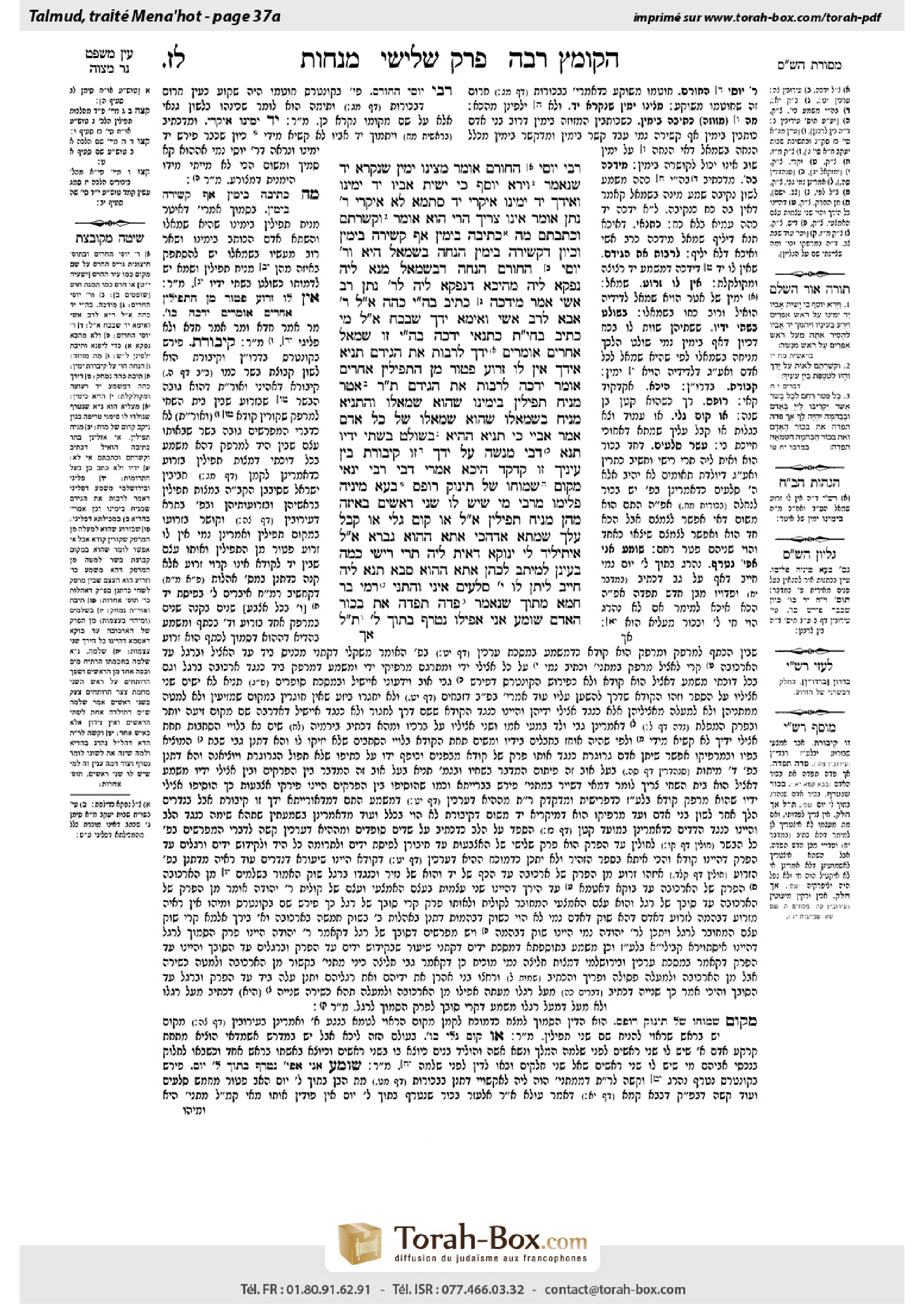
Menachot 37a: Talmud study for Daf Yomi
Daf Yomi is the daily study of one Talmud folio. Explore 37 tractates with scans, Hebrew text, Sefaria English and AI-generated French translations where annotated.
Passage selection and English or AI-generated French translation are available where the scan has annotations. Daf Study is independent of Torah-Box and Sefaria.
Browse Menachot · מנחות · All tractatesMenachot 37a text and translations
This page of Menachot includes the Aramaic text, an English translation and an AI-generated French translation, alongside the scan above.
מנחות ל״ז א · Aramaic and Hebrew text
רַבִּי יוֹסֵי הַחוֹרָם אוֹמֵר: מָצִינוּ יָמִין שֶׁנִּקְרָא יָד, שֶׁנֶּאֱמַר: ״וַיַּרְא יוֹסֵף כִּי יָשִׁית אָבִיו יַד יְמִינוֹ״. וְאִידַּךְ – ״יַד יְמִינוֹ״ אִיקְּרִי, ״יָד״ סְתָמָא לָא אִיקְּרִי.
רַבִּי נָתָן אוֹמֵר: אֵינוֹ צָרִיךְ, הֲרֵי הוּא אוֹמֵר: ״וּקְשַׁרְתָּם״ ״וּכְתַבְתָּם״ – מָה כְּתִיבָה בְּיָמִין, אַף קְשִׁירָה בְּיָמִין, וְכֵיוָן דִּקְשִׁירָה בְּיָמִין – הַנָּחָה בִּשְׂמֹאל הִיא. וְרַבִּי יוֹסֵי הַחוֹרָם, הַנָּחָה דְּבִשְׂמֹאל מְנָא לֵיהּ? נָפְקָא לֵיהּ מֵהֵיכָא דְּנָפְקָא לֵיהּ לְרַבִּי נָתָן.
רַב אָשֵׁי אָמַר: מִ״יָּדְכָה״ כְּתִיב, בְּהֵ״י כֵּהָה. אֲמַר לֵיהּ רַבִּי אַבָּא לְרַב אָשֵׁי: וְאֵימָא ״יָדְךָ״ שֶׁבְּכֹחַ? אֲמַר לֵיהּ: מִי כְּתִיב בְּחֵי״ת?
כְּתַנָּאֵי: ״יָדְכָה״ בְּהֵ״י – זוֹ שְׂמֹאל, אֲחֵרִים אוֹמְרִים: ״יָדְךָ״ לְרַבּוֹת אֶת הַגִּידֵּם. תַּנְיָא אִידַּךְ: אֵין לוֹ זְרוֹעַ – פָּטוּר מִן הַתְּפִילִּין, אֲחֵרִים אוֹמְרִים: ״יָדְכָה״ לְרַבּוֹת אֶת הַגִּידֵּם.
תָּנוּ רַבָּנַן: אִטֵּר מַנִּיחַ תְּפִילִּין בִּימִינוֹ, שֶׁהוּא שְׂמֹאלוֹ. וְהָתַנְיָא: מַנִּיחַ בִּשְׂמֹאלוֹ שֶׁהוּא שְׂמֹאלוֹ שֶׁל כׇּל אָדָם! אֲמַר אַבָּיֵי: כִּי תַּנְיָא הָהִיא בְּשׁוֹלֵט בִּשְׁתֵּי יָדָיו.
תָּנָא דְּבֵי מְנַשֶּׁה: ״עַל יָדְךָ״ – זוֹ קִיבּוֹרֶת, ״בֵּין עֵינֶיךָ״ – זוֹ קׇדְקֹד. הֵיכָא? אָמְרִי דְּבֵי רַבִּי יַנַּאי: מְקוֹם שֶׁמּוֹחוֹ שֶׁל תִּינוֹק רוֹפֵס.
בְּעָא מִינֵּיהּ פְּלֵימוֹ מֵרַבִּי: מִי שֶׁיֵּשׁ לוֹ שְׁנֵי רָאשִׁים, בְּאֵיזֶה מֵהֶן מַנִּיחַ תְּפִילִּין? אֲמַר לֵיהּ: אוֹ קוּם גְּלִי, אוֹ קַבֵּל עֲלָךְ שַׁמְתָּא. אַדְּהָכִי אֲתָא הָהוּא גַּבְרָא, אֲמַר לֵיהּ: אִיתְיְלִיד לִי יָנוֹקָא דְּאִית לֵיהּ תְּרֵי רֵישֵׁי, כַּמָּה בָּעֵינָא לְמִיתַּב לְכֹהֵן? אֲתָא הָהוּא סָבָא תְּנָא לֵיהּ: חַיָּיב לִיתֵּן לוֹ עֲשָׂרָה סְלָעִים.
אִינִי? וְהָתָנֵי רָמֵי בַּר חָמָא: מִתּוֹךְ שֶׁנֶּאֱמַר ״פָּדֹה תִפְדֶּה אֵת בְּכוֹר הָאָדָם״, שׁוֹמֵעַ אֲנִי אֲפִילּוּ נִטְרַף בְּתוֹךְ שְׁלֹשִׁים, תַּלְמוּד לוֹמַר
Menachot 37a · English translation
Rabbi Yosei HaḤorem says: This is no proof, as we have found that the right hand is also called yad, as it is stated: “And when Joseph saw that his father was laying his right hand [yad yemino]” (Genesis 48:17). The Gemara asks: And the other tanna, who maintains that the right hand is not called yad, how does he respond to this proof? He maintains that the right hand is called “his right hand [yad yemino],” but it is not called a yad without further specification.
Rabbi Natan says: This proof is not necessary, as it says: “And you shall bind them for a sign upon your arm” (Deuteronomy 6:8), and then it states: “And you shall write them upon the doorposts of your house” (Deuteronomy 6:9). This teaches that just as writing is with the right hand, as most people write with their right hands, so too, the binding of phylacteries must be performed with the right hand. And since binding is with the right hand, this means that donning is on the left arm, as one cannot bind the phylacteries with the same hand upon which he is donning them. The Gemara asks: And from where does Rabbi Yosei HaḤorem, who holds that the right hand is also called yad in the Torah, derive that donning phylacteries is on the left arm? The Gemara answers: He derives it from where Rabbi Natan derives it.
Rav Ashi said: The requirement that phylacteries be donned on the left arm is derived from the verse: “It shall be for a sign upon your arm [yadkha]” (Exodus 13:16), which is written with a letter heh at the end. This is expounded as though it stated: Your weak [keha] arm. Rabbi Abba said to Rav Ashi: But one can say that yadkha should be interpreted as yadko’aḥ, with a letter ḥet at the end instead of a heh. If so, this would mean: Your arm that is of strength [shebeko’aḥ], which is the right arm. Rav Ashi said to Rabbi Abba: Is this word written with a ḥet?
The Gemara notes that Rav Ashi’s opinion, that the halakha that phylacteries are donned on the left arm is derived from the term yadkha, is subject to a dispute between tanna’im, as it is taught in a baraita: Yadkha is written with a heh, indicating weakness, and this is referring to the left arm. Others say: “Your arm,” i.e., yadkha, serves to include one without a complete arm, i.e., one whose arm ends at the elbow, in the obligation to don phylacteries, as the remaining part is also categorized as a weak arm. It is taught in another baraita: If one does not have a left arm, i.e., not even above the elbow, he is exempt from the mitzva of phylacteries. Others say: Yadkha serves to include one without a left arm even above the elbow, teaching that he must don phylacteries on his right arm.
The Sages taught in a baraita: A left-handed person dons phylacteries on his right arm, which is equivalent to his left arm, i.e., his weaker arm. The Gemara raises a difficulty: But isn’t it taught in a baraita that a left-handed person dons phylacteries on his left arm, which is the left arm of every other person? Abaye said: When that baraita is taught, it is referring to one who has equal control with both his hands, i.e., an ambidextrous person. Since such an individual also uses his right hand, he dons phylacteries on his left arm.
The school of Menashe taught with regard to the verse: “And you shall bind them for a sign on your arm, and they shall be as frontlets between your eyes” (Deuteronomy 6:8): “On your arm”; this is the bicep. “Between your eyes”; this is the crown of the head. The Gemara asks: Where exactly on the crown of the head are the phylacteries placed? The school of Rabbi Yannai say: Phylacteries are placed on the place where the bone above the baby’s brain is soft after birth.
§ The Sage Peleimu raised a dilemma before Rabbi Yehuda HaNasi: In the case of one who has two heads, on which of them does he don phylacteries? Rabbi Yehuda HaNasi said to him: Either get up and exile yourself from here or accept upon yourself excommunication for asking such a ridiculous question. In the meantime, a certain man arrived and said to Rabbi Yehuda HaNasi: A firstborn child has been born to me who has two heads. How much money must I give to the priest for the redemption of the firstborn? A certain elder came and taught him: You are obligated to give him ten sela, the requisite five for each head.
The Gemara asks: Is that so? But Rami bar Ḥama teaches: Since it is stated with regard to the redemption of the firstborn: “The firstborn of man you shall redeem” (Numbers 18:15), I would derive that even if he was ravaged, e.g., by an animal, within thirty days of his birth, one should redeem him. To counter this, the verse states:
Menachot 37a · Traduction française (IA)
Rabbi Yosei HaḤorem dit : Ce n’est pas une preuve, car nous avons constaté que la main droite est également appelée yad, comme il est dit : « Joseph vit que son père posait sa main droite [yad yemino] » (Genèse 48, 17). La Guemara demande : Et l’autre tanna, qui soutient que la main droite n’est pas appelée yad, comment répond-il à cette preuve ? Il soutient que la main droite est appelée « sa main droite [yad yemino] », mais qu’elle n’est pas appelée yad sans autre précision.
Rabbi Natan dit : Cette preuve n’est pas nécessaire, car il est dit : « Tu les attacheras comme un signe sur ton bras » (Deutéronome 6, 8), puis : « Tu les écriras sur les montants de la porte de ta maison » (Deutéronome 6, 9). Cela enseigne que, de même que l’on écrit de la main droite, puisque la plupart des gens écrivent de la main droite, de même l’attache des téfilines doit se faire de la main droite. Et puisque l’on attache les téfilines de la main droite, cela signifie qu’on les met sur le bras gauche, car on ne peut pas les attacher avec la main même sur laquelle on les met. La Guemara demande : Et d’où Rabbi Yosei HaḤorem, qui considère que la main droite est également appelée yad dans la Torah, déduit-il que les téfilines se mettent sur le bras gauche ? La Guemara répond : Il le déduit de la même source que Rabbi Natan.
Rav Ashi dit : L’obligation de mettre les téfilines sur le bras gauche se déduit du verset : « Ce sera un signe sur ton bras [yadkha] » (Exode 13, 16), où le mot est écrit avec un hé à la fin. On l’interprète comme s’il était écrit : ton bras faible [keha]. Rabbi Abba dit à Rav Ashi : Mais on pourrait dire que yadkha s’interprète comme yadko’aḥ, avec un ḥet à la fin au lieu d’un hé. Cela signifierait alors : ton bras puissant [shebeko’aḥ], c’est-à-dire le bras droit. Rav Ashi dit à Rabbi Abba : Ce mot est-il écrit avec un ḥet ?
La Guemara relève que l’opinion de Rav Ashi, selon laquelle la halakha imposant de mettre les téfilines sur le bras gauche se déduit du terme yadkha, fait l’objet d’un désaccord entre tannaïm, comme l’enseigne une baraïta : Yadkha est écrit avec un hé, ce qui indique la faiblesse et désigne le bras gauche. D’autres disent : « Ton bras », c’est-à-dire yadkha, inclut dans l’obligation de mettre les téfilines celui qui n’a pas un bras entier, c’est-à-dire celui dont le bras s’arrête au coude, car la partie restante est également considérée comme un bras faible. Une autre baraïta enseigne : Celui qui n’a pas de bras gauche, pas même au-dessus du coude, est exempt de la mitsva des téfilines. D’autres disent : Yadkha inclut celui qui n’a pas de bras gauche, même au-dessus du coude, et enseigne qu’il doit mettre les téfilines sur son bras droit.
Les Sages enseignent dans une baraïta : Un gaucher met les téfilines sur son bras droit, qui équivaut à son bras gauche, c’est-à-dire à son bras le plus faible. La Guemara soulève une difficulté : Mais n’est-il pas enseigné dans une baraïta qu’un gaucher met les téfilines sur son bras gauche, qui est le bras gauche de toute autre personne ? Abaye dit : Cette baraïta concerne celui qui maîtrise ses deux mains de façon égale, c’est-à-dire une personne ambidextre. Puisqu’un tel individu utilise également sa main droite, il met les téfilines sur son bras gauche.
L’école de Menashe enseignait au sujet du verset : « Tu les attacheras comme un signe sur ton bras, et ils seront comme des frontaux entre tes yeux » (Deutéronome 6, 8) : « Sur ton bras » désigne le biceps. « Entre tes yeux » désigne le sommet de la tête. La Guemara demande : Où exactement, au sommet de la tête, met-on les téfilines ? L’école de Rabbi Yannai dit : Les téfilines se mettent à l’endroit où l’os situé au-dessus du cerveau du nourrisson est mou après la naissance.
§ Le sage Peleimu posa une question à Rabbi Yehuda HaNasi : Dans le cas d’un homme qui a deux têtes, sur laquelle met-il les téfilines ? Rabbi Yehuda HaNasi lui dit : Lève-toi et exile-toi d’ici, ou accepte d’être frappé d’excommunication pour avoir posé une question aussi ridicule. Entre-temps, un certain homme arriva et dit à Rabbi Yehuda HaNasi : Un premier-né vient de naître chez moi, et il a deux têtes. Combien d’argent dois-je donner au prêtre pour le rachat du premier-né ? Un certain ancien vint et lui enseigna : Tu es tenu de lui donner dix sela, soit les cinq requis pour chaque tête.
La Guemara demande : En est-il ainsi ? Mais Rami bar Ḥama enseigne : Puisqu’il est dit au sujet du rachat du premier-né : « Tu rachèteras le premier-né des hommes » (Nombres 18, 15), j’en déduirais que même si, dans les trente jours suivant sa naissance, il a été ravagé, par exemple par un animal, on doit le racheter. Pour écarter cette conclusion, le verset dit :
Traduction française générée par IA à partir de l’édition anglaise de Sefaria. Vérifie toujours un passage avec le texte source.
Text from Sefaria: William Davidson Edition - Vocalized Aramaic (unknown); William Davidson Edition - English (CC BY NC).