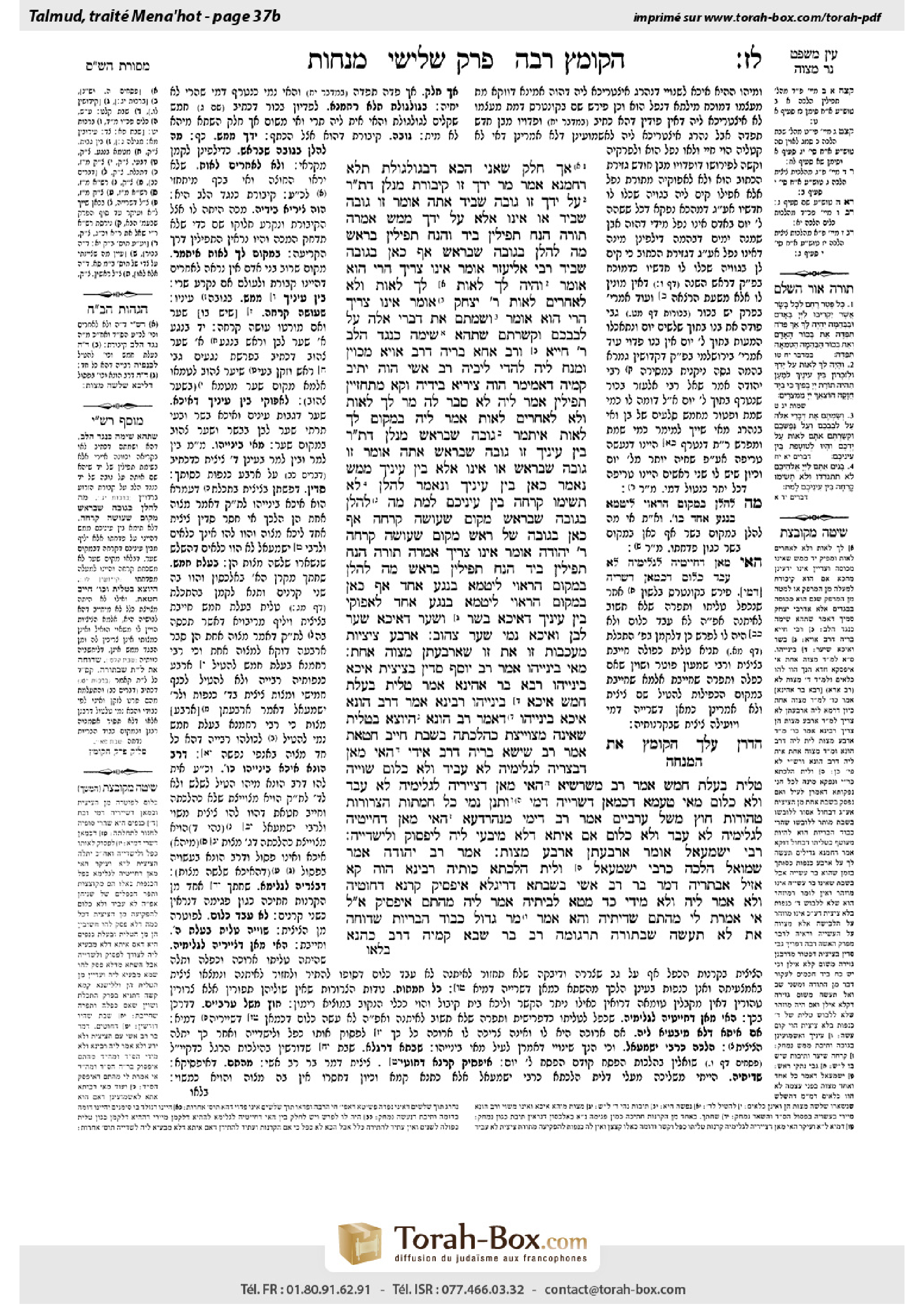
Menachot 37b: Talmud study for Daf Yomi
Daf Yomi is the daily study of one Talmud folio. Explore 37 tractates with scans, Hebrew text, Sefaria English and AI-generated French translations where annotated.
Passage selection and English or AI-generated French translation are available where the scan has annotations. Daf Study is independent of Torah-Box and Sefaria.
Browse Menachot · מנחות · All tractatesMenachot 37b text and translations
This page of Menachot includes the Aramaic text, an English translation and an AI-generated French translation, alongside the scan above.
מנחות ל״ז ב · Aramaic and Hebrew text
״אַךְ״ – חִלֵּק, שָׁאנֵי הָכָא דִּבְגוּלְגּוֹלֶת תְּלָא רַחֲמָנָא.
אָמַר מָר: ״יָדְךָ״ זוֹ קִיבּוֹרֶת, מְנָלַן? דְּתָנוּ רַבָּנַן: ״עַל יָדְךָ״ – זוֹ גּוֹבַהּ שֶׁבַּיָּד. אַתָּה אוֹמֵר: זוֹ גּוֹבַהּ שֶׁבַּיָּד, אוֹ אֵינוֹ אֶלָּא עַל יָדְךָ מַמָּשׁ? אָמְרָה תּוֹרָה: הַנַּח תְּפִילִּין בַּיָּד וְהַנַּח תְּפִילִּין בָּרֹאשׁ, מָה לְהַלָּן בְּגוֹבַהּ שֶׁבָּרֹאשׁ – אַף כָּאן בְּגוֹבַהּ שֶׁבַּיָּד.
רַבִּי אֱלִיעֶזֶר אוֹמֵר: אֵינוֹ צָרִיךְ, הֲרֵי הוּא אוֹמֵר: ״וְהָיָה לְךָ לְאוֹת״, לְךָ לְאוֹת וְלֹא לַאֲחֵרִים לְאוֹת. רַבִּי יִצְחָק אוֹמֵר: אֵינוֹ צָרִיךְ, הֲרֵי הוּא אוֹמֵר: ״וְשַׂמְתֶּם אֶת דְּבָרַי אֵלֶּה עַל לְבַבְכֶם ... וּקְשַׁרְתָּם״, שֶׁתְּהֵא שִׂימָה כְּנֶגֶד הַלֵּב.
רַבִּי חִיָּיא וְרַב אַחָא בְּרֵיהּ דְּרַב אַוְיָא מְכַוֵּין וּמַנַּח לֵיהּ לַהֲדֵי לִיבֵּיהּ. רַב אָשֵׁי הֲוָה יָתֵיב קַמֵּיהּ דְּאַמֵּימָר, הֲוָה צִירְיָא בִּידֵיהּ וְקָא מִתְחַזְיָין תְּפִילִּין. אֲמַר לֵיהּ: לָא סָבַר לַהּ מָר ״לְךָ לְאוֹת״ וְלֹא לַאֲחֵרִים לְאוֹת? אֲמַר לֵיהּ: בִּמְקוֹם ״לְךָ לְאוֹת״ אִיתְּמַר.
גּוֹבַהּ שֶׁבָּרֹאשׁ, מְנָלַן? דְּתָנוּ רַבָּנַן: ״בֵּין עֵינֶיךָ״ – זוֹ גּוֹבַהּ שֶׁבָּרֹאשׁ. אַתָּה אוֹמֵר זוֹ גּוֹבַהּ שֶׁבָּרֹאשׁ, אוֹ אֵינוֹ אֶלָּא בֵּין עֵינֶיךָ מַמָּשׁ? נֶאֱמַר כָּאן ״בֵּין עֵינֶיךָ״, וְנֶאֱמַר לְהַלָּן ״לֹא תָשִׂימוּ קׇרְחָה בֵּין עֵינֵיכֶם לָמֵת״. מָה לְהַלָּן בְּגוֹבַהּ שֶׁבָּרֹאשׁ, מְקוֹם שֶׁעוֹשֶׂה קׇרְחָה – אַף כָּאן בְּגוֹבַהּ שֶׁל רֹאשׁ, מְקוֹם שֶׁעוֹשֶׂה קׇרְחָה.
רַבִּי יְהוּדָה אוֹמֵר: אֵינוֹ צָרִיךְ, אָמְרָה תּוֹרָה: ״הַנַּח תְּפִילִּין בַּיָּד״, ״הַנַּח תְּפִילִּין בָּרֹאשׁ״, מָה לְהַלָּן בְּמָקוֹם הָרָאוּי לִיטָּמֵא בְּנֶגַע אֶחָד, אַף כָּאן בְּמָקוֹם הָרָאוּי לִיטָּמֵא בְּנֶגַע אֶחָד.
לְאַפּוֹקֵי ״בֵּין עֵינֶיךָ״, דְּאִיכָּא בָּשָׂר וְשֵׂעָר, דְּאִיכָּא שֵׂעָר לָבָן, וְאִיכָּא נָמֵי שֵׂעָר צָהוֹב.
אַרְבַּע צִיצִיּוֹת מְעַכְּבוֹת זוֹ אֶת זוֹ, שֶׁאַרְבַּעְתָּן מִצְוָה אַחַת. מַאי בֵּינַיְיהוּ? אָמַר רַב יוֹסֵף: סָדִין בְּצִיצִית אִיכָּא בֵּינַיְיהוּ.
רָבָא בַּר אֲהִינָא אָמַר: טַלִּית בַּעֲלַת חָמֵשׁ אִיכָּא בֵּינַיְיהוּ.
רָבִינָא אָמַר: דְּרַב הוּנָא אִיכָּא בֵּינַיְיהוּ, דְּאָמַר רַב הוּנָא: הַיּוֹצֵא בְּטַלִּית שֶׁאֵינָהּ מְצוּיֶּיצֶת כְּהִלְכָתָהּ בְּשַׁבָּת – חַיָּיב חַטָּאת.
אָמַר רַב שִׁישָׁא בְּרֵיהּ דְּרַב אִידִי: הַאי מַאן דְּבַצְּרֵיהּ לִגְלִימֵיהּ – לָא עֲבַד וְלֹא כְּלוּם, שַׁוְּיֵיהּ טַלִּית בַּעֲלַת חָמֵשׁ.
אָמַר רַב מְשַׁרְשְׁיָא: הַאי מַאן דְּצַיְּירֵיהּ לִגְלִימֵיהּ – לָא עֲבַד וְלֹא כְּלוּם. מַאי טַעְמָא? דִּכְמַאן דְּשַׁרְיֵיהּ דָּמֵי. וּתְנַן נָמֵי: כׇּל חֲמָתוֹת הַצְּרוּרוֹת טְהוֹרוֹת, חוּץ מִשֶּׁל עַרְבִיִּים.
אָמַר רַב דִּימִי מִנְּהַרְדְּעָא: הַאי מַאן דְּחַיְּיטֵיהּ לִגְלִימֵיהּ – לָא עֲבַד וְלֹא כְּלוּם, אִם אִיתָא דְּלָא מִיבְּעֵי לֵיהּ – לִיפְסוֹק וְלִישְׁדְּיֵיהּ.
רַבִּי יִשְׁמָעֵאל אוֹמֵר: אַרְבַּעְתָּן אַרְבַּע מִצְוֹת. אָמַר רַב יְהוּדָה אָמַר שְׁמוּאֵל: הֲלָכָה כְּרַבִּי יִשְׁמָעֵאל, וְלֵית הִלְכְתָא כְּוָתֵיהּ.
רָבִינָא הֲוָה קָא אָזֵיל אַבָּתְרֵיהּ דְּמָר בַּר רַב אָשֵׁי בְּשַׁבְּתָא דְּרִיגְלָא, אִיפְּסִיק קַרְנָא דְּחוּטֵיהּ, וְלָא אֲמַר לֵיהּ וְלָא מִידֵּי. כַּד מְטָא לְבֵיתֵיהּ, אֲמַר לֵיהּ: מֵהָתָם אִיפְּסִיק. אֲמַר לֵיהּ: אִי אֲמַרְתְּ לִי מֵהָתָם שְׁדֵיתֵיהּ.
וְהָא אָמַר מָר: גָּדוֹל כְּבוֹד הַבְּרִיּוֹת שֶׁדּוֹחֶה אֶת לֹא תַעֲשֶׂה שֶׁבַּתּוֹרָה?
תַּרְגְּומַהּ רַב בַּר שְׁבָא קַמֵּיהּ דְּרַב כָּהֲנָא,
Menachot 37b · English translation
“Yet the firstborn of man you shall redeem”; the addition of the word “yet” serves to differentiate and teach that there is a firstborn who is not redeemed, namely, one that was ravaged. A child with two heads is like one that was ravaged, as he will certainly not live. The Gemara answers: Here it is different, as the Merciful One makes the redemption of the firstborn dependent on his skull, as it is stated: “You shall take five shekels apiece, by the skull” (Numbers 3:47), which indicates that there is a case in which a firstborn with more than one skull must be redeemed.
The Gemara returns to its discussion of the baraita: The Master says: “On your arm”; this is the bicep. The term yad can mean either hand or arm. Therefore, the Gemara asks: From where do we derive this? As the Sages taught: “On your arm [yadkha]”; this is the upper part of the arm. Do you say that this is the upper part of the arm, or is it only literally on your actual hand, i.e., on the palm of the hand? The Torah says: Don phylacteries on the yad and don phylacteries on the head; just as there, with regard to the head, it means on the upper part of the head, as will be explained, so too here, it means on the upper part of the arm.
Rabbi Eliezer says: This proof is not necessary, as the verse states: “And it shall be for a sign for you upon your arm” (Exodus 13:9), which teaches: It shall be a sign for you, but not a sign for others, i.e., one must don the phylacteries of the arm in a place where they are not seen by others. This is the arm, which is usually covered, whereas the hand is usually visible. Rabbi Yitzḥak says: This proof is not necessary, as the verse states: “Therefore you shall place these words in your heart and in your soul, and you shall bind them” (Deuteronomy 11:18). This teaches that placing the words, i.e., donning the phylacteries, shall be opposite the heart, on the bicep.
The Gemara relates: Rabbi Ḥiyya and Rav Aḥa, son of Rav Avya, would direct the placement of his phylacteries of the arm and don them opposite his heart. Rav Ashi was sitting before Ameimar, and there was a cut in the sleeve covering Ameimar’s arm, and as a result his phylacteries were visible, as they were not covered by a garment. Rav Ashi said to Ameimar: Doesn’t the Master hold that the phylacteries shall be a sign for you but not a sign for others? Ameimar said to him: This does not mean that phylacteries must be hidden; rather, this was stated in order to teach that they must be donned in a place that is a sign for you, i.e., the bicep, which is generally not seen, but it does not matter if in practice the phylacteries are visible.
With regard to the statement of the baraita that the phylacteries of the head are donned on the upper part of the head, the Gemara asks: From where do we derive this? As the Sages taught: “Between your eyes” (Exodus 13:9); this is the upper part of the head. Do you say that this is the upper part of the head, or is it only literally between your eyes? It is stated here: “Between your eyes,” and it is stated there: “You shall not cut yourselves, nor make any baldness between your eyes for the dead” (Deuteronomy 14:1), Just as there, the phrase “between your eyes” is referring to a place on the upper part of the head, as that is a place where one can render himself bald by removing his hair, so too, the place where phylacteries are donned is on the upper part of the head, a place where one can render himself bald.
Rabbi Yehuda says: This proof is not necessary, as the Torah says: Don phylacteries on the arm and don phylacteries on the head. Just as there, with regard to the phylacteries of the arm, it is referring to a place which is fit to become ritually impure with only one type of leprous mark, that of the skin, so too here, with regard to the phylacteries of the head, it is referring to a place which is fit to become ritually impure with only one type of leprous mark, that of a place of hair (see Leviticus 13:29–37).
Rabbi Yehuda continues: This serves to exclude the area which is literally “between your eyes,” as there is flesh and the hair of the eyebrows present there, and therefore there is a possibility of leprosy through the growth of a white hair, which is impure according to the halakhot of leprosy of the skin (see Leviticus 13:3), and there is also a possibility of leprosy through the growth of a yellow hair, which is impure according to the halakhot of leprosy of the head or the beard (see Leviticus 13:30).
§ The mishna teaches: With regard to the four ritual fringes on a garment, the absence of each prevents fulfillment of the mitzva with the others, as the four of them constitute one mitzva. Rabbi Yishmael says: The four of them are four discrete mitzvot, and the absence of one does not prevent fulfillment of the rest. The Gemara asks: What is the difference between the opinions of the first tanna and Rabbi Yishmael? Rav Yosef said: The difference between their opinions is with regard to a linen sheet with woolen ritual fringes that has fewer than four ritual fringes. The first tanna maintains that since one is not performing a mitzva, he may not wrap himself in the sheet, due to the prohibition of diverse kinds, i.e., the prohibition against wearing clothing made from a mixture of wool and linen threads. Conversely, Rabbi Yishmael permits one to wrap himself in it, as each ritual fringe is a separate mitzva, and the mitzva of ritual fringes overrides the prohibition against wearing diverse kinds.
Rava bar Ahina said: The difference between their opinions is with regard to a cloak with five corners. It is derived that a cloak of this kind requires ritual fringes (see 43b), but it is unclear whether ritual fringes must be placed on each corner. If each fringe is a discrete mitzva, then the obligation applies to the fifth corner as well, but if it is one mitzva then it applies only to four of the corners of this garment.
Ravina said: The difference between their opinions is with regard to the opinion of Rav Huna, as Rav Huna says: One who goes out unwittingly to the public domain on Shabbat with a four-cornered cloak that does not have all of the requisite ritual fringes attached to its corners is liable to bring a sin offering, because the remaining fringes are not an integral part of the garment. Since they do not enable the wearer to fulfill the mitzva, they are considered a burden, which may not be carried into the public domain on Shabbat. The first tanna agrees with this ruling, whereas Rabbi Yishmael maintains that since each corner with ritual fringes is the fulfillment of a mitzva, one is not liable to bring a sin offering due to carrying on Shabbat for wearing it into the public domain.
Rav Sheisha, son of Rav Idi, said: One who cuts the corner of his garment has not done anything of consequence with regard to exempting the garment from the obligation of ritual fringes, as he has rendered it a cloak with five corners, to which the obligation of ritual fringes applies.
Rav Mesharshiyya similarly says: One who ties his garment has not done anything of consequence with regard to exempting the garment from the obligation of ritual fringes. What is the reason? It is considered as though the garment is untied, since the knot can be loosened at any time. And we learned likewise in a mishna (Kelim 26:4): All bound leather jugs, i.e., those whose bottoms are not sewn but tied, are ritually pure, i.e., they are not susceptible to ritual impurity. This is because they are not considered receptacles, as these knots will be untied, except for leather jugs of Arabs, who would tie them with a permanent knot.
Rav Dimi of Neharde’a similarly says: One who sews his garment, i.e., he folded over a long garment and sewed the edges together, has not done anything of consequence with regard to the obligation of ritual fringes, and he must place ritual fringes on the original corners. The reason is that if it is so that he does not need the folded part, which is why he is sewing it, let him cut it and throw it away.
§ The mishna teaches that Rabbi Yishmael says: The four of them are four discrete mitzvot, and the absence of one does not prevent fulfillment of the rest. Rav Yehuda says that Shmuel says: The halakha is in accordance with the opinion of Rabbi Yishmael. The Gemara states: But the halakha is not in accordance with his opinion.
The Gemara relates: Ravina was walking behind Mar bar Rav Ashi on the Shabbat of the Festival when the corner of Mar bar Rav Ashi’s garment on which his ritual fringes were hanging tore, and yet Ravina did not say anything to him. When he arrived at Mar bar Rav Ashi’s house, Ravina said to him: Back there, along the way, the corner tore. Mar bar Rav Ashi said to him: If you would have told me then, I would have thrown off the garment there, as once one of the ritual fringes is torn no mitzva is performed with the rest, and it is prohibited to walk in the public domain on Shabbat wearing such a garment. This is in accordance with the opinion of the first tanna, who disagrees with the ruling of Rabbi Yishmael.
The Gemara raises a difficulty: But didn’t the Master say: Great is human dignity, as it overrides a prohibition in the Torah? This includes the prohibition against carrying on Shabbat in the public domain. That being the case, why would he remove his garment in public?
The Gemara answers: Rav bar Shabba interpreted that statement before Rav Kahana:
Menachot 37b · Traduction française (IA)
« Pourtant, tu rachèteras le premier-né de l’homme » : l’ajout du mot « pourtant » sert à distinguer et à enseigner qu’il existe un premier-né qui n’est pas racheté, à savoir un enfant qui a été ravagé. Un enfant ayant deux têtes est comme un enfant ravagé, car il ne vivra certainement pas. La Guemara répond : ici, le cas est différent, car le Miséricordieux fait dépendre le rachat du premier-né de son crâne, comme il est dit : « Tu prendras cinq sicles par crâne » (Nombres 3:47), ce qui indique qu’il existe un cas où un premier-né ayant plus d’un crâne doit être racheté.
La Guemara revient à son analyse de la baraïta. Le Maître dit : « Sur ton bras » ; il s’agit du biceps. Le terme yad peut désigner soit la main, soit le bras. La Guemara demande donc : d’où tirons-nous cela ? Car les Sages ont enseigné : « Sur ton bras [yadkha] » ; il s’agit de la partie supérieure du bras. Peut-on dire qu’il s’agit de la partie supérieure du bras, ou bien cela signifie-t-il seulement, au sens littéral, sur ta main même, c’est-à-dire sur la paume ? La Torah dit de mettre les téfilines sur le yad et de mettre les téfilines sur la tête. De même que là, à propos de la tête, cela désigne la partie supérieure de la tête, comme cela sera expliqué, de même ici, cela désigne la partie supérieure du bras.
Rabbi Eliezer dit : cette preuve n’est pas nécessaire, car le verset dit : « Et ce sera pour toi un signe sur ton bras » (Exode 13:9), ce qui enseigne : ce sera un signe pour toi, mais pas un signe pour les autres ; autrement dit, il faut mettre les téfilines du bras à un endroit où les autres ne les voient pas. C’est le bras, qui est généralement couvert, tandis que la main est généralement visible. Rabbi Yitzḥak dit : cette preuve n’est pas nécessaire, car le verset dit : « Vous placerez donc ces paroles dans votre cœur et dans votre âme, et vous les attacherez » (Deutéronome 11:18). Cela enseigne que le placement des paroles, c’est-à-dire la pose des téfilines, doit se faire en face du cœur, sur le biceps.
La Guemara rapporte : Rabbi Ḥiyya et Rav Aḥa, fils de Rav Avya, orientaient la pose de ses téfilines du bras et les mettaient en face de son cœur. Rav Ashi était assis devant Ameimar ; la manche qui couvrait le bras d’Ameimar était déchirée, si bien que ses téfilines étaient visibles, puisqu’elles n’étaient pas couvertes par un vêtement. Rav Ashi dit à Ameimar : Le Maître ne tient-il pas que les téfilines doivent être un signe pour toi, mais pas un signe pour les autres ? Ameimar lui répondit : Cela ne signifie pas que les téfilines doivent être cachées ; cette formule a plutôt été énoncée pour enseigner qu’elles doivent être mises à un endroit qui constitue un signe pour toi, c’est-à-dire le biceps, généralement invisible ; peu importe toutefois si, en pratique, les téfilines sont visibles.
À propos de l’affirmation de la baraïta selon laquelle les téfilines de la tête sont mises sur la partie supérieure de la tête, la Guemara demande : d’où tirons-nous cela ? Car les Sages ont enseigné : « Entre tes yeux » (Exode 13:9) ; il s’agit de la partie supérieure de la tête. Peut-on dire qu’il s’agit de la partie supérieure de la tête, ou bien cela signifie-t-il seulement, au sens littéral, entre tes yeux ? Il est dit ici « entre tes yeux », et il est dit là : « Vous ne vous ferez pas d’incisions et ne vous ferez pas de tonsure entre les yeux pour un mort » (Deutéronome 14:1). De même que là, l’expression « entre les yeux » désigne un endroit sur la partie supérieure de la tête, puisqu’on peut s’y rendre chauve en s’arrachant les cheveux, de même l’endroit où l’on met les téfilines se trouve sur la partie supérieure de la tête, là où l’on peut se rendre chauve.
Rabbi Yehuda dit : cette preuve n’est pas nécessaire, car la Torah dit de mettre les téfilines sur le bras et de mettre les téfilines sur la tête. De même que là, à propos des téfilines du bras, il s’agit d’un endroit susceptible de devenir rituellement impur par un seul type de marque de lèpre, celle de la peau, de même ici, à propos des téfilines de la tête, il s’agit d’un endroit susceptible de devenir rituellement impur par un seul type de marque de lèpre, celle d’une zone pileuse (voir Lévitique 13:29–37).
Rabbi Yehuda poursuit : cela exclut la zone littéralement « entre tes yeux », car il s’y trouve de la chair et les poils des sourcils ; une lèpre peut donc s’y manifester par la pousse d’un poil blanc, ce qui est impur selon les halakhot de la lèpre de la peau (voir Lévitique 13:3), et aussi par la pousse d’un poil jaune, ce qui est impur selon les halakhot de la lèpre de la tête ou de la barbe (voir Lévitique 13:30).
§ La Michna enseigne : concernant les quatre franges rituelles d’un vêtement, l’absence de chacune empêche l’accomplissement de la mitsva avec les autres, car toutes quatre constituent une seule mitsva. Rabbi Yishmael dit : elles constituent quatre mitsvot distinctes, et l’absence de l’une n’empêche pas l’accomplissement des autres. La Guemara demande : quelle est la différence entre l’avis du premier tanna et celui de Rabbi Yishmael ? Rav Yosef dit : la différence porte sur un drap de lin muni de franges rituelles en laine auquel il manque une ou plusieurs des quatre franges. Le premier tanna estime que, puisqu’on n’accomplit pas de mitsva, on ne peut pas s’en envelopper en raison de l’interdiction du chaatnez, c’est-à-dire l’interdiction de porter un vêtement fait d’un mélange de laine et de lin. À l’inverse, Rabbi Yishmael permet de s’en envelopper, car chaque frange rituelle constitue une mitsva distincte, et la mitsva des franges rituelles l’emporte sur l’interdiction de porter du chaatnez.
Rava bar Ahina dit : la différence entre leurs avis porte sur un manteau à cinq coins. Il est établi qu’un manteau de ce genre requiert des franges rituelles (voir 43b), mais on ne sait pas clairement si des franges rituelles doivent être placées à chacun des coins. Si chaque frange constitue une mitsva distincte, l’obligation s’applique aussi au cinquième coin ; mais si les quatre constituent une seule mitsva, elle ne s’applique qu’à quatre des coins de ce vêtement.
Ravina dit : la différence entre leurs avis porte sur l’opinion de Rav Huna, car Rav Huna dit : celui qui sort involontairement dans le domaine public, pendant Chabbat, avec un manteau à quatre coins auquel ne sont pas attachées toutes les franges rituelles requises est tenu d’apporter un sacrifice expiatoire, car les franges restantes ne font pas partie intégrante du vêtement. Puisqu’elles ne permettent pas à celui qui le porte d’accomplir la mitsva, elles sont considérées comme un fardeau qu’il est interdit de transporter dans le domaine public pendant Chabbat. Le premier tanna est d’accord avec cette décision, tandis que Rabbi Yishmael estime que, puisque chaque coin muni de franges rituelles correspond à l’accomplissement d’une mitsva, celui qui porte ce vêtement dans le domaine public pendant Chabbat n’est pas tenu d’apporter un sacrifice expiatoire pour l’avoir transporté pendant Chabbat.
Rav Sheisha, fils de Rav Idi, dit : celui qui coupe un coin de son vêtement n’a rien fait qui puisse l’exempter de l’obligation des franges rituelles, car il en a fait un manteau à cinq coins, auquel s’applique cette obligation.
Rav Mesharshiyya dit de même : celui qui noue son vêtement n’a rien fait qui puisse l’exempter de l’obligation des franges rituelles. Pour quelle raison ? Le vêtement est considéré comme s’il était dénoué, puisque le nœud peut être défait à tout moment. Nous avons également appris dans une Michna (Kelim 26:4) : toutes les outres en cuir nouées, c’est-à-dire celles dont le fond n’est pas cousu mais noué, sont rituellement pures, autrement dit, elles ne sont pas susceptibles de devenir rituellement impures. En effet, elles ne sont pas considérées comme des récipients, car ces nœuds seront défaits, à l’exception des outres en cuir des Arabes, qui les nouaient avec un nœud permanent.
Rav Dimi de Neharde’a dit de même : celui qui coud son vêtement, c’est-à-dire qui replie un vêtement long et en coud les bords ensemble, n’a rien fait qui puisse le soustraire à l’obligation des franges rituelles ; il doit mettre des franges rituelles aux coins d’origine. En effet, s’il est vrai qu’il n’a pas besoin de la partie repliée, raison pour laquelle il la coud, qu’il la coupe et la jette.
§ La Michna enseigne que Rabbi Yishmael dit : les quatre franges constituent quatre mitsvot distinctes, et l’absence de l’une n’empêche pas l’accomplissement des autres. Rav Yehuda rapporte au nom de Shmuel : la halakha est conforme à l’avis de Rabbi Yishmael. La Guemara affirme : mais la halakha n’est pas conforme à son avis.
La Guemara rapporte : Ravina marchait derrière Mar bar Rav Ashi, pendant le Chabbat de la fête, lorsque le coin du vêtement de Mar bar Rav Ashi auquel étaient suspendues ses franges rituelles se déchira ; pourtant, Ravina ne lui dit rien. Lorsqu’il arriva chez Mar bar Rav Ashi, Ravina lui dit : tout à l’heure, en chemin, le coin s’est déchiré. Mar bar Rav Ashi lui dit : si tu me l’avais dit à ce moment-là, j’aurais retiré le vêtement sur place, car, dès qu’une des franges rituelles est déchirée, les autres ne permettent plus d’accomplir la mitsva, et il est interdit de marcher dans le domaine public pendant Chabbat en portant un tel vêtement. Cela est conforme à l’avis du premier tanna, qui contredit la décision de Rabbi Yishmael.
La Guemara soulève une difficulté : mais le Maître n’a-t-il pas dit : la dignité humaine est grande, car elle l’emporte sur une interdiction de la Torah ? Cela inclut l’interdiction de transporter un objet dans le domaine public pendant Chabbat. Dès lors, pourquoi aurait-il retiré son vêtement en public ?
La Guemara répond : Rav bar Shabba interpréta cette déclaration devant Rav Kahana :
Traduction française générée par IA à partir de l’édition anglaise de Sefaria. Vérifie toujours un passage avec le texte source.
Text from Sefaria: William Davidson Edition - Vocalized Aramaic (unknown); William Davidson Edition - English (CC BY NC).