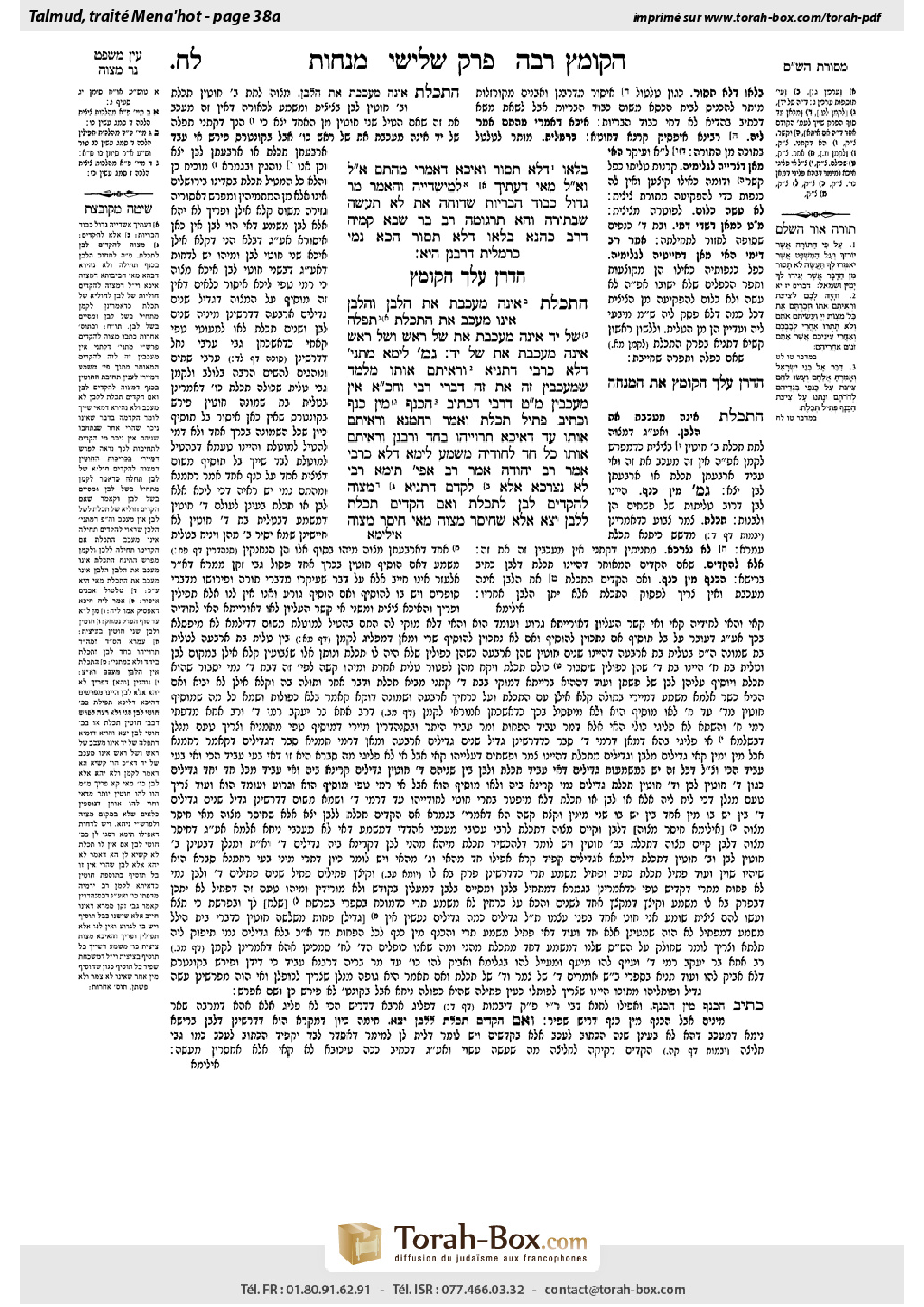
Menachot 38a: Talmud study for Daf Yomi
Daf Yomi is the daily study of one Talmud folio. Explore 37 tractates with scans, Hebrew text, Sefaria English and AI-generated French translations where annotated.
Passage selection and English or AI-generated French translation are available where the scan has annotations. Daf Study is independent of Torah-Box and Sefaria.
Browse Menachot · מנחות · All tractatesMenachot 38a text and translations
This page of Menachot includes the Aramaic text, an English translation and an AI-generated French translation, alongside the scan above.
מנחות ל״ח א · Aramaic and Hebrew text
בְּלָאו דְּ״לֹא תָסוּר״.
וְאִיכָּא דְּאָמְרִי מֵהָתָם אֲמַר לֵיהּ, וַאֲמַר לֵיהּ: מַאי דַּעְתָּיךְ לְמִישְׁדְּיֵיהּ? וְהָאָמַר מָר: גָּדוֹל כְּבוֹד הַבְרִיּוֹת שֶׁדּוֹחֶה אֶת לֹא תַעֲשֶׂה שֶׁבַּתּוֹרָה! וְהָא תַּרְגְּומַהּ רַב בַּר שְׁבָא קַמֵּיהּ דְּרַב כָּהֲנָא בְּלָאו דְּ״לֹא תָסוּר״, הָכָא נָמֵי כַּרְמְלִית דְּרַבָּנַן הִיא.
הֲדַרַן עֲלָךְ הַקּוֹמֵץ.
מַתְנִי׳ הַתְּכֵלֶת אֵינָהּ מְעַכֶּבֶת אֶת הַלָּבָן, וְהַלָּבָן אֵינוֹ מְעַכֵּב אֶת הַתְּכֵלֶת. תְּפִלָּה שֶׁל יָד אֵינָהּ מְעַכֶּבֶת אֶת שֶׁל רֹאשׁ, וְשֶׁל רֹאשׁ אֵינָהּ מְעַכֶּבֶת אֶת שֶׁל יָד.
גְּמָ׳ לֵימָא מַתְנִיתִין דְּלָא כְּרַבִּי, דְּתַנְיָא: ״וּרְאִיתֶם אֹתוֹ״ – מְלַמֵּד שֶׁמְּעַכְּבִין זֶה אֶת זֶה, דִּבְרֵי רַבִּי, וַחֲכָמִים אוֹמְרִים: אֵין מְעַכְּבִין.
מַאי טַעְמָא דְּרַבִּי? דִּכְתִיב ״הַכָּנָף״ – מִין כָּנָף, וּכְתִיב ״פְּתִיל תְּכֵלֶת״, וְאָמַר רַחֲמָנָא ״וּרְאִיתֶם אוֹתוֹ״ – עַד דְּאִיכָּא תַּרְוַיְיהוּ בְּחַד.
וְרַבָּנַן, ״וּרְאִיתֶם אוֹתוֹ״ – כֹּל חַד לְחוֹדֵיהּ מַשְׁמַע.
לֵימָא דְּלָא כְּרַבִּי? אָמַר רַב יְהוּדָה אָמַר רַב: אֲפִילּוּ תֵּימָא רַבִּי, לֹא נִצְרְכָא אֶלָּא לְקַדֵּם.
דְּתַנְיָא: מִצְוָה לְהַקְדִּים לָבָן לַתְּכֵלֶת, וְאִם הִקְדִּים תְּכֵלֶת לַלָּבָן – יָצָא, אֶלָּא שֶׁחִיסֵּר מִצְוָה. מַאי חִיסֵּר מִצְוָה?
Menachot 38a · English translation
He stated this with regard to the prohibition of: “You shall not deviate to the left or the right of that which they tell you” (Deuteronomy 17:11). A prohibition by rabbinic law is overridden by human dignity, but not a prohibition by Torah law. Therefore, Mar bar Rav Ashi would have removed his garment had he known about the tear.
And there are those who say there is a different version of this discussion: It was when they were there, in the place where the corner of Mar bar Rav Ashi’s garment tore, that Ravina said to him that it had torn, and Mar bar Rav Ashi said to him in response: What is your opinion? Do you think that I should throw the garment off? But doesn’t the Master say: Great is human dignity, as it overrides a prohibition in the Torah? The Gemara raises a difficulty: But Rav bar Shabba interpreted that statement before Rav Kahana: He stated this with regard to the prohibition of: “You shall not deviate,” not the prohibition against carrying in the public domain, which applies by Torah law. The Gemara answers that here too, it is not a prohibition by Torah law, as the place where they were walking was not a full-fledged public domain but a karmelit, in which carrying is prohibited by rabbinic law.
MISHNA: The absence of the sky-blue [tekhelet] strings does not prevent fulfillment of the mitzva of ritual fringes with the white strings, and the absence of white strings does not prevent fulfillment of the mitzva with the sky-blue strings. If one has only one, he wears it without the other. Absence of the phylacteries of the arm does not prevent fulfillment of the mitzva of the phylacteries of the head, and absence of the phylacteries of the head does not prevent fulfillment of the mitzva of the phylacteries of the arm. If one has only one, he dons it without the other.
GEMARA: The Gemara suggests: Let us say that the mishna is not in accordance with the opinion of Rabbi Yehuda HaNasi. As it is taught in a baraita: When the verse requires one to place white and sky-blue strings upon the corners of his garments and then states: “That you may look upon it” (Numbers 15:39), it teaches that the lack of either one prevents fulfillment of the mitzva with the other; this is the statement of Rabbi Yehuda HaNasi. But the Rabbis say: The lack of one does not prevent the fulfillment of the mitzva with the other.
The Gemara inquires: What is the reasoning of Rabbi Yehuda HaNasi, i.e., how does he derive his ruling from this verse? The Gemara explains: As it is written: “And they shall put on the fringe of the corner a sky-blue thread” (Numbers 15:38). “The fringe of the corner” is a reference to strings that are of the same type as the corner of the garment. Since garments are usually white, this phrase is referring to white strings. And it is written in this same verse: “A sky-blue thread.” And the Merciful One states in the following verse, referring to both types of strings: “And it shall be to you for a fringe that you may look upon it” (Numbers 15:39), in the singular. This teaches that one does not fulfill his obligation until both types are present together.
The Gemara asks: And how do the Rabbis, who hold that the one can fulfill one obligation without the other, understand this verse? The Gemara answers: They hold that the phrase “that you may look upon it” indicates that one fulfills a mitzva with each one individually.
The Gemara concludes its initial suggestion: Shall we say that the mishna, which states that one can fulfill the mitzva with either white or sky-blue strings even in the absence of the other, is not in accordance with the opinion of Rabbi Yehuda HaNasi? The Gemara responds: Rav Yehuda said that Rav said: You may even say that the mishna is in accordance with the opinion of Rabbi Yehuda HaNasi, and the ruling of the mishna is necessary only with regard to granting precedence. The white strings should precede the blue strings, but if the order is reversed, one still fulfills the mitzva.
This is as it is taught in a baraita: It is a mitzva to insert the white strings into the garment before inserting the sky-blue strings, but if one inserted the sky-blue strings before the white strings, he fulfilled his obligation but omitted the mitzva. The Gemara asks: What does the baraita mean by the phrase: Omitted the mitzva?
Menachot 38a · Traduction française (IA)
Il a dit cela au sujet de l’interdiction : « Tu ne t’écarteras ni à gauche ni à droite de ce qu’ils te diront » (Deutéronome 17, 11). Une interdiction d’ordre rabbinique est écartée au nom de la dignité humaine, mais pas une interdiction de la Torah. C’est pourquoi Mar bar Rav Ashi aurait ôté son vêtement s’il avait su qu’il était déchiré.
Et certains rapportent une autre version de cette discussion : alors qu’ils se trouvaient là, à l’endroit où le coin du vêtement de Mar bar Rav Ashi s’était déchiré, Ravina lui dit que son vêtement était déchiré, et Mar bar Rav Ashi lui répondit : « Que penses-tu ? Tu crois que je devrais enlever mon vêtement ? Mais le Maître ne dit-il pas : “Grande est la dignité humaine”, car elle l’emporte sur une interdiction de la Torah ? » La Guemara soulève une difficulté : Rav bar Shabba n’a-t-il pas interprété cette déclaration devant Rav Kahana ainsi : « Il a dit cela au sujet de l’interdiction “Tu ne t’écarteras pas”, et non au sujet de l’interdiction de transporter dans le domaine public, qui relève de la Torah » ? La Guemara répond qu’ici aussi, il ne s’agit pas d’une interdiction de la Torah, car l’endroit où ils marchaient n’était pas un véritable domaine public, mais un karmelit, où le transport est interdit par décret rabbinique.
MICHNA : L’absence de fils bleu ciel [tekhelet] n’empêche pas d’accomplir la mitsva des franges rituelles avec les fils blancs, et l’absence de fils blancs n’empêche pas d’accomplir la mitsva avec les fils bleu ciel. Si l’on ne possède que l’un des deux types, on le porte sans l’autre. L’absence des téfilines du bras n’empêche pas d’accomplir la mitsva des téfilines de la tête, et l’absence des téfilines de la tête n’empêche pas d’accomplir la mitsva des téfilines du bras. Si l’on ne possède qu’une seule des deux, on la met sans l’autre.
GUEMARA : La Guemara suggère : Disons que la Michna n’est pas conforme à l’opinion de Rabbi Yehouda HaNassi. En effet, il est enseigné dans une baraïta : Lorsque le verset ordonne de mettre des fils blancs et bleu ciel aux coins de ses vêtements, puis ajoute : « Afin que vous le regardiez » (Nombres 15, 39), il enseigne que l’absence de l’un empêche d’accomplir la mitsva avec l’autre. Telle est l’opinion de Rabbi Yehouda HaNassi. Mais les Sages disent : L’absence de l’un n’empêche pas d’accomplir la mitsva avec l’autre.
La Guemara demande : Quel est le raisonnement de Rabbi Yehouda HaNassi, c’est-à-dire comment déduit-il sa décision de ce verset ? La Guemara explique : Il est écrit : « Ils mettront sur la frange du coin un fil bleu ciel » (Nombres 15, 38). L’expression « la frange du coin » désigne des fils de même nature que le coin du vêtement. Comme les vêtements sont généralement blancs, cette expression renvoie à des fils blancs. Et il est écrit dans ce même verset : « Un fil bleu ciel ». Puis le Miséricordieux dit, dans le verset suivant, au sujet des deux types de fils : « Et cela vous servira de frange, afin que vous le regardiez » (Nombres 15, 39), au singulier. Cela enseigne qu’on ne s’acquitte de son obligation que lorsque les deux types sont présents ensemble.
La Guemara demande : Et comment les Sages, qui soutiennent qu’on peut accomplir l’une des deux obligations sans l’autre, comprennent-ils ce verset ? La Guemara répond : Selon eux, l’expression « afin que vous le regardiez » indique qu’on accomplit une mitsva avec chacun des deux types séparément.
La Guemara reprend sa suggestion initiale : Faut-il dire que la Michna, qui enseigne qu’on peut accomplir la mitsva avec des fils blancs ou bleu ciel même en l’absence de l’autre type, n’est pas conforme à l’opinion de Rabbi Yehouda HaNassi ? La Guemara répond : Rav Yehouda a dit au nom de Rav : On peut même dire que la Michna est conforme à l’opinion de Rabbi Yehouda HaNassi, et que la décision de la Michna ne vise qu’à établir un ordre de priorité. Les fils blancs doivent précéder les fils bleu ciel, mais si l’ordre est inversé, on accomplit tout de même la mitsva.
C’est ce qui est enseigné dans une baraïta : C’est une mitsva d’insérer les fils blancs dans le vêtement avant d’y insérer les fils bleu ciel, mais si l’on a inséré les fils bleu ciel avant les fils blancs, on s’est acquitté de son obligation, mais on a omis la mitsva. La Guemara demande : Que signifie, dans la baraïta, l’expression « on a omis la mitsva » ?
Traduction française générée par IA à partir de l’édition anglaise de Sefaria. Vérifie toujours un passage avec le texte source.
Text from Sefaria: William Davidson Edition - Vocalized Aramaic (unknown); William Davidson Edition - English (CC BY NC).