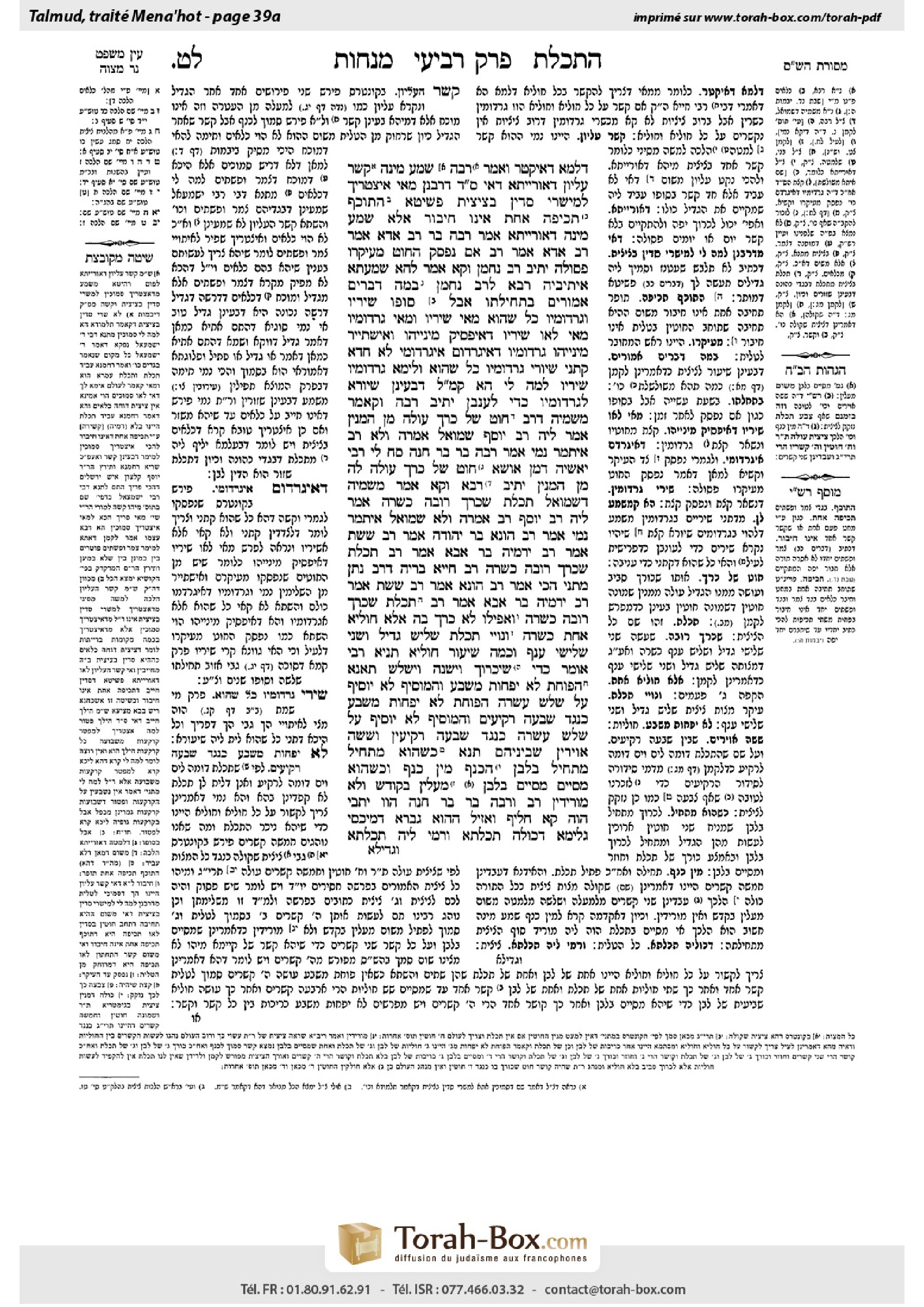
Menachot 39a: Talmud study for Daf Yomi
Daf Yomi is the daily study of one Talmud folio. Explore 37 tractates with scans, Hebrew text, Sefaria English and AI-generated French translations where annotated.
Passage selection and English or AI-generated French translation are available where the scan has annotations. Daf Study is independent of Torah-Box and Sefaria.
Browse Menachot · מנחות · All tractatesMenachot 39a text and translations
This page of Menachot includes the Aramaic text, an English translation and an AI-generated French translation, alongside the scan above.
מנחות ל״ט א · Aramaic and Hebrew text
דִּלְמָא דְּאִיקְּטַר.
וְאָמַר רַבָּה: שְׁמַע מִינַּהּ, קֶשֶׁר עֶלְיוֹן דְּאוֹרָיְיתָא, דְּאִי סָלְקָא דַעְתָּךְ דְּרַבָּנַן, מַאי אִיצְטְרִיךְ לְמִישְׁרֵי סָדִין בְּצִיצִית? פְּשִׁיטָא! הַתּוֹכֵף תְּכִיפָה אַחַת אֵינוֹ חִיבּוּר, אֶלָּא שְׁמַע מִינַּהּ דְּאוֹרָיְיתָא.
אָמַר רַבָּה בַּר רַב אַדָּא אָמַר רַב אַדָּא אָמַר רַב: אִם נִפְסַק הַחוּט מֵעִיקָּרוֹ – פְּסוּלָה. יָתֵיב רַב נַחְמָן וְקָא אָמַר לְהָא שְׁמַעְתָּא, אֵיתִיבֵיהּ רָבָא לְרַב נַחְמָן: בַּמֶּה דְּבָרִים אֲמוּרִים – בִּתְחִילָּתוֹ, אֲבָל סוֹפוֹ – שְׁיָרָיו וְגַרְדּוּמָּיו כׇּל שֶׁהוּא.
מַאי שְׁיָרָיו וּמַאי גַּרְדּוּמָּיו? מַאי לָאו ״שְׁיָרָיו״ – דְּאִיפְּסִיק מִינַּיְיהוּ וְאִישְׁתַּיַּיר מִינַּיְיהוּ, ״גַּרְדּוּמָּיו״ – דְּאִיגַּרְדּוּם אִיגַּרְדּוֹמֵי.
לָא, חֲדָא קָתָנֵי, שַׁיּוֹרֵי גַּרְדּוּמָּיו כׇּל שֶׁהוּא. וְלֵימָא: ״גַּרְדּוּמָּיו״, ״שְׁיָרָיו״ לְמָה לִי? הָא קָא מַשְׁמַע לַן, דְּבָעֵינַן שִׁיּוּרָא לְגַרְדּוּמָּיו כְּדֵי לְעׇנְבָן.
יָתֵיב רַבָּה וְקָאָמַר מִשְּׁמֵיהּ דְּרַב: חוּט שֶׁל כֶּרֶךְ עוֹלֶה מִן הַמִּנְיָן. אֲמַר לֵיהּ רַב יוֹסֵף: שְׁמוּאֵל אַמְרַהּ וְלָא רַב. אִיתְּמַר נָמֵי: אָמַר רַבָּה בַּר בַּר חָנָה, סָח לִי רַבִּי יֹאשִׁיָּה דְּמִן אוּשָׁא: חוּט שֶׁל כֶּרֶךְ עוֹלָה לָהּ מִן הַמִּנְיָן.
יָתֵיב רָבָא וְקָא אָמַר מִשְּׁמֵיהּ דִּשְׁמוּאֵל: תְּכֵלֶת שֶׁכָּרַךְ רוּבָּהּ – כְּשֵׁרָה. אֲמַר לֵיהּ רַב יוֹסֵף: רַב אַמְרַהּ, וְלָא שְׁמוּאֵל. אִיתְּמַר נָמֵי, אָמַר רַב הוּנָא בַּר יְהוּדָה אָמַר רַב שֵׁשֶׁת אָמַר רַב יִרְמְיָה בַּר אַבָּא אָמַר רַב: תְּכֵלֶת שֶׁכָּרַךְ רוּבָּהּ – כְּשֵׁרָה.
רַב חִיָּיא בְּרֵיהּ דְּרַב נָתָן מַתְנֵי הָכִי: אָמַר רַב הוּנָא, אָמַר רַב שֵׁשֶׁת, אָמַר רַב יִרְמְיָה בַּר אַבָּא, אָמַר רַב: תְּכֵלֶת שֶׁכָּרַךְ רוּבָּהּ – כְּשֵׁרָה, וַאֲפִילּוּ לֹא כָּרַךְ בָּהּ אֶלָּא חוּלְיָא אַחַת – כְּשֵׁרָה, וְנוֹיֵי תְכֵלֶת – שְׁלִישׁ גְּדִיל וּשְׁנֵי שְׁלִישֵׁי עָנָף.
וְכַמָּה שִׁיעוּר חוּלְיָא? תַּנְיָא, רַבִּי אוֹמֵר: כְּדֵי שֶׁיִּכְרוֹךְ וְיִשְׁנֶה וִישַׁלֵּשׁ. תָּאנָא: הַפּוֹחֵת לֹא יִפְחוֹת מִשֶּׁבַע, וְהַמּוֹסִיף לֹא יוֹסִיף עַל שְׁלֹשׁ עֶשְׂרֵה.
הַפּוֹחֵת לֹא יִפְחוֹת מִשֶּׁבַע, כְּנֶגֶד שִׁבְעָה רְקִיעִים, וְהַמּוֹסִיף לֹא יוֹסִיף עַל שְׁלֹשׁ עֶשְׂרֵה, כְּנֶגֶד שִׁבְעָה רְקִיעִין וְשִׁשָּׁה אֲוִירִין שֶׁבֵּינֵיהֶם.
תָּנָא: כְּשֶׁהוּא מַתְחִיל – מַתְחִיל בַּלָּבָן: ״הַכָּנָף״ – מִין כָּנָף, וּכְשֶׁהוּא מְסַיֵּים – מְסַיֵּים בַּלָּבָן, מַעֲלִין בַּקּוֹדֶשׁ וְלֹא מוֹרִידִין.
רַב וְרַבָּה בַּר בַּר חָנָה הֲווֹ יָתְבִי, הֲוָה קָא חָלֵיף וְאָזֵיל הָהוּא גַּבְרָא דְּמִיכַּסֵּי גְּלִימָא דְּכוּלֵּהּ תְּכֵלְתָּא, וּרְמֵי לֵיהּ תְּכֵלְתָּא
Menachot 39a · English translation
The Gemara rejects this proof: Perhaps the sons of Rabbi Ḥiyya were referring to a case where one tied knots between the sets of windings even though there is no obligation to do so.
And Rabba says: Learn from it that the uppermost knot in the ritual fringes is required by Torah law. As, if it enters your mind to say that it is by rabbinic law, whereas by Torah law it is sufficient to merely insert the strings into the hole without tying any knots, for what reason was it necessary for the Torah to permit placing wool ritual fringes on a linen cloak? It is obvious that it is permitted, since if one attaches a swatch of wool and a swatch of linen with a single connection, it is not considered a connection with regard to the prohibition against wearing a garment that includes both wool and linen. Rather, learn from it that the uppermost knot is required by Torah law.
§ Rabba bar Rav Adda says that Rav Adda says that Rav says: If a string was severed at its base, i.e., where it is connected to the garment, the ritual fringes are unfit. Rav Naḥman sat in the study hall and stated this halakha. Rava raised an objection to Rav Naḥman from a baraita: In what case is this statement said, i.e., that there is a minimum length required for the strings? That is only when the strings are initially affixed to the garment. But in the end, i.e., after the strings are affixed in an acceptable manner, its remainder and its severed strings are fit at any length.
The Gemara clarifies: What is its remainder and what are its severed strings? What, is it not that when the baraita mentions its remainder it is referring to a case where parts of the strings were severed and parts of them remain, and when the baraita mentions its severed strings it is referring to a case where the strings were completely severed, and nevertheless the strings are fit for the mitzva?
The Gemara responds to Rava’s objection: No, the tanna of the baraita is teaching one halakha, and the baraita should be understood as follows: The remainder of its severed strings are fit at any length. The Gemara asks: If so, let the baraita simply say: Its severed strings are fit at any length; why do I need the mention of its remainder? This teaches us that we require a remainder of its severed strings long enough to wrap them around the other strings and tie them in a slipknot.
§ Rabba sat in the study hall and said in the name of Rav: The string used for winding around the other strings is counted in the quota of ritual fringes, i.e., it is one of the eight strings on each corner, and there is no need to have an additional string for winding. Rav Yosef said to Rabba: Shmuel said it, and not Rav. This was also stated by another amora: Rabba bar bar Ḥana says: Rabbi Yoshiya of Usha told me that the string used for winding around the other strings is counted in the quota of ritual fringes.
Rava sat in the study hall and said in the name of Shmuel: If one wound the majority of the white and the sky-blue strings instead of leaving the larger portion of the strings hanging loose beyond the windings, the ritual fringes are nevertheless fit. Rav Yosef said to Rava: Rav said it, and not Shmuel. The Gemara supports Rav Yosef’s version from that which was also stated: Rav Huna bar Yehuda says that Rav Sheshet says that Rav Yirmeya bar Abba says that Rav says: If one wound the majority of the white and the sky-blue strings, the ritual fringes are nevertheless fit.
Rav Ḥiyya, son of Rav Natan, teaches this discussion like this: Rav Huna says that Rav Sheshet says that Rav Yirmeya bar Abba says that Rav says: If one wound the majority of the white and the sky-blue strings, the ritual fringes are nevertheless fit. And even if he wound only one set of windings, the ritual fringes are fit. But the finest way to affix the white and sky-blue strings is to ensure that one-third of the length of the strings is windings and two-thirds are loose hanging strings.
The Gemara asks: And what is the measure of a set of windings? It is taught in a baraita that Rabbi Yehuda HaNasi says: It is such that one winds once and winds a second and third time, i.e., each set must contain at least three windings. It was taught: One who minimizes the sets of windings may not have fewer than seven sets, and one who adds to this number of sets may not have more than thirteen sets of windings.
The Gemara provides explanations for these guidelines: One who minimizes the sets of windings may not wind fewer than seven sets, corresponding to the seven firmaments. And one who adds to this number of sets may not wind more than thirteen sets of windings, corresponding to the seven firmaments and the six air spaces between them.
It was taught: When one begins to form the windings, he begins winding with a white string. This is because the verse indicates that one first inserts “the fringe of the corner” (Numbers 15:38), i.e., the white strings, which are of the same type as the corner of the garment. And when he concludes the windings, he concludes with a white string, in accordance with the principle: One elevates to a higher level in matters of sanctity and does not downgrade.
§ The Gemara relates: Rav and Rabba bar bar Ḥana were sitting together. A certain man was passing by wearing a cloak that was made entirely of sky-blue wool, on which he had affixed white and sky-blue strings,
Menachot 39a · Traduction française (IA)
La Guemara rejette cette preuve : Peut-être les fils de Rabbi Ḥiyya faisaient-ils référence à un cas où l’on avait noué des nœuds entre les séries d’enroulements, alors qu’il n’y avait aucune obligation de le faire.
Et Rabba dit : Apprends-en que le nœud supérieur des franges rituelles est requis par la Torah. En effet, si tu penses qu’il relève de la loi rabbinique, tandis que, selon la Torah, il suffit d’insérer les fils dans le trou sans faire de nœuds, pourquoi la Torah aurait-elle dû autoriser à mettre des franges rituelles en laine sur un vêtement en lin ? Il est évident que cela est permis, car si l’on attache un morceau de laine à un morceau de lin par un seul lien, cela n’est pas considéré comme une connexion au regard de l’interdiction de porter un vêtement composé de laine et de lin. Apprends plutôt de là que le nœud supérieur est requis par la Torah.
§ Rabba bar Rav Adda dit au nom de Rav Adda, qui dit au nom de Rav : si un fil est coupé à sa base, c’est-à-dire à l’endroit où il est fixé au vêtement, les franges rituelles sont invalides. Rav Naḥman était assis à la maison d’étude et énonça cette halakha. Rava souleva une objection contre Rav Naḥman à partir d’une baraïta : Dans quel cas cette déclaration est-elle faite, c’est-à-dire qu’une longueur minimale est requise pour les fils ? Seulement lorsque les fils sont fixés au vêtement au départ. Mais ensuite, c’est-à-dire une fois les fils fixés de manière conforme, ce qui en reste et les fils coupés sont valides quelle que soit leur longueur.
La Guemara précise : Que désignent « ce qui en reste » et « les fils coupés » ? N’est-ce pas que, lorsque la baraïta mentionne ce qui en reste, elle parle d’un cas où une partie des fils a été coupée et où une autre partie subsiste, et que, lorsqu’elle mentionne les fils coupés, elle parle d’un cas où les fils ont été entièrement sectionnés ? Et pourtant, les fils sont valides pour la mitsva.
La Guemara répond à l’objection de Rava : Non, le tanna de la baraïta enseigne une seule halakha, et la baraïta doit être comprise ainsi : ce qui reste des fils coupés est valide quelle que soit sa longueur. La Guemara demande : Si c’est ainsi, que la baraïta dise simplement : « Les fils coupés sont valides quelle que soit leur longueur » ; pourquoi mentionner ce qui en reste ? Cela nous enseigne qu’il faut qu’il subsiste, parmi les fils coupés, une longueur suffisante pour les enrouler autour des autres fils et les nouer en nœud coulant.
§ Rabba était assis à la maison d’étude et dit au nom de Rav : le fil utilisé pour enrouler les autres fils est compté dans le nombre requis pour les franges rituelles, c’est-à-dire qu’il fait partie des huit fils de chaque coin ; il n’est donc pas nécessaire d’avoir un fil supplémentaire pour les enroulements. Rav Yossef dit à Rabba : c’est Chemouel qui l’a dit, et non Rav. Un autre amora a également transmis cet enseignement : Rabba bar bar Ḥana dit : Rabbi Yoshiya d’Ousha m’a dit que le fil utilisé pour enrouler les autres fils est compté dans le nombre requis pour les franges rituelles.
Rava était assis à la maison d’étude et dit au nom de Chemouel : si l’on a enroulé la majeure partie des fils blancs et bleu ciel au lieu de laisser pendre librement la plus grande partie des fils au-delà des enroulements, les franges rituelles restent néanmoins valides. Rav Yossef dit à Rava : c’est Rav qui l’a dit, et non Chemouel. La version de Rav Yossef est corroborée par ce qui a également été enseigné : Rav Houna bar Yehouda dit au nom de Rav Chéchet, qui dit au nom de Rav Yirmeya bar Abba, qui dit au nom de Rav : si l’on a enroulé la majeure partie des fils blancs et bleu ciel, les franges rituelles restent néanmoins valides.
Rav Ḥiyya, fils de Rav Natan, rapporte cette discussion ainsi : Rav Houna dit au nom de Rav Chéchet, qui dit au nom de Rav Yirmeya bar Abba, qui dit au nom de Rav : si l’on a enroulé la majeure partie des fils blancs et bleu ciel, les franges rituelles restent néanmoins valides. Même si l’on n’a fait qu’une seule série d’enroulements, les franges rituelles sont valides. Toutefois, la meilleure manière de fixer les fils blancs et bleu ciel consiste à faire en sorte qu’un tiers de leur longueur soit constitué d’enroulements et que les deux tiers restants pendent librement.
La Guemara demande : Quelle est la mesure d’une série d’enroulements ? Il est enseigné dans une baraïta que Rabbi Yehouda HaNassi dit : il faut enrouler une fois, puis une deuxième et une troisième fois, c’est-à-dire que chaque série doit comporter au moins trois enroulements. Il a été enseigné : celui qui réduit le nombre de séries d’enroulements ne doit pas en faire moins de sept, et celui qui augmente ce nombre ne doit pas dépasser treize séries d’enroulements.
La Guemara explique ces directives : celui qui réduit le nombre de séries d’enroulements ne doit pas en faire moins de sept, en correspondance avec les sept firmaments. Et celui qui augmente ce nombre ne doit pas dépasser treize séries d’enroulements, en correspondance avec les sept firmaments et les six espaces d’air qui les séparent.
Il a été enseigné : lorsqu’on commence à former les enroulements, on commence par enrouler avec un fil blanc. En effet, le verset indique qu’on insère d’abord « la frange de l’angle » (Nombres 15:38), c’est-à-dire les fils blancs, qui sont de même nature que l’angle du vêtement. Et lorsqu’on termine les enroulements, on les termine avec un fil blanc, conformément au principe selon lequel, en matière de sainteté, on s’élève vers un niveau supérieur et on ne redescend pas.
§ La Guemara rapporte : Rav et Rabba bar bar Ḥana étaient assis ensemble. Un homme passa près d’eux, vêtu d’un manteau entièrement en laine bleu ciel, auquel il avait fixé des fils blancs et bleu ciel,
Traduction française générée par IA à partir de l’édition anglaise de Sefaria. Vérifie toujours un passage avec le texte source.
Text from Sefaria: William Davidson Edition - Vocalized Aramaic (unknown); William Davidson Edition - English (CC BY NC).