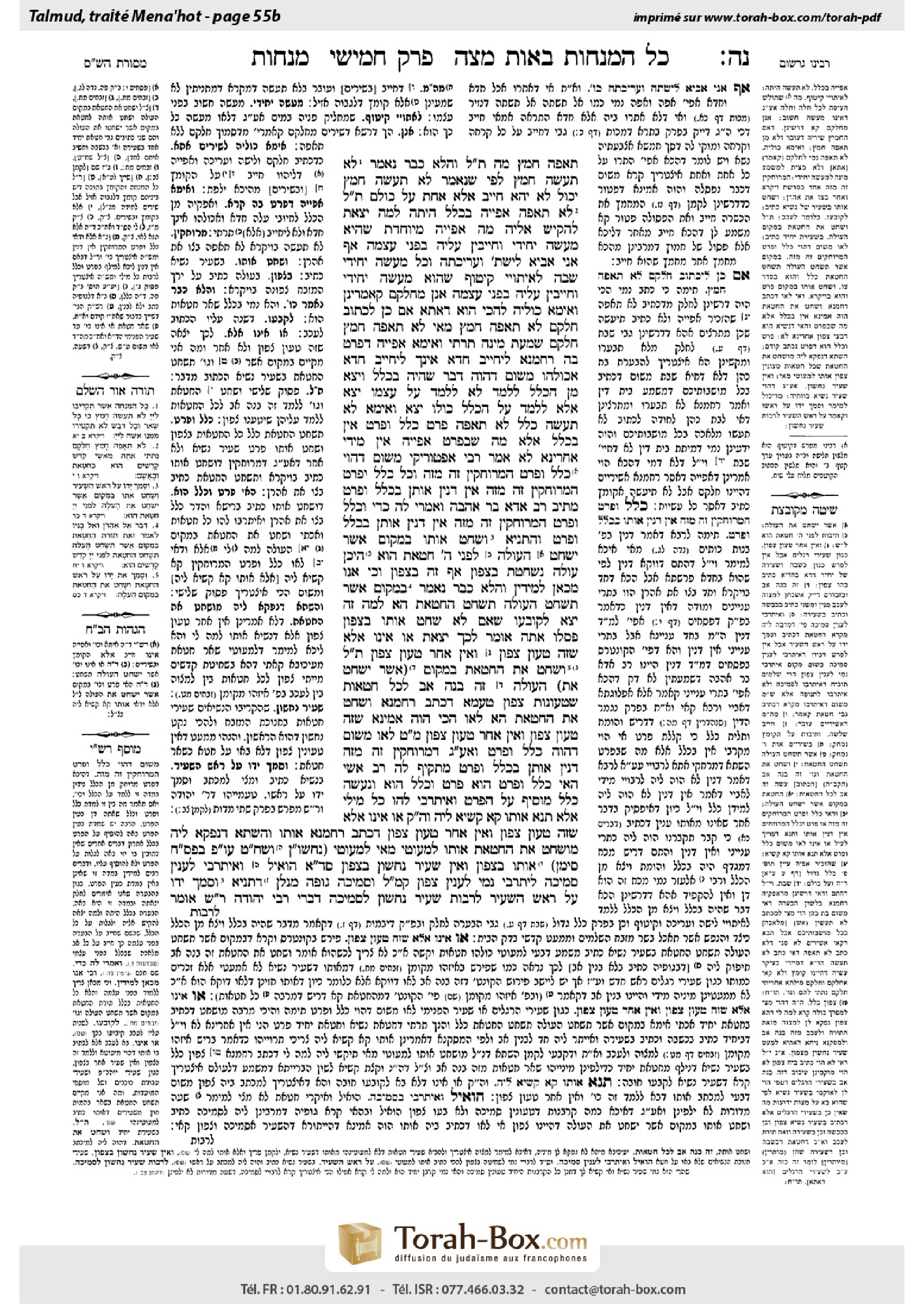
Menachot 55b: Talmud study for Daf Yomi
Daf Yomi is the daily study of one Talmud folio. Explore 37 tractates with scans, Hebrew text, Sefaria English and AI-generated French translations where annotated.
Passage selection and English or AI-generated French translation are available where the scan has annotations. Daf Study is independent of Torah-Box and Sefaria.
Browse Menachot · מנחות · All tractatesMenachot 55b text and translations
This page of Menachot includes the Aramaic text, an English translation and an AI-generated French translation, alongside the scan above.
מנחות נ״ה ב · Aramaic and Hebrew text
תֵאָפֶה חָמֵץ״ – מָה תַּלְמוּד לוֹמַר? וַהֲלֹא כְּבָר נֶאֱמַר ״לֹא תֵעָשֶׂה חָמֵץ״! לְפִי שֶׁנֶּאֱמַר ״לֹא תֵעָשֶׂה חָמֵץ״, יָכוֹל לֹא יְהֵא חַיָּיב אֶלָּא אַחַת עַל כּוּלָּם? תַּלְמוּד לוֹמַר: ״לֹא תֵאָפֶה״.
אֲפִיָּיה בַּכְּלָל הָיָתָה, לָמָּה יָצָאת לְהַקִּישׁ אֵלֶיהָ? מָה אֲפִיָּיה מְיוּחֶדֶת שֶׁהִיא מַעֲשֶׂה יְחִידִי, וְחַיָּיבִין עָלֶיהָ בִּפְנֵי עַצְמָהּ, אַף אֲנִי אָבִיא לִישָׁתָהּ וַעֲרִיכָתָהּ.
וְכׇל מַעֲשֶׂה יְחִידִי שֶׁבָּהּ, לְאֵיתוֹיֵי קִיטּוּף, שֶׁהוּא מַעֲשֶׂה יְחִידִי, וְחַיָּיבִין עָלֶיהָ בִּפְנֵי עַצְמָהּ.
אֲנַן מֵ״חֶלְקָם״ קָאָמְרִינַן.
וְאֵימָא: כּוּלֵּיהּ לְהָכִי הוּא דַּאֲתָא?
אִם כֵּן, לִכְתּוֹב ״חֶלְקָם לֹא תֵאָפֶה חָמֵץ״, מַאי ״לֹא תֵאָפֶה חָמֵץ חֶלְקָם״? שָׁמְעַתְּ מִינַּהּ תַּרְתֵּי.
וְאֵימָא: אֲפִיָּיה, דִּפְרַט בַּהּ רַחֲמָנָא, לִיחַיַּיב חֲדָא; אִינָךְ לִיחַיַּיב חֲדָא אַכּוּלְּהוּ! מִשּׁוּם דְּהָוֵה דָּבָר שֶׁהָיָה בַּכְּלָל וְיָצָא מִן הַכְּלָל לְלַמֵּד, לֹא לְלַמֵּד עַל עַצְמוֹ יָצָא, אֶלָּא לְלַמֵּד עַל הַכְּלָל כּוּלּוֹ יָצָא.
וְאֵימָא: ״לֹא תֵעָשֶׂה״ – כָּלַל, ״לֹא תֵאָפֶה״ – פָּרַט, כְּלָל וּפְרָט – אֵין בַּכְּלָל אֶלָּא מַה שֶּׁבַּפְּרָט; אֲפִיָּיה – אִין, מִידֵּי אַחֲרִינָא – לָא.
אָמַר רַבִּי אַפְטוֹרִיקִי: מִשּׁוּם דְּהָוֵי כְּלָל וּפְרָט הַמְרוּחָקִין זֶה מִזֶּה, וְכׇל כְּלָל וּפְרָט הַמְרוּחָקִין זֶה מִזֶּה – אֵין דָּנִין אוֹתָן בִּכְלָל וּפְרָט.
מֵתִיב רַב אַדָּא בַּר אַהֲבָה, וְאָמְרִי לַהּ כְּדִי: וּכְלָל וּפְרָט הַמְרוּחָקִין זֶה מִזֶּה אֵין דָּנִין אוֹתָן בִּכְלָל וּפְרָט? וְהָתַנְיָא: ״וְשָׁחַט אֹתוֹ בִּמְקוֹם אֲשֶׁר יִשְׁחַט הָעֹלָה לִפְנֵי ה׳ חַטָּאת הוּא״ – הֵיכָן עוֹלָה נִשְׁחֶטֶת? בַּצָּפוֹן, אַף זֶה בַּצָּפוֹן.
וְכִי אָנוּ מִכָּאן לְמֵידִין? וַהֲלֹא כְּבָר נֶאֱמַר: ״בִּמְקוֹם אֲשֶׁר תִּשָּׁחֵט הָעֹלָה תִּשָּׁחֵט הַחַטָּאת״! הָא לְמָה זֶה יָצָא? לְקוֹבְעוֹ, שֶׁאִם לֹא שָׁחַט אוֹתוֹ בַּצָּפוֹן – פְּסָלוֹ.
אַתָּה אוֹמֵר לְכָךְ יָצָאת, אוֹ אֵינוֹ אֶלָּא שֶׁזֶּה טָעוּן צָפוֹן וְאֵין אַחֵר טָעוּן צָפוֹן? תַּלְמוּד לוֹמַר ״וְשָׁחַט אֶת הַחַטָּאת בִּמְקוֹם אֲשֶׁר יִשְׁחַט אֶת הָעֹלָה״, זֶה בָּנָה אָב לְכׇל חַטָּאוֹת שֶׁטְּעוּנוֹת צָפוֹן.
טַעְמָא דִּכְתַב רַחֲמָנָא ״וְשָׁחַט אֶת הַחַטָּאת״, הָא לָאו הָכִי הֲוָה אָמֵינָא שֶׁזֶּה טָעוּן צָפוֹן, וְאֵין אַחֵר טָעוּן צָפוֹן. מַאי טַעְמָא?
לָאו מִשּׁוּם דְּהָוֵה כְּלָל וּפְרָט, וְאַף עַל גַּב דִּמְרוּחָקִין זֶה מִזֶּה, דָּנִין אוֹתָן בִּכְלָל וּפְרָט.
מַתְקֵיף לַהּ רַב אָשֵׁי: הַאי כְּלָל וּפְרָט הוּא?! פְּרָט וּכְלָל הוּא, וְנַעֲשָׂה כְּלָל מוֹסִיף עַל הַפְּרָט, (וְאִיתְרַבִּי) [וְאִיתְרַבּוֹ] לְהוּ כֹּל מִילֵּי.
אֶלָּא תַּנָּא, ״אֹתוֹ״ קָא קַשְׁיָא לֵיהּ, וְהָכִי קָאָמַר: אוֹ אֵינוֹ אֶלָּא שֶׁזֶּה טָעוּן צָפוֹן וְאֵין אַחֵר טָעוּן צָפוֹן, דִּכְתַב רַחֲמָנָא ״אֹתוֹ״.
וְהַשְׁתָּא דְּנָפְקָא לֵיהּ מִ״וְשָׁחַט אֶת הַחַטָּאת״, ״אֹתוֹ״ לְמַעוֹטֵי מַאי? לְמַעוֹטֵי (נַחְשׁוֹן, וְשָׁחַט, עוֹף, בַּפֶּסַח סִימָן).
״אוֹתוֹ״ בַּצָּפוֹן, וְאֵין שָׂעִיר נַחְשׁוֹן בַּצָּפוֹן.
סָלְקָא דַּעְתָּךְ אָמֵינָא: הוֹאִיל וְאִיתְרַבִּי לְעִנְיַן סְמִיכָה, לִיתְרַבֵּי נָמֵי לְעִנְיַן צָפוֹן, קָא מַשְׁמַע לַן.
וּסְמִיכָה גּוּפַהּ מְנָלַן? דְּתַנְיָא: ״וְסָמַךְ יָדוֹ עַל רֹאשׁ הַשָּׂעִיר״ – לְרַבּוֹת שְׂעִיר נַחְשׁוֹן לִסְמִיכָה, דִּבְרֵי רַבִּי יְהוּדָה. רַבִּי שִׁמְעוֹן אוֹמֵר:
Menachot 55b · English translation
be baked with leaven” (Leviticus 6:10). What is the meaning when the verse states this? Isn’t this requirement already stated earlier: “No meal offering that you shall bring to the Lord shall be made with leaven; as you shall burn no leaven nor any honey as an offering made by fire to the Lord” (Leviticus 2:11)? Rather, the phrase “it shall not be baked with leaven” serves to teach a different halakha. Since the prohibition concerning leaven is first stated in general terms: Shall not be made with leaven, without specification, one might have thought that one who causes a meal offering to become leaven will be liable to receive only one set of lashes for all of his actions, i.e., kneading, shaping, and baking the dough. Therefore, the verse states: “It shall not be baked with leaven,” which teaches that one who causes a meal offering to become leaven is liable separately for baking it, and for each stage of its preparation.
The baraita explains this derivation: Baking leaven was included in the general prohibition incorporating all of the stages involved in preparing the meal offering. Why did it emerge from the generalization to be mentioned explicitly? It emerged in order to compare the other stages to it: Just as the act of baking is notable in that it is a single, i.e., separately defined, action, and one is liable to receive lashes for it by itself if the dough is leaven, so too, I will include the other stages of the preparation of a meal offering, i.e., kneading it and shaping it, and conclude that one is liable separately for each of these actions if the dough is leavened.
And the same applies to any single action involved in the preparation of a meal offering. This statement serves to include the act of smoothing the surface of the dough with water. The reason this act is included is that although it is not a significant stage in the preparation of the dough, it is a single, independent action, and therefore one is liable to receive lashes for it by itself. This baraita demonstrates that one cannot derive the prohibition against allowing the remainder of a meal offering to become leavened from the verse: “It shall not be baked with leaven,” as this verse is the source of a different halakha. If so, from where is that prohibition derived?
The Gemara answers: The verse: “It shall not be baked with leaven,” is required for the principle stated earlier. We say that the prohibition against allowing the remainder of a meal offering to become leavened is derived from the subsequent phrase: “I have given it as their portion of My offerings made by fire” (Leviticus 6:10). The remainder is the portion of the meal offering eaten by the priests.
The Gemara challenges: But once it has been determined that the term “their portion” teaches the prohibition against leavening the remainder of a meal offering, one can say this entire section of the verse comes only for this purpose, which would mean that there is no source for the halakha that one is liable separately for each stage of the preparation of a meal offering with leaven.
The Gemara answers: One cannot say that this teaches only the prohibition against leavening the remainder of a meal offering, as if so, let the verse write: Their portion shall not be baked with leaven. What is meant by the fact that the verse stated it in a different order: “Shall not be baked with leaven. I have given it as their portion”? This indicates that one should learn from this two halakhot, i.e., that there is a prohibition against leavening the remainder of a meal offering and that one is liable to receive a separate set of lashes for each stage of preparation performed with leavened dough.
The Gemara raises another difficulty: But one can say that the act of baking is different, as the Merciful One specified it in the Torah, and therefore one should be liable to receive one set of lashes for baking the dough. As for the other stages in the preparation of a meal offering, i.e., kneading, shaping, and smoothing, which are not explicitly stated in the verse, let him be liable to receive one set of lashes for all of them. The Gemara answers that this cannot be the halakha, because baking is something that was included in a generalization but emerged from the generalization in order to teach a halakha. According to a hermeneutic principle, a case of this kind did not emerge to teach a halakha only about itself, but rather it emerged to teach a halakha about the entire generalization, in this case, about all the other stages in the preparation of a meal offering.
The Gemara further challenges: But one can say that the phrase: Shall not be made with leaven, is a generalization, as it does not mention any specific acts, and the phrase: “It shall not be baked with leaven,” is a detail, as it specifies one particular stage of the preparation; and there is another standard hermeneutic principle: When there is a generalization and a detail, the generalization is referring only to that which is specified in the detail. In this case, that would mean that baking, yes, is included in this prohibition, but other matters, e.g., kneading and shaping, are not included.
Rabbi Aptoriki said: That hermeneutic principle is not relevant here, because this is a case of a generalization and a detail that appear in the Torah distanced from one another, as the phrase: Shall not be made with leaven (Leviticus 2:11), is far from the expression: “It shall not be baked with leaven” (Leviticus 6:10). And for any instance of a generalization and a detail that appear in the Torah distanced from one another, one cannot derive a halakha from them by analyzing them as a generalization and a detail.
Rav Adda bar Ahava raises an objection, and some say that this objection is unattributed [kedi]: And is it correct that in the case of a generalization and a detail that appear in the Torah distanced from one another, one cannot derive a halakha from them by analyzing them as a generalization and a detail? But isn’t it taught in a baraita with regard to a goat brought by a king as a sin offering: The verse states: “And he shall place his hand upon the head of the goat, and slaughter it in the place where they slaughter the burnt offering before the Lord; it is a sin offering” (Leviticus 4:24). Where is the burnt offering slaughtered? On the northern side of the Temple courtyard, as it is stated: “And he shall slaughter it on the side of the altar northward before the Lord” (Leviticus 1:11). This sin offering of a king must consequently also be slaughtered in the north of the Temple courtyard.
The baraita asks: And do you learn this halakha from here? But isn’t it already stated: “Speak to Aaron and to his sons, saying: This is the law of the sin offering: In the place where the burnt offering is slaughtered shall the sin offering be slaughtered before God; it is most holy” (Leviticus 6:18)? If so, to what purpose was this singled out? Why does the Torah state explicitly that the sin offering of the king requires slaughter in the north? The baraita answers: It is to fix a place for it, that this is the only place where a sin offering may be slaughtered, teaching that if he did not slaughter it in the north of the Temple courtyard, he has disqualified it even after the fact.
The baraita asks: Do you say that it is singled out for this purpose, to teach that even after the fact a sin offering slaughtered anywhere other than in the north is disqualified? Or perhaps it is only to teach that this goat sin offering requires slaughter in the north, but no other goat sin offering requires slaughter in the north. The baraita answers: The verse states elsewhere: “And he shall place his hand upon the head of the sin offering, and slaughter the sin offering in the place of burnt offering” (Leviticus 4:29), and this established a paradigm for all sin offerings, that they require slaughter in the north. Therefore, the additional verse stated with regard to the sin offering of a king teaches that if he did not slaughter it in the north it is disqualified.
The Gemara analyzes the baraita. The reason that all sin offerings must be slaughtered in the north is that the Merciful One wrote: “And slaughter the sin offering in the place of the burnt offering,” from which it can be inferred that if not for this verse I would say that only this sin offering, the male goat brought by a king, requires slaughter in the north, but no other type of sin offering requires slaughter in the north. What is the reason for this? After all, the verse: “In the place where the burnt offering is slaughtered shall the sin offering be slaughtered,” appears to be referring to all types of sin offerings.
Isn’t it because this verse is a generalization and a detail, as the verse first generalizes about all sin offerings, and then the verse concerning the sin offering of a king: “And slaughter it in the place where they slaughter the burnt offering,” is a detail, as it is referring to a specific sin offering? And even though the verse concerning sin offerings and the verse concerning the sin offering of a king are distanced from one another, nevertheless we would derive a halakha from them by means of the principle of a generalization and a detail. This appears to disprove the explanation of Rabbi Aptoriki.
Rav Ashi objects to this claim raised by Rav Adda bar Ahava: Is this a generalization and a detail? It is in fact a detail and a generalization, as the verse: “And slaughter it in the place where they slaughter the burnt offering” (Leviticus 4:24), appears in the Torah earlier than the verse: “In the place where the burnt offering is slaughtered the sin offering shall be slaughtered” (Leviticus 6:18). A hermeneutic principle states that in this case the generalization adds to the detail, and includes all matters.
Rather, the reason that if not for the specific textual derivation we would have thought that only a sin offering brought by a king requires slaughter in the north is that the word “it,” which is an exclusion, is difficult for the tanna of the baraita, as it is unclear what this term serves to exclude. And this is what the baraita is saying: Or perhaps the verse is teaching that only this sin offering requires slaughter in the north, but no other type of sin offering requires slaughter in the north, as the Merciful One writes “it,” which is an exclusion. Therefore, the additional verse: “And slaughter the sin offering in the place of the burnt offering,” teaches that this halakha applies to all burnt offerings.
The Gemara asks: And now that the tanna of the baraita derives it from the phrase: “And slaughter the sin offering in the place of the burnt offering,” to exclude what does the term “it” serve? The Gemara answers: It serves to exclude the case that emerges from the following discussion, summarized by the mnemonic: Nahshon; and slaughter; bird; on Passover.
The Gemara explains the first suggestion: It, the goat sin offering of a king, is slaughtered in the north, but the goat offered by Nahshon, prince of the tribe of Judah, was not slaughtered in the north of the Tabernacle. He, along with all the other princes of the tribes, brought offerings to inaugurate the altar and the Tabernacle, as recorded in the Torah (see Numbers, chapter 7). The sin offerings brought at this time were unique because they were not brought to atone for any sin. The term “it” teaches that even though they had some characteristics of a sin offering, the offerings of the princes did not require slaughter in the north.
The Gemara explains: It might enter your mind to say that since the sin offerings of the princes are included in the requirement of placing hands, they are also included in the requirement to be slaughtered in the north. Therefore, the term “it” teaches us that there was no requirement of slaughter in the north for the goats brought as sin offerings by Nahshon and the other princes.
The Gemara asks: And from where do we derive that the requirement of placing hands on the head of the animal itself applies to the goats offered by Nahshon and the other princes? The Gemara answers: As it is taught in a baraita: The verse states with regard to the sin offering of a king: “And he shall place his hand upon the head of the goat, and slaughter it in the place where they slaughter the burnt offering before the Lord; it is a sin offering” (Leviticus 4:24). The verse could have stated: Upon its head. The reason it adds “of the goat” is to include the goat brought as a sin offering by Nahshon in the requirement of placing hands on the head of an offering. This is the statement of Rabbi Yehuda. Rabbi Shimon says:
Menachot 55b · Traduction française (IA)
« être cuite avec du levain » (Lévitique 6,10). Que signifie cette précision dans le verset ? Cette exigence n’a-t-elle pas déjà été énoncée auparavant : « Aucune offrande de farine que vous présenterez à l’Éternel ne sera faite avec du levain ; car vous ne ferez brûler ni levain ni miel comme offrande consumée par le feu pour l’Éternel » (Lévitique 2,11) ? L’expression « elle ne sera pas cuite avec du levain » vient plutôt enseigner une autre halakha. Puisque l’interdiction relative au levain est d’abord énoncée de manière générale — « ne sera pas faite avec du levain », sans autre précision —, on aurait pu penser que celui qui fait fermenter une offrande de farine n’est passible que d’une seule série de coups pour tous ses actes, c’est-à-dire le pétrissage, le façonnage et la cuisson de la pâte. Le verset dit donc : « Elle ne sera pas cuite avec du levain », enseignant que celui qui fait fermenter une offrande de farine est passible séparément pour sa cuisson et pour chaque étape de sa préparation.
La baraïta explique cette déduction : la cuisson avec du levain était incluse dans l’interdiction générale qui englobe toutes les étapes de la préparation de l’offrande de farine. Pourquoi a-t-elle été extraite de cette généralité pour être mentionnée explicitement ? Elle l’a été afin de comparer les autres étapes à la cuisson : de même que la cuisson se distingue en ce qu’elle constitue une action unique, c’est-à-dire définie séparément, et que l’on est passible de coups à ce seul titre si la pâte est levée, de même faut-il inclure les autres étapes de la préparation d’une offrande de farine, à savoir le pétrissage et le façonnage, et conclure que l’on est passible séparément pour chacune de ces actions si la pâte est levée.
Il en va de même pour toute action unique liée à la préparation d’une offrande de farine. Cette affirmation inclut le lissage de la surface de la pâte avec de l’eau. Cette action est incluse parce que, bien qu’elle ne constitue pas une étape importante de la préparation de la pâte, elle est unique et indépendante ; on est donc passible de coups à ce seul titre. Cette baraïta montre qu’on ne peut pas déduire du verset « Elle ne sera pas cuite avec du levain » l’interdiction de laisser le reste d’une offrande de farine fermenter, car ce verset est la source d’une autre halakha. Si tel est le cas, de quelle source déduit-on cette interdiction ?
La Guemara répond : le verset « Elle ne sera pas cuite avec du levain » est nécessaire pour le principe énoncé précédemment. Nous disons que l’interdiction de laisser le reste d’une offrande de farine fermenter se déduit de la phrase suivante : « Je l’ai donnée comme leur part de mes offrandes consumées par le feu » (Lévitique 6,10). Le reste constitue la part de l’offrande de farine consommée par les prêtres.
La Guemara objecte : mais, une fois établi que l’expression « leur part » enseigne l’interdiction de faire fermenter le reste d’une offrande de farine, on peut dire que toute cette section du verset ne sert qu’à cela ; il n’y aurait alors aucune source pour la halakha selon laquelle on est passible séparément pour chaque étape de la préparation d’une offrande de farine avec du levain.
La Guemara répond : on ne peut pas dire que le verset enseigne uniquement l’interdiction de faire fermenter le reste d’une offrande de farine, car, dans ce cas, que le verset dise : « Leur part ne sera pas cuite avec du levain. » Que signifie donc l’ordre différent des termes dans le verset : « Elle ne sera pas cuite avec du levain. Je l’ai donnée comme leur part » ? Cela indique qu’il faut en tirer deux halakhot : l’interdiction de faire fermenter le reste d’une offrande de farine et l’obligation de recevoir une série distincte de coups pour chaque étape de préparation effectuée avec une pâte levée.
La Guemara soulève une autre difficulté : on peut dire que la cuisson est différente, puisque le Miséricordieux l’a précisée dans la Torah ; on est donc passible d’une série de coups pour avoir cuit la pâte. Quant aux autres étapes de la préparation d’une offrande de farine — le pétrissage, le façonnage et le lissage —, qui ne sont pas explicitement mentionnées dans le verset, qu’on soit passible d’une seule série de coups pour l’ensemble. La Guemara répond que cela ne peut pas être la halakha, car la cuisson était incluse dans une généralité, puis en a été extraite afin d’enseigner une halakha. Selon un principe herméneutique, un cas de ce genre n’a pas été extrait pour enseigner une halakha le concernant uniquement, mais pour enseigner une halakha sur l’ensemble de la généralité, en l’occurrence sur toutes les autres étapes de la préparation d’une offrande de farine.
La Guemara objecte encore : on peut dire que l’expression « ne sera pas faite avec du levain » est une généralité, puisqu’elle ne mentionne aucun acte particulier, et que l’expression « elle ne sera pas cuite avec du levain » est une précision, puisqu’elle désigne une étape particulière de la préparation ; or il existe un autre principe herméneutique courant : lorsqu’une généralité et une précision se suivent, la généralité ne vise que ce qui est spécifié dans la précision. Dans ce cas, cela signifierait que la cuisson est incluse dans cette interdiction, mais pas les autres opérations, comme le pétrissage et le façonnage.
Rabbi Aptoriki dit : ce principe herméneutique ne s’applique pas ici, car il s’agit d’une généralité et d’une précision qui apparaissent dans la Torah à distance l’une de l’autre : l’expression « ne sera pas faite avec du levain » (Lévitique 2,11) est éloignée de l’expression « elle ne sera pas cuite avec du levain » (Lévitique 6,10). Or, lorsqu’une généralité et une précision apparaissent dans la Torah à distance l’une de l’autre, on ne peut pas en déduire une halakha en les analysant comme une généralité et une précision.
Rav Adda bar Ahava soulève une objection — et certains disent que cette objection est anonyme [kedi] : est-il exact que, dans le cas d’une généralité et d’une précision qui apparaissent dans la Torah à distance l’une de l’autre, on ne peut pas en déduire une halakha en les analysant comme une généralité et une précision ? Mais n’enseigne-t-on pas dans une baraïta, à propos du bouc qu’un roi apporte comme sacrifice expiatoire : le verset dit : « Il posera sa main sur la tête du bouc et l’égorgera à l’endroit où l’on égorge l’holocauste devant l’Éternel ; c’est un sacrifice expiatoire » (Lévitique 4,24). Où l’holocauste est-il égorgé ? Du côté nord du parvis du Temple, comme il est dit : « Il l’égorgera du côté nord de l’autel, devant l’Éternel » (Lévitique 1,11). Ce sacrifice expiatoire du roi doit donc lui aussi être égorgé au nord du parvis du Temple.
La baraïta demande : est-ce de là que tu apprends cette halakha ? N’est-il pas déjà dit : « Parle à Aaron et à ses fils, en ces termes : Voici la loi du sacrifice expiatoire : à l’endroit où l’on égorge l’holocauste, on égorgera le sacrifice expiatoire devant Dieu ; il est très saint » (Lévitique 6,18) ? À quoi sert donc cette mention particulière ? Pourquoi la Torah précise-t-elle que le sacrifice expiatoire du roi doit être égorgé au nord ? La baraïta répond : elle sert à lui fixer un emplacement, c’est-à-dire que c’est le seul endroit où un sacrifice expiatoire peut être égorgé ; elle enseigne que s’il ne l’a pas égorgé au nord du parvis du Temple, il l’a disqualifié, même après coup.
La baraïta demande : dis-tu qu’il est mentionné à part dans ce but, pour enseigner que même après coup, un sacrifice expiatoire égorgé ailleurs qu’au nord est disqualifié ? Ou peut-être est-ce seulement pour enseigner que ce sacrifice expiatoire — un bouc — doit être égorgé au nord, tandis qu’aucun autre sacrifice expiatoire apporté sous la forme d’un bouc n’a besoin d’être égorgé au nord ? La baraïta répond : le verset dit ailleurs : « Il posera sa main sur la tête du sacrifice expiatoire et égorgera le sacrifice expiatoire à l’endroit où l’on égorge l’holocauste » (Lévitique 4,29), établissant ainsi un modèle pour tous les sacrifices expiatoires : ils doivent être égorgés au nord. Le verset supplémentaire relatif au sacrifice expiatoire du roi enseigne donc que, s’il ne l’a pas égorgé au nord, il est disqualifié.
La Guemara analyse la baraïta. Si tous les sacrifices expiatoires doivent être égorgés au nord, c’est parce que le Miséricordieux a écrit : « Et égorgera le sacrifice expiatoire à l’endroit où l’on égorge l’holocauste », d’où l’on peut déduire que, sans ce verset, j’aurais dit que seul ce sacrifice expiatoire — le bouc mâle apporté par un roi — doit être égorgé au nord, mais qu’aucun autre type de sacrifice expiatoire n’a besoin de l’être. Pourquoi en serait-il ainsi ? Après tout, le verset « À l’endroit où l’on égorge l’holocauste, on égorgera le sacrifice expiatoire » semble se rapporter à tous les types de sacrifices expiatoires.
N’est-ce pas parce que ce verset constitue une généralité et une précision : le verset énonce d’abord une généralité au sujet de tous les sacrifices expiatoires, puis le verset concernant le sacrifice expiatoire du roi — « Et l’égorgera à l’endroit où l’on égorge l’holocauste » — apporte une précision, puisqu’il vise un sacrifice expiatoire particulier ? Et même si le verset concernant les sacrifices expiatoires et celui concernant le sacrifice expiatoire du roi sont éloignés l’un de l’autre, nous en déduirions néanmoins une halakha au moyen du principe de la généralité et de la précision. Cela semble réfuter l’explication de Rabbi Aptoriki.
Rav Ashi conteste cette affirmation de Rav Adda bar Ahava : s’agit-il d’une généralité et d’une précision ? C’est en réalité une précision suivie d’une généralité, car le verset « Et l’égorgera à l’endroit où l’on égorge l’holocauste » (Lévitique 4,24) apparaît dans la Torah avant le verset « À l’endroit où l’on égorge l’holocauste, on égorgera le sacrifice expiatoire » (Lévitique 6,18). Un principe herméneutique stipule que, dans ce cas, la généralité ajoute à la précision et inclut toutes les choses.
La raison pour laquelle, sans cette déduction textuelle précise, on aurait pensé que seul un sacrifice expiatoire apporté par un roi doit être égorgé au nord est plutôt que le mot « le », qui exprime une exclusion, pose problème au tanna de la baraïta, car on ne voit pas ce que ce terme sert à exclure. Voici ce que dit la baraïta : ou peut-être le verset enseigne-t-il que seul ce sacrifice expiatoire doit être égorgé au nord, mais qu’aucun autre type de sacrifice expiatoire n’a besoin de l’être, puisque le Miséricordieux écrit « le », un terme d’exclusion. Le verset supplémentaire « Et égorgera le sacrifice expiatoire à l’endroit où l’on égorge l’holocauste » enseigne donc que cette halakha s’applique à tous les sacrifices expiatoires.
La Guemara demande : et maintenant que le tanna de la baraïta déduit cette halakha de l’expression « Et égorgera le sacrifice expiatoire à l’endroit où l’on égorge l’holocauste », qu’est-ce que le terme « le » sert à exclure ? La Guemara répond : il sert à exclure le cas qui ressort de la discussion suivante, résumée par le moyen mnémotechnique : Nahshon ; égorger ; oiseau ; à Pessa’h.
La Guemara explique la première suggestion : lui, le bouc offert comme sacrifice expiatoire par un roi, est égorgé au nord, mais le bouc apporté par Nahshon, prince de la tribu de Juda, n’a pas été égorgé au nord du Tabernacle. Nahshon, ainsi que tous les autres princes des tribus, apporta des offrandes pour inaugurer l’autel et le Tabernacle, comme le rapporte la Torah (voir Nombres, chapitre 7). Les sacrifices expiatoires apportés à cette occasion étaient particuliers, car ils n’étaient pas offerts pour expier une faute. Le terme « le » enseigne que, bien qu’elles présentent certaines caractéristiques d’un sacrifice expiatoire, les offrandes des princes n’avaient pas à être égorgées au nord.
La Guemara explique : on aurait pu penser que, puisque les sacrifices expiatoires des princes sont soumis à l’obligation d’imposer les mains, ils sont également soumis à l’obligation d’être égorgés au nord. Le terme « le » nous enseigne donc que les boucs apportés comme sacrifices expiatoires par Nahshon et les autres princes n’étaient pas soumis à l’obligation d’être égorgés au nord.
La Guemara demande : d’où déduit-on que l’obligation d’imposer les mains sur la tête de l’animal lui-même s’applique aux boucs offerts par Nahshon et les autres princes ? La Guemara répond : une baraïta enseigne qu’au sujet du sacrifice expiatoire du roi, le verset dit : « Il posera sa main sur la tête du bouc et l’égorgera à l’endroit où l’on égorge l’holocauste devant l’Éternel ; c’est un sacrifice expiatoire » (Lévitique 4,24). Le verset aurait pu dire : « sur sa tête ». S’il ajoute « du bouc », c’est pour inclure le bouc apporté comme sacrifice expiatoire par Nahshon dans l’obligation d’imposer les mains sur la tête d’une offrande. Telle est la déclaration de Rabbi Yehouda. Rabbi Shimon dit :
Traduction française générée par IA à partir de l’édition anglaise de Sefaria. Vérifie toujours un passage avec le texte source.
Text from Sefaria: William Davidson Edition - Vocalized Aramaic (unknown); William Davidson Edition - English (CC BY NC).