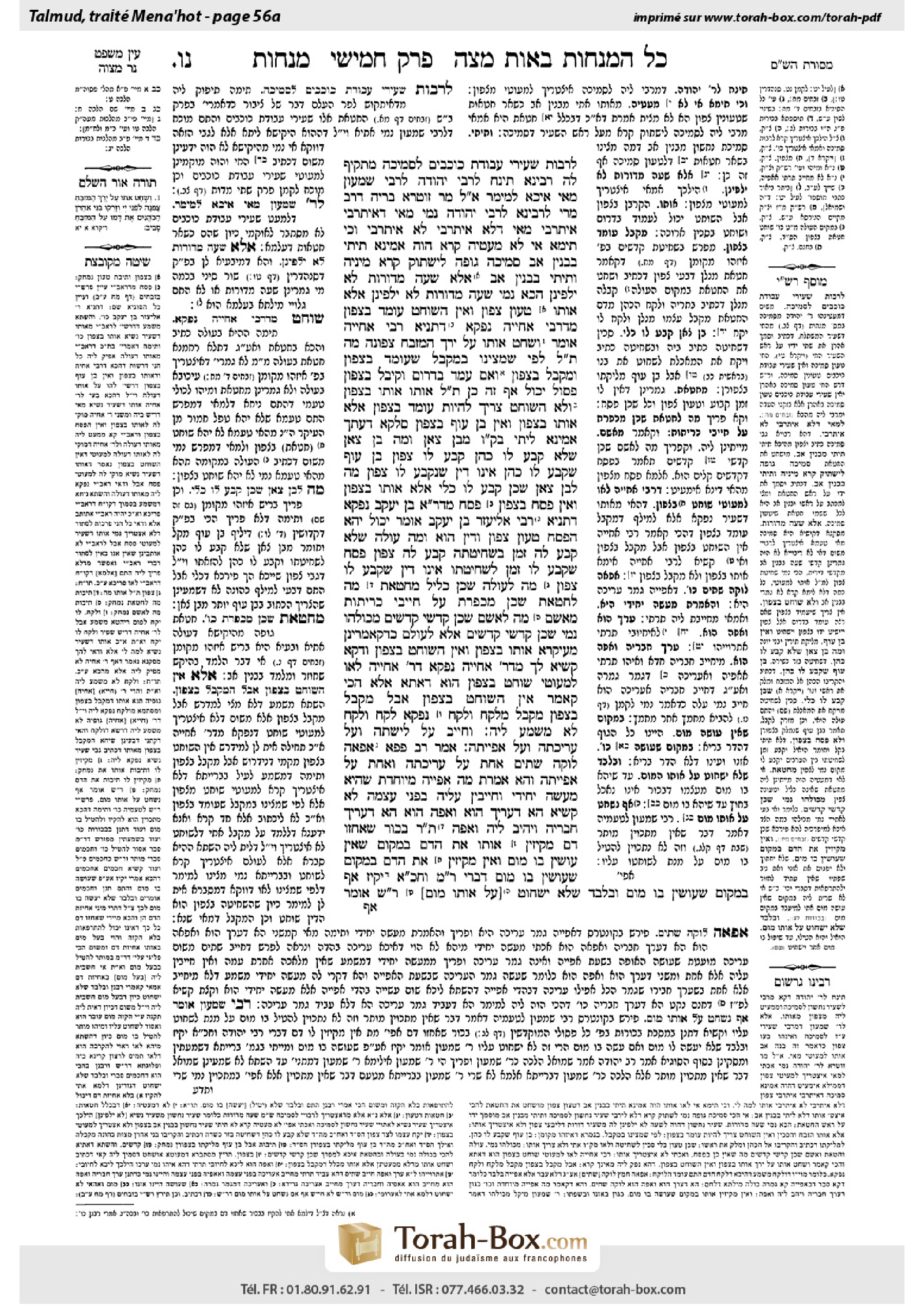
Menachot 56a: Talmud study for Daf Yomi
Daf Yomi is the daily study of one Talmud folio. Explore 37 tractates with scans, Hebrew text, Sefaria English and AI-generated French translations where annotated.
Passage selection and English or AI-generated French translation are available where the scan has annotations. Daf Study is independent of Torah-Box and Sefaria.
Browse Menachot · מנחות · All tractatesMenachot 56a text and translations
This page of Menachot includes the Aramaic text, an English translation and an AI-generated French translation, alongside the scan above.
מנחות נ״ו א · Aramaic and Hebrew text
לְרַבּוֹת שְׂעִירֵי עֲבוֹדָה זָרָה לִסְמִיכָה.
מַתְקֵיף לַהּ רָבִינָא: תִּינַח לְרַבִּי יְהוּדָה, לְרַבִּי שִׁמְעוֹן מַאי אִיכָּא לְמֵימַר?
אֲמַר לֵיהּ מָר זוּטְרָא בְּרֵיהּ דְּרַב מָרִי לְרָבִינָא: לְרַבִּי יְהוּדָה נָמֵי, מַאי דְּאִיתְרַבִּי – אִיתְרַבִּי, מַאי דְּלָא אִיתְרַבִּי – לָא אִיתְרַבִּי.
וְכִי תֵּימָא, אִי לָא מַעֲטֵיהּ קְרָא, הֲוָה אָמֵינָא תֵּיתֵי בְּבִנְיַן אָב, סְמִיכָה גּוּפַהּ לִישְׁתּוֹק קְרָא מִינֵּיהּ וְתֵיתֵי בְּבִנְיַן אָב! אֶלָּא, שָׁעָה מִדּוֹרוֹת לָא יָלְפִינַן. הָכָא נָמֵי, שָׁעָה מִדּוֹרוֹת לָא יָלְפִינַן.
אֶלָּא, ״אוֹתוֹ״ טָעוּן צָפוֹן, וְאֵין הַשּׁוֹחֵט עוֹמֵד בַּצָּפוֹן.
מִדְּרַבִּי אֲחִיָּיה נָפְקָא! דְּתַנְיָא: רַבִּי אֲחִיָּיה אוֹמֵר: ״וְשָׁחַט אֹתוֹ עַל יֶרֶךְ הַמִּזְבֵּחַ צָפוֹנָה״, מָה תַּלְמוּד לוֹמַר?
לְפִי שֶׁמָּצִינוּ בִּמְקַבֵּל, שֶׁעוֹמֵד בַּצָּפוֹן וּמְקַבֵּל בַּצָּפוֹן, וְאִם עָמַד בְּדָרוֹם וְקִיבֵּל בַּצָּפוֹן – פָּסוּל, יָכוֹל אַף זֶה כֵּן? תַּלְמוּד לוֹמַר: ״אֹתוֹ״ – אוֹתוֹ בַּצָּפוֹן, וְלֹא הַשּׁוֹחֵט צָרִיךְ לִהְיוֹת עוֹמֵד בַּצָּפוֹן!
אֶלָּא, אוֹתוֹ בַּצָּפוֹן, וְאֵין בֶּן עוֹף בַּצָּפוֹן. סָלְקָא דַּעְתָּךְ אָמֵינָא: לֵיתֵי בְּקַל וָחוֹמֶר מִבֶּן צֹאן – וּמָה בֶּן צֹאן שֶׁלָּא קָבַע לוֹ כֹּהֵן קָבַע לוֹ צָפוֹן, בֶּן עוֹף שֶׁקָּבַע לוֹ כֹּהֵן – אֵינוֹ דִּין שֶׁנִּקְבַּע לוֹ צָפוֹן?
מָה לְבֶן צֹאן, שֶׁכֵּן קָבַע לוֹ כְּלִי.
אֶלָּא: ״אוֹתוֹ״ בַּצָּפוֹן, וְאֵין פֶּסַח בַּצָּפוֹן. פֶּסַח מִדְּרַבִּי אֱלִיעֶזֶר בֶּן יַעֲקֹב נָפְקָא.
דְּתַנְיָא, רַבִּי אֱלִיעֶזֶר בֶּן יַעֲקֹב אוֹמֵר: יָכוֹל יְהֵא הַפֶּסַח טָעוּן צָפוֹן? וְדִין הוּא, וּמָה עוֹלָה שֶׁלָּא קָבַע לָהּ זְמַן בִּשְׁחִיטָתָהּ קָבַע לָהּ צָפוֹן, פֶּסַח שֶׁקָּבַע לוֹ זְמַן לִשְׁחִיטָתוֹ – אֵינוֹ דִּין שֶׁקָּבַע לוֹ צָפוֹן!
מָה לְעוֹלָה, שֶׁכֵּן כָּלִיל!
מֵחַטָּאת – מָה לְחַטָּאת שֶׁכֵּן מְכַפֶּרֶת עַל חַיָּיבֵי כָרֵיתוֹת!
מֵאָשָׁם – מָה לְאָשָׁם שֶׁכֵּן קׇדְשֵׁי קָדָשִׁים, מִכּוּלְּהוּ נָמֵי שֶׁכֵּן קׇדְשֵׁי קָדָשִׁים.
אֶלָּא לְעוֹלָם כִּדְקָאָמְרִינַן מֵעִיקָּרָא, ״אוֹתוֹ״ בַּצָּפוֹן, וְאֵין הַשּׁוֹחֵט בַּצָּפוֹן. וּדְקָא קַשְׁיָא לָךְ מִדְּרַבִּי אֲחִיָּיה נָפְקָא – דְּרַבִּי אֲחִיָּיה לָאו לְמַעוֹטֵי שׁוֹחֵט בַּצָּפוֹן הוּא דַּאֲתָא, אֶלָּא הָכִי קָאָמַר: אֵין הַשּׁוֹחֵט בְּצָפוֹן, אֲבָל מְקַבֵּל בַּצָּפוֹן.
מְקַבֵּל מִ״לָּקַח״ ״וְלָקַח״ נָפְקָא, ״לָקַח״ ״וְלָקַח״ לָא מַשְׁמַע לֵיהּ.
וְחַיָּיב עַל לִישָׁתָהּ, וְעַל עֲרִיכָתָהּ, וְעַל אֲפִיָּיתָהּ. אָמַר רַב פָּפָּא: אֲפָאָהּ – לוֹקֶה שְׁתַּיִם, אַחַת עַל עֲרִיכָתָהּ, וְאַחַת עַל אֲפִיָּיתָהּ. וְהָא אָמְרַתְּ: מָה אֲפִיָּיה מְיוּחֶדֶת שֶׁהִיא מַעֲשֶׂה יְחִידִי וְחַיָּיבִין עָלֶיהָ בִּפְנֵי עַצְמָהּ?
לָא קַשְׁיָא, הָא דַּעֲרַךָ הוּא וַאֲפָה הוּא, הָא דַּעֲרַךָ חַבְרֵיהּ וִיהַיב לֵיהּ וַאֲפָה.
תָּנוּ רַבָּנַן: בְּכוֹר שֶׁאֲחָזוֹ דָּם, מַקִּיזִין אוֹתוֹ אֶת הַדָּם בִּמְקוֹם שֶׁאֵין עוֹשִׂין בּוֹ מוּם, וְאֵין מַקִּיזִין אֶת הַדָּם בִּמְקוֹם שֶׁעוֹשִׂין בּוֹ מוּם, דִּבְרֵי רַבִּי מֵאִיר.
וַחֲכָמִים אוֹמְרִים: יַקִּיז, אַף בִּמְקוֹם שֶׁעוֹשִׂין בּוֹ מוּם, וּבִלְבַד שֶׁלֹּא יִשְׁחוֹט עַל אוֹתוֹ מוּם. רַבִּי שִׁמְעוֹן אוֹמֵר:
Menachot 56a · English translation
The term “of the goat” serves to include the goats brought as communal sin offerings for idol worship in the requirement of placing hands on the head of an offering.
Ravina objects to this: This works out well according to the opinion of Rabbi Yehuda, who says that the offering of Nahshon was included in the requirement of placing hands on the head of the animal. But according to the opinion of Rabbi Shimon, what is there to say? Why should the Torah write the term “it,” since there is no reason to assume that it would require slaughter in the north?
Mar Zutra, son of Rav Mari, said to Ravina: And according to the opinion of Rabbi Yehuda as well, why not say that for that which it was included, i.e., placing hands on the head of an animal, it was included; and for that which it was not included, i.e., slaughter in the north, it was not included. Why would one think that the obligation to slaughter in the north applies to the offering of Nahshon merely because the requirement of placing hands applies to that offering?
And if you would say that had the verse not excluded the offerings of the princes I would say that one could derive the requirement for slaughter in the north via a paradigm from all other sin offerings, if so, one could also derive the requirement for placing hands on the head of an animal itself via the same paradigm. Rather, the reason that the requirement of placing hands cannot be derived via a paradigm is that we do not learn the requirements of the sin offering of Nahshon, which was for the time of the inauguration of the Tabernacle alone, from the requirements of sin offerings applicable to all generations. So too, the requirement of slaughter in the north cannot be derived via a paradigm because we do not learn the requirements of the sin offering of Nahshon, which was for the time of the inauguration of the Tabernacle alone, from the requirement of sin offerings applicable to all generations.
Rather, the term “it” stated with regard to the sin offering of a king serves to teach that it must be slaughtered in the north of the Temple courtyard, but the one who slaughters it does not need to stand in the north when he slaughters. The offering would be valid even if he were to stand in the south of the courtyard and use a long knife to slaughter the animal that is positioned in the north.
The Gemara challenges this: The halakha of the one who slaughters has already been derived from the statement of Rabbi Aḥiyya, as it is taught in a baraita: Rabbi Aḥiyya says: The verse states with regard to the burnt offering: “And he shall slaughter it on the side of the altar northward before God” (Leviticus 1:11). Why must the verse state the exclusionary term “it”?
He explains: Since we have found that the priest stands in the north and collects the blood from the neck of the animal in the north, and if he stood in the south and collected the blood in the north the offering is disqualified, one might have thought that this is so also with regard to this one who slaughters the offering. Therefore, the verse states: “And he shall slaughter it,” to teach that it, the animal, must be in the north, but the one who slaughters does not have to be standing in the north of the Temple courtyard when he slaughters the animal. The question returns: What is derived from the exclusionary term “it” stated with regard to the sin offering of a king?
The Gemara answers: Rather, the term “it” stated with regard to the sin offering of a king serves to teach that it, a goat brought as a sin offering, must be slaughtered in the north, but a bird brought as an offering does not need to be killed in the north. It might enter your mind to say: Let it be derived that a bird must be killed in the north by an a fortiori inference from the halakha of a sheep, as follows: Just as is the case for a sheep brought as a burnt offering, that the Torah did not fix that its slaughter must be performed by a priest, yet nevertheless it fixed that its slaughter must be in the north, with regard to a bird brought as an offering, for which the Torah did fix that its slaughter must be performed by a priest, is it not logical that the Torah should also fix its slaughter in the north? Therefore, the verse states “it,” to exclude a bird from the requirement of being killed in the north.
The Gemara questions the logical inference. One cannot derive the halakha of a bird offering from the halakha of a sheep offering, as what is notable about a sheep offering? It is notable in that the Torah fixed the requirement that it be slaughtered with a utensil, i.e., a knife. By contrast, a bird is killed by the priest pinching the nape of its neck with his fingernail, without a utensil. Therefore, the term “it” cannot serve to counter this derivation. If so, there is no reason to think that a bird should also have to be killed in the north, and the term “it” is not necessary to exclude this possibility.
The Gemara explains: Rather, the term “it” stated with regard to the sin offering of a king serves to teach that it, the goat of the king, is slaughtered in the north, but the Paschal offering is not slaughtered in the north. The Gemara raises a difficulty: The halakha that the Paschal offering need not be slaughtered in the north is not derived from the term: “It,” but rather it is derived as stated by Rabbi Eliezer ben Yaakov.
As it is taught in a baraita: Rabbi Eliezer ben Yaakov says: One might have thought that a Paschal offering requires slaughter in the north. And this can be derived through a logical inference: Just as in the case of a burnt offering, for which the Torah did not fix a time for its slaughter yet fixed that it requires slaughter in the north, with regard to a Paschal offering, for which the Torah fixed a time for its slaughter, i.e., it must be slaughtered in the afternoon of the fourteenth day of Nisan, is it not logical that the Torah would fix that it must be slaughtered in the north? Therefore, the verse states “it,” to exclude the Paschal offering from the requirement of slaughter in the north.
The Gemara questions the logical inference. One cannot derive the halakha of a Paschal offering from the halakha of a burnt offering, as what is notable about a burnt offering? It is notable in that the Torah teaches that it is entirely burned on the altar. This is not so with regard to a Paschal offering.
The Gemara continues: If you would suggest learning a logical inference from the halakha of a sin offering, which is not entirely burned upon the altar yet is slaughtered only in the north, this too can be refuted. As what is notable about a sin offering? It is notable in that it has the power to atone for those sins liable for punishment by excision from the World-to-Come [karet], which is not so with regard to a Paschal offering.
The Gemara continues: If you would suggest learning a logical inference from the halakha of a guilt offering, which is not entirely burned, does not atone for those sins liable for punishment by karet, and is slaughtered only in the north, this too can be refuted. As what is notable about a guilt offering? It is notable in that it is an offering of the most sacred order, which is not so with regard to a Paschal offering. The Gemara adds: Having noted this distinction between a guilt offering and a Paschal offering, one can say that for all of the three offerings the halakha of a Paschal offering cannot be derived from them either, since each of them is an offering of the most sacred order.
The Gemara returns to the earlier inference: Rather, the term “it” teaches as we said initially: It, i.e., the animal, must be standing in the north, but the one who slaughters the animal does not have to stand in the north. And that which is difficult for you, that we derive this halakha from the statement of Rabbi Aḥiyya, is in fact not difficult. The derivation of Rabbi Aḥiyya from the term “it” does not come to exclude one who slaughters from the requirement to slaughter in the north, since that is known already from the term “it” stated with regard to the sin offering of a king. Rather, this is what Rabbi Aḥiyya is saying: The one who slaughters the animal does not have to stand in the north, but by inference, the one who collects the blood from the neck of the animal must stand in the north.
The Gemara questions this inference: The halakha that the one who collects the blood from the neck of the animal must stand in the north is derived from the fact that the Torah could have written: The priest shall take, and instead writes: “And the priest shall take” (Leviticus 4:34). The Gemara explains: This tanna does not learn anything from this distinction between: The priest shall take, and: “And the priest shall take.” Since he does not agree with this derivation, he must therefore derive the requirement to collect the blood while standing in the north from a different verse.
§ The mishna teaches: And one is liable to be flogged for kneading the meal offering, and for shaping it, and for baking it, if the meal offering becomes leaven. Rav Pappa said: If one baked a meal offering as leaven he is flogged with two sets of lashes, one for shaping the dough and one for baking it. The Gemara raises a difficulty: But you said in the baraita: Just as the act of baking is notable in that it is a single action and one is liable to receive lashes for it by itself; this indicates that one receives one set of lashes for baking a meal offering as leavened bread, not two.
The Gemara answers: This is not difficult, as this statement of the baraita, i.e., that one receives a single set of lashes for baking, is referring to a case where he shaped the dough and he, the same person, also baked it. Since he already incurred liability to receive lashes for shaping the dough before he baked it, he is not liable again for shaping when he bakes it. That statement of Rav Pappa, that one who bakes the dough is liable to receive two sets of lashes, is referring to a situation where another person shaped the dough and gave the shaped dough to him, and he baked it. Although the one who shaped it is liable to receive lashes for the act of shaping, nevertheless, the one who bakes it is liable to receive two sets of lashes, as his act of baking also completed the shaping of the dough.
§ The Gemara continues to discuss the leavening of a meal offering. The Sages taught in a baraita (Tosefta, Bekhorot 3:6): In the case of an unblemished firstborn kosher animal whose blood circulation is constricted, a condition that can be healed only through bloodletting, one may let the animal’s blood by cutting it in a place where the incision does not cause a permanent blemish. But one may not let the animal’s blood by cutting it in a place where the incision causes a permanent blemish, as it is prohibited to intentionally cause a blemish in a firstborn animal; this is the statement of Rabbi Meir.
And the Rabbis say: One may even let the animal’s blood by cutting it in a place where the incision causes a permanent blemish, provided that he does not slaughter the animal on the basis of that blemish, even though in general, a firstborn animal may be slaughtered once it develops a permanent blemish. The Rabbis maintain that in this case, since he caused the blemish himself, he may not slaughter it until it develops a different, unrelated blemish. Rabbi Shimon says:
Menachot 56a · Traduction française (IA)
Le terme « du bouc » sert à inclure les boucs offerts comme sacrifices expiatoires communautaires pour l’idolâtrie dans l’obligation de poser les mains sur la tête de l’offrande.
Ravina objecte : Cela s’explique bien selon l’opinion de Rabbi Yehouda, qui dit que l’offrande de Nahshon était soumise à l’obligation de poser les mains sur la tête de l’animal. Mais, selon l’opinion de Rabbi Shimon, que répondre ? Pourquoi la Torah aurait-elle écrit le terme « elle », puisqu’il n’y a aucune raison de supposer que l’égorgement devait avoir lieu au nord ?
Mar Zutra, fils de Rav Mari, dit à Ravina : Même selon l’opinion de Rabbi Yehouda, pourquoi ne pas dire que l’offrande a été incluse pour ce qui la concernait, c’est-à-dire l’imposition des mains sur la tête de l’animal, mais pas pour ce qui ne la concernait pas, c’est-à-dire l’égorgement au nord ? Pourquoi penser que l’obligation d’égorger au nord s’applique à l’offrande de Nahshon simplement parce que l’obligation de poser les mains s’applique à cette offrande ?
Et si tu dis que, si le verset n’avait pas exclu les offrandes des princes, on aurait pu déduire l’obligation d’égorger au nord par analogie avec tous les autres sacrifices expiatoires, alors on pourrait aussi déduire par la même analogie l’obligation de poser les mains sur la tête de l’animal. Au contraire, si l’obligation de poser les mains ne peut être déduite par analogie, c’est parce que nous ne déduisons pas les règles du sacrifice expiatoire de Nahshon, qui ne concernait que l’époque de l’inauguration du Tabernacle, des règles des sacrifices expiatoires applicables à toutes les générations. De même, l’obligation d’égorger au nord ne peut être déduite par analogie, car nous ne déduisons pas les règles du sacrifice expiatoire de Nahshon, qui ne concernait que l’époque de l’inauguration du Tabernacle, des règles des sacrifices expiatoires applicables à toutes les générations.
Au contraire, le terme « elle », énoncé à propos du sacrifice expiatoire d’un roi, enseigne que l’animal doit être égorgé au nord du parvis du Temple, mais que celui qui l’égorge n’a pas besoin de se tenir au nord pendant l’égorgement. L’offrande serait valide même s’il se tenait au sud du parvis et utilisait un long couteau pour égorger l’animal placé au nord.
La Guemara objecte : La halakha concernant celui qui égorge a déjà été déduite de l’enseignement de Rabbi Aḥiyya, comme on l’enseigne dans une baraïta : Rabbi Aḥiyya dit : À propos de l’holocauste, le verset dit : « Il l’égorgera sur le côté nord de l’autel, devant Dieu » (Lévitique 1,11). Pourquoi le verset emploie-t-il le terme restrictif « elle » ?
Il explique : Nous avons appris que le prêtre se tient au nord et recueille au nord le sang au niveau du cou de l’animal ; s’il se tenait au sud et recueillait le sang au nord, l’offrande serait disqualifiée. On aurait pu penser qu’il en va de même pour celui qui égorge l’offrande. Le verset dit donc : « Il l’égorgera », pour enseigner que l’animal, lui, doit se trouver au nord, mais que celui qui l’égorge n’a pas besoin de se tenir au nord du parvis du Temple pendant l’égorgement. La question se pose à nouveau : Que déduit-on du terme restrictif « elle », énoncé à propos du sacrifice expiatoire d’un roi ?
La Guemara répond : Au contraire, le terme « elle », énoncé à propos du sacrifice expiatoire d’un roi, enseigne que le bouc offert en sacrifice expiatoire doit être égorgé au nord, mais qu’un oiseau offert en sacrifice n’a pas besoin d’être tué au nord. On pourrait être tenté de dire qu’on peut déduire qu’un oiseau doit être tué au nord par un raisonnement a fortiori fondé sur la halakha du mouton, comme suit : De même que, dans le cas d’un mouton offert en holocauste, la Torah n’a pas fixé que son égorgement devait être effectué par un prêtre, mais a néanmoins fixé qu’il devait être égorgé au nord, pour un oiseau offert en sacrifice, dont la Torah a fixé que la mise à mort devait être effectuée par un prêtre, n’est-il pas logique que la Torah fixe aussi que sa mise à mort doit avoir lieu au nord ? Le verset dit donc « elle », afin d’exclure l’oiseau de l’obligation d’être tué au nord.
La Guemara conteste ce raisonnement. On ne peut pas déduire la halakha d’une offrande d’oiseau de celle d’une offrande de mouton, car qu’est-ce qui distingue l’offrande de mouton ? La Torah a fixé l’obligation de l’égorger avec un ustensile, c’est-à-dire un couteau. En revanche, le prêtre tue l’oiseau en lui pinçant la nuque avec l’ongle, sans ustensile. Le terme « elle » ne peut donc pas servir à écarter cette objection à la déduction. Dès lors, rien ne permet de penser qu’un oiseau devrait lui aussi être tué au nord, et le terme « elle » n’est pas nécessaire pour exclure cette possibilité.
La Guemara explique : Au contraire, le terme « elle », énoncé à propos du sacrifice expiatoire d’un roi, enseigne que le bouc du roi doit être égorgé au nord, mais que l’offrande pascale n’a pas besoin d’être égorgée au nord. La Guemara soulève une difficulté : La halakha selon laquelle l’offrande pascale n’a pas besoin d’être égorgée au nord n’est pas déduite du terme « elle », mais de l’enseignement de Rabbi Eliezer ben Yaakov.
En effet, on l’enseigne dans une baraïta : Rabbi Eliezer ben Yaakov dit : On aurait pu penser qu’une offrande pascale doit être égorgée au nord. On peut le déduire par un raisonnement logique : De même que, dans le cas d’un holocauste, la Torah n’a pas fixé de moment pour l’égorgement, mais a fixé qu’il devait être égorgé au nord, pour une offrande pascale, dont la Torah a fixé le moment de l’égorgement — l’après-midi du quatorze nissan —, n’est-il pas logique que la Torah fixe qu’elle doit être égorgée au nord ? Le verset dit donc « elle », afin d’exclure l’offrande pascale de l’obligation d’être égorgée au nord.
La Guemara conteste ce raisonnement. On ne peut pas déduire la halakha d’une offrande pascale de celle d’un holocauste, car qu’est-ce qui distingue l’holocauste ? La Torah enseigne qu’il est entièrement brûlé sur l’autel. Ce n’est pas le cas de l’offrande pascale.
La Guemara poursuit : Si tu proposes de déduire cette halakha par un raisonnement logique à partir de la halakha du sacrifice expiatoire, qui n’est pas entièrement brûlé sur l’autel et qui n’est pourtant égorgé qu’au nord, cette déduction peut elle aussi être réfutée. Qu’est-ce qui distingue le sacrifice expiatoire ? Il peut expier les péchés passibles de la peine de retranchement du monde à venir [karet], ce qui n’est pas le cas de l’offrande pascale.
La Guemara poursuit : Si tu proposes de déduire cette halakha par un raisonnement logique à partir de la halakha du sacrifice de culpabilité, qui n’est pas entièrement brûlé, n’expie pas les péchés passibles de la peine de karet et n’est égorgé qu’au nord, cette déduction peut elle aussi être réfutée. Qu’est-ce qui distingue le sacrifice de culpabilité ? C’est une offrande de sainteté éminente, ce qui n’est pas le cas de l’offrande pascale. La Guemara ajoute : Puisqu’on a relevé cette distinction entre le sacrifice de culpabilité et l’offrande pascale, on peut dire que la halakha de l’offrande pascale ne peut pas non plus être déduite de chacune de ces trois offrandes, puisque chacune est une offrande de sainteté éminente.
La Guemara revient à la déduction précédente : Au contraire, le terme « elle » enseigne ce que nous avons dit au début : l’animal doit se trouver au nord, mais celui qui l’égorge n’a pas besoin de se tenir au nord. Quant à la difficulté que tu soulèves, à savoir que nous déduisons cette halakha de l’enseignement de Rabbi Aḥiyya, elle n’en est pas une. La déduction de Rabbi Aḥiyya à partir du terme « elle » ne vise pas à exclure celui qui égorge de l’obligation d’égorger au nord, puisque cela est déjà connu grâce au terme « elle », énoncé à propos du sacrifice expiatoire d’un roi. Voici plutôt ce que dit Rabbi Aḥiyya : Celui qui égorge l’animal n’a pas besoin de se tenir au nord, mais on en déduit que celui qui recueille le sang au niveau du cou de l’animal doit se tenir au nord.
La Guemara conteste cette déduction : La halakha selon laquelle celui qui recueille le sang au niveau du cou de l’animal doit se tenir au nord est déduite du fait que la Torah aurait pu écrire : « Le prêtre prendra », mais écrit à la place : « Et le prêtre prendra » (Lévitique 4,34). La Guemara explique : Ce tanna ne tire rien de la différence entre « Le prêtre prendra » et « Et le prêtre prendra ». Puisqu’il n’admet pas cette déduction, il doit déduire d’un autre verset l’obligation de recueillir le sang en se tenant au nord.
§ La Michna enseigne : On est passible de flagellation pour avoir pétri l’offrande végétale, l’avoir façonnée et l’avoir cuite, si elle devient du hamets. Rav Pappa dit : Si quelqu’un cuit une offrande végétale en la faisant fermenter, il reçoit deux séries de coups, l’une pour avoir façonné la pâte et l’autre pour l’avoir cuite. La Guemara soulève une difficulté : Mais tu as dit dans la baraïta : De même que la cuisson se distingue par le fait qu’elle constitue un acte unique pour lequel on est passible de flagellation à elle seule ; cela indique qu’on ne reçoit qu’une seule série de coups pour avoir cuit une offrande végétale en la faisant fermenter, et non deux.
La Guemara répond : Il n’y a pas de difficulté, car cette déclaration de la baraïta, selon laquelle on ne reçoit qu’une seule série de coups pour la cuisson, concerne le cas où la même personne a façonné la pâte puis l’a également cuite. Puisqu’elle est déjà passible de flagellation pour avoir façonné la pâte avant de la cuire, elle n’est pas de nouveau passible pour l’avoir façonnée au moment de la cuisson. La déclaration de Rav Pappa, selon laquelle celui qui cuit la pâte est passible de deux séries de coups, concerne le cas où une autre personne a façonné la pâte et la lui a remise, et où lui-même l’a cuite. Bien que celui qui l’a façonnée soit passible de flagellation pour cet acte, celui qui la cuit est néanmoins passible de deux séries de coups, car son acte de cuisson achève aussi le façonnage de la pâte.
§ La Guemara poursuit son examen de la fermentation d’une offrande végétale. Les Sages enseignent dans une baraïta (Tossefta, Bekhorot 3:6) : Dans le cas d’un animal casher premier-né, sans défaut, dont la circulation sanguine est entravée — une affection qui ne peut être guérie que par une saignée —, on peut le saigner en l’incisant à un endroit où l’incision ne cause pas de défaut permanent. Mais on ne peut pas le saigner en l’incisant à un endroit où l’incision cause un défaut permanent, car il est interdit de provoquer intentionnellement un défaut chez un animal premier-né ; telle est la déclaration de Rabbi Meïr.
Et les Rabbins disent : On peut même saigner l’animal en l’incisant à un endroit où l’incision cause un défaut permanent, à condition de ne pas l’égorger en raison de ce défaut, bien qu’en général un animal premier-né puisse être égorgé dès qu’il présente un défaut permanent. Les Rabbins estiment que, dans ce cas, puisqu’il a lui-même causé le défaut, il ne peut pas l’égorger avant qu’il ne présente un autre défaut, sans rapport avec le premier. Rabbi Shimon dit :
Traduction française générée par IA à partir de l’édition anglaise de Sefaria. Vérifie toujours un passage avec le texte source.
Text from Sefaria: William Davidson Edition - Vocalized Aramaic (unknown); William Davidson Edition - English (CC BY NC).