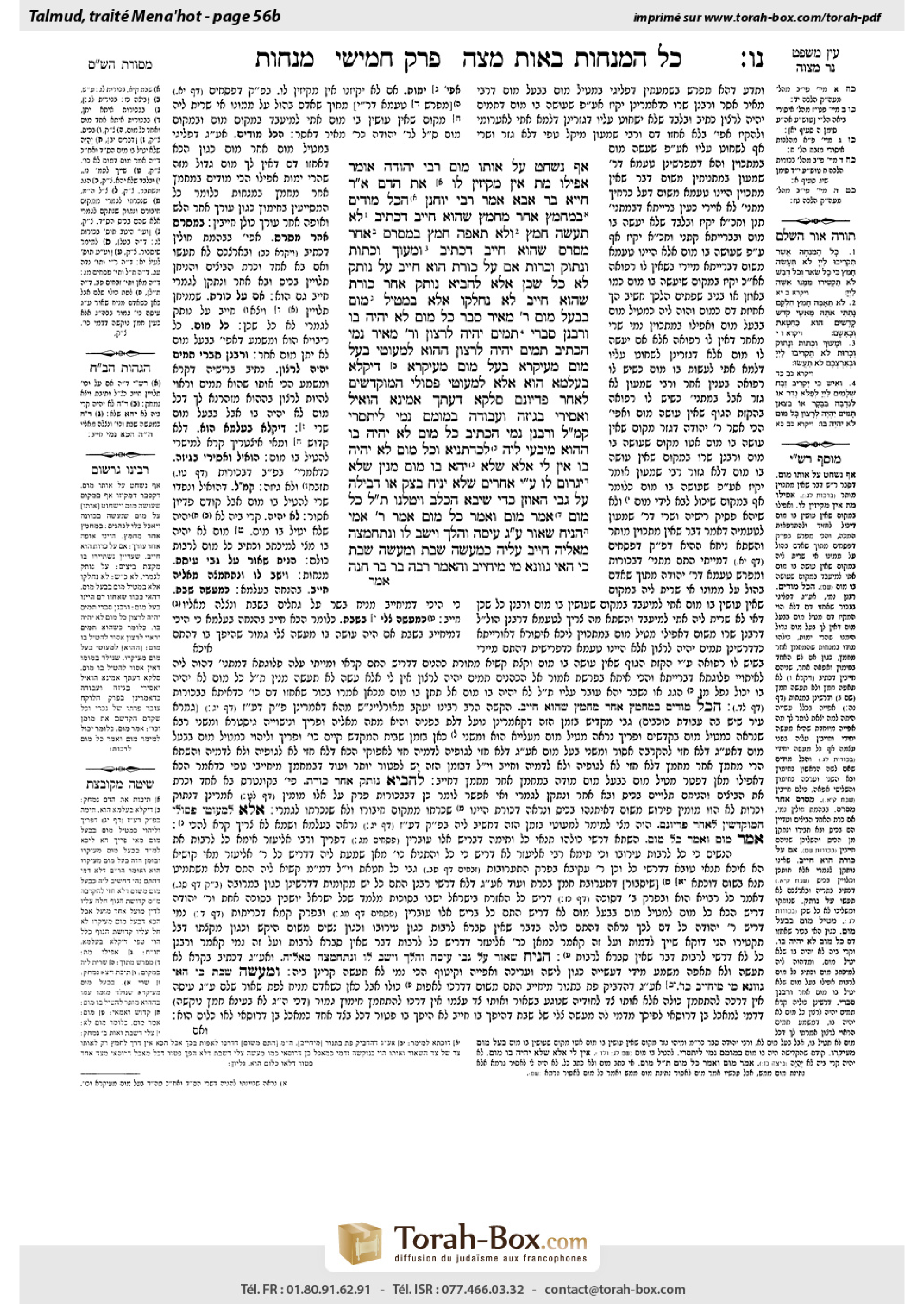
Menachot 56b: Talmud study for Daf Yomi
Daf Yomi is the daily study of one Talmud folio. Explore 37 tractates with scans, Hebrew text, Sefaria English and AI-generated French translations where annotated.
Passage selection and English or AI-generated French translation are available where the scan has annotations. Daf Study is independent of Torah-Box and Sefaria.
Browse Menachot · מנחות · All tractatesMenachot 56b text and translations
This page of Menachot includes the Aramaic text, an English translation and an AI-generated French translation, alongside the scan above.
מנחות נ״ו ב · Aramaic and Hebrew text
אַף נִשְׁחָט עַל אוֹתוֹ מוּם. רַבִּי יְהוּדָה אוֹמֵר: אֲפִילּוּ מֵת – אֵין מַקִּיזִין לוֹ אֶת הַדָּם.
אָמַר רַבִּי חִיָּיא בַּר אַבָּא, אָמַר רַבִּי יוֹחָנָן: הַכֹּל מוֹדִים בִּמְחַמֵּץ אַחַר מְחַמֵּץ שֶׁהוּא חַיָּיב, דִּכְתִיב ״לֹא תֵעָשֶׂה חָמֵץ״ וְ״לֹא תֵאָפֶה חָמֵץ״.
בִּמְסָרֵס אַחֵר מְסָרֵס, שֶׁהוּא חַיָּיב, דִּכְתִיב: ״וּמָעוּךְ וְכָתוּת וְנָתוּק וְכָרוּת״, אִם עַל כּוֹרֵת הוּא חַיָּיב, עַל נוֹתֵק לֹא כׇּל שֶׁכֵּן? אֶלָּא לְהָבִיא נוֹתֵק אַחַר כּוֹרֵת, שֶׁהוּא חַיָּיב.
לֹא נֶחְלְקוּ אֶלָּא בְּמֵטִיל מוּם בְּבַעַל מוּם, רַבִּי מֵאִיר סָבַר: ״כׇּל מוּם לֹא יִהְיֶה בּוֹ״, וְרַבָּנַן סָבְרִי: ״תָּמִים יִהְיֶה לְרָצוֹן״.
וְרַבִּי מֵאִיר נָמֵי, הָכְתִיב ״תָּמִים יִהְיֶה לְרָצוֹן״? הָהוּא לְמַעוֹטֵי בַּעַל מוּם מֵעִיקָּרָא.
בַּעַל מוּם מֵעִיקָּרָא – דִּיקְלָא בְּעָלְמָא הוּא.
אֶלָּא, לְמַעוֹטֵי פְּסוּלֵי הַמּוּקְדָּשִׁים לְאַחַר פִּדְיוֹנָם, סָלְקָא דַּעְתָּךְ אָמֵינָא: הוֹאִיל וַאֲסִירִי בְּגִיזָּה וַעֲבוֹדָה, בְּמוּמָם נָמֵי (לִיתַּסְרִי) [לִיתַּסְרוּ], קָא מַשְׁמַע לַן.
וְרַבָּנַן נָמֵי, הָכְתִיב: ״כׇּל מוּם לֹא יִהְיֶה בּוֹ״? הָהוּא מִיבְּעֵי לֵיהּ לְכִדְתַנְיָא: ״וְכׇל מוּם לֹא יִהְיֶה בּוֹ״ – אֵין לִי אֶלָּא שֶׁלֹּא יְהֵא בּוֹ מוּם, מִנַּיִן שֶׁלֹּא יִגְרוֹם לוֹ עַל יְדֵי אֲחֵרִים, שֶׁלֹּא יַנִּיחַ בָּצֵק אוֹ דְבֵילָה עַל גַּבֵּי הָאוֹזֶן כְּדֵי שֶׁיָּבֹא הַכֶּלֶב וְיִטְּלֶנּוּ? תַּלְמוּד לוֹמַר: ״כׇּל מוּם״. אָמַר ״מוּם״ וְאָמַר ״כׇּל מוּם״.
אָמַר רַבִּי אַמֵּי: הִנִּיחַ שְׂאוֹר עַל גַּבֵּי עִיסָּה, וְהָלַךְ וְיָשַׁב לוֹ, וְנִתְחַמְּצָה מֵאֵלֶיהָ – חַיָּיב עָלֶיהָ כְּמַעֲשֵׂה שַׁבָּת. וּמַעֲשֵׂה שַׁבָּת כִּי הַאי גַּוְונָא מִי מִיחַיַּיב? וְהָאָמַר רַבָּה בַּר בַּר חָנָה
Menachot 56b · English translation
The animal may even be slaughtered on the basis of that blemish. Rabbi Yehuda says: Even if the firstborn would die if its blood is not let, one may not let its blood at all.
The Gemara discusses similar cases, including examples involving meal offerings. Rabbi Ḥiyya bar Abba says that Rabbi Yoḥanan says: All of the Sages who disagree as to whether one may let the blood of a firstborn animal whose blood circulation is constricted concede that one who leavens a meal offering after another had already leavened it is liable to receive lashes for the additional leavening, as it is written: “No meal offering that you shall bring to the Lord shall be made with leaven” (Leviticus 2:11), and it is also stated: “It shall not be baked with leaven” (Leviticus 6:10). This indicates that one is liable for every act of leavening performed on a meal offering.
Similarly, everyone agrees that one who castrates an animal after one who castrates it is liable, as it is written: “Those whose testicles are bruised, or crushed, or detached, or cut, shall not be offered to the Lord, and you shall not do this in your land” (Leviticus 22:24). If one is liable when the seminal vesicles are cut, then when the testicles are detached altogether is he not all the more so liable? Rather, this verse serves to include one who detaches the testicles after one who cuts the seminal vesicles, to indicate that he is liable. Apparently, one is liable for castrating an animal that is already sterilized.
These Sages disagree only with regard to one who inflicts a blemish on an already blemished animal, such as one whose blood circulation is constricted. Rabbi Meir maintains that as the verse states: “It shall be perfect to be accepted; there shall be no blemish in it” (Leviticus 22:21), this categorical statement includes even the infliction of a blemish on an offering that is already blemished. And the Rabbis maintain that the phrase “it shall be perfect to be accepted” indicates that the prohibition against inflicting a blemish applies only to an animal that is currently perfect, i.e., unblemished, and can therefore be accepted, meaning that it is suitable to be sacrificed upon the altar. If the animal is already blemished, there is no prohibition against inflicting an additional blemish upon it.
The Gemara analyzes this dispute. And according to the opinion of Rabbi Meir, who derives the halakha from the phrase “there shall be no blemish in it,” isn’t it written also: “It shall be perfect to be accepted”? The Gemara answers: That verse serves to exclude only an animal that was blemished from the outset, i.e., an animal that was born with a blemish. In such a case, there is no prohibition to inflict an additional blemish on it. But if the animal was initially unblemished and later developed a blemish, it is prohibited to inflict another blemish upon it.
The Gemara rejects this suggestion: There is no need to exclude an animal that was blemished from the outset, as it is merely like a palm tree, i.e., it is an item that can never attain the status of an animal consecrated as an offering. Therefore, it is obvious that the prohibition against inflicting a blemish does not apply to this animal.
Rather, Rabbi Meir maintains that the phrase “it shall be perfect to be accepted” serves to exclude disqualified consecrated animals, to teach that after their redemption, when they become non-sacred, the prohibition against inflicting a blemish does not apply to them any longer. This exclusion is necessary, as it might enter your mind to say that since it is prohibited to shear disqualified consecrated animals or use them for labor even after they have been redeemed and are non-sacred, perhaps let it also be prohibited to inflict a blemish upon them. Consequently, this verse teaches us that there is no prohibition against inflicting a blemish upon these animals.
The Gemara analyzes the opinion of the Rabbis. And according to the opinion of the Rabbis as well, who base their opinion on the phrase: “It shall be perfect to be accepted,” isn’t it written: “There shall not be any blemish in it,” which indicates an expansion of the prohibition against inflicting a blemish? The Gemara answers: That verse is necessary for that which is taught in a baraita: The verse states: “There shall not be any blemish in it” (Leviticus 22:21). I have derived only that it may not have a blemish caused directly by human action. From where is it derived that one may not cause a blemish to be inflicted upon it indirectly by means of other agents, e.g., that one may not place dough or pressed figs on its ear so that a dog will come and take it, thereby biting off part of the animal’s ear and leaving it blemished? The verse states: “Any blemish.” It says: “Blemish,” and it says “Any blemish”; the word “no” serves to teach that one may not cause a blemish indirectly.
§ The Gemara returns to discuss the leavening of a meal offering. Rabbi Ami says: If one placed leaven, i.e., dough that has leavened to such an extent that it is no longer used as food but as a leavening agent for other dough, on top of the dough of a meal offering, and he went and sat himself down to wait, meaning that he performed no other action, and the dough then leavened of its own accord, he is liable to receive lashes for it. This is similar to performing a prohibited action on Shabbat. The Gemara questions this comparison: And is one liable for performing a prohibited action on Shabbat in a case like this? But doesn’t Rabba bar bar Ḥana say
Menachot 56b · Traduction française (IA)
On peut même abattre l’animal en raison de ce défaut. Rabbi Yehouda dit : Même si le premier-né mourrait si l’on ne lui faisait pas de saignée, il ne faut en aucun cas lui faire de saignée.
La Guemara examine des cas semblables, notamment des exemples concernant les offrandes végétales. Rabbi Ḥiyya bar Abba dit au nom de Rabbi Yoḥanan : Tous les Sages qui sont en désaccord sur la question de savoir si l’on peut faire une saignée à un animal premier-né dont la circulation sanguine est entravée reconnaissent que celui qui fait lever une offrande végétale après qu’une autre personne l’a déjà fait lever est passible de flagellation pour cette levée supplémentaire. En effet, il est écrit : « Aucune offrande végétale que vous présenterez au Seigneur ne sera faite avec du levain » (Lévitique 2:11), et il est également dit : « Elle ne sera pas cuite avec du levain » (Lévitique 6:10). Cela indique que l’on est passible pour chaque acte de levée effectué sur une offrande végétale.
De même, tous reconnaissent que celui qui châtre un animal après qu’une autre personne l’a châtré est passible, comme il est écrit : « Ceux dont les testicules sont meurtris, écrasés, arrachés ou coupés ne seront pas présentés au Seigneur, et vous ne ferez pas cela dans votre pays » (Lévitique 22:24). Si l’on est passible lorsque les vésicules séminales sont coupées, ne l’est-on pas à plus forte raison lorsque les testicules sont entièrement arrachés ? En réalité, ce verset vient inclure le cas de celui qui arrache les testicules après qu’une autre personne a coupé les vésicules séminales, pour enseigner qu’il est passible. Il apparaît donc que l’on est passible pour avoir châtré un animal déjà stérilisé.
Ces Sages ne sont en désaccord qu’au sujet de celui qui inflige un défaut à un animal déjà atteint d’un défaut, tel que celui dont la circulation sanguine est entravée. Rabbi Meïr soutient que, puisque le verset dit : « Il sera parfait pour être agréé ; il n’y aura aucun défaut en lui » (Lévitique 22:21), cette formulation catégorique inclut également le fait d’infliger un défaut à une offrande déjà atteinte d’un défaut. Les Rabbins, eux, soutiennent que l’expression « il sera parfait pour être agréé » indique que l’interdiction d’infliger un défaut ne s’applique qu’à un animal qui est actuellement parfait, c’est-à-dire sans défaut, et peut donc être agréé, autrement dit qu’il convient d’être sacrifié sur l’autel. Si l’animal est déjà atteint d’un défaut, il n’est pas interdit de lui en infliger un autre.
La Guemara analyse ce désaccord. Selon l’opinion de Rabbi Meïr, qui déduit la halakha de l’expression « il n’y aura aucun défaut en lui », n’est-il pas également écrit : « Il sera parfait pour être agréé » ? La Guemara répond : Ce verset ne vient exclure que l’animal qui était atteint d’un défaut dès le départ, c’est-à-dire celui qui est né avec un défaut. Dans ce cas, il est permis de lui infliger un défaut supplémentaire. Mais si l’animal était initialement sans défaut et qu’il en a développé un par la suite, il est interdit de lui en infliger un autre.
La Guemara rejette cette proposition : il n’est pas nécessaire d’exclure l’animal qui était atteint d’un défaut dès le départ, car il est simplement comme un palmier, c’est-à-dire qu’il ne peut jamais acquérir le statut d’animal consacré comme offrande. Il est donc évident que l’interdiction d’infliger un défaut ne s’applique pas à cet animal.
En réalité, Rabbi Meïr soutient que l’expression « il sera parfait pour être agréé » vient exclure les animaux consacrés devenus inaptes, afin d’enseigner qu’après leur rachat, lorsqu’ils deviennent profanes, l’interdiction de leur infliger un défaut ne s’applique plus. Cette exclusion est nécessaire, car on pourrait penser que, puisqu’il est interdit de tondre ces animaux consacrés devenus inaptes ou de les utiliser pour le travail même après leur rachat, lorsqu’ils sont profanes, il pourrait également être interdit de leur infliger un défaut. Par conséquent, ce verset nous enseigne qu’il n’est pas interdit d’infliger un défaut à ces animaux.
La Guemara analyse l’opinion des Rabbins. Selon l’opinion des Rabbins également, qui fondent leur avis sur l’expression « il sera parfait pour être agréé », n’est-il pas écrit : « Il n’y aura aucun défaut en lui », ce qui indique une extension de l’interdiction d’infliger un défaut ? La Guemara répond : Ce verset est nécessaire pour ce qui est enseigné dans une baraïta : le verset dit : « Il n’y aura aucun défaut en lui » (Lévitique 22:21). J’ai seulement déduit qu’il ne doit pas avoir de défaut causé directement par l’action d’un homme. D’où déduit-on qu’on ne doit pas provoquer indirectement un défaut au moyen d’autres agents, par exemple en déposant de la pâte ou des figues pressées sur son oreille afin qu’un chien vienne les prendre, morde ainsi une partie de l’oreille de l’animal et le laisse avec un défaut ? Le verset dit : « Aucun défaut ». Il est écrit « défaut », et il est écrit « aucun défaut » ; le mot « aucun » enseigne qu’on ne doit pas provoquer indirectement un défaut.
§ La Guemara revient à la question de la levée d’une offrande végétale. Rabbi Ami dit : Si quelqu’un dépose du levain, c’est-à-dire une pâte qui a suffisamment levé pour ne plus servir d’aliment, mais d’agent levant pour d’autres pâtes, sur la pâte d’une offrande végétale, puis va s’asseoir pour attendre, autrement dit sans accomplir aucune autre action, et que la pâte lève ensuite d’elle-même, il est passible de flagellation pour cela. Cela ressemble à l’accomplissement d’un acte interdit pendant Chabbat. La Guemara conteste cette comparaison : Est-on passible pour avoir accompli un acte interdit pendant Chabbat dans un cas pareil ? Or Rabba bar bar Ḥana ne dit-il pas
Traduction française générée par IA à partir de l’édition anglaise de Sefaria. Vérifie toujours un passage avec le texte source.
Text from Sefaria: William Davidson Edition - Vocalized Aramaic (unknown); William Davidson Edition - English (CC BY NC).