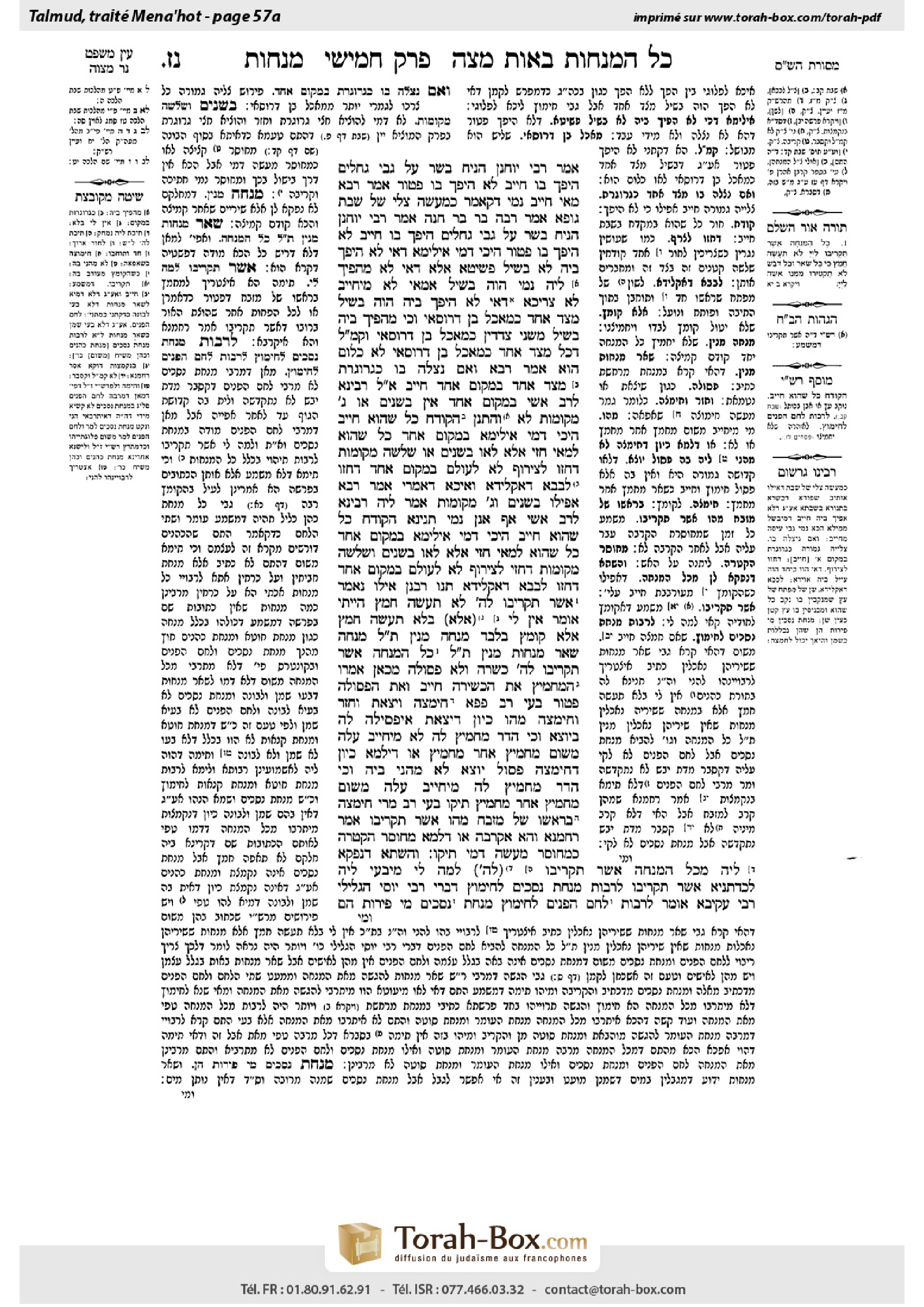
Menachot 57a: Talmud study for Daf Yomi
Daf Yomi is the daily study of one Talmud folio. Explore 37 tractates with scans, Hebrew text, Sefaria English and AI-generated French translations where annotated.
Passage selection and English or AI-generated French translation are available where the scan has annotations. Daf Study is independent of Torah-Box and Sefaria.
Browse Menachot · מנחות · All tractatesMenachot 57a text and translations
This page of Menachot includes the Aramaic text, an English translation and an AI-generated French translation, alongside the scan above.
מנחות נ״ז א · Aramaic and Hebrew text
אָמַר רַבִּי יוֹחָנָן: הִנִּיחַ בָּשָׂר עַל גַּבֵּי גֶּחָלִים – הִיפֵּךְ בּוֹ חַיָּיב, לֹא הִיפֵּךְ בּוֹ פָּטוּר.
אָמַר רָבָא: מַאי ״חַיָּיב״ נָמֵי דְּקָאָמַר? כְּמַעֲשֵׂה צָלִי שֶׁל שַׁבָּת.
גּוּפָא, אָמַר רַבָּה בַּר בַּר חָנָה, אָמַר רַבִּי יוֹחָנָן: הִנִּיחַ בָּשָׂר עַל גַּבֵּי גֶּחָלִים, הִיפֵּךְ בּוֹ – חַיָּיב, לֹא הִיפֵּךְ בּוֹ – פָּטוּר. הֵיכִי דָמֵי? אִילֵּימָא דְּאִי לָא הִיפֵּךְ בֵּיהּ לָא בְּשִׁיל – פְּשִׁיטָא! אֶלָּא דְּאִי לָא מְהַפֵּיךְ לֵיהּ נָמֵי הֲוָה בְּשִׁיל, אַמַּאי לָא מִיחַיַּיב?
לָא צְרִיכָא, דְּאִי לָא הַפֵּיךְ בֵּיהּ – הֲוָה בְּשִׁיל מִצַּד אֶחָד כְּמַאֲכָל בֶּן דְּרוֹסַאי, וְכִי מְהַפֵּיךְ בֵּיהּ – בְּשִׁיל מִשְּׁנֵי צְדָדִין כְּמַאֲכָל בֶּן דְּרוֹסַאי, וְקָא מַשְׁמַע לַן דְּכֹל מִצַּד אֶחָד כְּמַאֲכָל בֶּן דְּרוֹסַאי – לָא כְּלוּם הוּא.
אָמַר רָבָא: וְאִם נִצְלָה בּוֹ כִּגְרוֹגֶרֶת מִצַּד אֶחָד בִּמְקוֹם אֶחָד – חַיָּיב. אֲמַר לֵיהּ רָבִינָא לְרַב אָשֵׁי: בִּמְקוֹם אֶחָד – אִין, בִּשְׁנַיִם אוֹ שְׁלֹשָׁה מְקוֹמוֹת – לָא? וְהָתְנַן: הַקּוֹדֵחַ כׇּל שֶׁהוּא – חַיָּיב!
הֵיכִי דָּמֵי? אִילֵּימָא בְּמָקוֹם אֶחָד, כׇּל שֶׁהוּא לְמַאי חֲזֵי? אֶלָּא לָאו בִּשְׁנַיִם אוֹ שְׁלֹשָׁה מְקוֹמוֹת, דַּחֲזוֹ לְצֵירוּף? לָא, לְעוֹלָם בְּמָקוֹם אֶחָד, דַּחֲזוּ לְבָבָא דְּאַקְלִידָא.
וְאִיכָּא דְּאָמְרִי, אָמַר רָבָא: אֲפִילּוּ בִּשְׁנַיִם וּשְׁלֹשָׁה מְקוֹמוֹת. אֲמַר לֵיהּ רָבִינָא לְרַב אָשֵׁי: אַף אֲנַן נָמֵי תְּנֵינָא – הַקּוֹדֵחַ כׇּל שֶׁהוּא חַיָּיב. הֵיכִי דָמֵי? אִילֵּימָא בְּמָקוֹם אֶחָד – כׇּל שֶׁהוּא לְמַאי חֲזֵי? אֶלָּא לָאו בִּשְׁנַיִם וּשְׁלֹשָׁה מְקוֹמוֹת, דַּחֲזֵי לְצֵירוּף? לָא, לְעוֹלָם בְּמָקוֹם אֶחָד, דַּחֲזוּ לְבָבָא דְּאַקְלִידָא.
תָּנוּ רַבָּנַן: אִילּוּ נֶאֱמַר ״אֲשֶׁר תַּקְרִיבוּ לַה׳ לֹא תֵעָשֶׂה חָמֵץ״, הָיִיתִי אוֹמֵר אֵין לִי בְּלֹא תֵעָשֶׂה חָמֵץ אֶלָּא קוֹמֶץ בִּלְבָד.
מִנְחָה מִנַּיִן? תַּלְמוּד לוֹמַר ״מִנְחָה״. שְׁאָר מְנָחוֹת מִנַּיִן? תַּלְמוּד לוֹמַר ״כׇּל הַמִּנְחָה״.
״אֲשֶׁר תַּקְרִיבוּ לַה׳״ – כְּשֵׁרָה, וְלֹא פְּסוּלָה. מִכָּאן אָמְרוּ: הַמְחַמֵּיץ אֶת הַכְּשֵׁירָה – חַיָּיב, וְאֶת הַפְּסוּלָה – פָּטוּר.
בָּעֵי רַב פָּפָּא: חִימְּצָהּ וְיָצָאת, וְחָזַר וְחִימְּצָהּ – מַהוּ? כֵּיוָן דְּיָצָאת אִיפְּסִילָה לַהּ בְּיוֹצֵא, וְכִי הָדַר מְחַמֵּיץ לַהּ – לָא מִיחַיַּיב עֲלַהּ מִשּׁוּם מְחַמֵּיץ אַחֵר מְחַמֵּיץ.
אוֹ דִילְמָא, כֵּיוָן דְּחִימְּצָהּ, פְּסוּל יוֹצֵא לָא מַהֲנֵי בַּיהּ, וְכִי הֲדַר מְחַמֵּיץ לַהּ – מִיחַיַּיב עֲלַהּ מִשּׁוּם מְחַמֵּיץ אַחֵר מְחַמֵּיץ? תֵּיקוּ.
בָּעֵי רַב מָרִי: חִימְּצָהּ בְּרֹאשׁוֹ שֶׁל מִזְבֵּחַ, מַהוּ? ״אֲשֶׁר תַּקְרִיבוּ״ אָמַר רַחֲמָנָא, וְהָא אַקְרְבַהּ,
אוֹ דִלְמָא מְחוּסַּר הַקְטָרָה כִּמְחוּסַּר מַעֲשֶׂה דָּמֵי? תֵּיקוּ.
וְהַשְׁתָּא דְּנָפְקָא לֵיהּ מִ״כׇּל הַמִּנְחָה״, ״אֲשֶׁר תַּקְרִיבוּ (לַה׳)״ לְמָה לִי? מִיבְּעֵי לֵיהּ לְכִדְתַנְיָא: ״אֲשֶׁר תַּקְרִיבוּ״ – לְרַבּוֹת מִנְחַת נְסָכִים לְחִימּוּץ, דִּבְרֵי רַבִּי יוֹסֵי הַגְּלִילִי. רַבִּי עֲקִיבָא אוֹמֵר: לְרַבּוֹת לֶחֶם הַפָּנִים לְחִימּוּץ.
מִנְחַת נְסָכִים? מֵי פֵירוֹת הֵם!
Menachot 57a · English translation
that Rabbi Yoḥanan says: In the case of one who placed meat on top of coals on Shabbat, if he subsequently turned over the meat to its other side, so that both sides were roasted, he is liable for cooking on Shabbat. But if he did not turn over the meat he is exempt, as the meat is considered cooked only if both sides were roasted. If so, the same should apply to one who places leaven on the dough of a meal offering: He should be liable only if he turns the dough over. This contradicts the ruling of Rabbi Ami.
Rava said: What does Rabbi Yoḥanan, as well, mean when he says: He is liable to receive lashes for it, similar to performing a prohibited action on Shabbat? He means that one who places leaven on the dough of a meal offering, even if he does not turn it over, is similar to one who performs a prohibited action of roasting on Shabbat, meaning that he is similar to one who turned over the roasting food on the coals.
§ The Gemara discusses the matter itself. Rabba bar bar Ḥana says that Rabbi Yoḥanan says: In the case of one who placed meat on top of coals on Shabbat, if he subsequently turned over the meat he is liable for cooking on Shabbat, and if he did not turn over the meat he is exempt. The Gemara asks: What are the circumstances of this case? If we say that this was a situation where if he does not turn over the meat it would not cook, then it is obvious that if he does not turn it over he is exempt. Rather, it must be referring to a case where even if he does not turn over the meat it would nevertheless cook. But if so, why isn’t he liable for merely placing the meat on the coals, despite the fact that he did not turn it over?
The Gemara answers: No, it is necessary to state this halakha in a case where if he does not turn over the meat it would cook on one side only partially, roughly one-third of the ordinary process of cooking, like the food of ben Derosai. And now that he turns it over, it cooks on both sides like the food of ben Derosai. And Rabbi Yoḥanan teaches us that any meat roasted on only one side like the food of ben Derosai is nothing, i.e., this is not a violation of the prohibited labor of cooking on Shabbat. If it was roasted on both sides like the food of ben Derosai this is classified as cooking, and he is liable for cooking on Shabbat.
The Gemara continues to discuss the case of meat roasted on one side on Shabbat. Rava says: And if a quantity of that meat equivalent in volume to a fig-bulk was fully roasted on one side of the meat and the roasted area was in one spot on the piece of meat, while the rest of the meat remained raw, he is liable for cooking on Shabbat. Ravina said to Rav Ashi: It can be inferred from Rava’s statement that if the fig-bulk of meat that was roasted was in one spot, yes, he is liable, whereas if the amount of the fig-bulk was distributed over two or three separate spots he is not liable. But didn’t we learn in a mishna (Shabbat 102b): One who drills a hole of any size is liable for the labor of building or the labor of striking a blow with a hammer to complete the production process of a vessel?
The Gemara analyzes that mishna: What are the circumstances? If we say that the mishna is referring to one who drills a hole in one spot alone, why is he liable? For what purpose is a hole of any size, which includes a very small hole, fit to be used? Rather, is it not referring to one who drills holes in two or three different spots, and the reason he is liable is that these holes are fit to be joined? Builders who require a large hole will often start by drilling a few small holes which they later enlarge and join together. By the same logic, if the meat was roasted in a few spots he should be liable, as these can join together. The Gemara answers: No; actually the mishna is referring to one who drills in only one spot, as one can say that the hole is fit as an entrance [levava] for the placement of the tooth of a key [aklida], which is very small.
And there are those who say there is a different version of this discussion: Rava says: Even if the fig-bulk of the meat that was fully roasted on only one side was distributed over two or three separate spots, he is liable for cooking on Shabbat. Ravina said to Rav Ashi: We learn this halakha in the mishna as well: One who drills a hole of any size is liable. What are the circumstances? If we say that the hole is in one spot alone, why is he liable? For what purpose is a hole of any size fit to be used? Rather, is it not referring to one who drills holes in two or three different spots, and the reason he is liable is that these holes are fit to be joined? Similarly, in the case discussed by Rava, one is liable for the cooking of the meat in a few different spots which can join together. The Gemara answers: No; actually the mishna is referring to one who drills in only one spot, as one can say that it is fit as an entrance for the placement of the tooth of a key.
§ The Gemara returns to discussing the prohibition against leavening a meal offering. The Sages taught in a baraita: Concerning the deep-pan meal offering, the verse states: “No meal offering that you shall bring to the Lord shall be made with leaven; for any leaven, and any honey, you shall not burn any of it as an offering made by fire to the Lord” (Leviticus 2:11). The term “meal offering” is apparently superfluous, and therefore the baraita explains: If the verse had stated only: Nothing that you shall bring to the Lord shall be made with leaven, I would say: I have derived only that the handful removed from the meal offering for burning on the altar alone is included in the prohibition: “Shall not be made with leaven,” as only the handful is burned on the altar.
From where is it derived that one is liable for the leavening of a meal offering whose handful has not yet been removed? The verse states: “Meal offering,” to teach that the prohibition includes a meal offering before the removal of its handful. The Gemara asks: Since this verse is stated in the context of the deep-pan meal offering, from where is it derived that one is liable for leavening the other meal offerings, which are not mentioned in this passage? Therefore, the verse states the inclusive phrase: “No meal offering,” to apply this halakha to other meal offerings.
The baraita continues to expound the verse. The phrase: “That you shall bring to the Lord,” indicates that this prohibition applies only to a fit meal offering, but not to a disqualified meal offering, e.g., a meal offering that was taken outside the Temple or that was rendered ritually impure. From here the Sages stated that one who leavens a fit meal offering is liable to receive lashes, but one who leavens a disqualified meal offering is exempt.
With regard to the ruling that the prohibition against leavening does not apply to a disqualified meal offering, Rav Pappa raises a dilemma: If one leavened a meal offering when it was fit, and subsequently someone removed the meal offering and it emerged from the Temple courtyard and was thereby disqualified, and he again leavened it, what is the halakha? Is he liable for the second leavening as well? The Gemara explains the possibilities: Does one say that since it emerged it is disqualified in accordance with the status of a sacred item that emerges from its permitted area, and therefore when he again leavens it he is not liable for it due to the prohibition against leavening a meal offering after one who already leavened it?
Or perhaps, since one already leavened the meal offering, from this point forward the disqualification of a sacred item that emerges from its permitted area is ineffective with regard to removing it from the prohibition against leavening, as the prohibition against emerging from the Temple itself applies only to a fit meal offering. And therefore, when he again leavens it he is liable for it due to the prohibition against leavening a meal offering after one who already leavened it. No answer was found, and the Gemara states that the dilemma shall stand unresolved.
Rav Mari raises another dilemma concerning the leavening of a meal offering. If a priest leavened a meal offering while standing at the top of the altar, what is the halakha? The Gemara clarifies the possibilities: The Merciful One states in the Torah: “No meal offering that you shall bring to the Lord shall be made with leaven” (Leviticus 2:11), which indicates that this prohibition applies only to a meal offering that has not yet been brought to the Lord, i.e., to the altar. And therefore, as this meal offering has already been brought to the top of the altar, even though it has not yet been burned, perhaps it is not included in the prohibition.
Or perhaps any offering whose burning has not yet been performed is considered like one whose action of sacrifice has not yet been performed, despite the fact that it has already been brought to the top of the altar. If so, this meal offering is included in the prohibition against leavening. No answer was found, and the Gemara states that the dilemma shall stand unresolved.
The Gemara asks: And now that the tanna of the baraita derives from the phrase: “No meal offering,” that the prohibition includes even a meal offering before the removal of its handful, why do I need the phrase: “That you shall bring,” in the same verse? The Gemara answers: It is necessary for that which is taught in a baraita: The verse states: “That you shall bring,” in order to include the meal offering brought with the libations that accompany certain animal offerings such as burnt offerings, peace offerings, and the sin offerings and guilt offerings of a leper in the prohibition against leavening. Unlike the standard meal offerings, from which a handful is removed, these are entirely burned upon the altar, and the additional derivation is necessary to include them in the prohibition against leavening. This is the statement of Rabbi Yosei HaGelili. Rabbi Akiva says: This phrase serves to include the shewbread in the prohibition against leavening.
The Gemara clarifies these opinions: With regard to the opinion of Rabbi Yosei HaGelili, the Gemara asks: How is it possible to leaven the meal offering brought with libations? This type of meal offering is kneaded only with olive oil, which is a type of fruit juice,
Menachot 57a · Traduction française (IA)
Rabbi Yoḥanan dit en effet : Dans le cas de celui qui a posé de la viande sur des braises pendant Chabbat, s’il retourne ensuite la viande de l’autre côté, de sorte que les deux côtés soient rôtis, il est passible pour avoir cuisiné pendant Chabbat. Mais s’il ne retourne pas la viande, il est exempt, car elle n’est considérée comme cuite que lorsque les deux côtés ont été rôtis. Si tel est le cas, il devrait en être de même pour celui qui met du levain sur la pâte d’une offrande de farine : il ne devrait être passible que s’il retourne la pâte. Cela contredit la décision de Rabbi Ami.
Rava dit : Que veut dire également Rabbi Yoḥanan lorsqu’il dit qu’il est passible de flagellation pour cela, comme lorsqu’on accomplit un acte interdit pendant Chabbat ? Il veut dire que celui qui met du levain sur la pâte d’une offrande de farine, même s’il ne la retourne pas, est comparable à celui qui accomplit l’acte interdit de rôtir pendant Chabbat, c’est-à-dire à celui qui retourne les aliments en train de rôtir sur les braises.
§ La Guemara revient sur le sujet lui-même. Rabba bar bar Ḥana dit au nom de Rabbi Yoḥanan : Dans le cas de celui qui a posé de la viande sur des braises pendant Chabbat, s’il retourne ensuite la viande, il est passible pour avoir cuisiné pendant Chabbat, et s’il ne la retourne pas, il est exempt. La Guemara demande : Dans quelles circonstances ? Si l’on dit qu’il s’agit d’un cas où, s’il ne retourne pas la viande, elle ne cuira pas, il est évident qu’il est exempt s’il ne la retourne pas. Il faut donc plutôt comprendre qu’il s’agit d’un cas où la viande cuira malgré tout, même s’il ne la retourne pas. Mais alors, pourquoi n’est-il pas passible pour le simple fait d’avoir posé la viande sur les braises, même s’il ne l’a pas retournée ?
La Guemara répond : Non, cette halakha est nécessaire dans un cas où, si l’homme ne retourne pas la viande, elle ne cuira que partiellement d’un côté, à peu près au tiers du processus ordinaire de cuisson, comme les aliments de ben Derosai. Et maintenant qu’il la retourne, elle cuit des deux côtés comme les aliments de ben Derosai. Rabbi Yoḥanan nous enseigne que toute viande rôtie d’un seul côté comme les aliments de ben Derosai ne compte pas, c’est-à-dire que cela ne constitue pas une transgression du travail interdit de cuisson pendant Chabbat. En revanche, si elle est rôtie des deux côtés comme les aliments de ben Derosai, cela est considéré comme une cuisson, et l’homme est passible pour avoir cuisiné pendant Chabbat.
La Guemara poursuit l’examen du cas de la viande rôtie d’un seul côté pendant Chabbat. Rava dit : Et si une quantité de cette viande équivalant, en volume, au volume d’une figue a été entièrement rôtie sur un côté, en un seul endroit du morceau, tandis que le reste de la viande est resté cru, l’homme est passible pour avoir cuisiné pendant Chabbat. Ravina dit à Rav Ashi : On peut déduire de la déclaration de Rava que si la quantité équivalant au volume d’une figue a été rôtie en un seul endroit, l’homme est passible, mais que si cette quantité est répartie en deux ou trois endroits distincts, il n’est pas passible. Or n’avons-nous pas appris dans une Michna (Chabbat 102b) : Celui qui perce un trou, quelle qu’en soit la taille, est passible au titre du travail de construction ou du travail consistant à porter un coup de marteau pour achever la fabrication d’un ustensile ?
La Guemara analyse cette Michna : Dans quelles circonstances ? Si l’on dit que la Michna parle de celui qui perce un trou en un seul endroit, pourquoi est-il passible ? À quoi peut servir un trou, même très petit ? Il faut plutôt comprendre qu’elle parle de celui qui perce des trous en deux ou trois endroits différents, et qu’il est passible parce que ces trous peuvent être réunis. Les artisans qui ont besoin d’un grand trou commencent souvent par en percer quelques petits, qu’ils agrandissent et réunissent ensuite. Selon le même raisonnement, si la viande a été rôtie en plusieurs endroits, l’homme devrait être passible, puisque ces endroits peuvent se rejoindre. La Guemara répond : Non ; en réalité, la Michna parle de celui qui perce en un seul endroit, car on peut dire que le trou convient comme entrée [levava] pour recevoir le panneton d’une clé [aklida], qui est très petit.
Et certains transmettent une autre version de cette discussion : Rava dit : Même si la quantité de viande équivalant au volume d’une figue, entièrement rôtie d’un seul côté, est répartie en deux ou trois endroits distincts, l’homme est passible pour avoir cuisiné pendant Chabbat. Ravina dit à Rav Ashi : Nous apprenons également cette halakha dans la Michna : Celui qui perce un trou, quelle qu’en soit la taille, est passible. Dans quelles circonstances ? Si le trou se trouve en un seul endroit, pourquoi est-il passible ? À quoi peut servir un trou, quelle qu’en soit la taille ? Il faut plutôt comprendre qu’il s’agit de celui qui perce des trous en deux ou trois endroits différents, et qu’il est passible parce que ces trous peuvent être réunis. De même, dans le cas évoqué par Rava, l’homme est passible pour avoir fait cuire la viande en plusieurs endroits distincts qui peuvent se rejoindre. La Guemara répond : Non ; en réalité, la Michna parle de celui qui perce en un seul endroit, car on peut dire que le trou convient comme entrée pour recevoir le panneton d’une clé.
§ La Guemara revient à l’interdiction de faire lever une offrande de farine. Les Sages ont enseigné dans une baraïta : À propos de l’offrande de farine cuite dans une poêle profonde, le verset dit : « Aucune offrande de farine que vous apporterez à l’Éternel ne sera faite avec du levain ; car vous ne brûlerez rien de levé ni de miel comme offrande consumée par le feu pour l’Éternel » (Lévitique 2:11). Le terme « offrande de farine » semble superflu ; la baraïta l’explique donc ainsi : Si le verset avait seulement dit : « Rien de ce que vous apporterez à l’Éternel ne sera fait avec du levain », j’aurais déduit uniquement que la poignée prélevée sur l’offrande de farine pour être brûlée sur l’autel seule est incluse dans l’interdiction : « ne sera pas faite avec du levain », puisque seule la poignée est brûlée sur l’autel.
D’où déduit-on qu’on est passible pour avoir fait lever une offrande de farine dont la poignée n’a pas encore été prélevée ? Le verset dit « offrande de farine », pour enseigner que l’interdiction inclut l’offrande de farine avant le prélèvement de sa poignée. La Guemara demande : Puisque ce verset figure dans le passage concernant l’offrande de farine cuite dans une poêle profonde, d’où déduit-on qu’on est passible pour avoir fait lever les autres offrandes de farine, qui ne sont pas mentionnées dans ce passage ? Le verset emploie donc l’expression inclusive « aucune offrande de farine », afin d’appliquer cette halakha aux autres offrandes de farine.
La baraïta poursuit son interprétation du verset. L’expression « que vous apporterez à l’Éternel » indique que cette interdiction s’applique uniquement à une offrande de farine valide, mais non à une offrande de farine disqualifiée, par exemple une offrande de farine qui a été emportée hors du Temple ou rendue rituellement impure. C’est de là que les Sages ont conclu que celui qui fait lever une offrande de farine valide est passible de flagellation, tandis que celui qui fait lever une offrande de farine disqualifiée est exempt.
À propos de la décision selon laquelle l’interdiction de faire lever ne s’applique pas à une offrande de farine disqualifiée, Rav Pappa soulève un dilemme : Si quelqu’un a fait lever une offrande de farine alors qu’elle était valide, puis qu’une autre personne l’a retirée et qu’elle est sortie de la cour du Temple, la disqualifiant ainsi, et qu’il l’a de nouveau fait lever, quelle est la halakha ? Est-il également passible pour l’avoir fait lever une seconde fois ? La Guemara expose les possibilités : dira-t-on que, puisqu’elle est sortie, elle est disqualifiée conformément au statut d’un objet sacré qui sort de l’enceinte où il est permis, et que, par conséquent, lorsqu’il la fait de nouveau lever, il n’en est pas passible, étant donné qu’une autre personne l’a déjà fait lever ?
Ou peut-être, puisque l’offrande de farine a déjà été faite lever, à partir de ce moment, la disqualification d’un objet sacré qui sort de l’enceinte où il est permis ne peut plus la soustraire à l’interdiction de faire lever, car l’interdiction liée à sa sortie du Temple ne s’applique qu’à une offrande de farine valide. Par conséquent, lorsqu’il la fait de nouveau lever, il en est passible en vertu de l’interdiction de faire lever une offrande de farine après qu’une autre personne l’a déjà fait lever. Aucune réponse n’a été trouvée, et la Guemara indique que le dilemme reste sans solution.
Rav Mari soulève un autre dilemme concernant le fait de faire lever une offrande de farine. Si un prêtre fait lever une offrande de farine alors qu’il se tient au sommet de l’autel, quelle est la halakha ? La Guemara précise les possibilités : Le Miséricordieux dit dans la Torah : « Aucune offrande de farine que vous apporterez à l’Éternel ne sera faite avec du levain » (Lévitique 2:11), ce qui indique que cette interdiction ne s’applique qu’à une offrande de farine qui n’a pas encore été apportée à l’Éternel, c’est-à-dire à l’autel. Ainsi, puisque cette offrande de farine a déjà été apportée au sommet de l’autel, même si elle n’a pas encore été brûlée, peut-être n’est-elle pas incluse dans l’interdiction.
Ou peut-être toute offrande dont la combustion n’a pas encore eu lieu est-elle considérée comme n’ayant pas encore été sacrifiée, bien qu’elle ait déjà été apportée au sommet de l’autel. Si tel est le cas, cette offrande de farine est incluse dans l’interdiction de faire lever. Aucune réponse n’a été trouvée, et la Guemara indique que le dilemme reste sans solution.
La Guemara demande : Et maintenant que le tanna de la baraïta déduit de l’expression « aucune offrande de farine » que l’interdiction inclut même une offrande de farine avant le prélèvement de sa poignée, pourquoi le verset contient-il aussi l’expression « que vous apporterez » ? La Guemara répond : Elle est nécessaire pour ce qui est enseigné dans une baraïta : le verset dit « que vous apporterez » afin d’inclure dans l’interdiction de faire lever l’offrande de farine apportée avec les libations qui accompagnent certaines offrandes animales, telles que les holocaustes, les offrandes de paix, ainsi que les sacrifices expiatoires et les sacrifices de culpabilité d’un lépreux. Contrairement aux offrandes de farine ordinaires, dont on prélève une poignée, celles-ci sont entièrement brûlées sur l’autel ; cette déduction supplémentaire est donc nécessaire pour les inclure dans l’interdiction de faire lever. Telle est la déclaration de Rabbi Yosei HaGelili. Rabbi Akiva dit : Cette expression sert à inclure le pain de proposition dans l’interdiction de faire lever.
La Guemara précise ces opinions : Concernant l’opinion de Rabbi Yosei HaGelili, la Guemara demande : Comment est-il possible de faire lever l’offrande de farine apportée avec les libations ? Ce type d’offrande de farine est pétri uniquement avec de l’huile d’olive, qui est une sorte de jus de fruit,
Traduction française générée par IA à partir de l’édition anglaise de Sefaria. Vérifie toujours un passage avec le texte source.
Text from Sefaria: William Davidson Edition - Vocalized Aramaic (unknown); William Davidson Edition - English (CC BY NC).