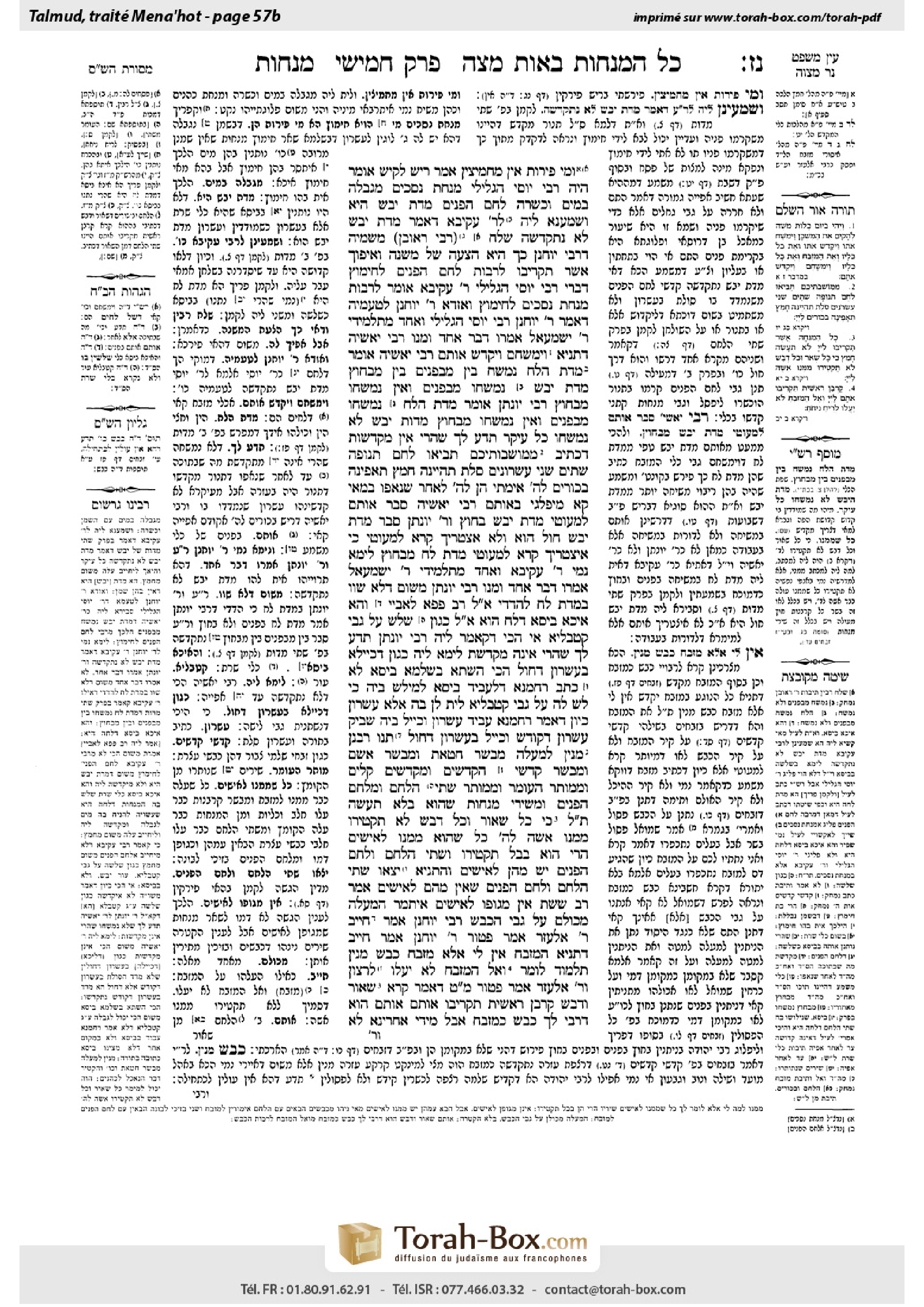
Menachot 57b: Talmud study for Daf Yomi
Daf Yomi is the daily study of one Talmud folio. Explore 37 tractates with scans, Hebrew text, Sefaria English and AI-generated French translations where annotated.
Passage selection and English or AI-generated French translation are available where the scan has annotations. Daf Study is independent of Torah-Box and Sefaria.
Browse Menachot · מנחות · All tractatesMenachot 57b text and translations
This page of Menachot includes the Aramaic text, an English translation and an AI-generated French translation, alongside the scan above.
מנחות נ״ז ב · Aramaic and Hebrew text
וּמֵי פֵירוֹת אֵין מַחְמִיצִין? אָמַר רֵישׁ לָקִישׁ: אוֹמֵר הָיָה רַבִּי יוֹסֵי הַגְּלִילִי, מִנְחַת נְסָכִים מְגַבְּלָהּ בְּמַיִם וּכְשֵׁרָה.
לֶחֶם הַפָּנִים מִדַּת יָבֵשׁ הִיא, וּשְׁמַעְנָא לֵיהּ לְרַבִּי עֲקִיבָא דְּאָמַר: מִדַּת יָבֵשׁ לֹא נִתְקַדְּשָׁה.
שְׁלַח רַבִּי רְאוּבֵן מִשְּׁמֵיהּ דְּרַבִּי יוֹחָנָן: כָּךְ הִיא הַצָּעָה שֶׁל מִשְׁנָה, וְאֵיפוֹךְ – ״אֲשֶׁר תַּקְרִיבוּ״ לְרַבּוֹת לֶחֶם הַפָּנִים לְחִימּוּץ, דִּבְרֵי רַבִּי יוֹסֵי הַגְּלִילִי. רַבִּי עֲקִיבָא אוֹמֵר: לְרַבּוֹת מִנְחַת נְסָכִים לְחִימּוּץ.
וְאַזְדָּא רַבִּי יוֹחָנָן לְטַעְמֵיהּ, דְּאָמַר רַבִּי יוֹחָנָן: רַבִּי יוֹסֵי הַגְּלִילִי וְאֶחָד מִתַּלְמִידֵי רַבִּי יִשְׁמָעֵאל אָמְרוּ דָּבָר אֶחָד, וּמַנּוּ רַבִּי יֹאשִׁיָּה.
דְּתַנְיָא, ״וַיִּמְשָׁחֵם וַיְקַדֵּשׁ אֹתָם״. רַבִּי יֹאשִׁיָּה אוֹמֵר: מִדַּת הַלַּח נִמְשַׁח בֵּין מִבִּפְנִים בֵּין מִבַּחוּץ, מִדַּת יָבֵשׁ נִמְשְׁחוּ מִבִּפְנִים וְאֵין נִמְשְׁחוּ מִבַּחוּץ.
רַבִּי יוֹנָתָן אוֹמֵר: מִדַּת הַלַּח נִמְשְׁחוּ מִבִּפְנִים, וְאֵין נִמְשְׁחוּ מִבַּחוּץ, מִדּוֹת יָבֵשׁ לֹא נִמְשְׁחוּ כׇּל עִיקָּר. תֵּדַע לְךָ שֶׁהֲרֵי אֵין מְקַדְּשׁוֹת, דִּכְתִיב ״מִמּוֹשְׁבֹתֵיכֶם תָּבִיאּוּ לֶחֶם תְּנוּפָה שְׁתַּיִם שְׁנֵי עֶשְׂרֹנִים סֹלֶת תִּהְיֶינָה חָמֵץ תֵּאָפֶינָה בִּכּוּרִים לַה׳״. אֵימָתַי הֵן ״לַה׳״? לְאַחַר שֶׁנֶּאֱפוּ.
בְּמַאי קָא מִיפַּלְגִי? ״בְּאֹתָם״. רַבִּי יֹאשִׁיָּה סָבַר ״אֹתָם״ לְמַעוֹטֵי מִדַּת יָבֵשׁ בַּחוּץ, וְרַבִּי יוֹנָתָן סָבַר מִדַּת יָבֵשׁ חוֹל הוּא, וְלָא אִצְטְרִיךְ קְרָא לְמַעוֹטֵי, כִּי אִיצְטְרִיךְ קְרָא לְמַעוֹטֵי מִדַּת לַח מִבַּחוּץ.
לֵימָא נָמֵי רַבִּי עֲקִיבָא וְאֶחָד מִתַּלְמִידֵי רַבִּי יִשְׁמָעֵאל אָמְרוּ דָּבָר אֶחָד, וּמַנּוּ? רַבִּי יוֹנָתָן, מִשּׁוּם דְּלָא שָׁווּ בְּמִדַּת לַח לַהֲדָדֵי.
אֲמַר לֵיהּ רַב פָּפָּא לְאַבָּיֵי: וְהָא אִיכָּא בִּיסָא, דְּלַח הוּא. אֲמַר לֵיהּ: כְּגוֹן שֶׁלָּשׁ עַל גַּבֵּי קַטְבֻלְיָא.
אִי הָכִי, דְּקָאָמַר לֵיהּ רַבִּי יוֹנָתָן: תֵּדַע לְךָ שֶׁהֲרֵי אֵינָהּ מְקַדֶּשֶׁת, לֵימָא לֵיהּ: כְּגוֹן דְּכַיְילָא בְּעִשָּׂרוֹן דְּחוֹל.
הָכִי הַשְׁתָּא? בִּשְׁלָמָא בִּיסָא – לָא כְּתַב רַחֲמָנָא דְּלֶעֱבֵיד בִּיסָא לְמֵילַשׁ בֵּיהּ, כִּי לָשׁ לַהּ עַל גַּבֵּי קַטְבֻלְיָא – לֵית לַן בַּהּ. אֶלָּא עִשָּׂרוֹן, כֵּיוָן דְּאָמַר רַחֲמָנָא: עֲבֵיד עִשָּׂרוֹן וּכְיֵיל בֵּיהּ – שָׁבֵיק עִשָּׂרוֹן דְּקוֹדֶשׁ וְכָיֵיל בְּעִשָּׂרוֹן דְּחוֹל?!
תָּנוּ רַבָּנַן: מִנַּיִן לְמַעֲלֶה מִבְּשַׂר חַטָּאת, וּמִבְּשַׂר אָשָׁם, וּמִבְּשַׂר קׇדְשֵׁי הַקֳּדָשִׁים, וּמִקֳּדָשִׁים קַלִּים, וּמִמּוֹתַר הָעוֹמֶר, וּמִמּוֹתַר שְׁתֵּי הַלֶּחֶם, וּמִלֶּחֶם הַפָּנִים, וּמִשְּׁיָרֵי מְנָחוֹת, שֶׁהוּא בְּלֹא תַעֲשֶׂה?
תַּלְמוּד לוֹמַר: ״כִּי כׇל שְׂאֹר וְכׇל דְּבַשׁ לֹא תַקְטִירוּ מִמֶּנּוּ אִשֶּׁה לַה׳״, כֹּל שֶׁהוּא מִמֶּנּוּ לָאִישִּׁים הֲרֵי הוּא בְּבַל תַּקְטִירוּ.
וּשְׁתֵּי הַלֶּחֶם וְלֶחֶם הַפָּנִים, יֵשׁ מֵהֶן לָאִישִּׁים? וְהָתַנְיָא: יָצְאוּ שְׁתֵּי הַלֶּחֶם וְלֶחֶם הַפָּנִים שֶׁאֵין מֵהֶם לָאִישִּׁים!
אָמַר רַב שֵׁשֶׁת: אֵין מִגּוּפוֹ לָאִישִּׁים.
אִיתְּמַר: הַמַּעֲלֶה מִכּוּלָּם עַל גַּבֵּי הַכֶּבֶשׁ, רַבִּי יוֹחָנָן אָמַר: חַיָּיב, רַבִּי אֶלְעָזָר אָמַר: פָּטוּר.
רַבִּי יוֹחָנָן אָמַר חַיָּיב, דְּתַנְיָא: ״הַמִּזְבֵּחַ״ – אֵין לִי אֶלָּא מִזְבֵּחַ, כֶּבֶשׁ מִנַּיִן? תַּלְמוּד לוֹמַר ״וְאֶל הַמִּזְבֵּחַ לֹא יַעֲלוּ לְרָצוֹן״.
וְרַבִּי אֶלְעָזָר אָמַר פָּטוּר, מַאי טַעְמָא? דְּאָמַר קְרָא: ״שְׂאֹר וּדְבַשׁ ... קׇרְבַּן רֵאשִׁית תַּקְרִיבוּ אֹתָם״.
״אוֹתָם״ – הוּא דְּרַבִּי לְךָ כֶּבֶשׁ כְּמִזְבֵּחַ, אֲבָל מִידֵּי אַחֲרִינָא – לָא.
Menachot 57b · English translation
and there is a principle that fruit juices do not leaven dough. Reish Lakish says that Rabbi Yosei HaGelili would say: Even though the oil of the meal offering brought with libations is plentiful, sometimes one might also knead a meal offering with some water, if he considers it necessary to add it, and it is fit. If so, it is possible for this meal offering to leaven due to the water, and therefore the verse: “That you shall bring,” teaches that the prohibition against leavening also applies to this type of meal offering.
The Gemara asks: With regard to Rabbi Akiva’s opinion, the vessel into which a tenth of an ephah of flour for baking the shewbread is placed in is a measuring vessel for dry items, and we have heard that Rabbi Akiva said: The measuring vessels for dry items were not consecrated as service vessels. This means the shewbread becomes consecrated only when it is placed on the Table in the Sanctuary, after it has been baked. If so, at this stage, the prohibition against leavening is not relevant.
In answer to this question, the Gemara states that Rabbi Reuven sent a letter from Eretz Yisrael to Babylonia, in which he cited a statement in the name of Rabbi Yoḥanan: This is the correct version [hetze’ah] of this baraita, and one should reverse the names of the Sages in it: The phrase “that you shall bring” serves to include the shewbread in the prohibition against leavening; this is the statement of Rabbi Yosei HaGelili. Rabbi Akiva says: This phrase serves to include the meal offering brought with libations in the prohibition against leavening. Consequently, there is no contradiction between Rabbi Akiva’s statement here and his statement with regard to measuring vessels for dry items.
The Gemara comments: And Rabbi Yoḥanan, who holds that Rabbi Yosei HaGelili is the one who maintains that the measuring vessels for dry items were consecrated, follows [ve’azda] his line of reasoning stated elsewhere. As Rabbi Yoḥanan says: Rabbi Yosei HaGelili and one of the students of Rabbi Yishmael both said the same thing. And who is that student of Rabbi Yishmael? It is Rabbi Yoshiya.
As it is taught in a baraita: The verse states with regard to the consecration of the Tabernacle and its vessels before their inauguration: “And it came to pass on the day that Moses had made an end of setting up the Tabernacle, and had anointed it and sanctified it, and all its vessels, and the altar and all its vessels, and had anointed them and sanctified them” (Numbers 7:1). Rabbi Yoshiya says: The measuring vessels for liquid items, e.g., oil, and wine for libations, were anointed and thereby consecrated both on the inside and on the outside. The measuring vessels for dry items, such as the flour for meal offerings, were anointed and consecrated only on the inside, but were not anointed on the outside.
Rabbi Yonatan says: The measuring vessels for liquid items were anointed on the inside and were not anointed on the outside, whereas the measuring vessels for dry items were not anointed at all. Rabbi Yonatan cites a proof for his opinion: You can know that the measuring vessels for dry items were not consecrated at all, because it is taught that these vessels do not consecrate items placed inside them. As it is written: “You shall bring out of your dwellings two wave-loaves of two tenth-parts of a ephah. They shall be of fine flour; they shall be baked with leaven, for first produce to the Lord” (Leviticus 23:17). When are they considered consecrated to the Lord? Only after they are baked with leaven. This demonstrates that when the flour is placed into the tenth of an ephah measuring vessel the meal offering is not yet consecrated.
The Gemara asks: With regard to what principle do Rabbi Yoshiya and Rabbi Yonatan disagree? They disagree with regard to the interpretation of the word “them” in the phrase: “And sanctified them” (Numbers 7:1). Both tanna’im agree that the term “them” serves to exclude something from the anointing and consecration, but they disagree over what is excluded. Rabbi Yoshiya maintains that “them” serves to exclude the consecration of the measuring vessels for dry items on the outside, i.e., only the inside of the vessels is consecrated. And Rabbi Yonatan maintains that the measuring vessels for dry items are non-sacred, i.e., not consecrated at all, and therefore it is not necessary for the verse to exclude them. Where it was necessary for the verse to exclude something, it was with regard to measuring vessels used for liquid items, to teach that they are consecrated only on the inside but not on the outside.
The Gemara asks: Since the dispute between Rabbi Yoshiya and Rabbi Yonatan concerns the halakha of measuring vessels for dry items, let Rabbi Yoḥanan say also, as he did with regard to Rabbi Yosei HaGelili and Rabbi Yoshiya: Rabbi Akiva and one of the students of Rabbi Yishmael both said the same thing, and who is that student? Rabbi Yonatan. The Gemara explains: Rabbi Yoḥanan did not say this due to the fact that their opinions are not the same with regard to measuring vessels used for liquid items: Rabbi Akiva maintains that these vessels are consecrated both on the inside and on the outside, whereas Rabbi Yonatan rules that they are consecrated only on the inside.
Rav Pappa said to Abaye: How can it be suggested, according to the opinion that the measuring vessels for dry items were not consecrated, that the shewbread is consecrated only when it is placed on the Table? But before that there is the stage in which the dough is placed into the receptacle [bisa] in which it is kneaded. Since this vessel is used for liquid items, the dough should be consecrated at that point. Abaye said to Rav Pappa: This is referring to a case where he kneaded the dough on top of a flat leather spread [katavliyya], which does not sanctify the dough.
The Gemara asks: If so, with regard to that which Rabbi Yonatan said to Rabbi Yoshiya as proof of his opinion, that you can know that it is so, as it is taught that these vessels do not consecrate items placed inside them, let Rabbi Yoshiya say to him in refutation of his claim: This is referring to a case where he measured the flour for the two loaves in a vessel used for measuring a tenth of an ephah, but it was a vessel that was non-sacred, and it is for this reason that the loaves are not consecrated.
The Gemara responds: How can these cases be compared? Granted, one can say that the shewbread was kneaded on a leather spread rather than in a receptacle, as the Merciful One does not write in the Torah that one should specifically use a receptacle to knead the shewbread. Therefore, when one kneads the dough of a meal offering on top of a leather spread, we have no problem with it. But in the case of the two loaves whose flour was measured in a vessel used for measuring a tenth of an ephah, since the Merciful One states explicitly to use a vessel of a tenth of an ephah and measure with it, can it be suggested that the one preparing the meal offering should leave aside the consecrated vessel for a tenth of an ephah and measure with a non-sacred vessel for a tenth of an ephah?
§ The Sages taught in a baraita: From where is it derived that one who offers up outside the Temple courtyard a portion of the meat of a sin offering, or a portion of the meat of a guilt offering, or a portion of the meat of offerings of the most sacred order, or a portion of the meat of offerings of lesser sanctity, or a portion of the surplus of the omer offering, or a portion of the leftover of the two loaves, i.e., the public offering on Shavuot of two loaves from the new wheat, or the shewbread, or the remainder of meal offerings, that in all these cases he violates a prohibition, although these items are not meant to be sacrificed on the altar?
The baraita answers: The verse states: “For any leaven, and any honey, you shall not burn any of it as an offering made by fire to the Lord” (Leviticus 2:11). The extra term “of it” teaches that any item that has already had some part of it burned in the fire on the altar is included in the prohibition: Do not burn, stated in that verse explicitly with regard to honey and leaven.
The Gemara asks: And with regard to the two loaves and the shewbread, is there some part of them burned in the fire? But isn’t it taught in a baraita: A portion of every offering is sacrificed on the altar, except for the two loaves and the shewbread, as no part of them is burned in the fire?
Rav Sheshet said: Although no part of the two loaves or the shewbread themselves is burned in the fire, nevertheless, they are included in the prohibition against offering them up to the altar, since they are not viewed as independent entities but rather as parts of larger offerings. The two loaves accompany the sheep sacrificed as burnt offerings on Shavuot, and are permitted for consumption only once those sheep have been burned on the altar. Similarly, the shewbread is permitted for consumption only after the bowls of frankincense that were on the Table with it have been burned on the altar.
§ The Gemara discusses the prohibition against offering up on the altar parts of offerings after their sacrificial portions have already been burned. It was stated: With regard to one who brings up any part of any of the items listed in the baraita onto the ramp leading to the altar, but not to the altar itself, Rabbi Yoḥanan says he is liable and Rabbi Elazar says he is exempt.
The Gemara elaborates. Rabbi Yoḥanan says he is liable, as it is taught in a baraita: After the verse: “As any leaven and any honey, you shall not burn any of it as an offering made by fire to the Lord,” the next verse states: “As an offering of first fruits you may bring them to the Lord, but they shall not come up to the altar for a pleasing aroma” (Leviticus 2:12). I have derived only that this halakha applies to an item that is brought on the altar. From where is it derived that the same applies if it is brought to the ramp of the altar? The verse states: “But they shall not come up to the altar for a pleasing aroma,” to be accepted, and the ramp is the means to ascend to the altar.
And what is the reason that Rabbi Elazar says that one who brings up parts to the ramp is exempt? As the verse states: “For any leaven, and any honey, you shall not burn any of it as an offering made by fire to the Lord. As an offering of first produce you may bring them to the Lord, but they shall not come up to the altar for a pleasing aroma” (Leviticus 2:11–12).
The Gemara explains: The term “them” indicates that this halakha applies only to those offerings that come from leaven or honey and which are called: “An offering of first produce.” This category consists of first fruits, which are brought from dates and other sweet fruit and which are called: “The choicest first fruits of your land” (Exodus 23:19), and the two loaves, which are leaven and are the first meal offerings brought from the new crop each year. In other words, it is with regard to this category that the verse amplifies for you the halakha that the ramp of the altar is considered like the altar itself. But with regard to other items, e.g., the meat of sin offerings and guilt offerings, the ramp of the altar is not treated like the altar itself.
Menachot 57b · Traduction française (IA)
Et il existe un principe selon lequel les jus de fruits ne font pas lever la pâte. Reish Lakish dit que Rabbi Yosei HaGelili disait : Même si l’offrande de farine apportée avec les libations contient une grande quantité d’huile, il arrive qu’on y pétrisse aussi un peu d’eau, si l’on juge nécessaire d’en ajouter, et cela est valable. Dans ce cas, cette offrande de farine peut lever à cause de l’eau. Le verset « que tu apporteras » enseigne donc que l’interdiction de faire lever s’applique également à ce type d’offrande de farine.
La Guemara demande : Selon l’opinion de Rabbi Akiva, le récipient dans lequel on met un dixième d’épha de farine pour préparer le pain de proposition est un récipient de mesure pour les matières sèches. Or, nous avons appris que Rabbi Akiva disait que les récipients de mesure pour les matières sèches n’ont pas été consacrés comme ustensiles de service. Cela signifie que le pain de proposition n’est consacré qu’une fois placé sur la Table dans le Sanctuaire, après avoir été cuit. Dans ce cas, à ce stade, l’interdiction de faire lever n’est pas pertinente.
Pour répondre à cette question, la Guemara rapporte que Rabbi Reuven envoya une lettre d’Eretz Israël en Babylonie, dans laquelle il citait une déclaration au nom de Rabbi Yoḥanan : voici la version correcte [hetze’ah] de cette baraïta, et il faut en inverser les noms des Sages. L’expression « que tu apporteras » sert à inclure le pain de proposition dans l’interdiction de faire lever ; telle est l’opinion de Rabbi Yosei HaGelili. Rabbi Akiva dit : cette expression sert à inclure l’offrande de farine apportée avec les libations dans l’interdiction de faire lever. Par conséquent, il n’y a aucune contradiction entre la déclaration de Rabbi Akiva ici et celle qu’il a faite au sujet des récipients de mesure pour les matières sèches.
La Guemara fait remarquer que Rabbi Yoḥanan, qui soutient que Rabbi Yosei HaGelili affirme que les récipients de mesure pour les matières sèches ont été consacrés, suit le raisonnement qu’il expose ailleurs [ve’azda]. En effet, Rabbi Yoḥanan dit : Rabbi Yosei HaGelili et l’un des élèves de Rabbi Yishmael ont tous deux exprimé la même opinion. Et qui est cet élève de Rabbi Yishmael ? C’est Rabbi Yoshiya.
Comme il est enseigné dans une baraïta : au sujet de la consécration du Tabernacle et de ses ustensiles avant leur inauguration, le verset dit : « Le jour où Moïse eut achevé de dresser le Tabernacle, de l’oindre et de le consacrer, ainsi que tous ses ustensiles, l’autel et tous ses ustensiles, et de les oindre et de les consacrer » (Nombres 7:1). Rabbi Yoshiya dit : Les récipients de mesure pour les liquides, par exemple l’huile et le vin des libations, furent oints et ainsi consacrés à l’intérieur comme à l’extérieur. Les récipients de mesure pour les matières sèches, comme la farine des offrandes de farine, furent oints et consacrés uniquement à l’intérieur, mais ne furent pas oints à l’extérieur.
Rabbi Yonatan dit : Les récipients de mesure pour les liquides furent oints à l’intérieur, mais pas à l’extérieur, tandis que les récipients de mesure pour les matières sèches ne furent pas oints du tout. Rabbi Yonatan apporte une preuve à son opinion : on peut savoir que les récipients de mesure pour les matières sèches ne furent pas du tout consacrés, car il est enseigné que ces récipients ne consacrent pas les objets placés à l’intérieur. En effet, il est écrit : « Vous apporterez de vos demeures deux pains de balancement, faits de deux dixièmes d’épha ; ils seront de fleur de farine et seront cuits avec du levain, comme prémices pour le Seigneur » (Lévitique 23:17). Quand sont-ils considérés comme consacrés au Seigneur ? Seulement après avoir été cuits avec du levain. Cela montre que, lorsque la farine est placée dans un récipient de mesure d’un dixième d’épha, l’offrande de farine n’est pas encore consacrée.
La Guemara demande : Sur quel principe Rabbi Yoshiya et Rabbi Yonatan sont-ils en désaccord ? Leur désaccord porte sur l’interprétation du mot « eux » dans l’expression « et les consacra » (Nombres 7:1). Les deux tannaïm conviennent que le terme « eux » sert à exclure quelque chose de l’onction et de la consécration, mais ils ne s’accordent pas sur ce qui est exclu. Rabbi Yoshiya estime que « eux » sert à exclure la consécration de l’extérieur des récipients de mesure pour les matières sèches, c’est-à-dire que seule leur face intérieure est consacrée. Rabbi Yonatan, lui, estime que les récipients de mesure pour les matières sèches sont profanes, autrement dit qu’ils ne sont pas consacrés du tout ; le verset n’avait donc pas besoin de les exclure. Ce que le verset devait exclure, ce sont les récipients de mesure pour les liquides, afin d’enseigner qu’ils ne sont consacrés qu’à l’intérieur, et non à l’extérieur.
La Guemara demande : Puisque le désaccord entre Rabbi Yoshiya et Rabbi Yonatan porte sur la halakha relative aux récipients de mesure pour les matières sèches, pourquoi Rabbi Yoḥanan ne dit-il pas aussi, comme il l’a fait au sujet de Rabbi Yosei HaGelili et de Rabbi Yoshiya : Rabbi Akiva et l’un des élèves de Rabbi Yishmael ont tous deux exprimé la même opinion ? Et quel est cet élève ? Rabbi Yonatan. La Guemara explique que Rabbi Yoḥanan ne l’a pas dit parce que leurs opinions diffèrent au sujet des récipients de mesure pour les liquides : Rabbi Akiva soutient que ces récipients sont consacrés à l’intérieur comme à l’extérieur, tandis que Rabbi Yonatan affirme qu’ils ne sont consacrés qu’à l’intérieur.
Rav Pappa dit à Abaye : Comment peut-on soutenir, selon l’opinion selon laquelle les récipients de mesure pour les matières sèches n’ont pas été consacrés, que le pain de proposition n’est consacré qu’au moment où il est placé sur la Table ? Auparavant, il y a l’étape où la pâte est placée dans le récipient [bisa] dans lequel elle est pétrie. Puisque ce récipient sert aux liquides, la pâte devrait être consacrée à ce moment-là. Abaye dit à Rav Pappa : Il s’agit d’un cas où la pâte a été pétrie sur une pièce de cuir étendue à plat [katavliyya], qui ne consacre pas la pâte.
La Guemara demande : Dans ce cas, à propos de l’argument que Rabbi Yonatan a avancé à Rabbi Yoshiya pour prouver son opinion — on peut savoir qu’il en est bien ainsi, car il est enseigné que ces récipients ne consacrent pas les objets placés à l’intérieur —, Rabbi Yoshiya pourrait lui répondre pour réfuter son affirmation : il s’agit d’un cas où l’on a mesuré la farine des deux pains dans un récipient servant à mesurer un dixième d’épha, mais où ce récipient était profane ; c’est pour cette raison que les pains ne sont pas consacrés.
La Guemara répond : Comment comparer ces cas ? Certes, on peut dire que le pain de proposition a été pétri sur une pièce de cuir plutôt que dans un récipient, car le Miséricordieux n’a pas écrit dans la Torah qu’il faut précisément utiliser un récipient pour pétrir le pain de proposition. Par conséquent, pétrir la pâte d’une offrande de farine sur une pièce de cuir ne pose aucun problème. Mais, dans le cas des deux pains, dont la farine a été mesurée dans un récipient servant à mesurer un dixième d’épha, puisque le Miséricordieux ordonne explicitement d’utiliser un récipient d’un dixième d’épha et de mesurer avec celui-ci, peut-on prétendre que celui qui prépare l’offrande de farine doit délaisser le récipient consacré d’un dixième d’épha et mesurer avec un récipient profane de même mesure ?
§ Les Sages ont enseigné dans une baraïta : D’où déduit-on que celui qui offre hors du parvis du Temple une partie de la viande d’un sacrifice expiatoire, ou une partie de la viande d’un sacrifice de culpabilité, ou une partie de la viande d’offrandes de sainteté suprême, ou une partie de la viande d’offrandes de moindre sainteté, ou une partie du surplus de l’offrande de l’omer, ou une partie du reste des deux pains — c’est-à-dire l’offrande publique de Chavouot, constituée de deux pains de blé nouveau —, ou du pain de proposition, ou le reste d’offrandes de farine, enfreint une interdiction dans tous ces cas, bien que ces éléments ne soient pas destinés à être sacrifiés sur l’autel ?
La baraïta répond : Le verset dit : « Tout levain et tout miel, vous n’en brûlerez rien comme offrande consumée par le feu pour le Seigneur » (Lévitique 2:11). Le terme supplémentaire « en » enseigne que tout élément dont une partie a déjà été brûlée sur l’autel est inclus dans l’interdiction « vous n’en brûlerez rien », énoncée explicitement dans ce verset au sujet du miel et du levain.
La Guemara demande : Mais, en ce qui concerne les deux pains et le pain de proposition, une partie en est-elle brûlée ? Pourtant, il est enseigné dans une baraïta : une partie de chaque offrande est sacrifiée sur l’autel, à l’exception des deux pains et du pain de proposition, dont aucune partie n’est brûlée.
Rav Sheshet dit : Bien qu’aucune partie des deux pains ni du pain de proposition ne soit elle-même brûlée, ils sont néanmoins inclus dans l’interdiction de les offrir sur l’autel, car on ne les considère pas comme des éléments indépendants, mais comme des parties d’offrandes plus vastes. Les deux pains accompagnent les moutons offerts en holocaustes à Chavouot et ne peuvent être consommés qu’une fois ces moutons brûlés sur l’autel. De même, le pain de proposition ne peut être consommé qu’après que les coupes d’encens qui se trouvaient avec lui sur la Table ont été brûlées sur l’autel.
§ La Guemara examine l’interdiction d’offrir sur l’autel des parties d’offrandes après que leurs portions sacrificielles ont déjà été brûlées. Il a été dit : Au sujet de celui qui dépose sur la rampe conduisant à l’autel, mais pas sur l’autel lui-même, une partie quelconque de l’un des éléments énumérés dans la baraïta, Rabbi Yoḥanan dit qu’il est passible, tandis que Rabbi Elazar dit qu’il est exempt.
La Guemara développe : Rabbi Yoḥanan dit qu’il est passible, comme il est enseigné dans une baraïta : après le verset « Tout levain et tout miel, vous n’en brûlerez rien comme offrande consumée par le feu pour le Seigneur », le verset suivant dit : « Vous pourrez les apporter au Seigneur comme offrande de prémices, mais ils ne monteront pas sur l’autel comme parfum agréable » (Lévitique 2:12). J’ai seulement déduit que cette halakha s’applique à un élément apporté sur l’autel. D’où déduit-on qu’elle s’applique aussi s’il est apporté sur la rampe de l’autel ? Le verset dit : « mais ils ne monteront pas sur l’autel comme parfum agréable », c’est-à-dire pour être agréés ; or, la rampe permet de monter à l’autel.
Et pourquoi Rabbi Elazar dit-il que celui qui dépose des parties sur la rampe est exempt ? Le verset dit : « Tout levain et tout miel, vous n’en brûlerez rien comme offrande consumée par le feu pour le Seigneur. Vous pourrez les apporter au Seigneur comme offrande de prémices, mais ils ne monteront pas sur l’autel comme parfum agréable » (Lévitique 2:11–12).
La Guemara explique : Le terme « eux » indique que cette halakha ne s’applique qu’aux offrandes provenant du levain ou du miel et appelées « offrande de prémices ». Cette catégorie comprend les prémices, qui proviennent des dattes et d’autres fruits doux et sont appelées « les meilleurs des premiers fruits de ton sol » (Exode 23:19), ainsi que les deux pains, qui sont levés et constituent les premières offrandes de farine apportées chaque année à partir de la nouvelle récolte. Autrement dit, c’est pour cette catégorie que le verset étend la halakha selon laquelle la rampe de l’autel est considérée comme l’autel lui-même. En revanche, pour les autres éléments, par exemple la viande des sacrifices expiatoires et des sacrifices de culpabilité, la rampe de l’autel n’est pas assimilée à l’autel lui-même.
Traduction française générée par IA à partir de l’édition anglaise de Sefaria. Vérifie toujours un passage avec le texte source.
Text from Sefaria: William Davidson Edition - Vocalized Aramaic (unknown); William Davidson Edition - English (CC BY NC).