Menachot 58a: Talmud study for Daf Yomi
Daf Yomi is the daily study of one Talmud folio. Explore 37 tractates with scans, Hebrew text, Sefaria English and AI-generated French translations where annotated.
Passage selection and English or AI-generated French translation are available where the scan has annotations. Daf Study is independent of Torah-Box and Sefaria.
Browse Menachot · מנחות · All tractatesMenachot 58a text and translations
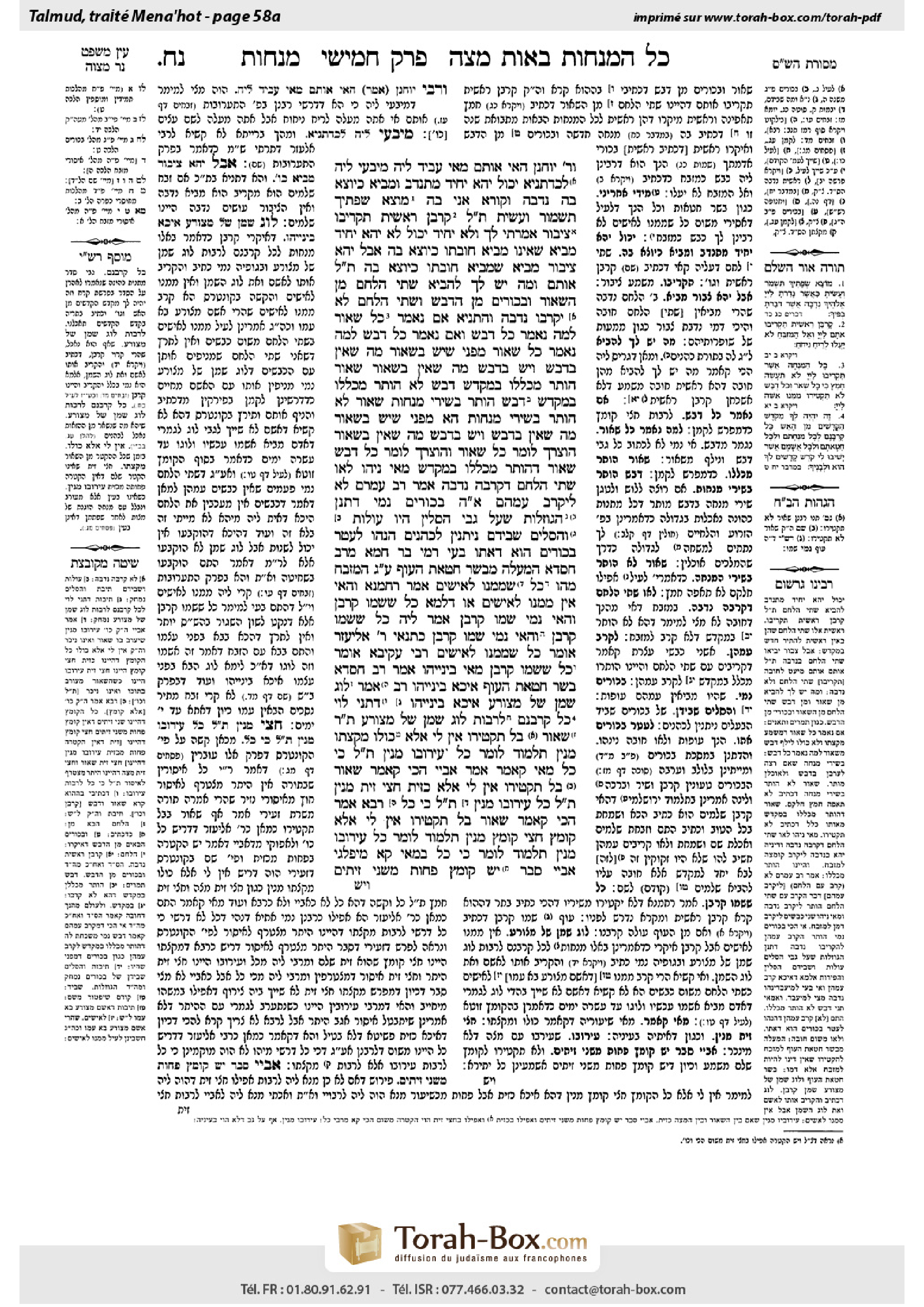
This page of Menachot includes the Aramaic text, an English translation and an AI-generated French translation, alongside the scan above.
מנחות נ״ח א · Aramaic and Hebrew text
וְרַבִּי יוֹחָנָן, הַאי ״אֹתָם״ מַאי עָבֵיד לֵיהּ?
מִיבְּעֵי לֵיהּ לְכִדְתַנְיָא: יָכוֹל יְהֵא יָחִיד מִתְנַדֵּב וּמֵבִיא כַּיּוֹצֵא בָּהּ נְדָבָה, וְקוֹרֵא אֲנִי בָּהּ ״מוֹצָא שְׂפָתֶיךָ תִּשְׁמֹר וְעָשִׂיתָ״?
תַּלְמוּד לוֹמַר ״קׇרְבַּן רֵאשִׁית תַּקְרִיבוּ״, צִיבּוּר אָמַרְתִּי לְךָ, וְלֹא יָחִיד.
יָכוֹל לֹא יְהֵא יָחִיד מֵבִיא, שֶׁאֵינוֹ מֵבִיא חוֹבָתוֹ כַּיּוֹצֵא בָּהּ, אֲבָל יְהֵא צִיבּוּר מֵבִיא שֶׁמֵּבִיא חוֹבָתוֹ כַּיּוֹצֵא בָּהּ? תַּלְמוּד לוֹמַר ״אֹתָם״, וּמָה יֵשׁ לְךָ לְהָבִיא? שְׁתֵּי הַלֶּחֶם מִן הַשְּׂאוֹר, וּבִכּוּרִים מִן הַדְּבַשׁ.
וּשְׁתֵּי הַלֶּחֶם לֹא יִקְרְבוּ נְדָבָה? וְהָתַנְיָא: אִם נֶאֱמַר ״כׇּל שְׂאֹר״, לָמָּה נֶאֱמַר ״כׇּל דְּבַשׁ״? וְאִם נֶאֱמַר ״כׇּל דְּבַשׁ״, לָמָּה נֶאֱמַר ״כׇּל שְׂאֹר״? מִפְּנֵי שֶׁיֵּשׁ בַּשְּׂאוֹר מַה שֶּׁאֵין בַּדְּבַשׁ, וְיֵשׁ בַּדְּבַשׁ מַה שֶּׁאֵין בִּשְׂאוֹר.
שְׂאוֹר הוּתַּר מִכְּלָלוֹ בַּמִּקְדָּשׁ, דְּבַשׁ לֹא הוּתַּר מִכְּלָלוֹ בַּמִּקְדָּשׁ.
דְּבַשׁ הוּתַּר בִּשְׁיָרֵי מְנָחוֹת, שְׂאוֹר לֹא הוּתַּר בִּשְׁיָרֵי מְנָחוֹת. הָא מִפְּנֵי שֶׁיֵּשׁ בַּשְּׂאוֹר מַה שֶּׁאֵין בַּדְּבַשׁ, וְיֵשׁ בַּדְּבַשׁ מַה שֶּׁאֵין בִּשְׂאוֹר, הוּצְרַךְ לוֹמַר ״כׇּל שְׂאֹר״, וְהוּצְרַךְ לוֹמַר ״כׇּל דְּבַשׁ״.
שְׂאוֹר דְּהוּתַּר מִכְּלָלוֹ בַּמִּקְדָּשׁ, מַאי נִיהוּ? לָאו שְׁתֵּי הַלֶּחֶם דְּקָרְבָה נְדָבָה? אָמַר רַב עַמְרָם: לָא, לִיקְרַב עִמָּהֶם.
אִי הָכִי, בִּכּוּרִים נָמֵי, דִּתְנַן: הַגּוֹזָלוֹת שֶׁעַל גַּבֵּי הַסַּלִּין הָיוּ עוֹלוֹת, וְהַסַּלִּים שֶׁבְּיָדָם נִיתָּנִין לַכֹּהֲנִים. הָנְהוּ לְעַטֵּר בִּכּוּרִים הוּא דְּאָתוּ.
בָּעֵי רָמֵי בַּר חָמָא מֵרַב חִסְדָּא: הַמַּעֲלֶה מִבְּשַׂר חַטַּאת הָעוֹף עַל גַּבֵּי הַמִּזְבֵּחַ, מַהוּ?
כֹּל שֶׁמִּמֶּנּוּ לָאִישִּׁים, אָמַר רַחֲמָנָא, וְהַאי אֵין מִמֶּנּוּ לָאִישִּׁים? אוֹ דִלְמָא כֹּל שֶׁשְּׁמוֹ קׇרְבָּן, וְהַאי נָמֵי שְׁמוֹ קׇרְבָּן? אֲמַר לֵיהּ: כֹּל שֶׁשְּׁמוֹ קׇרְבָּן, וְהַאי נָמֵי שְׁמוֹ קׇרְבָּן.
כְּתַנָּאֵי: רַבִּי אֱלִיעֶזֶר אוֹמֵר: כֹּל שֶׁמִּמֶּנּוּ לָאִישִּׁים, רַבִּי עֲקִיבָא אוֹמֵר: כֹּל שֶׁשְּׁמוֹ קׇרְבָּן.
מַאי בֵּינַיְיהוּ? אָמַר רַב חִסְדָּא: בְּשַׂר חַטַּאת הָעוֹף אִיכָּא בֵּינַיְיהוּ.
רַב אָמַר: לוֹג שֶׁמֶן שֶׁל מְצוֹרָע אִיכָּא בֵּינַיְיהוּ, דְּתָנֵי לֵוִי: ״כׇּל קׇרְבָּנָם״ – לְרַבּוֹת לוֹג שֶׁמֶן שֶׁל מְצוֹרָע.
תָּנוּ רַבָּנַן: ״שְׂאֹר ... בַּל תַּקְטִירוּ״ – אֵין לִי אֶלָּא כּוּלּוֹ, מִקְצָתוֹ מִנַּיִן? תַּלְמוּד לוֹמַר: ״כׇל״. עֵירוּבוֹ מִנַּיִן? תַּלְמוּד לוֹמַר: ״כִּי כׇל״.
מַאי קָאָמַר? אָמַר אַבָּיֵי, הָכִי קָאָמַר: ״שְׂאֹר בַּל תַּקְטִירוּ״ – אֵין לִי אֶלָּא כְּזַיִת, חֲצִי זַיִת מִנַּיִן? תַּלְמוּד לוֹמַר ״כׇּל״, עֵירוּבוֹ מִנַּיִן? תַּלְמוּד לוֹמַר ״כִּי כׇל״.
רָבָא אָמַר: הָכִי קָאָמַר – ״שְׂאֹר בַּל תַּקְטִירוּ״ אֵין לִי אֶלָּא קוֹמֶץ, חֲצִי קוֹמֶץ מִנַּיִן? תַּלְמוּד לוֹמַר: ״כׇל״. עֵירוּבוֹ מִנַּיִן? תַּלְמוּד לוֹמַר: ״כִּי כׇל״.
בְּמַאי קָא מִיפַּלְגִי? אַבָּיֵי סָבַר: יֵשׁ קוֹמֶץ פָּחוֹת מִשְּׁנֵי זֵיתִים,
Menachot 58a · English translation
The Gemara asks: And what does Rabbi Yoḥanan, who maintains that the prohibition against bringing leftover portions up to the ramp applies to all of the items listed in the baraita, do with this term: “Them,” in the verse: “As an offering of first produce you may bring them” (Leviticus 2:12), from which Rabbi Elazar learns that only first fruits and the two loaves are included in the prohibition?
The Gemara answers: He requires it for that which is taught in a baraita: One might have thought that an individual may donate and bring to the Temple a gift offering similar to those two loaves brought by the community, and in support I will read with regard to this offering the verse that deals with other gift offerings: “That which has gone out of your lips you shall observe and do; according to what you have vowed freely to the Lord your God, even that which you have promised with your mouth” (Deuteronomy 23:24), which would mean that the offering is consecrated and he must bring it as he declared.
Therefore, the verse states: “As an offering of first produce you may bring.” The phrase: “You may bring,” is written in the plural, meaning that it is addressed to the community. Therefore, it is interpreted to mean: I said to you that a community may consecrate and bring the two loaves, which are an offering of first produce, but an individual may not consecrate and bring two loaves of this nature.
The baraita continues: One might have thought that only an individual may not bring two loaves as a gift offering, as an individual does not bring his obligatory offering in a manner similar to those two loaves, i.e., perhaps specifically an individual, who never has an obligatory offering of two loaves, may not bring two loaves as a gift offering. But the community shall bring two loaves as a gift offering, as the community does bring its obligatory offering in a manner similar to those two loaves. Therefore, the verse states: “You may bring them,” to exclude the possibility of a communal gift offering of two loaves. The baraita concludes: And what is there left for you to bring as offerings that come from leaven and honey? The two loaves that come from leaven, and the first fruits that come from honey, i.e., sweet fruits.
The Gemara asks: And may the two loaves not be sacrificed as communal gift offerings? But isn’t it taught in a baraita with regard to the verse: “As any leaven, and any honey, you shall not burn any of it” (Leviticus 2:11): If it is stated: “Any leaven,” why is it stated: “Any honey”? And if it is stated: “Any honey,” why is it stated: “Any leaven”? In other words, why is it necessary for the verse to repeat the inclusive term “any,” from which it is derived that offering an insufficient quantity of honey or leaven is included in the prohibition? The baraita answers: Both of these terms had to be stated, because there is a halakha that applies to leaven that is not applicable to honey, and there is another halakha that applies to honey that is not applicable to leaven.
The baraita explains: In the case of leaven, although it may not be sacrificed on the altar, its general prohibition was permitted in certain circumstances in the Temple, as the two loaves and the bread of the thanks offering, i.e., the four loaves of the thanks offering that were eaten by the priests, are leavened bread. By contrast, with regard to honey, there are no circumstances in which its general prohibition was permitted in the Temple.
There is a halakha that applies to honey but not to leaven, as the prohibition concerning honey is permitted in the case of the remainder of meal offerings, meaning that the priests may eat their portion of meal offerings with honey, whereas the prohibition concerning leaven is not permitted in the case of the remainder of meal offerings, since one may not leaven this remainder. The baraita summarizes: Due to the fact that there is a halakha that applies to leaven that is not applicable to honey, and there is a halakha that applies to honey that is not applicable to leaven, it was necessary for the verse to state: “Any leaven,” and it was also necessary for it to state: “Any honey.”
The Gemara analyzes the baraita. When the baraita states concerning leaven that its general prohibition was permitted in certain circumstances in the Temple, what is this? Isn’t this referring to the halakha that the meal offering of the two loaves may be sacrificed by the community as a gift offering on the altar, as the two loaves of the communal offering themselves were not sacrificed on the altar? This would mean that two loaves may be brought as a gift offering by the community, which contradicts this claim of the previous baraita. Rav Amram said: No, the baraita is referring to the fact that the two loaves, which were leaven, are brought as an offering with the two lambs, which are brought up onto the altar as communal peace offerings. Since they are brought together, the two loaves and the two lambs are considered a single offering, and the lambs are sacrificed on the altar.
The Gemara asks: If so, in the case of first fruits also, the fruits should be considered part of the offering that was brought with them. As we learned in a mishna (Bikkurim 3:5): As for the fledglings that were placed on top of the baskets that contained the first fruits brought to the Temple, they would sacrifice these as burnt offerings, and the baskets themselves that were in the possession of those bringing the first fruits would be given to the priests. Accordingly, with regard to honey as well, its general prohibition was permitted in certain circumstances, as these first fruits containing honey are included with the sacrifice of burnt offerings. The Gemara answers: These fledglings came only to decorate the first fruits, despite the fact that they were later sacrificed as burnt offerings. Bringing the fledglings is not obligatory, and therefore cannot be considered part of the same offering as first fruits.
§ The Gemara continues to discuss the prohibition against bringing leftover parts of offerings up to the altar after the sacrificial parts have been burned. Rami bar Ḥama asked Rav Ḥisda: With regard to one who offers up on the altar some of the meat of a bird sacrificed as a sin offering, which is meant to be eaten by the priests, what is the halakha? Is he liable to receive lashes for this action?
The Gemara clarifies the possibilities: The Merciful One states with regard to any item that has already had some portion of it burned in the fire on the altar that one who sacrifices any leftover part of it violates the prohibition. And as no part of this bird sacrificed as a sin offering is burned in the fire on the altar, is he therefore exempt? Or perhaps, any item that is called an offering is included in the prohibition, and since this bird is also called an offering, one is liable. Rav Ḥisda said to Rami bar Ḥama: Any item that is called an offering is included in the prohibition, and this bird sacrificed as a sin offering is also called an offering.
The Gemara notes: Rami bar Ḥama’s dilemma is subject to a dispute between tanna’im, as is taught in a baraita: Rabbi Eliezer says: Only any item that has already had some portion of it burned in the fire on the altar is included in the prohibition: Do not burn. Rabbi Akiva says: Any item that is called an offering is included in this prohibition.
The Gemara asks: What is the difference between the opinions of Rabbi Akiva and Rabbi Eliezer? Rav Ḥisda said: The difference between them concerns the case discussed earlier, of one who brings some of the meat of a bird sin offering up to the altar. Rabbi Akiva maintains that he is liable, as it is called an offering, whereas Rabbi Eliezer holds that he is exempt, as no portion of it is burned on the altar.
Rav said: The difference between them concerns the log of oil that accompanies the guilt offering of a recovered leper, as Levi teaches: Concerning the consecrated items given to priests as gifts, the verse states: “Every offering of theirs…shall be most holy for you and for your sons” (Numbers 18:9). The phrase “every offering” serves to include the log of oil of a leper. This oil is not burned on the altar. Nevertheless, Rabbi Akiva would deem one who brings some of this log up to the altar liable, as it is called an offering, whereas Rabbi Eliezer would deem him exempt, since no part of it is burned in the fire.
§ The Gemara returns to the discussion about the prohibition against sacrificing leaven. The Sages taught in a baraita: When the Torah states with regard to leaven: Do not burn it (see Leviticus 2:11), I have derived only that one who burns all of it is liable, as will be explained. From where is it derived that one who burns only part of it is also included in the prohibition? The verse states: “Any [kol] leaven,” which serves to include such a case. The baraita adds: This halakha has been derived only with regard to leaven in a pure state; from where is it derived that the same applies to one who sacrifices it in its mixed state, i.e., mixed with another substance? The verse states the additional expression: “As [ki] any leaven.”
The Gemara analyzes this baraita: What is it saying? What is the meaning of the term: All of it, and the term: Part of it? Abaye said: This is what the baraita is saying: When the verse states about leaven: Do not burn it, I have derived only that this prohibition applies to an olive-bulk of leaven. From where is it derived that this prohibition applies if it is only half an olive-bulk? The verse states: “Any leaven.” Furthermore, from where is it derived that one is liable not only for leaven by itself, but also for leaven in its mixed state? The verse states: “As any leaven.”
Rava said that there is a different interpretation of the baraita: This is what the baraita is saying: When the verse states about leaven: Do not burn it, I have derived only that this prohibition applies to the entire handful that is removed from the meal offering. From where is it derived that this prohibition applies to half of the handful? The verse states: “Any leaven.” Furthermore, from where is it derived that one is liable not only for leaven by itself, but also for its mixed state? The verse states: “As any leaven.”
The Gemara asks: With regard to what principle do Abaye and Rava disagree? The Gemara answers: Abaye holds: There is such an entity as a handful that is less than the volume of two olives.
Menachot 58a · Traduction française (IA)
La Guemara demande : Que fait Rabbi Yoḥanan, qui soutient que l’interdiction de porter les portions restantes jusqu’à la rampe s’applique à tous les éléments énumérés dans la baraïta, du terme « elles » dans le verset : « Comme offrande des prémices, vous pouvez les apporter » (Lévitique 2, 12), dont Rabbi Elazar déduit que seuls les prémices et les deux pains sont concernés par l’interdiction ?
La Guemara répond : Il en a besoin pour l’enseignement d’une baraïta : On aurait pu penser qu’un particulier peut faire don au Temple d’une offrande volontaire semblable à ces deux pains apportés par la communauté et l’y apporter. À l’appui de cette idée, on pourrait citer à propos de cette offrande le verset qui traite des autres offrandes volontaires : « Tu observeras et accompliras ce qui est sorti de tes lèvres ; conformément à ce que tu as voué volontairement à l’Éternel, ton Dieu, et à ce que tu as promis de ta bouche » (Deutéronome 23, 24), ce qui signifierait que l’offrande est consacrée et qu’il doit l’apporter comme il l’a déclaré.
C’est pourquoi le verset dit : « Comme offrande des prémices, vous pouvez les apporter. » L’expression « vous pouvez les apporter » est au pluriel, ce qui signifie qu’elle s’adresse à la communauté. On l’interprète donc ainsi : Je vous ai dit qu’une communauté peut consacrer et apporter les deux pains, qui sont une offrande des prémices, mais qu’un particulier ne peut pas consacrer et apporter deux pains de cette nature.
La baraïta poursuit : On aurait pu penser que seul un particulier ne peut pas apporter deux pains comme offrande volontaire, puisqu’un particulier n’apporte pas son offrande obligatoire sous une forme semblable à ces deux pains ; autrement dit, peut-être seul un particulier, qui n’a jamais d’offrande obligatoire de deux pains, ne peut-il apporter deux pains comme offrande volontaire. Mais la communauté, elle, peut apporter deux pains comme offrande volontaire, puisqu’elle apporte bien son offrande obligatoire sous une forme semblable à ces deux pains. C’est pourquoi le verset dit : « Vous pouvez les apporter », afin d’exclure la possibilité d’une offrande volontaire de deux pains par la communauté. La baraïta conclut : Que vous reste-t-il donc à apporter comme offrandes contenant du levain et du miel ? Les deux pains, qui contiennent du levain, et les prémices, qui sont des fruits sucrés contenant du miel.
La Guemara demande : Les deux pains ne peuvent-ils donc pas être offerts comme offrandes volontaires de la communauté ? Pourtant, une baraïta enseigne à propos du verset : « Vous ne brûlerez rien de ce qui est levain, ni de ce qui est miel » (Lévitique 2, 11) : S’il est dit « tout levain », pourquoi est-il dit « tout miel » ? Et s’il est dit « tout miel », pourquoi est-il dit « tout levain » ? Autrement dit, pourquoi le verset répète-t-il le terme inclusif « tout », dont on déduit que l’offrande d’une quantité insuffisante de miel ou de levain est comprise dans l’interdiction ? La baraïta répond : Il fallait mentionner les deux, car une halakha s’applique au levain mais pas au miel, et une autre halakha s’applique au miel mais pas au levain.
La baraïta explique : Dans le cas du levain, bien qu’il ne puisse pas être sacrifié sur l’autel, l’interdiction générale qui le concerne connaît des exceptions dans certaines circonstances au Temple : les deux pains et le pain de l’offrande de remerciement — c’est-à-dire les quatre pains de cette offrande qui étaient consommés par les prêtres — sont du pain levé. En revanche, pour le miel, il n’existe aucune circonstance où l’interdiction générale qui le concerne connaisse une exception au Temple.
Une halakha s’applique au miel mais pas au levain : l’interdiction relative au miel connaît une exception dans le cas du reste des offrandes de farine, ce qui signifie que les prêtres peuvent manger leur part de ces offrandes avec du miel, tandis que l’interdiction relative au levain ne connaît pas d’exception dans le cas du reste des offrandes de farine, puisque ce reste ne peut pas être levé. La baraïta résume : Puisqu’une halakha s’applique au levain mais pas au miel, et qu’une halakha s’applique au miel mais pas au levain, il fallait que le verset dise « tout levain », et il fallait aussi qu’il dise « tout miel ».
La Guemara analyse la baraïta. Quand celle-ci affirme, à propos du levain, que l’interdiction générale qui le concerne connaît des exceptions dans certaines circonstances au Temple, de quoi s’agit-il ? Ne s’agit-il pas de la halakha selon laquelle la communauté peut offrir sur l’autel l’offrande de farine des deux pains comme offrande volontaire, puisque les deux pains de l’offrande communautaire eux-mêmes n’étaient pas sacrifiés sur l’autel ? Cela signifierait que la communauté peut apporter deux pains comme offrande volontaire, ce qui contredit l’affirmation de la baraïta précédente. Rav Amram dit : Non, la baraïta fait référence au fait que les deux pains, qui contiennent du levain, sont apportés comme offrande avec les deux agneaux, lesquels sont offerts sur l’autel comme sacrifices de paix communautaires. Comme ils sont apportés ensemble, les deux pains et les deux agneaux sont considérés comme une seule offrande, et les agneaux sont sacrifiés sur l’autel.
La Guemara demande : Si c’est ainsi, les prémices aussi devraient être considérées comme faisant partie de l’offrande apportée avec elles. En effet, nous avons appris dans une Michna (Bikkourim 3, 5) : Quant aux oisillons placés au-dessus des corbeilles contenant les prémices apportées au Temple, on les sacrifiait en holocaustes, et les corbeilles elles-mêmes, qui appartenaient à ceux qui apportaient les prémices, étaient données aux prêtres. En conséquence, pour le miel également, l’interdiction générale qui le concerne connaîtrait des exceptions dans certaines circonstances, puisque ces prémices contenant du miel sont associées au sacrifice d’holocaustes. La Guemara répond : Ces oisillons ne servaient qu’à décorer les prémices, bien qu’ils fussent ensuite sacrifiés en holocaustes. Leur apport n’est pas obligatoire et, par conséquent, ils ne peuvent pas être considérés comme faisant partie de la même offrande que les prémices.
§ La Guemara poursuit son examen de l’interdiction de porter sur l’autel les parties restantes des offrandes après la combustion des parties sacrificielles. Rami bar Ḥama demanda à Rav Ḥisda : Quel est le statut de celui qui fait brûler sur l’autel une partie de la chair d’un oiseau offert en sacrifice expiatoire, chair destinée à être consommée par les prêtres ? Est-il passible de la flagellation pour cet acte ?
La Guemara précise les possibilités : Le Miséricordieux dit que, pour tout élément dont une partie a déjà été brûlée dans le feu sur l’autel, celui qui en sacrifie une partie restante transgresse l’interdiction. Or, aucune partie de cet oiseau offert en sacrifice expiatoire n’est brûlée dans le feu sur l’autel ; en est-il donc quitte ? Ou peut-être tout élément appelé offrande est-il compris dans l’interdiction et, puisque cet oiseau est lui aussi appelé offrande, est-il passible ? Rav Ḥisda dit à Rami bar Ḥama : Tout élément appelé offrande est compris dans l’interdiction, et cet oiseau offert en sacrifice expiatoire est lui aussi appelé offrande.
La Guemara relève que le dilemme de Rami bar Ḥama fait l’objet d’une controverse entre des tannaim, comme l’enseigne une baraïta : Rabbi Eliezer dit : Seul un élément dont une partie a déjà été brûlée dans le feu sur l’autel est compris dans l’interdiction « Ne le brûle pas ». Rabbi Akiva dit : Tout élément appelé offrande est compris dans cette interdiction.
La Guemara demande : Quelle est la différence entre les opinions de Rabbi Akiva et de Rabbi Eliezer ? Rav Ḥisda dit : Leur désaccord porte sur le cas évoqué précédemment, celui de quelqu’un qui porte sur l’autel une partie de la chair d’un oiseau offert en sacrifice expiatoire. Rabbi Akiva soutient qu’il est passible, car cet oiseau est appelé offrande, tandis que Rabbi Eliezer estime qu’il est quitte, car aucune partie de l’oiseau n’est brûlée sur l’autel.
Rav dit : Leur désaccord porte sur le log d’huile qui accompagne le sacrifice de culpabilité d’un lépreux guéri, comme l’enseigne Levi : Au sujet des choses consacrées données aux prêtres, le verset dit : « Toute leur offrande… sera très sainte pour toi et pour tes fils » (Nombres 18, 9). L’expression « toute leur offrande » inclut le log d’huile du lépreux. Cette huile n’est pas brûlée sur l’autel. Néanmoins, Rabbi Akiva jugerait passible celui qui en porte une partie sur l’autel, car elle est appelée offrande, tandis que Rabbi Eliezer le jugerait quitte, puisqu’aucune partie n’en est brûlée dans le feu.
§ La Guemara revient à la discussion sur l’interdiction de sacrifier du levain. Les Sages ont enseigné dans une baraïta : Lorsque la Torah dit au sujet du levain : « Ne le brûle pas » (voir Lévitique 2, 11), j’ai seulement déduit que celui qui le brûle en entier est passible, comme cela sera expliqué. D’où déduit-on que celui qui n’en brûle qu’une partie est également visé par l’interdiction ? Le verset dit : « Tout [kol] levain », ce qui inclut ce cas. La baraïta ajoute : Cette halakha n’a été déduite que pour le levain à l’état pur ; d’où déduit-on que la même règle s’applique à celui qui le sacrifie à l’état de mélange, c’est-à-dire mélangé à une autre substance ? Le verset dit l’expression supplémentaire : « Comme [ki] tout levain ».
La Guemara analyse cette baraïta : Que dit-elle ? Que signifient les expressions « en entier » et « une partie » ? Abayé dit : Voici ce que dit la baraïta : Lorsque le verset dit au sujet du levain : « Ne le brûle pas », j’ai seulement déduit que cette interdiction s’applique à un volume d’olive de levain. D’où déduit-on qu’elle s’applique même s’il n’y en a qu’un demi-volume d’olive ? Le verset dit : « Tout levain ». En outre, d’où déduit-on qu’on est passible non seulement pour du levain seul, mais aussi pour du levain à l’état de mélange ? Le verset dit : « Comme tout levain ».
Rava donne une autre interprétation de la baraïta : Voici ce que dit la baraïta : Lorsque le verset dit au sujet du levain : « Ne le brûle pas », j’ai seulement déduit que cette interdiction s’applique à la poignée entière prélevée de l’offrande de farine. D’où déduit-on qu’elle s’applique à la moitié de la poignée ? Le verset dit : « Tout levain ». En outre, d’où déduit-on qu’on est passible non seulement pour du levain seul, mais aussi pour du levain à l’état de mélange ? Le verset dit : « Comme tout levain ».
La Guemara demande : Sur quel principe Abayé et Rava sont-ils en désaccord ? La Guemara répond : Abayé soutient qu’il existe une poignée dont le volume est inférieur à deux volumes d’olive.
Traduction française générée par IA à partir de l’édition anglaise de Sefaria. Vérifie toujours un passage avec le texte source.
Text from Sefaria: William Davidson Edition - Vocalized Aramaic (unknown); William Davidson Edition - English (CC BY NC).