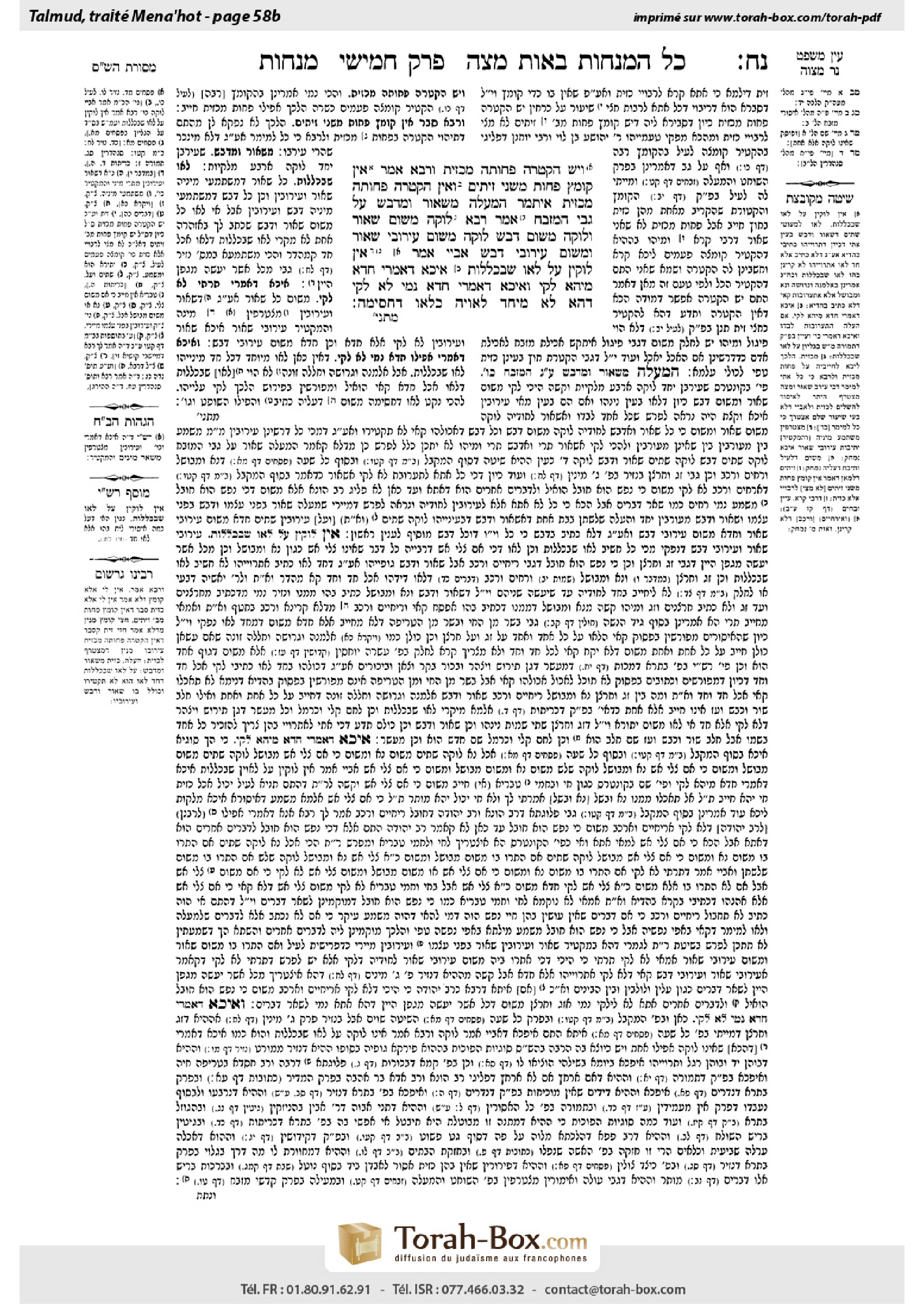
Menachot 58b: Talmud study for Daf Yomi
Daf Yomi is the daily study of one Talmud folio. Explore 37 tractates with scans, Hebrew text, Sefaria English and AI-generated French translations where annotated.
Passage selection and English or AI-generated French translation are available where the scan has annotations. Daf Study is independent of Torah-Box and Sefaria.
Browse Menachot · מנחות · All tractatesMenachot 58b text and translations
This page of Menachot includes the Aramaic text, an English translation and an AI-generated French translation, alongside the scan above.
מנחות נ״ח ב · Aramaic and Hebrew text
וְיֵשׁ הַקְטָרָה פְּחוּתָה מִכְּזַיִת.
וְרָבָא אָמַר: אֵין קוֹמֶץ פָּחוֹת מִשְּׁנֵי זֵיתִים, וְאֵין הַקְטָרָה פְּחוּתָה מִכְּזַיִת.
אִיתְּמַר: הַמַּעֲלֶה מִשְּׂאוֹר וּמִדְּבַשׁ עַל גַּבֵּי הַמִּזְבֵּחַ, אָמַר רָבָא: לוֹקֶה מִשּׁוּם שְׂאוֹר, וְלוֹקֶה מִשּׁוּם דְּבַשׁ, לוֹקֶה מִשּׁוּם עֵירוּבֵי שְׂאוֹר, וּמִשּׁוּם עֵירוּבֵי דְּבַשׁ.
אַבָּיֵי אָמַר: אֵין לוֹקִין עַל לָאו שֶׁבִּכְלָלוֹת.
אִיכָּא דְּאָמְרִי: חֲדָא מִיהָא לָקֵי.
וְאִיכָּא דְּאָמְרִי, חֲדָא נָמֵי לָא לָקֵי, דְּהָא לָא מְיַחַד לָאוֵיהּ כְּלָאו דַּחֲסִימָה.
Menachot 58b · English translation
And Abaye consequently maintains that there is such a matter as a halakhically significant burning of a handful even if it is less than the volume of an olive-bulk. It follows that the phrase “any leaven” teaches that if one sacrificed less than an olive-bulk of a handful that was leaven, he is liable.
And Rava says: There is no such entity as a handful that is less than the size of two olives, and consequently the mitzva not to burn leaven is referring initially to a full handful of two olive-bulks. And Rava holds that there is no such matter as a halakhically significant burning of a handful if it is less than the volume of an olive-bulk. Therefore, one cannot derive from the phrase “as any leaven” that one can be liable for sacrificing leaven of less than one olive-bulk. Instead, the phrase must be referring to a case where half the handful is leaven.
§ The Gemara discusses another dispute between Abaye and Rava on this topic: It was stated: With regard to one who offers up a mixture made of leaven and of honey on the altar, Rava says: He is flogged with four sets of lashes for this act, as the verse: “As any leaven and any honey, you shall not burn any of it as an offering made by fire to the Lord” (Leviticus 2:11), includes four separate prohibitions. He is flogged one set due to the prohibition against sacrificing leaven, and he is flogged a second set due to the prohibition against sacrificing honey, and he is flogged a third set due to the prohibition against sacrificing mixtures of leaven, and he is flogged a fourth set due to the prohibition against sacrificing mixtures of honey.
Abaye says: One is not flogged for a general prohibition, i.e., a single mitzva in the Torah that includes many different prohibited acts. Since all these actions are covered by the prohibition: “You shall not burn,” it is considered a general prohibition, for which one is not flogged.
The Gemara cites a dispute between the Sages with regard to the opinion of Abaye. There are those who say that Abaye concedes that in any event the offender is flogged with one set of lashes for sacrificing leaven, and he is also flogged a second set of lashes for sacrificing honey, as these are not considered general prohibitions. Since the phrase: “You shall not burn,” is referring to both leaven and honey, it is as though it were written: You shall not burn leaven; you shall not burn honey.
And there are those who say that Abaye maintains that the offender is not even flogged with one set of lashes, as the prohibition he transgressed is not specific to one matter, like the prohibition against muzzling. The principle that one is liable to be flogged for violating a prohibition is derived from the juxtaposition of the mitzva: “You shall not muzzle an ox while it treads out the grain” (Deuteronomy 25:4), with the verses that mention lashes. It is inferred from this juxtaposition that one is not liable to be flogged for violating prohibitions whose circumstances are not similar to that of muzzling, e.g., a general prohibition that is not referring to one specific action.
Menachot 58b · Traduction française (IA)
Abayé soutient donc qu’il existe un acte de combustion d’une poignée ayant une portée halakhique, même si celle-ci contient moins que le volume d’une olive. Il s’ensuit que l’expression « tout levain » enseigne que celui qui a offert un fragment de poignée contenant du levain, d’un volume inférieur à celui d’une olive, est passible.
Rava dit : une poignée d’un volume inférieur à celui de deux olives n’existe pas. Par conséquent, l’interdiction de brûler du levain vise d’emblée une poignée entière, d’un volume de deux olives. Rava considère qu’un acte de combustion d’une poignée n’a pas de portée halakhique si celle-ci contient moins que le volume d’une olive. On ne peut donc pas déduire de l’expression « comme tout levain » que l’on peut être passible pour avoir offert du levain d’un volume inférieur à celui d’une olive. L’expression doit plutôt désigner le cas où la moitié de la poignée est du levain.
§ La Guemara examine un autre désaccord entre Abayé et Rava sur ce sujet. Il a été rapporté : au sujet de celui qui offre sur l’autel un mélange de levain et de miel, Rava dit : il reçoit quatre séries de coups pour cet acte, car le verset « Comme tout levain et tout miel, vous n’en brûlerez rien en offrande consumée par le feu pour le Seigneur » (Lévitique 2,11) comprend quatre interdictions distinctes. Il reçoit une série de coups pour avoir offert du levain en sacrifice, une deuxième pour avoir offert du miel en sacrifice, une troisième pour avoir offert en sacrifice des mélanges contenant du levain et une quatrième pour avoir offert en sacrifice des mélanges contenant du miel.
Abayé dit : on ne reçoit pas de coups pour une interdiction générale, c’est-à-dire une mitsva unique de la Torah qui englobe de nombreux actes interdits. Puisque tous ces actes relèvent de l’interdiction « Vous n’en brûlerez rien », celle-ci est considérée comme une interdiction générale, pour laquelle on ne reçoit pas de coups.
La Guemara rapporte un désaccord entre les Sages au sujet de l’opinion d’Abayé. Certains disent qu’Abayé reconnaît que, dans tous les cas, le coupable reçoit une série de coups pour avoir offert du levain en sacrifice, et une deuxième série pour avoir offert du miel en sacrifice, car ces interdictions ne sont pas considérées comme générales. Puisque l’expression « Vous n’en brûlerez rien » se rapporte à la fois au levain et au miel, c’est comme s’il était écrit : « Vous ne brûlerez pas de levain ; vous ne brûlerez pas de miel. »
D’autres disent qu’Abayé estime que le coupable ne reçoit même pas une seule série de coups, car l’interdiction qu’il a transgressée ne porte pas sur un objet précis, contrairement à l’interdiction de museler. Le principe selon lequel on est passible de coups pour avoir transgressé une interdiction est déduit du rapprochement entre la mitsva « Tu ne muselleras pas un bœuf pendant qu’il foule le grain » (Deutéronome 25,4) et les versets qui mentionnent les coups. Ce rapprochement permet de déduire qu’on n’est pas passible de coups pour avoir transgressé des interdictions dont les circonstances ne sont pas analogues à celles de l’interdiction de museler, par exemple une interdiction générale qui ne vise pas un acte précis.
Traduction française générée par IA à partir de l’édition anglaise de Sefaria. Vérifie toujours un passage avec le texte source.
Text from Sefaria: William Davidson Edition - Vocalized Aramaic (unknown); William Davidson Edition - English (CC BY NC).